THE PHILIPPINES:
A PHARMACEUTICAL MARKET
RESEARCH STUDY
Nadia Dias, Marketing Intern
Guide: Francis Pires, Business Head-International Division
PART I: AN INTRODUCTION TO THE DEMOGRAPHIC LANDSCAPE
OF THE PHILIPPINES
• Introduction
• The Demographic Landscape of the Philippines
• Political Context
• Economy
• Healthcare in the Philippines
• Pharmaceutical Supply Chain
• Medical Human Resource Statistics
PART II: THE PHARMACEUTICAL MARKET IN THE PHILIPPINES
• The Pharmaceutical Market in the Philippines
• Product Registration
• Pharmaceutical Importers
• Manufacturers and Distributors
• Foreign Companies in the Philippines
• Pharmaceutical Retailers in the Philippines
• Pricing Regulation for the Private Sector
CONTENTS
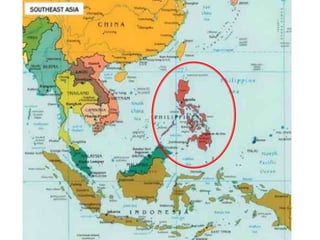
• South-East Asian Archipelago.
• 7,107 Islands.
• Capital City-Manila.
• 2,000/7,107 Islands Inhabited.
• Urban Population: 31.8% to 50.32% (last 3 decades).
• Fragmentary nature of Islands- challenge to trade and
commerce in the country.
• Economy resilient to global shocks due to , lower dependence
on exports, relatively resilient domestic consumption, large
remittances.
• 1 PHP (Filipino Peso)=0.020 USD=1.37 INR
INTRODUCTION
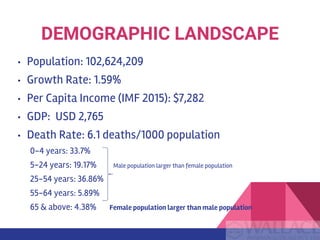
• Population: 102,624,209
• Growth Rate: 1.59%
• Per Capita Income (IMF 2015): $7,282
• GDP: USD 2,765
• Death Rate: 6.1 deaths/1000 population
0-4 years: 33.7%
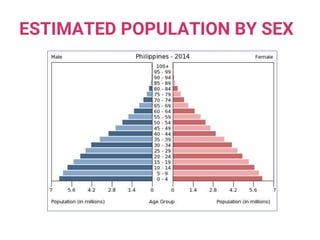
5-24 years: 19.17% Male population larger than female population
25-54 years: 36.86%
55-64 years: 5.89%
65 & above: 4.38% Female population larger than male population
DEMOGRAPHIC LANDSCAPE
ESTIMATED POPULATION BY SEX
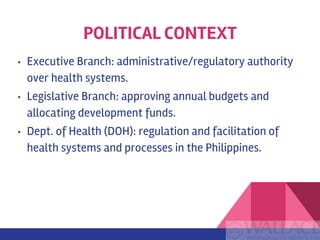
• Executive Branch: administrative/regulatory authority
over health systems.
• Legislative Branch: approving annual budgets and
allocating development funds.
• Dept. of Health (DOH): regulation and facilitation of
health systems and processes in the Philippines.
POLITICAL CONTEXT
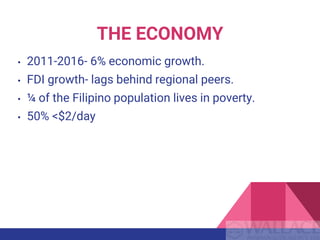
• 2011-2016- 6% economic growth.
• FDI growth- lags behind regional peers.
• ¼ of the Filipino population lives in poverty.
• 50% <$2/day
THE ECONOMY
• Health Outcomes-Lags behind most of South-East
Asia and North Asia
• Health Index UNDP-Rank 117, 0.749
• Social and geographic barriers- inequitable access
to resources.
• Lower-income families and less developed areas-
poor health status
• Life expectancy in richer provinces is more than 10
years longer than in poorer ones
HEALTHCARE
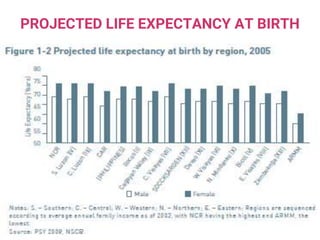
PROJECTED LIFE EXPECTANCY AT BIRTH
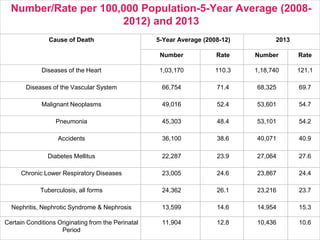
Number/Rate per 100,000 Population-5-Year Average (2008-
2012) and 2013
Cause of Death 5-Year Average (2008-12) 2013
Number Rate Number Rate
Diseases of the Heart 1,03,170 110.3 1,18,740 121.1
Diseases of the Vascular System 66,754 71.4 68,325 69.7
Malignant Neoplasms 49,016 52.4 53,601 54.7
Pneumonia 45,303 48.4 53,101 54.2
Accidents 36,100 38.6 40,071 40.9
Diabetes Mellitus 22,287 23.9 27,064 27.6
Chronic Lower Respiratory Diseases 23,005 24.6 23,867 24.4
Tuberculosis, all forms 24,362 26.1 23,216 23.7
Nephritis, Nephrotic Syndrome & Nephrosis 13,599 14.6 14,954 15.3
Certain Conditions Originating from the Perinatal
Period
11,904 12.8 10,436 10.6
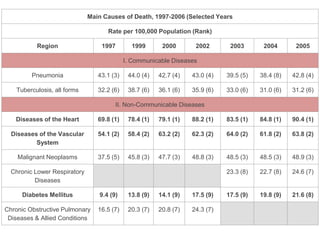
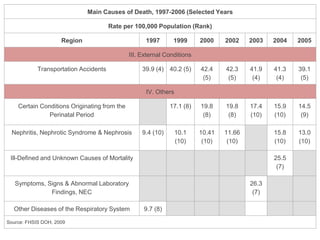
Main Causes of Death, 1997-2006 (Selected Years
Rate per 100,000 Population (Rank)
Region 1997 1999 2000 2002 2003 2004 2005
I. Communicable Diseases
Pneumonia 43.1 (3) 44.0 (4) 42.7 (4) 43.0 (4) 39.5 (5) 38.4 (8) 42.8 (4)
Tuberculosis, all forms 32.2 (6) 38.7 (6) 36.1 (6) 35.9 (6) 33.0 (6) 31.0 (6) 31.2 (6)
II. Non-Communicable Diseases
Diseases of the Heart 69.8 (1) 78.4 (1) 79.1 (1) 88.2 (1) 83.5 (1) 84.8 (1) 90.4 (1)
Diseases of the Vascular
System
54.1 (2) 58.4 (2) 63.2 (2) 62.3 (2) 64.0 (2) 61.8 (2) 63.8 (2)
Malignant Neoplasms 37.5 (5) 45.8 (3) 47.7 (3) 48.8 (3) 48.5 (3) 48.5 (3) 48.9 (3)
Chronic Lower Respiratory
Diseases
23.3 (8) 22.7 (8) 24.6 (7)
Diabetes Mellitus 9.4 (9) 13.8 (9) 14.1 (9) 17.5 (9) 17.5 (9) 19.8 (9) 21.6 (8)
Chronic Obstructive Pulmonary
Diseases & Allied Conditions
16.5 (7) 20.3 (7) 20.8 (7) 24.3 (7)
Main Causes of Death, 1997-2006 (Selected Years
Rate per 100,000 Population (Rank)
Region 1997 1999 2000 2002 2003 2004 2005
III. External Conditions
Transportation Accidents 39.9 (4) 40.2 (5) 42.4
(5)
42.3
(5)
41.9
(4)
41.3
(4)
39.1
(5)
IV. Others
Certain Conditions Originating from the
Perinatal Period
17.1 (8) 19.8
(8)
19.8
(8)
17.4
(10)
15.9
(10)
14.5
(9)
Nephritis, Nephrotic Syndrome & Nephrosis 9.4 (10) 10.1
(10)
10.41
(10)
11.66
(10)
15.8
(10)
13.0
(10)
Ill-Defined and Unknown Causes of Mortality 25.5
(7)
Symptoms, Signs & Abnormal Laboratory
Findings, NEC
26.3
(7)
Other Diseases of the Respiratory System 9.7 (8)
Source: FHSIS DOH, 2009
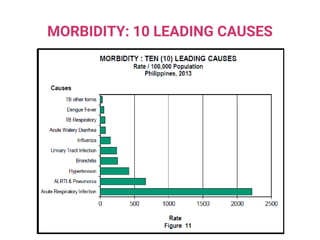
MORBIDITY: 10 LEADING CAUSES
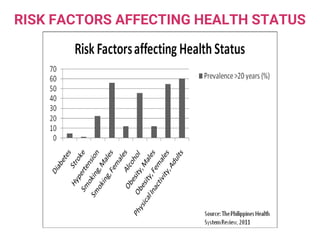
RISK FACTORS AFFECTING HEALTH STATUS
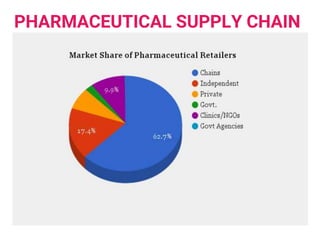
PHARMACEUTICAL SUPPLY CHAIN
• Monopolistic pricing exists in drug sales in
hospitals.
• Drug prices in hospitals double those in retail
pharmacies
• Access to essential drugs- constrained due to
limited availability and high costs
• Availability depends on presence of doctors and
drugstores in the region
• Doctor prescriptions must be signed by pharmacist-
implementation is difficult
• 1988-Generic Drugs Act to make drugs more affordable
• Failed to encourage use of generic drugs
• Lack of information on safety and efficacy
• Essential Drugs List established
• 2009-DOH set Max. Retail Drug Prices for selected drugs
• 1987-Philippines National Drug Policy (PNDP)
• PNDP-Ensure quality and drugs and availability and affordability to all
sections of the Filipino population.
• Essential Drugs List/Philippines National Drug Formulatory set
standards for procurement of drugs in the government sector.
• Generics Act 2008-Compulsory Licensing, Parallel Importation, Price
Control, generic substitution
• Regulatory Reforms supported Botika ng Barangays Programme
(BnB)-Sold drugs @ 62% cheaper
PHARMACEUTICAL SUPPLY CHAIN
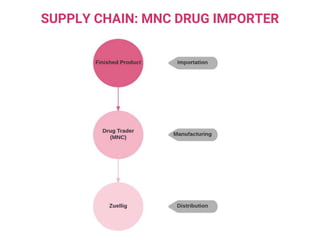
SUPPLY CHAIN: MNCs
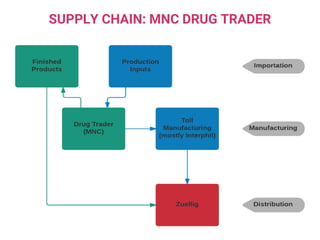
● Pharmaceutical MNCs are mainly drug traders
● Import large amounts of their merchandise from
abroad
● Giant MNCs hire manufacturing services of
InterPhil (Toll Manufacturer)
● Zuellig-mostly distribution of MNCs drug products
SUPPLY CHAIN: MNC DRUG TRADER
SUPPLY CHAIN: MNC DRUG IMPORTER
SUPPLY CHAIN: LOCAL MANUFACTURERS AND
TRADERS
● Local Pharma sector-mix of manufacturers and
traders
● Top 20 list-only 4 local companies
● Local giant- United Laboratories owns 28% local
sales
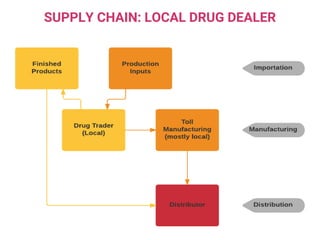
SUPPLY CHAIN: LOCAL DRUG DEALER
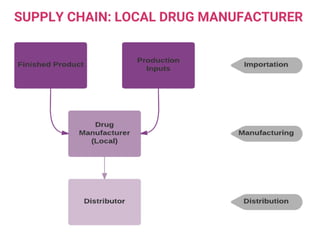
SUPPLY CHAIN: LOCAL DRUG MANUFACTURER
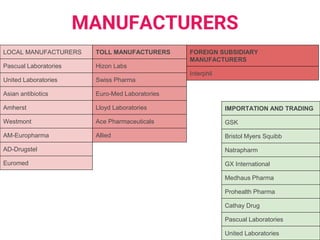
FOREIGN SUBSIDIARY
MANUFACTURERS
Interphil
TOLL MANUFACTURERS
Hizon Labs
Swiss Pharma
Euro-Med Laboratories
Lloyd Laboratories
Ace Pharmaceuticals
Allied
LOCAL MANUFACTURERS
Pascual Laboratories
United Laboratories
Asian antibiotics
Amherst
Westmont
AM-Europharma
AD-Drugstel
Euromed
IMPORTATION AND TRADING
GSK
Bristol Myers Squibb
Natrapharm
GX International
Medhaus Pharma
Prohealth Pharma
Cathay Drug
Pascual Laboratories
United Laboratories
MANUFACTURERS
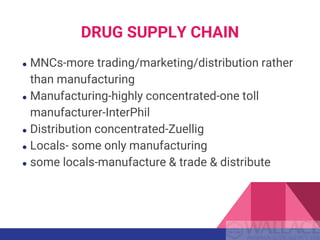
DRUG SUPPLY CHAIN
● MNCs-more trading/marketing/distribution rather
than manufacturing
● Manufacturing-highly concentrated-one toll
manufacturer-InterPhil
● Distribution concentrated-Zuellig
● Locals- some only manufacturing
● some locals-manufacture & trade & distribute
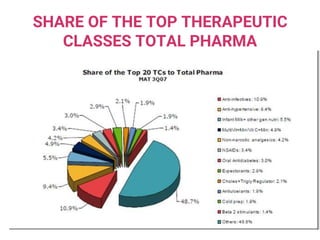
SHARE OF THE TOP THERAPEUTIC
CLASSES TOTAL PHARMA
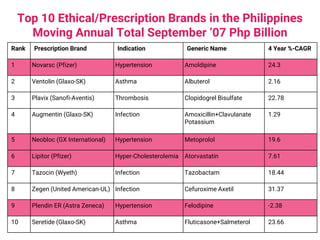
Top 10 Ethical/Prescription Brands in the Philippines
Moving Annual Total September ’07 Php Billion
Rank Prescription Brand Indication Generic Name 4 Year %-CAGR
1 Novarsc (Pfizer) Hypertension Amoldipine 24.3
2 Ventolin (Glaxo-SK) Asthma Albuterol 2.16
3 Plavix (Sanofi-Aventis) Thrombosis Clopidogrel Bisulfate 22.78
4 Augmentin (Glaxo-SK) Infection Amoxicillin+Clavulanate
Potassium
1.29
5 Neobloc (GX International) Hypertension Metoprolol 19.6
6 Lipitor (Pfizer) Hyper-Cholesterolemia Atorvastatin 7.61
7 Tazocin (Wyeth) Infection Tazobactam 18.44
8 Zegen (United American-UL) Infection Cefuroxime Axetil 31.37
9 Plendin ER (Astra Zeneca) Hypertension Felodipine -2.38
10 Seretide (Glaxo-SK) Asthma Fluticasone+Salmeterol 23.66
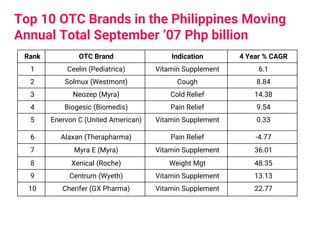
Top 10 OTC Brands in the Philippines Moving
Annual Total September ’07 Php billion
Rank OTC Brand Indication 4 Year % CAGR
1 Ceelin (Pediatrica) Vitamin Supplement 6.1
2 Solmux (Westmont) Cough 8.84
3 Neozep (Myra) Cold Relief 14.38
4 Biogesic (Biomedis) Pain Relief 9.54
5 Enervon C (United American) Vitamin Supplement 0.33
6 Alaxan (Therapharma) Pain Relief -4.77
7 Myra E (Myra) Vitamin Supplement 36.01
8 Xenical (Roche) Weight Mgt 48.35
9 Centrum (Wyeth) Vitamin Supplement 13.13
10 Cherifer (GX Pharma) Vitamin Supplement 22.77
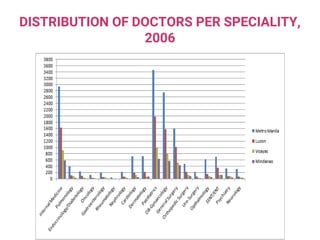
DISTRIBUTION OF DOCTORS PER SPECIALITY,
2006
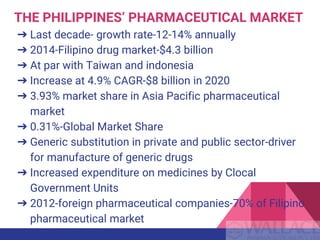
THE PHILIPPINES’ PHARMACEUTICAL MARKET
➔ Last decade- growth rate-12-14% annually
➔ 2014-Filipino drug market-$4.3 billion
➔ At par with Taiwan and indonesia
➔ Increase at 4.9% CAGR-$8 billion in 2020
➔ 3.93% market share in Asia Pacific pharmaceutical
market
➔ 0.31%-Global Market Share
➔ Generic substitution in private and public sector-driver
for manufacture of generic drugs
➔ Increased expenditure on medicines by Clocal
Government Units
➔ 2012-foreign pharmaceutical companies-70% of Filipino
pharmaceutical market
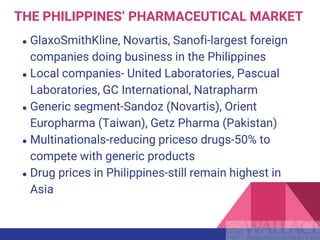
THE PHILIPPINES’ PHARMACEUTICAL MARKET
● GlaxoSmithKline, Novartis, Sanofi-largest foreign
companies doing business in the Philippines
● Local companies- United Laboratories, Pascual
Laboratories, GC International, Natrapharm
● Generic segment-Sandoz (Novartis), Orient
Europharma (Taiwan), Getz Pharma (Pakistan)
● Multinationals-reducing priceso drugs-50% to
compete with generic products
● Drug prices in Philippines-still remain highest in
Asia
Why are drug prices so high?
➔ Poor purchasing practices in Filipino hospitals.
➔ High Retail Markups because of monopolistic competition
➔ Prohibitive cost of importing pharmaceutical ingredients
➔ Low rates of health insurance
➔ Low rates of coverage for out-patient drugs
➔ 2008-Universally Accessible Cheaper and Quality
Medicines Act-power to impose Max. retail price on drugs
mentioned in the essential drugs list
➔ Philippines Respects International Property Rights (IPR)
➔ Cannot simply introduce generics that are under patent
PRODUCT REGISTRATION
➔Companies that are involved in the manufacture,
import, export, distribution, retailing, packaging and
re-packaging of pharmaceuticals
➔Companies require a Licence to Operate (LTO)
before registering their product with the FDA
➔Licence to Operate (LTOs) from the manufacturer,
distributor and / or importer
➔A Certificate of Agreement between the
manufacturer and distributor or the manufacturer
and importer for the product being registered
➔The Application for Registration of Pharmaceutical
form
PRODUCT REGISTRATION
● Information on product formulation and dosage
● A Certificate of Analysis and Specifications for all raw
materials
● Information on the manufacturing process, including
procedure, in-process controls, production equipment and
packaging procedure
● Labelling materials
● Stability studies
● A product sample (which should include English labels for
the product registration number, the generic and brand
names, the name of the product license holder,
indications for use, dosage, warnings and precautions, the
batch number and the expiration date)
PRODUCT REGISTRATION
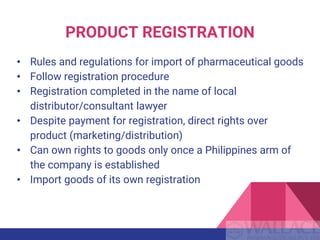
• Rules and regulations for import of pharmaceutical goods
• Follow registration procedure
• Registration completed in the name of local
distributor/consultant lawyer
• Despite payment for registration, direct rights over
product (marketing/distribution)
• Can own rights to goods only once a Philippines arm of
the company is established
• Import goods of its own registration
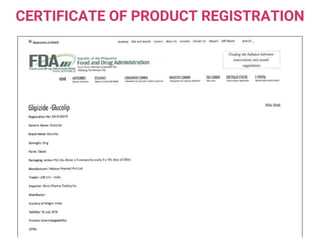
CERTIFICATE OF PRODUCT REGISTRATION
PHARMACEUTICAL IMPORTERS
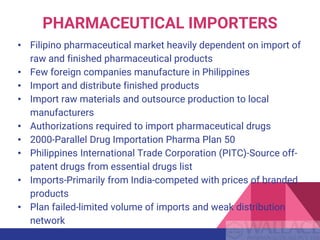
• Filipino pharmaceutical market heavily dependent on import of
raw and finished pharmaceutical products
• Few foreign companies manufacture in Philippines
• Import and distribute finished products
• Import raw materials and outsource production to local
manufacturers
• Authorizations required to import pharmaceutical drugs
• 2000-Parallel Drug Importation Pharma Plan 50
• Philippines International Trade Corporation (PITC)-Source off-
patent drugs from essential drugs list
• Imports-Primarily from India-competed with prices of branded
products
• Plan failed-limited volume of imports and weak distribution
network
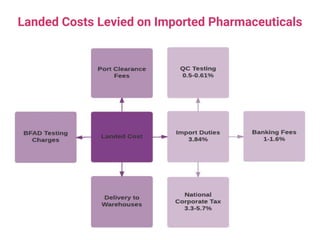
Landed Costs Levied on Imported Pharmaceuticals
PHARMACEUTICAL MANUFACTURING
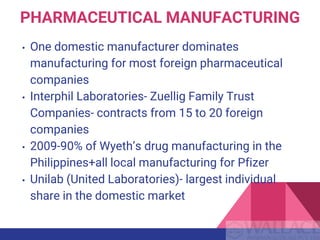
• One domestic manufacturer dominates
manufacturing for most foreign pharmaceutical
companies
• Interphil Laboratories- Zuellig Family Trust
Companies- contracts from 15 to 20 foreign
companies
• 2009-90% of Wyeth’s drug manufacturing in the
Philippines+all local manufacturing for Pfizer
• Unilab (United Laboratories)- largest individual
share in the domestic market
PHARMACEUTICAL MANUFACTURING
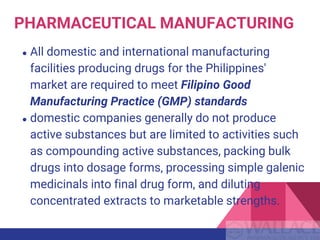
● All domestic and international manufacturing
facilities producing drugs for the Philippines'
market are required to meet Filipino Good
Manufacturing Practice (GMP) standards
● domestic companies generally do not produce
active substances but are limited to activities such
as compounding active substances, packing bulk
drugs into dosage forms, processing simple galenic
medicinals into final drug form, and diluting
concentrated extracts to marketable strengths.
PHARMACEUTICAL MANUFACTURING
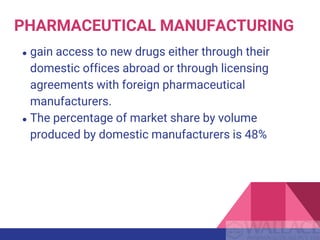
● gain access to new drugs either through their
domestic offices abroad or through licensing
agreements with foreign pharmaceutical
manufacturers.
● The percentage of market share by volume
produced by domestic manufacturers is 48%
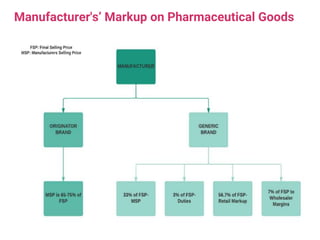
Manufacturer's’ Markup on Pharmaceutical Goods
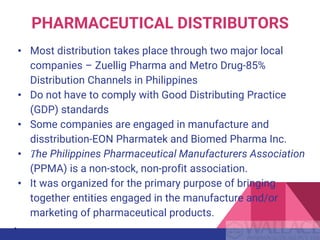
PHARMACEUTICAL DISTRIBUTORS
• Most distribution takes place through two major local
companies – Zuellig Pharma and Metro Drug-85%
Distribution Channels in Philippines
• Do not have to comply with Good Distributing Practice
(GDP) standards
• Some companies are engaged in manufacture and
disstribution-EON Pharmatek and Biomed Pharma Inc.
• The Philippines Pharmaceutical Manufacturers Association
(PPMA) is a non-stock, non-profit association.
• It was organized for the primary purpose of bringing
together entities engaged in the manufacture and/or
marketing of pharmaceutical products.
•
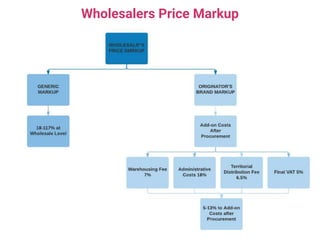
Wholesalers Price Markup
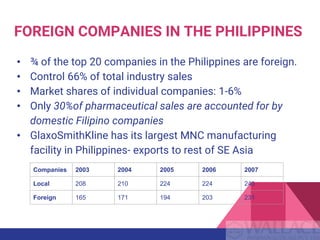
FOREIGN COMPANIES IN THE PHILIPPINES
• ¾ of the top 20 companies in the Philippines are foreign.
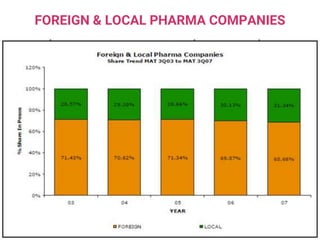
• Control 66% of total industry sales
• Market shares of individual companies: 1-6%
• Only 30%of pharmaceutical sales are accounted for by
domestic Filipino companies
• GlaxoSmithKline has its largest MNC manufacturing
facility in Philippines- exports to rest of SE Asia
Companies 2003 2004 2005 2006 2007
Local 208 210 224 224 240
Foreign 165 171 194 203 231
FOREIGN & LOCAL PHARMA COMPANIES
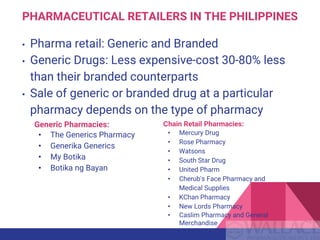
PHARMACEUTICAL RETAILERS IN THE PHILIPPINES
• Pharma retail: Generic and Branded
• Generic Drugs: Less expensive-cost 30-80% less
than their branded counterparts
• Sale of generic or branded drug at a particular
pharmacy depends on the type of pharmacy
Generic Pharmacies:
• The Generics Pharmacy
• Generika Generics
• My Botika
• Botika ng Bayan
Chain Retail Pharmacies:
• Mercury Drug
• Rose Pharmacy
• Watsons
• South Star Drug
• United Pharm
• Cherub's Face Pharmacy and
Medical Supplies
• KChan Pharmacy
• New Lords Pharmacy
• Caslim Pharmacy and General
Merchandise
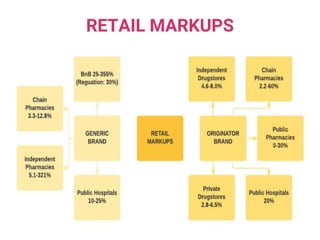
RETAIL MARKUPS
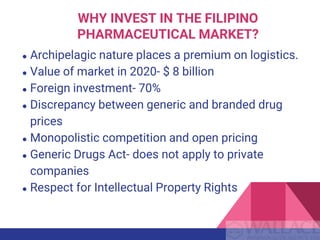
WHY INVEST IN THE FILIPINO
PHARMACEUTICAL MARKET?
● Archipelagic nature places a premium on logistics.
● Value of market in 2020- $ 8 billion
● Foreign investment- 70%
● Discrepancy between generic and branded drug
prices
● Monopolistic competition and open pricing
● Generic Drugs Act- does not apply to private
companies
● Respect for Intellectual Property Rights
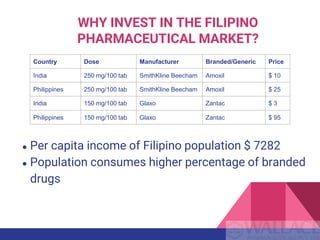
WHY INVEST IN THE FILIPINO
PHARMACEUTICAL MARKET?
● Per capita income of Filipino population $ 7282
● Population consumes higher percentage of branded
drugs
Country Dose Manufacturer Branded/Generic Price
India 250 mg/100 tab SmithKline Beecham Amoxil $ 10
Philippines 250 mg/100 tab SmithKline Beecham Amoxil $ 25
India 150 mg/100 tab Glaxo Zantac $ 3
Philippines 150 mg/100 tab Glaxo Zantac $ 95
WHY INVEST IN THE FILIPINO
PHARMACEUTICAL MARKET?
● 11th largest in Asia Pacific
● 3rd largest in ASEAN
● Thailand-generic manufacturing
● Philippines- larger market share- value/unit
● Offers higher value per unit
● Potential to create and sustain brands
SALAMAT!

The philippines market research presentation

  • 1.
    THE PHILIPPINES: A PHARMACEUTICALMARKET RESEARCH STUDY Nadia Dias, Marketing Intern Guide: Francis Pires, Business Head-International Division
  • 2.
    PART I: ANINTRODUCTION TO THE DEMOGRAPHIC LANDSCAPE OF THE PHILIPPINES • Introduction • The Demographic Landscape of the Philippines • Political Context • Economy • Healthcare in the Philippines • Pharmaceutical Supply Chain • Medical Human Resource Statistics PART II: THE PHARMACEUTICAL MARKET IN THE PHILIPPINES • The Pharmaceutical Market in the Philippines • Product Registration • Pharmaceutical Importers • Manufacturers and Distributors • Foreign Companies in the Philippines • Pharmaceutical Retailers in the Philippines • Pricing Regulation for the Private Sector CONTENTS
  • 3.
    • South-East AsianArchipelago. • 7,107 Islands. • Capital City-Manila. • 2,000/7,107 Islands Inhabited. • Urban Population: 31.8% to 50.32% (last 3 decades). • Fragmentary nature of Islands- challenge to trade and commerce in the country. • Economy resilient to global shocks due to , lower dependence on exports, relatively resilient domestic consumption, large remittances. • 1 PHP (Filipino Peso)=0.020 USD=1.37 INR INTRODUCTION
  • 5.
    • Population: 102,624,209 •Growth Rate: 1.59% • Per Capita Income (IMF 2015): $7,282 • GDP: USD 2,765 • Death Rate: 6.1 deaths/1000 population 0-4 years: 33.7% 5-24 years: 19.17% Male population larger than female population 25-54 years: 36.86% 55-64 years: 5.89% 65 & above: 4.38% Female population larger than male population DEMOGRAPHIC LANDSCAPE
  • 6.
  • 7.
    • Executive Branch:administrative/regulatory authority over health systems. • Legislative Branch: approving annual budgets and allocating development funds. • Dept. of Health (DOH): regulation and facilitation of health systems and processes in the Philippines. POLITICAL CONTEXT
  • 8.
    • 2011-2016- 6%economic growth. • FDI growth- lags behind regional peers. • ¼ of the Filipino population lives in poverty. • 50% <$2/day THE ECONOMY
  • 9.
    • Health Outcomes-Lagsbehind most of South-East Asia and North Asia • Health Index UNDP-Rank 117, 0.749 • Social and geographic barriers- inequitable access to resources. • Lower-income families and less developed areas- poor health status • Life expectancy in richer provinces is more than 10 years longer than in poorer ones HEALTHCARE
  • 10.
  • 11.
    Number/Rate per 100,000Population-5-Year Average (2008- 2012) and 2013 Cause of Death 5-Year Average (2008-12) 2013 Number Rate Number Rate Diseases of the Heart 1,03,170 110.3 1,18,740 121.1 Diseases of the Vascular System 66,754 71.4 68,325 69.7 Malignant Neoplasms 49,016 52.4 53,601 54.7 Pneumonia 45,303 48.4 53,101 54.2 Accidents 36,100 38.6 40,071 40.9 Diabetes Mellitus 22,287 23.9 27,064 27.6 Chronic Lower Respiratory Diseases 23,005 24.6 23,867 24.4 Tuberculosis, all forms 24,362 26.1 23,216 23.7 Nephritis, Nephrotic Syndrome & Nephrosis 13,599 14.6 14,954 15.3 Certain Conditions Originating from the Perinatal Period 11,904 12.8 10,436 10.6
  • 12.
    Main Causes ofDeath, 1997-2006 (Selected Years Rate per 100,000 Population (Rank) Region 1997 1999 2000 2002 2003 2004 2005 I. Communicable Diseases Pneumonia 43.1 (3) 44.0 (4) 42.7 (4) 43.0 (4) 39.5 (5) 38.4 (8) 42.8 (4) Tuberculosis, all forms 32.2 (6) 38.7 (6) 36.1 (6) 35.9 (6) 33.0 (6) 31.0 (6) 31.2 (6) II. Non-Communicable Diseases Diseases of the Heart 69.8 (1) 78.4 (1) 79.1 (1) 88.2 (1) 83.5 (1) 84.8 (1) 90.4 (1) Diseases of the Vascular System 54.1 (2) 58.4 (2) 63.2 (2) 62.3 (2) 64.0 (2) 61.8 (2) 63.8 (2) Malignant Neoplasms 37.5 (5) 45.8 (3) 47.7 (3) 48.8 (3) 48.5 (3) 48.5 (3) 48.9 (3) Chronic Lower Respiratory Diseases 23.3 (8) 22.7 (8) 24.6 (7) Diabetes Mellitus 9.4 (9) 13.8 (9) 14.1 (9) 17.5 (9) 17.5 (9) 19.8 (9) 21.6 (8) Chronic Obstructive Pulmonary Diseases & Allied Conditions 16.5 (7) 20.3 (7) 20.8 (7) 24.3 (7)
  • 13.
    Main Causes ofDeath, 1997-2006 (Selected Years Rate per 100,000 Population (Rank) Region 1997 1999 2000 2002 2003 2004 2005 III. External Conditions Transportation Accidents 39.9 (4) 40.2 (5) 42.4 (5) 42.3 (5) 41.9 (4) 41.3 (4) 39.1 (5) IV. Others Certain Conditions Originating from the Perinatal Period 17.1 (8) 19.8 (8) 19.8 (8) 17.4 (10) 15.9 (10) 14.5 (9) Nephritis, Nephrotic Syndrome & Nephrosis 9.4 (10) 10.1 (10) 10.41 (10) 11.66 (10) 15.8 (10) 13.0 (10) Ill-Defined and Unknown Causes of Mortality 25.5 (7) Symptoms, Signs & Abnormal Laboratory Findings, NEC 26.3 (7) Other Diseases of the Respiratory System 9.7 (8) Source: FHSIS DOH, 2009
  • 14.
  • 15.
  • 16.
  • 17.
    PHARMACEUTICAL SUPPLY CHAIN •Monopolistic pricing exists in drug sales in hospitals. • Drug prices in hospitals double those in retail pharmacies • Access to essential drugs- constrained due to limited availability and high costs • Availability depends on presence of doctors and drugstores in the region • Doctor prescriptions must be signed by pharmacist- implementation is difficult
  • 18.
    • 1988-Generic DrugsAct to make drugs more affordable • Failed to encourage use of generic drugs • Lack of information on safety and efficacy • Essential Drugs List established • 2009-DOH set Max. Retail Drug Prices for selected drugs • 1987-Philippines National Drug Policy (PNDP) • PNDP-Ensure quality and drugs and availability and affordability to all sections of the Filipino population. • Essential Drugs List/Philippines National Drug Formulatory set standards for procurement of drugs in the government sector. • Generics Act 2008-Compulsory Licensing, Parallel Importation, Price Control, generic substitution • Regulatory Reforms supported Botika ng Barangays Programme (BnB)-Sold drugs @ 62% cheaper PHARMACEUTICAL SUPPLY CHAIN
  • 19.
    SUPPLY CHAIN: MNCs ●Pharmaceutical MNCs are mainly drug traders ● Import large amounts of their merchandise from abroad ● Giant MNCs hire manufacturing services of InterPhil (Toll Manufacturer) ● Zuellig-mostly distribution of MNCs drug products
  • 20.
    SUPPLY CHAIN: MNCDRUG TRADER
  • 21.
    SUPPLY CHAIN: MNCDRUG IMPORTER
  • 22.
    SUPPLY CHAIN: LOCALMANUFACTURERS AND TRADERS ● Local Pharma sector-mix of manufacturers and traders ● Top 20 list-only 4 local companies ● Local giant- United Laboratories owns 28% local sales
  • 23.
  • 24.
    SUPPLY CHAIN: LOCALDRUG MANUFACTURER
  • 25.
    FOREIGN SUBSIDIARY MANUFACTURERS Interphil TOLL MANUFACTURERS HizonLabs Swiss Pharma Euro-Med Laboratories Lloyd Laboratories Ace Pharmaceuticals Allied LOCAL MANUFACTURERS Pascual Laboratories United Laboratories Asian antibiotics Amherst Westmont AM-Europharma AD-Drugstel Euromed IMPORTATION AND TRADING GSK Bristol Myers Squibb Natrapharm GX International Medhaus Pharma Prohealth Pharma Cathay Drug Pascual Laboratories United Laboratories MANUFACTURERS
  • 26.
    DRUG SUPPLY CHAIN ●MNCs-more trading/marketing/distribution rather than manufacturing ● Manufacturing-highly concentrated-one toll manufacturer-InterPhil ● Distribution concentrated-Zuellig ● Locals- some only manufacturing ● some locals-manufacture & trade & distribute
  • 27.
    SHARE OF THETOP THERAPEUTIC CLASSES TOTAL PHARMA
  • 28.
    Top 10 Ethical/PrescriptionBrands in the Philippines Moving Annual Total September ’07 Php Billion Rank Prescription Brand Indication Generic Name 4 Year %-CAGR 1 Novarsc (Pfizer) Hypertension Amoldipine 24.3 2 Ventolin (Glaxo-SK) Asthma Albuterol 2.16 3 Plavix (Sanofi-Aventis) Thrombosis Clopidogrel Bisulfate 22.78 4 Augmentin (Glaxo-SK) Infection Amoxicillin+Clavulanate Potassium 1.29 5 Neobloc (GX International) Hypertension Metoprolol 19.6 6 Lipitor (Pfizer) Hyper-Cholesterolemia Atorvastatin 7.61 7 Tazocin (Wyeth) Infection Tazobactam 18.44 8 Zegen (United American-UL) Infection Cefuroxime Axetil 31.37 9 Plendin ER (Astra Zeneca) Hypertension Felodipine -2.38 10 Seretide (Glaxo-SK) Asthma Fluticasone+Salmeterol 23.66
  • 29.
    Top 10 OTCBrands in the Philippines Moving Annual Total September ’07 Php billion Rank OTC Brand Indication 4 Year % CAGR 1 Ceelin (Pediatrica) Vitamin Supplement 6.1 2 Solmux (Westmont) Cough 8.84 3 Neozep (Myra) Cold Relief 14.38 4 Biogesic (Biomedis) Pain Relief 9.54 5 Enervon C (United American) Vitamin Supplement 0.33 6 Alaxan (Therapharma) Pain Relief -4.77 7 Myra E (Myra) Vitamin Supplement 36.01 8 Xenical (Roche) Weight Mgt 48.35 9 Centrum (Wyeth) Vitamin Supplement 13.13 10 Cherifer (GX Pharma) Vitamin Supplement 22.77
  • 30.
    DISTRIBUTION OF DOCTORSPER SPECIALITY, 2006
  • 31.
    THE PHILIPPINES’ PHARMACEUTICALMARKET ➔ Last decade- growth rate-12-14% annually ➔ 2014-Filipino drug market-$4.3 billion ➔ At par with Taiwan and indonesia ➔ Increase at 4.9% CAGR-$8 billion in 2020 ➔ 3.93% market share in Asia Pacific pharmaceutical market ➔ 0.31%-Global Market Share ➔ Generic substitution in private and public sector-driver for manufacture of generic drugs ➔ Increased expenditure on medicines by Clocal Government Units ➔ 2012-foreign pharmaceutical companies-70% of Filipino pharmaceutical market
  • 32.
    THE PHILIPPINES’ PHARMACEUTICALMARKET ● GlaxoSmithKline, Novartis, Sanofi-largest foreign companies doing business in the Philippines ● Local companies- United Laboratories, Pascual Laboratories, GC International, Natrapharm ● Generic segment-Sandoz (Novartis), Orient Europharma (Taiwan), Getz Pharma (Pakistan) ● Multinationals-reducing priceso drugs-50% to compete with generic products ● Drug prices in Philippines-still remain highest in Asia
  • 33.
    Why are drugprices so high? ➔ Poor purchasing practices in Filipino hospitals. ➔ High Retail Markups because of monopolistic competition ➔ Prohibitive cost of importing pharmaceutical ingredients ➔ Low rates of health insurance ➔ Low rates of coverage for out-patient drugs ➔ 2008-Universally Accessible Cheaper and Quality Medicines Act-power to impose Max. retail price on drugs mentioned in the essential drugs list ➔ Philippines Respects International Property Rights (IPR) ➔ Cannot simply introduce generics that are under patent
  • 34.
    PRODUCT REGISTRATION ➔Companies thatare involved in the manufacture, import, export, distribution, retailing, packaging and re-packaging of pharmaceuticals ➔Companies require a Licence to Operate (LTO) before registering their product with the FDA ➔Licence to Operate (LTOs) from the manufacturer, distributor and / or importer ➔A Certificate of Agreement between the manufacturer and distributor or the manufacturer and importer for the product being registered ➔The Application for Registration of Pharmaceutical form
  • 35.
    PRODUCT REGISTRATION ● Informationon product formulation and dosage ● A Certificate of Analysis and Specifications for all raw materials ● Information on the manufacturing process, including procedure, in-process controls, production equipment and packaging procedure ● Labelling materials ● Stability studies ● A product sample (which should include English labels for the product registration number, the generic and brand names, the name of the product license holder, indications for use, dosage, warnings and precautions, the batch number and the expiration date)
  • 36.
    PRODUCT REGISTRATION • Rulesand regulations for import of pharmaceutical goods • Follow registration procedure • Registration completed in the name of local distributor/consultant lawyer • Despite payment for registration, direct rights over product (marketing/distribution) • Can own rights to goods only once a Philippines arm of the company is established • Import goods of its own registration
  • 37.
  • 38.
    PHARMACEUTICAL IMPORTERS • Filipinopharmaceutical market heavily dependent on import of raw and finished pharmaceutical products • Few foreign companies manufacture in Philippines • Import and distribute finished products • Import raw materials and outsource production to local manufacturers • Authorizations required to import pharmaceutical drugs • 2000-Parallel Drug Importation Pharma Plan 50 • Philippines International Trade Corporation (PITC)-Source off- patent drugs from essential drugs list • Imports-Primarily from India-competed with prices of branded products • Plan failed-limited volume of imports and weak distribution network
  • 39.
    Landed Costs Leviedon Imported Pharmaceuticals
  • 40.
    PHARMACEUTICAL MANUFACTURING • Onedomestic manufacturer dominates manufacturing for most foreign pharmaceutical companies • Interphil Laboratories- Zuellig Family Trust Companies- contracts from 15 to 20 foreign companies • 2009-90% of Wyeth’s drug manufacturing in the Philippines+all local manufacturing for Pfizer • Unilab (United Laboratories)- largest individual share in the domestic market
  • 41.
    PHARMACEUTICAL MANUFACTURING ● Alldomestic and international manufacturing facilities producing drugs for the Philippines' market are required to meet Filipino Good Manufacturing Practice (GMP) standards ● domestic companies generally do not produce active substances but are limited to activities such as compounding active substances, packing bulk drugs into dosage forms, processing simple galenic medicinals into final drug form, and diluting concentrated extracts to marketable strengths.
  • 42.
    PHARMACEUTICAL MANUFACTURING ● gainaccess to new drugs either through their domestic offices abroad or through licensing agreements with foreign pharmaceutical manufacturers. ● The percentage of market share by volume produced by domestic manufacturers is 48%
  • 43.
    Manufacturer's’ Markup onPharmaceutical Goods
  • 44.
    PHARMACEUTICAL DISTRIBUTORS • Mostdistribution takes place through two major local companies – Zuellig Pharma and Metro Drug-85% Distribution Channels in Philippines • Do not have to comply with Good Distributing Practice (GDP) standards • Some companies are engaged in manufacture and disstribution-EON Pharmatek and Biomed Pharma Inc. • The Philippines Pharmaceutical Manufacturers Association (PPMA) is a non-stock, non-profit association. • It was organized for the primary purpose of bringing together entities engaged in the manufacture and/or marketing of pharmaceutical products. •
  • 45.
  • 46.
    FOREIGN COMPANIES INTHE PHILIPPINES • ¾ of the top 20 companies in the Philippines are foreign. • Control 66% of total industry sales • Market shares of individual companies: 1-6% • Only 30%of pharmaceutical sales are accounted for by domestic Filipino companies • GlaxoSmithKline has its largest MNC manufacturing facility in Philippines- exports to rest of SE Asia Companies 2003 2004 2005 2006 2007 Local 208 210 224 224 240 Foreign 165 171 194 203 231
  • 47.
    FOREIGN & LOCALPHARMA COMPANIES
  • 48.
    PHARMACEUTICAL RETAILERS INTHE PHILIPPINES • Pharma retail: Generic and Branded • Generic Drugs: Less expensive-cost 30-80% less than their branded counterparts • Sale of generic or branded drug at a particular pharmacy depends on the type of pharmacy Generic Pharmacies: • The Generics Pharmacy • Generika Generics • My Botika • Botika ng Bayan Chain Retail Pharmacies: • Mercury Drug • Rose Pharmacy • Watsons • South Star Drug • United Pharm • Cherub's Face Pharmacy and Medical Supplies • KChan Pharmacy • New Lords Pharmacy • Caslim Pharmacy and General Merchandise
  • 49.
  • 50.
    WHY INVEST INTHE FILIPINO PHARMACEUTICAL MARKET? ● Archipelagic nature places a premium on logistics. ● Value of market in 2020- $ 8 billion ● Foreign investment- 70% ● Discrepancy between generic and branded drug prices ● Monopolistic competition and open pricing ● Generic Drugs Act- does not apply to private companies ● Respect for Intellectual Property Rights
  • 51.
    WHY INVEST INTHE FILIPINO PHARMACEUTICAL MARKET? ● Per capita income of Filipino population $ 7282 ● Population consumes higher percentage of branded drugs Country Dose Manufacturer Branded/Generic Price India 250 mg/100 tab SmithKline Beecham Amoxil $ 10 Philippines 250 mg/100 tab SmithKline Beecham Amoxil $ 25 India 150 mg/100 tab Glaxo Zantac $ 3 Philippines 150 mg/100 tab Glaxo Zantac $ 95
  • 52.
    WHY INVEST INTHE FILIPINO PHARMACEUTICAL MARKET? ● 11th largest in Asia Pacific ● 3rd largest in ASEAN ● Thailand-generic manufacturing ● Philippines- larger market share- value/unit ● Offers higher value per unit ● Potential to create and sustain brands
  • 53.