The pharmaceutical industry: Delivering for Europe
Who is EFPIA, and what does it do?EFPIA, the European Federation of Pharmaceutical Industries and Associations represents the research-based pharmaceutical industry operating in Europe;
Our direct members include 40 leading pharmaceutical companies and 31 national associations;
EFPIA provides a voice in the EU scene for around 2,200 companies committed to researching and developing medicines to benefit patients now and in the future;
Our mission is to:
Promote pharmaceutical research and development in Europe
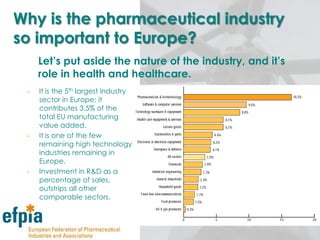
Create a economic, regulatory and political environment to compete with the US and Asia;Why is the pharmaceutical industry so important to Europe?Let’s put aside the nature of the industry, and it’s role in health and healthcare. It is the 5th largest industry sector in Europe; it contributes 3.5% of the total EU manufacturing value added.It is one of the few remaining high technology industries remaining in Europe. Investment in R&D as a percentage of sales, outstrips all other comparable sectors.
Why is the pharmaceutical industry so important to Europe?The industry employs more that 110,000 in research and development facilities in Europe; equivalent to the entire population of Maastricht or Bruges. Furthermore, the industry in total directly employs more than 630,000 people – equivalent to the population of city the size of Frankfurt. Indirect employment takes this figure to over 1 million people; roughly the size of GenevaThis helps keeps Europe remain an important hub of innovation, able to attract high-quality researchers
Why is the pharmaceutical industry so important to Europe?Financially, the industry is a substantial contributor to the European economy 
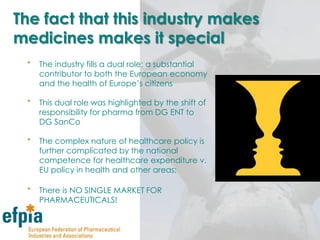
The fact that this industry makes medicines makes it specialThe industry fills a dual role; a substantial contributor to both the European economy and the health of Europe’s citizens
This dual role was highlighted by the shift of responsibility for pharma from DG ENT to DG SanCo
The complex nature of healthcare policy is further complicated by the national competence for healthcare expenditure v.  EU policy in health and other areas;
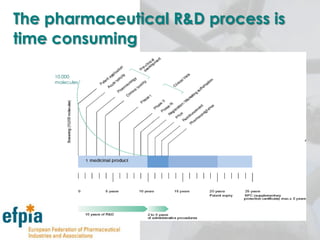
There is NO SINGLE MARKET FOR PHARMACEUTICALS!The pharmaceutical R&D process istime consuming10.000 molecules
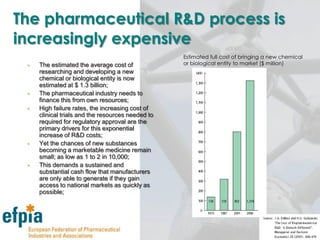
The pharmaceutical R&D process isThe estimated the average cost of researching and developing a new chemical or biological entity is now estimated at $ 1.3 billion;The pharmaceutical industry needs to finance this from own resources;High failure rates, the increasing cost of clinical trials and the resources needed to required for regulatory approval are the primary drivers for this exponential increase of R&D costs; Yet the chances of new substances becoming a marketable medicine remain small; as low as 1 to 2 in 10,000;This demands a sustained and substantial cash flow that manufacturers are only able to generate if they gain access to national markets as quickly as possible;increasingly expensiveEstimated full cost of bringing a new chemical or biological entity to market ($ million)
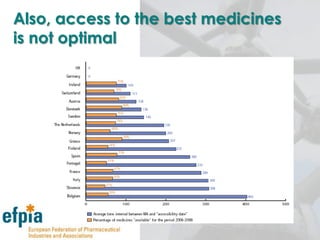
Also, access to the best medicines is not optimal
Also, access to the best medicines is not optimalOnly a few patients receive up-to-date breast cancer treatmentSource: Schöffski (2004), Impediments to the Diffusion of Innovative Medicines in Europe
Are accusations of ‘selling sickness’ valid? No.The reality is that the European regulatory and approval process makes it impossible
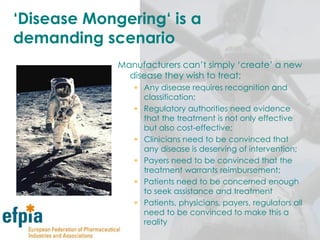
‘Disease Mongering‘ is a demanding scenarioManufacturers can’t simply ‘create’ a new disease they wish to treat;Any disease requires recognition and classification;Regulatory authorities need evidence that the treatment is not only effective but also cost-effective;Clinicians need to be convinced that any disease is deserving of intervention;Payers need to be convinced that the treatment warrants reimbursement;Patients need to be concerned enough to seek assistance and treatmentPatients, physicians, payers, regulators all need to be convinced to make this a reality
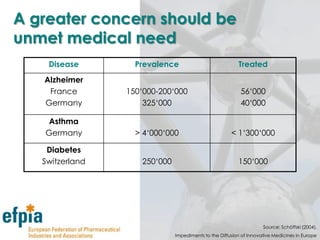
A greater concern should be unmet medical needSource: Schöffski (2004), Impediments to the Diffusion of Innovative Medicines in Europe
Industry has made, and will continue make, a real differenceLife expectancy at birth 30 years more than 100 years agoHuge reductions in mortality (e.g. HIV/AIDS, many cancers, cardiovascular diseases)Significant progress in quality of life (e.g. asthma, diabetes)Still addressing unmet needs in  Alzheimer, multiple sclerosis, many cancers and orphan diseasesAddressing Dutch Priority Medicines report
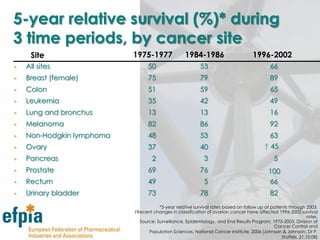
5-year relative survival (%)* during 3 time periods, by cancer site1975-19771984-19861996-2002SiteAll sites	50	53		66Breast (female)	75	79		89Colon 	51	59		65Leukemia	35	42		49Lung and bronchus	13	13		16Melanoma	82	86		92Non-Hodgkin lymphoma	48	53		63Ovary	37	40	          Pancreas	2	3 	  	  5Prostate	6976	         	Rectum49	5		66Urinary bladder	73	78		82† 45100*5-year relative survival rates based on follow up of patients through 2003. †Recent changes in classification of ovarian cancer have affected 1996-2002 survival rates.Source: Surveillance, Epidemiology, and End Results Program, 1975-2003, Division of Cancer Control andPopulation Sciences, National Cancer Institute, 2006 (Johnson & Johnson, Dr P. Stoffels, 21.10.08)
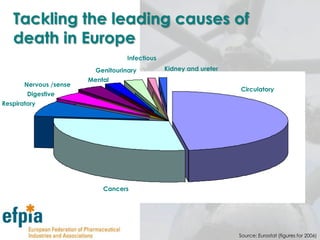
Tackling the leading causes of death in EuropeInfectiousKidney and ureterGenitourinaryMentalNervous /senseCirculatoryDigestiveRespiratoryCancersSource: Eurostat (figures for 2006)
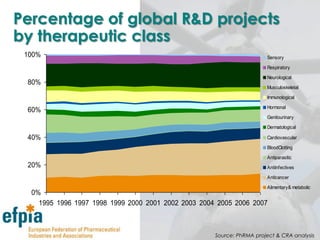
Percentage of global R&D projects by therapeutic classSource: PhRMA project & CRA analysis
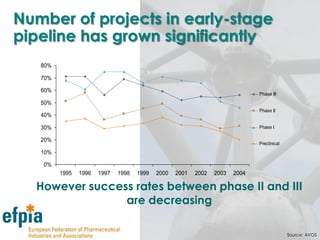
Number of projects in early-stage pipeline has grown significantlyHowever success rates between phase II and III are decreasingSource: AVOS
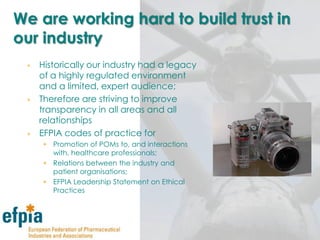
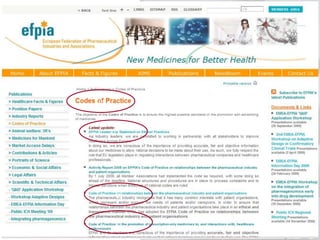
EFPIA and ethical behaviour by industry

Brian Ager - Selling Sickness 2010

  • 1.
    The pharmaceutical industry:Delivering for Europe
  • 2.
    Who is EFPIA,and what does it do?EFPIA, the European Federation of Pharmaceutical Industries and Associations represents the research-based pharmaceutical industry operating in Europe;
  • 3.
    Our direct membersinclude 40 leading pharmaceutical companies and 31 national associations;
  • 4.
    EFPIA provides avoice in the EU scene for around 2,200 companies committed to researching and developing medicines to benefit patients now and in the future;
  • 5.
  • 6.
    Promote pharmaceutical researchand development in Europe
  • 7.
    Create a economic,regulatory and political environment to compete with the US and Asia;Why is the pharmaceutical industry so important to Europe?Let’s put aside the nature of the industry, and it’s role in health and healthcare. It is the 5th largest industry sector in Europe; it contributes 3.5% of the total EU manufacturing value added.It is one of the few remaining high technology industries remaining in Europe. Investment in R&D as a percentage of sales, outstrips all other comparable sectors.
  • 8.
    Why is thepharmaceutical industry so important to Europe?The industry employs more that 110,000 in research and development facilities in Europe; equivalent to the entire population of Maastricht or Bruges. Furthermore, the industry in total directly employs more than 630,000 people – equivalent to the population of city the size of Frankfurt. Indirect employment takes this figure to over 1 million people; roughly the size of GenevaThis helps keeps Europe remain an important hub of innovation, able to attract high-quality researchers
  • 9.
    Why is thepharmaceutical industry so important to Europe?Financially, the industry is a substantial contributor to the European economy 
  • 10.
    The fact thatthis industry makes medicines makes it specialThe industry fills a dual role; a substantial contributor to both the European economy and the health of Europe’s citizens
  • 11.
    This dual rolewas highlighted by the shift of responsibility for pharma from DG ENT to DG SanCo
  • 12.
    The complex natureof healthcare policy is further complicated by the national competence for healthcare expenditure v. EU policy in health and other areas;
  • 13.
    There is NOSINGLE MARKET FOR PHARMACEUTICALS!The pharmaceutical R&D process istime consuming10.000 molecules
  • 14.
    The pharmaceutical R&Dprocess isThe estimated the average cost of researching and developing a new chemical or biological entity is now estimated at $ 1.3 billion;The pharmaceutical industry needs to finance this from own resources;High failure rates, the increasing cost of clinical trials and the resources needed to required for regulatory approval are the primary drivers for this exponential increase of R&D costs; Yet the chances of new substances becoming a marketable medicine remain small; as low as 1 to 2 in 10,000;This demands a sustained and substantial cash flow that manufacturers are only able to generate if they gain access to national markets as quickly as possible;increasingly expensiveEstimated full cost of bringing a new chemical or biological entity to market ($ million)
  • 15.
    Also, access tothe best medicines is not optimal
  • 16.
    Also, access tothe best medicines is not optimalOnly a few patients receive up-to-date breast cancer treatmentSource: Schöffski (2004), Impediments to the Diffusion of Innovative Medicines in Europe
  • 17.
    Are accusations of‘selling sickness’ valid? No.The reality is that the European regulatory and approval process makes it impossible
  • 18.
    ‘Disease Mongering‘ isa demanding scenarioManufacturers can’t simply ‘create’ a new disease they wish to treat;Any disease requires recognition and classification;Regulatory authorities need evidence that the treatment is not only effective but also cost-effective;Clinicians need to be convinced that any disease is deserving of intervention;Payers need to be convinced that the treatment warrants reimbursement;Patients need to be concerned enough to seek assistance and treatmentPatients, physicians, payers, regulators all need to be convinced to make this a reality
  • 19.
    A greater concernshould be unmet medical needSource: Schöffski (2004), Impediments to the Diffusion of Innovative Medicines in Europe
  • 20.
    Industry has made,and will continue make, a real differenceLife expectancy at birth 30 years more than 100 years agoHuge reductions in mortality (e.g. HIV/AIDS, many cancers, cardiovascular diseases)Significant progress in quality of life (e.g. asthma, diabetes)Still addressing unmet needs in Alzheimer, multiple sclerosis, many cancers and orphan diseasesAddressing Dutch Priority Medicines report
  • 21.
    5-year relative survival(%)* during 3 time periods, by cancer site1975-19771984-19861996-2002SiteAll sites 50 53 66Breast (female) 75 79 89Colon 51 59 65Leukemia 35 42 49Lung and bronchus 13 13 16Melanoma 82 86 92Non-Hodgkin lymphoma 48 53 63Ovary 37 40 Pancreas 2 3 5Prostate 6976 Rectum49 5 66Urinary bladder 73 78 82† 45100*5-year relative survival rates based on follow up of patients through 2003. †Recent changes in classification of ovarian cancer have affected 1996-2002 survival rates.Source: Surveillance, Epidemiology, and End Results Program, 1975-2003, Division of Cancer Control andPopulation Sciences, National Cancer Institute, 2006 (Johnson & Johnson, Dr P. Stoffels, 21.10.08)
  • 22.
    Tackling the leadingcauses of death in EuropeInfectiousKidney and ureterGenitourinaryMentalNervous /senseCirculatoryDigestiveRespiratoryCancersSource: Eurostat (figures for 2006)
  • 23.
    Percentage of globalR&D projects by therapeutic classSource: PhRMA project & CRA analysis
  • 24.
    Number of projectsin early-stage pipeline has grown significantlyHowever success rates between phase II and III are decreasingSource: AVOS
  • 25.
    EFPIA and ethicalbehaviour by industry