The Periodic Table
The Periodic Table
• The periodic table is a tabular arrangement of the chemical elements,
ordered by their atomic number, and recurring chemical properties.
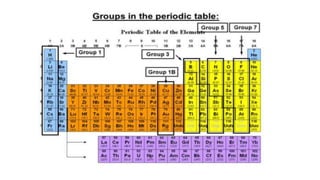
• A group or family is a column of elements in the periodic table. There
are a total of 18 numbered groups in the periodic table
• A period or series is a row of elements in the periodic table. In the
periodic table, there are a total of seven rows.
The Periodic Table has 18 groups. Groups 1 – 2 (Group 1 A and 2 A) and 13 –
18 (Group 3A to 8A) are known as the Representative elements.
• Group 1A is known as the Alkali Metals
• Group 2A is known as the Alkaline Earth Metals
• Group 3A is known as the Boron Group
• Group 4A is known as the Carbon Group
• Group 5A is known as the Nitrogen Group
• Group 6A is known as the Chalcogens Group or Oxygen Group
• Group 7A is known as the Halogens
• Group 8A is known as the Noble Gases (all groups except the Noble gases
interact with other elements to be stable. Noble Gases have 8 complete
electrons, they are already stable, they don’t need to interact with other
elements).
• Groups 3 to 12 (Groups 1B to 8B) are known as the transition metals
Properties of Alkali Metals
The Alkali Metals have the following properties in common:
• They have low melting and boiling points compared to most other
metals
• They are very soft and can be cut easily with a knife They have low
densities.
• Lithium, sodium and potassium will float in water
• They react quickly with water, producing hydroxides and hydrogen gas
Properties of Alkali Earth Metals
The Alkaline Earth Metals have the following properties in common:
• They are shiny
• They are silvery - white
• They are somewhat reactive at standard temperature and pressure
• They have low densities
• They have low melting points
• They have low boiling points
Properties of Transition Metals
The Transition Metals have the following properties in common:
• They are very hard, usually shiny, ductile and malleable
• They have high melting points
• The have high boiling points
• They have high thermal conductivity
• They have high electrical conductivity
• They have high densities
Properties of Halogens
The halogens have the following properties in common:
• They are poor electrical conductors
• They are poor thermal conductors
• They form brittle solids
• They have low melting points
• The have low boiling points
• Valence electrons are electrons found on the outermost energy level.
The outermost energy level or shell is known as the valence shell.
For Representative elements (Groups 1A to 8A):
the number of valence electrons is equal to its group number.
For example:
Oxygen is found on Group 6A. Therefore, oxygen has six valence
electrons.
Neon is found on Group 8A, a noble gas. Therefore, neon has
eight valence electrons.
For Transition Metals:
Group 1B – 1 or 2 valence electrons
Group 2B – 2 valence electrons
Group 3B – 3 valence electrons
Group 4B – 2 to 4 valence electrons
Group 5B – 2 to 5 valence electrons
Group 6B – 2 to 6 valence electrons
Group 7B – 2 to 7 valence electrons
Group 8B – 2 or 3 valence electrons
TRENDS IN ATOMIC PROPERTIES IN THE
PERIODIC TABLE
Atomic Radius
Ionization Energy
Electron Affinity
Electronegativity
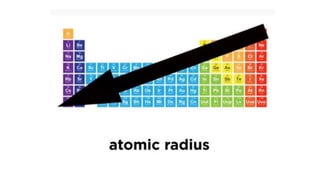
Atomic Radius
– size of the atom
In the Periodic Table of Elements as you move:
Downward – atomic radius increases
Right – atomic radius decreases
Ionization Energy
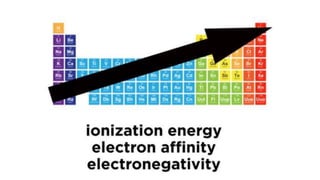
– is the amount of energy needed to remove an
electron from an atom
- lowest on Francium, because its valence electron is
farthest from all of the nucleus
- highest on Helium
In the Periodic Table of Elements as you move:
Left to Right – ionization energy increases
Electron Affinity
– is the amount of energy needed to gain electron from
an atom
- Flourine has the highest Electron Afinity
- Noble gases is not affected
In the Periodic Table of Elements as you move:
Left to Right – electron afinity increases
Electronegativity
– is the ability of an atom to hold electrons tightly
- Flourine is the highest effective nuclear charge
- Noble gases is not affected
In the Periodic Table of Elements as you move:
Left to Right – electronegativity increases
The Periodic Table

The Periodic Table

  • 1.
  • 2.
    The Periodic Table •The periodic table is a tabular arrangement of the chemical elements, ordered by their atomic number, and recurring chemical properties. • A group or family is a column of elements in the periodic table. There are a total of 18 numbered groups in the periodic table • A period or series is a row of elements in the periodic table. In the periodic table, there are a total of seven rows.
  • 4.
    The Periodic Tablehas 18 groups. Groups 1 – 2 (Group 1 A and 2 A) and 13 – 18 (Group 3A to 8A) are known as the Representative elements. • Group 1A is known as the Alkali Metals • Group 2A is known as the Alkaline Earth Metals • Group 3A is known as the Boron Group • Group 4A is known as the Carbon Group • Group 5A is known as the Nitrogen Group • Group 6A is known as the Chalcogens Group or Oxygen Group • Group 7A is known as the Halogens • Group 8A is known as the Noble Gases (all groups except the Noble gases interact with other elements to be stable. Noble Gases have 8 complete electrons, they are already stable, they don’t need to interact with other elements). • Groups 3 to 12 (Groups 1B to 8B) are known as the transition metals
  • 5.
    Properties of AlkaliMetals The Alkali Metals have the following properties in common: • They have low melting and boiling points compared to most other metals • They are very soft and can be cut easily with a knife They have low densities. • Lithium, sodium and potassium will float in water • They react quickly with water, producing hydroxides and hydrogen gas
  • 6.
    Properties of AlkaliEarth Metals The Alkaline Earth Metals have the following properties in common: • They are shiny • They are silvery - white • They are somewhat reactive at standard temperature and pressure • They have low densities • They have low melting points • They have low boiling points
  • 7.
    Properties of TransitionMetals The Transition Metals have the following properties in common: • They are very hard, usually shiny, ductile and malleable • They have high melting points • The have high boiling points • They have high thermal conductivity • They have high electrical conductivity • They have high densities
  • 8.
    Properties of Halogens Thehalogens have the following properties in common: • They are poor electrical conductors • They are poor thermal conductors • They form brittle solids • They have low melting points • The have low boiling points
  • 9.
    • Valence electronsare electrons found on the outermost energy level. The outermost energy level or shell is known as the valence shell. For Representative elements (Groups 1A to 8A): the number of valence electrons is equal to its group number. For example: Oxygen is found on Group 6A. Therefore, oxygen has six valence electrons. Neon is found on Group 8A, a noble gas. Therefore, neon has eight valence electrons.
  • 10.
    For Transition Metals: Group1B – 1 or 2 valence electrons Group 2B – 2 valence electrons Group 3B – 3 valence electrons Group 4B – 2 to 4 valence electrons Group 5B – 2 to 5 valence electrons Group 6B – 2 to 6 valence electrons Group 7B – 2 to 7 valence electrons Group 8B – 2 or 3 valence electrons
  • 11.
    TRENDS IN ATOMICPROPERTIES IN THE PERIODIC TABLE Atomic Radius Ionization Energy Electron Affinity Electronegativity
  • 12.
    Atomic Radius – sizeof the atom In the Periodic Table of Elements as you move: Downward – atomic radius increases Right – atomic radius decreases
  • 14.
    Ionization Energy – isthe amount of energy needed to remove an electron from an atom - lowest on Francium, because its valence electron is farthest from all of the nucleus - highest on Helium In the Periodic Table of Elements as you move: Left to Right – ionization energy increases
  • 15.
    Electron Affinity – isthe amount of energy needed to gain electron from an atom - Flourine has the highest Electron Afinity - Noble gases is not affected In the Periodic Table of Elements as you move: Left to Right – electron afinity increases
  • 16.
    Electronegativity – is theability of an atom to hold electrons tightly - Flourine is the highest effective nuclear charge - Noble gases is not affected In the Periodic Table of Elements as you move: Left to Right – electronegativity increases