4º E.S.O. EUROPEAN SECTION
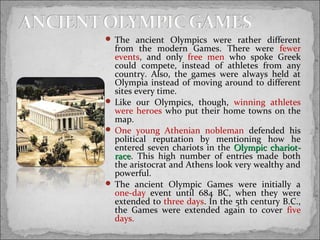
 The ancient Olympics were rather different

from the modern Games. There were fewer
events, and only free men who spoke Greek
could compete, instead of athletes from any
country. Also, the games were always held at
Olympia instead of moving around to different
sites every time.
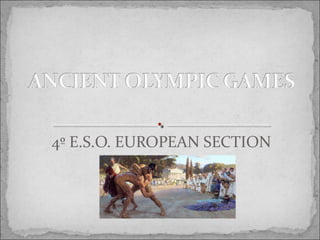
 Like our Olympics, though, winning athletes
were heroes who put their home towns on the
map.
 One young Athenian nobleman defended his
political reputation by mentioning how he
entered seven chariots in the Olympic chariotrace. This high number of entries made both
race
the aristocrat and Athens look very wealthy and
powerful.
 The ancient Olympic Games were initially a
one-day event until 684 BC, when they were
extended to three days. In the 5th century B.C.,
the Games were extended again to cover five
days.
 One difference between the ancient and

modern Olympic Games is that the ancient
games were played within the context of a
religious festival.
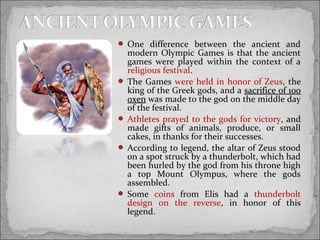
 The Games were held in honor of Zeus, the
king of the Greek gods, and a sacrifice of 100
oxen was made to the god on the middle day
of the festival.
 Athletes prayed to the gods for victory, and
made gifts of animals, produce, or small
cakes, in thanks for their successes.
 According to legend, the altar of Zeus stood
on a spot struck by a thunderbolt, which had
been hurled by the god from his throne high
a top Mount Olympus, where the gods
assembled.
 Some coins from Elis had a thunderbolt
design on the reverse, in honor of this
legend.
 The Greeks referred to the Sanctuary of

Zeus as the Altis. The name Altis came
from a corruption of the Elean word for
grove, alsos .
 Sanctuaries were centers of religious
worship where the Greeks built temples,
treasuries, altars, statues, and other
structures.
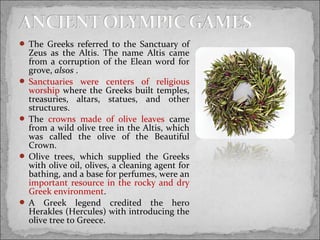
 The crowns made of olive leaves came
from a wild olive tree in the Altis, which
was called the olive of the Beautiful
Crown.
 Olive trees, which supplied the Greeks
with olive oil, olives, a cleaning agent for
bathing, and a base for perfumes, were an
important resource in the rocky and dry
Greek environment.
 A Greek legend credited the hero
Herakles (Hercules) with introducing the
olive tree to Greece.
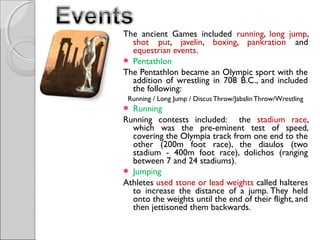
The ancient Games included running, long jump,
shot put, javelin, boxing, pankration and
equestrian events.
 Pentathlon
The Pentathlon became an Olympic sport with the
addition of wrestling in 708 B.C., and included
the following:
Running / Long Jump / Discus Throw/Jabalin Throw/Wrestling
 Running

Running contests included: the stadium race,
which was the pre-eminent test of speed,
covering the Olympia track from one end to the
other (200m foot race), the diaulos (two
stadium - 400m foot race), dolichos (ranging
between 7 and 24 stadiums).
 Jumping
Athletes used stone or lead weights called halteres
to increase the distance of a jump. They held
onto the weights until the end of their flight, and
then jettisoned them backwards.
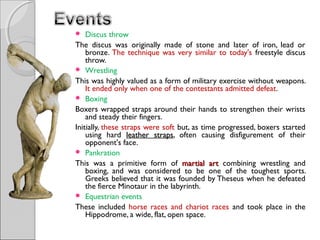
Discus throw
The discus was originally made of stone and later of iron, lead or
bronze. The technique was very similar to today's freestyle discus
throw.
 Wrestling
This was highly valued as a form of military exercise without weapons.
It ended only when one of the contestants admitted defeat.
 Boxing
Boxers wrapped straps around their hands to strengthen their wrists
and steady their fingers.
Initially, these straps were soft but, as time progressed, boxers started
using hard leather straps, often causing disfigurement of their
straps
opponent's face.
 Pankration
This was a primitive form of martial art combining wrestling and
boxing, and was considered to be one of the toughest sports.
Greeks believed that it was founded by Theseus when he defeated
the fierce Minotaur in the labyrinth.
 Equestrian events
These included horse races and chariot races and took place in the
Hippodrome, a wide, flat, open space.

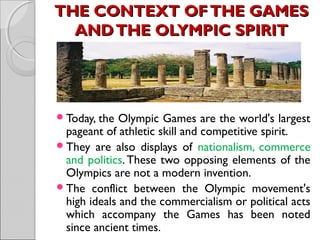
THE CONTEXT OF THE GAMES
AND THE OLYMPIC SPIRIT

Today, the

Olympic Games are the world's largest
pageant of athletic skill and competitive spirit.
They are also displays of nationalism, commerce
and politics. These two opposing elements of the
Olympics are not a modern invention.
The conflict between the Olympic movement's
high ideals and the commercialism or political acts
which accompany the Games has been noted
since ancient times.









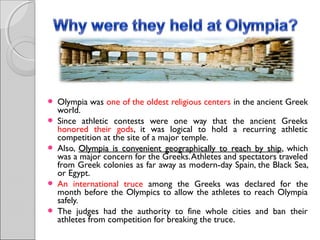
Olympia was one of the oldest religious centers in the ancient Greek
world.
Since athletic contests were one way that the ancient Greeks
honored their gods, it was logical to hold a recurring athletic
competition at the site of a major temple.
Also, Olympia is convenient geographically to reach by ship, which
ship
was a major concern for the Greeks. Athletes and spectators traveled
from Greek colonies as far away as modern-day Spain, the Black Sea,
or Egypt.
An international truce among the Greeks was declared for the
month before the Olympics to allow the athletes to reach Olympia
safely.
The judges had the authority to fine whole cities and ban their
athletes from competition for breaking the truce.
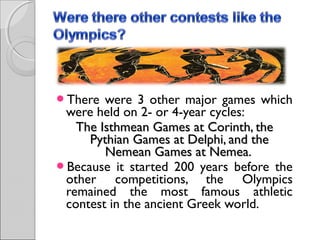
There

were 3 other major games which
were held on 2- or 4-year cycles:
The Isthmean Games at Corinth, the
Pythian Games at Delphi, and the
Nemean Games at Nemea.
Because it started 200 years before the
other competitions, the Olympics
remained the most famous athletic
contest in the ancient Greek world.
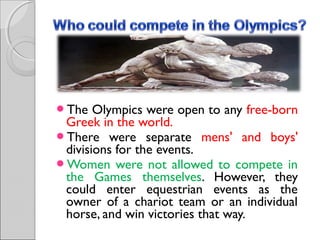
The

Olympics were open to any free-born
Greek in the world.
There were separate mens' and boys'
divisions for the events.
Women were not allowed to compete in
the Games themselves. However, they
could enter equestrian events as the
owner of a chariot team or an individual
horse, and win victories that way.
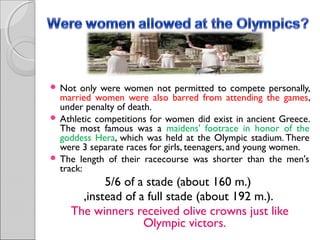
 Not

only were women not permitted to compete personally,
married women were also barred from attending the games,
under penalty of death.
 Athletic competitions for women did exist in ancient Greece.
The most famous was a maidens' footrace in honor of the
goddess Hera, which was held at the Olympic stadium. There
were 3 separate races for girls, teenagers, and young women.
 The length of their racecourse was shorter than the men's
track:

5/6 of a stade (about 160 m.)
,instead of a full stade (about 192 m.).
The winners received olive crowns just like
Olympic victors.








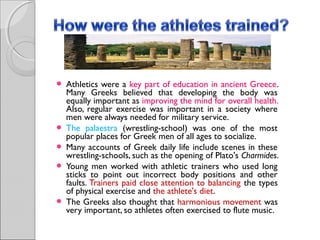
Athletics were a key part of education in ancient Greece.
Many Greeks believed that developing the body was
equally important as improving the mind for overall health.
Also, regular exercise was important in a society where
men were always needed for military service.
The palaestra (wrestling-school) was one of the most
popular places for Greek men of all ages to socialize.
Many accounts of Greek daily life include scenes in these
wrestling-schools, such as the opening of Plato's Charmides.
Young men worked with athletic trainers who used long
sticks to point out incorrect body positions and other
faults. Trainers paid close attention to balancing the types
of physical exercise and the athlete's diet.
The Greeks also thought that harmonious movement was
very important, so athletes often exercised to flute music.
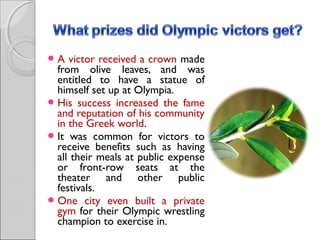
A

victor received a crown made
from olive leaves, and was
entitled to have a statue of
himself set up at Olympia.
 His success increased the fame
and reputation of his community
in the Greek world.
 It was common for victors to
receive benefits such as having
all their meals at public expense
or front-row seats at the
theater and other public
festivals.
 One city even built a private
gym for their Olympic wrestling
champion to exercise in.
 Anyone

who violated the rules was fined by the
judges. The money was used to set up statues of Zeus,
the patron god of the Games at Olympia.
Actions: 
 In addition to using bribes.
 Other offenses included deliberately avoiding the
training period at Olympia. One athlete claimed that
bad winds kept his ship from arriving in time, but was
later proved to have spent the training period
traveling around Greece winning prize money in
other competitions.
 Another athlete was so intimidated by his opponents
that he left the Games the day before he was to
compete, and was fined for cowardice.
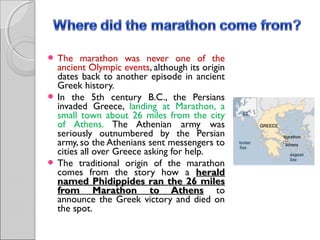
 The

marathon was never one of the
ancient Olympic events, although its origin
dates back to another episode in ancient
Greek history.
 In the 5th century B.C., the Persians
invaded Greece, landing at Marathon, a
small town about 26 miles from the city
of Athens. The Athenian army was
seriously outnumbered by the Persian
army, so the Athenians sent messengers to
cities all over Greece asking for help.
 The traditional origin of the marathon
comes from the story how a herald
named Phidippides ran the 26 miles
from Marathon to Athens to
announce the Greek victory and died on
the spot.
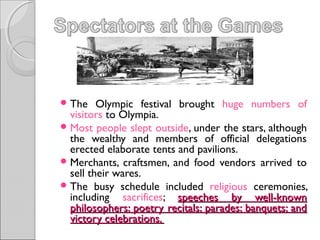
 The

Olympic festival brought huge numbers of
visitors to Olympia.
 Most people slept outside, under the stars, although
the wealthy and members of official delegations
erected elaborate tents and pavilions.
 Merchants, craftsmen, and food vendors arrived to
sell their wares.
 The busy schedule included religious ceremonies,
including sacrifices; speeches by well-known
philosophers; poetry recitals; parades; banquets; and
victory celebrations.
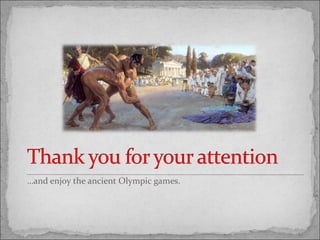
…and enjoy the ancient Olympic games.

1.ancient olympic games

  • 1.
  • 2.
     The ancientOlympics were rather different from the modern Games. There were fewer events, and only free men who spoke Greek could compete, instead of athletes from any country. Also, the games were always held at Olympia instead of moving around to different sites every time.  Like our Olympics, though, winning athletes were heroes who put their home towns on the map.  One young Athenian nobleman defended his political reputation by mentioning how he entered seven chariots in the Olympic chariotrace. This high number of entries made both race the aristocrat and Athens look very wealthy and powerful.  The ancient Olympic Games were initially a one-day event until 684 BC, when they were extended to three days. In the 5th century B.C., the Games were extended again to cover five days.
  • 3.
     One differencebetween the ancient and modern Olympic Games is that the ancient games were played within the context of a religious festival.  The Games were held in honor of Zeus, the king of the Greek gods, and a sacrifice of 100 oxen was made to the god on the middle day of the festival.  Athletes prayed to the gods for victory, and made gifts of animals, produce, or small cakes, in thanks for their successes.  According to legend, the altar of Zeus stood on a spot struck by a thunderbolt, which had been hurled by the god from his throne high a top Mount Olympus, where the gods assembled.  Some coins from Elis had a thunderbolt design on the reverse, in honor of this legend.
  • 4.
     The Greeksreferred to the Sanctuary of Zeus as the Altis. The name Altis came from a corruption of the Elean word for grove, alsos .  Sanctuaries were centers of religious worship where the Greeks built temples, treasuries, altars, statues, and other structures.  The crowns made of olive leaves came from a wild olive tree in the Altis, which was called the olive of the Beautiful Crown.  Olive trees, which supplied the Greeks with olive oil, olives, a cleaning agent for bathing, and a base for perfumes, were an important resource in the rocky and dry Greek environment.  A Greek legend credited the hero Herakles (Hercules) with introducing the olive tree to Greece.
  • 5.
    The ancient Gamesincluded running, long jump, shot put, javelin, boxing, pankration and equestrian events.  Pentathlon The Pentathlon became an Olympic sport with the addition of wrestling in 708 B.C., and included the following: Running / Long Jump / Discus Throw/Jabalin Throw/Wrestling  Running Running contests included: the stadium race, which was the pre-eminent test of speed, covering the Olympia track from one end to the other (200m foot race), the diaulos (two stadium - 400m foot race), dolichos (ranging between 7 and 24 stadiums).  Jumping Athletes used stone or lead weights called halteres to increase the distance of a jump. They held onto the weights until the end of their flight, and then jettisoned them backwards.
  • 6.
    Discus throw The discuswas originally made of stone and later of iron, lead or bronze. The technique was very similar to today's freestyle discus throw.  Wrestling This was highly valued as a form of military exercise without weapons. It ended only when one of the contestants admitted defeat.  Boxing Boxers wrapped straps around their hands to strengthen their wrists and steady their fingers. Initially, these straps were soft but, as time progressed, boxers started using hard leather straps, often causing disfigurement of their straps opponent's face.  Pankration This was a primitive form of martial art combining wrestling and boxing, and was considered to be one of the toughest sports. Greeks believed that it was founded by Theseus when he defeated the fierce Minotaur in the labyrinth.  Equestrian events These included horse races and chariot races and took place in the Hippodrome, a wide, flat, open space. 
  • 7.
    THE CONTEXT OFTHE GAMES AND THE OLYMPIC SPIRIT Today, the Olympic Games are the world's largest pageant of athletic skill and competitive spirit. They are also displays of nationalism, commerce and politics. These two opposing elements of the Olympics are not a modern invention. The conflict between the Olympic movement's high ideals and the commercialism or political acts which accompany the Games has been noted since ancient times.
  • 8.
         Olympia was oneof the oldest religious centers in the ancient Greek world. Since athletic contests were one way that the ancient Greeks honored their gods, it was logical to hold a recurring athletic competition at the site of a major temple. Also, Olympia is convenient geographically to reach by ship, which ship was a major concern for the Greeks. Athletes and spectators traveled from Greek colonies as far away as modern-day Spain, the Black Sea, or Egypt. An international truce among the Greeks was declared for the month before the Olympics to allow the athletes to reach Olympia safely. The judges had the authority to fine whole cities and ban their athletes from competition for breaking the truce.
  • 9.
    There were 3 othermajor games which were held on 2- or 4-year cycles: The Isthmean Games at Corinth, the Pythian Games at Delphi, and the Nemean Games at Nemea. Because it started 200 years before the other competitions, the Olympics remained the most famous athletic contest in the ancient Greek world.
  • 10.
    The Olympics were opento any free-born Greek in the world. There were separate mens' and boys' divisions for the events. Women were not allowed to compete in the Games themselves. However, they could enter equestrian events as the owner of a chariot team or an individual horse, and win victories that way.
  • 11.
     Not only werewomen not permitted to compete personally, married women were also barred from attending the games, under penalty of death.  Athletic competitions for women did exist in ancient Greece. The most famous was a maidens' footrace in honor of the goddess Hera, which was held at the Olympic stadium. There were 3 separate races for girls, teenagers, and young women.  The length of their racecourse was shorter than the men's track: 5/6 of a stade (about 160 m.) ,instead of a full stade (about 192 m.). The winners received olive crowns just like Olympic victors.
  • 12.
         Athletics were akey part of education in ancient Greece. Many Greeks believed that developing the body was equally important as improving the mind for overall health. Also, regular exercise was important in a society where men were always needed for military service. The palaestra (wrestling-school) was one of the most popular places for Greek men of all ages to socialize. Many accounts of Greek daily life include scenes in these wrestling-schools, such as the opening of Plato's Charmides. Young men worked with athletic trainers who used long sticks to point out incorrect body positions and other faults. Trainers paid close attention to balancing the types of physical exercise and the athlete's diet. The Greeks also thought that harmonious movement was very important, so athletes often exercised to flute music.
  • 13.
    A victor received acrown made from olive leaves, and was entitled to have a statue of himself set up at Olympia.  His success increased the fame and reputation of his community in the Greek world.  It was common for victors to receive benefits such as having all their meals at public expense or front-row seats at the theater and other public festivals.  One city even built a private gym for their Olympic wrestling champion to exercise in.
  • 14.
     Anyone who violatedthe rules was fined by the judges. The money was used to set up statues of Zeus, the patron god of the Games at Olympia. Actions:   In addition to using bribes.  Other offenses included deliberately avoiding the training period at Olympia. One athlete claimed that bad winds kept his ship from arriving in time, but was later proved to have spent the training period traveling around Greece winning prize money in other competitions.  Another athlete was so intimidated by his opponents that he left the Games the day before he was to compete, and was fined for cowardice.
  • 15.
     The marathon wasnever one of the ancient Olympic events, although its origin dates back to another episode in ancient Greek history.  In the 5th century B.C., the Persians invaded Greece, landing at Marathon, a small town about 26 miles from the city of Athens. The Athenian army was seriously outnumbered by the Persian army, so the Athenians sent messengers to cities all over Greece asking for help.  The traditional origin of the marathon comes from the story how a herald named Phidippides ran the 26 miles from Marathon to Athens to announce the Greek victory and died on the spot.
  • 16.
     The Olympic festivalbrought huge numbers of visitors to Olympia.  Most people slept outside, under the stars, although the wealthy and members of official delegations erected elaborate tents and pavilions.  Merchants, craftsmen, and food vendors arrived to sell their wares.  The busy schedule included religious ceremonies, including sacrifices; speeches by well-known philosophers; poetry recitals; parades; banquets; and victory celebrations.
  • 17.
    …and enjoy theancient Olympic games.