Introduction Conjecture Contribution Bound Characterization


     Geometric Routing: Theoretical Foundations, an
       Important Conjecture and Some Progress


                                                    Subhas K. Ghosh


                                                  March 2, 2010


                                           Subhas K. Ghosh    Greedy Embedding
Introduction Conjecture Contribution Bound Characterization   Geometric routing Greedy routing Greedy routing fails! Rubber band


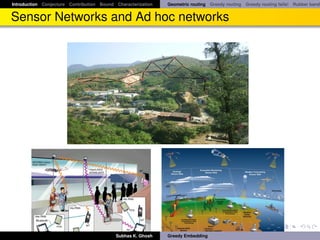
Sensor Networks and Ad hoc networks


                                           Subhas K. Ghosh    Greedy Embedding
Introduction Conjecture Contribution Bound Characterization   Geometric routing Greedy routing Greedy routing fails! Rubber band


Geometric routing


      Ad hoc networks and Distributed Wireless Sensor Networks: no
      universally known system of addresses.
      Resource limitations: prohibitive to store and maintain large forwarding
      tables.
      Geometric routing: use geographic coordinates of the nodes as
      addresses.
      Simplest of routing strategy: recursively select a vertex that is closer to
      destination than current vertex.
      Point-to-point routing service: enable data centric storage, a Distributed
      Hash Table (DHT) is implemented in the sensor network, and data is
      stored at the nodes of the network using the DHT.


                                           Subhas K. Ghosh    Greedy Embedding
Introduction Conjecture Contribution Bound Characterization   Geometric routing Greedy routing Greedy routing fails! Rubber band


Geometric routing


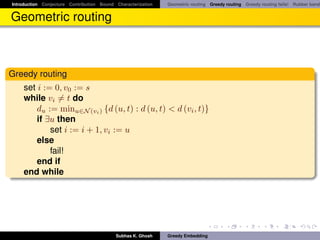
Greedy routing
    set i := 0, v0 := s
    while vi = t do
        du := minu∈N (vi ) {d (u, t) : d (u, t) < d (vi , t)}
        if ∃u then
            set i := i + 1, vi := u
        else
            fail!
        end if
    end while


                                           Subhas K. Ghosh    Greedy Embedding
Introduction Conjecture Contribution Bound Characterization                               Geometric routing Greedy routing Greedy routing fails! Rubber band


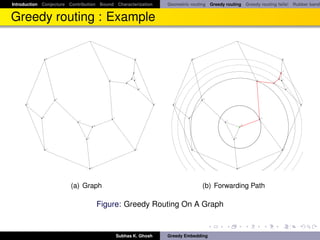
Greedy routing : Example
                                       7                                                                                      7


                 15                                                          6                          15                                                   6


                                                                                                                                                             s
                                                                         1                                                                               1


                                                                     2                                                                               2
                                                    8                    3                                                              8                3
                                                                 9                                                                               9


                                                                                  4                                                                               4


                      16                                                                                     16

      14                                                                              5     14                                                                        5


            20                                                                                     20
                                                        10                                                                                  10
                             17                                                                                     17
                                                                                                                                    t
                                            18                                                                                     18


                                  19                                                                                     19


                 13                                                          11                         13                                                   11


                                       12                                                                                     12


                           (a) Graph                                                                         (b) Forwarding Path

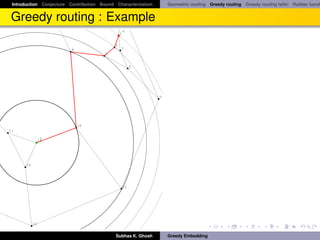
                                                 Figure: Greedy Routing On A Graph


                                                             Subhas K. Ghosh              Greedy Embedding
Introduction Conjecture Contribution Bound Characterization       Geometric routing Greedy routing Greedy routing fails! Rubber band
                                                    6


Greedy routing : Example
                                                    s
                                                1


                                            2
                          8                     3
                                        9


                                                         4


                                                               5


                              10
17
                  t
                 18


       19


                                                    11


            12


                                            Subhas K. Ghosh        Greedy Embedding
Introduction Conjecture Contribution Bound Characterization                            Geometric routing Greedy routing Greedy routing fails! Rubber band


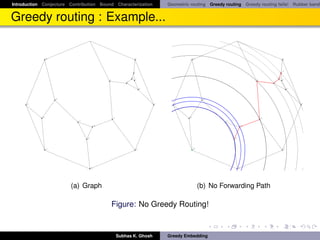
Greedy routing : Example...
                                       7                                                                                    7


                 15                                                       6                          15                                                    6


                                                                                                                                                           s
                                                                      1                                                                                1


                                                                  2                                                                                2
                                                 8                    3                                                               8                3
                                                              9                                                                                9


                                                                               4                                                                                4


                      16                                                                                   16

      14                                                                           5     14                                                                         5


            20                                                                                  20
                                                     10                                                                                   10
                             17                                                                                   17

                                            18                                                                                   18


                                  19                                                                                   19


                                                                                                      t
                 13                                                       11                         13                                                    11


                                       12                                                                                   12


                           (a) Graph                                                                      (b) No Forwarding Path

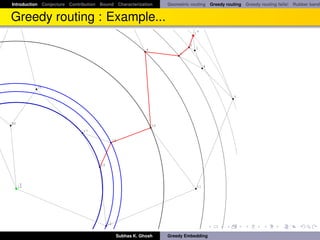
                                                     Figure: No Greedy Routing!


                                                          Subhas K. Ghosh              Greedy Embedding
Introduction Conjecture Contribution Bound Characterization          Geometric routing Greedy routing Greedy routing fails! Rubber band
     15                                                                               6


Greedy routing : Example...
                                                                                      s
                                                                                  1


                                                                              2
                                                            8                     3
                                                                          9


                                                                                           4


          16

                                                                                                 5


20
                                                                10
                              17

                                               18


                                     19


      t
     13                                                                               11


                                          12


                                                Subhas K. Ghosh      Greedy Embedding
Introduction Conjecture Contribution Bound Characterization   Geometric routing Greedy routing Greedy routing fails! Rubber band


Greedy routing sometimes fails!


      Greedy routing sometimes fails to deliver a packet because of the
      phenomenon of “voids” (nodes with no neighbor closer to the destination).
      This is essentially reaching a local minimum with respect to the distance
      functional defined by s, t -pair.
      Alternative: face routing [KK00].


                                           Subhas K. Ghosh    Greedy Embedding
Introduction Conjecture Contribution Bound Characterization   Geometric routing Greedy routing Greedy routing fails! Rubber band


Geometric routing is complicated


      It is unlikely that future ad hoc networks can rely on the availability of
      precise geographic coordinates (GPS is costly and does not work in all
      situation).
      Importantly, the precise coordinates may be disadvantageous as they do
      not account for obstructions or other topological properties of the
      network.
How to retain the benefits of geographic routing in the absence of location
information?

Rao, Papadimitriou, Shenker and Stoica (in [RPSS03]) defined a scalable
coordinate-based routing algorithm that does not rely on location information,
and thus can be used in a wide variety of ad hoc and sensor-nets
environments.


                                           Subhas K. Ghosh    Greedy Embedding
Introduction Conjecture Contribution Bound Characterization   Geometric routing Greedy routing Greedy routing fails! Rubber band


Virtual Coordinates


In [RPSS03] the nodes first decide on fictitious virtual coordinates in R2 , and
then apply greedy routing based on those. The coordinates are found by a
distributed version of the rubber band algorithm originally due to Tutte [Tut60].

      Note that embedding in higher dimension requires storing more
      information per node.
      On the basis of extensive experimentation in [RPSS03] authors showed
      that this approach makes greedy routing much more reliable (works
      97.5% cases).
      Kleinberg proved 100% success rate by assigning virtual coordinates in
      the hyperbolic plane rather than the Euclidean plane.


                                           Subhas K. Ghosh    Greedy Embedding
Introduction Conjecture Contribution Bound Characterization   Geometric routing Greedy routing Greedy routing fails! Rubber band


Graph Embedding


An embedding of an undirected graph G in a metric space (X, d) is a mapping
e : V (G) → X.

 1    In this work we will be concerned with a special case when X is the plane
      R2 with the Euclidean (i.e. 2 ) metric.
 2    The function e then maps each edge of the graph G to the line-segments
      joining the images of its end points.


                                           Subhas K. Ghosh    Greedy Embedding
Introduction Conjecture Contribution Bound Characterization   Geometric routing Greedy routing Greedy routing fails! Rubber band


Planar Embedding


An undirected graph G is a planar graph if it can be drawn on a plane so that
no edges intersect.

 1    Since we are concerned with R2 we can say that embedding e is planar
      when no two line-segments on the embedded graph intersect at any point
      other than their end points.


                                           Subhas K. Ghosh    Greedy Embedding
Introduction Conjecture Contribution Bound Characterization   Geometric routing Greedy routing Greedy routing fails! Rubber band


Required Defn.


Let G = (V, E) be a finite undirected graph with vertex set V (G) and edge set
E(G).
  1 A connected acyclic subgraph T of G is a tree. If V (T ) = V (G), then T is
    a spanning tree.
  2 For x, y ∈ V (G), xy-paths P and Q in G are internally (vertex) disjoint or
    openly disjoint if V (P ) ∩ V (Q) = {x, y}.
  3 Let p(x, y) denote the maximum number of pair-wise internally disjoint
    paths between x, y ∈ V (G).
  4 A nontrivial graph G is k-connected if p(u, v) ≥ k for any two distinct
    vertices u, v ∈ V (G).
  5 The connectivity κ(G) of G is the maximum value of k for which G is
    k-connected.


                                           Subhas K. Ghosh    Greedy Embedding
Introduction Conjecture Contribution Bound Characterization   Geometric routing Greedy routing Greedy routing fails! Rubber band


Tutte Embedding: Rubber band representation


Let G = (V, E) be a connected graph and ∅ = S ⊆ V . Fix a map x0 : S → R2 .
We extend this to a map x : V → R2 (a geometric representation of G, or a
drawing on paper) as follows:
  1 Replace the edges by ideal rubber bands (satisfying Hooke’s Law). Think
    of the nodes in S as nailed to their given position (node u ∈ S to
    x0 (u) ∈ R2 ), but let the other nodes settle in equilibrium.
  2 We’ll see that this equilibrium position is uniquely determined.
  3 We call it the rubber band representation of G in R2 extending x0 .


                                           Subhas K. Ghosh    Greedy Embedding
Introduction Conjecture Contribution Bound Characterization     Geometric routing Greedy routing Greedy routing fails! Rubber band


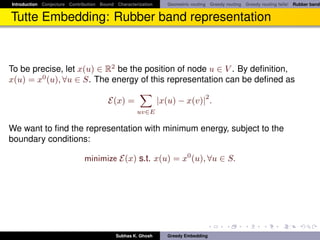
Tutte Embedding: Rubber band representation


To be precise, let x(u) ∈ R2 be the position of node u ∈ V . By definition,
x(u) = x0 (u), ∀u ∈ S. The energy of this representation can be defined as
                                                                                2
                                        E(x) =                |x(u) − x(v)| .
                                                    uv∈E

We want to find the representation with minimum energy, subject to the
boundary conditions:

                              minimize E(x) s.t. x(u) = x0 (u), ∀u ∈ S.


                                           Subhas K. Ghosh      Greedy Embedding
Introduction Conjecture Contribution Bound Characterization   Geometric routing Greedy routing Greedy routing fails! Rubber band


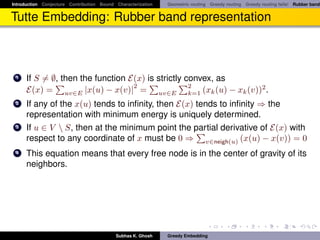
Tutte Embedding: Rubber band representation


 1    If S = ∅, then the function E(x) is strictly convex, as
                                   2                2
      E(x) = uv∈E |x(u) − x(v)| = uv∈E k=1 (xk (u) − xk (v))2 .
 2    If any of the x(u) tends to infinity, then E(x) tends to infinity ⇒ the
      representation with minimum energy is uniquely determined.
 3    If u ∈ V  S, then at the minimum point the partial derivative of E(x) with
      respect to any coordinate of x must be 0 ⇒ v∈neigh(u) (x(u) − x(v)) = 0
 4    This equation means that every free node is in the center of gravity of its
      neighbors.


                                           Subhas K. Ghosh    Greedy Embedding
Introduction Conjecture Contribution Bound Characterization   Geometric routing Greedy routing Greedy routing fails! Rubber band


Tutte Embedding


Every 3-connected planar graph has a convex embedding in the the Euclidean
plane (using Tutte’s rubber band algorithm [Tut60]).

Theorem
Let G = ({1, ·, n} , E) be a 3-connected, planar graph that has a face
(k + 1, . . . , n) for some k < n. Let pk+1 , . . . , pn be the vertices (in this order) of
a convex (n − k)-gon. Let w : E → R+ be an assignment of positive weights
to the internal edges. Then:
     There are unique positions p1 , . . . , pk ∈ R2 for the interior vertices such
     that all interior vertices are in equilibrium.
     All internal faces of G are then realized as non-overlapping convex
     polygons.


                                           Subhas K. Ghosh    Greedy Embedding
Introduction Conjecture Contribution Bound Characterization   Geometric routing Greedy routing Greedy routing fails! Rubber band


Tutte Embedding: example


                                           Subhas K. Ghosh    Greedy Embedding
Introduction Conjecture Contribution Bound Characterization   Geometric routing Greedy routing Greedy routing fails! Rubber band


Virtual coordinate: Foundation?


Despite the solid grounding of the ideas in geometric graph theory, no
theoretical results and guarantees were known for such schemes.


                                           Subhas K. Ghosh    Greedy Embedding
Introduction Conjecture Contribution Bound Characterization   Greedy Embedding Conjecture Conjecture - Details Known results


Greedy Embedding


Let d (pu , pv ) denote the Euclidean distance between two points pu and pv .

Definition
Greedy embedding ([PR05]): A greedy embedding x of a graph G = (V, E)
into a metric space (X, d) is a function x : V (G) → X with the following
property: for every pair of non-adjacent vertices s, t ∈ V (G) there exists a
vertex u ∈ V (G) adjacent to s such that d (x (u) , x (t)) < d (x (s) , x (t)).


                                           Subhas K. Ghosh    Greedy Embedding
Introduction Conjecture Contribution Bound Characterization   Greedy Embedding Conjecture Conjecture - Details Known results


Greedy Embedding : Conjecture(Weak)


This notion of greedy embedding was defined by Papadimitriou and Ratajczak
in [PR05]. They have presented graphs which does not admit a greedy
embedding in the Euclidean plane, and conjectured following:

Conjecture
(Weak). Every 3-connected planar graph has a greedy embedding in the
Euclidean plane.


                                           Subhas K. Ghosh    Greedy Embedding
Introduction Conjecture Contribution Bound Characterization   Greedy Embedding Conjecture Conjecture - Details Known results


Greedy Embedding : Conjecture (Strong)


A convex embedding of a planar graph is a planar embedding with a property
that all faces, including the external faces are convex. Additionally,
Papadimitriou and Ratajczak stated the following stronger form of the
conjecture:

Conjecture
(Strong). Every 3-connected planar graph has a greedy convex embedding in
the Euclidean plane.

Note that every 3-connected planar graph has a convex embedding in the the
Euclidean plane (using Tutte’s rubber band algorithm [Tut60]).


                                           Subhas K. Ghosh    Greedy Embedding
Introduction Conjecture Contribution Bound Characterization       Greedy Embedding Conjecture Conjecture - Details Known results


Both hypothesis are necessary

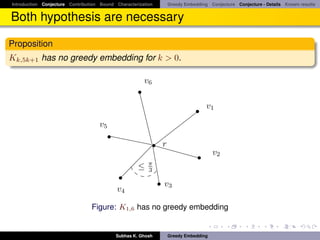
Proposition
Kk,5k+1 has no greedy embedding for k > 0.

                                                       v6

                                                                                  v1

                                    v5

                                                              r
                                                                                     v2
                                                         π
                                                    ≤    3

                                                              v3
                                            v4

                                 Figure: K1,6 has no greedy embedding


                                           Subhas K. Ghosh        Greedy Embedding
Introduction Conjecture Contribution Bound Characterization   Greedy Embedding Conjecture Conjecture - Details Known results


Both hypothesis are necessary


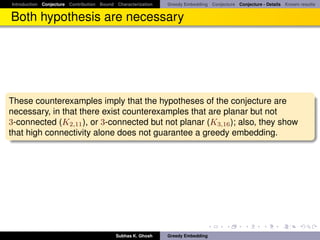
These counterexamples imply that the hypotheses of the conjecture are
necessary, in that there exist counterexamples that are planar but not
3-connected (K2,11 ), or 3-connected but not planar (K3,16 ); also, they show
that high connectivity alone does not guarantee a greedy embedding.


                                           Subhas K. Ghosh    Greedy Embedding
Introduction Conjecture Contribution Bound Characterization   Greedy Embedding Conjecture Conjecture - Details Known results


Implications of the conjecture being true


      There exists a way to assign virtual coordinates to a large class of graphs
      where greedy routing is guaranteed.
      Since adding edges only improves the embeddability of a graph, the
      conjecture extends immediately to any graph with a 3-connected planar
      subgraph. Hence to a even larger class.


                                           Subhas K. Ghosh    Greedy Embedding
Introduction Conjecture Contribution Bound Characterization   Greedy Embedding Conjecture Conjecture - Details Known results


Known results


Recently, greedy embedding conjecture has been proved in [LM08]. In [LM08]
authors construct a greedy embedding into the Euclidean plane for all circuit
graphs – which is a generalization of 3-connected planar graphs. Similar
result was independently discovered by Angelini, Frati and Grilli [AFG08].

Theorem
([LM08]) Any 3-connected graph G without having a K3,3 minor admits a
greedy embedding into the Euclidean plane.


                                           Subhas K. Ghosh    Greedy Embedding
Introduction Conjecture Contribution Bound Characterization   Open Problem Weak greedy


Open Problem


The greedy embedding algorithm presented in [LM08, AFG08] not necessarily
produce a convex greedy embedding, and in fact the embedding may not
even be a planar one. In this work we consider the convex greedy embedding
conjecture. Other questions that we can ask:
  1 What is the least dimension of a normed vector space V where every
    graph with n nodes has a greedy embedding?
  2 Why Tutte embedding improves delivery success?


                                           Subhas K. Ghosh    Greedy Embedding
Introduction Conjecture Contribution Bound Characterization   Open Problem Weak greedy


Contribution


Given a 3-connected planar graph G = (V, E),
 1    An embedding x : V → R2 of G is a planar convex greedy embedding if
      and only if, in the embedding x, weight of the maximum weight spanning
      tree (wt(T )) and weight of the minimum weight spanning tree (wt(MST))
                                           1−δ
      satisfies wt(T )/wt(MST) ≤ (|V | − 1) , for some 0 < δ ≤ 1.
                                                                    √
 2    G has a β-weak greedy convex embedding in R2 with β ∈ [1, 2 2 · d(G)].
      Also, this bound is achieved by Tutte embedding.
 3    We show a possibility that Tutte embedding with correct choice of edge
      weights may produce greedy embedding of G.


                                           Subhas K. Ghosh    Greedy Embedding
Introduction Conjecture Contribution Bound Characterization   Open Problem Weak greedy


Weak greedy embedding


In order to obtain this result we consider a weaker notion of greedy
embedding. Weak greedy embedding allows path finding algorithm to
proceed as long as local optima is bounded by a factor. Formally,

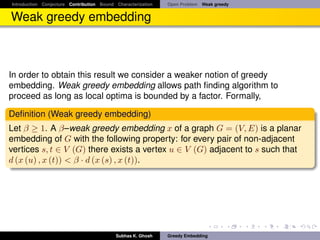
Definition (Weak greedy embedding)
Let β ≥ 1. A β–weak greedy embedding x of a graph G = (V, E) is a planar
embedding of G with the following property: for every pair of non-adjacent
vertices s, t ∈ V (G) there exists a vertex u ∈ V (G) adjacent to s such that
d (x (u) , x (t)) < β · d (x (s) , x (t)).


                                           Subhas K. Ghosh    Greedy Embedding
Introduction Conjecture Contribution Bound Characterization   Open Problem Weak greedy


Weak greedy routing


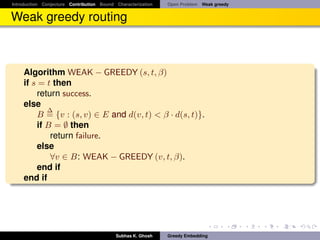
    Algorithm WEAK − GREEDY (s, t, β)
    if s = t then
         return success.
    else
            ∆
         B = {v : (s, v) ∈ E and d(v, t) < β · d(s, t)}.
         if B = ∅ then
             return failure.
         else
             ∀v ∈ B: WEAK − GREEDY (v, t, β).
         end if
    end if


                                           Subhas K. Ghosh    Greedy Embedding
Introduction Conjecture Contribution Bound Characterization   Trees of all kind ... and a Theorem


Outline


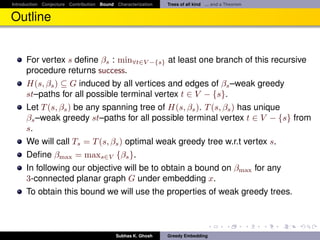
      For vertex s define βs : min∀t∈V −{s} at least one branch of this recursive
      procedure returns success.
      H(s, βs ) ⊆ G induced by all vertices and edges of βs –weak greedy
      st–paths for all possible terminal vertex t ∈ V − {s}.
      Let T (s, βs ) be any spanning tree of H(s, βs ). T (s, βs ) has unique
      βs –weak greedy st–paths for all possible terminal vertex t ∈ V − {s} from
      s.
      We will call Ts = T (s, βs ) optimal weak greedy tree w.r.t vertex s.
      Define βmax = maxs∈V {βs }.
      In following our objective will be to obtain a bound on βmax for any
      3-connected planar graph G under embedding x.
      To obtain this bound we will use the properties of weak greedy trees.


                                           Subhas K. Ghosh    Greedy Embedding
Introduction Conjecture Contribution Bound Characterization   Trees of all kind ... and a Theorem


Bounding the weight of trees: Outline


      In the planar convex embedding of G, let weight of an edge e = uv be its
      length i.e. wt(e) = d(u, v).
      Define wt(T (s, βs )) = e∈E(T (s,βs )) wt(e).
      We obtain a lower and upper bound on the weight of T (s, βs ).
      On the other hand we also obtain a upper bound on the weight of any
      spanning tree T of G in its embedding wt(T ), and
      a lower bound on the weight of any minimum spanning tree MST of G,
      wt(MST).


                                           Subhas K. Ghosh    Greedy Embedding
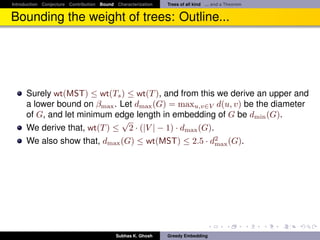
Introduction Conjecture Contribution Bound Characterization   Trees of all kind ... and a Theorem


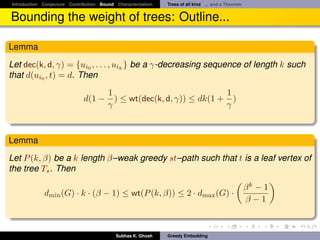
Bounding the weight of trees: Outline...


      Surely wt(MST) ≤ wt(Ts ) ≤ wt(T ), and from this we derive an upper and
      a lower bound on βmax . Let dmax (G) = maxu,v∈V d(u, v) be the diameter
      of G, and let minimum edge length in embedding of G be dmin (G).
                              √
      We derive that, wt(T ) ≤ 2 · (|V | − 1) · dmax (G).
      We also show that, dmax (G) ≤ wt(MST) ≤ 2.5 · d2 (G).
                                                          max


                                           Subhas K. Ghosh    Greedy Embedding
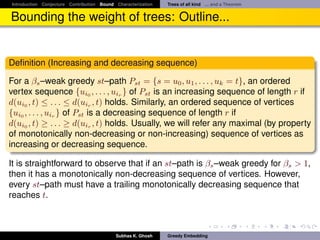
Introduction Conjecture Contribution Bound Characterization   Trees of all kind ... and a Theorem


Bounding the weight of trees: Outline...


Definition (Increasing and decreasing sequence)

For a βs –weak greedy st–path Pst = {s = u0 , u1 , . . . , uk = t}, an ordered
vertex sequence {ui0 , . . . , uir } of Pst is an increasing sequence of length r if
d(ui0 , t) ≤ . . . ≤ d(uir , t) holds. Similarly, an ordered sequence of vertices
{ui0 , . . . , uir } of Pst is a decreasing sequence of length r if
d(ui0 , t) ≥ . . . ≥ d(uir , t) holds. Usually, we will refer any maximal (by property
of monotonically non-decreasing or non-increasing) sequence of vertices as
increasing or decreasing sequence.

It is straightforward to observe that if an st–path is βs –weak greedy for βs > 1,
then it has a monotonically non-decreasing sequence of vertices. However,
every st–path must have a trailing monotonically decreasing sequence that
reaches t.


                                           Subhas K. Ghosh    Greedy Embedding
Introduction Conjecture Contribution Bound Characterization   Trees of all kind ... and a Theorem


Bounding the weight of trees: Outline...


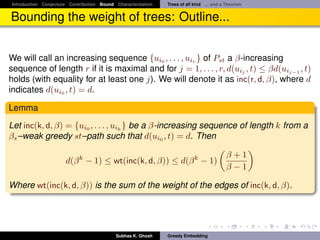
We will call an increasing sequence {ui0 , . . . , uir } of Pst a β-increasing
sequence of length r if it is maximal and for j = 1, . . . , r, d(uij , t) ≤ βd(uij−1 , t)
holds (with equality for at least one j). We will denote it as inc(r, d, β), where d
indicates d(ui0 , t) = d.

Lemma
Let inc(k, d, β) = {ui0 , . . . , uik } be a β-increasing sequence of length k from a
βs –weak greedy st–path such that d(ui0 , t) = d. Then

                                                                                         β+1
                      d(β k − 1) ≤ wt(inc(k, d, β)) ≤ d(β k − 1)
                                                                                         β−1

Where wt(inc(k, d, β)) is the sum of the weight of the edges of inc(k, d, β).


                                           Subhas K. Ghosh    Greedy Embedding
Introduction Conjecture Contribution Bound Characterization   Trees of all kind ... and a Theorem


Bounding the weight of trees: Outline...

Lemma
Let dec(k, d, γ) = {ui0 , . . . , uik } be a γ-decreasing sequence of length k such
that d(ui0 , t) = d. Then
                                        1                              1
                              d(1 −       ) ≤ wt(dec(k, d, γ)) ≤ dk(1 + )
                                        γ                              γ


Lemma
Let P (k, β) be a k length β–weak greedy st–path such that t is a leaf vertex of
the tree Ts . Then

                                                                                                    βk − 1
             dmin (G) · k · (β − 1) ≤ wt(P (k, β)) ≤ 2 · dmax (G) ·
                                                                                                    β−1


                                           Subhas K. Ghosh    Greedy Embedding
Introduction Conjecture Contribution Bound Characterization   Trees of all kind ... and a Theorem


Bounding the weight of trees: Outline...

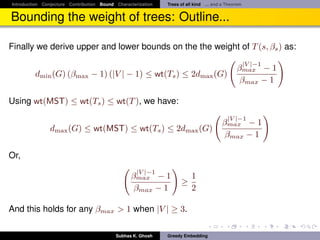
Finally we derive upper and lower bounds on the the weight of T (s, βs ) as:
                                                                                                    |V |−1
                                                                                              βmax − 1
         dmin (G) (βmax − 1) (|V | − 1) ≤ wt(Ts ) ≤ 2dmax (G)
                                                                                               βmax − 1

Using wt(MST) ≤ wt(Ts ) ≤ wt(T ), we have:
                                                                                          |V |−1
                                                                                       βmax − 1
                dmax (G) ≤ wt(MST) ≤ wt(Ts ) ≤ 2dmax (G)
                                                                                        βmax − 1

Or,
                                                    |V |−1
                                                 βmax − 1                1
                                                                    ≥
                                                  βmax − 1               2

And this holds for any βmax > 1 when |V | ≥ 3.

                                           Subhas K. Ghosh    Greedy Embedding
Introduction Conjecture Contribution Bound Characterization   Trees of all kind ... and a Theorem


Bounding the weight of trees: Outline...


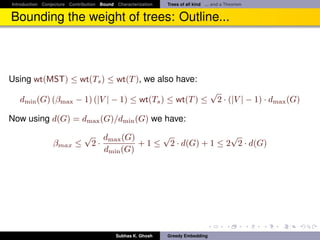
Using wt(MST) ≤ wt(Ts ) ≤ wt(T ), we also have:
                                                                                  √
   dmin (G) (βmax − 1) (|V | − 1) ≤ wt(Ts ) ≤ wt(T ) ≤                                2 · (|V | − 1) · dmax (G)

Now using d(G) = dmax (G)/dmin (G) we have:
                              √        dmax (G)      √                √
                 βmax ≤           2·            + 1 ≤ 2 · d(G) + 1 ≤ 2 2 · d(G)
                                       dmin (G)


                                           Subhas K. Ghosh    Greedy Embedding
Introduction Conjecture Contribution Bound Characterization   Trees of all kind ... and a Theorem


Bounding the weight of trees: Outline...


It follows
Theorem

Let G = (V, E) be any three connected planar√graph. Then G has a β-weak
greedy convex embedding in R2 with β ∈ [1, 2 2 · d(G)]. Also, this bound is
achieved by Tutte embedding.


                                           Subhas K. Ghosh    Greedy Embedding
Introduction Conjecture Contribution Bound Characterization       Trees of all kind ... and a Theorem


However, this is not very good


                                     F                  G     F                        G

                                                                                   C
                                          B         C
                                                                         B   D
                                          A         D
                                                                    A

                                     E                  H     E                        H


                                              (a)                            (b)

Figure: Illustration of Tutte embedding of a cube: (a)Equal edge weights, (b)Unequal
edge weights


         √
β ∈ [1, 2 2 · d(G)]
In Tutte embedding of a 3–connected planar graph G with arbitrary weights on
the edges, bound on β depends entirely on the choice of the edge weights in
the Tutte embedding.

                                           Subhas K. Ghosh        Greedy Embedding
Introduction Conjecture Contribution Bound Characterization   When weights are close When weights must be close


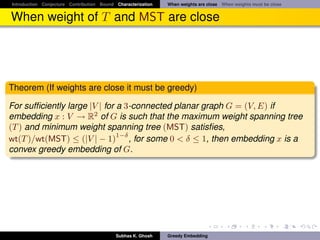
When weight of T and MST are close


Theorem (If weights are close it must be greedy)

For sufficiently large |V | for a 3-connected planar graph G = (V, E) if
embedding x : V → R2 of G is such that the maximum weight spanning tree
(T ) and minimum weight spanning tree (MST) satisfies,
                               1−δ
wt(T )/wt(MST) ≤ (|V | − 1) , for some 0 < δ ≤ 1, then embedding x is a
convex greedy embedding of G.


                                           Subhas K. Ghosh    Greedy Embedding
Introduction Conjecture Contribution Bound Characterization   When weights are close When weights must be close


When weight of T and MST are close


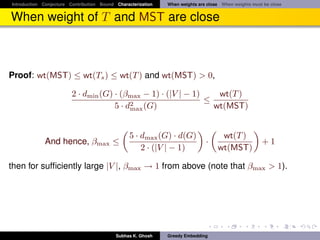
Proof: wt(MST) ≤ wt(Ts ) ≤ wt(T ) and wt(MST) > 0,

                         2 · dmin (G) · (βmax − 1) · (|V | − 1)    wt(T )
                                                                ≤
                                      5 · d2 (G)
                                           max                    wt(MST)


                                                 5 · dmax (G) · d(G)                wt(T )
             And hence, βmax ≤                                                ·                       +1
                                                     2 · (|V | − 1)                wt(MST)

then for sufficiently large |V |, βmax → 1 from above (note that βmax > 1).


                                           Subhas K. Ghosh    Greedy Embedding
Introduction Conjecture Contribution Bound Characterization   When weights are close When weights must be close


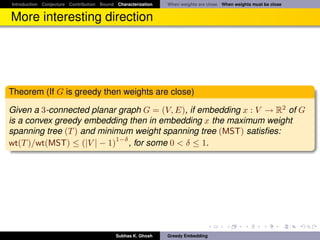
More interesting direction


Theorem (If G is greedy then weights are close)

Given a 3-connected planar graph G = (V, E), if embedding x : V → R2 of G
is a convex greedy embedding then in embedding x the maximum weight
spanning tree (T ) and minimum weight spanning tree (MST) satisfies:
                           1−δ
wt(T )/wt(MST) ≤ (|V | − 1) , for some 0 < δ ≤ 1.


                                           Subhas K. Ghosh    Greedy Embedding
Introduction Conjecture Contribution Bound Characterization   When weights are close When weights must be close


Proof outline


Fact
A graph is 3-connected and planar if and only if each edge is in exactly two
non-separating induced cycles [Kel78]

 1     Consider two cases: (Case - 1) e is on two internal faces F and F , and
       (Case - 2) e is on the boundary face (infinite face is the other one).
 2     Let us also assume that wt(T )/wt(MST) ≥ (|V | − 1). W.l.o.g. let
       wt(MST) = 1. Since T is a spanning tree it has (|V | − 1) edges, and
       hence has at least one edge e ∈ T of weight wt(e) ≥ 1.


                                           Subhas K. Ghosh    Greedy Embedding
Introduction Conjecture Contribution Bound Characterization   When weights are close When weights must be close


Proof outline...


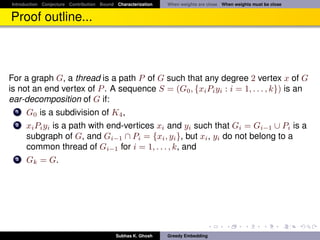
For a graph G, a thread is a path P of G such that any degree 2 vertex x of G
is not an end vertex of P . A sequence S = (G0 , {xi Pi yi : i = 1, . . . , k}) is an
ear-decomposition of G if:
  1  G0 is a subdivision of K4 ,
  2  xi Pi yi is a path with end-vertices xi and yi such that Gi = Gi−1 ∪ Pi is a
     subgraph of G, and Gi−1 ∩ Pi = {xi , yi }, but xi , yi do not belong to a
     common thread of Gi−1 for i = 1, . . . , k, and
  3  Gk = G.


                                           Subhas K. Ghosh    Greedy Embedding
Introduction Conjecture Contribution Bound Characterization   When weights are close When weights must be close


Proof outline...


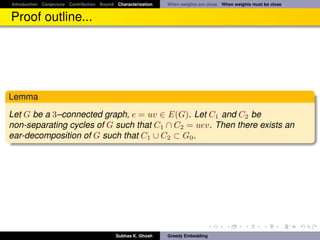
Lemma
Let G be a 3–connected graph, e = uv ∈ E(G). Let C1 and C2 be
non-separating cycles of G such that C1 ∩ C2 = uev. Then there exists an
ear-decomposition of G such that C1 ∪ C2 ⊂ G0 .


                                           Subhas K. Ghosh    Greedy Embedding
Introduction Conjecture Contribution Bound Characterization   When weights are close When weights must be close


Proof outline...

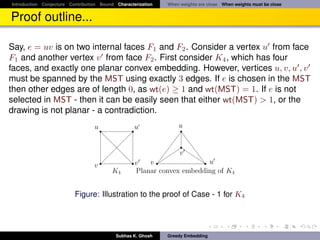
Say, e = uv is on two internal faces F1 and F2 . Consider a vertex u from face
F1 and another vertex v from face F2 . First consider K4 , which has four
faces, and exactly one planar convex embedding. However, vertices u, v, u , v
must be spanned by the MST using exactly 3 edges. If e is chosen in the MST
then other edges are of length 0, as wt(e) ≥ 1 and wt(MST) = 1. If e is not
selected in MST - then it can be easily seen that either wt(MST) > 1, or the
drawing is not planar - a contradiction.
                                  u                u              u


                                                                v
                                  v                v   v                u
                                          K4       Planar convex embedding of K4


                          Figure: Illustration to the proof of Case - 1 for K4


                                           Subhas K. Ghosh    Greedy Embedding
Introduction Conjecture Contribution Bound Characterization   When weights are close When weights must be close


Concluding remarks


With our result, and the example presented above we can ask following
question:

For every 3–connected planar graph G, is it possible to choose edge weights
in the Tutte embedding such that we obtain a greedy convex embedding?

We believe that answer to this question will help in resolving convex greedy
embedding conjecture of Papadimitriou and Ratajczak.


                                           Subhas K. Ghosh    Greedy Embedding
Introduction Conjecture Contribution Bound Characterization   When weights are close When weights must be close


                                           Subhas K. Ghosh    Greedy Embedding
Appendix     Reference


Reference: I
  Patrizio Angelini, Fabrizio Frati, and Luca Grilli.
  An algorithm to construct greedy drawings of triangulations.
  In 16th International Symposium on Graph Drawing (GD ’08), 2008.
  To appear.

  Alexander Kelmans.
  The concept of a vertex in a matroid, the non-separating cycles, and a new criterion for graph planarity.
  In Algebraic Methods in Graph Theory, Colloq. Math. Soc. Janos Bolyai, (Szeged, Hungary, 1978)NorthHolland, 1:345–388, 1978.

  Brad Karp and H. T. Kung.
  GPSR: greedy perimeter stateless routing for wireless networks.
  In MobiCom ’00: Proceedings of the 6th annual international conference on Mobile computing and networking, pages 243–254, New York, NY,
  USA, 2000. ACM Press.

  Tom Leighton and Ankur Moitra.
  Some results on greedy embeddings in metric spaces.
  In FOCS ’08: Proceedings of the 49th Annual IEEE Symposium on Foundations of Computer Science (FOCS’08), Washington, DC, USA, 2008.
  IEEE Computer Society.

  Christos H. Papadimitriou and David Ratajczak.
  On a conjecture related to geometric routing.
  Theor. Comput. Sci., 344(1):3–14, 2005.

  Ananth Rao, Christos Papadimitriou, Scott Shenker, and Ion Stoica.
  Geographic routing without location information.
  In MobiCom ’03: Proceedings of the 9th annual international conference on Mobile computing and networking, pages 96–108, New York, NY, USA,
  2003. ACM Press.

  W. T. Tutte.
  Convex Representations of Graphs.
  Proc. London Math. Soc., s3-10(1):304–320, 1960.


                                                    Subhas K. Ghosh    Greedy Embedding

Greedy embedding problem

  • 1.
    Introduction Conjecture ContributionBound Characterization Geometric Routing: Theoretical Foundations, an Important Conjecture and Some Progress Subhas K. Ghosh March 2, 2010 Subhas K. Ghosh Greedy Embedding
  • 2.
    Introduction Conjecture ContributionBound Characterization Geometric routing Greedy routing Greedy routing fails! Rubber band Sensor Networks and Ad hoc networks Subhas K. Ghosh Greedy Embedding
  • 3.
    Introduction Conjecture ContributionBound Characterization Geometric routing Greedy routing Greedy routing fails! Rubber band Geometric routing Ad hoc networks and Distributed Wireless Sensor Networks: no universally known system of addresses. Resource limitations: prohibitive to store and maintain large forwarding tables. Geometric routing: use geographic coordinates of the nodes as addresses. Simplest of routing strategy: recursively select a vertex that is closer to destination than current vertex. Point-to-point routing service: enable data centric storage, a Distributed Hash Table (DHT) is implemented in the sensor network, and data is stored at the nodes of the network using the DHT. Subhas K. Ghosh Greedy Embedding
  • 4.
    Introduction Conjecture ContributionBound Characterization Geometric routing Greedy routing Greedy routing fails! Rubber band Geometric routing Greedy routing set i := 0, v0 := s while vi = t do du := minu∈N (vi ) {d (u, t) : d (u, t) < d (vi , t)} if ∃u then set i := i + 1, vi := u else fail! end if end while Subhas K. Ghosh Greedy Embedding
  • 5.
    Introduction Conjecture ContributionBound Characterization Geometric routing Greedy routing Greedy routing fails! Rubber band Greedy routing : Example 7 7 15 6 15 6 s 1 1 2 2 8 3 8 3 9 9 4 4 16 16 14 5 14 5 20 20 10 10 17 17 t 18 18 19 19 13 11 13 11 12 12 (a) Graph (b) Forwarding Path Figure: Greedy Routing On A Graph Subhas K. Ghosh Greedy Embedding
  • 6.
    Introduction Conjecture ContributionBound Characterization Geometric routing Greedy routing Greedy routing fails! Rubber band 6 Greedy routing : Example s 1 2 8 3 9 4 5 10 17 t 18 19 11 12 Subhas K. Ghosh Greedy Embedding
  • 7.
    Introduction Conjecture ContributionBound Characterization Geometric routing Greedy routing Greedy routing fails! Rubber band Greedy routing : Example... 7 7 15 6 15 6 s 1 1 2 2 8 3 8 3 9 9 4 4 16 16 14 5 14 5 20 20 10 10 17 17 18 18 19 19 t 13 11 13 11 12 12 (a) Graph (b) No Forwarding Path Figure: No Greedy Routing! Subhas K. Ghosh Greedy Embedding
  • 8.
    Introduction Conjecture ContributionBound Characterization Geometric routing Greedy routing Greedy routing fails! Rubber band 15 6 Greedy routing : Example... s 1 2 8 3 9 4 16 5 20 10 17 18 19 t 13 11 12 Subhas K. Ghosh Greedy Embedding
  • 9.
    Introduction Conjecture ContributionBound Characterization Geometric routing Greedy routing Greedy routing fails! Rubber band Greedy routing sometimes fails! Greedy routing sometimes fails to deliver a packet because of the phenomenon of “voids” (nodes with no neighbor closer to the destination). This is essentially reaching a local minimum with respect to the distance functional defined by s, t -pair. Alternative: face routing [KK00]. Subhas K. Ghosh Greedy Embedding
  • 10.
    Introduction Conjecture ContributionBound Characterization Geometric routing Greedy routing Greedy routing fails! Rubber band Geometric routing is complicated It is unlikely that future ad hoc networks can rely on the availability of precise geographic coordinates (GPS is costly and does not work in all situation). Importantly, the precise coordinates may be disadvantageous as they do not account for obstructions or other topological properties of the network. How to retain the benefits of geographic routing in the absence of location information? Rao, Papadimitriou, Shenker and Stoica (in [RPSS03]) defined a scalable coordinate-based routing algorithm that does not rely on location information, and thus can be used in a wide variety of ad hoc and sensor-nets environments. Subhas K. Ghosh Greedy Embedding
  • 11.
    Introduction Conjecture ContributionBound Characterization Geometric routing Greedy routing Greedy routing fails! Rubber band Virtual Coordinates In [RPSS03] the nodes first decide on fictitious virtual coordinates in R2 , and then apply greedy routing based on those. The coordinates are found by a distributed version of the rubber band algorithm originally due to Tutte [Tut60]. Note that embedding in higher dimension requires storing more information per node. On the basis of extensive experimentation in [RPSS03] authors showed that this approach makes greedy routing much more reliable (works 97.5% cases). Kleinberg proved 100% success rate by assigning virtual coordinates in the hyperbolic plane rather than the Euclidean plane. Subhas K. Ghosh Greedy Embedding
  • 12.
    Introduction Conjecture ContributionBound Characterization Geometric routing Greedy routing Greedy routing fails! Rubber band Graph Embedding An embedding of an undirected graph G in a metric space (X, d) is a mapping e : V (G) → X. 1 In this work we will be concerned with a special case when X is the plane R2 with the Euclidean (i.e. 2 ) metric. 2 The function e then maps each edge of the graph G to the line-segments joining the images of its end points. Subhas K. Ghosh Greedy Embedding
  • 13.
    Introduction Conjecture ContributionBound Characterization Geometric routing Greedy routing Greedy routing fails! Rubber band Planar Embedding An undirected graph G is a planar graph if it can be drawn on a plane so that no edges intersect. 1 Since we are concerned with R2 we can say that embedding e is planar when no two line-segments on the embedded graph intersect at any point other than their end points. Subhas K. Ghosh Greedy Embedding
  • 14.
    Introduction Conjecture ContributionBound Characterization Geometric routing Greedy routing Greedy routing fails! Rubber band Required Defn. Let G = (V, E) be a finite undirected graph with vertex set V (G) and edge set E(G). 1 A connected acyclic subgraph T of G is a tree. If V (T ) = V (G), then T is a spanning tree. 2 For x, y ∈ V (G), xy-paths P and Q in G are internally (vertex) disjoint or openly disjoint if V (P ) ∩ V (Q) = {x, y}. 3 Let p(x, y) denote the maximum number of pair-wise internally disjoint paths between x, y ∈ V (G). 4 A nontrivial graph G is k-connected if p(u, v) ≥ k for any two distinct vertices u, v ∈ V (G). 5 The connectivity κ(G) of G is the maximum value of k for which G is k-connected. Subhas K. Ghosh Greedy Embedding
  • 15.
    Introduction Conjecture ContributionBound Characterization Geometric routing Greedy routing Greedy routing fails! Rubber band Tutte Embedding: Rubber band representation Let G = (V, E) be a connected graph and ∅ = S ⊆ V . Fix a map x0 : S → R2 . We extend this to a map x : V → R2 (a geometric representation of G, or a drawing on paper) as follows: 1 Replace the edges by ideal rubber bands (satisfying Hooke’s Law). Think of the nodes in S as nailed to their given position (node u ∈ S to x0 (u) ∈ R2 ), but let the other nodes settle in equilibrium. 2 We’ll see that this equilibrium position is uniquely determined. 3 We call it the rubber band representation of G in R2 extending x0 . Subhas K. Ghosh Greedy Embedding
  • 16.
    Introduction Conjecture ContributionBound Characterization Geometric routing Greedy routing Greedy routing fails! Rubber band Tutte Embedding: Rubber band representation To be precise, let x(u) ∈ R2 be the position of node u ∈ V . By definition, x(u) = x0 (u), ∀u ∈ S. The energy of this representation can be defined as 2 E(x) = |x(u) − x(v)| . uv∈E We want to find the representation with minimum energy, subject to the boundary conditions: minimize E(x) s.t. x(u) = x0 (u), ∀u ∈ S. Subhas K. Ghosh Greedy Embedding
  • 17.
    Introduction Conjecture ContributionBound Characterization Geometric routing Greedy routing Greedy routing fails! Rubber band Tutte Embedding: Rubber band representation 1 If S = ∅, then the function E(x) is strictly convex, as 2 2 E(x) = uv∈E |x(u) − x(v)| = uv∈E k=1 (xk (u) − xk (v))2 . 2 If any of the x(u) tends to infinity, then E(x) tends to infinity ⇒ the representation with minimum energy is uniquely determined. 3 If u ∈ V S, then at the minimum point the partial derivative of E(x) with respect to any coordinate of x must be 0 ⇒ v∈neigh(u) (x(u) − x(v)) = 0 4 This equation means that every free node is in the center of gravity of its neighbors. Subhas K. Ghosh Greedy Embedding
  • 18.
    Introduction Conjecture ContributionBound Characterization Geometric routing Greedy routing Greedy routing fails! Rubber band Tutte Embedding Every 3-connected planar graph has a convex embedding in the the Euclidean plane (using Tutte’s rubber band algorithm [Tut60]). Theorem Let G = ({1, ·, n} , E) be a 3-connected, planar graph that has a face (k + 1, . . . , n) for some k < n. Let pk+1 , . . . , pn be the vertices (in this order) of a convex (n − k)-gon. Let w : E → R+ be an assignment of positive weights to the internal edges. Then: There are unique positions p1 , . . . , pk ∈ R2 for the interior vertices such that all interior vertices are in equilibrium. All internal faces of G are then realized as non-overlapping convex polygons. Subhas K. Ghosh Greedy Embedding
  • 19.
    Introduction Conjecture ContributionBound Characterization Geometric routing Greedy routing Greedy routing fails! Rubber band Tutte Embedding: example Subhas K. Ghosh Greedy Embedding
  • 20.
    Introduction Conjecture ContributionBound Characterization Geometric routing Greedy routing Greedy routing fails! Rubber band Virtual coordinate: Foundation? Despite the solid grounding of the ideas in geometric graph theory, no theoretical results and guarantees were known for such schemes. Subhas K. Ghosh Greedy Embedding
  • 21.
    Introduction Conjecture ContributionBound Characterization Greedy Embedding Conjecture Conjecture - Details Known results Greedy Embedding Let d (pu , pv ) denote the Euclidean distance between two points pu and pv . Definition Greedy embedding ([PR05]): A greedy embedding x of a graph G = (V, E) into a metric space (X, d) is a function x : V (G) → X with the following property: for every pair of non-adjacent vertices s, t ∈ V (G) there exists a vertex u ∈ V (G) adjacent to s such that d (x (u) , x (t)) < d (x (s) , x (t)). Subhas K. Ghosh Greedy Embedding
  • 22.
    Introduction Conjecture ContributionBound Characterization Greedy Embedding Conjecture Conjecture - Details Known results Greedy Embedding : Conjecture(Weak) This notion of greedy embedding was defined by Papadimitriou and Ratajczak in [PR05]. They have presented graphs which does not admit a greedy embedding in the Euclidean plane, and conjectured following: Conjecture (Weak). Every 3-connected planar graph has a greedy embedding in the Euclidean plane. Subhas K. Ghosh Greedy Embedding
  • 23.
    Introduction Conjecture ContributionBound Characterization Greedy Embedding Conjecture Conjecture - Details Known results Greedy Embedding : Conjecture (Strong) A convex embedding of a planar graph is a planar embedding with a property that all faces, including the external faces are convex. Additionally, Papadimitriou and Ratajczak stated the following stronger form of the conjecture: Conjecture (Strong). Every 3-connected planar graph has a greedy convex embedding in the Euclidean plane. Note that every 3-connected planar graph has a convex embedding in the the Euclidean plane (using Tutte’s rubber band algorithm [Tut60]). Subhas K. Ghosh Greedy Embedding
  • 24.
    Introduction Conjecture ContributionBound Characterization Greedy Embedding Conjecture Conjecture - Details Known results Both hypothesis are necessary Proposition Kk,5k+1 has no greedy embedding for k > 0. v6 v1 v5 r v2 π ≤ 3 v3 v4 Figure: K1,6 has no greedy embedding Subhas K. Ghosh Greedy Embedding
  • 25.
    Introduction Conjecture ContributionBound Characterization Greedy Embedding Conjecture Conjecture - Details Known results Both hypothesis are necessary These counterexamples imply that the hypotheses of the conjecture are necessary, in that there exist counterexamples that are planar but not 3-connected (K2,11 ), or 3-connected but not planar (K3,16 ); also, they show that high connectivity alone does not guarantee a greedy embedding. Subhas K. Ghosh Greedy Embedding
  • 26.
    Introduction Conjecture ContributionBound Characterization Greedy Embedding Conjecture Conjecture - Details Known results Implications of the conjecture being true There exists a way to assign virtual coordinates to a large class of graphs where greedy routing is guaranteed. Since adding edges only improves the embeddability of a graph, the conjecture extends immediately to any graph with a 3-connected planar subgraph. Hence to a even larger class. Subhas K. Ghosh Greedy Embedding
  • 27.
    Introduction Conjecture ContributionBound Characterization Greedy Embedding Conjecture Conjecture - Details Known results Known results Recently, greedy embedding conjecture has been proved in [LM08]. In [LM08] authors construct a greedy embedding into the Euclidean plane for all circuit graphs – which is a generalization of 3-connected planar graphs. Similar result was independently discovered by Angelini, Frati and Grilli [AFG08]. Theorem ([LM08]) Any 3-connected graph G without having a K3,3 minor admits a greedy embedding into the Euclidean plane. Subhas K. Ghosh Greedy Embedding
  • 28.
    Introduction Conjecture ContributionBound Characterization Open Problem Weak greedy Open Problem The greedy embedding algorithm presented in [LM08, AFG08] not necessarily produce a convex greedy embedding, and in fact the embedding may not even be a planar one. In this work we consider the convex greedy embedding conjecture. Other questions that we can ask: 1 What is the least dimension of a normed vector space V where every graph with n nodes has a greedy embedding? 2 Why Tutte embedding improves delivery success? Subhas K. Ghosh Greedy Embedding
  • 29.
    Introduction Conjecture ContributionBound Characterization Open Problem Weak greedy Contribution Given a 3-connected planar graph G = (V, E), 1 An embedding x : V → R2 of G is a planar convex greedy embedding if and only if, in the embedding x, weight of the maximum weight spanning tree (wt(T )) and weight of the minimum weight spanning tree (wt(MST)) 1−δ satisfies wt(T )/wt(MST) ≤ (|V | − 1) , for some 0 < δ ≤ 1. √ 2 G has a β-weak greedy convex embedding in R2 with β ∈ [1, 2 2 · d(G)]. Also, this bound is achieved by Tutte embedding. 3 We show a possibility that Tutte embedding with correct choice of edge weights may produce greedy embedding of G. Subhas K. Ghosh Greedy Embedding
  • 30.
    Introduction Conjecture ContributionBound Characterization Open Problem Weak greedy Weak greedy embedding In order to obtain this result we consider a weaker notion of greedy embedding. Weak greedy embedding allows path finding algorithm to proceed as long as local optima is bounded by a factor. Formally, Definition (Weak greedy embedding) Let β ≥ 1. A β–weak greedy embedding x of a graph G = (V, E) is a planar embedding of G with the following property: for every pair of non-adjacent vertices s, t ∈ V (G) there exists a vertex u ∈ V (G) adjacent to s such that d (x (u) , x (t)) < β · d (x (s) , x (t)). Subhas K. Ghosh Greedy Embedding
  • 31.
    Introduction Conjecture ContributionBound Characterization Open Problem Weak greedy Weak greedy routing Algorithm WEAK − GREEDY (s, t, β) if s = t then return success. else ∆ B = {v : (s, v) ∈ E and d(v, t) < β · d(s, t)}. if B = ∅ then return failure. else ∀v ∈ B: WEAK − GREEDY (v, t, β). end if end if Subhas K. Ghosh Greedy Embedding
  • 32.
    Introduction Conjecture ContributionBound Characterization Trees of all kind ... and a Theorem Outline For vertex s define βs : min∀t∈V −{s} at least one branch of this recursive procedure returns success. H(s, βs ) ⊆ G induced by all vertices and edges of βs –weak greedy st–paths for all possible terminal vertex t ∈ V − {s}. Let T (s, βs ) be any spanning tree of H(s, βs ). T (s, βs ) has unique βs –weak greedy st–paths for all possible terminal vertex t ∈ V − {s} from s. We will call Ts = T (s, βs ) optimal weak greedy tree w.r.t vertex s. Define βmax = maxs∈V {βs }. In following our objective will be to obtain a bound on βmax for any 3-connected planar graph G under embedding x. To obtain this bound we will use the properties of weak greedy trees. Subhas K. Ghosh Greedy Embedding
  • 33.
    Introduction Conjecture ContributionBound Characterization Trees of all kind ... and a Theorem Bounding the weight of trees: Outline In the planar convex embedding of G, let weight of an edge e = uv be its length i.e. wt(e) = d(u, v). Define wt(T (s, βs )) = e∈E(T (s,βs )) wt(e). We obtain a lower and upper bound on the weight of T (s, βs ). On the other hand we also obtain a upper bound on the weight of any spanning tree T of G in its embedding wt(T ), and a lower bound on the weight of any minimum spanning tree MST of G, wt(MST). Subhas K. Ghosh Greedy Embedding
  • 34.
    Introduction Conjecture ContributionBound Characterization Trees of all kind ... and a Theorem Bounding the weight of trees: Outline... Surely wt(MST) ≤ wt(Ts ) ≤ wt(T ), and from this we derive an upper and a lower bound on βmax . Let dmax (G) = maxu,v∈V d(u, v) be the diameter of G, and let minimum edge length in embedding of G be dmin (G). √ We derive that, wt(T ) ≤ 2 · (|V | − 1) · dmax (G). We also show that, dmax (G) ≤ wt(MST) ≤ 2.5 · d2 (G). max Subhas K. Ghosh Greedy Embedding
  • 35.
    Introduction Conjecture ContributionBound Characterization Trees of all kind ... and a Theorem Bounding the weight of trees: Outline... Definition (Increasing and decreasing sequence) For a βs –weak greedy st–path Pst = {s = u0 , u1 , . . . , uk = t}, an ordered vertex sequence {ui0 , . . . , uir } of Pst is an increasing sequence of length r if d(ui0 , t) ≤ . . . ≤ d(uir , t) holds. Similarly, an ordered sequence of vertices {ui0 , . . . , uir } of Pst is a decreasing sequence of length r if d(ui0 , t) ≥ . . . ≥ d(uir , t) holds. Usually, we will refer any maximal (by property of monotonically non-decreasing or non-increasing) sequence of vertices as increasing or decreasing sequence. It is straightforward to observe that if an st–path is βs –weak greedy for βs > 1, then it has a monotonically non-decreasing sequence of vertices. However, every st–path must have a trailing monotonically decreasing sequence that reaches t. Subhas K. Ghosh Greedy Embedding
  • 36.
    Introduction Conjecture ContributionBound Characterization Trees of all kind ... and a Theorem Bounding the weight of trees: Outline... We will call an increasing sequence {ui0 , . . . , uir } of Pst a β-increasing sequence of length r if it is maximal and for j = 1, . . . , r, d(uij , t) ≤ βd(uij−1 , t) holds (with equality for at least one j). We will denote it as inc(r, d, β), where d indicates d(ui0 , t) = d. Lemma Let inc(k, d, β) = {ui0 , . . . , uik } be a β-increasing sequence of length k from a βs –weak greedy st–path such that d(ui0 , t) = d. Then β+1 d(β k − 1) ≤ wt(inc(k, d, β)) ≤ d(β k − 1) β−1 Where wt(inc(k, d, β)) is the sum of the weight of the edges of inc(k, d, β). Subhas K. Ghosh Greedy Embedding
  • 37.
    Introduction Conjecture ContributionBound Characterization Trees of all kind ... and a Theorem Bounding the weight of trees: Outline... Lemma Let dec(k, d, γ) = {ui0 , . . . , uik } be a γ-decreasing sequence of length k such that d(ui0 , t) = d. Then 1 1 d(1 − ) ≤ wt(dec(k, d, γ)) ≤ dk(1 + ) γ γ Lemma Let P (k, β) be a k length β–weak greedy st–path such that t is a leaf vertex of the tree Ts . Then βk − 1 dmin (G) · k · (β − 1) ≤ wt(P (k, β)) ≤ 2 · dmax (G) · β−1 Subhas K. Ghosh Greedy Embedding
  • 38.
    Introduction Conjecture ContributionBound Characterization Trees of all kind ... and a Theorem Bounding the weight of trees: Outline... Finally we derive upper and lower bounds on the the weight of T (s, βs ) as: |V |−1 βmax − 1 dmin (G) (βmax − 1) (|V | − 1) ≤ wt(Ts ) ≤ 2dmax (G) βmax − 1 Using wt(MST) ≤ wt(Ts ) ≤ wt(T ), we have: |V |−1 βmax − 1 dmax (G) ≤ wt(MST) ≤ wt(Ts ) ≤ 2dmax (G) βmax − 1 Or, |V |−1 βmax − 1 1 ≥ βmax − 1 2 And this holds for any βmax > 1 when |V | ≥ 3. Subhas K. Ghosh Greedy Embedding
  • 39.
    Introduction Conjecture ContributionBound Characterization Trees of all kind ... and a Theorem Bounding the weight of trees: Outline... Using wt(MST) ≤ wt(Ts ) ≤ wt(T ), we also have: √ dmin (G) (βmax − 1) (|V | − 1) ≤ wt(Ts ) ≤ wt(T ) ≤ 2 · (|V | − 1) · dmax (G) Now using d(G) = dmax (G)/dmin (G) we have: √ dmax (G) √ √ βmax ≤ 2· + 1 ≤ 2 · d(G) + 1 ≤ 2 2 · d(G) dmin (G) Subhas K. Ghosh Greedy Embedding
  • 40.
    Introduction Conjecture ContributionBound Characterization Trees of all kind ... and a Theorem Bounding the weight of trees: Outline... It follows Theorem Let G = (V, E) be any three connected planar√graph. Then G has a β-weak greedy convex embedding in R2 with β ∈ [1, 2 2 · d(G)]. Also, this bound is achieved by Tutte embedding. Subhas K. Ghosh Greedy Embedding
  • 41.
    Introduction Conjecture ContributionBound Characterization Trees of all kind ... and a Theorem However, this is not very good F G F G C B C B D A D A E H E H (a) (b) Figure: Illustration of Tutte embedding of a cube: (a)Equal edge weights, (b)Unequal edge weights √ β ∈ [1, 2 2 · d(G)] In Tutte embedding of a 3–connected planar graph G with arbitrary weights on the edges, bound on β depends entirely on the choice of the edge weights in the Tutte embedding. Subhas K. Ghosh Greedy Embedding
  • 42.
    Introduction Conjecture ContributionBound Characterization When weights are close When weights must be close When weight of T and MST are close Theorem (If weights are close it must be greedy) For sufficiently large |V | for a 3-connected planar graph G = (V, E) if embedding x : V → R2 of G is such that the maximum weight spanning tree (T ) and minimum weight spanning tree (MST) satisfies, 1−δ wt(T )/wt(MST) ≤ (|V | − 1) , for some 0 < δ ≤ 1, then embedding x is a convex greedy embedding of G. Subhas K. Ghosh Greedy Embedding
  • 43.
    Introduction Conjecture ContributionBound Characterization When weights are close When weights must be close When weight of T and MST are close Proof: wt(MST) ≤ wt(Ts ) ≤ wt(T ) and wt(MST) > 0, 2 · dmin (G) · (βmax − 1) · (|V | − 1) wt(T ) ≤ 5 · d2 (G) max wt(MST) 5 · dmax (G) · d(G) wt(T ) And hence, βmax ≤ · +1 2 · (|V | − 1) wt(MST) then for sufficiently large |V |, βmax → 1 from above (note that βmax > 1). Subhas K. Ghosh Greedy Embedding
  • 44.
    Introduction Conjecture ContributionBound Characterization When weights are close When weights must be close More interesting direction Theorem (If G is greedy then weights are close) Given a 3-connected planar graph G = (V, E), if embedding x : V → R2 of G is a convex greedy embedding then in embedding x the maximum weight spanning tree (T ) and minimum weight spanning tree (MST) satisfies: 1−δ wt(T )/wt(MST) ≤ (|V | − 1) , for some 0 < δ ≤ 1. Subhas K. Ghosh Greedy Embedding
  • 45.
    Introduction Conjecture ContributionBound Characterization When weights are close When weights must be close Proof outline Fact A graph is 3-connected and planar if and only if each edge is in exactly two non-separating induced cycles [Kel78] 1 Consider two cases: (Case - 1) e is on two internal faces F and F , and (Case - 2) e is on the boundary face (infinite face is the other one). 2 Let us also assume that wt(T )/wt(MST) ≥ (|V | − 1). W.l.o.g. let wt(MST) = 1. Since T is a spanning tree it has (|V | − 1) edges, and hence has at least one edge e ∈ T of weight wt(e) ≥ 1. Subhas K. Ghosh Greedy Embedding
  • 46.
    Introduction Conjecture ContributionBound Characterization When weights are close When weights must be close Proof outline... For a graph G, a thread is a path P of G such that any degree 2 vertex x of G is not an end vertex of P . A sequence S = (G0 , {xi Pi yi : i = 1, . . . , k}) is an ear-decomposition of G if: 1 G0 is a subdivision of K4 , 2 xi Pi yi is a path with end-vertices xi and yi such that Gi = Gi−1 ∪ Pi is a subgraph of G, and Gi−1 ∩ Pi = {xi , yi }, but xi , yi do not belong to a common thread of Gi−1 for i = 1, . . . , k, and 3 Gk = G. Subhas K. Ghosh Greedy Embedding
  • 47.
    Introduction Conjecture ContributionBound Characterization When weights are close When weights must be close Proof outline... Lemma Let G be a 3–connected graph, e = uv ∈ E(G). Let C1 and C2 be non-separating cycles of G such that C1 ∩ C2 = uev. Then there exists an ear-decomposition of G such that C1 ∪ C2 ⊂ G0 . Subhas K. Ghosh Greedy Embedding
  • 48.
    Introduction Conjecture ContributionBound Characterization When weights are close When weights must be close Proof outline... Say, e = uv is on two internal faces F1 and F2 . Consider a vertex u from face F1 and another vertex v from face F2 . First consider K4 , which has four faces, and exactly one planar convex embedding. However, vertices u, v, u , v must be spanned by the MST using exactly 3 edges. If e is chosen in the MST then other edges are of length 0, as wt(e) ≥ 1 and wt(MST) = 1. If e is not selected in MST - then it can be easily seen that either wt(MST) > 1, or the drawing is not planar - a contradiction. u u u v v v v u K4 Planar convex embedding of K4 Figure: Illustration to the proof of Case - 1 for K4 Subhas K. Ghosh Greedy Embedding
  • 49.
    Introduction Conjecture ContributionBound Characterization When weights are close When weights must be close Concluding remarks With our result, and the example presented above we can ask following question: For every 3–connected planar graph G, is it possible to choose edge weights in the Tutte embedding such that we obtain a greedy convex embedding? We believe that answer to this question will help in resolving convex greedy embedding conjecture of Papadimitriou and Ratajczak. Subhas K. Ghosh Greedy Embedding
  • 50.
    Introduction Conjecture ContributionBound Characterization When weights are close When weights must be close Subhas K. Ghosh Greedy Embedding
  • 51.
    Appendix Reference Reference: I Patrizio Angelini, Fabrizio Frati, and Luca Grilli. An algorithm to construct greedy drawings of triangulations. In 16th International Symposium on Graph Drawing (GD ’08), 2008. To appear. Alexander Kelmans. The concept of a vertex in a matroid, the non-separating cycles, and a new criterion for graph planarity. In Algebraic Methods in Graph Theory, Colloq. Math. Soc. Janos Bolyai, (Szeged, Hungary, 1978)NorthHolland, 1:345–388, 1978. Brad Karp and H. T. Kung. GPSR: greedy perimeter stateless routing for wireless networks. In MobiCom ’00: Proceedings of the 6th annual international conference on Mobile computing and networking, pages 243–254, New York, NY, USA, 2000. ACM Press. Tom Leighton and Ankur Moitra. Some results on greedy embeddings in metric spaces. In FOCS ’08: Proceedings of the 49th Annual IEEE Symposium on Foundations of Computer Science (FOCS’08), Washington, DC, USA, 2008. IEEE Computer Society. Christos H. Papadimitriou and David Ratajczak. On a conjecture related to geometric routing. Theor. Comput. Sci., 344(1):3–14, 2005. Ananth Rao, Christos Papadimitriou, Scott Shenker, and Ion Stoica. Geographic routing without location information. In MobiCom ’03: Proceedings of the 9th annual international conference on Mobile computing and networking, pages 96–108, New York, NY, USA, 2003. ACM Press. W. T. Tutte. Convex Representations of Graphs. Proc. London Math. Soc., s3-10(1):304–320, 1960. Subhas K. Ghosh Greedy Embedding