





Child care in
the on-demand
economy
Current Topics in Marketing
October 27, 2015
Rishi Dean
Sittercity.com
Case Readings
§  HBR Article: Strategies for Two-Sided Markets (Oct 2006)
§  Steve Schlafman (RRE Ventures): Uberification of the US
Service Economy
§  MIT Sloan Management Review: Strategic Decisions for
Multi-sided Platforms (2014)
Today’s Objectives
1) Underlying market dynamics
2) Practical framework
3) How to think like a pirate
Class Agenda
1.  Market dynamics & case preview
2.  Academic underpinnings
3.  Practical frameworks
4.  Case deep dive
5.  Presentations & Feedback
6.  Epilogue & Closing thoughts
3:05-3:15
3:15-3:30
3:30-3:45
3:45-3:55
4:15-5:15
5:15-5:30
The disruption of the
global service economy
How many of you have heard of Uber?
…has anyone not used Uber?
Let’s rewind 4 years (almost) today
Well, it was actually more like this…
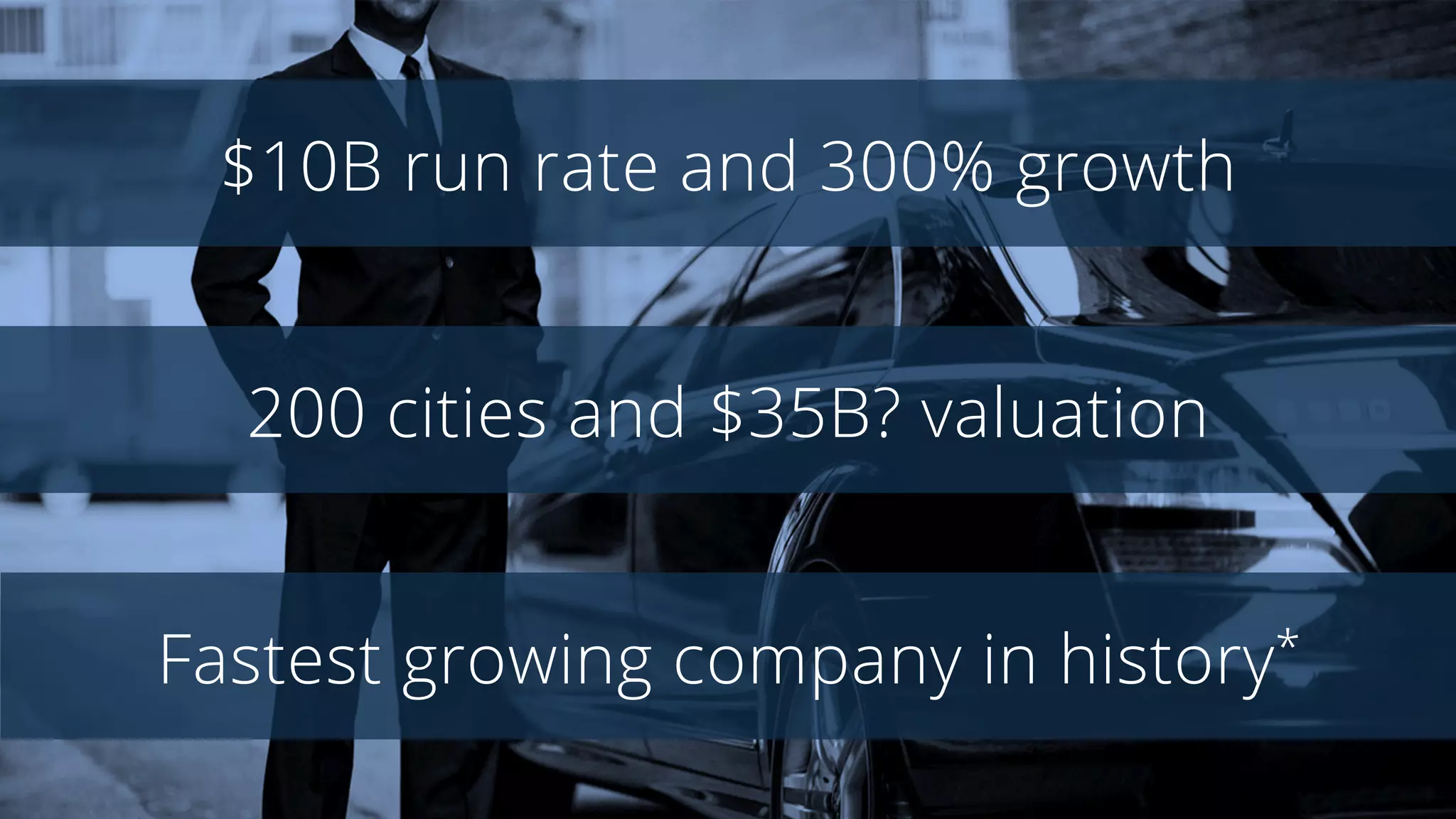
63 countries, 300+ cities
Market creation vs. market share
5 years to $60-70B valuation*
Playbook for next generation businesses
§  Collision of underlying tech trends
§  Integrated consumer experience
§  Labor force changes
Welcome to the new, “uber” inspired economy
§  Mobile apps that
aggregate consumer
demand, then fulfill
via offline services
§  Delivering a “closed
loop”, end-to-end
experience
Incumbents innovate via incremental improvements
Focus on improving
existing (premium)
products
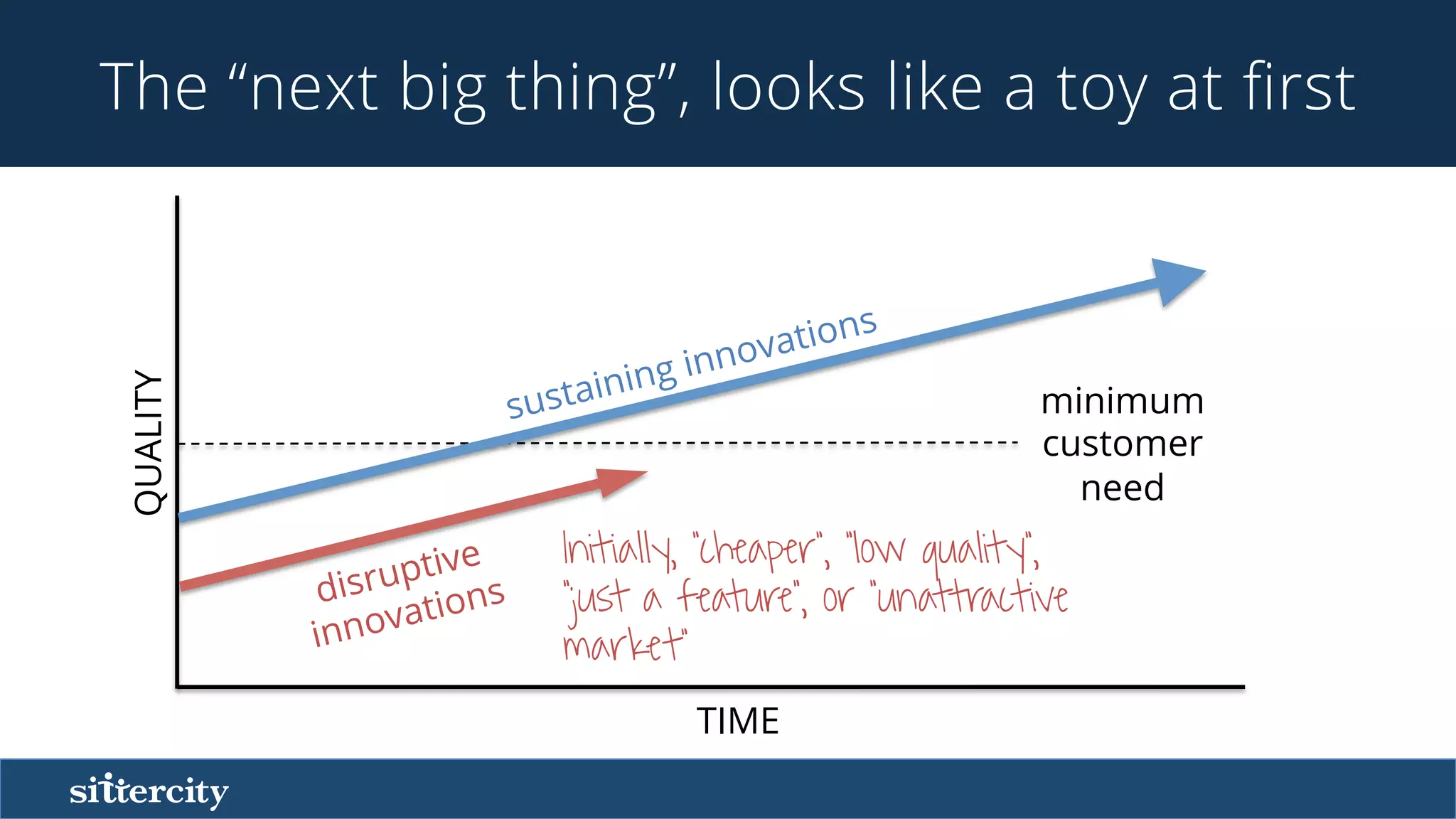
TIME
QUALITY
minimum
customer
need
sustaining innovations
The “next big thing”, looks like a toy at first
Initially, “cheaper”, “low quality”,
“just a feature”, or “unattractive
market”
TIME
QUALITY
minimum
customer
need
sustaining innovations
disruptive
innovations
“Good-enough” is the tipping point
Eventually reach a flashpoint
where they begin eroding share–
focus and depth accelerates this
TIME
QUALITY
minimum
customer
need
sustaining innovations
disruptive
innovations
Meanwhile, in Chicago…
Sittercity invented the online child care category
6MM caregivers
“Demand-side” subscription model
“Matchmaking” vs. “transactional”
3MM parents
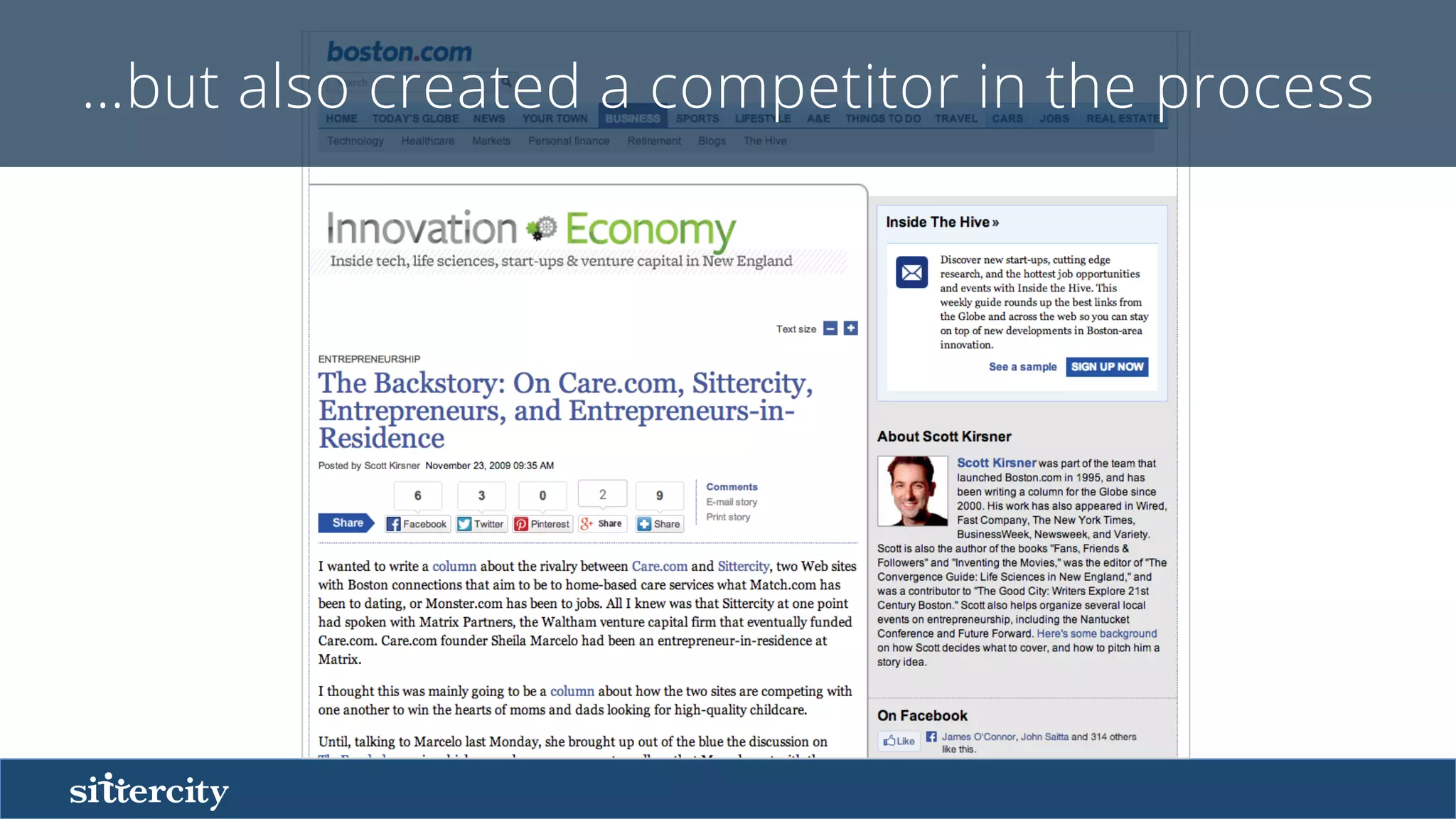
…but also created a competitor in the process
…who was about to get bigger
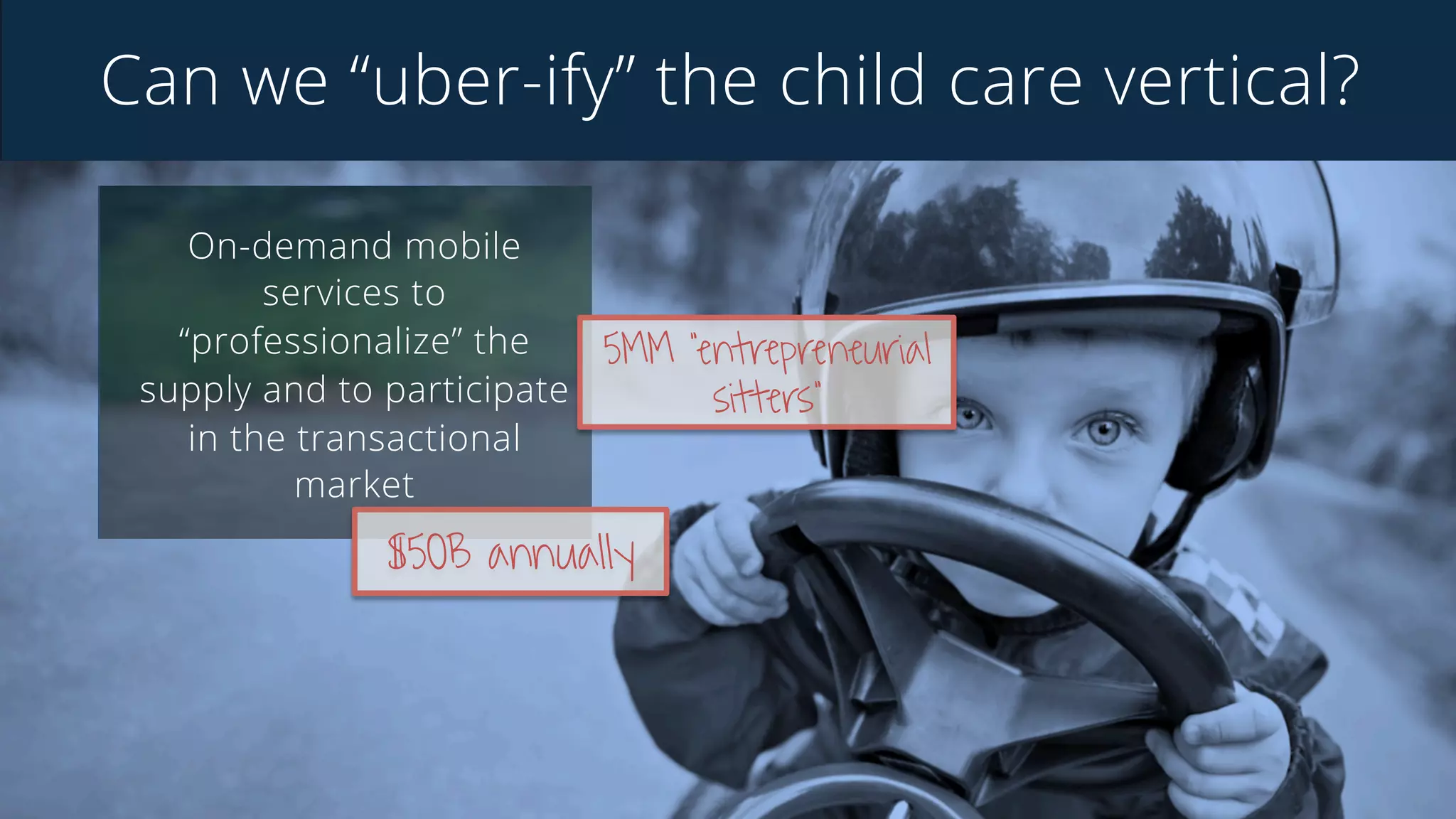
Can we “uber-ify” the child care vertical?
On-demand mobile
services to
“professionalize” the
supply and to participate
in the transactional
market
$50B annually
5MM “entrepreneurial
sitters”
Marketplaces are the
foundation of the
internet
The internet makes markets efficient
§  Aggregate long-tail supply and demand
where offline would be inefficient
§  Tools to seamlessly communicate
§  Platform-mediated payments /
transactions
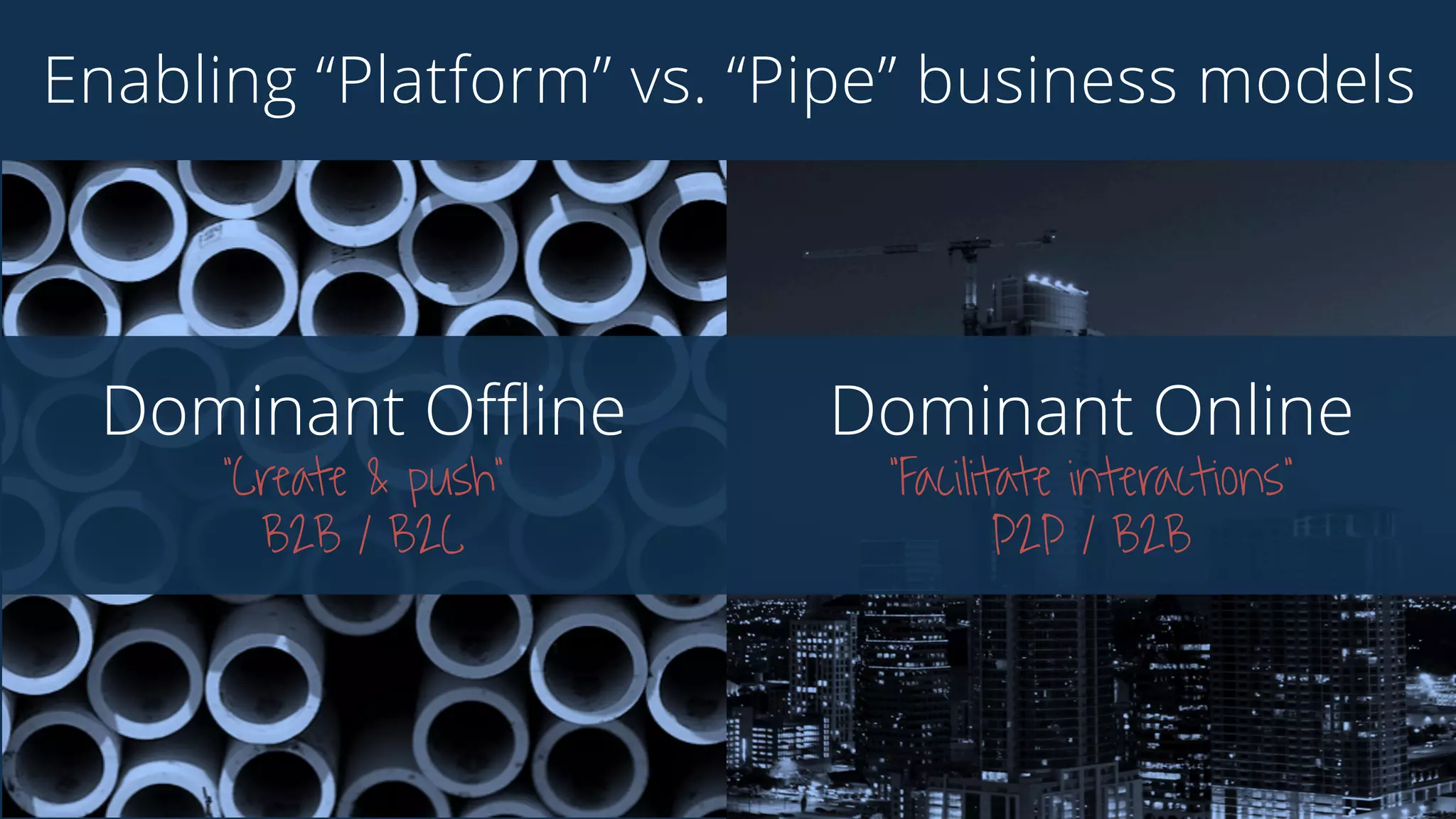
Dominant Offline
“Create & push”
B2B / B2C
Dominant Online
“Facilitate interactions”
P2P / B2B
Enables “Platform” vs. “Pipe” business models
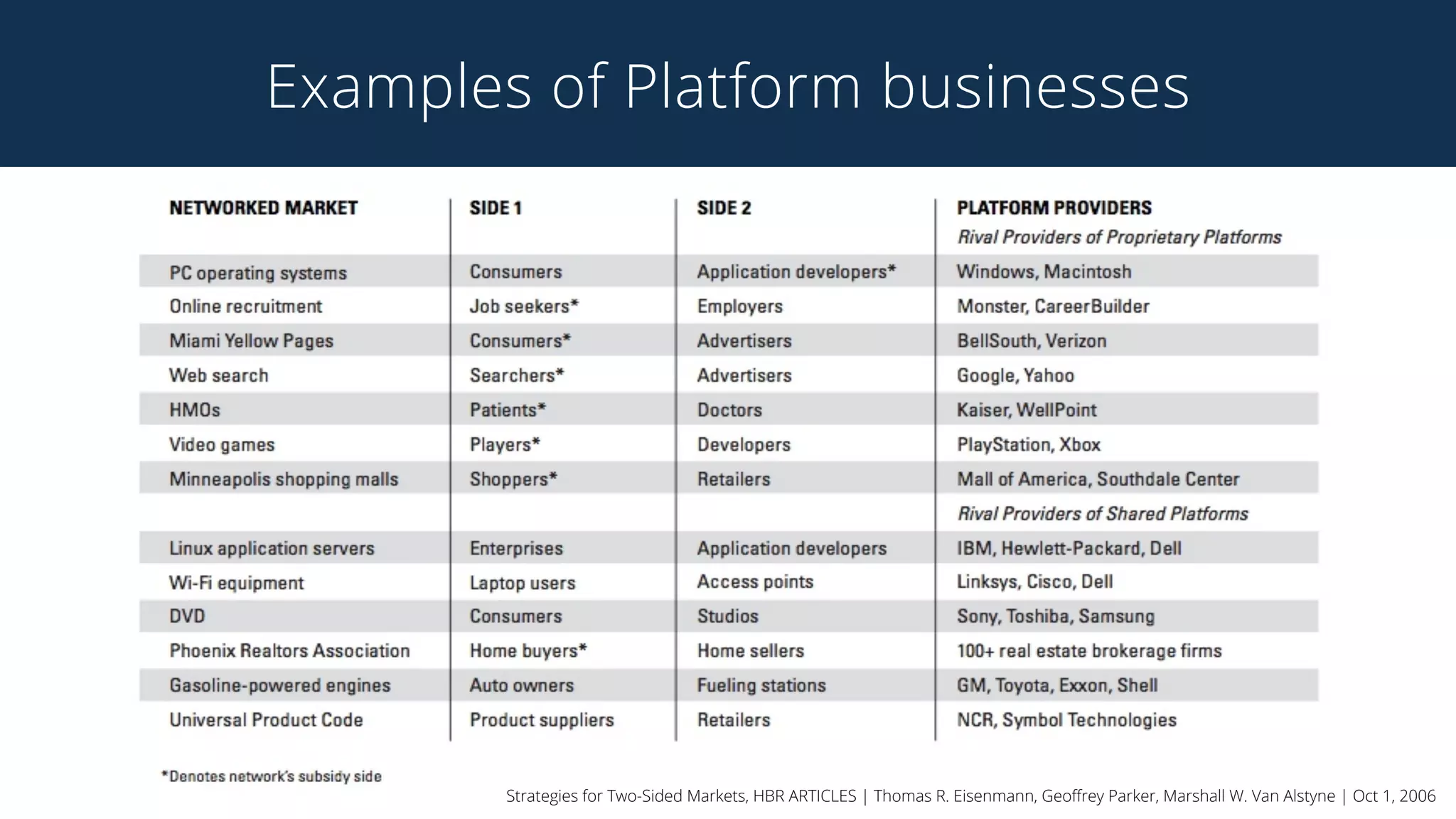
Examples of Platform businesses
Strategies for Two-Sided Markets, HBR ARTICLES | Thomas R. Eisenmann, Geoffrey Parker, Marshall W. Van Alstyne | Oct 1, 2006
…almost every massively
successful tech business is
a platform, many of those
are marketplaces
And the market has proven this
§  ~20 years of consumer internet
§  24 public companies >$1B x 2 for
acquisitions
§  140+ private “unicorn” companies
§  2/3 are “platform” businesses
Source: James Slavet, Greylock
Academic
Underpinnings
2-sided market incentives
Demand Supply
1) Initial Adoption 1) Initial Adoption
2) Same-
side
Effects
2) Same-
side
Effects
3) Cross-Network Effects
o  Increase in liquidity Cross-side Effects o  Increased liquidity
Platform
Strategies for Two-Sided Markets, HBR ARTICLES | Thomas R. Eisenmann, Geoffrey Parker, Marshall W. Van Alstyne | Oct 1, 2006
o  Why do seekers initially adopt? Initial Adoption o  Why do providers initially adopt?
o  How do more seekers help one
another? Same-side Effects o  How do more providers help
one another?
Keys to building
P2P marketplaces
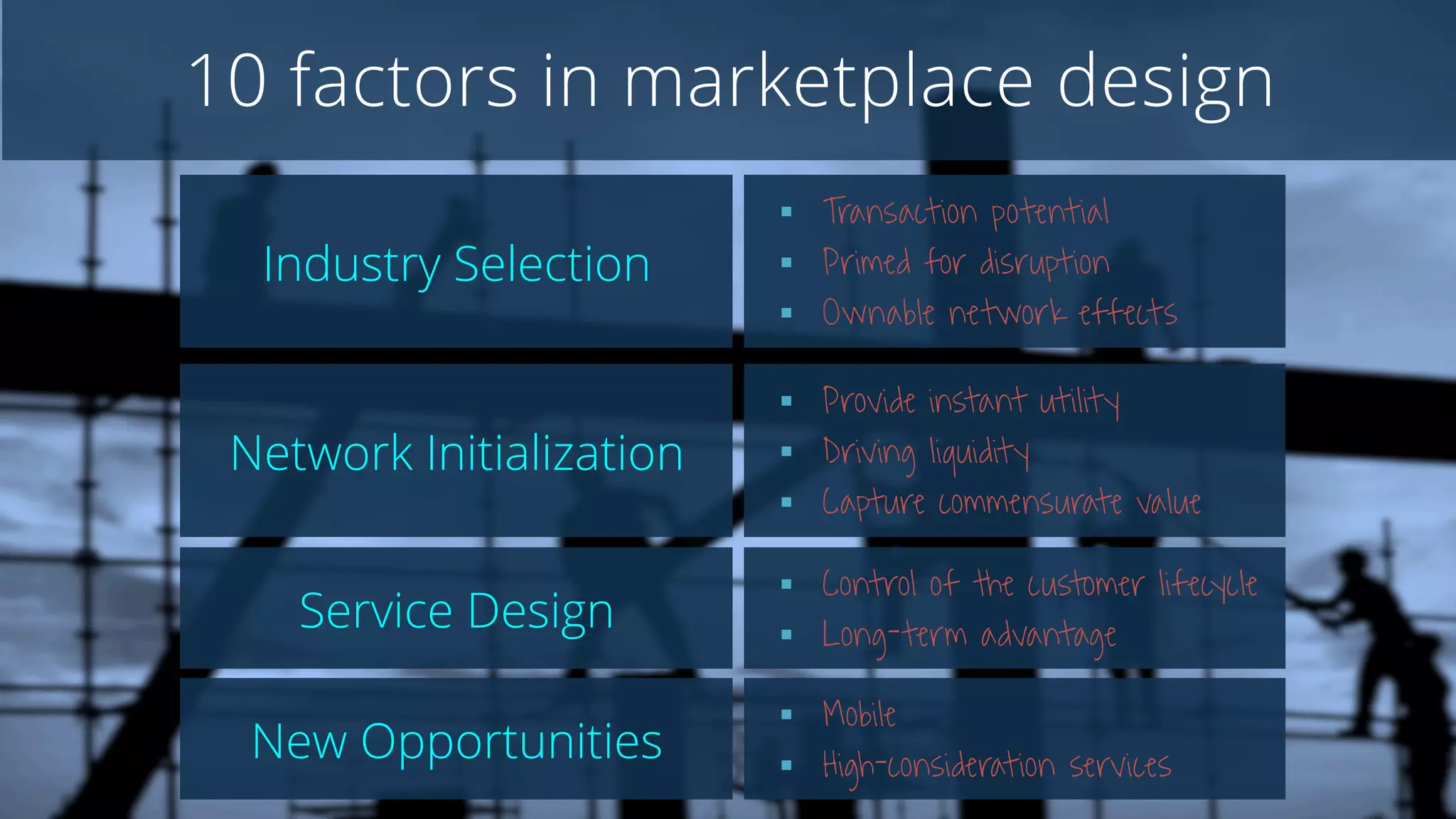
I) Select an attractive industry
i) Big transaction potential
ii) Ripe for disruption
iii) Inherent network effects
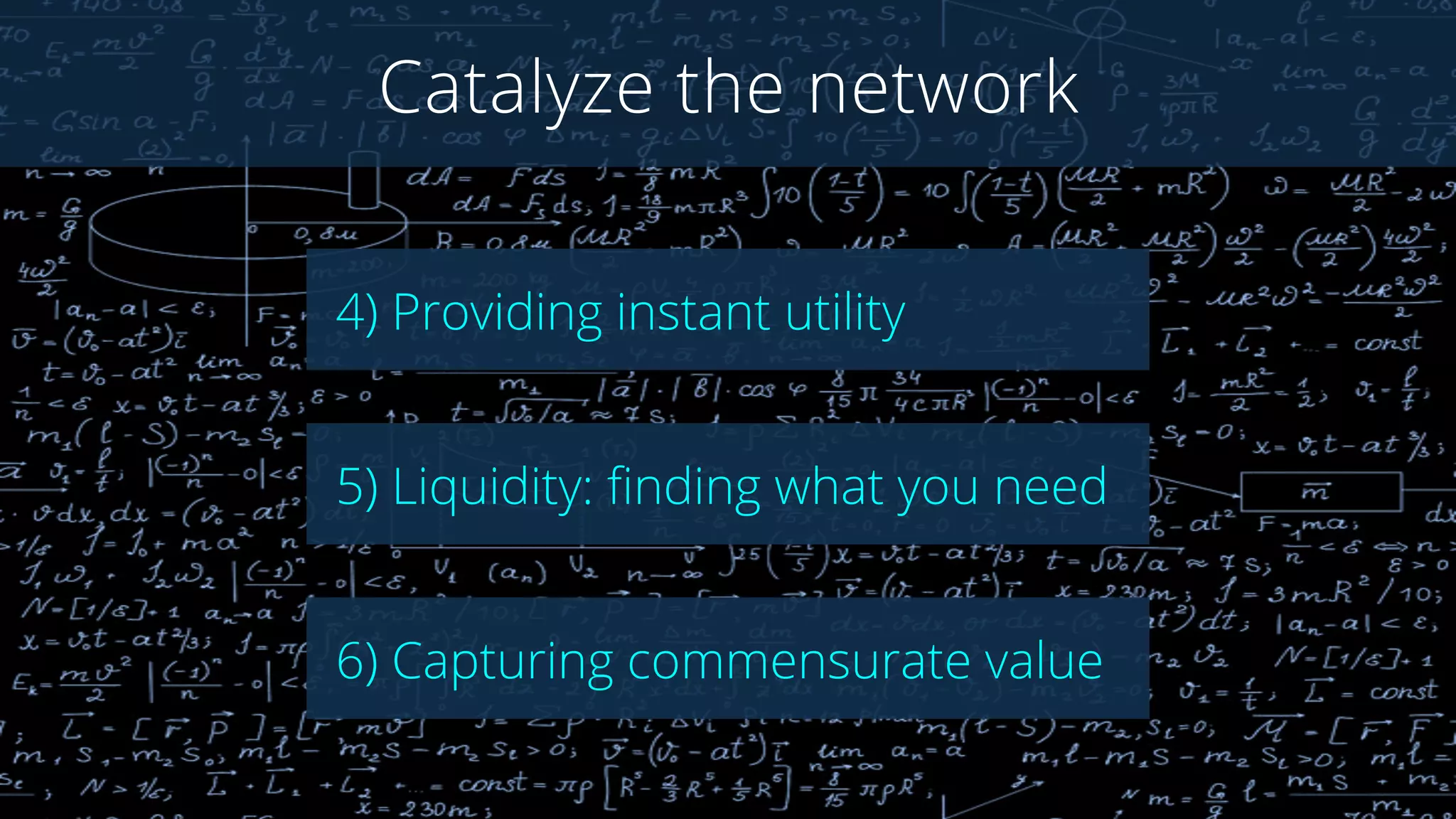
2) Catalyze the network
iv) Providing instant utility
v) Liquidity: finding what you need
vi) Capturing commensurate value
3) Protect & grow the platform
vii) Control the customer lifecycle
viii) Cost-effective expansion
ix) Cultivate competitive lockout
x) Leverage emerging dynamics
Marketplace Design
Patterns
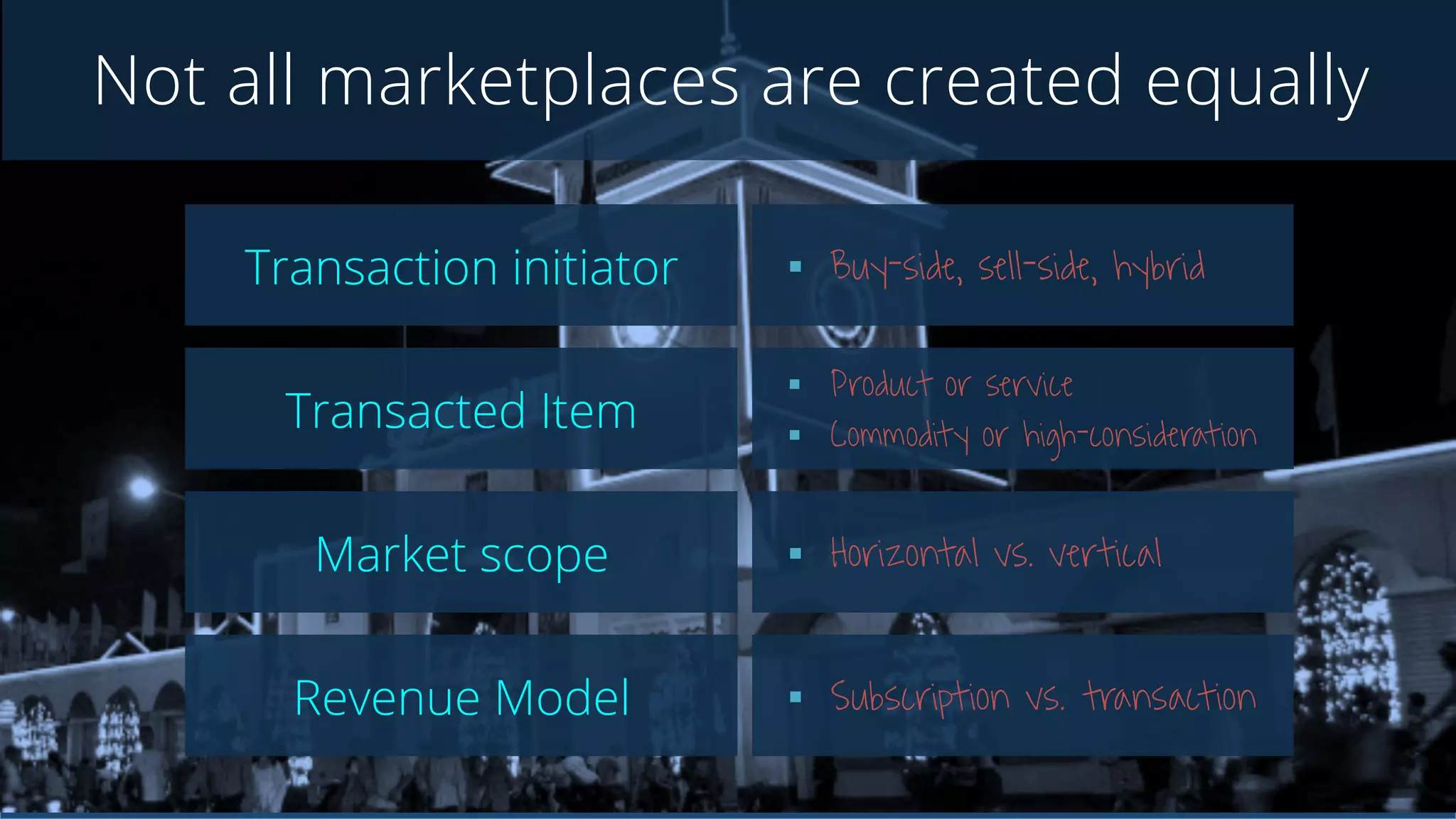
Not all marketplaces are created equally
Transaction initiator §  Buy-side, sell-side, hybrid
Transacted Item
§  Product or service
§  Commodity or high-consideration
Market scope §  Horizontal vs. vertical
Revenue Model §  Subscription vs. transaction
Commodity Regular Low
Service Type
 Frequency
 Consideration
http://rdean.me/marketplacematrix
Type 1:
“Uber for X”
Commodity Ad-hoc LowType 2:
“Long-tail commerce”
Experiential Regular LowType 3:
“Recurring Relationships”
Experiential Ad-hoc LowType 4:
“Delegation & Indulgences”
Commodity Ad-hoc HighType 5:
“Big-ticket commerce”
Experiential Ad-hoc HighType 6:
“Episodic significance”
Experiential Regular HighType 7:
“Trusted Advisors”
Initial Search
Trust barrier
Liquidity / Supply-side curation
Ongoing Management
Reuse incentive
Disintermediation
2 keys in platform design and management
Your Turn…
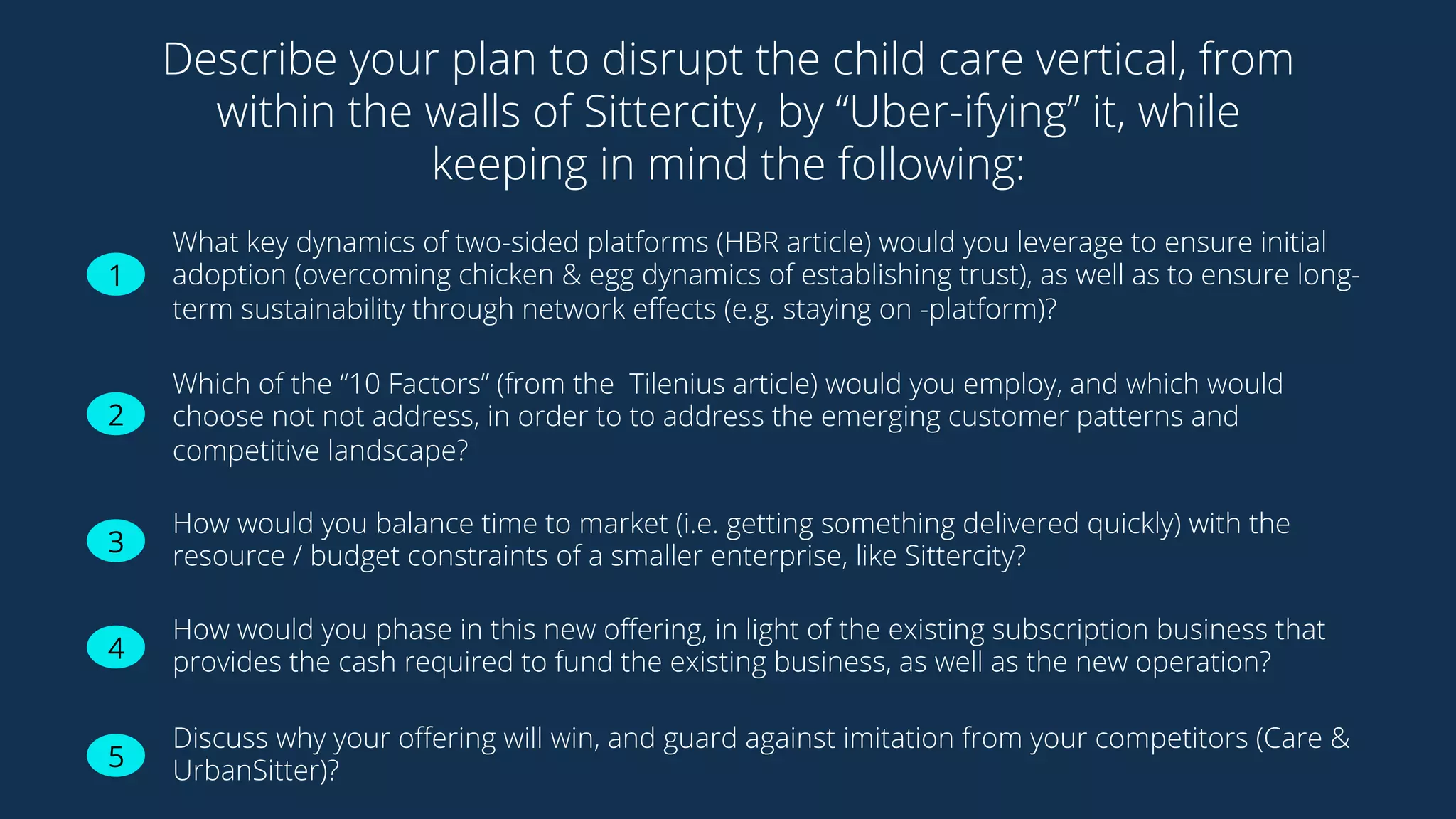
Describe how you (Sittercity) will disrupt the child care
vertical, by leading it into the on-demand economy
Provide a brief outline of the key dynamics of two-sided platforms (HBR article) you would
leverage to ensure initial adoption (overcoming chicken & egg dynamics of establishing trust),
and to ensure long-term sustainability through network effects (e.g. staying on platform)?
ALL
COMPETITION: Discuss why your offering will win, and guard against imitation from
competitors (Care & UrbanSitter)?
4
1
ADOPTION: How would you help consumers overcome the initial “trust hurdle” to adopt
Chime at-scale?
2
RETENTION: What tactics would you use to keep consumers using Chime, and avoid
“disintermediation” – to the point where users would recruit their personal networks?
3
GROWTH: How might Sittercity “unlock” non-vetted supply, in order to scale Chime more
quickly and reach new geographies, while balancing the need for quality & safety.
PRODUCT: What relationship should the new “Chime” product have with the core Sittercity
business line?
5
Epilogue
Disrupting yourself is hard
1.  Core revenue streams
2.  Comfort & complacency
3.  Cost of doing business
4.  Controls over operations
5.  Culture / lack of precedent
Say hello to…
What do you need?
Choose one of our
amazing sitters…
Easy payments…
Stay connected
while you’re away…
Rebook your
favorites…
P2P marketplaces can reduce “economic
slackness” (i.e. unemployment)
§  Change lives for parents and children
§  Provide meaningful economic opportunity
and empowerment to sitters
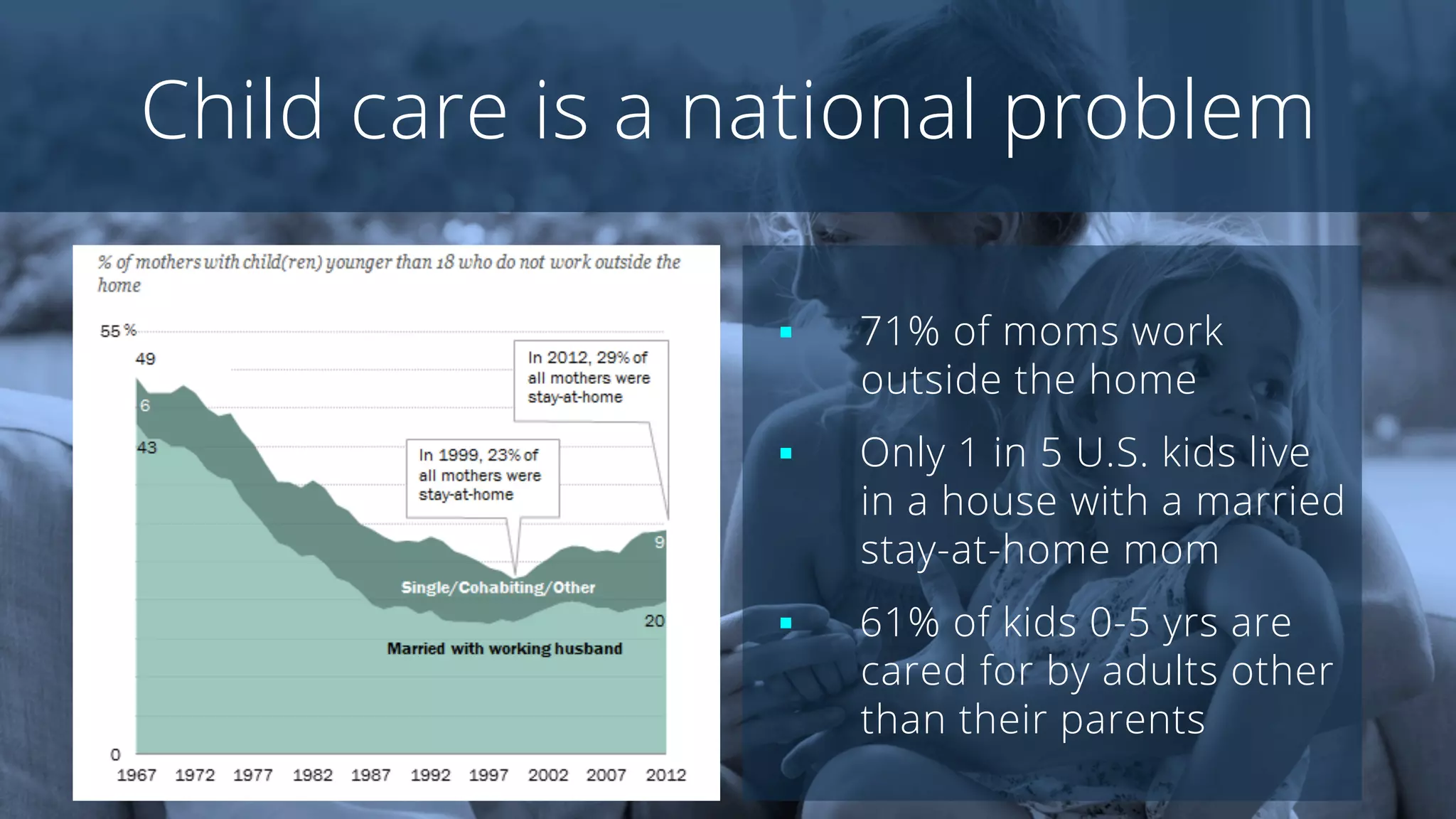
Child care is a national problem
§  71% of moms work
outside the home
§  Only 1 in 5 U.S. kids live in
a house with a married
stay-at-home mom
§  61% of kids 0-5 yrs are
cared for by adults other
than their parents
Not Affordable
More or
less
Affordable
Easily Affordable
25% of
households
<5% of households
Who we can serve today
Not Affordable
More or
less
Affordable
Easily Affordable
Who we can serve today
Tomorrow: “Everyone’s Private Nanny”?
More or less
Affordable
Easily Affordable
Current Topics in Marketing
October 27, 2015
Rishi Dean
Sittercity.com
Child care in
the on-demand
economy

Child care in the on-demand economy: 10 keys for building successful P2P marketplaces

  • 1.
    Child care in theon-demand economy Current Topics in Marketing October 27, 2015 Rishi Dean Sittercity.com
  • 2.
    Case Readings §  HBRArticle: Strategies for Two-Sided Markets (Oct 2006) §  Steve Schlafman (RRE Ventures): Uberification of the US Service Economy §  MIT Sloan Management Review: Strategic Decisions for Multi-sided Platforms (2014)
  • 3.
  • 4.
  • 5.
  • 6.
    3) How tothink like a pirate
  • 7.
    Class Agenda 1.  Marketdynamics & case preview 2.  Academic underpinnings 3.  Practical frameworks 4.  Case deep dive 5.  Presentations & Feedback 6.  Epilogue & Closing thoughts 3:05-3:15 3:15-3:30 3:30-3:45 3:45-3:55 4:15-5:15 5:15-5:30
  • 8.
    The disruption ofthe global service economy
  • 9.
    How many ofyou have heard of Uber?
  • 10.
    How many ofyou have heard of Uber? …has anyone not used Uber?
  • 11.
    Let’s rewind 4years (almost) today
  • 12.
    Well, it wasactually more like this…
  • 13.
    63 countries, 300+cities Market creation vs. market share 5 years to $60-70B valuation*
  • 14.
    Playbook for nextgeneration businesses §  Collision of underlying tech trends §  Integrated consumer experience §  Labor force changes
  • 15.
    Welcome to thenew, “uber” inspired economy §  Mobile apps that aggregate consumer demand, then fulfill via offline services §  Delivering a “closed loop”, end-to-end experience
  • 16.
    Incumbents innovate viaincremental improvements Focus on improving existing (premium) products TIME QUALITY minimum customer need sustaining innovations
  • 17.
    The “next bigthing”, looks like a toy at first Initially, “cheaper”, “low quality”, “just a feature”, or “unattractive market” TIME QUALITY minimum customer need sustaining innovations disruptive innovations
  • 18.
    “Good-enough” is thetipping point Eventually reach a flashpoint where they begin eroding share– focus and depth accelerates this TIME QUALITY minimum customer need sustaining innovations disruptive innovations
  • 19.
  • 21.
    Sittercity invented theonline child care category 6MM caregivers “Demand-side” subscription model “Matchmaking” vs. “transactional” 3MM parents
  • 22.
    …but also createda competitor in the process
  • 23.
    …who was aboutto get bigger
  • 24.
    Can we “uber-ify”the child care vertical? On-demand mobile services to “professionalize” the supply and to participate in the transactional market $50B annually 5MM “entrepreneurial sitters”
  • 25.
  • 27.
    The internet makesmarkets efficient §  Aggregate long-tail supply and demand where offline would be inefficient §  Tools to seamlessly communicate §  Platform-mediated payments / transactions
  • 28.
    Dominant Offline “Create &push” B2B / B2C Dominant Online “Facilitate interactions” P2P / B2B Enables “Platform” vs. “Pipe” business models
  • 29.
    Examples of Platformbusinesses Strategies for Two-Sided Markets, HBR ARTICLES | Thomas R. Eisenmann, Geoffrey Parker, Marshall W. Van Alstyne | Oct 1, 2006
  • 30.
    …almost every massively successfultech business is a platform, many of those are marketplaces
  • 31.
    And the markethas proven this §  ~20 years of consumer internet §  24 public companies >$1B x 2 for acquisitions §  140+ private “unicorn” companies §  2/3 are “platform” businesses Source: James Slavet, Greylock
  • 32.
  • 33.
    2-sided market incentives DemandSupply 1) Initial Adoption 1) Initial Adoption 2) Same- side Effects 2) Same- side Effects 3) Cross-Network Effects o  Increase in liquidity Cross-side Effects o  Increased liquidity Platform Strategies for Two-Sided Markets, HBR ARTICLES | Thomas R. Eisenmann, Geoffrey Parker, Marshall W. Van Alstyne | Oct 1, 2006 o  Why do seekers initially adopt? Initial Adoption o  Why do providers initially adopt? o  How do more seekers help one another? Same-side Effects o  How do more providers help one another?
  • 34.
  • 35.
    I) Select anattractive industry i) Big transaction potential ii) Ripe for disruption iii) Inherent network effects
  • 36.
    2) Catalyze thenetwork iv) Providing instant utility v) Liquidity: finding what you need vi) Capturing commensurate value
  • 37.
    3) Protect &grow the platform vii) Control the customer lifecycle viii) Cost-effective expansion ix) Cultivate competitive lockout
  • 38.
  • 39.
  • 40.
    Not all marketplacesare created equally Transaction initiator §  Buy-side, sell-side, hybrid Transacted Item §  Product or service §  Commodity or high-consideration Market scope §  Horizontal vs. vertical Revenue Model §  Subscription vs. transaction
  • 41.
    Commodity Regular Low ServiceType Frequency Consideration http://rdean.me/marketplacematrix Type 1: “Uber for X” Commodity Ad-hoc LowType 2: “Long-tail commerce” Experiential Regular LowType 3: “Recurring Relationships” Experiential Ad-hoc LowType 4: “Delegation & Indulgences” Commodity Ad-hoc HighType 5: “Big-ticket commerce” Experiential Ad-hoc HighType 6: “Episodic significance” Experiential Regular HighType 7: “Trusted Advisors”
  • 42.
    Initial Search Trust barrier Liquidity/ Supply-side curation Ongoing Management Reuse incentive Disintermediation 2 keys in platform design and management
  • 43.
  • 44.
    Describe how you(Sittercity) will disrupt the child care vertical, by leading it into the on-demand economy Provide a brief outline of the key dynamics of two-sided platforms (HBR article) you would leverage to ensure initial adoption (overcoming chicken & egg dynamics of establishing trust), and to ensure long-term sustainability through network effects (e.g. staying on platform)? ALL COMPETITION: Discuss why your offering will win, and guard against imitation from competitors (Care & UrbanSitter)? 4 1 ADOPTION: How would you help consumers overcome the initial “trust hurdle” to adopt Chime at-scale? 2 RETENTION: What tactics would you use to keep consumers using Chime, and avoid “disintermediation” – to the point where users would recruit their personal networks? 3 GROWTH: How might Sittercity “unlock” non-vetted supply, in order to scale Chime more quickly and reach new geographies, while balancing the need for quality & safety. PRODUCT: What relationship should the new “Chime” product have with the core Sittercity business line? 5
  • 46.
  • 47.
    Disrupting yourself ishard 1.  Core revenue streams 2.  Comfort & complacency 3.  Cost of doing business 4.  Controls over operations 5.  Culture / lack of precedent
  • 49.
  • 50.
  • 51.
    Choose one ofour amazing sitters…
  • 52.
  • 53.
  • 54.
  • 56.
    P2P marketplaces canreduce “economic slackness” (i.e. unemployment) §  Change lives for parents and children §  Provide meaningful economic opportunity and empowerment to sitters
  • 57.
    Child care isa national problem §  71% of moms work outside the home §  Only 1 in 5 U.S. kids live in a house with a married stay-at-home mom §  61% of kids 0-5 yrs are cared for by adults other than their parents
  • 58.
    Not Affordable More or less Affordable EasilyAffordable 25% of households <5% of households Who we can serve today
  • 59.
    Not Affordable More or less Affordable EasilyAffordable Who we can serve today
  • 60.
    Tomorrow: “Everyone’s PrivateNanny”? More or less Affordable Easily Affordable
  • 61.
    Current Topics inMarketing October 27, 2015 Rishi Dean Sittercity.com Child care in the on-demand economy