The New Bloom Folwell Dunbar, 2007
BLOOM 1956 Knowledge Comprehension Application Analysis Synthesis Evaluation
Creating Evaluating Remembering Understanding Applying Analyzing BLOOM 2007
Retrieving, recognizing, and recalling relevant knowledge from long-term memory.
Constructing meaning from oral, written, and graphic messages through interpreting, exemplifying, classifying, summarizing, inferring, comparing, and explaining.
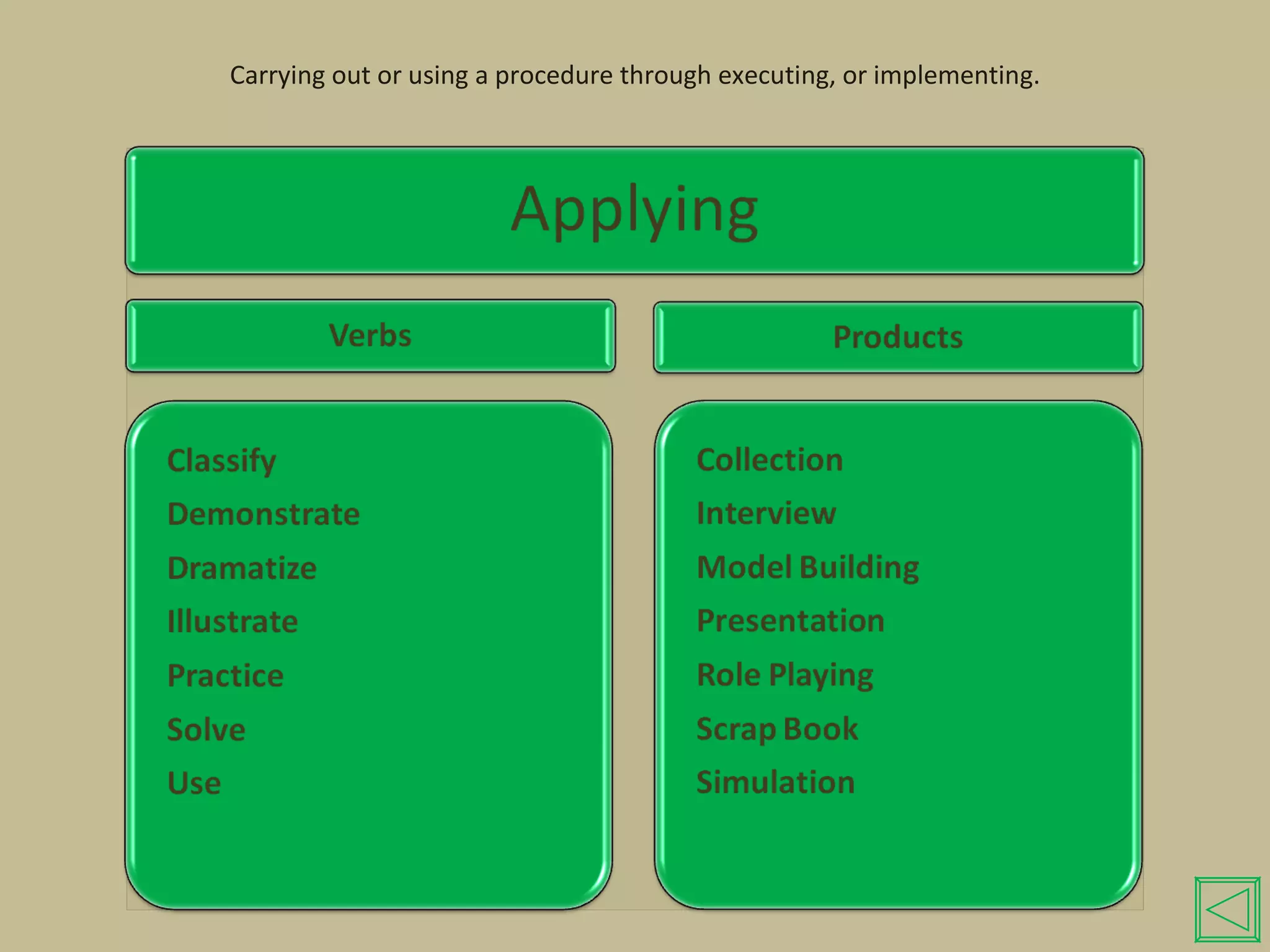
Carrying out or using a procedure through executing, or implementing.
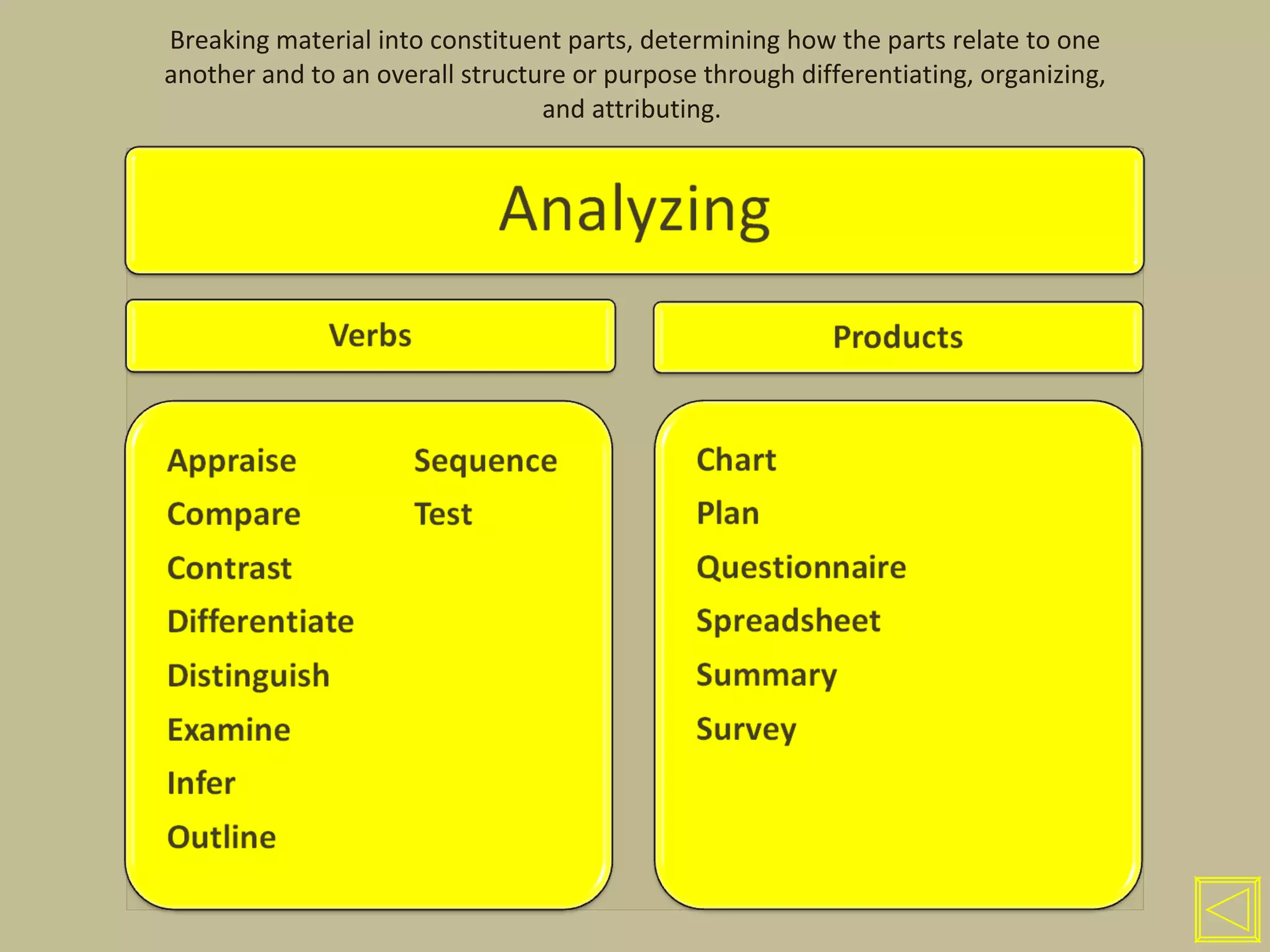
Breaking material into constituent parts, determining how the parts relate to one another and to an overall structure or purpose through differentiating, organizing, and attributing.
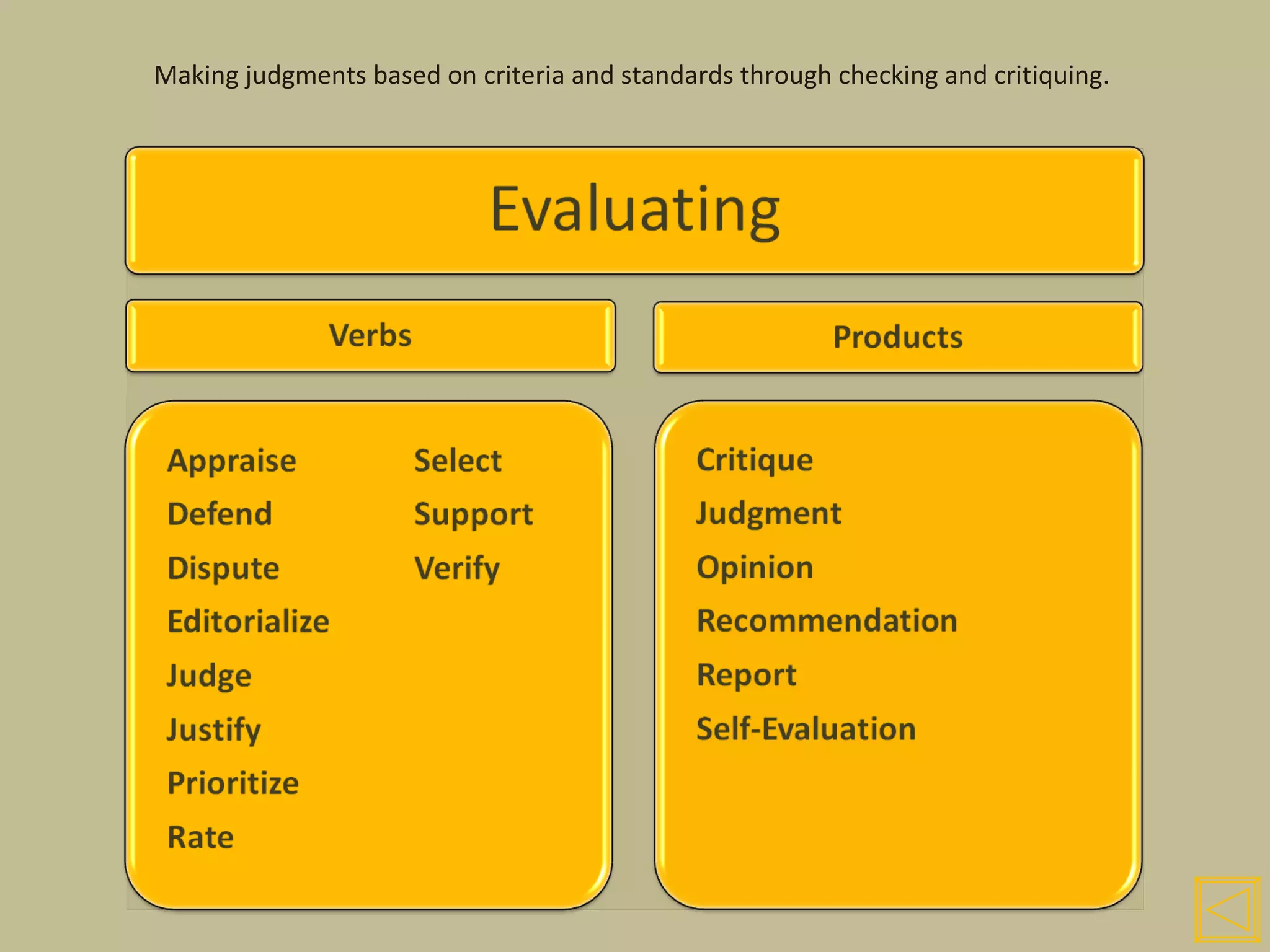
Making judgments based on criteria and standards through checking and critiquing.
Putting elements together to form a coherent or functional whole; reorganizing elements into a new pattern or structure through generating, planning, or producing.
 
Bibliography Anderson, L. W., & Krathwohl, D. R. (Eds.). (2001). A taxonomy for learning, teaching and assessing: A revision of Bloom's Taxonomy of educational objectives: Complete edition, New York : Longman. Bloom, Benjamin S. & David R. Krathwohl. (1956). Taxonomy of Educational Objectives: The Classification of Educational Goals by a Committee of College and University Examiners. Handbook 1: Cognitive Domain. New York, Longmans.  Ferguson , C. (2002). Using the Revised Taxonomy to Plan and Deliver Team- Taught, Integrated, Thematic Units. Theory into Practice, 41 (4).

The New Bloom

  • 1.
    The New BloomFolwell Dunbar, 2007
  • 2.
    BLOOM 1956 KnowledgeComprehension Application Analysis Synthesis Evaluation
  • 3.
    Creating Evaluating RememberingUnderstanding Applying Analyzing BLOOM 2007
  • 4.
    Retrieving, recognizing, andrecalling relevant knowledge from long-term memory.
  • 5.
    Constructing meaning fromoral, written, and graphic messages through interpreting, exemplifying, classifying, summarizing, inferring, comparing, and explaining.
  • 6.
    Carrying out orusing a procedure through executing, or implementing.
  • 7.
    Breaking material intoconstituent parts, determining how the parts relate to one another and to an overall structure or purpose through differentiating, organizing, and attributing.
  • 8.
    Making judgments basedon criteria and standards through checking and critiquing.
  • 9.
    Putting elements togetherto form a coherent or functional whole; reorganizing elements into a new pattern or structure through generating, planning, or producing.
  • 10.
  • 11.
    Bibliography Anderson, L.W., & Krathwohl, D. R. (Eds.). (2001). A taxonomy for learning, teaching and assessing: A revision of Bloom's Taxonomy of educational objectives: Complete edition, New York : Longman. Bloom, Benjamin S. & David R. Krathwohl. (1956). Taxonomy of Educational Objectives: The Classification of Educational Goals by a Committee of College and University Examiners. Handbook 1: Cognitive Domain. New York, Longmans. Ferguson , C. (2002). Using the Revised Taxonomy to Plan and Deliver Team- Taught, Integrated, Thematic Units. Theory into Practice, 41 (4).