Learning Progressions:  A Discussion Ravit Golan Duncan Rutgers University
Learning Progressions What are they (nature of LP) Why we need them (motivation) How do we build them
Commonalities Progression over larger time units Deepening of ideas and level of sophistication (conceptual framework) Change in terms of what kids can  do   over time  (performances) Based on research on student learning
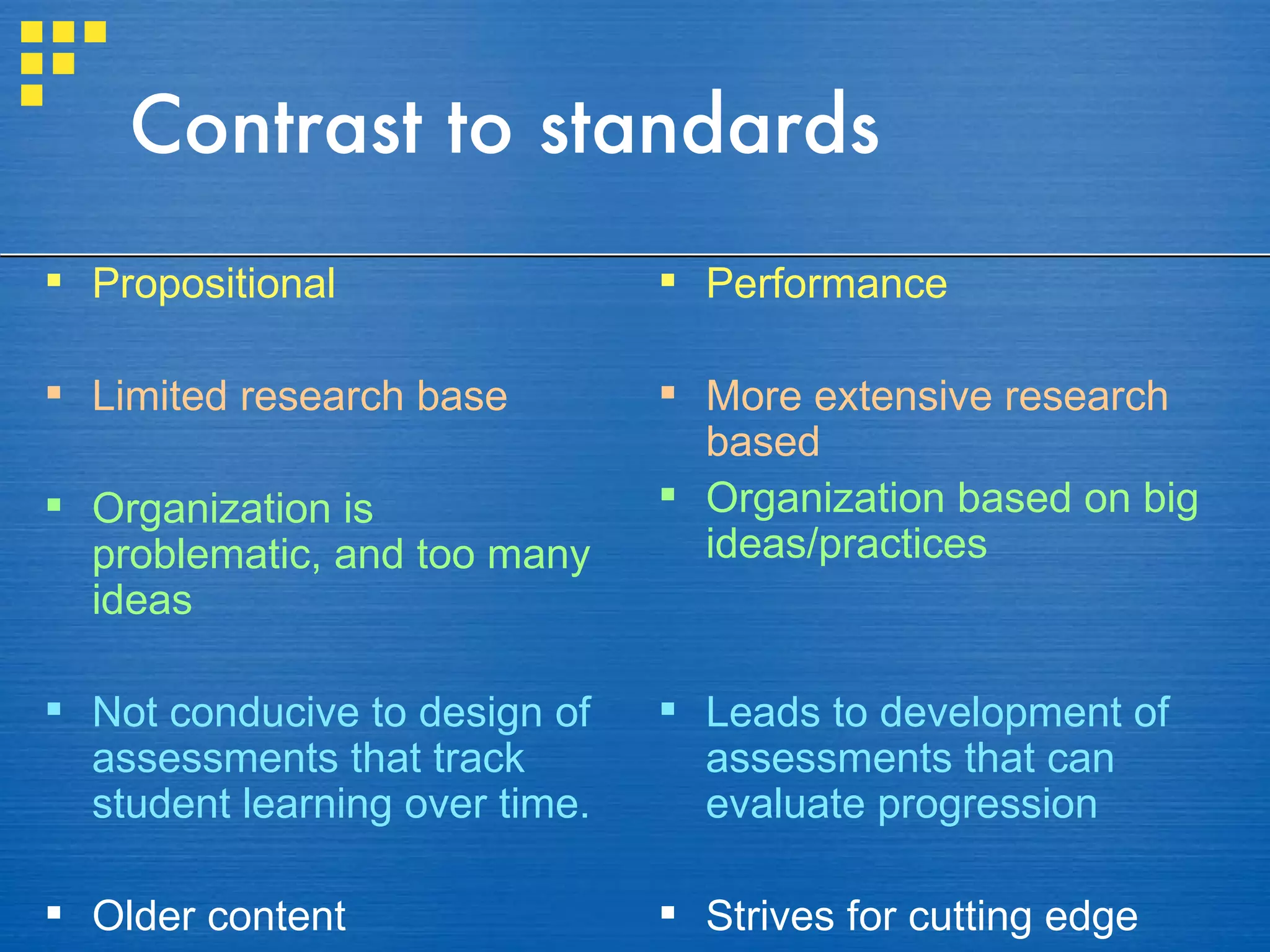
Contrast to standards Propositional  Limited research base Organization is problematic, and too many ideas Not conducive to design of assessments that track student learning over time. Older content Performance More extensive research based Organization based on big ideas/practices Leads to development of assessments that can evaluate progression Strives for cutting edge
Differences Motivation- what was the driving force to develop the progression Nature of progression- what does it mean to move along the progression The “stuff” of progressions- what are the big ideas? How do we know what we know? Building progressions Questions that remain
Motivation Environmental literacy- informed and active citizenry
Environmental literacy Theoretical Framework-Key Practices for Literacy (1) Scientific inquiry: developing and evaluating scientific arguments from evidence,  (2) Scientific accounts: using scientific accounts of the material world,  (3) Application: using scientific accounts as tools to predict and explain, and  (4) Citizenship: using scientific reasoning for responsible citizenship.
Motivation Environmental literacy- informed and active citizenry Students superficial understanding of current school science content (standards-based)
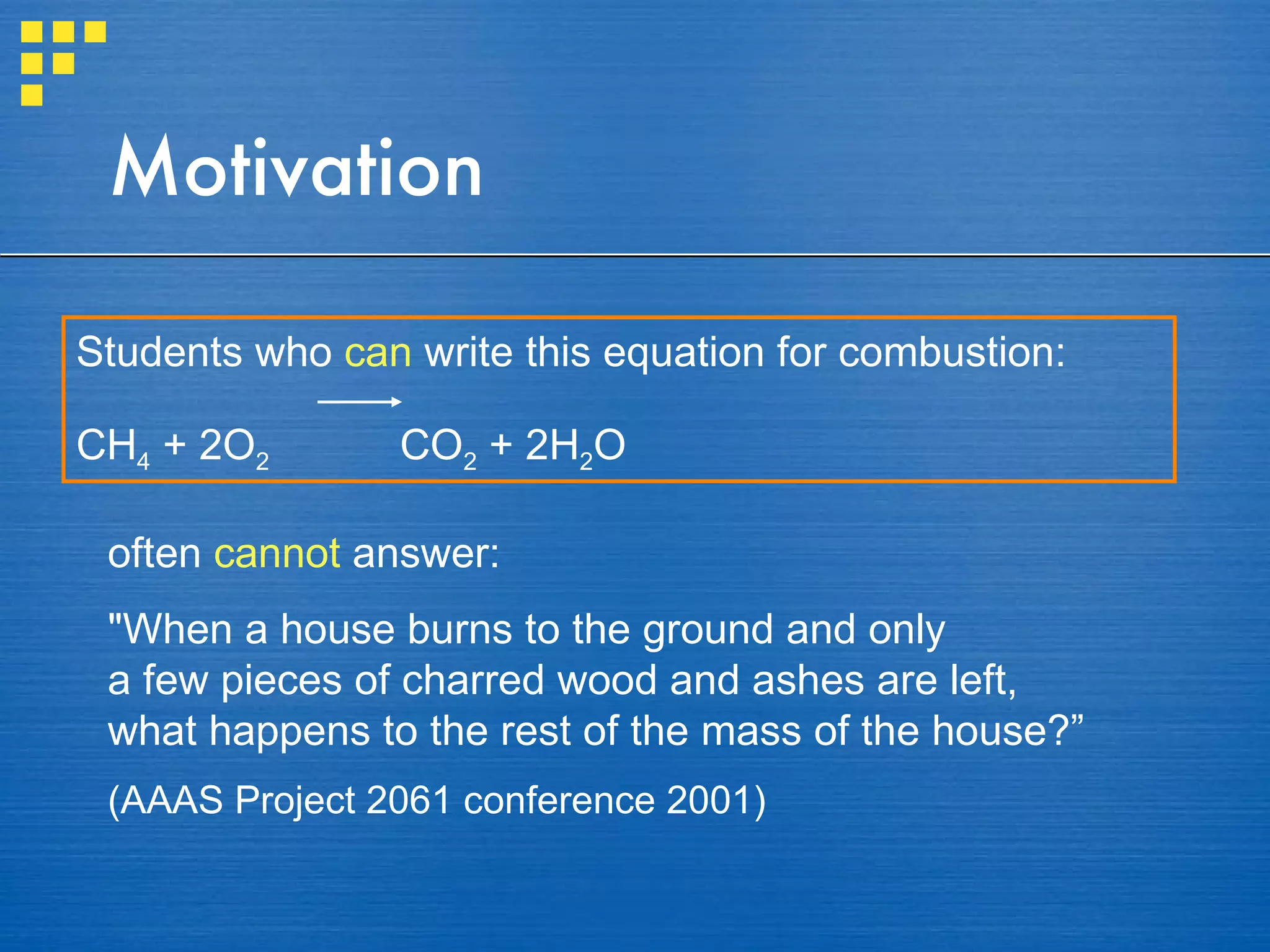
Motivation Students who  can   write this equation for combustion: CH 4  + 2O 2   CO 2  + 2H 2 O often  cannot  answer:  "When a house burns to the ground and only  a few pieces of charred wood and ashes are left,  what happens to the rest of the mass of the house?” (AAAS Project 2061 conference 2001)
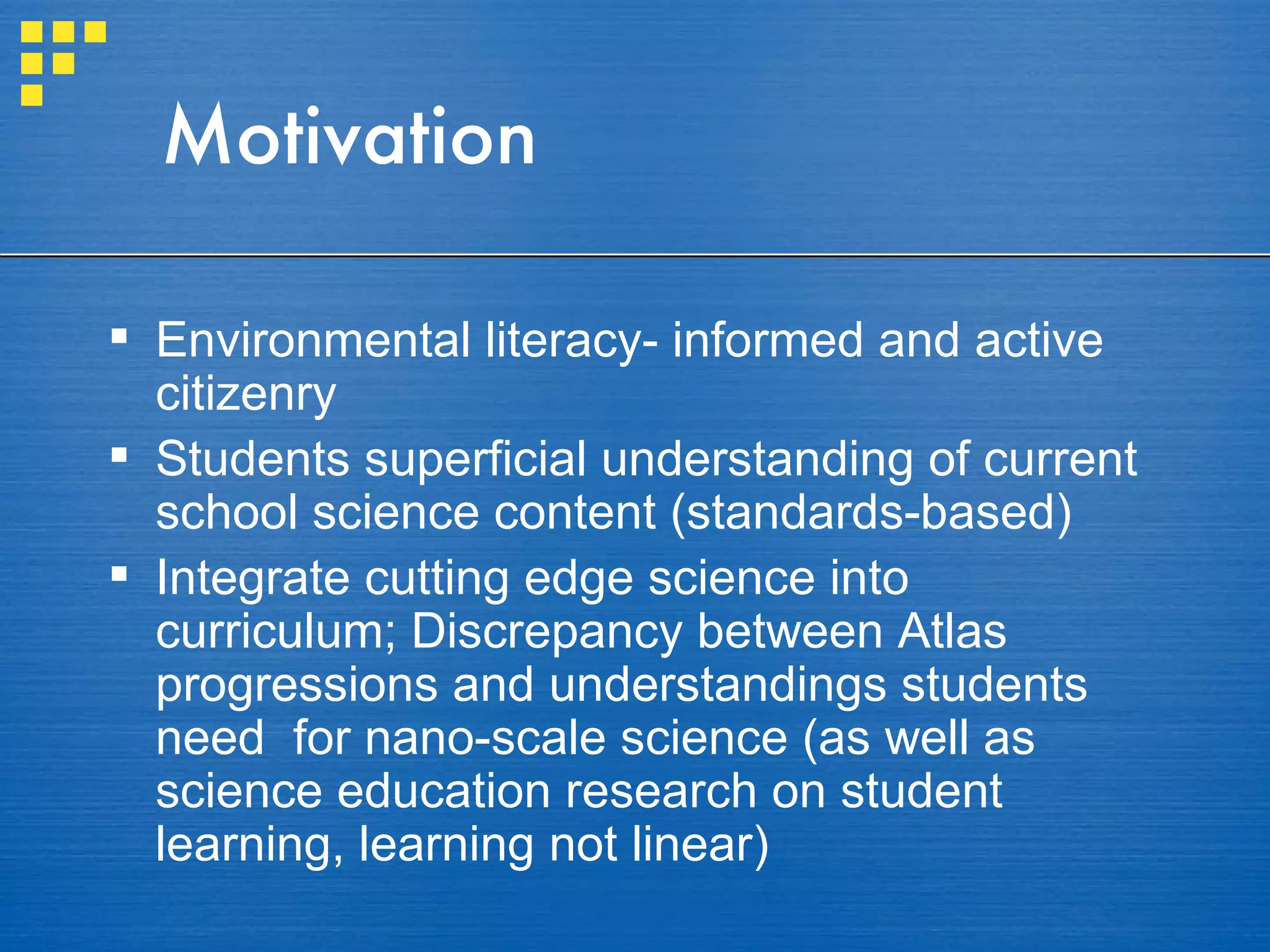
Motivation Environmental literacy- informed and active citizenry Students superficial understanding of current school science content (standards-based) Integrate cutting edge science into curriculum; Discrepancy between Atlas progressions and understandings students need  for nano-scale science (as well as science education research on student learning, learning not linear)
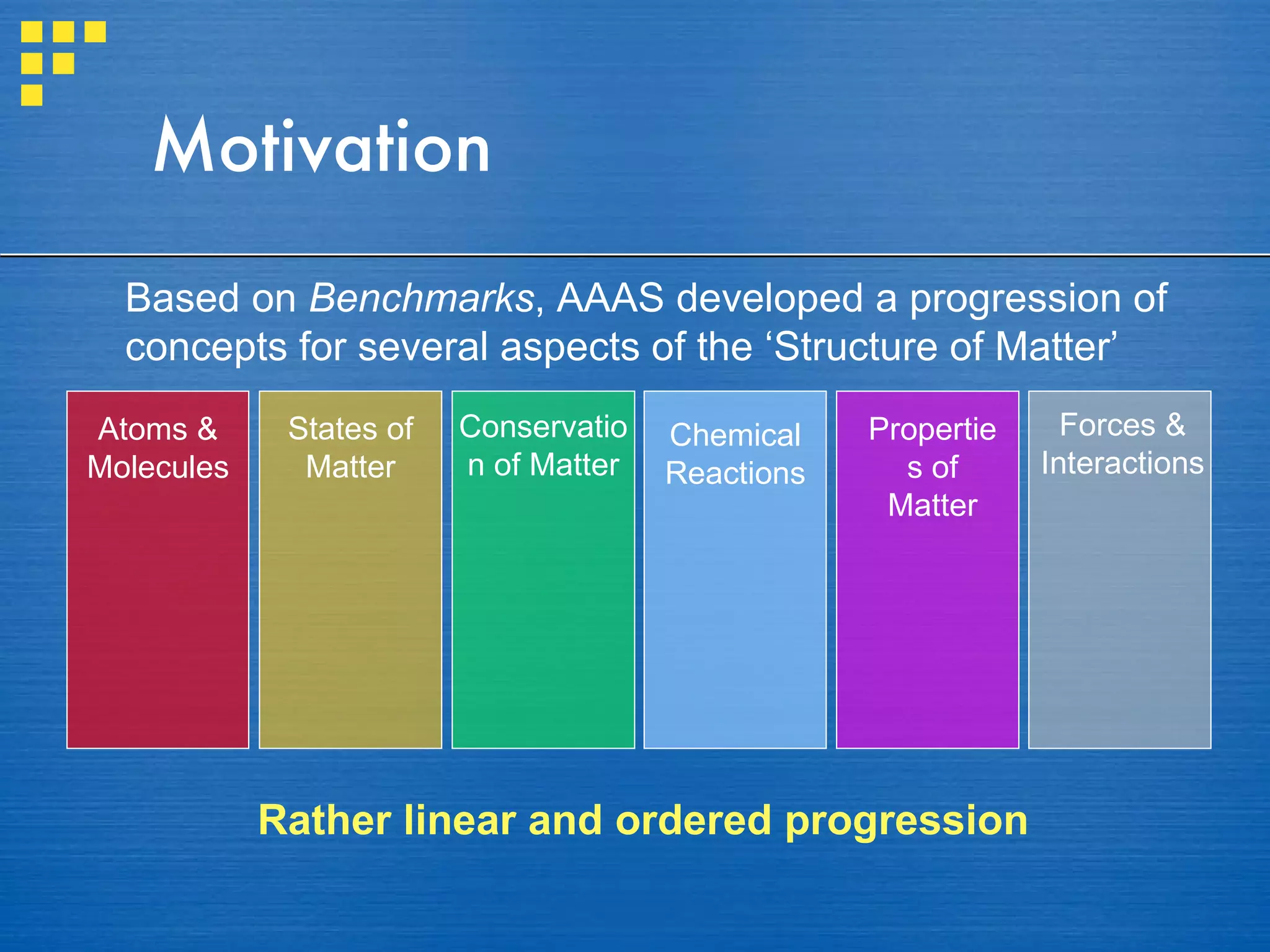
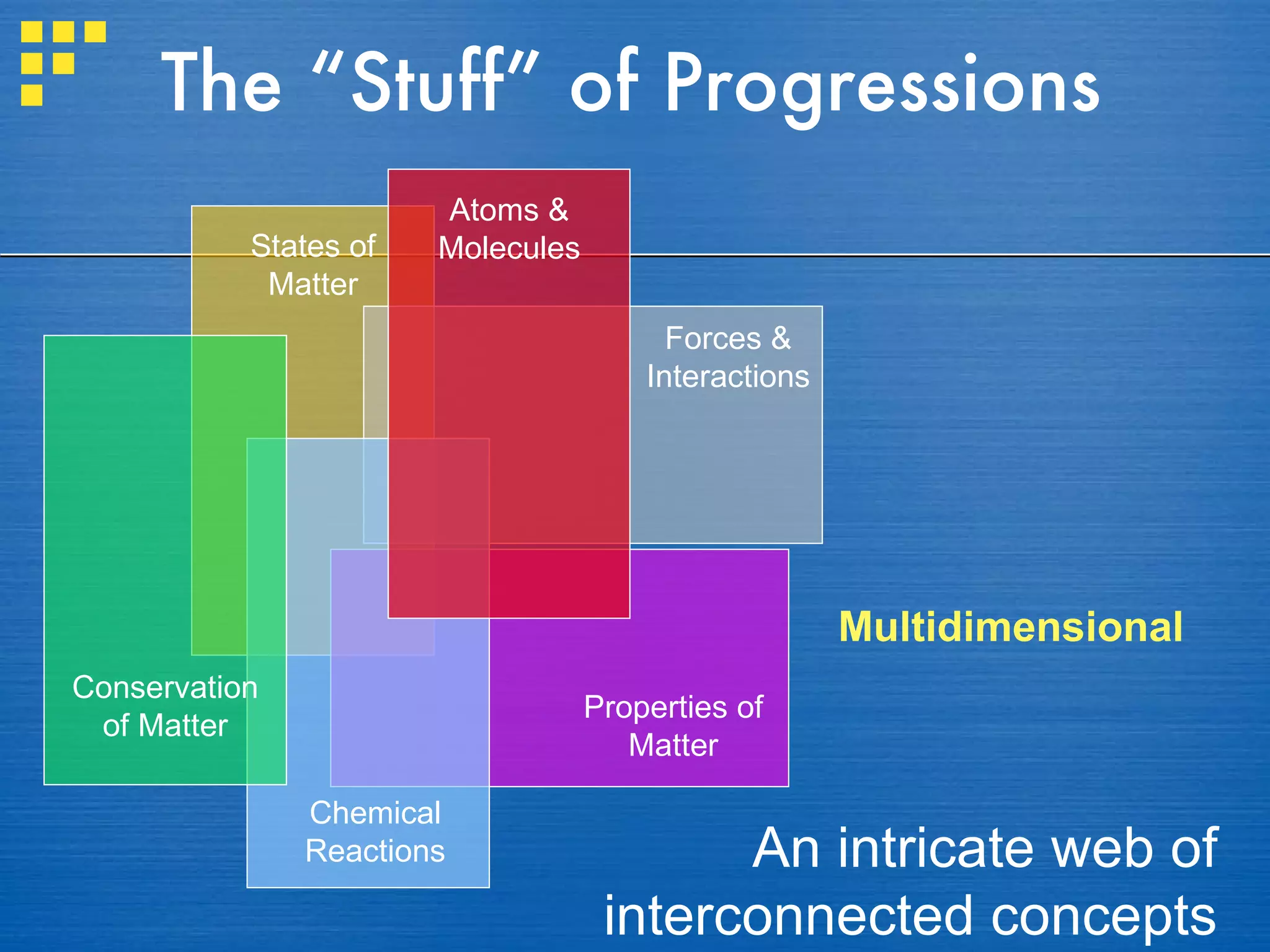
Motivation Based on  Benchmarks , AAAS developed a progression of concepts for several aspects of the ‘Structure of Matter’ Rather linear and ordered progression Forces & Interactions Properties of Matter Conservation of Matter States of Matter Atoms & Molecules Chemical Reactions
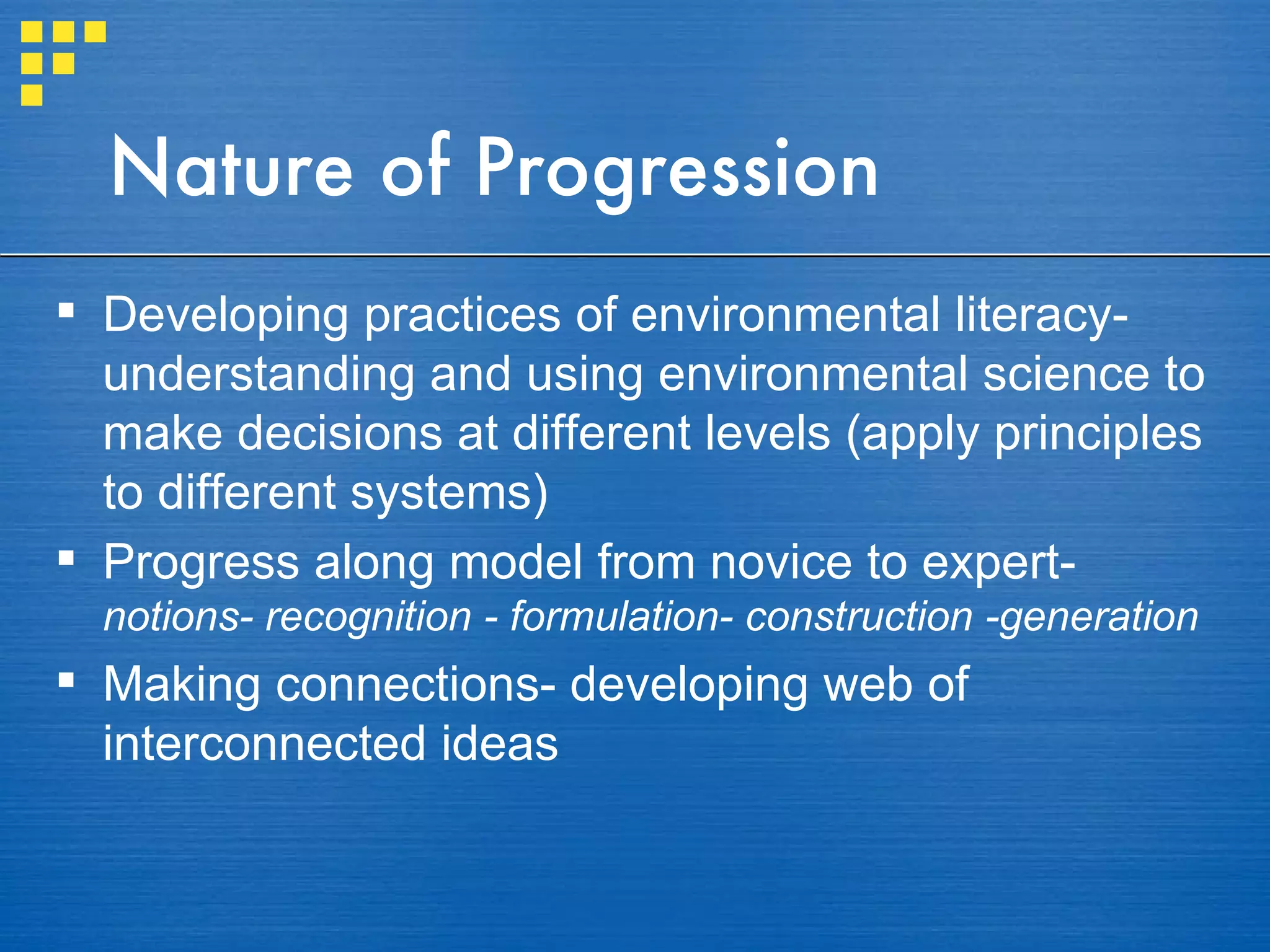
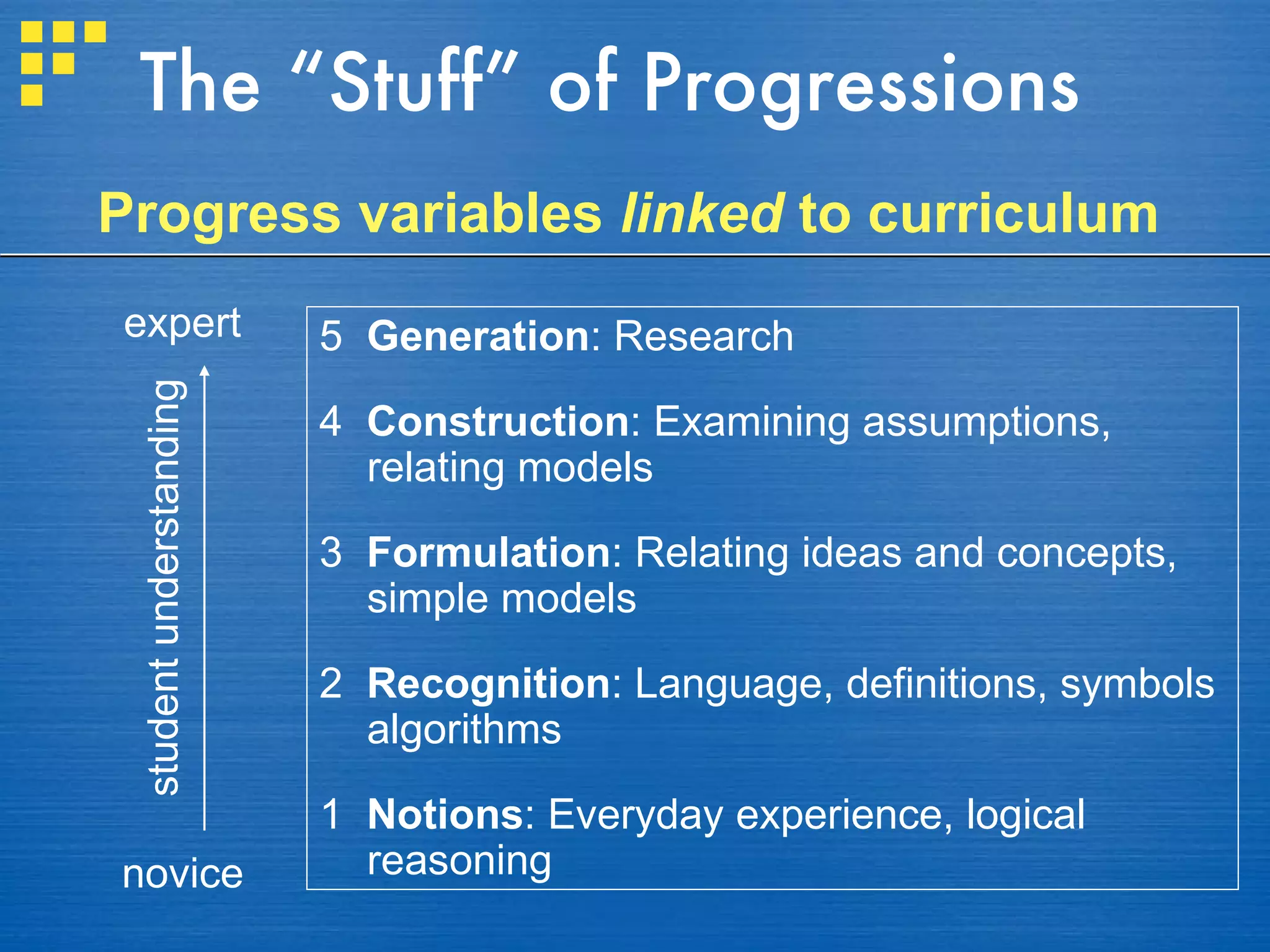
Nature of Progression Developing practices of environmental literacy- understanding and using environmental science to make decisions at different levels (apply principles to different systems) Progress along model from novice to expert-  notions- recognition - formulation- construction -generation Making connections- developing web of interconnected ideas
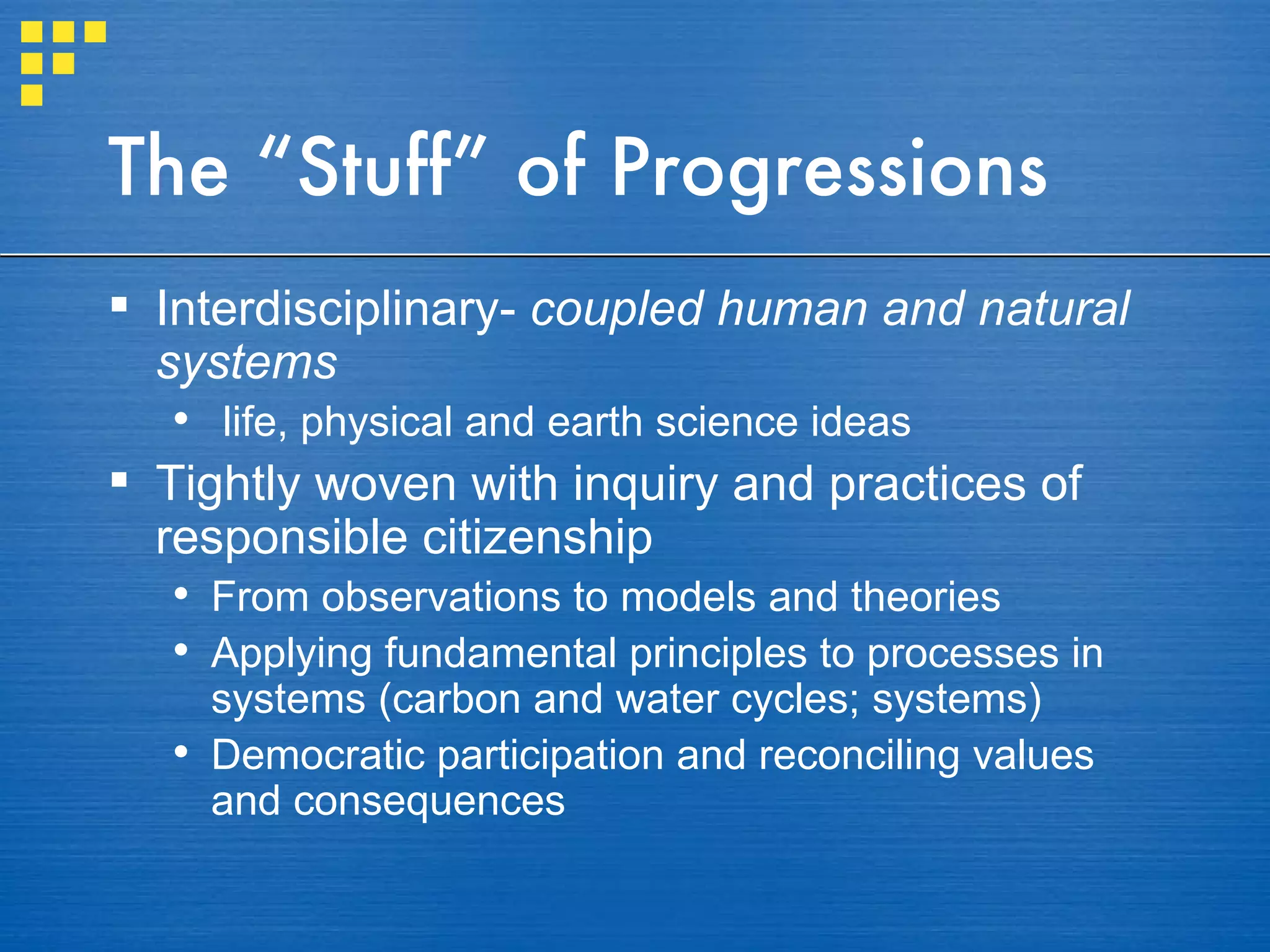
The “Stuff” of Progressions Interdisciplinary-  coupled human and natural systems life, physical and earth science ideas Tightly woven with inquiry and practices of responsible citizenship From observations to models and theories Applying fundamental principles to processes in systems (carbon and water cycles; systems) Democratic participation and reconciling values and consequences
The “Stuff” of Progressions 5  Generation : Research 4  Construction : Examining assumptions, relating models 3  Formulation : Relating ideas and concepts, simple models  2  Recognition : Language, definitions, symbols algorithms  1  Notions : Everyday experience, logical reasoning novice expert student understanding Progress variables  linked  to curriculum
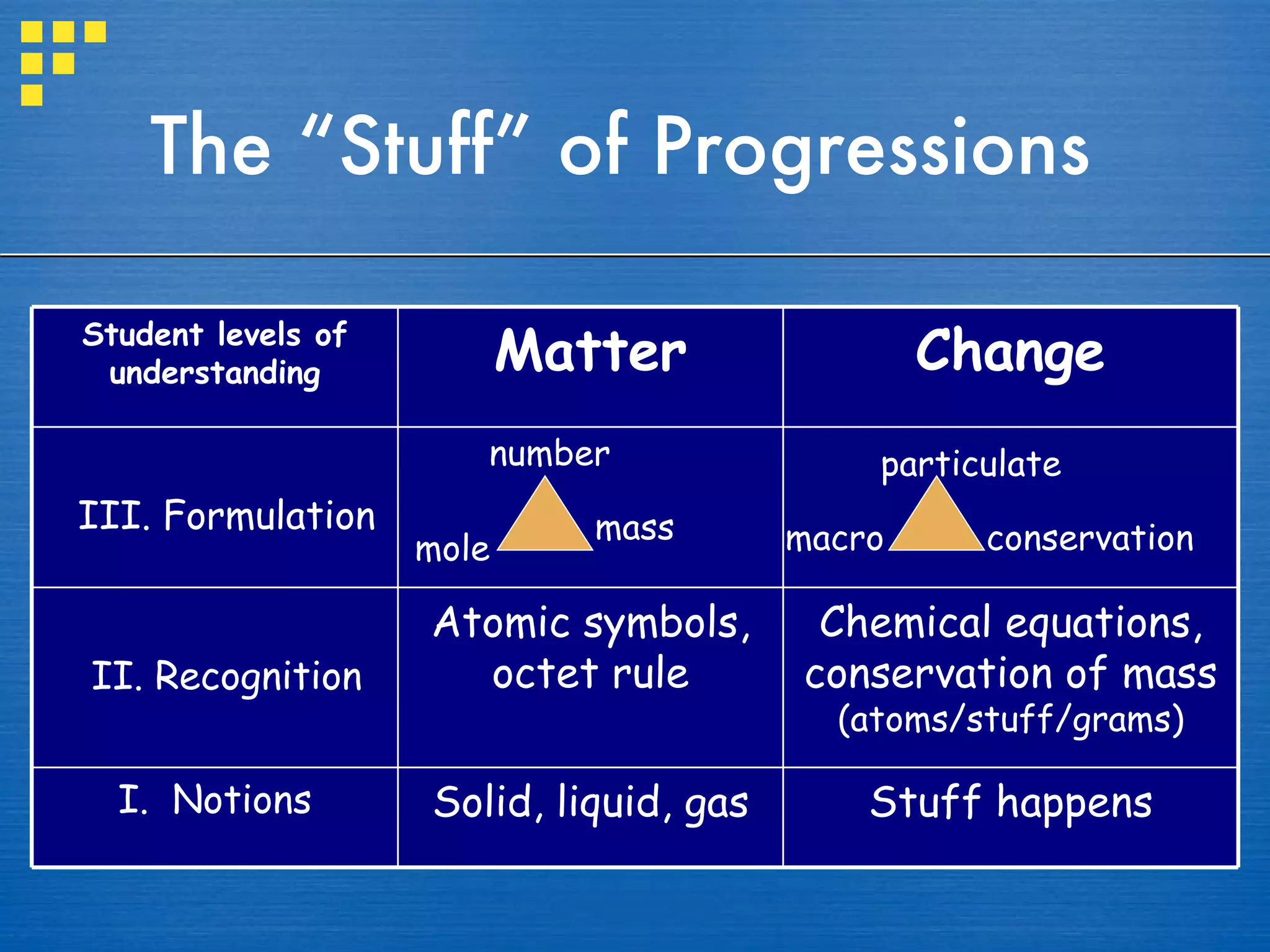
The “Stuff” of Progressions I.  Notions II. Recognition III. Formulation Student levels of understanding Stuff happens Solid, liquid, gas Chemical equations, conservation of mass  (atoms/stuff/grams) Atomic symbols, octet rule Change Matter number mole mass macro particulate conservation
The “Stuff” of Progressions An intricate web of interconnected concepts Multidimensional  States of Matter Forces & Interactions Properties of Matter Chemical Reactions Conservation of Matter Atoms & Molecules
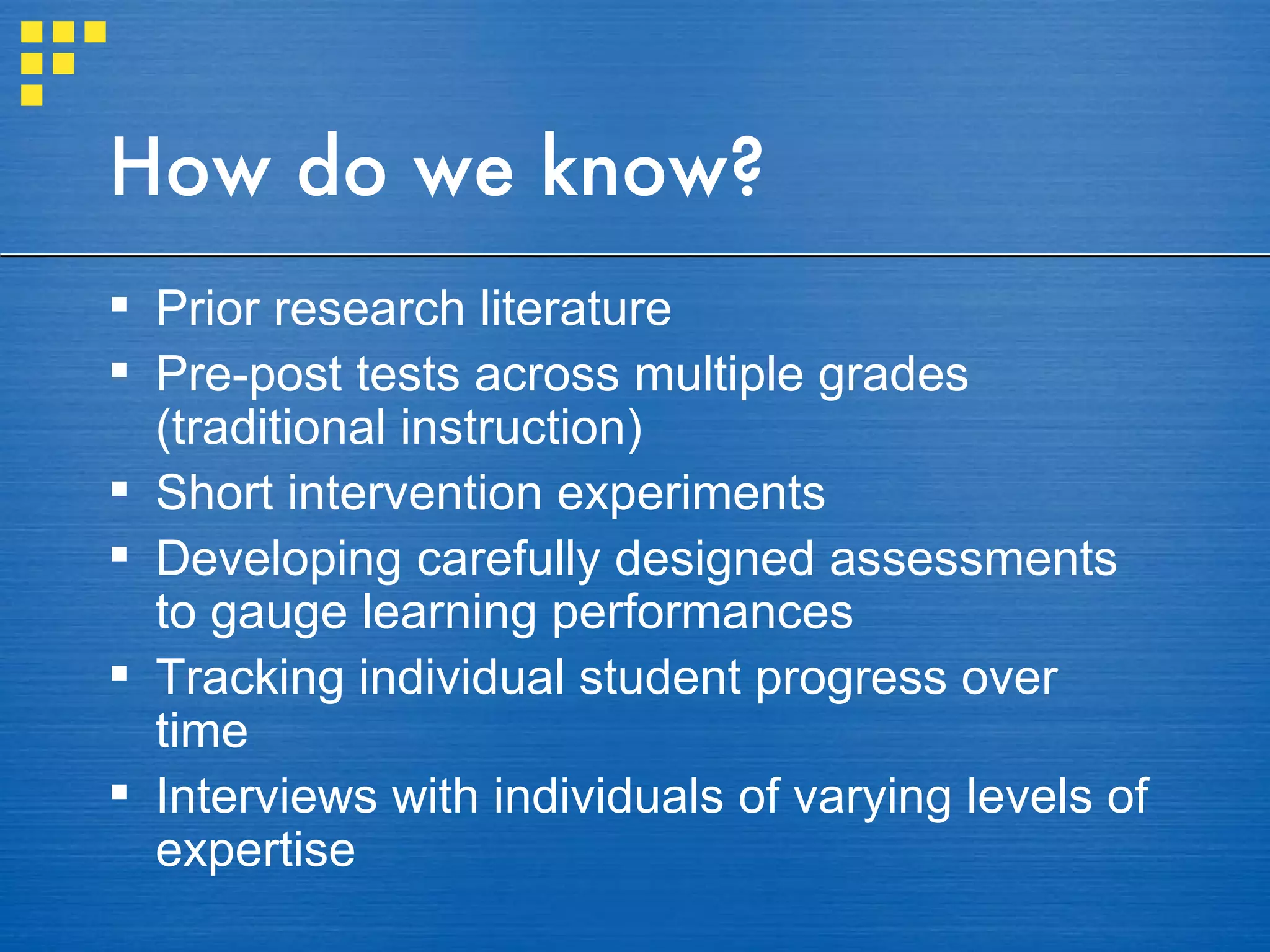
How do we know? Prior research literature Pre-post tests across multiple grades (traditional instruction) Short intervention experiments Developing carefully designed assessments to gauge learning performances  Tracking individual student progress over time  Interviews with individuals of varying levels of expertise
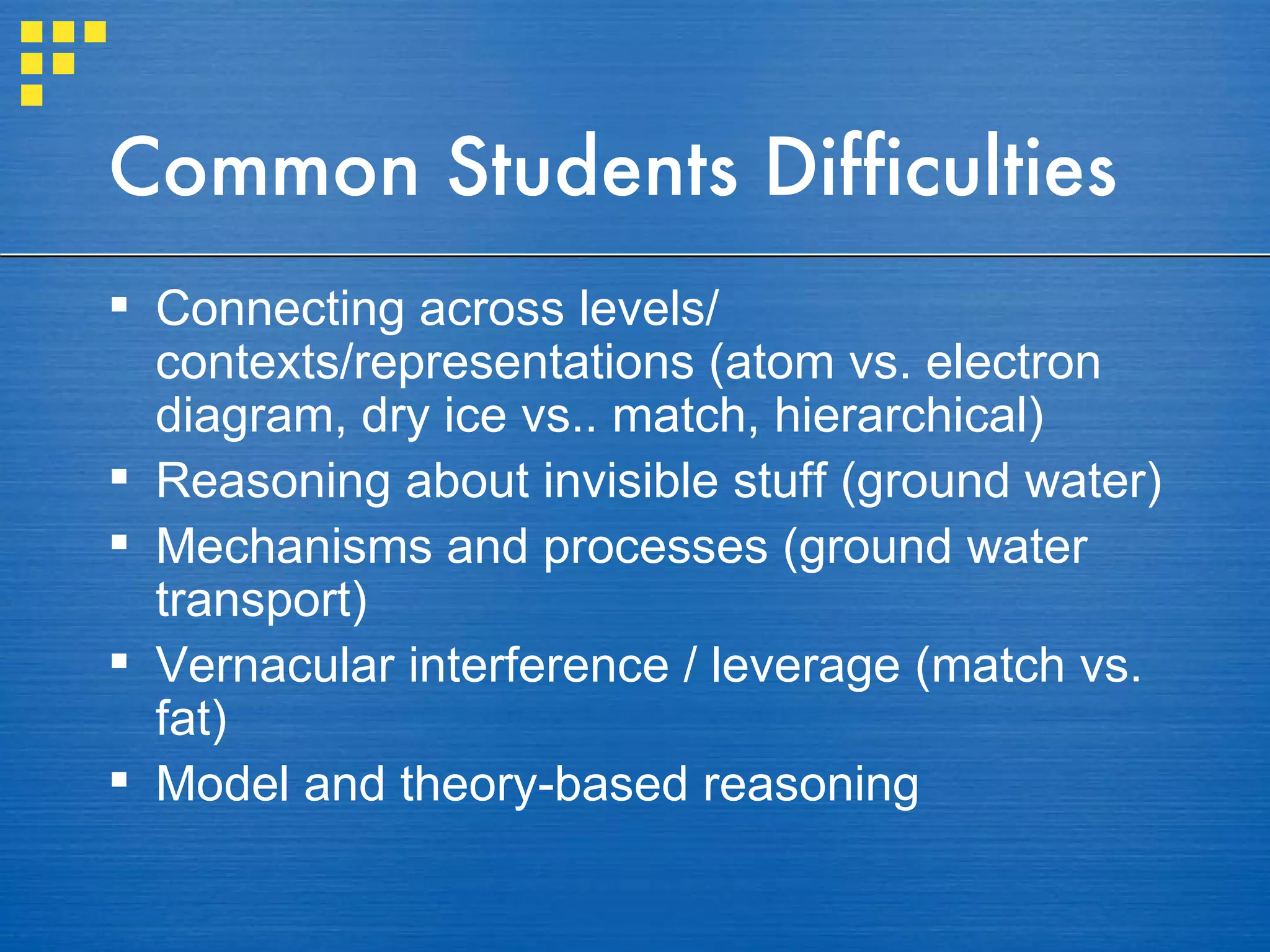
Common Students Difficulties Connecting across levels/ contexts/representations (atom vs. electron diagram, dry ice vs.. match, hierarchical) Reasoning about invisible stuff (ground water) Mechanisms and processes (ground water transport) Vernacular interference / leverage (match vs. fat) Model and theory-based reasoning
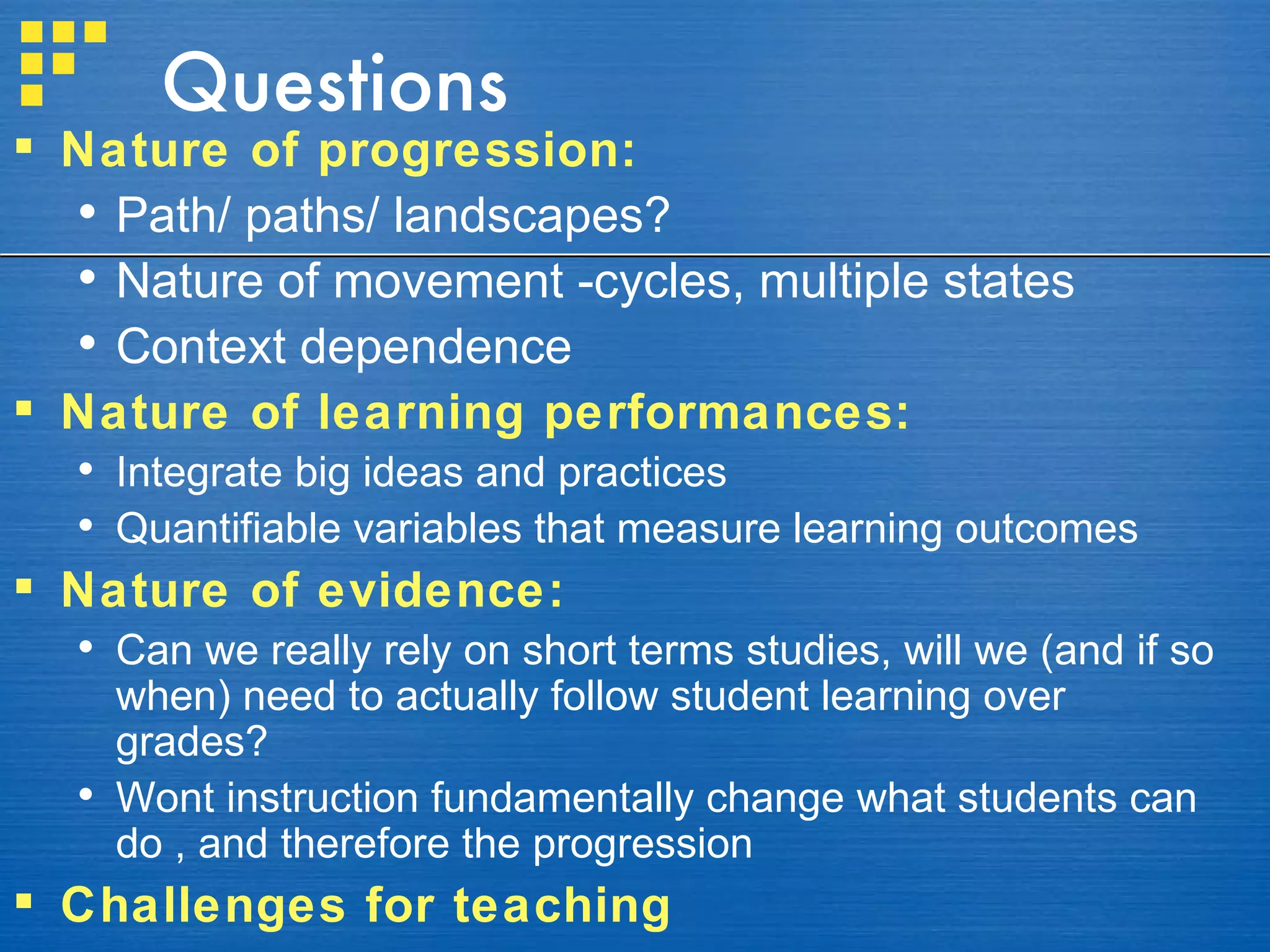
Questions Nature of progression: Path/ paths/ landscapes? Nature of movement -cycles, multiple states Context dependence Nature of learning performances: Integrate big ideas and practices  Quantifiable variables that measure learning outcomes Nature of evidence: Can we really rely on short terms studies, will we (and if so when) need to actually follow student learning over grades? Wont instruction fundamentally change what students can do , and therefore the progression Challenges for teaching
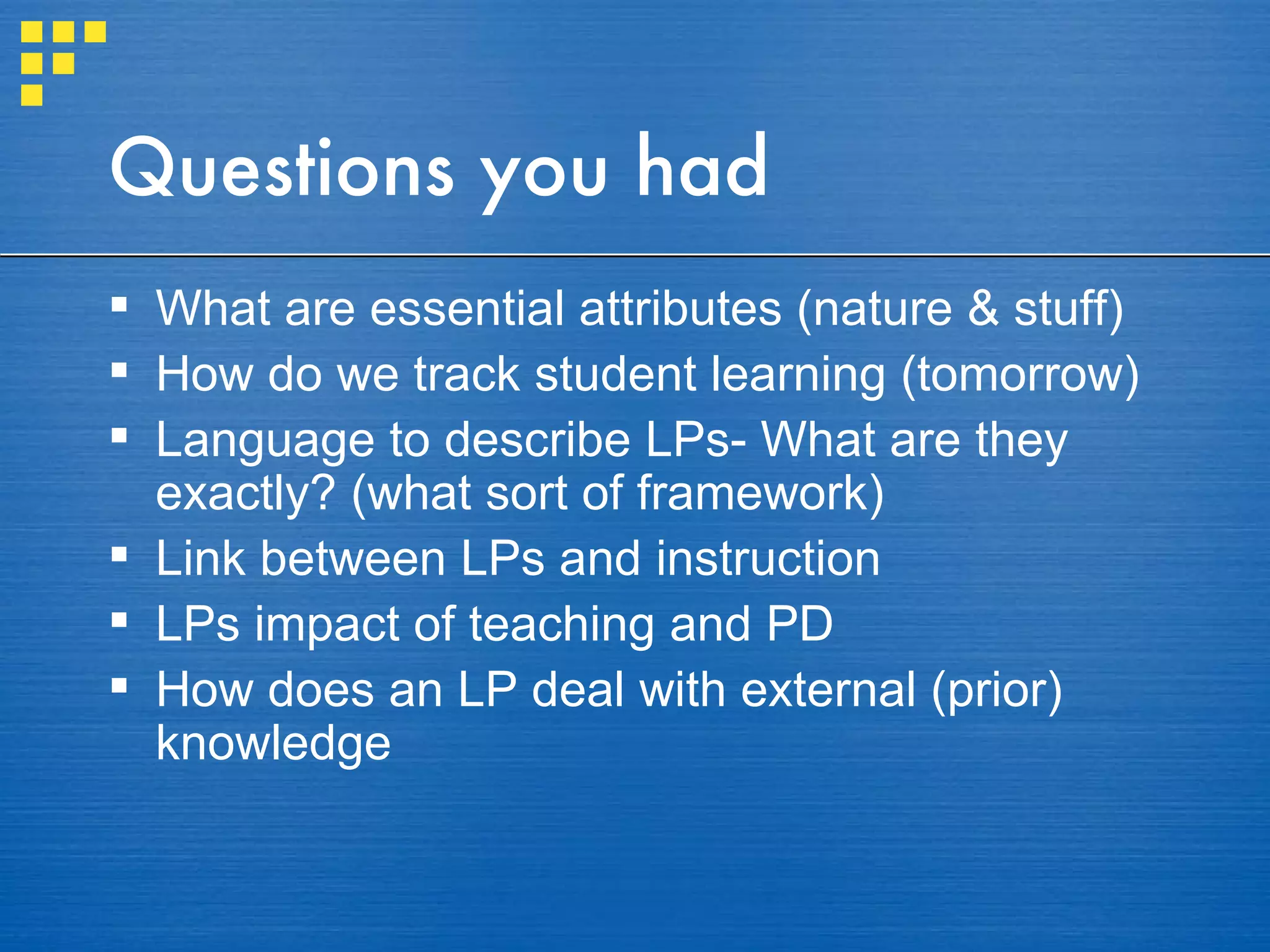
Questions you had What are essential attributes (nature & stuff) How do we track student learning (tomorrow) Language to describe LPs- What are they exactly? (what sort of framework) Link between LPs and instruction LPs impact of teaching and PD How does an LP deal with external (prior) knowledge

Learning progressions

  • 1.
    Learning Progressions: A Discussion Ravit Golan Duncan Rutgers University
  • 2.
    Learning Progressions Whatare they (nature of LP) Why we need them (motivation) How do we build them
  • 3.
    Commonalities Progression overlarger time units Deepening of ideas and level of sophistication (conceptual framework) Change in terms of what kids can do over time (performances) Based on research on student learning
  • 4.
    Contrast to standardsPropositional Limited research base Organization is problematic, and too many ideas Not conducive to design of assessments that track student learning over time. Older content Performance More extensive research based Organization based on big ideas/practices Leads to development of assessments that can evaluate progression Strives for cutting edge
  • 5.
    Differences Motivation- whatwas the driving force to develop the progression Nature of progression- what does it mean to move along the progression The “stuff” of progressions- what are the big ideas? How do we know what we know? Building progressions Questions that remain
  • 6.
    Motivation Environmental literacy-informed and active citizenry
  • 7.
    Environmental literacy TheoreticalFramework-Key Practices for Literacy (1) Scientific inquiry: developing and evaluating scientific arguments from evidence, (2) Scientific accounts: using scientific accounts of the material world, (3) Application: using scientific accounts as tools to predict and explain, and (4) Citizenship: using scientific reasoning for responsible citizenship.
  • 8.
    Motivation Environmental literacy-informed and active citizenry Students superficial understanding of current school science content (standards-based)
  • 9.
    Motivation Students who can write this equation for combustion: CH 4 + 2O 2 CO 2 + 2H 2 O often cannot answer: "When a house burns to the ground and only a few pieces of charred wood and ashes are left, what happens to the rest of the mass of the house?” (AAAS Project 2061 conference 2001)
  • 10.
    Motivation Environmental literacy-informed and active citizenry Students superficial understanding of current school science content (standards-based) Integrate cutting edge science into curriculum; Discrepancy between Atlas progressions and understandings students need for nano-scale science (as well as science education research on student learning, learning not linear)
  • 11.
    Motivation Based on Benchmarks , AAAS developed a progression of concepts for several aspects of the ‘Structure of Matter’ Rather linear and ordered progression Forces & Interactions Properties of Matter Conservation of Matter States of Matter Atoms & Molecules Chemical Reactions
  • 12.
    Nature of ProgressionDeveloping practices of environmental literacy- understanding and using environmental science to make decisions at different levels (apply principles to different systems) Progress along model from novice to expert- notions- recognition - formulation- construction -generation Making connections- developing web of interconnected ideas
  • 13.
    The “Stuff” ofProgressions Interdisciplinary- coupled human and natural systems life, physical and earth science ideas Tightly woven with inquiry and practices of responsible citizenship From observations to models and theories Applying fundamental principles to processes in systems (carbon and water cycles; systems) Democratic participation and reconciling values and consequences
  • 14.
    The “Stuff” ofProgressions 5 Generation : Research 4 Construction : Examining assumptions, relating models 3 Formulation : Relating ideas and concepts, simple models 2 Recognition : Language, definitions, symbols algorithms 1 Notions : Everyday experience, logical reasoning novice expert student understanding Progress variables linked to curriculum
  • 15.
    The “Stuff” ofProgressions I. Notions II. Recognition III. Formulation Student levels of understanding Stuff happens Solid, liquid, gas Chemical equations, conservation of mass (atoms/stuff/grams) Atomic symbols, octet rule Change Matter number mole mass macro particulate conservation
  • 16.
    The “Stuff” ofProgressions An intricate web of interconnected concepts Multidimensional States of Matter Forces & Interactions Properties of Matter Chemical Reactions Conservation of Matter Atoms & Molecules
  • 17.
    How do weknow? Prior research literature Pre-post tests across multiple grades (traditional instruction) Short intervention experiments Developing carefully designed assessments to gauge learning performances Tracking individual student progress over time Interviews with individuals of varying levels of expertise
  • 18.
    Common Students DifficultiesConnecting across levels/ contexts/representations (atom vs. electron diagram, dry ice vs.. match, hierarchical) Reasoning about invisible stuff (ground water) Mechanisms and processes (ground water transport) Vernacular interference / leverage (match vs. fat) Model and theory-based reasoning
  • 19.
    Questions Nature ofprogression: Path/ paths/ landscapes? Nature of movement -cycles, multiple states Context dependence Nature of learning performances: Integrate big ideas and practices Quantifiable variables that measure learning outcomes Nature of evidence: Can we really rely on short terms studies, will we (and if so when) need to actually follow student learning over grades? Wont instruction fundamentally change what students can do , and therefore the progression Challenges for teaching
  • 20.
    Questions you hadWhat are essential attributes (nature & stuff) How do we track student learning (tomorrow) Language to describe LPs- What are they exactly? (what sort of framework) Link between LPs and instruction LPs impact of teaching and PD How does an LP deal with external (prior) knowledge