French Language Lecture
Level A2
Futur Proche
What is the futur proche?
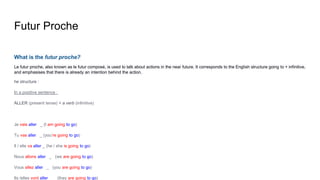
Le futur proche, also known as le futur composé, is used to talk about actions in the near future. It corresponds to the English structure going to + infinitive,
and emphasises that there is already an intention behind the action.
he structure :
In a positive sentence :
ALLER (present tense) + a verb (infinitive)
Je vais aller _ (I am going to go)
Tu vas aller _ (you’re going to go)
Il / elle va aller _ (he / she is going to go)
Nous allons aller _ (we are going to go)
Vous allez aller _ (you are going to go)
Ils /elles vont aller _ (they are going to go)
Other examples :
Je vais manger chez mes grands parents.
Elle va dormir chez ses amies.
On va faire du vélo ce week end.
In a negative sentence :
The first verb of the two always gets the negation. (Note that the same thing happens in English)
Je ne vais pas aller _ (I’m not going to go)
Tu ne vas pas aller _ (You are not going to go)
Il / elle ne va pas aller _ (He / She is not going to go)
Nous n’allons pas aller _ (We are not going to go)
Vous n’allez pas aller _ (You are not going to go)
Ils / elles ne vont pas aller _ (They are not going to go)
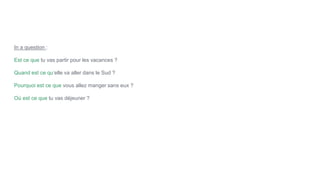
In a question :
Est ce que tu vas partir pour les vacances ?
Quand est ce qu’elle va aller dans le Sud ?
Pourquoi est ce que vous allez manger sans eux ?
Où est ce que tu vas déjeuner ?
How to use French in Daily Life
Greetings
Greetings, like with all conversations is how an introduction in the French language will start. A standard greeting that you
can’t go wrong with is bonjour (good day). Though it translates to “good day” it is as universal as the English “hello.” Bonjour
can also be used at most times of the day, and can in both formal and informal scenarios.
For more specific times of the day, you can say bon matin (good morning) or bonsoir (good evening). Bonne nuit (good
night), however, is generally used to say goodbye when it’s late at night or when you’re heading to bed so best not to use
this one as a greeting.
For a greeting not bound to any particular time of the day, you can use the trusted salut (hello). Lastly, if you’re talking to
someone on the phone, it’s customary to answer with âllo (hello).
Your Name
If someone asks you for your name, they will say comment t’appelles-tu ? (What is your name?). This is the
informal option. The formal version of this question is comment vous appelez-vous ? (What is your name?).
To answer this question, begin your sentence with je m’appelle… (I call myself…) and then say your name.
You could also say je suis… (I am…) and then your name.
In return, it’s always polite to ask for the other person’s name. Remember to think about whether the formal or
informal version of the question is more appropriate. Alternatively, you could simply ask et tu ? (and you?) for
informal situations and et vous ? (and you?) for formal situations.
Your Basic Information
Now that you’ve got the pleasantries out of the way and your conversation partner knows you by name, it’s time for them to get to know
you a little better. Sharing basic information is the first step to making French friends and acquaintances!
Where are you from?
The common questions you might get asked include d’où venez-vous ? (where are you from?), or the informal version d’où viens-tu ?.
This question is generally asking for your country or region of origin, but it’s also appropriate to name a major city such as New York or
London.To answer this question, you can say ** je viens de…** (I am from) followed by the name of the place.
You may also get asked où habitez-vous ? (where do you live?) or the informal version où habites-tu ?. You can answer the question
by saying J’habite à… (I live in…) followed by the name of the city, town or village where you’re currently living.
What do you do?
Another common topic of conversation when getting to know eachother better is asking “what do you do for work?” In French, you can say quel est ton travail ? (what is your job?) or the more formal version quel
est votre travail ? To answer, you can simply say je suis… (I am) followed by the name of your job or profession. Here are some common job titles in French:
Gérant/Gérante - Manager
Enseignant/Enseignante - Teacher
Infirmier/Infirmière - Nurse
Écrivain - Writer
Peintre - Painter
Boulanger/Boulangère - Baker
Coiffeur/Coiffeuse - Hairdresser
Do you have any hobbies?
Okay, the conversation is going well, good job! You’ve nailed the basics and now you just need something
interesting to talk about - your interests and hobbies!
Questions around this topic may sound like qu’est-ce que tu aimes faire ? (what do you like to do?) or the
formal qu’est-ce que vous aimez faire ?. To answer this question, you can say j’aime… (I like) and then list a
noun or a verb. For example, j’aime voyager, lire et étudier les langues étrangères (I like to travel, read and
study foreign languages).
You could also say** je m’intéresse à…** (I am interested in) and then name a noun or two. For example, je
m’intéresse à la culture française (I am interested in French culture).
Goodbye
To politely end the conversation (or when the conversation has come to a natural end), you can say enchanté
(charmed) to indicate that you’ve been happy to meet someone. In formal contexts, c’est un plaisir de faire
votre connaissance (it is a pleasure to make your acquaintaince) or c’est un plaisir de vous rencontrer (it is a
pleasure to meet you) would be more appropriate.
Then, to say goodbye, you can say au revoir (goodbye) or the less formal à bientôt (see you later).
And there you have it, you have just made a nouvel ami français (new French friend)!
Introducing Family in French
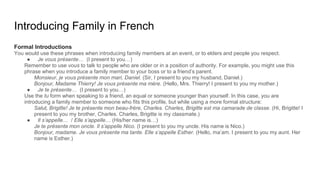
Formal Introductions
You would use these phrases when introducing family members at an event, or to elders and people you respect.
● Je vous présente… (I present to you…)
Remember to use vous to talk to people who are older or in a position of authority. For example, you might use this
phrase when you introduce a family member to your boss or to a friend’s parent.
Monsieur, je vous présente mon mari, Daniel. (Sir, I present to you my husband, Daniel.)
Bonjour, Madame Thierry! Je vous présente ma mère. (Hello, Mrs. Thierry! I present to you my mother.)
● Je te présente… (I present to you…)
Use the tu form when speaking to a friend, an equal or someone younger than yourself. In this case, you are
introducing a family member to someone who fits this profile, but while using a more formal structure:
Salut, Brigitte! Je te présente mon beau-frère, Charles. Charles, Brigitte est ma camarade de classe. (Hi, Brigitte! I
present to you my brother, Charles. Charles, Brigitte is my classmate.)
● Il s’appelle… / Elle s’appelle… (His/her name is…)
Je te présente mon oncle. Il s’appelle Nico. (I present to you my uncle. His name is Nico.)
Bonjour, madame. Je vous présente ma tante. Elle s’appelle Esther. (Hello, ma’am. I present to you my aunt. Her
name is Esther.)
Informal Introductions
You would use these informal introductions with your close pals. Sometimes people use these terms as quick
introductions if they are in a hurry or distracted. Let’s say your mom randomly walks into the room while you
guys are playing video games. You don’t have time for formalities, you’ve got dragons to kill!
● C’est… (This is…)
C’est is a casual way to say, “This is.”
Salut! C’est mon cousin. (Hi! This is my cousin.)
● Voilà… (Here is…)
This would be used in a situation when you are surprised to see someone. For example, if you weren’t
expecting a family member to walk in at that moment, you use voilà as a quick announcement of their
arrival.
Oh, voilà ma femme! (Oh, here is my wife!)
Example - Bonjour! Je m’appelle XYZ . J’ai 20 ans. Dans ma famille, il y a 5 membres. Dans ma famille, ma
mère, mon grand-père, ma grand-mère,mon oncle et moi. Ma mère a 49 ans, mon grand-père a 85 ans, ma grand-
mère a 85 ans et mon oncle a 48 ans. Ma mère est calme, belle, sincère, brune, élégante et optimiste! Elle est
professeur. Mon grand-pere est grand, il cheveux c’est blanc. Il parle beaucoup! Ma grand-mere cheveux blanc.
Elle est petite, cultivée et gentille. Mon oncle est intelligent, grand, sportif. Il est amusant! Il habite Spain. Il est
mari.
Talking about City
Talking about where you live in French
In French, to talk about where you live, you can mention the type of home you are living in (house, flat…) or you can say in which
country or city you live in. So, we are going to see how to build sentences.
Types of home
-To talk about the type of home you are living in, we will start the sentence with “j’habite dans…” (I live in…).
J’habite dans (I live in)
Tu habite dans (you live in)
Nous habitons dans (we live in)
un appartement (a flat)
une maison (a house)
un immeuble (a block of flats)
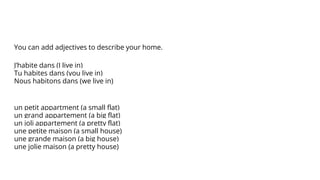
You can add adjectives to describe your home.
J’habite dans (I live in)
Tu habites dans (you live in)
Nous habitons dans (we live in)
un petit appartment (a small flat)
un grand appartement (a big flat)
un joli appartement (a pretty flat)
une petite maison (a small house)
une grande maison (a big house)
une jolie maison (a pretty house)
Countries and cities
To talk about the country or city you live in, we will say “j’habite en/au/aux/à”. So let’s see together when do you use
“en”, “au, “aux and ” à”.
“En” is used for countries that are feminine “j’habite en France” (I live in France), “France” is female, we say “la France”.
“Au” is used for countries that are masculine “j’habite au Canada” (I live in Canada), “Canada” is male, we say “le
Canada”.
“Aux” is used for plurals “j’habites aux Etats-Unis” (I live in United States), “Etats-Unis” is plural, we say “les Etats-Unis”.
” à” is used for cities “j’habite à Paris” (I live in Paris).
Examples of female countries:
L’Espagne (Spain)
L’Angleterre (England)
La Chine (China)
L’Argentine (Argentina)
La Colombie (Colombia)
L’Inde (India)
Examples of male countries:
Le Portugal (Portugal)
Le Mexique (Mexico)
Le Pays de Galles (Wales)
Le Brésil (Brazil)
Le Japon (Japan)
Le Danemark (Denmark)
Le Maroc (Morocco)
Le Liban (Lebanon)
Le Pérou (Peru)
Further examples
Nous habitons dans une petite maison en Allemagne.
We live in a small house in Germany.
Ils habitent dans une grande maison en Australie.
They live in a big house in Australia.
Tu habites dans un appartement à Marseille.
You live in a flat in Marseille.
Common Questions in French
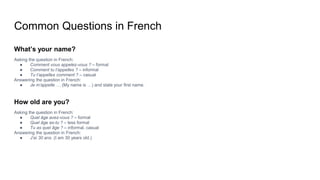
What’s your name?
Asking the question in French:
● Comment vous appelez-vous ? – formal
● Comment tu t’appelles ? – informal
● Tu t’appelles comment ? – casual
Answering the question in French:
● Je m’appelle … (My name is …) and state your first name.
How old are you?
Asking the question in French:
● Quel âge avez-vous ? – formal
● Quel âge as-tu ? – less formal
● Tu as quel âge ? – informal, casual
Answering the question in French:
● J’ai 30 ans. (I am 30 years old.)
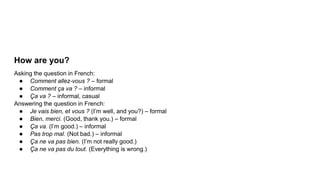
How are you?
Asking the question in French:
● Comment allez-vous ? – formal
● Comment ça va ? – informal
● Ça va ? – informal, casual
Answering the question in French:
● Je vais bien, et vous ? (I’m well, and you?) – formal
● Bien, merci. (Good, thank you.) – formal
● Ça va. (I’m good.) – informal
● Pas trop mal. (Not bad.) – informal
● Ça ne va pas bien. (I’m not really good.)
● Ça ne va pas du tout. (Everything is wrong.)
Getting personal
Where are you from?
Asking the question in French:
● D’où venez-vous ? – formal
● D’où viens-tu ? – less formal
● Tu viens d’où ? – informal, casual
Answering the question in French:
● Je viens de/du … (I’m from …)
You can end this sentence with the name of a country or a city.
For example:
● Je viens de Lyon. (I’m from Lyon.)
● Je viens du Portugal. (I’m from Portugal.)
Where do you live?
Asking the question in French:
● Où habitez-vous? – formal
● Tu habites où? – informal
Answering the question in French:
● J’habite à … (I live in …) and state the name of the city you live in.
● J’habite près de … (I live near …) and state the name of the closest well-known city next to yours.
For example:
● J’habite à Paris. (I live in Paris.)
● J’habite près de New York. (I live near New York.)
What do you study?
Asking the question in French:
● Vous étudiez quoi ? – formal
● Vous faites quoi comme études ? – formal
● Tu étudies quoi ? – informal
● Tu fais quoi comme études ? – informal
Answering the question in French:
● J’étudie … (I study …) and state what you study as a noun.
● Je fais de/du … (I study) and state what you study as a noun.
● Je fais des études en … (I study …) and state your field of study.
For example:
● J’étudie la psychologie. (I study psychology.)
● Je fais du droit. (I study law.)
● Je fais des études en médecine. (I study medicine.)
What do you do for a living?
Asking the question in French:
● Quel est votre métier ? – formal
● Quel est ton métier ? – informal
● Vous faites quoi comme métier ? – formal, casual
● Tu fais quoi comme métier ? – informal, casual
Answering the question in French:
● Je suis … (I am a …) and state your job.
Socializing
What are you going to do this weekend?
Asking the question in French:
● Qu’allez-vous faire ce week-end ? – formal
● Qu’est-ce que vous allez faire ce week-end ? – less formal
● Qu’est-ce que tu vas faire ce week-end ? – informal
● Tu vas faire quoi ce week-end ? – casual
Answering the question in French:
● Je vais … (I’m going to …)
For example,
● Je vais voir mes amis. (I’m going to see my friends.)
● Je vais faire du sport. (I’m going to workout.)
● Je vais faire du shopping. (I’m going to go shopping.)
Where are you going?
Asking the question in French:
● Où allez-vous ? – formal
● Tu vas où ? – informal
Answering the question in French:
● Je vais au centre commercial. (I’m going to the mall.)
● Je vais à la salle de sport. (I’m going to the gym.)
● Je vais voir mes amis. (I’m going to see my friends.)
● Je vais courir. (I’m going to run.)
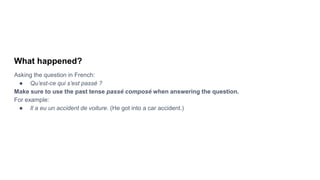
What happened?
Asking the question in French:
● Qu’est-ce qui s’est passé ?
Make sure to use the past tense passé composé when answering the question.
For example:
● Il a eu un accident de voiture. (He got into a car accident.)
What’s the weather like?
Asking the question in French:
● Quel temps fait-il ? – formal
● Il fait quel temps ? – informal
Answering the question in French:
● Il fait beau. (It’s sunny.)
● Il fait chaud. (It’s hot.)
● Il fait mauvais. (It’s bad.)
● Il fait froid. (It’s cold.)
What time is it?
Asking the question in French:
● Quelle heure est-il ? – formal
● Il est quelle heure ? – informal
Answering the question in French:
● Il est 10 heures et demie. (It’s 10:30)
● Il est midi. (It’s noon.)
● Il est 14 h. (It’s 2 p.m.)
What day is it?
Asking the question in French:
● Quel jour sommes-nous ? – formal
● On est quel jour ? – informal
Answering the question in French:
● Nous sommes mercredi. (It’s Wednesday.) – formal
● On est mercredi. (It’s Wednesday.) – informal
How much does it cost?
Asking the question in French:
● Combien ça coûte ?
● Ça coûte combien ? – informal
● C’est combien ? – casual
Answering the question in French:
● Ça coûte dix euros. (It’s ten euros.)
● Ça coûte 3 €. (It’s 3 €.)
Do you speak English?
Asking the question in French:
● Parlez-vous anglais ? – formal
● Tu parles anglais ? – informal
Answering the question in French:
● Oui, je parle anglais. (Yes, I speak English.)
● Un peu. (A little bit.)
How do you spell that?
When you’re learning a new French word but are not sure how to spell it, you can ask:
● Comment écrivez-vous ça ? – formal
● Comment ça s’écrit ? – informal
● Ça s’écrit comment ? – casual

A2 Lecture 15 .pptx

  • 1.
  • 2.
    Futur Proche What isthe futur proche? Le futur proche, also known as le futur composé, is used to talk about actions in the near future. It corresponds to the English structure going to + infinitive, and emphasises that there is already an intention behind the action. he structure : In a positive sentence : ALLER (present tense) + a verb (infinitive) Je vais aller _ (I am going to go) Tu vas aller _ (you’re going to go) Il / elle va aller _ (he / she is going to go) Nous allons aller _ (we are going to go) Vous allez aller _ (you are going to go) Ils /elles vont aller _ (they are going to go)
  • 3.
    Other examples : Jevais manger chez mes grands parents. Elle va dormir chez ses amies. On va faire du vélo ce week end. In a negative sentence : The first verb of the two always gets the negation. (Note that the same thing happens in English) Je ne vais pas aller _ (I’m not going to go) Tu ne vas pas aller _ (You are not going to go) Il / elle ne va pas aller _ (He / She is not going to go) Nous n’allons pas aller _ (We are not going to go) Vous n’allez pas aller _ (You are not going to go) Ils / elles ne vont pas aller _ (They are not going to go)
  • 4.
    In a question: Est ce que tu vas partir pour les vacances ? Quand est ce qu’elle va aller dans le Sud ? Pourquoi est ce que vous allez manger sans eux ? Où est ce que tu vas déjeuner ?
  • 5.
    How to useFrench in Daily Life Greetings Greetings, like with all conversations is how an introduction in the French language will start. A standard greeting that you can’t go wrong with is bonjour (good day). Though it translates to “good day” it is as universal as the English “hello.” Bonjour can also be used at most times of the day, and can in both formal and informal scenarios. For more specific times of the day, you can say bon matin (good morning) or bonsoir (good evening). Bonne nuit (good night), however, is generally used to say goodbye when it’s late at night or when you’re heading to bed so best not to use this one as a greeting. For a greeting not bound to any particular time of the day, you can use the trusted salut (hello). Lastly, if you’re talking to someone on the phone, it’s customary to answer with âllo (hello).
  • 6.
    Your Name If someoneasks you for your name, they will say comment t’appelles-tu ? (What is your name?). This is the informal option. The formal version of this question is comment vous appelez-vous ? (What is your name?). To answer this question, begin your sentence with je m’appelle… (I call myself…) and then say your name. You could also say je suis… (I am…) and then your name. In return, it’s always polite to ask for the other person’s name. Remember to think about whether the formal or informal version of the question is more appropriate. Alternatively, you could simply ask et tu ? (and you?) for informal situations and et vous ? (and you?) for formal situations.
  • 7.
    Your Basic Information Nowthat you’ve got the pleasantries out of the way and your conversation partner knows you by name, it’s time for them to get to know you a little better. Sharing basic information is the first step to making French friends and acquaintances! Where are you from? The common questions you might get asked include d’où venez-vous ? (where are you from?), or the informal version d’où viens-tu ?. This question is generally asking for your country or region of origin, but it’s also appropriate to name a major city such as New York or London.To answer this question, you can say ** je viens de…** (I am from) followed by the name of the place. You may also get asked où habitez-vous ? (where do you live?) or the informal version où habites-tu ?. You can answer the question by saying J’habite à… (I live in…) followed by the name of the city, town or village where you’re currently living.
  • 8.
    What do youdo? Another common topic of conversation when getting to know eachother better is asking “what do you do for work?” In French, you can say quel est ton travail ? (what is your job?) or the more formal version quel est votre travail ? To answer, you can simply say je suis… (I am) followed by the name of your job or profession. Here are some common job titles in French: Gérant/Gérante - Manager Enseignant/Enseignante - Teacher Infirmier/Infirmière - Nurse Écrivain - Writer Peintre - Painter Boulanger/Boulangère - Baker Coiffeur/Coiffeuse - Hairdresser
  • 9.
    Do you haveany hobbies? Okay, the conversation is going well, good job! You’ve nailed the basics and now you just need something interesting to talk about - your interests and hobbies! Questions around this topic may sound like qu’est-ce que tu aimes faire ? (what do you like to do?) or the formal qu’est-ce que vous aimez faire ?. To answer this question, you can say j’aime… (I like) and then list a noun or a verb. For example, j’aime voyager, lire et étudier les langues étrangères (I like to travel, read and study foreign languages). You could also say** je m’intéresse à…** (I am interested in) and then name a noun or two. For example, je m’intéresse à la culture française (I am interested in French culture).
  • 10.
    Goodbye To politely endthe conversation (or when the conversation has come to a natural end), you can say enchanté (charmed) to indicate that you’ve been happy to meet someone. In formal contexts, c’est un plaisir de faire votre connaissance (it is a pleasure to make your acquaintaince) or c’est un plaisir de vous rencontrer (it is a pleasure to meet you) would be more appropriate. Then, to say goodbye, you can say au revoir (goodbye) or the less formal à bientôt (see you later). And there you have it, you have just made a nouvel ami français (new French friend)!
  • 11.
    Introducing Family inFrench Formal Introductions You would use these phrases when introducing family members at an event, or to elders and people you respect. ● Je vous présente… (I present to you…) Remember to use vous to talk to people who are older or in a position of authority. For example, you might use this phrase when you introduce a family member to your boss or to a friend’s parent. Monsieur, je vous présente mon mari, Daniel. (Sir, I present to you my husband, Daniel.) Bonjour, Madame Thierry! Je vous présente ma mère. (Hello, Mrs. Thierry! I present to you my mother.) ● Je te présente… (I present to you…) Use the tu form when speaking to a friend, an equal or someone younger than yourself. In this case, you are introducing a family member to someone who fits this profile, but while using a more formal structure: Salut, Brigitte! Je te présente mon beau-frère, Charles. Charles, Brigitte est ma camarade de classe. (Hi, Brigitte! I present to you my brother, Charles. Charles, Brigitte is my classmate.) ● Il s’appelle… / Elle s’appelle… (His/her name is…) Je te présente mon oncle. Il s’appelle Nico. (I present to you my uncle. His name is Nico.) Bonjour, madame. Je vous présente ma tante. Elle s’appelle Esther. (Hello, ma’am. I present to you my aunt. Her name is Esther.)
  • 12.
    Informal Introductions You woulduse these informal introductions with your close pals. Sometimes people use these terms as quick introductions if they are in a hurry or distracted. Let’s say your mom randomly walks into the room while you guys are playing video games. You don’t have time for formalities, you’ve got dragons to kill! ● C’est… (This is…) C’est is a casual way to say, “This is.” Salut! C’est mon cousin. (Hi! This is my cousin.) ● Voilà… (Here is…) This would be used in a situation when you are surprised to see someone. For example, if you weren’t expecting a family member to walk in at that moment, you use voilà as a quick announcement of their arrival. Oh, voilà ma femme! (Oh, here is my wife!)
  • 13.
    Example - Bonjour!Je m’appelle XYZ . J’ai 20 ans. Dans ma famille, il y a 5 membres. Dans ma famille, ma mère, mon grand-père, ma grand-mère,mon oncle et moi. Ma mère a 49 ans, mon grand-père a 85 ans, ma grand- mère a 85 ans et mon oncle a 48 ans. Ma mère est calme, belle, sincère, brune, élégante et optimiste! Elle est professeur. Mon grand-pere est grand, il cheveux c’est blanc. Il parle beaucoup! Ma grand-mere cheveux blanc. Elle est petite, cultivée et gentille. Mon oncle est intelligent, grand, sportif. Il est amusant! Il habite Spain. Il est mari.
  • 14.
    Talking about City Talkingabout where you live in French In French, to talk about where you live, you can mention the type of home you are living in (house, flat…) or you can say in which country or city you live in. So, we are going to see how to build sentences. Types of home -To talk about the type of home you are living in, we will start the sentence with “j’habite dans…” (I live in…). J’habite dans (I live in) Tu habite dans (you live in) Nous habitons dans (we live in) un appartement (a flat) une maison (a house) un immeuble (a block of flats)
  • 15.
    You can addadjectives to describe your home. J’habite dans (I live in) Tu habites dans (you live in) Nous habitons dans (we live in) un petit appartment (a small flat) un grand appartement (a big flat) un joli appartement (a pretty flat) une petite maison (a small house) une grande maison (a big house) une jolie maison (a pretty house)
  • 16.
    Countries and cities Totalk about the country or city you live in, we will say “j’habite en/au/aux/à”. So let’s see together when do you use “en”, “au, “aux and ” à”. “En” is used for countries that are feminine “j’habite en France” (I live in France), “France” is female, we say “la France”. “Au” is used for countries that are masculine “j’habite au Canada” (I live in Canada), “Canada” is male, we say “le Canada”. “Aux” is used for plurals “j’habites aux Etats-Unis” (I live in United States), “Etats-Unis” is plural, we say “les Etats-Unis”.
  • 17.
    ” à” isused for cities “j’habite à Paris” (I live in Paris). Examples of female countries: L’Espagne (Spain) L’Angleterre (England) La Chine (China) L’Argentine (Argentina) La Colombie (Colombia) L’Inde (India) Examples of male countries: Le Portugal (Portugal) Le Mexique (Mexico) Le Pays de Galles (Wales) Le Brésil (Brazil) Le Japon (Japan) Le Danemark (Denmark) Le Maroc (Morocco) Le Liban (Lebanon) Le Pérou (Peru)
  • 18.
    Further examples Nous habitonsdans une petite maison en Allemagne. We live in a small house in Germany. Ils habitent dans une grande maison en Australie. They live in a big house in Australia. Tu habites dans un appartement à Marseille. You live in a flat in Marseille.
  • 19.
    Common Questions inFrench What’s your name? Asking the question in French: ● Comment vous appelez-vous ? – formal ● Comment tu t’appelles ? – informal ● Tu t’appelles comment ? – casual Answering the question in French: ● Je m’appelle … (My name is …) and state your first name. How old are you? Asking the question in French: ● Quel âge avez-vous ? – formal ● Quel âge as-tu ? – less formal ● Tu as quel âge ? – informal, casual Answering the question in French: ● J’ai 30 ans. (I am 30 years old.)
  • 20.
    How are you? Askingthe question in French: ● Comment allez-vous ? – formal ● Comment ça va ? – informal ● Ça va ? – informal, casual Answering the question in French: ● Je vais bien, et vous ? (I’m well, and you?) – formal ● Bien, merci. (Good, thank you.) – formal ● Ça va. (I’m good.) – informal ● Pas trop mal. (Not bad.) – informal ● Ça ne va pas bien. (I’m not really good.) ● Ça ne va pas du tout. (Everything is wrong.)
  • 21.
    Getting personal Where areyou from? Asking the question in French: ● D’où venez-vous ? – formal ● D’où viens-tu ? – less formal ● Tu viens d’où ? – informal, casual Answering the question in French: ● Je viens de/du … (I’m from …) You can end this sentence with the name of a country or a city. For example: ● Je viens de Lyon. (I’m from Lyon.) ● Je viens du Portugal. (I’m from Portugal.)
  • 22.
    Where do youlive? Asking the question in French: ● Où habitez-vous? – formal ● Tu habites où? – informal Answering the question in French: ● J’habite à … (I live in …) and state the name of the city you live in. ● J’habite près de … (I live near …) and state the name of the closest well-known city next to yours. For example: ● J’habite à Paris. (I live in Paris.) ● J’habite près de New York. (I live near New York.)
  • 23.
    What do youstudy? Asking the question in French: ● Vous étudiez quoi ? – formal ● Vous faites quoi comme études ? – formal ● Tu étudies quoi ? – informal ● Tu fais quoi comme études ? – informal Answering the question in French: ● J’étudie … (I study …) and state what you study as a noun. ● Je fais de/du … (I study) and state what you study as a noun. ● Je fais des études en … (I study …) and state your field of study. For example: ● J’étudie la psychologie. (I study psychology.) ● Je fais du droit. (I study law.) ● Je fais des études en médecine. (I study medicine.) What do you do for a living?
  • 24.
    Asking the questionin French: ● Quel est votre métier ? – formal ● Quel est ton métier ? – informal ● Vous faites quoi comme métier ? – formal, casual ● Tu fais quoi comme métier ? – informal, casual Answering the question in French: ● Je suis … (I am a …) and state your job. Socializing What are you going to do this weekend? Asking the question in French: ● Qu’allez-vous faire ce week-end ? – formal ● Qu’est-ce que vous allez faire ce week-end ? – less formal ● Qu’est-ce que tu vas faire ce week-end ? – informal ● Tu vas faire quoi ce week-end ? – casual Answering the question in French: ● Je vais … (I’m going to …)
  • 25.
    For example, ● Jevais voir mes amis. (I’m going to see my friends.) ● Je vais faire du sport. (I’m going to workout.) ● Je vais faire du shopping. (I’m going to go shopping.) Where are you going? Asking the question in French: ● Où allez-vous ? – formal ● Tu vas où ? – informal Answering the question in French: ● Je vais au centre commercial. (I’m going to the mall.) ● Je vais à la salle de sport. (I’m going to the gym.) ● Je vais voir mes amis. (I’m going to see my friends.) ● Je vais courir. (I’m going to run.)
  • 26.
    What happened? Asking thequestion in French: ● Qu’est-ce qui s’est passé ? Make sure to use the past tense passé composé when answering the question. For example: ● Il a eu un accident de voiture. (He got into a car accident.)
  • 27.
    What’s the weatherlike? Asking the question in French: ● Quel temps fait-il ? – formal ● Il fait quel temps ? – informal Answering the question in French: ● Il fait beau. (It’s sunny.) ● Il fait chaud. (It’s hot.) ● Il fait mauvais. (It’s bad.) ● Il fait froid. (It’s cold.) What time is it? Asking the question in French: ● Quelle heure est-il ? – formal ● Il est quelle heure ? – informal Answering the question in French: ● Il est 10 heures et demie. (It’s 10:30) ● Il est midi. (It’s noon.) ● Il est 14 h. (It’s 2 p.m.)
  • 28.
    What day isit? Asking the question in French: ● Quel jour sommes-nous ? – formal ● On est quel jour ? – informal Answering the question in French: ● Nous sommes mercredi. (It’s Wednesday.) – formal ● On est mercredi. (It’s Wednesday.) – informal How much does it cost? Asking the question in French: ● Combien ça coûte ? ● Ça coûte combien ? – informal ● C’est combien ? – casual Answering the question in French: ● Ça coûte dix euros. (It’s ten euros.) ● Ça coûte 3 €. (It’s 3 €.)
  • 29.
    Do you speakEnglish? Asking the question in French: ● Parlez-vous anglais ? – formal ● Tu parles anglais ? – informal Answering the question in French: ● Oui, je parle anglais. (Yes, I speak English.) ● Un peu. (A little bit.)
  • 30.
    How do youspell that? When you’re learning a new French word but are not sure how to spell it, you can ask: ● Comment écrivez-vous ça ? – formal ● Comment ça s’écrit ? – informal ● Ça s’écrit comment ? – casual