The Modern ERP Landscape
Pres ent ed by :
Smija Simon and St ev e R onan
December 1, 2020
Strategy & Business Transformation Team
Speakers
Principal, Leader of the Strategy &
Business Transformation and Business
Process Outsourcing Practices
sronan@citrincooperman.com
Steve Ronan
Manager, Strategy & Business
Transformation Practice
ssimon@citrincooperman.com
Smija Simon
Today’s Agenda
Ab o u t U s 5 mins
ER P Sp eed R evi ew
• Id e n ti f y i n g E R P r e l a te d p r o b l e m s
• Va l u e o f E R P
• C h a n g i n g y o u r m i n d s e t - e c o s y s te m s
• C h o o s i n g y o u r ti e r
• K e y s to s u c c e s s
• B e n e f i ts o f a n i n d e p e n d e n t E R P s e l e c ti o n p a r tn e r
Yo u r Qu esti o n s
45 mins
10 mins
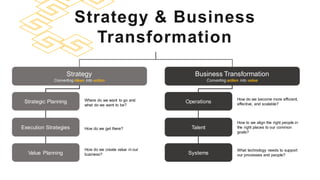
Strategy & Business
Transformation
Strategy
Converting ideas into action
Business Transformation
Converting action into value
Strategic Planning
Execution Strategies
Value Planning
Where do we want to go and
what do we want to be?
How do we get there?
How do we create value in our
business?
Operations
Systems
Talent
How do we become more efficient,
effective, and scalable?
What technology needs to support
our processes and people?
How to we align the right people in
the right places to our common
goals?
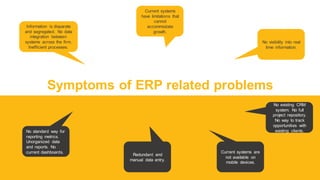
Symptoms of ERP related problems
No standard way for
reporting metrics.
Unorganized data
and reports. No
current dashboards.
Redundant and
manual data entry.
No existing CRM
system. No full
project repository.
No way to track
opportunities with
existing clients.
Information is disparate
and segregated. No data
integration between
systems across the firm.
Inefficient processes.
Current systems
have limitations that
cannot
accommodate
growth.
No visibility into real
time information.
Current systems are
not available on
mobile devices.
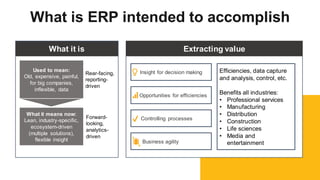
What is ERP intended to accomplish
What it is
Efficiencies, data capture
and analysis, control, etc.
Benefits all industries:
• Professional services
• Manufacturing
• Distribution
• Construction
• Life sciences
• Media and
entertainment
Used to mean:
Old, expensive, painful,
for big companies,
inflexible, data
What it means now:
Lean, industry-specific,
ecosystem-driven
(multiple solutions),
flexible insight
Rear-facing,
reporting-
driven
Forward-
looking,
analytics-
driven
Insight for decision making
Opportunities for efficiencies
Controlling processes
Business agility
Extracting value
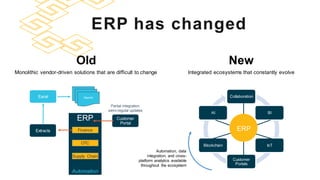
ERP has changed
New
Integrated ecosystems that constantly evolve
Old
Monolithic vendor-driven solutions that are difficult to change
Collaboration
BI
IoT
Customer
Portals
Blockchain
AI
ERP
ERP
Finance
OTC
Supply Chain
Automation
Extracts
Excel
Customer
Portal
Partial integration,
semi-regular updates
Reports
Automation, data
integration, and cross-
platform analytics available
throughout the ecosystem
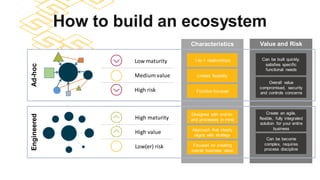
Value and RiskCharacteristics
Designed with end-to-
end processes in mind
Approach that clearly
aligns with strategy
Focused on creating
overall business value
Ad-hocEngineered
1-to-1 relationships
Limited flexibility
Function-focused
Can be built quickly,
satisfies specific
functional needs
Overall value
compromised, security
and controls concerns
Create an agile,
flexible, fully integrated
solution for your entire
business
Can be become
complex, requires
process discipline
Low maturity
Medium value
High risk
High maturity
High value
Low(er) risk
How to build an ecosystem
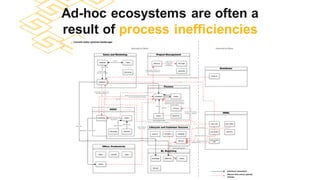
Ad-hoc ecosystems are often a
result of process inefficiencies
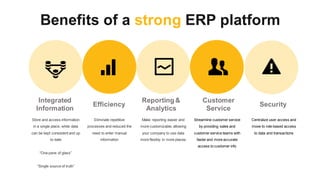
Store and access information
in a single place, while data
can be kept consistent and up
to date
“One pane of glass”
“Single source of truth”
Integrated
Information
Eliminate repetitive
processes and reduced the
need to enter manual
information
Efficiency
Make reporting easier and
more customizable, allowing
your company to use data
more flexibly in more places
Reporting &
Analytics
Streamline customer service
by providing sales and
customer service teams with
faster and more accurate
access to customer info
Customer
Service
Benefits of a strong ERP platform
Centralize user access and
move to role-based access
to data and transactions
Security
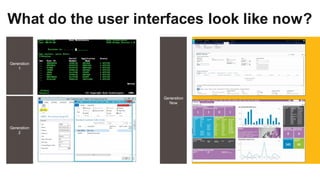
What do the user interfaces look like now?
Generation
1
Generation
2
Generation
Now
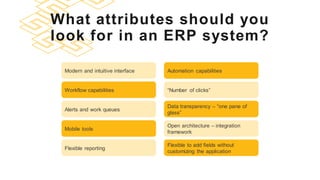
What attributes should you
look for in an ERP system?
Modern and intuitive interface
Workflow capabilities
Alerts and work queues
Mobile tools
Flexible reporting
Automation capabilities
“Number of clicks”
Data transparency – “one pane of
glass”
Open architecture – integration
framework
Flexible to add fields without
customizing the application
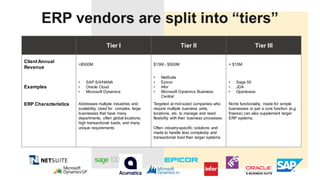
ERP vendors are split into “tiers”
Tier I Tier II Tier III
ClientAnnual
Revenue
>$500M $15M - $500M < $15M
Examples
• SAP S/4/HANA
• Oracle Cloud
• Microsoft Dynamics
• NetSuite
• Epicor
• Infor
• Microsoft Dynamics Business
Central
• Sage 50
• JDA
• Openbravo
ERP Characteristics Addresses multiple industries and
scalability. Used for complex, large
businesses that have many
departments, often global locations,
high transactional loads, and many
unique requirements
Targeted at mid-sized companies who
require multiple business units,
locations, etc. to manage and need
flexibility with their business processes
Often industry-specific solutions and
made to handle less complexity and
transactional load than larger systems
Niche functionality, made for simple
businesses or just a core function (e.g.
finance) can also supplement larger
ERP systems.
13
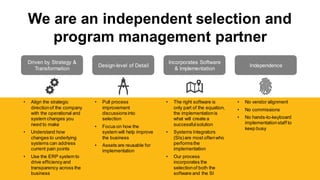
We are an independent selection and
program management partner
Driven by Strategy &
Transformation
• Align the strategic
directionof the company
with the operational and
system changes you
need to make
• Understand how
changes to underlying
systems can address
current pain points
• Use the ERP system to
drive efficiencyand
transparency across the
business
Design-level of Detail
• Pull process
improvement
discussionsinto
selection
• Focus on how the
system will help improve
the business
• Assets are reusable for
implementation
Incorporates Software
& Implementation
• The right software is
only part of the equation,
the implementationis
what will create a
successfulsolution
• Systems Integrators
(SIs)are most oftenwho
performsthe
implementation
• Our process
incorporates the
selectionof both the
software and the SI
Independence
• No vendor alignment
• No commissions
• No hands-to-keyboard
implementationstaff to
keep busy
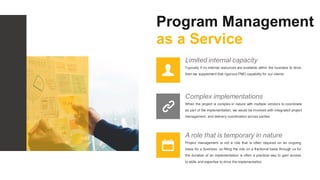
Program Management
as a Service
Typically if no internal resources are available within the business to drive,
then we supplement that rigorous PMO capability for our clients
When the project is complex in nature with multiple vendors to coordinate
as part of the implementation, we would be involved with integrated project
management, and delivery coordination across parties
Limited internal capacity
Complex implementations
Project management is not a role that is often required on an ongoing
basis for a business, so filling the role on a fractional basis through us for
the duration of an implementation is often a practical way to gain access
to skills and expertise to drive the implementation
A role that is temporary in nature
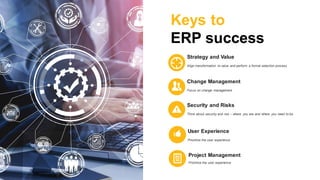
Align transformation to value and perform a formal selection process
Strategy and Value
Keys to
ERP success
Focus on change management
Change Management
Think about security and risk – where you are and where you need to be
Security and Risks
Prioritize the user experience
User Experience
Project Management
Prioritize the user experience
Questions?
Thank You
For Watching & Listening

The Modern ERP Landscape

  • 1.
    The Modern ERPLandscape Pres ent ed by : Smija Simon and St ev e R onan December 1, 2020
  • 2.
    Strategy & BusinessTransformation Team Speakers Principal, Leader of the Strategy & Business Transformation and Business Process Outsourcing Practices sronan@citrincooperman.com Steve Ronan Manager, Strategy & Business Transformation Practice ssimon@citrincooperman.com Smija Simon
  • 3.
    Today’s Agenda Ab ou t U s 5 mins ER P Sp eed R evi ew • Id e n ti f y i n g E R P r e l a te d p r o b l e m s • Va l u e o f E R P • C h a n g i n g y o u r m i n d s e t - e c o s y s te m s • C h o o s i n g y o u r ti e r • K e y s to s u c c e s s • B e n e f i ts o f a n i n d e p e n d e n t E R P s e l e c ti o n p a r tn e r Yo u r Qu esti o n s 45 mins 10 mins
  • 4.
    Strategy & Business Transformation Strategy Convertingideas into action Business Transformation Converting action into value Strategic Planning Execution Strategies Value Planning Where do we want to go and what do we want to be? How do we get there? How do we create value in our business? Operations Systems Talent How do we become more efficient, effective, and scalable? What technology needs to support our processes and people? How to we align the right people in the right places to our common goals?
  • 5.
    Symptoms of ERPrelated problems No standard way for reporting metrics. Unorganized data and reports. No current dashboards. Redundant and manual data entry. No existing CRM system. No full project repository. No way to track opportunities with existing clients. Information is disparate and segregated. No data integration between systems across the firm. Inefficient processes. Current systems have limitations that cannot accommodate growth. No visibility into real time information. Current systems are not available on mobile devices.
  • 6.
    What is ERPintended to accomplish What it is Efficiencies, data capture and analysis, control, etc. Benefits all industries: • Professional services • Manufacturing • Distribution • Construction • Life sciences • Media and entertainment Used to mean: Old, expensive, painful, for big companies, inflexible, data What it means now: Lean, industry-specific, ecosystem-driven (multiple solutions), flexible insight Rear-facing, reporting- driven Forward- looking, analytics- driven Insight for decision making Opportunities for efficiencies Controlling processes Business agility Extracting value
  • 7.
    ERP has changed New Integratedecosystems that constantly evolve Old Monolithic vendor-driven solutions that are difficult to change Collaboration BI IoT Customer Portals Blockchain AI ERP ERP Finance OTC Supply Chain Automation Extracts Excel Customer Portal Partial integration, semi-regular updates Reports Automation, data integration, and cross- platform analytics available throughout the ecosystem
  • 8.
    Value and RiskCharacteristics Designedwith end-to- end processes in mind Approach that clearly aligns with strategy Focused on creating overall business value Ad-hocEngineered 1-to-1 relationships Limited flexibility Function-focused Can be built quickly, satisfies specific functional needs Overall value compromised, security and controls concerns Create an agile, flexible, fully integrated solution for your entire business Can be become complex, requires process discipline Low maturity Medium value High risk High maturity High value Low(er) risk How to build an ecosystem
  • 9.
    Ad-hoc ecosystems areoften a result of process inefficiencies
  • 10.
    Store and accessinformation in a single place, while data can be kept consistent and up to date “One pane of glass” “Single source of truth” Integrated Information Eliminate repetitive processes and reduced the need to enter manual information Efficiency Make reporting easier and more customizable, allowing your company to use data more flexibly in more places Reporting & Analytics Streamline customer service by providing sales and customer service teams with faster and more accurate access to customer info Customer Service Benefits of a strong ERP platform Centralize user access and move to role-based access to data and transactions Security
  • 11.
    What do theuser interfaces look like now? Generation 1 Generation 2 Generation Now
  • 12.
    What attributes shouldyou look for in an ERP system? Modern and intuitive interface Workflow capabilities Alerts and work queues Mobile tools Flexible reporting Automation capabilities “Number of clicks” Data transparency – “one pane of glass” Open architecture – integration framework Flexible to add fields without customizing the application
  • 13.
    ERP vendors aresplit into “tiers” Tier I Tier II Tier III ClientAnnual Revenue >$500M $15M - $500M < $15M Examples • SAP S/4/HANA • Oracle Cloud • Microsoft Dynamics • NetSuite • Epicor • Infor • Microsoft Dynamics Business Central • Sage 50 • JDA • Openbravo ERP Characteristics Addresses multiple industries and scalability. Used for complex, large businesses that have many departments, often global locations, high transactional loads, and many unique requirements Targeted at mid-sized companies who require multiple business units, locations, etc. to manage and need flexibility with their business processes Often industry-specific solutions and made to handle less complexity and transactional load than larger systems Niche functionality, made for simple businesses or just a core function (e.g. finance) can also supplement larger ERP systems. 13
  • 14.
    We are anindependent selection and program management partner Driven by Strategy & Transformation • Align the strategic directionof the company with the operational and system changes you need to make • Understand how changes to underlying systems can address current pain points • Use the ERP system to drive efficiencyand transparency across the business Design-level of Detail • Pull process improvement discussionsinto selection • Focus on how the system will help improve the business • Assets are reusable for implementation Incorporates Software & Implementation • The right software is only part of the equation, the implementationis what will create a successfulsolution • Systems Integrators (SIs)are most oftenwho performsthe implementation • Our process incorporates the selectionof both the software and the SI Independence • No vendor alignment • No commissions • No hands-to-keyboard implementationstaff to keep busy
  • 15.
    Program Management as aService Typically if no internal resources are available within the business to drive, then we supplement that rigorous PMO capability for our clients When the project is complex in nature with multiple vendors to coordinate as part of the implementation, we would be involved with integrated project management, and delivery coordination across parties Limited internal capacity Complex implementations Project management is not a role that is often required on an ongoing basis for a business, so filling the role on a fractional basis through us for the duration of an implementation is often a practical way to gain access to skills and expertise to drive the implementation A role that is temporary in nature
  • 16.
    Align transformation tovalue and perform a formal selection process Strategy and Value Keys to ERP success Focus on change management Change Management Think about security and risk – where you are and where you need to be Security and Risks Prioritize the user experience User Experience Project Management Prioritize the user experience
  • 17.
  • 18.