DZEVAD SARIC
UEFA PRO COACH/TECHNICAL DIRECTOR
"Our Idea of Playing Style"
1. Offensive style of play, with many space for players individual decision
making and creativity.
2. Safe play in the construction of the attack, especially in the beginning of
the construction of the attack.
3. 1st and 2nd phases of attack should be collective efforts with last phase of
attack as an encouragement for individual efforts.
4. A team that keeps at all time a good defensive balance with players
readapting their position to every ball movement. Zonal marking with
occupation of vital spaces and active search for ball recovery.
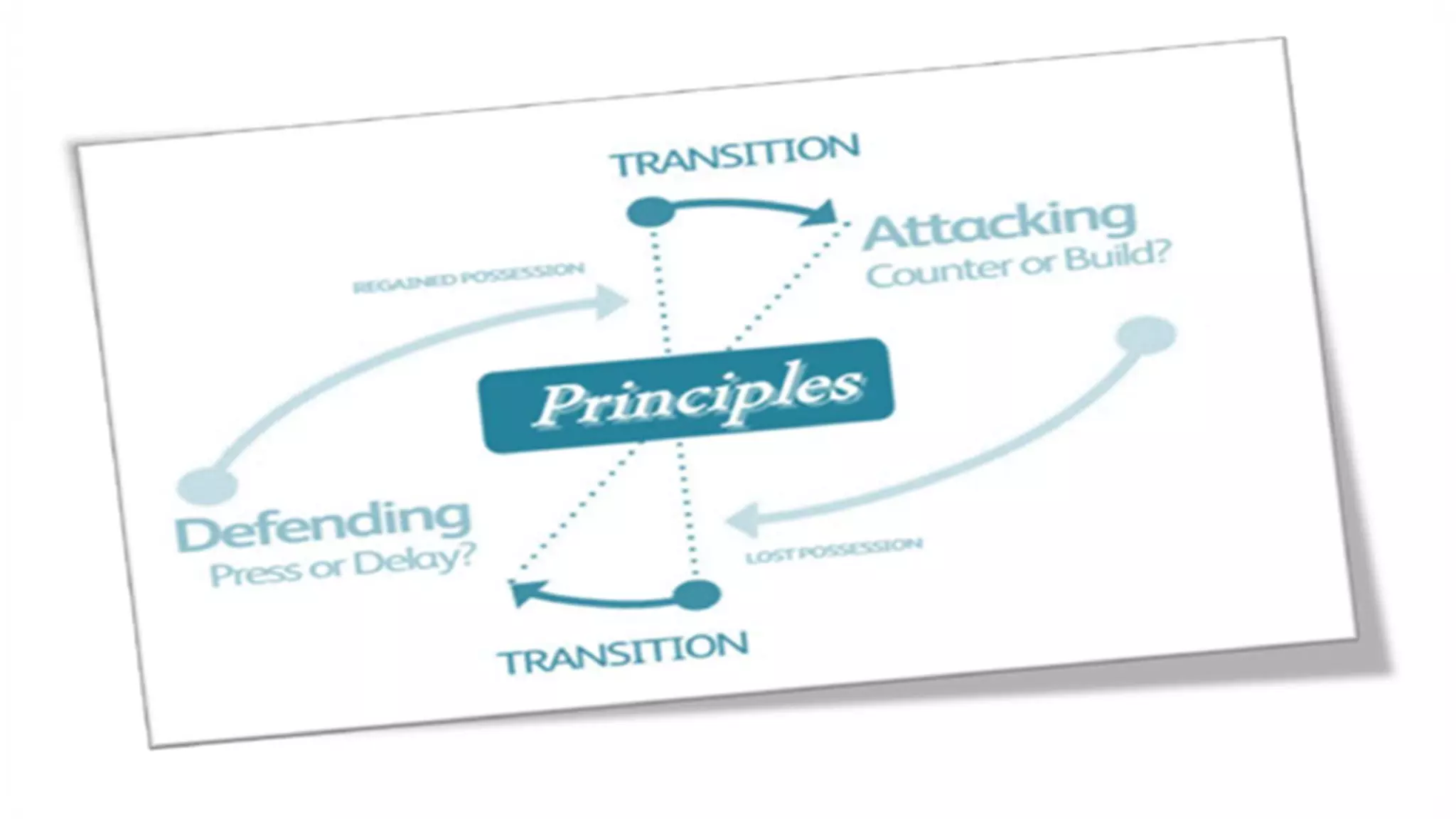
5. Great control in game rhythms and clear distinction of the 4 moments of
the game.
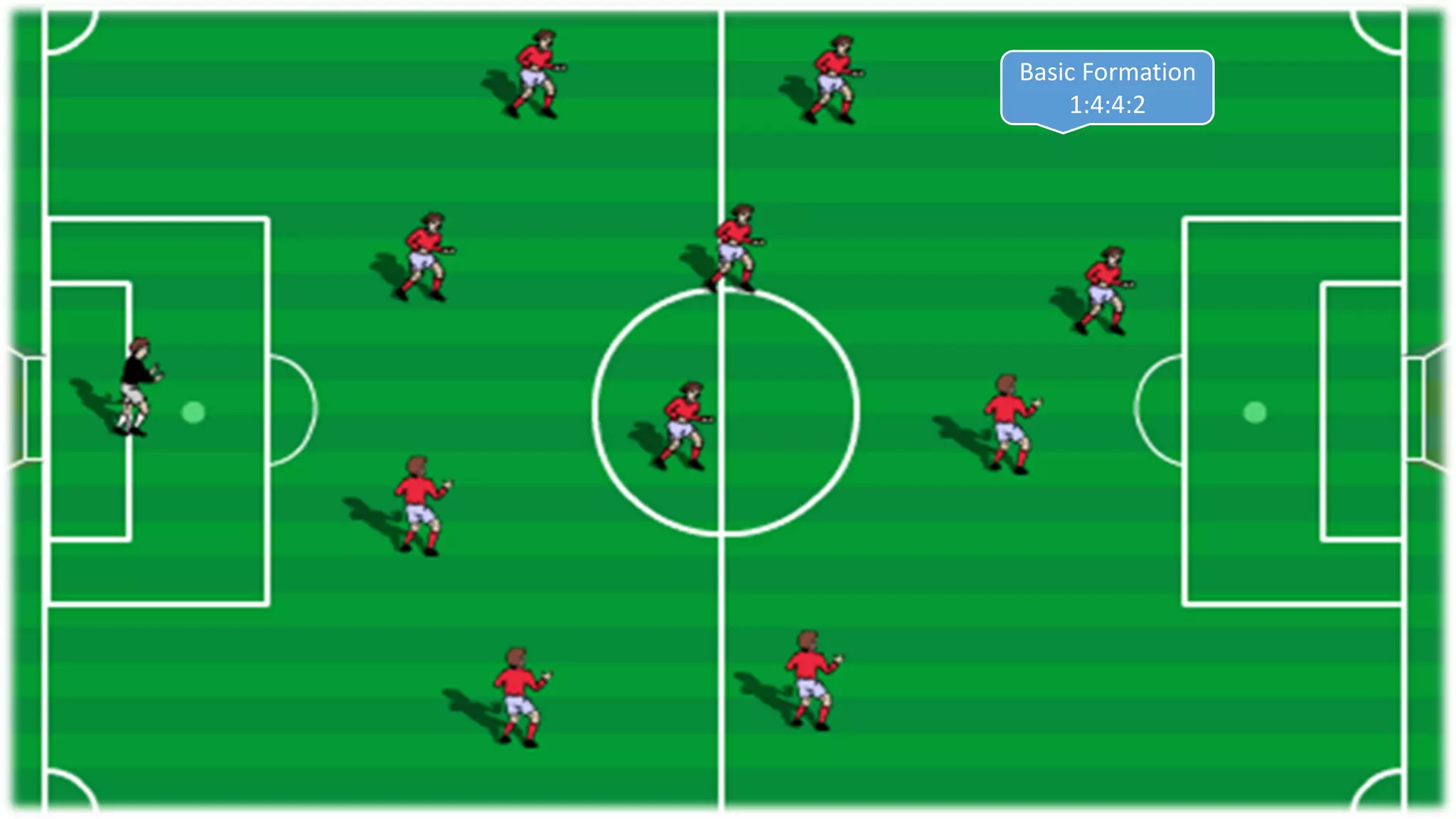
Basic Formation
1:4:4:2
Attacking
Organisation
"Our Idea of Attack"
1. The first option must be always to search for an offensive passing line in
order to be closer to the opposite goal, if possible finishing.
2. If not possible to find a good option for offensive line passing, the team
must start the supported construction of the organized attack.
3. The first and second phase of the attack are collective, in the third
phase is allowed individual creativity.
4. Safe play, without much risk, especially in own half of the field.
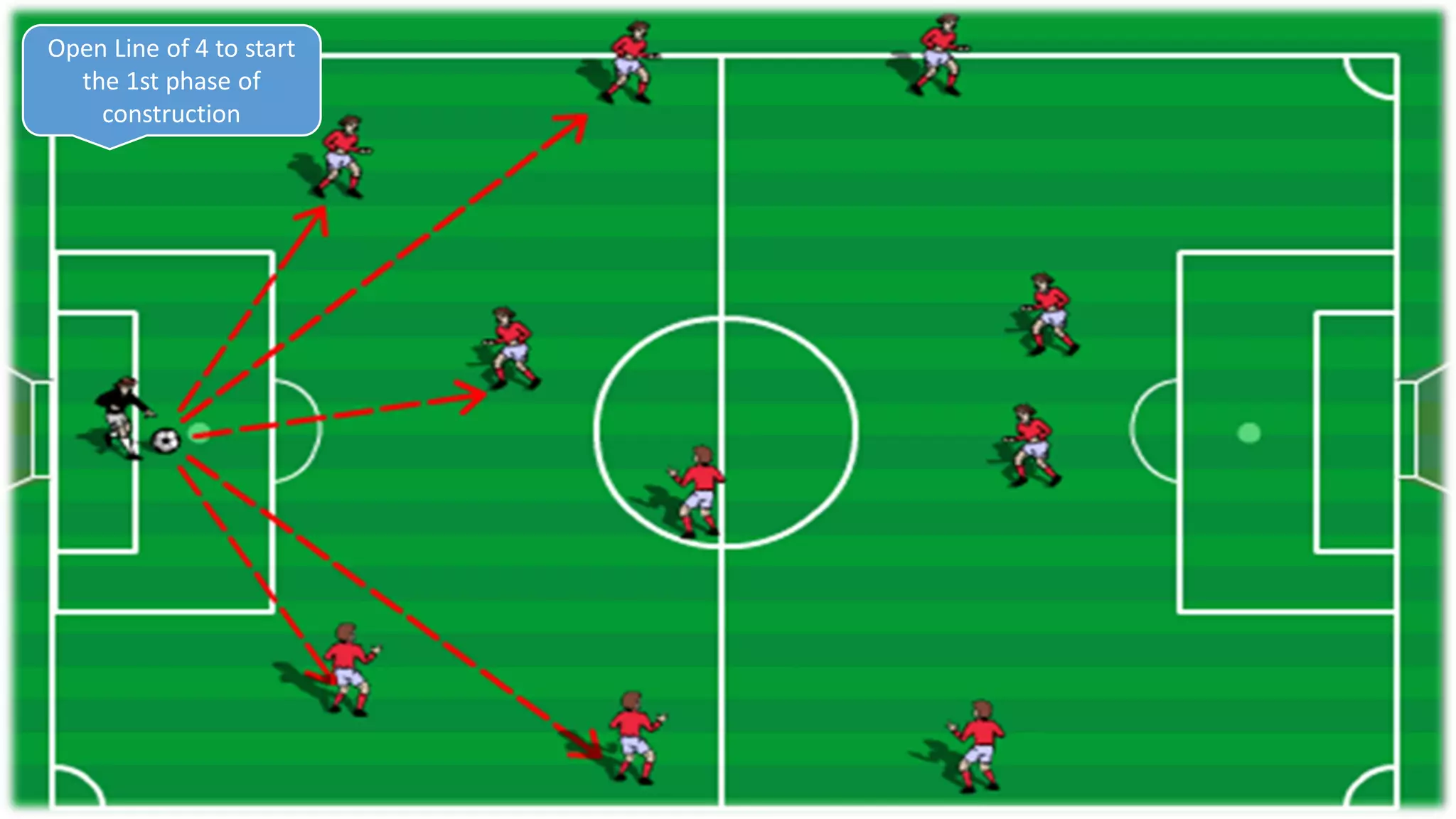
5. When initiating the construction in defensive sector it must be used a
line of 4 players.
6. Create numerical superiority in own half.
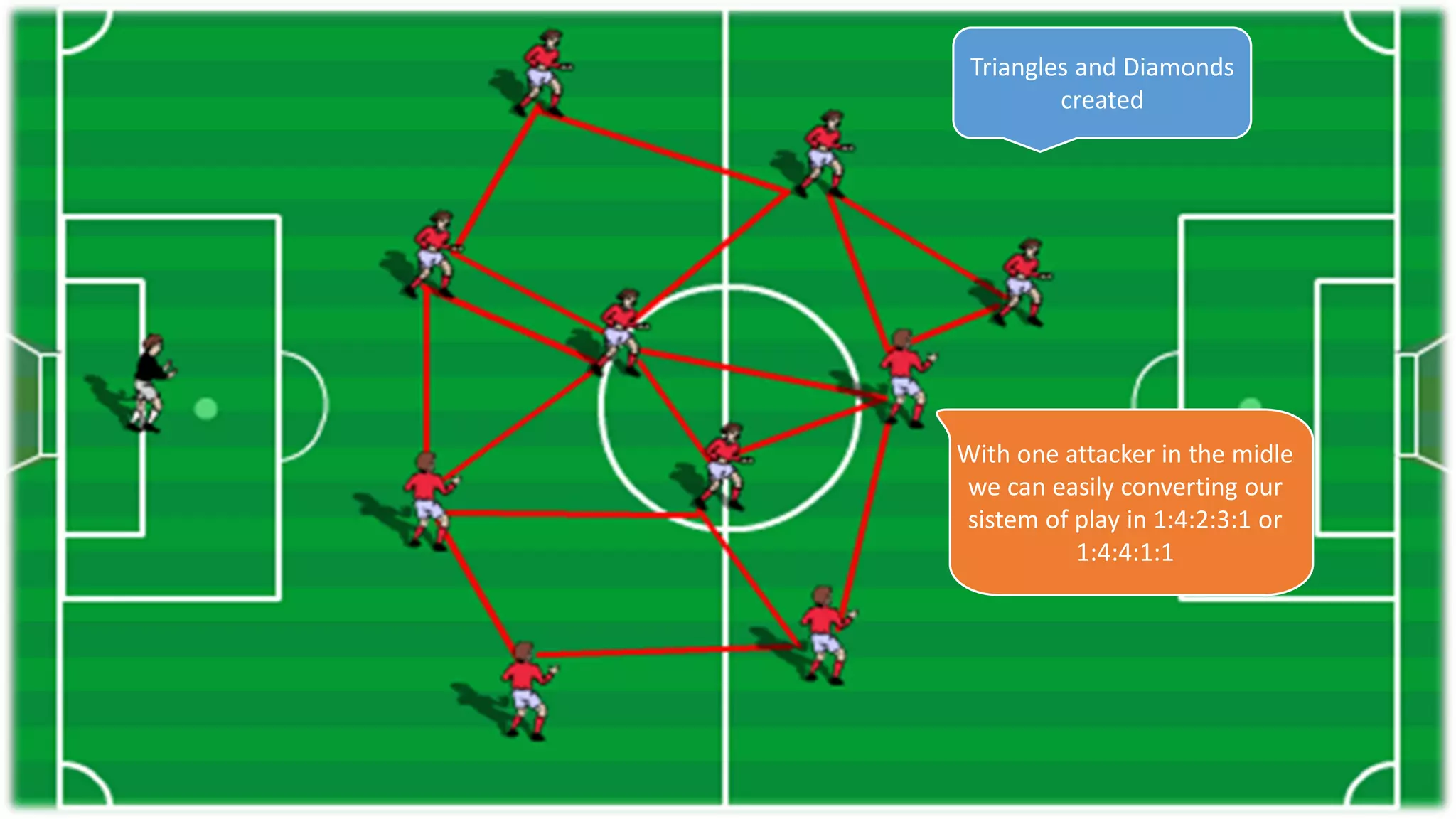
7. All this possession game must be supported in basic triangle and
diamond formations of passing lines.
7. The ball possession must be a meaningful one, not possession without
a goal, the general strategy behind this ball possession must be
connected with 2 situations;
The 1st one must be to try to create a numerical superiority situation
near the ball zone, when this is achieved players must immediately “fasten
up” the game and try to progress in the field to unbalance defensive
organization from opposition;
2nd one is related with the impossibility to achieve this “fasten up” of the
game, so the collective strategy must turn into a change in point of attack
strategy, taking the ball away from pressing zone in order to place players
in opposite side of the field in a numerical superiority or equality and
allowing them to produce the necessary actions to explore the “open
spaces” in the defense.
8. Team open (full-backs & wingers) and deep (wingers and forwards) to
create spaces in the inside zones.
9. Optimum velocity in the circulation of the ball (jump one passing line if
possible).
10. Supporting runs in the inside zones by players from back lines.
11. Show intention when in possession of the ball.
12. Defensive balance on the weak side with ball in one side channel.
13. In the last phase of attack the idea is to give maximum freedom for
individual actions and promote the 1x1 challenge as many times
possible.
14. When in crossing situations the team must approach the finishing zone
(box) placing at least 3 players inside and 1 players setting up for delay
balls or second ball challenge.
15. All attack complete with the shot on goal.
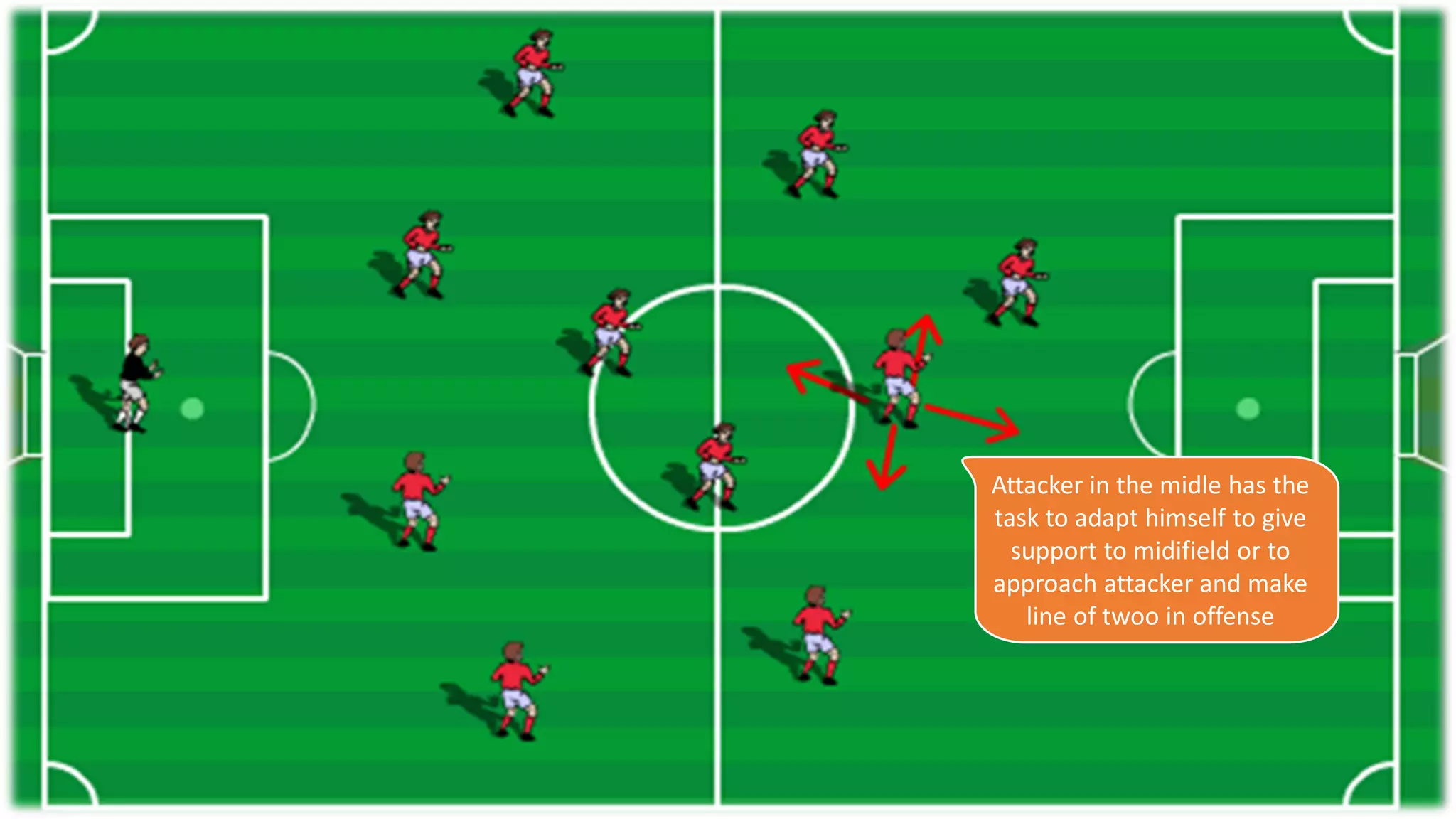
With one attacker in the midle
we can easily converting our
sistem of play in 1:4:2:3:1 or
1:4:4:1:1
Triangles and Diamonds
created
Attacker in the midle has the
task to adapt himself to give
support to midifield or to
approach attacker and make
line of twoo in offense
Open Line of 4 to start
the 1st phase of
construction
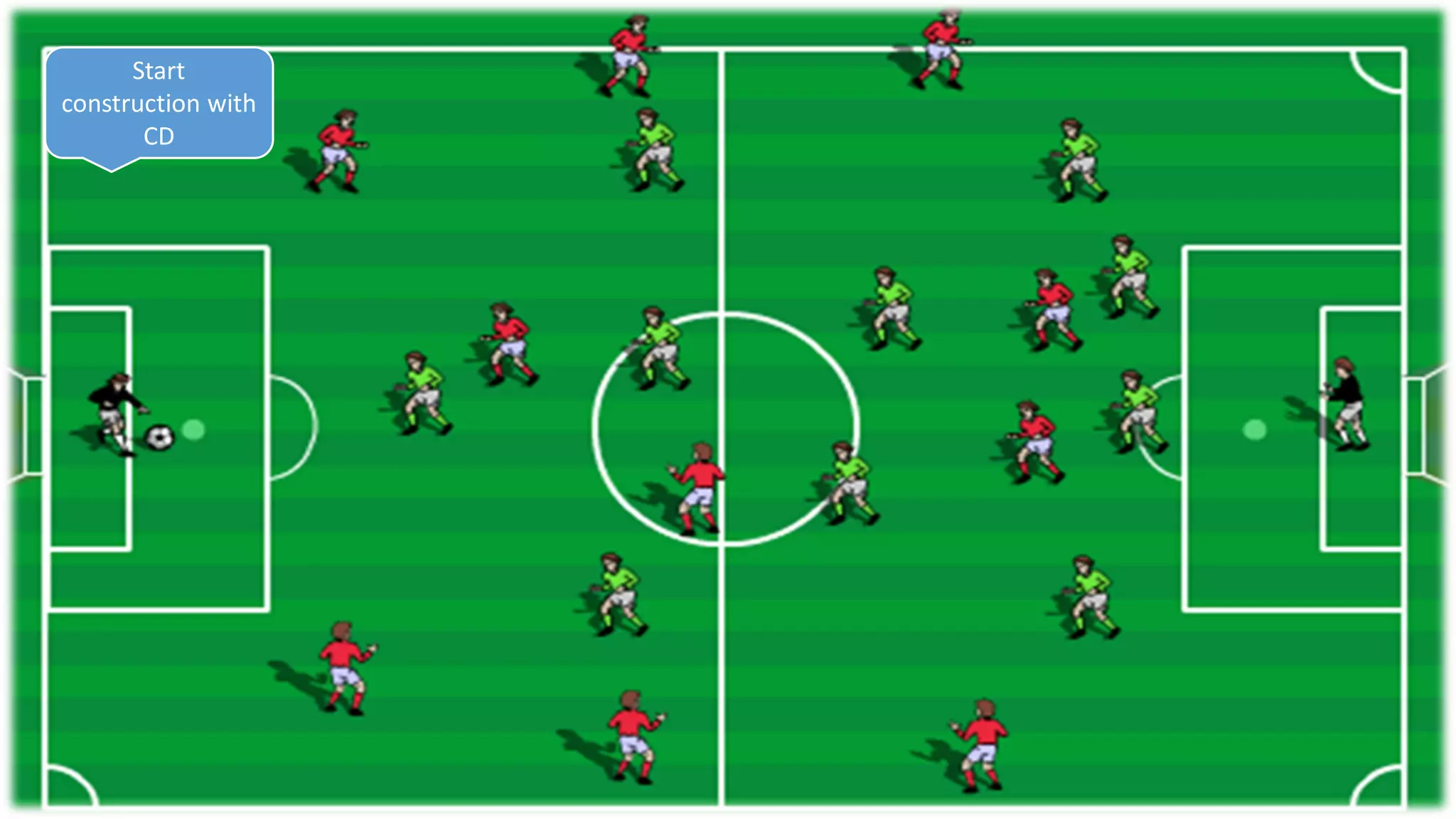
Start
construction with
CD
Start
construction with
LD or RD
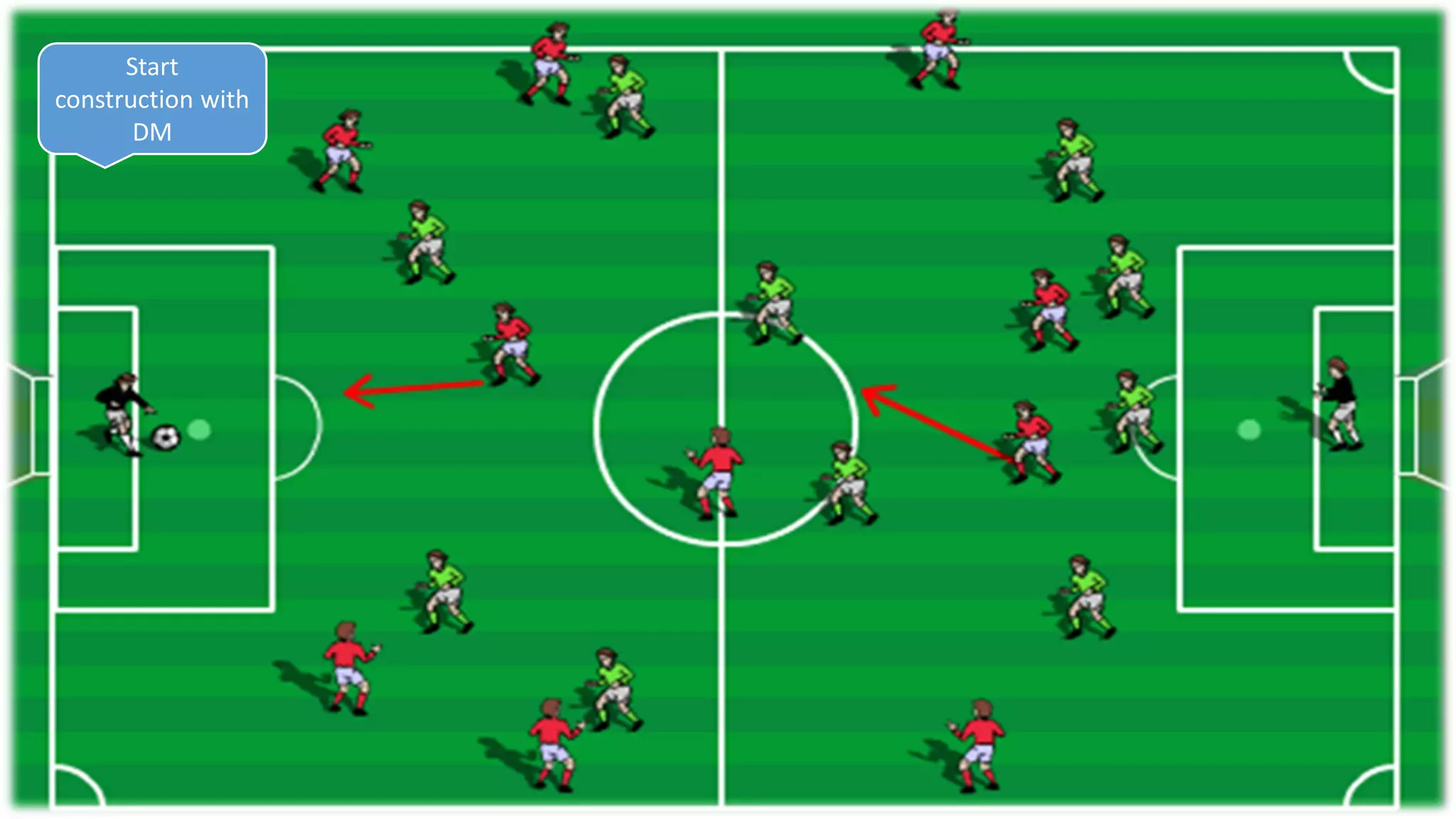
Start
construction with
DM
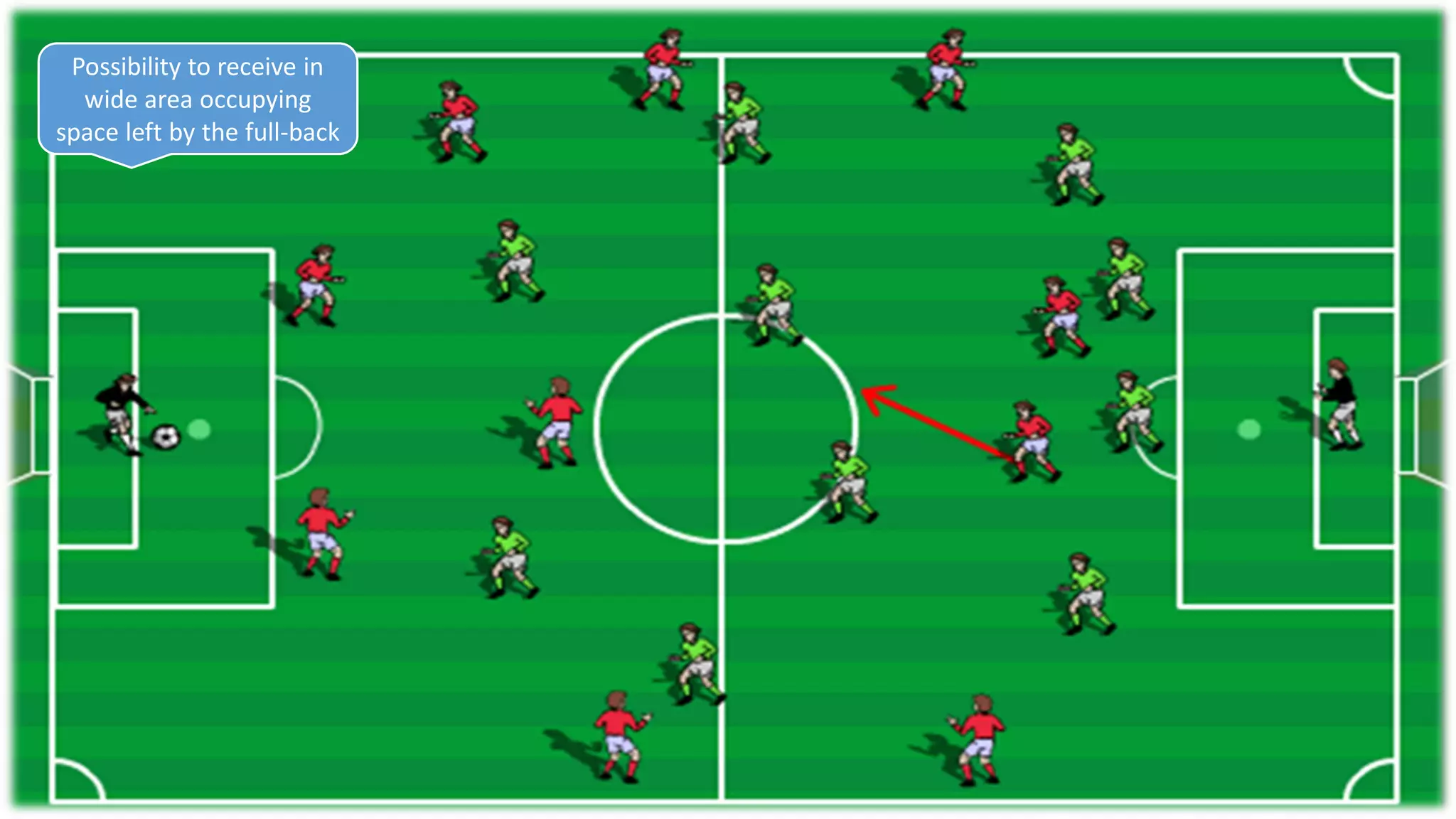
Possibility to receive in
wide area occupying
space left by the full-back
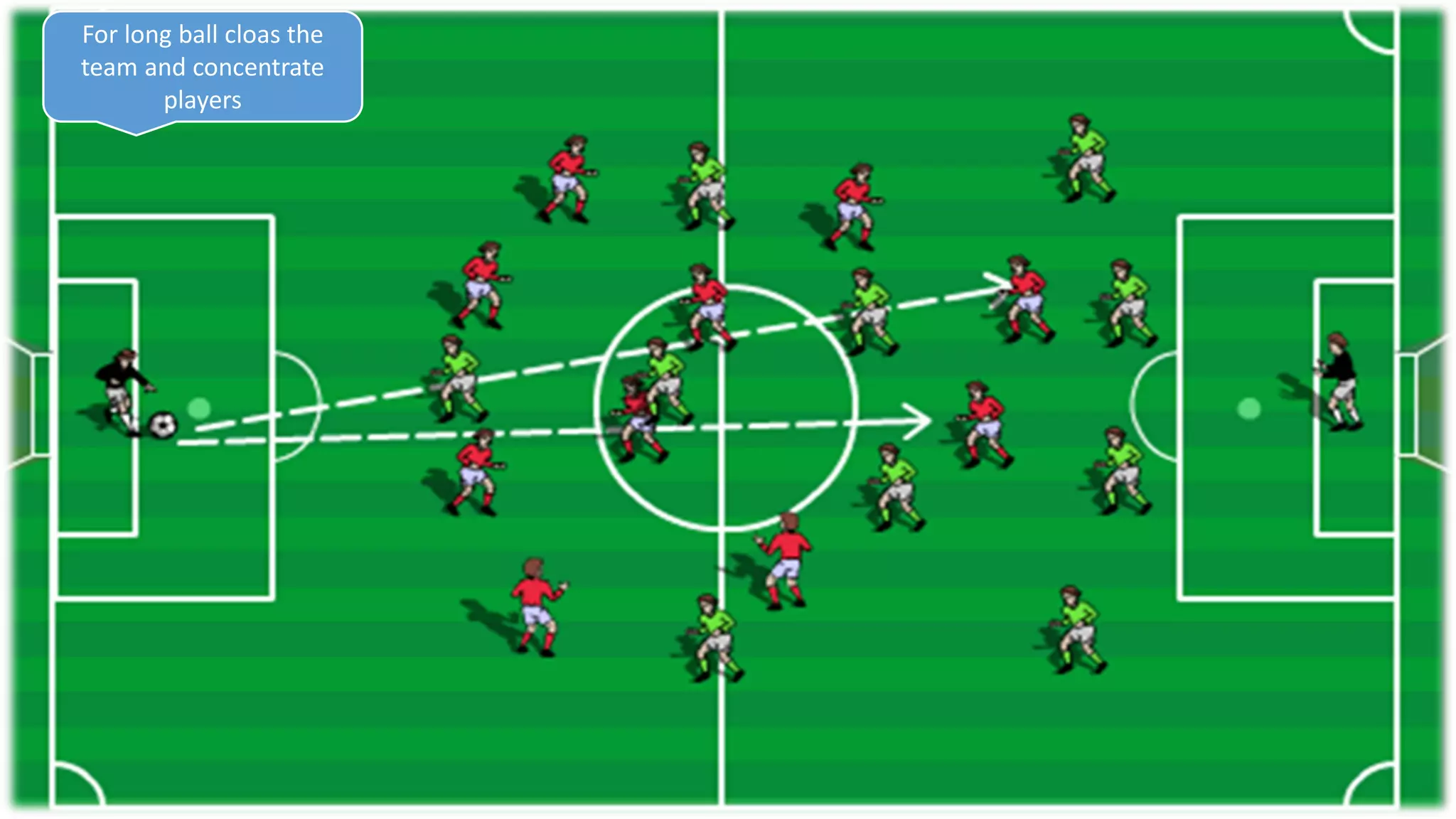
For long ball cloas the
team and concentrate
players
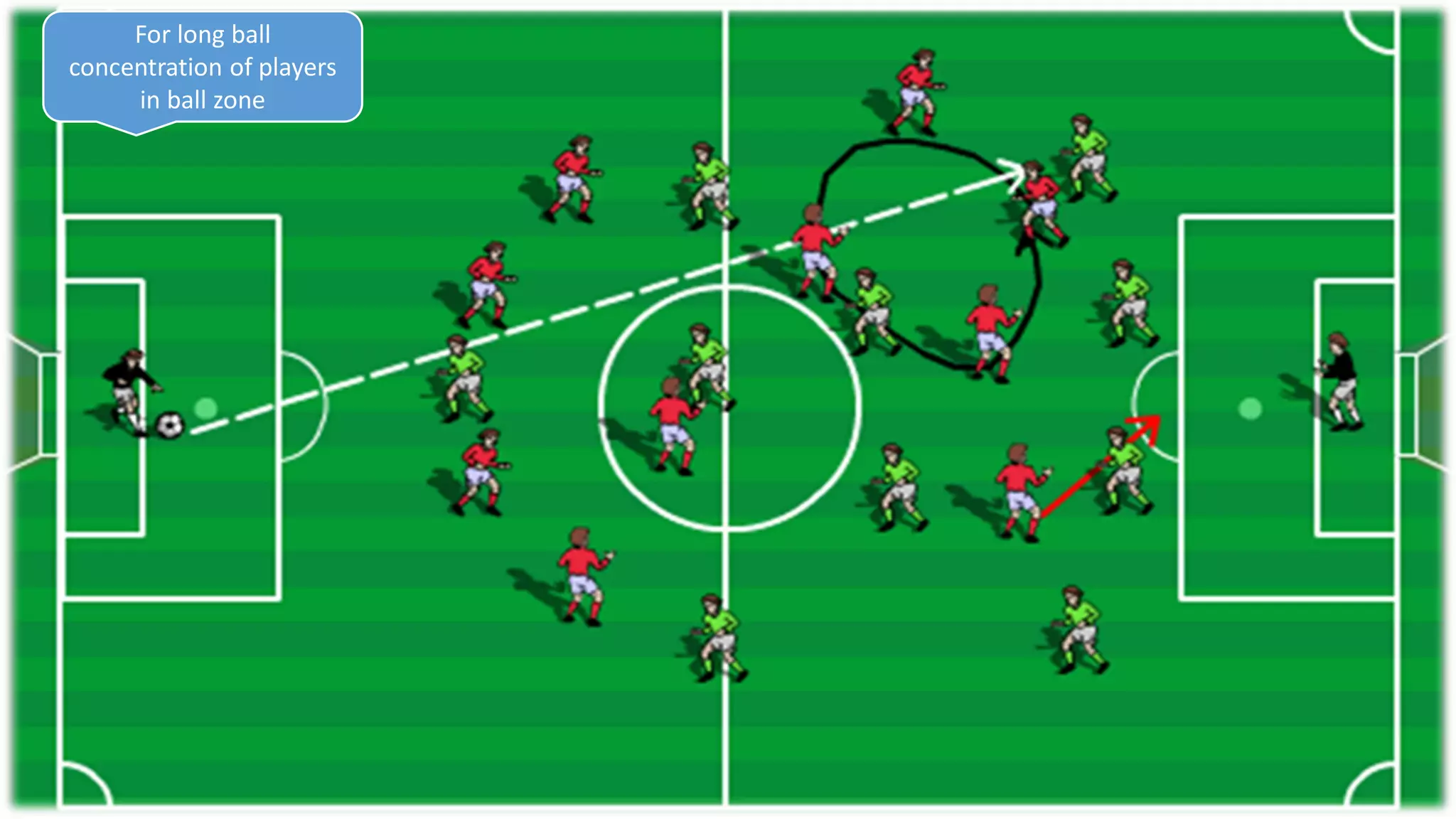
For long ball
concentration of players
in ball zone
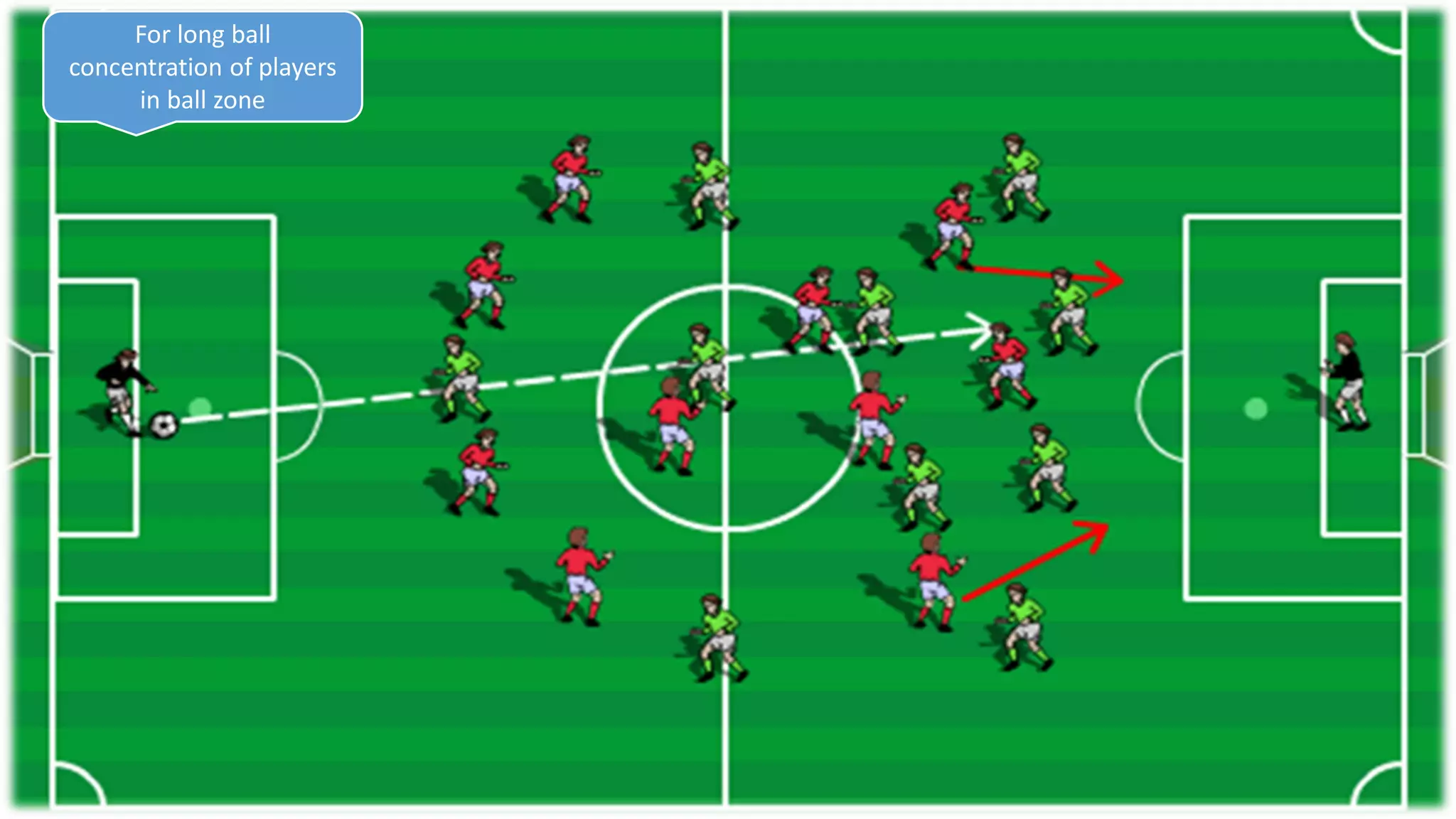
For long ball
concentration of players
in ball zone
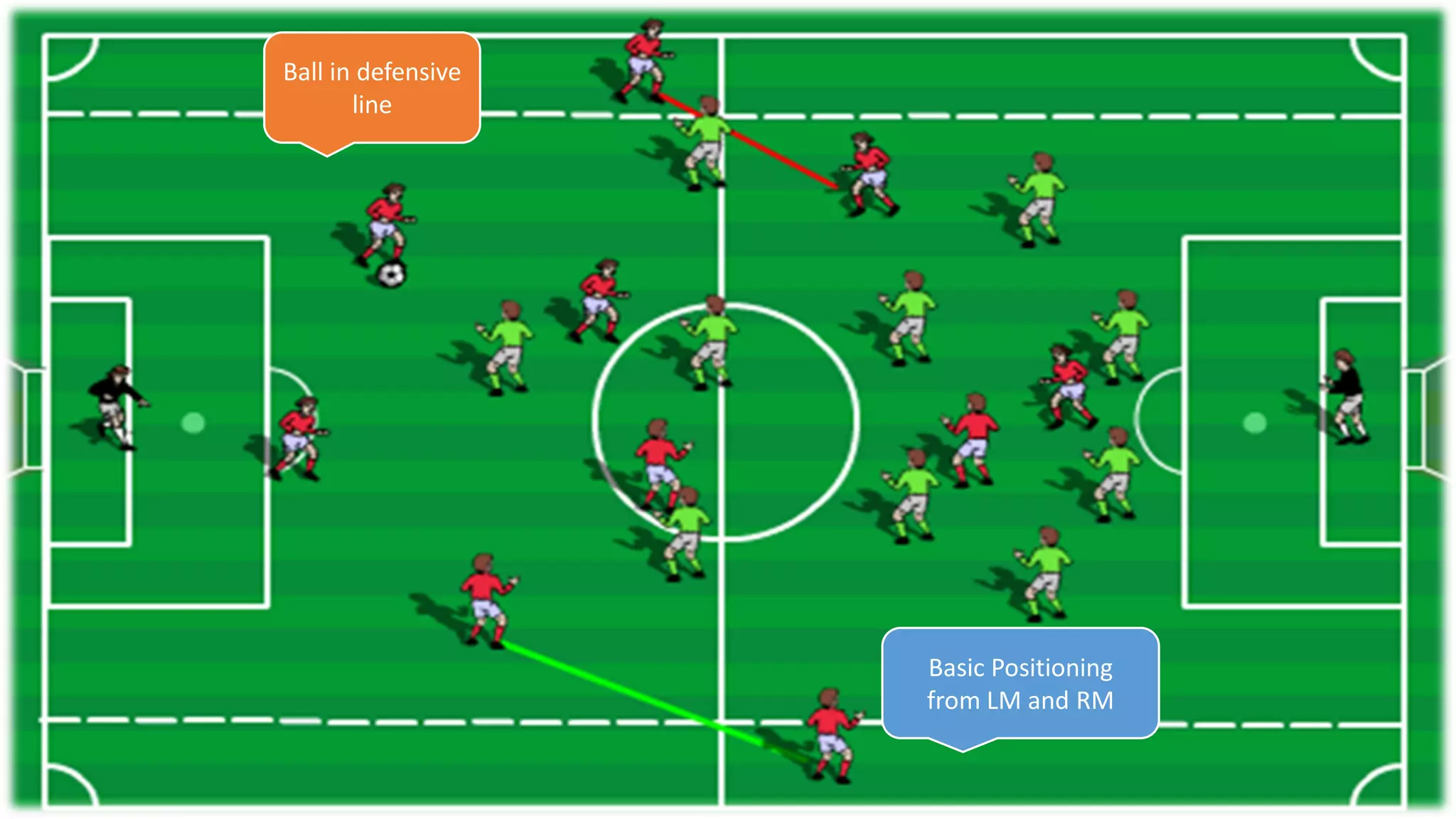
Ball in defensive
line
Basic Positioning
from LM and RM
Situation when CD on left
side has ball
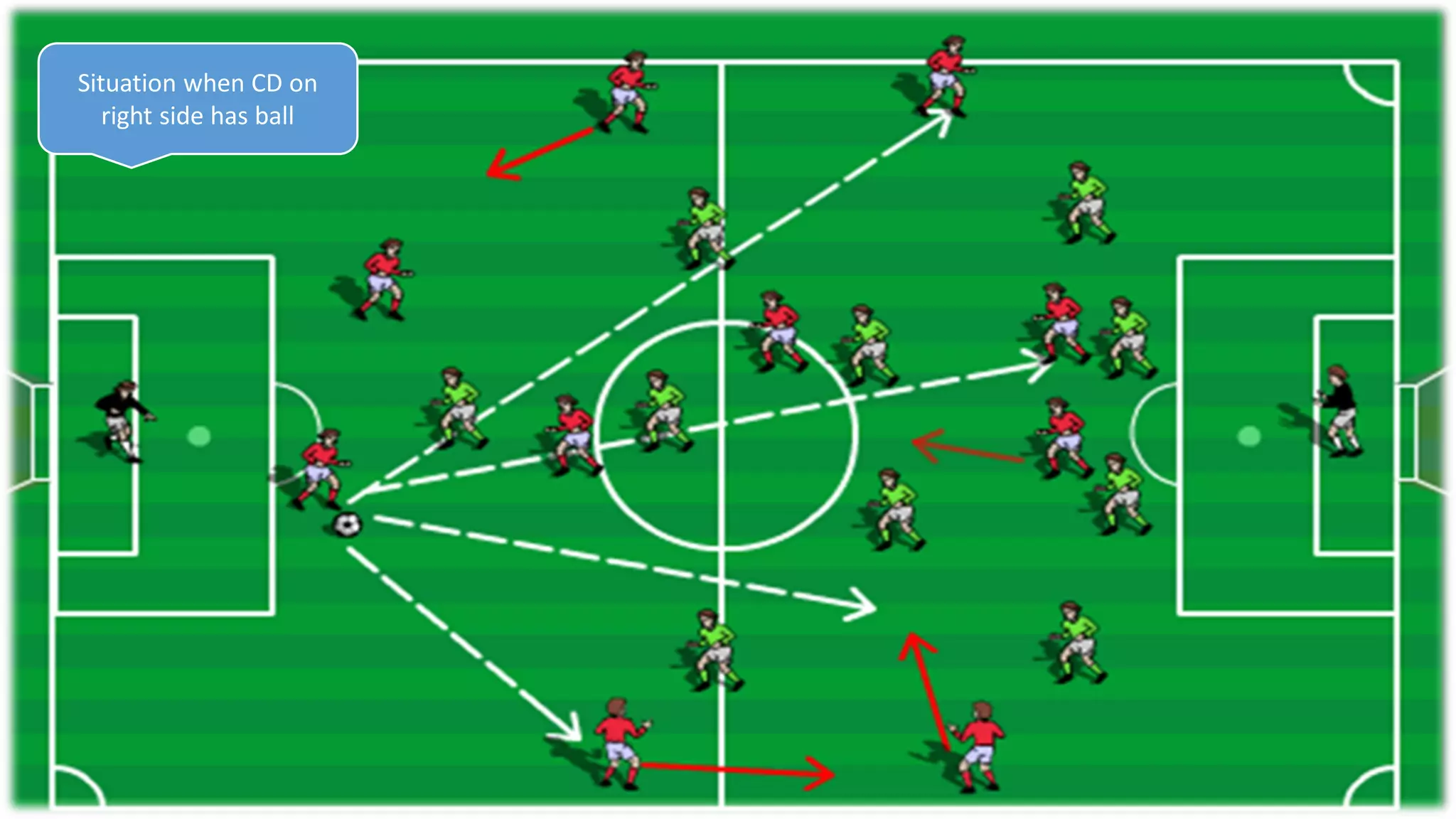
Situation when CD on
right side has ball
Ball in defensive
line
Basic Positioning
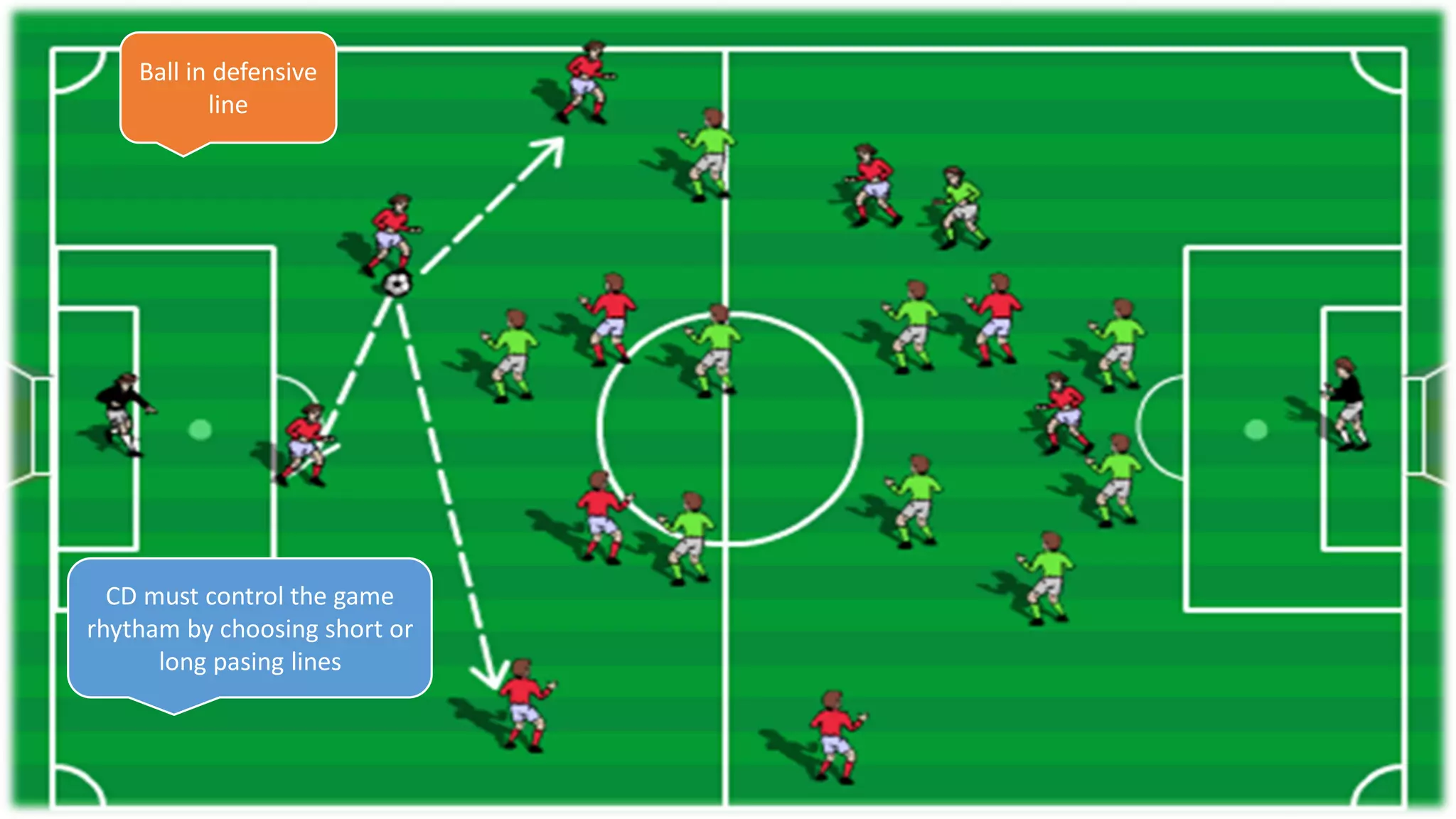
from CD
CD must control the game
rhytham by choosing short or
long pasing lines
Ball in defensive
line
Ball in defensive
line
Cereful with the passing for DM
because this player is with his back to
the game and it is necessary a lot of
communitation
The quality of the pass will determinate
where and how the player will face the
game
Ball in defensive
line
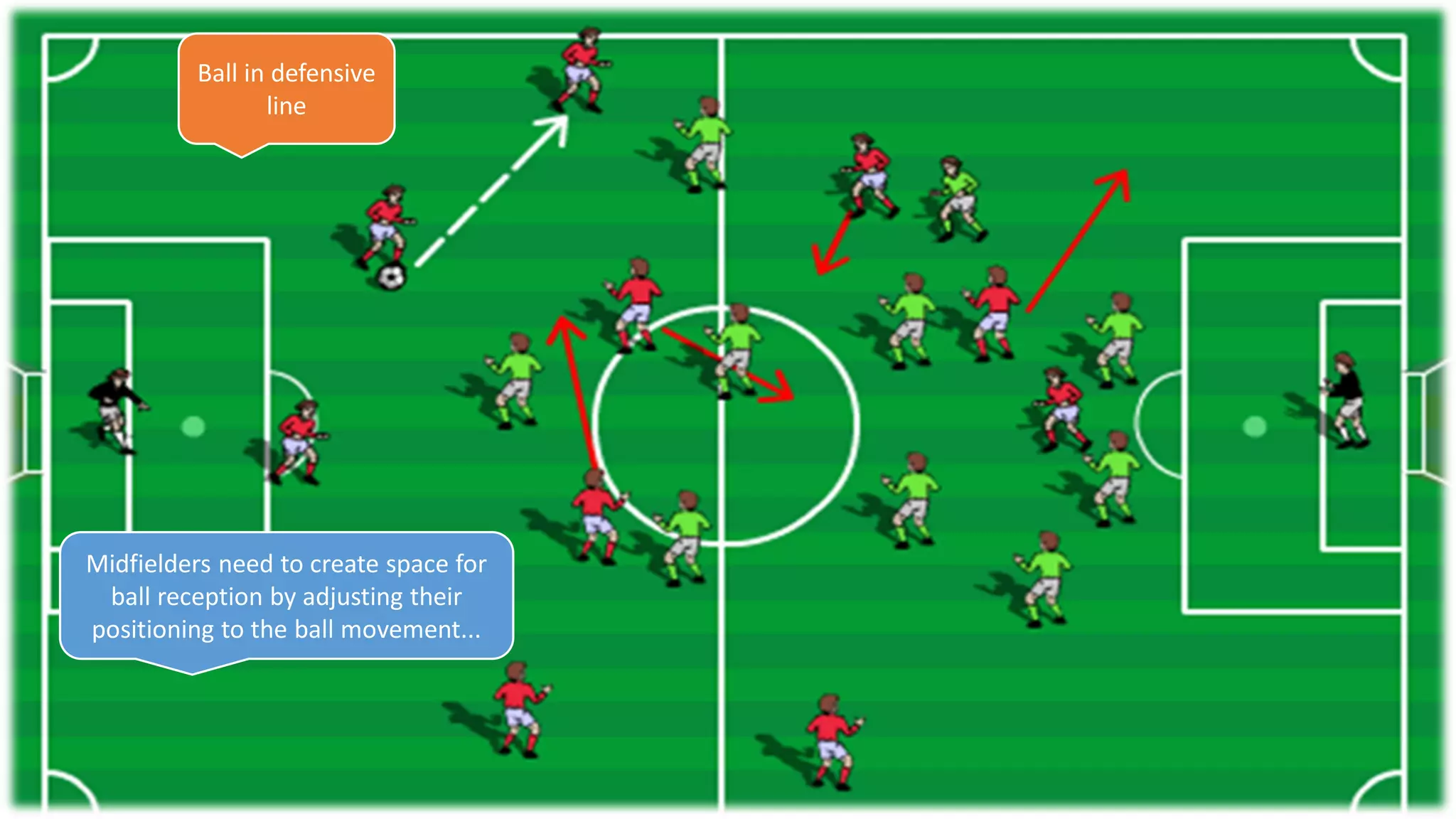
Midfielders need to create space for
ball reception by adjusting their
positioning to the ball movement...
Ball in defensive
line
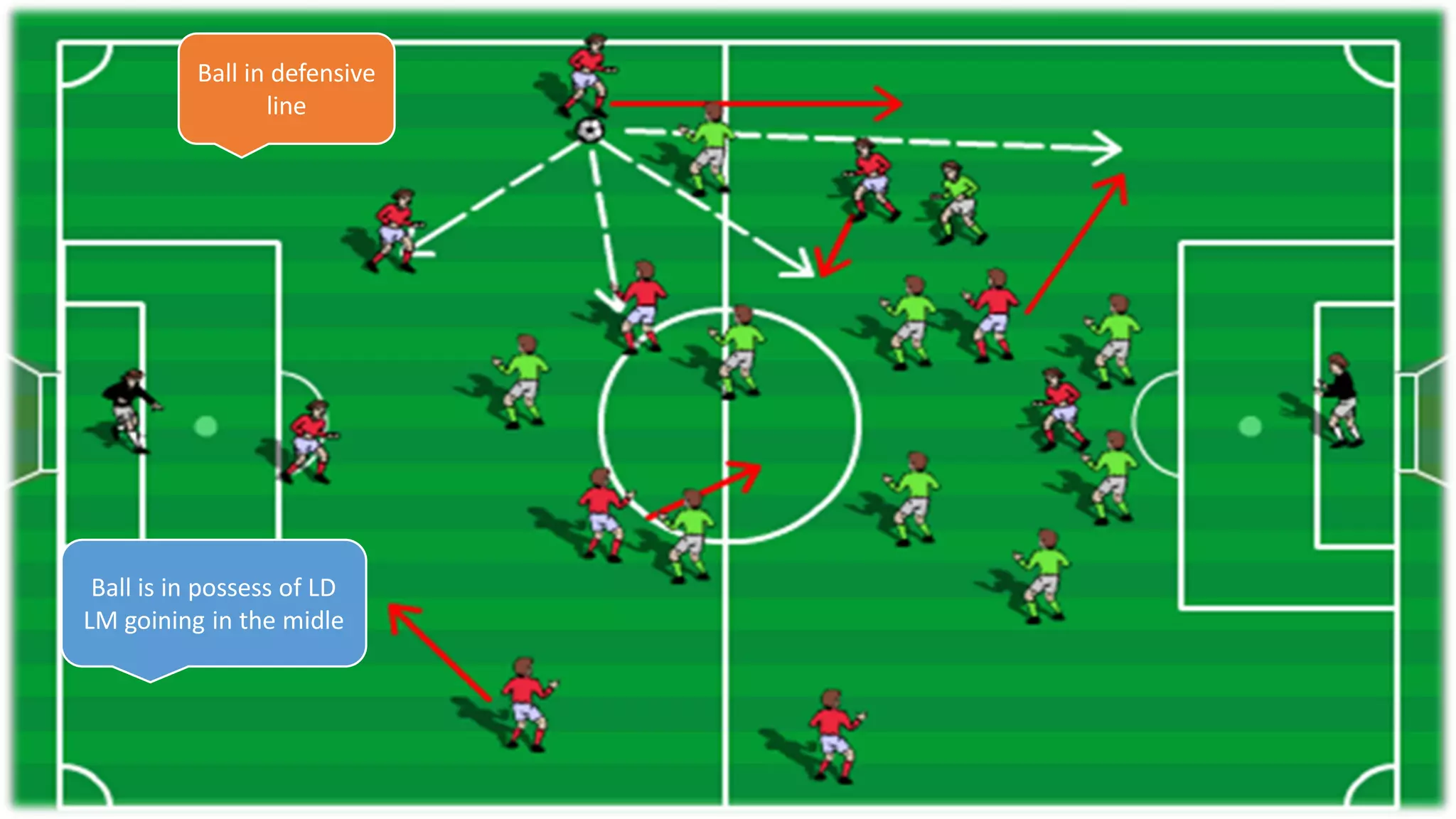
Ball is in possess of LD
LM goining in the midle
Ball in defensive
line
Ball is in possess of LD
LM stay on the line
Ball in defensive
line
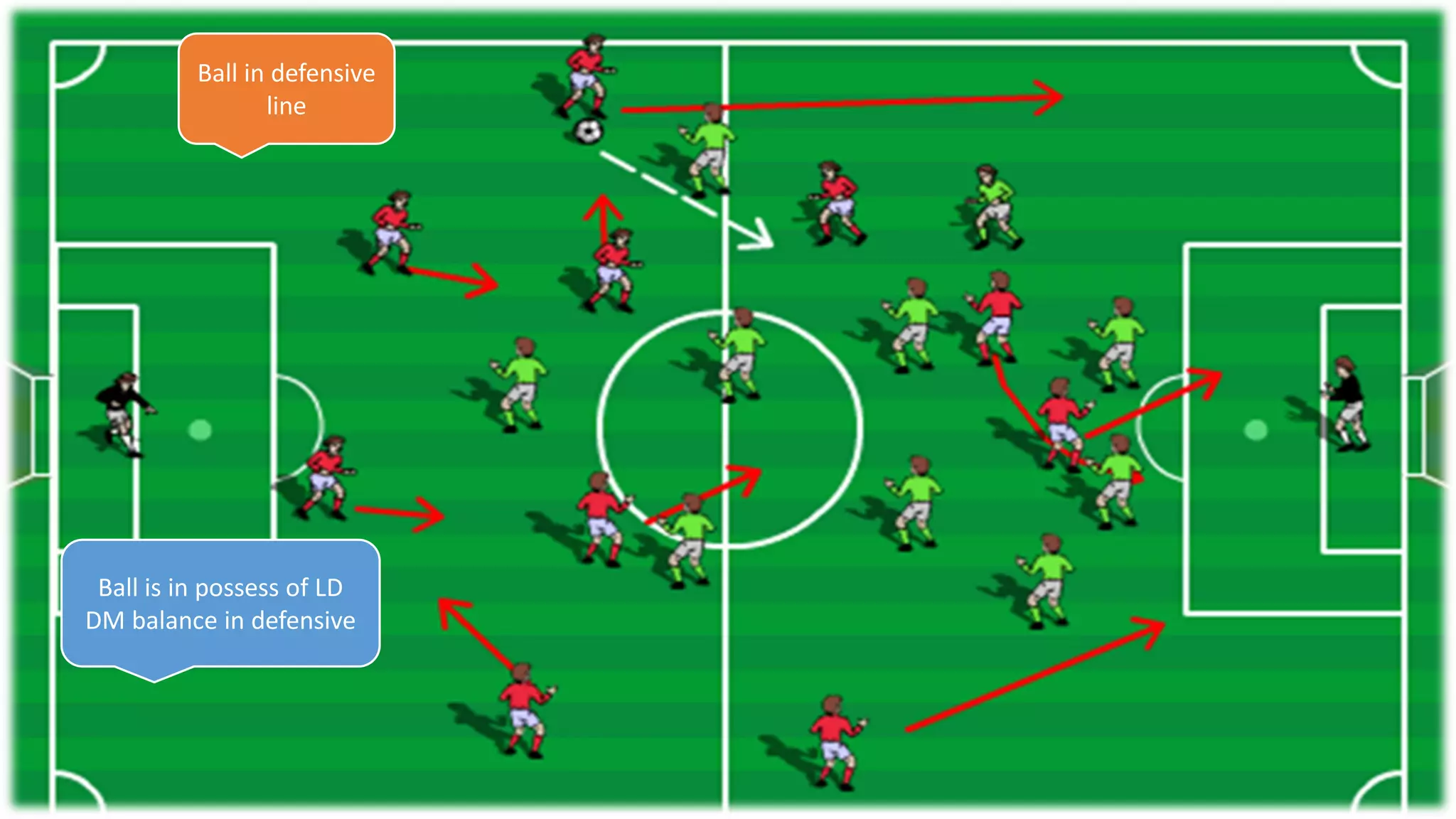
Ball is in possess of LD
DM balance in defensive
Ball in defensive
line
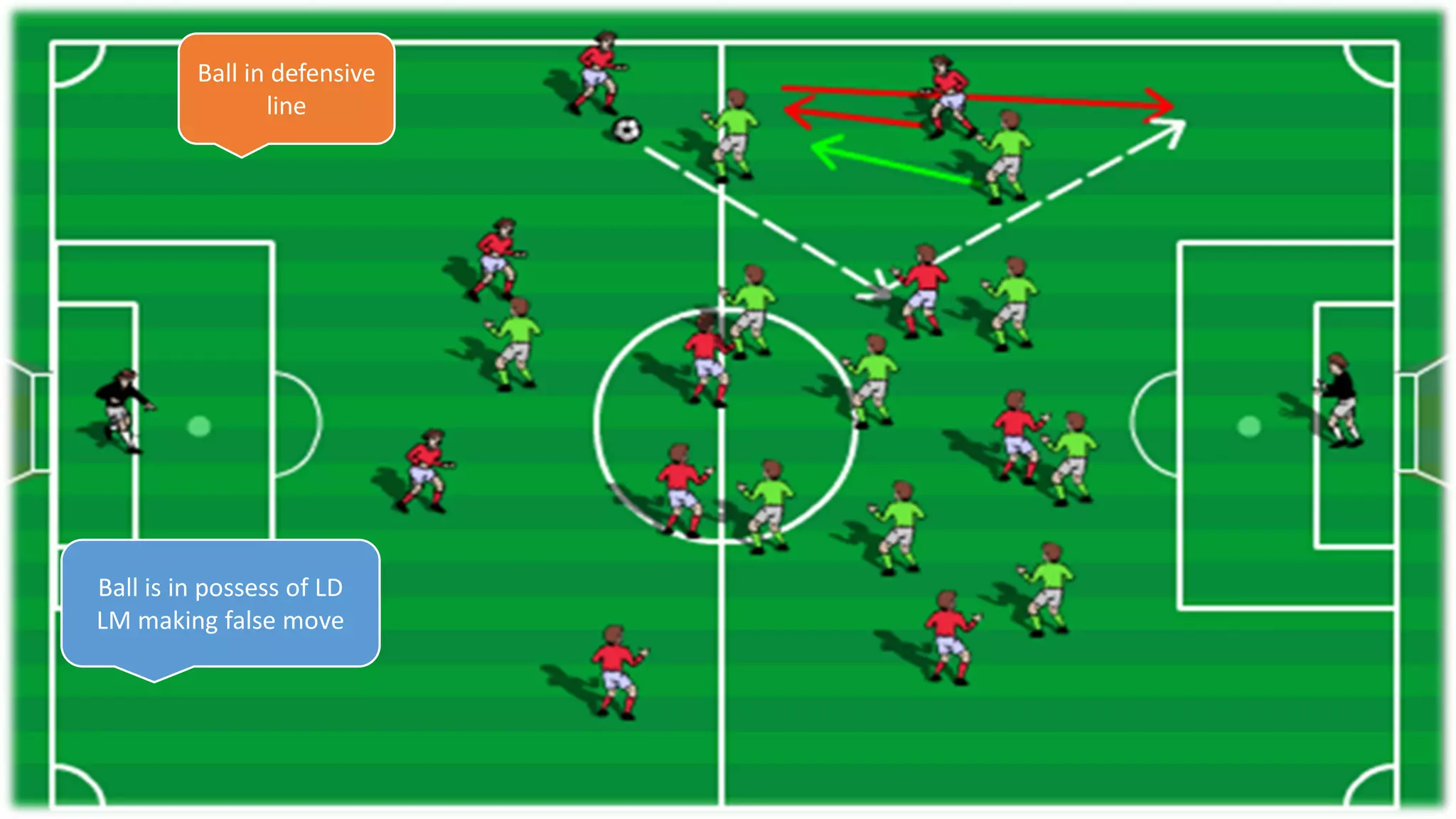
Ball is in possess of LD
LM making false move
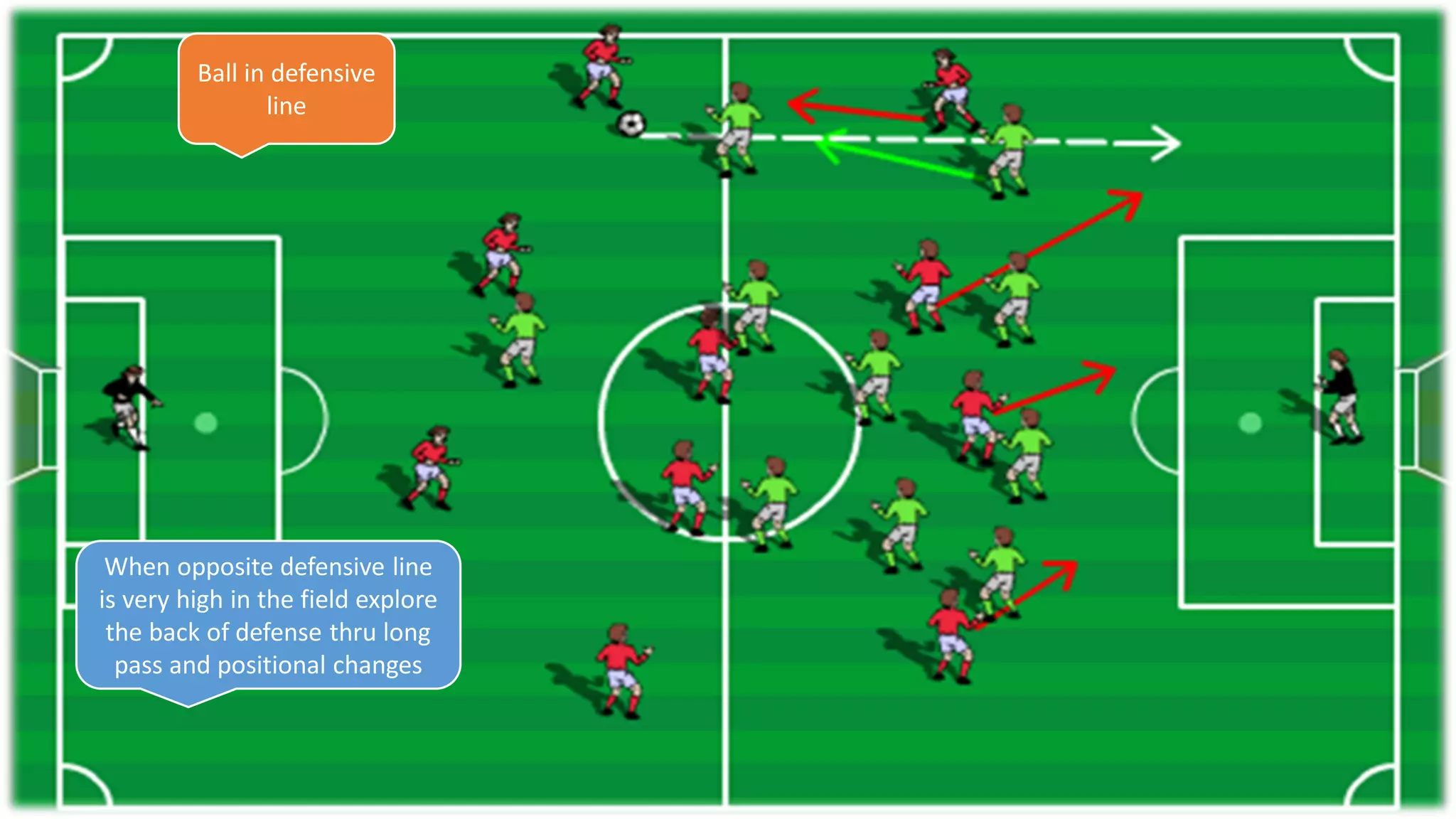
When opposite defensive line
is very high in the field explore
the back of defense thru long
pass and positional changes
Ball in defensive
line
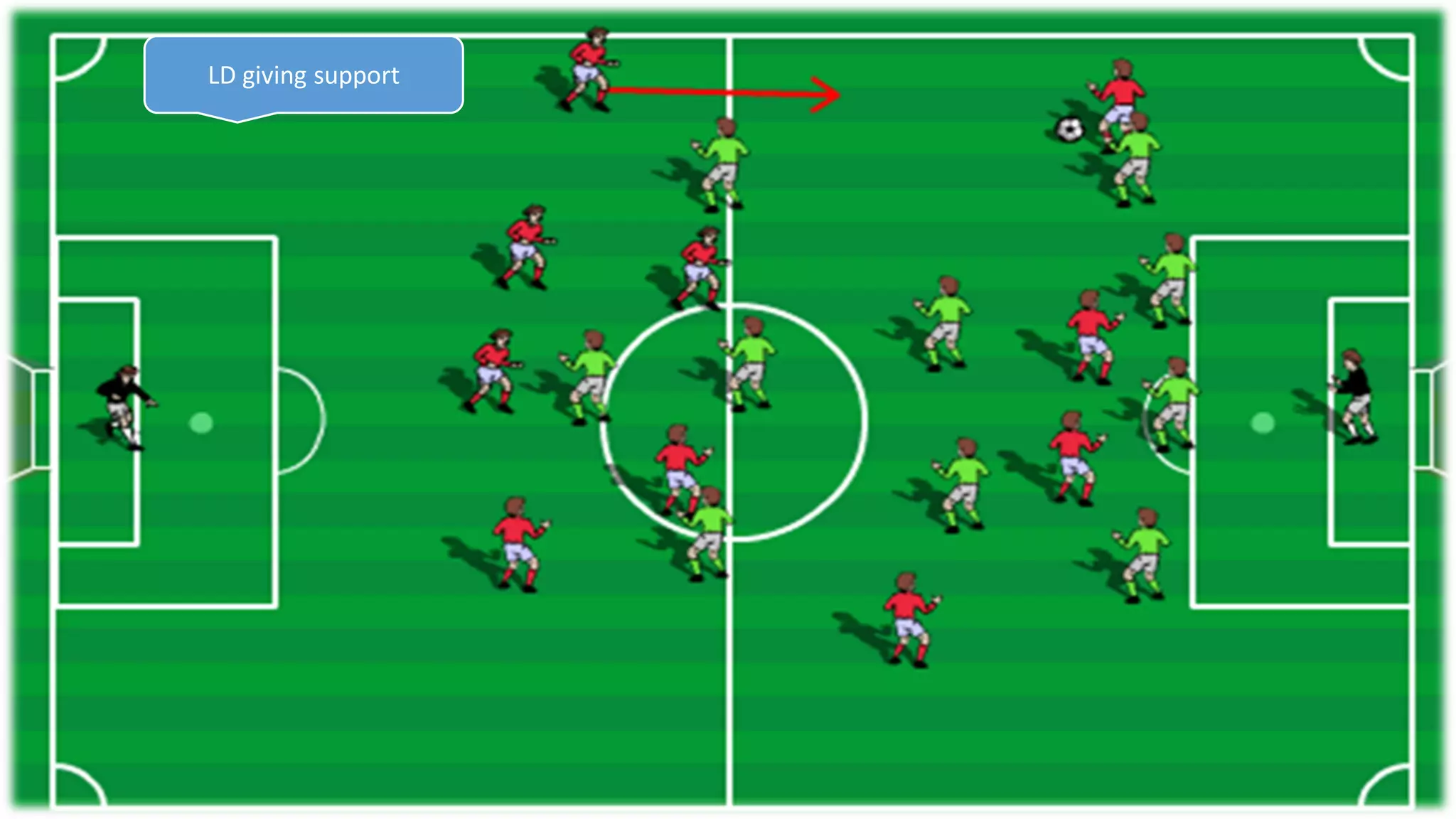
LD giving support
LD giving early cross
LD giving support for
change of point of attack
LD going in crosing zone
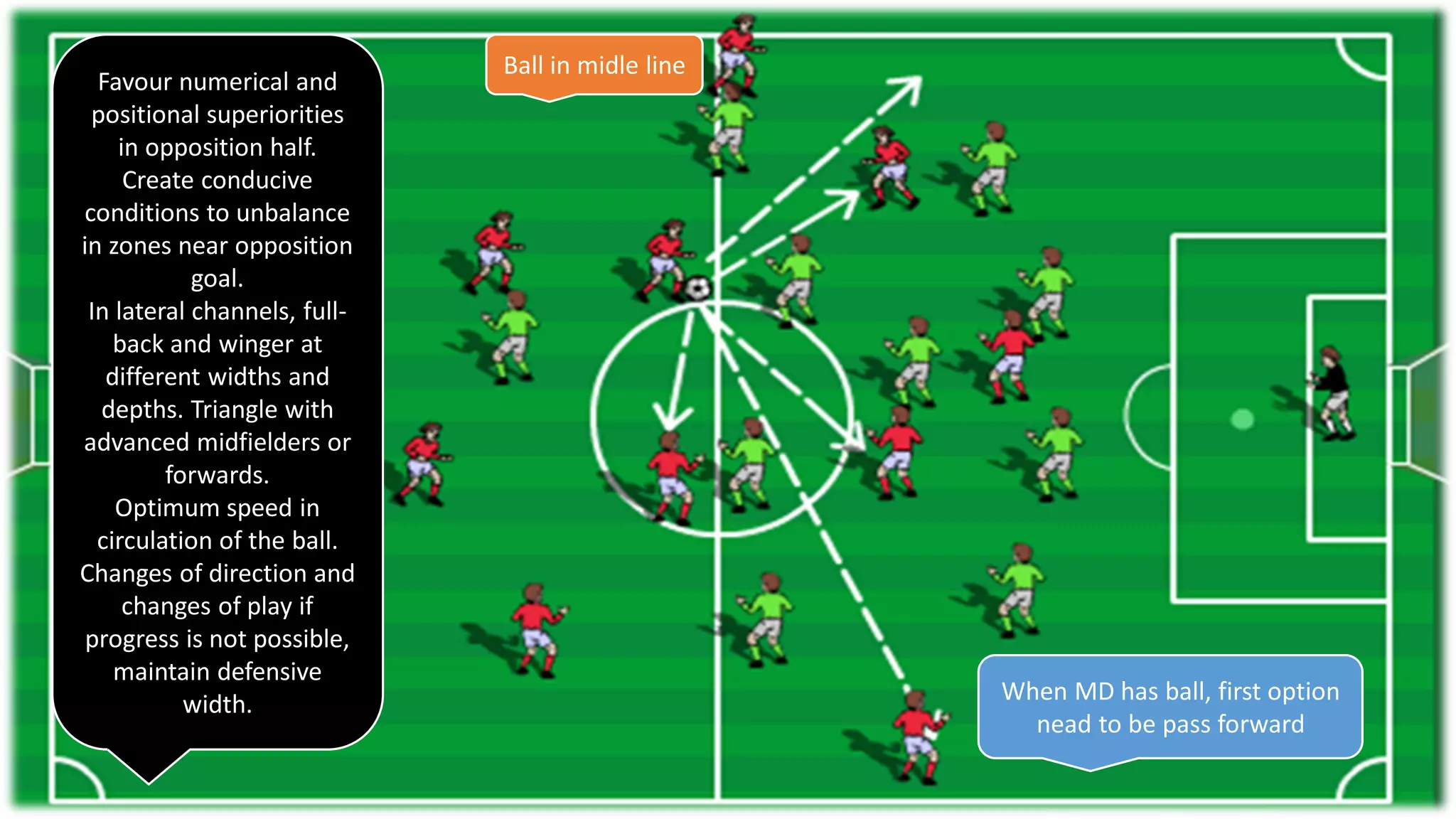
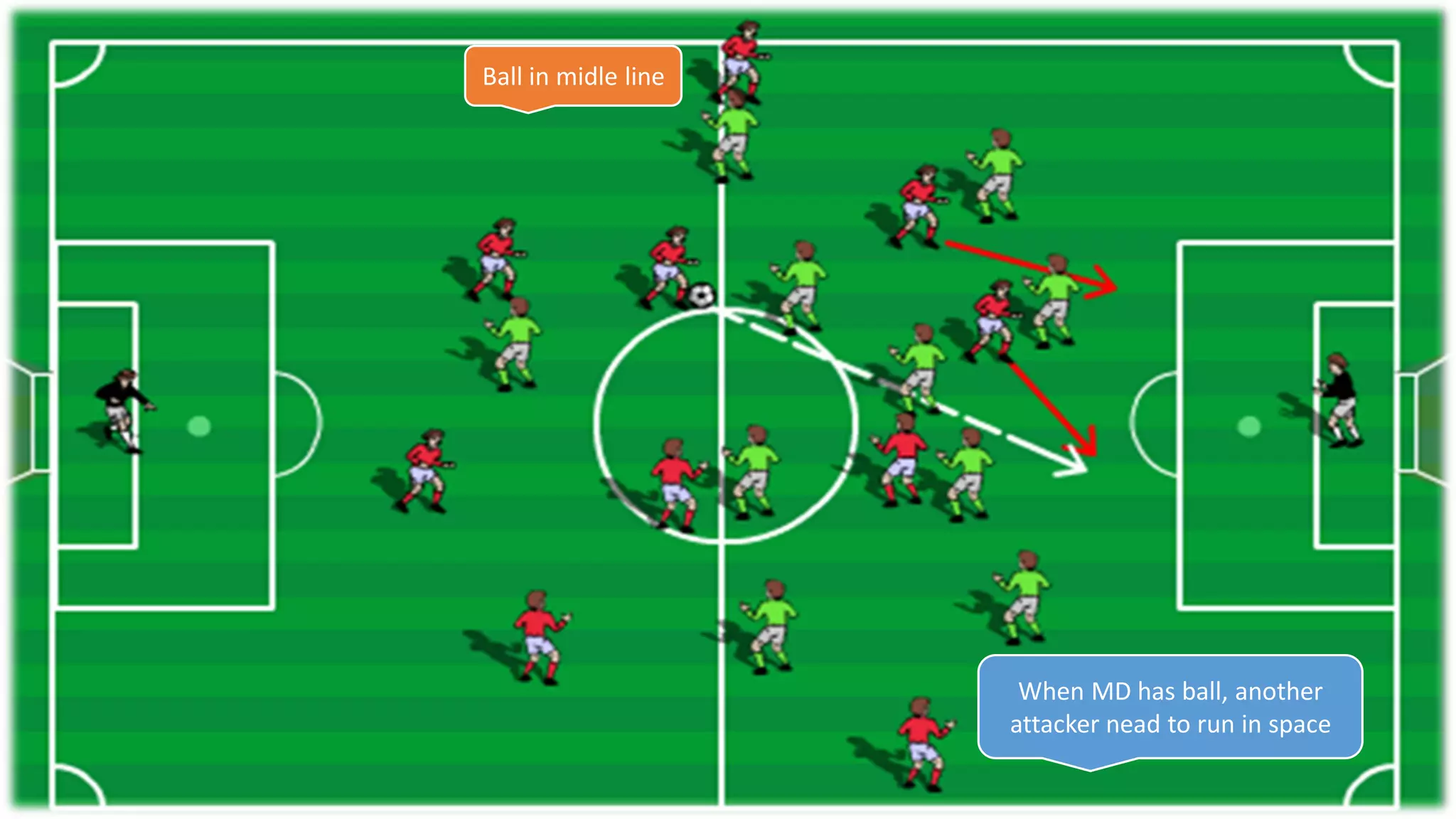
Ball in midle line
When MD has ball, first option
nead to be pass forward
Favour numerical and
positional superiorities
in opposition half.
Create conducive
conditions to unbalance
in zones near opposition
goal.
In lateral channels, full-
back and winger at
different widths and
depths. Triangle with
advanced midfielders or
forwards.
Optimum speed in
circulation of the ball.
Changes of direction and
changes of play if
progress is not possible,
maintain defensive
width.
Ball in midle line
When MD has ball, find oposite
LM with long pass
Ball in midle line
When MD has ball, another
attacker nead to run in space
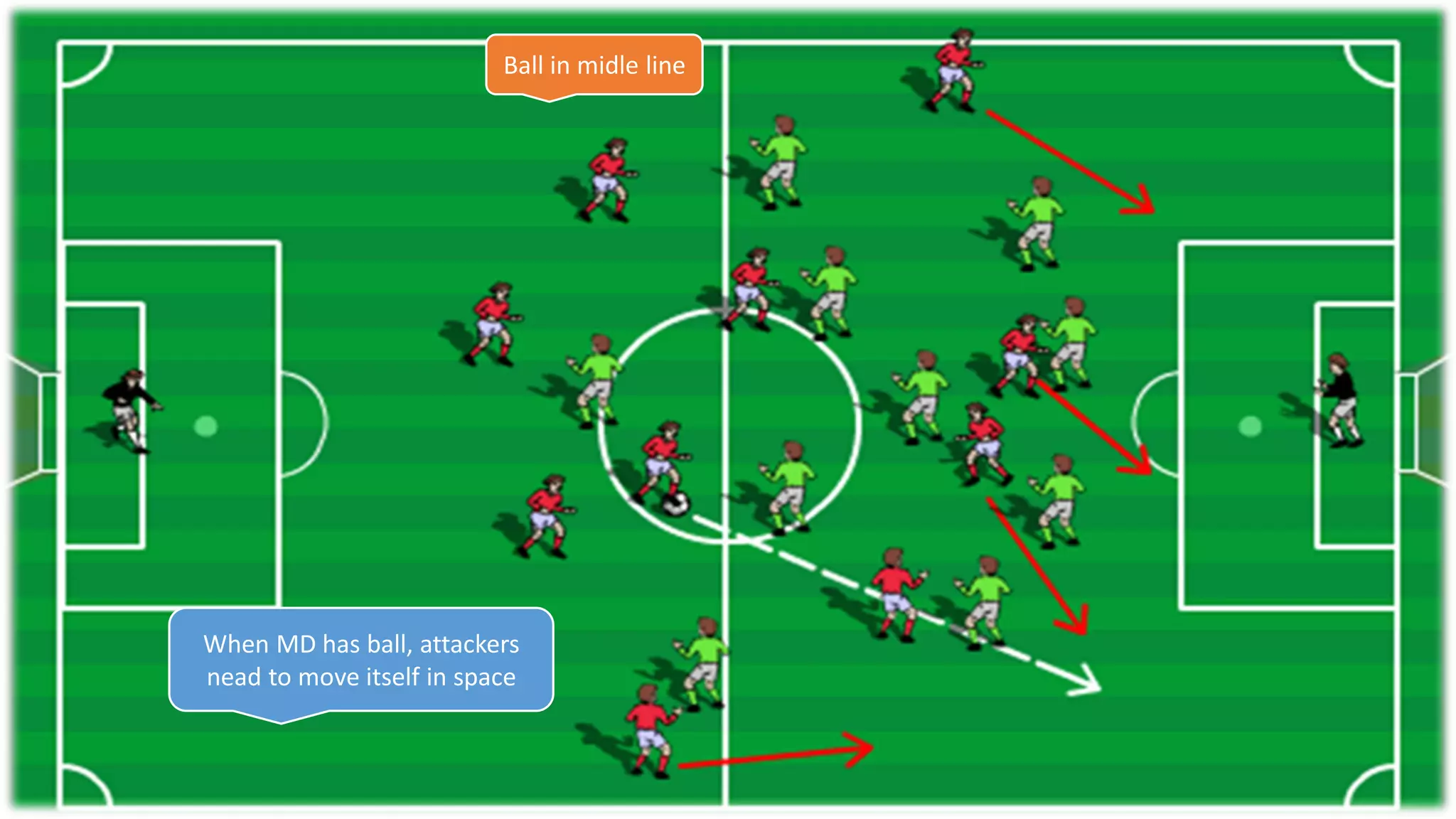
Ball in midle line
When MD has ball, attackers
nead to move itself in space
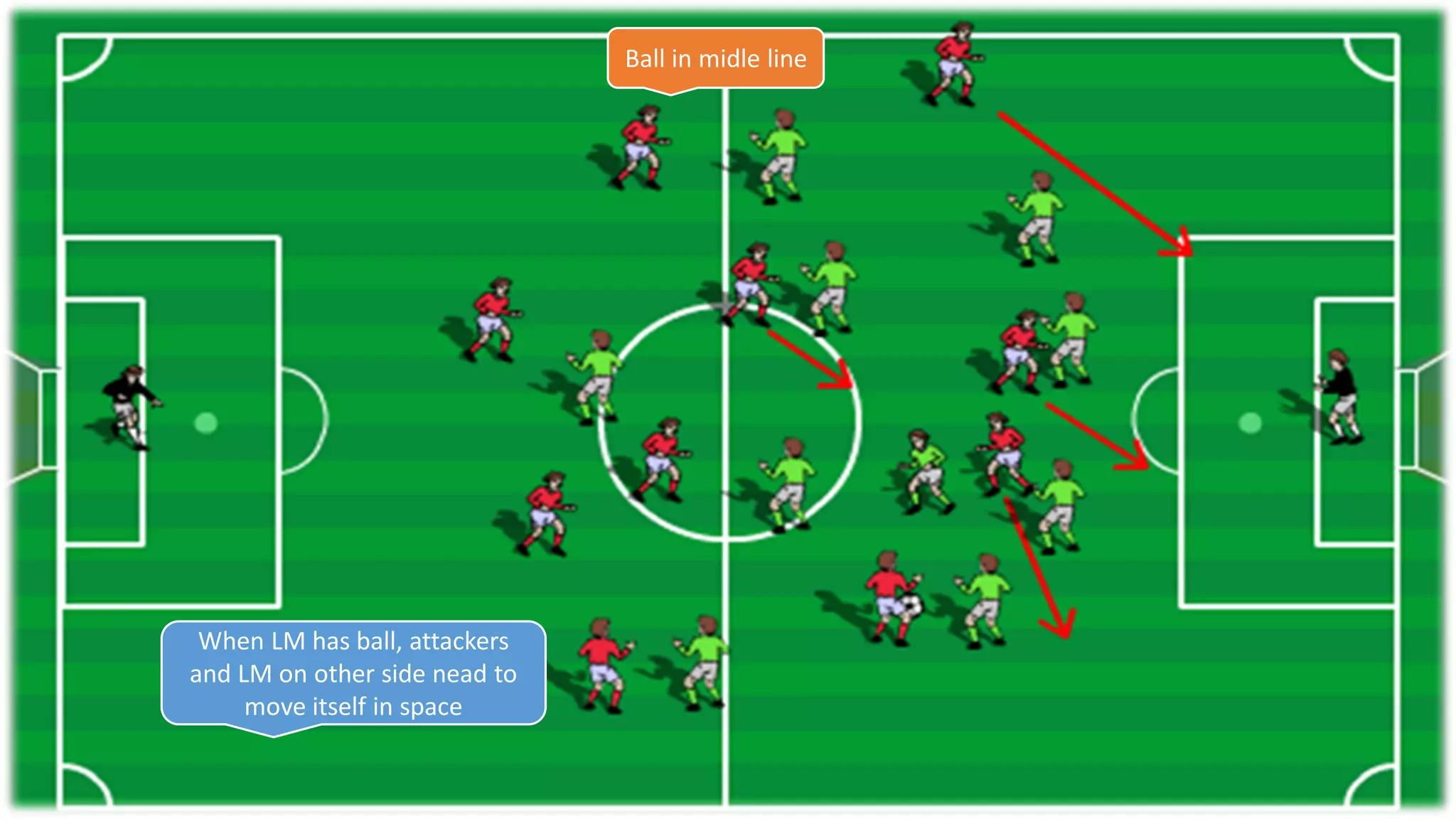
When LM has ball, attackers
and LM on other side nead to
move itself in space
Ball in midle line
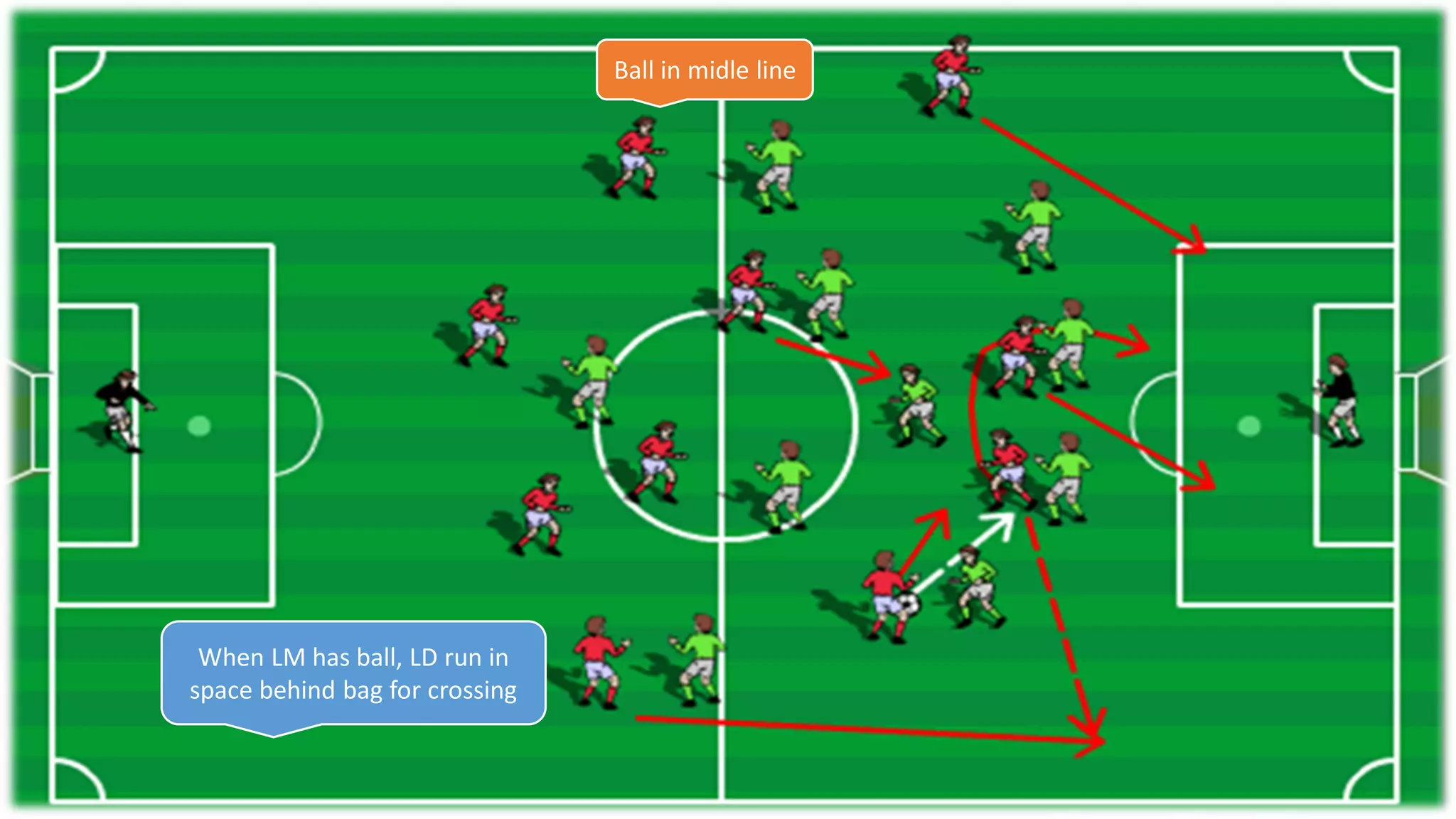
Ball in midle line
When LM has ball, LD run in
space behind bag for crossing
Ball in offansive line
When FS has ball, LM, other FS
and one MD running in free
space
Complete situations of
attack with efficiency.
Guarantee continuity by
picking up clearances.
Incorporate the greatest
number of players into the
area in a staggered
manner, Normally 3
players (forwards and
opposite winger). 4 players
(wingers and forwards) if
the full-back crosses.
Appear at the optimum
moment to shoot while
running.
Occupy different shooting
positions.
Try to complete actions.
Defensive
Transition
"Our Idea of transition from attack to defense"
1. When ball possession is lost its an obligation from players near to this
zone to react immediately and prevent the long pass / counter attack
construction from opposition. The first 5 seconds after the ball
possession lost are crucial to prevent easy construction from adversary,
it's not necessarily important to win back the ball but it is important to
create troubles to opposition to make easier the work from players away
from this pressing zone.
2. While this is happening the player outside this pressing zone must
reorganize themselves into the defensive structure of the team and
rebalance the security of the team. If not achieved the ball recovery in
this first moment team must regroup and start defensive organized
process.
Losing ball possession with
our offensive style of
football, will bring some
difficulties and its important
to know where is our weak
points
The space between central
defenders and lateral
defenders, space in the midle
is a particulary weak point
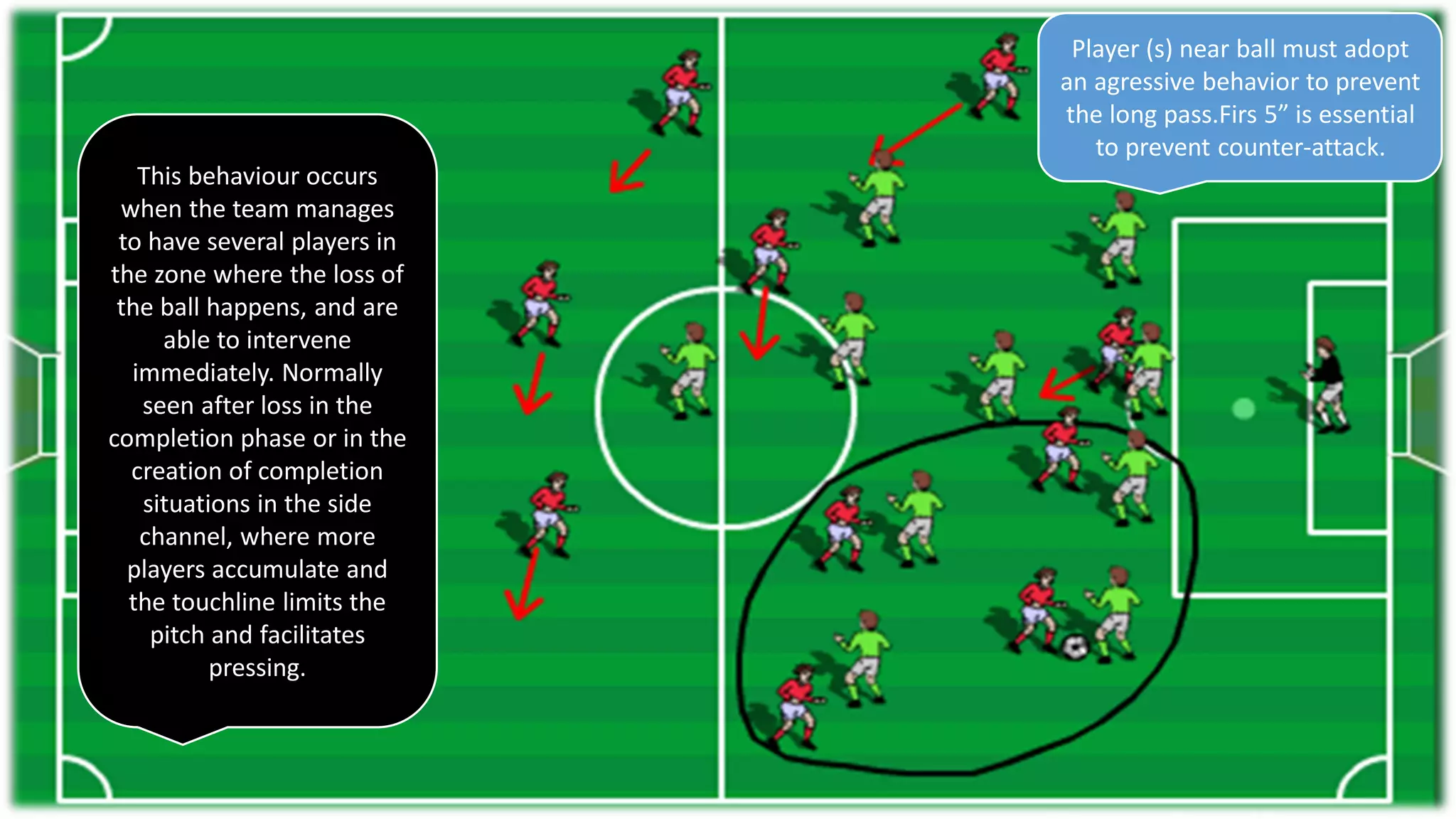
Player (s) near ball must adopt
an agressive behavior to prevent
the long pass.Firs 5” is essential
to prevent counter-attack.
This behaviour occurs
when the team manages
to have several players in
the zone where the loss of
the ball happens, and are
able to intervene
immediately. Normally
seen after loss in the
completion phase or in the
creation of completion
situations in the side
channel, where more
players accumulate and
the touchline limits the
pitch and facilitates
pressing.
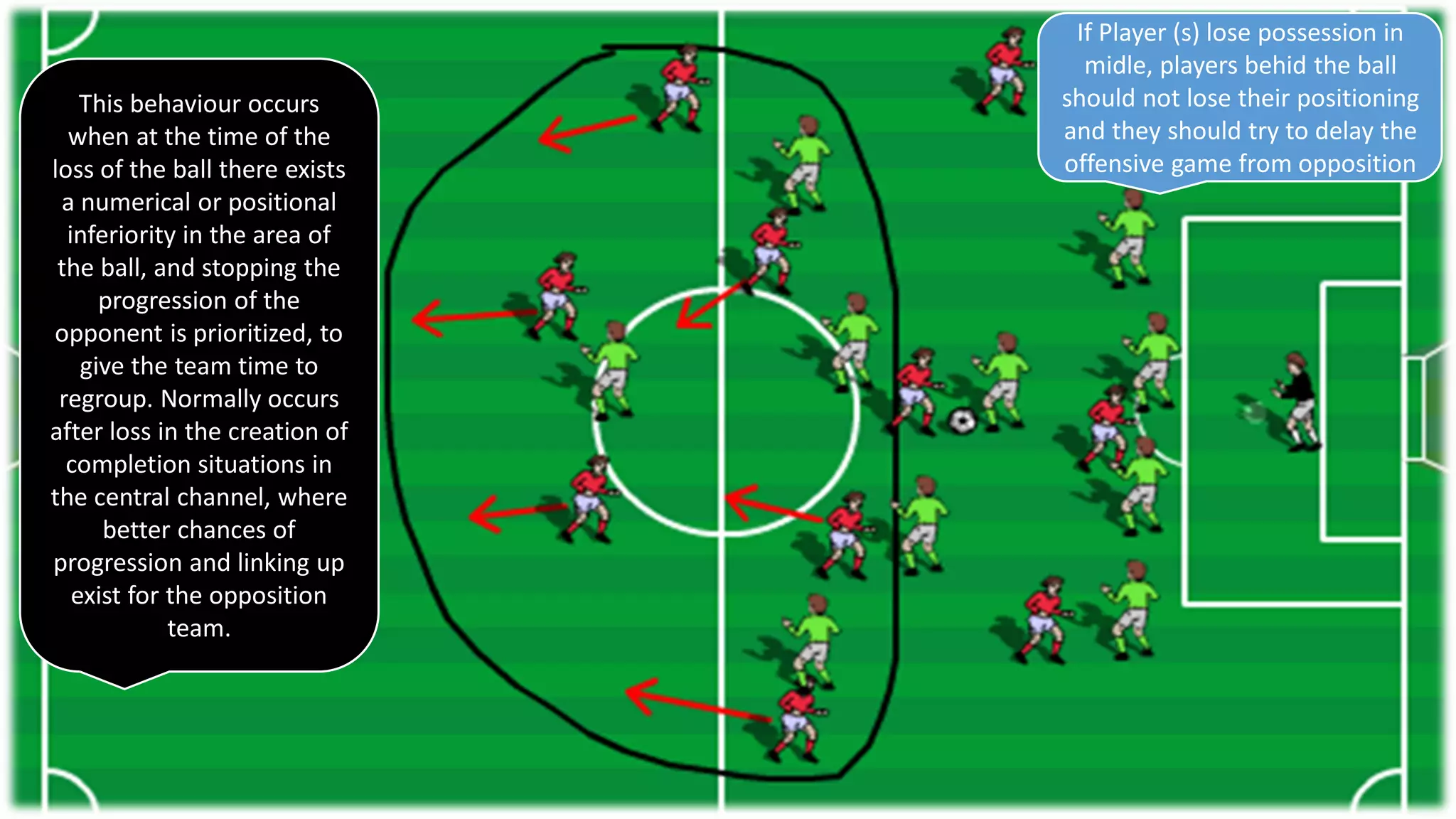
If Player (s) lose possession in
midle, players behid the ball
should not lose their positioning
and they should try to delay the
offensive game from opposition
This behaviour occurs
when at the time of the
loss of the ball there exists
a numerical or positional
inferiority in the area of
the ball, and stopping the
progression of the
opponent is prioritized, to
give the team time to
regroup. Normally occurs
after loss in the creation of
completion situations in
the central channel, where
better chances of
progression and linking up
exist for the opposition
team.
Defender maintains a secure
distance from attacker and tries
to route him to the sideline
Losing a ball in front of goal
Prevent successful
completion by
opposition.
Reduction of spaces in
diagonal towards the
centre (tunnel). Guide
counter-attack to the
side channels.
Make the shot at goal
impossible in zones close
to /inside the area.
Mark the player in
situation of cross.
Drop-back quickly the
maximum number of
players to structure the
low block.
Defensive
Organisation
"Our Idea of defense"
1. The first basic principle must be the positioning of as many players
possible behind ball line and in front of our goal .
2. When in defensive process the team must position itself according to
zonal defense principles and have, at least, 3 completely defined
defensive lines with a minimum of 9 players distribution.
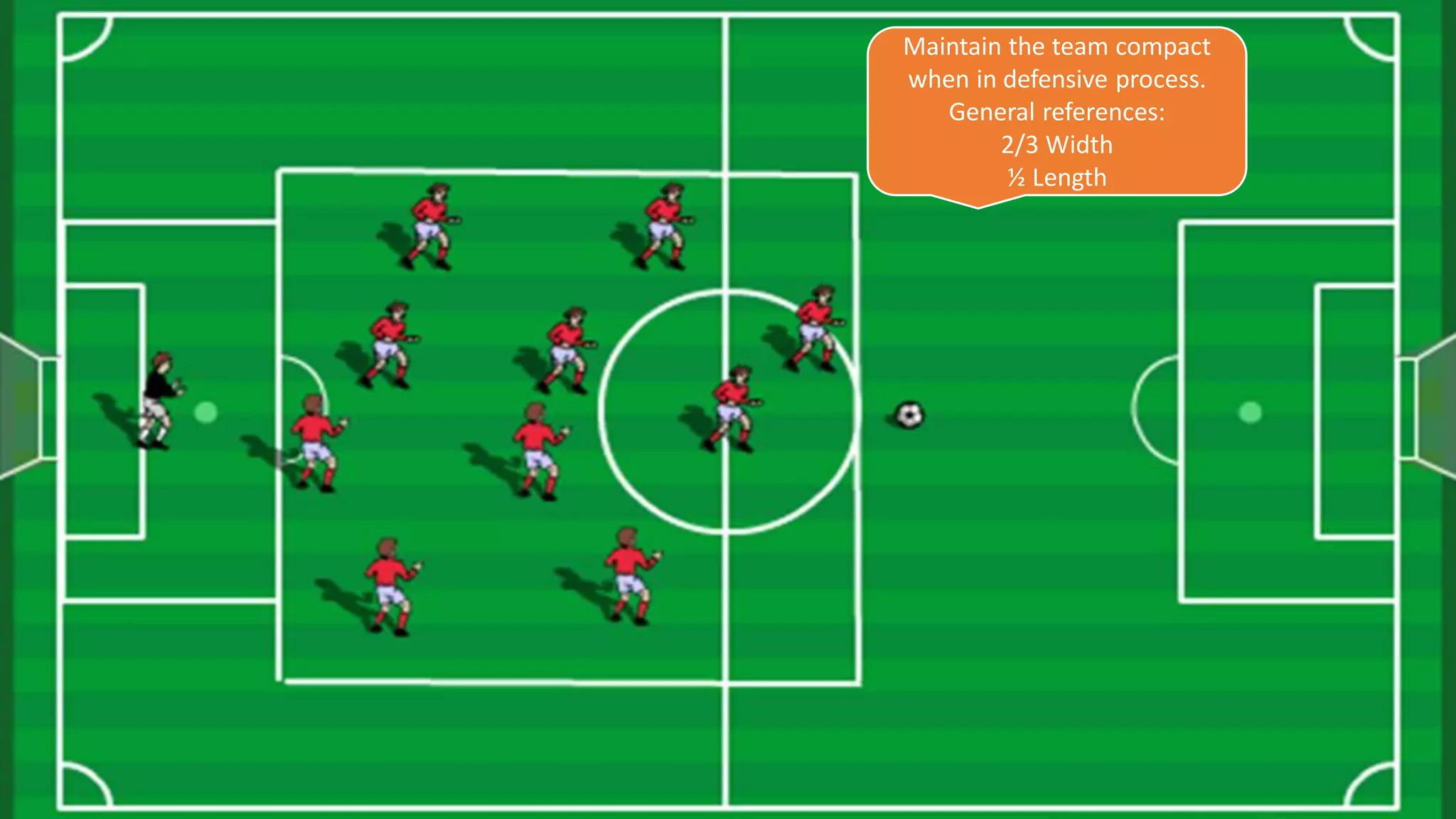
3. The zonal defense must be done according to some references which are
the occupation of the vital spaces of the field (central space and
surrounding of the ball) and the maximum length of the team must be
approximately 1/2 of the field and the maximum width 2/3 of the field.
4. Another essential skill is the capacity to communicate and establish
adaptation to the opposition style of play.
5. Discipline and collective work in defense.
6. Verbal communication.
7. Defensive line must maintain itself as the security zone and place as
many players possible in central zone of defense. When ball is played
into side line of our defense there are 2 situations for players to
evaluate and react according to it.
On one hand, if the ball is played into the back of the defense the
central defender closer to this position must give cover to the lateral
defender and try to sweep the play.
On the other hand, if the ball is played into the position of the
opposition attacker the lateral defender must react to this, approaching
him and trying to delay the play, secure the central position and giving time
for midfielder to approach and giving him the defensive support, in this
situation the central defender must stay in central zone and not approach
to much to the lateral defender.
Maintain the team compact
when in defensive process.
General references:
2/3 Width
½ Length
Move the team in relation to
the ball. Working together
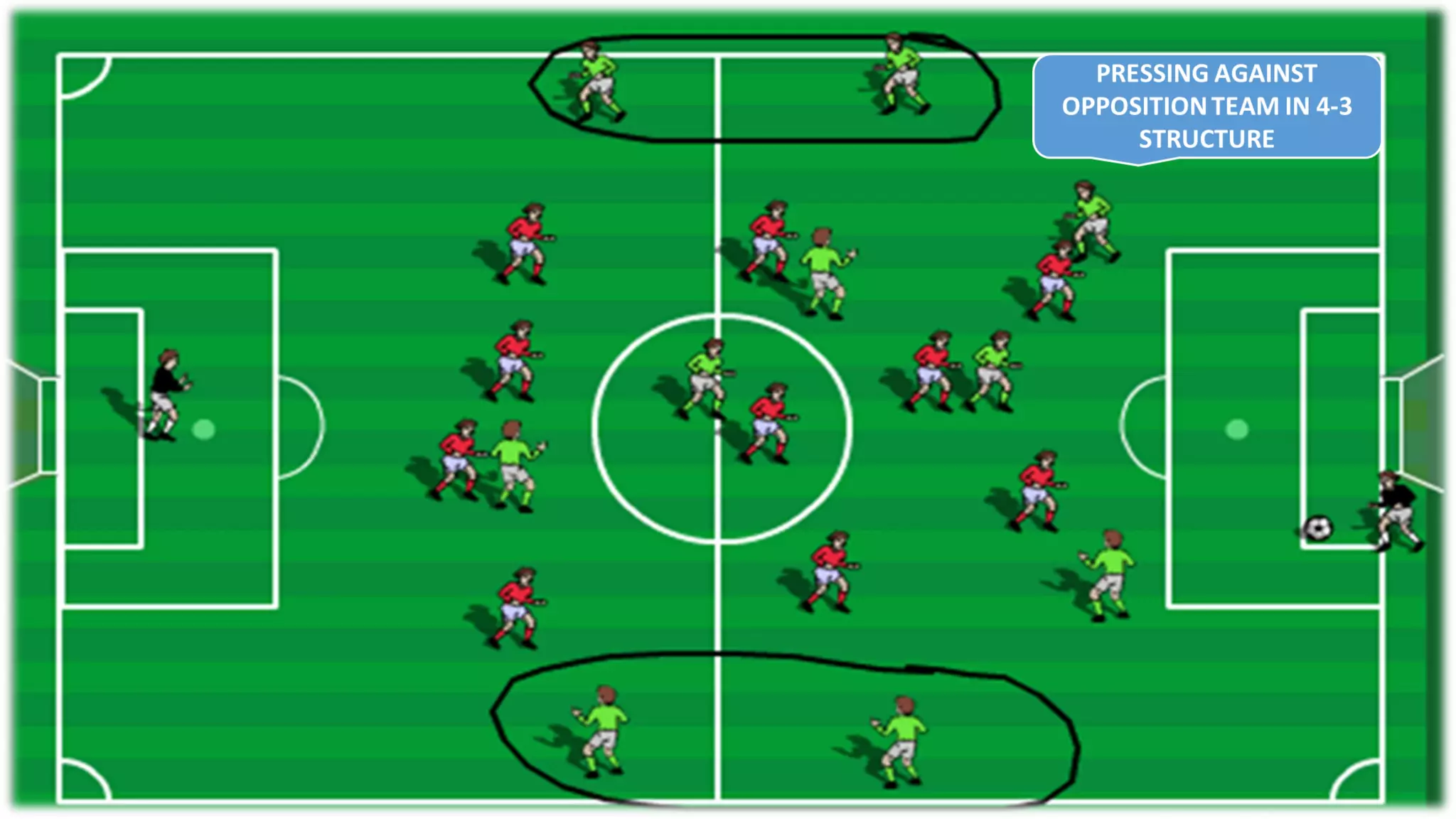
PRESSING AGAINST
OPPOSITION TEAM IN 4-2
STRUCTURE
Condition the opponent to
play direct. If not achieved,
guide the construction of
play of the opponent
towards favourable areas for
recovery.
Impede the player on the
ball from passing
comfortably. Force an error.
Harass the player on the
ball. Prevent being
overlapped and provoke its
error.
Fix potential receivers of the
ball. Prevent them from
receiving to provoke the
long pass. Otherwise: make
it difficult to control, do not
let turn or prevent
progression. Individual
marking at time of pressing
Central long ball played in the air, the reference
for 2nd ball fight must be the construction of a
pentagon around the player who is heading the
ball covering all the space around him
Lateral long ball played in the air, the reference
for 2nd ball fight must be the construction of a
romb around the player who is heading the ball
covering all the space around him
Force CD to play ball on the side.
Close central space
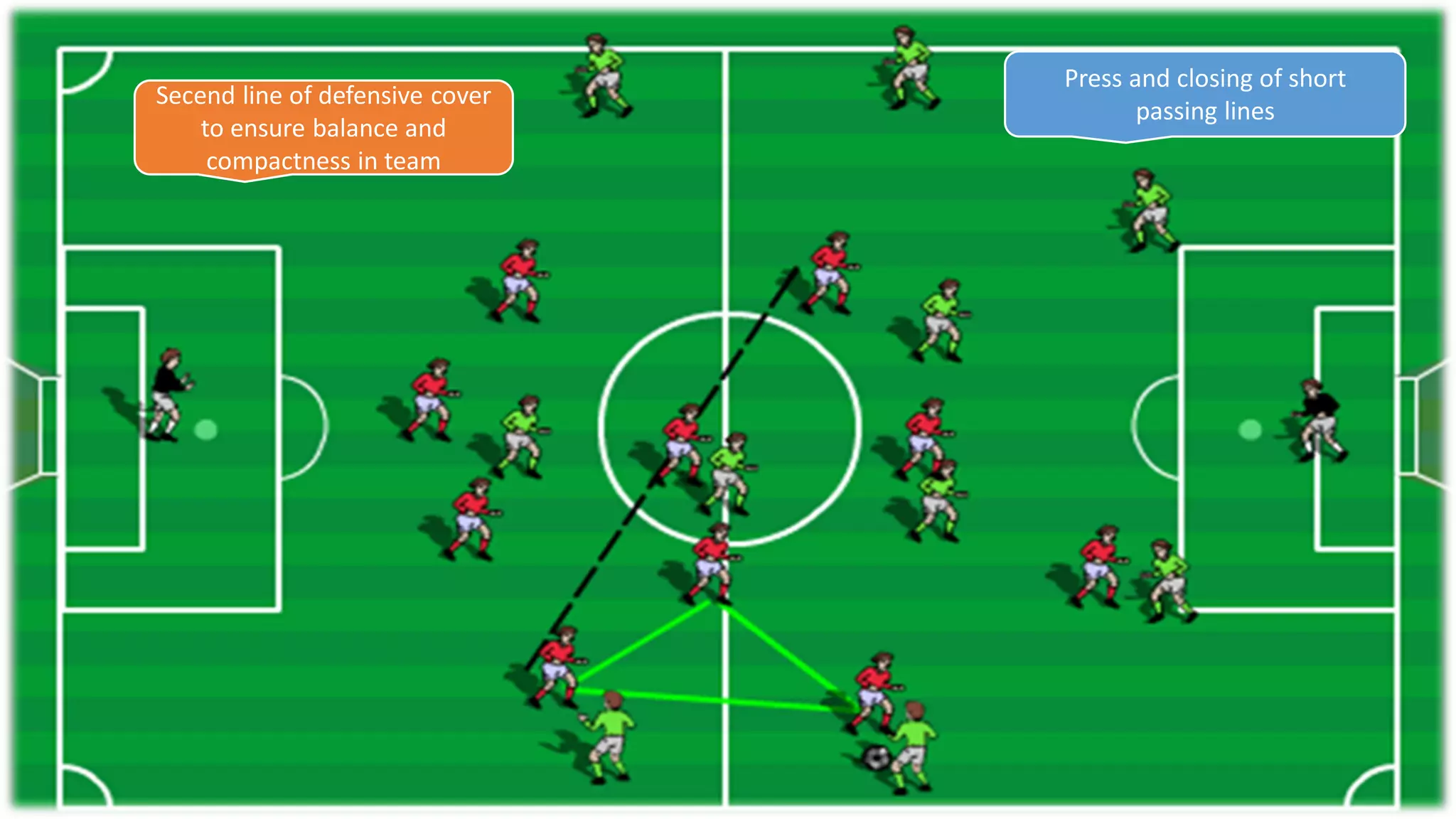
Press and closing of short
passing lines
Secend line of defensive cover
to ensure balance and
compactness in team
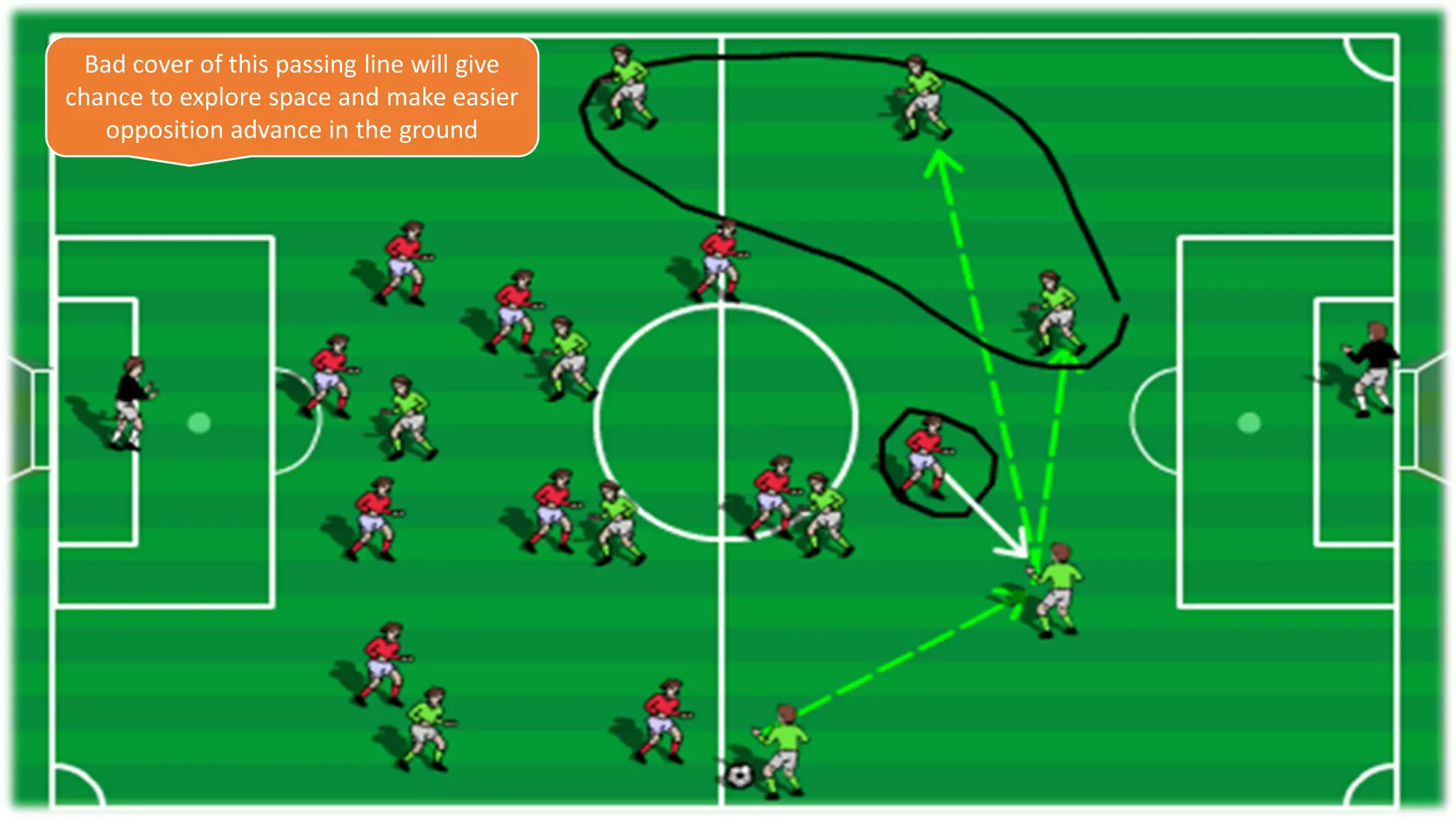
Bad cover of this passing line will give
chance to explore space and make easier
opposition advance in the ground
Organised defence in the middle
block
Prevent creation of
situations of numerical
superiority in spaces near
the goal. Show own
numerical superiority if
possible.
Avoid being overwhelmed or
overtaken by penetrating
supporting runs.
Detect favourable times to
move to a pressing defence.
Keep the defensive unit
wide and with reduced
depth. "Shrink" in back pass,
maintain when pressed and
drop-back if the opponent
can play with depth.
Harass the holder of the ball,
avoiding being overrun.
Fix nearby players and
monitor the ones further
away.
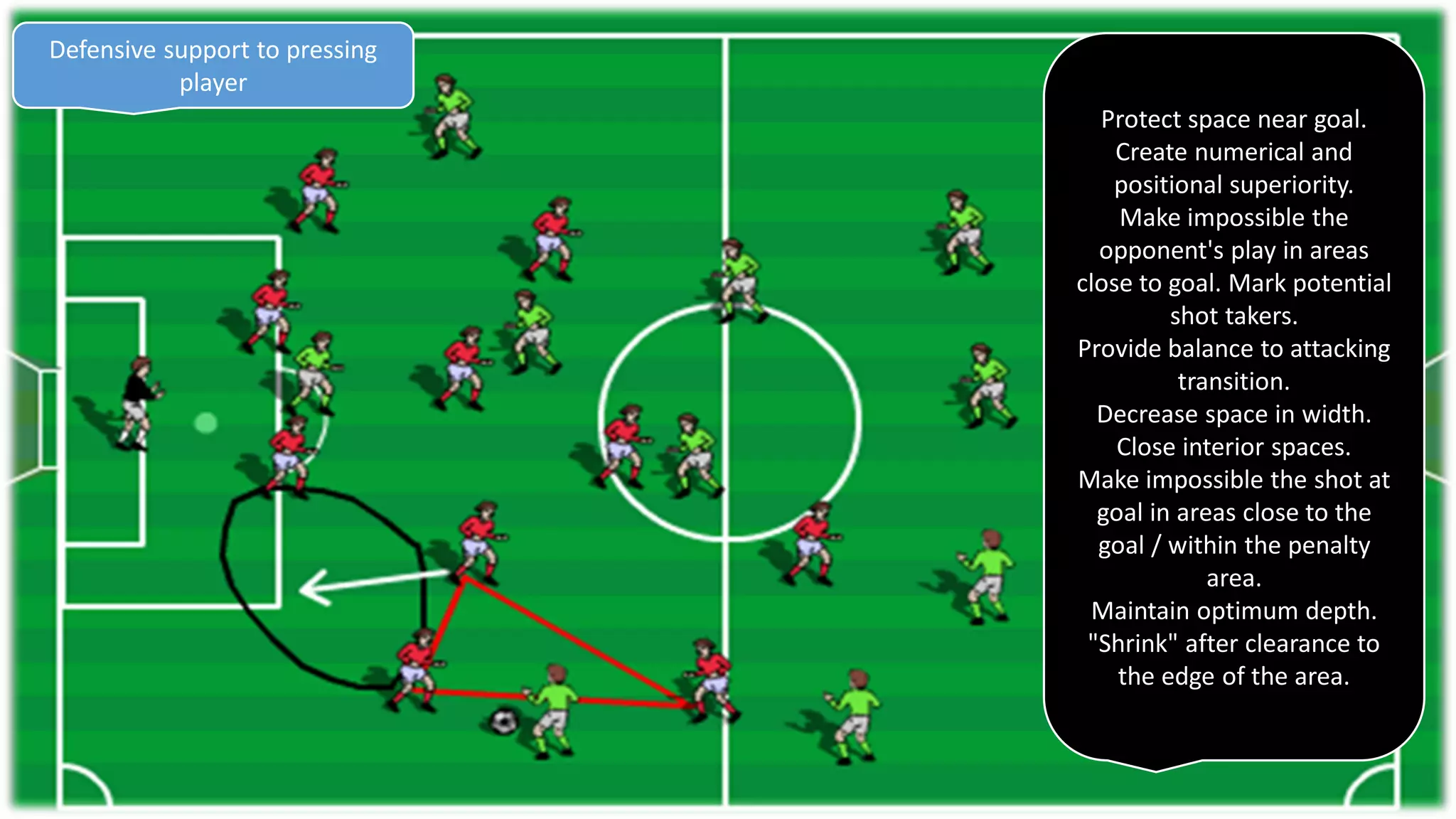
Defensive support to pressing
player
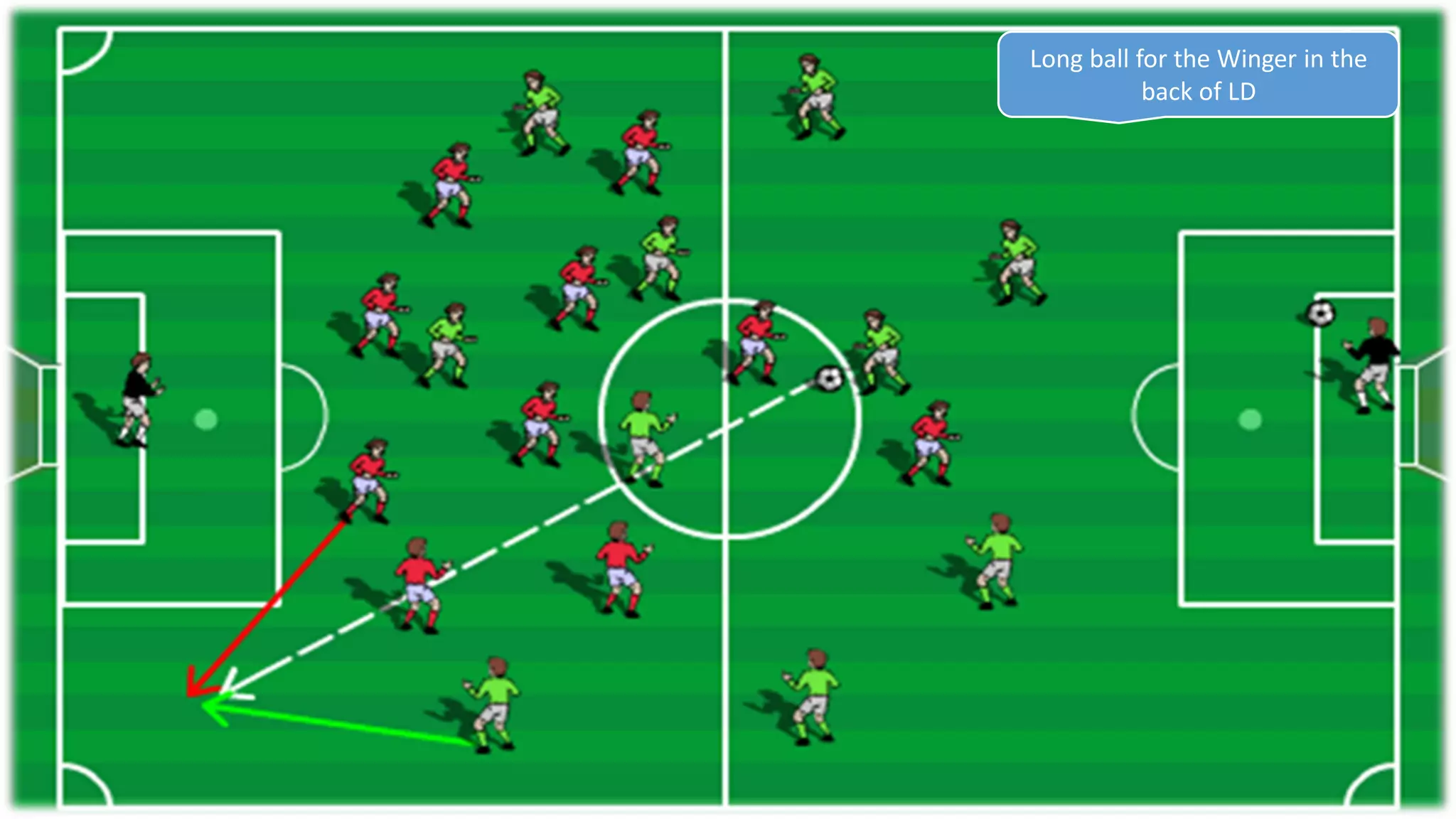
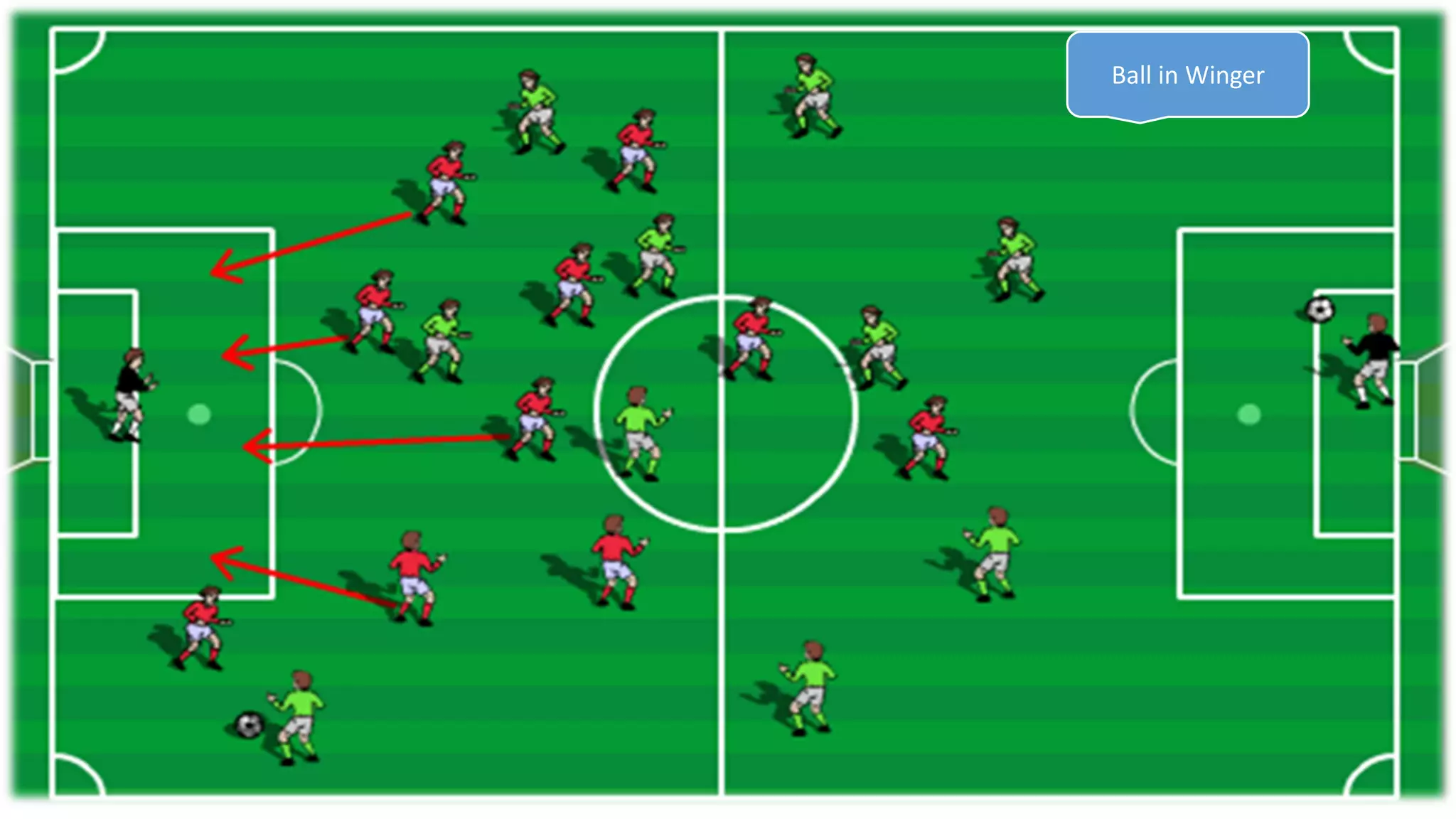
Long ball for the Winger in the
back of LD
Ball in Winger
Ball in Winger
CD goes in ball possession and
DM covers central space
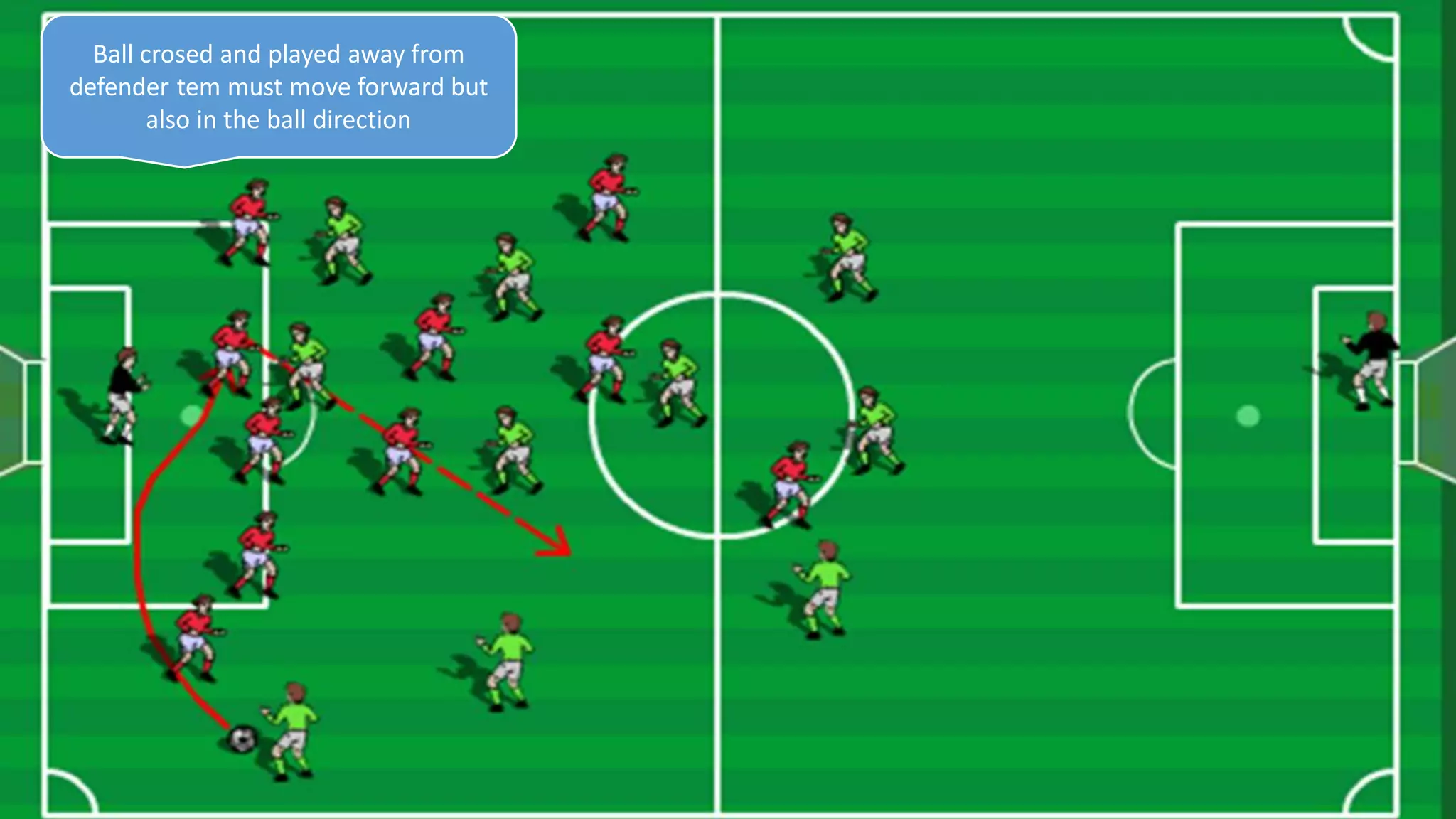
Ball crosed and played away from
defender tem must move forward but
also in the ball direction
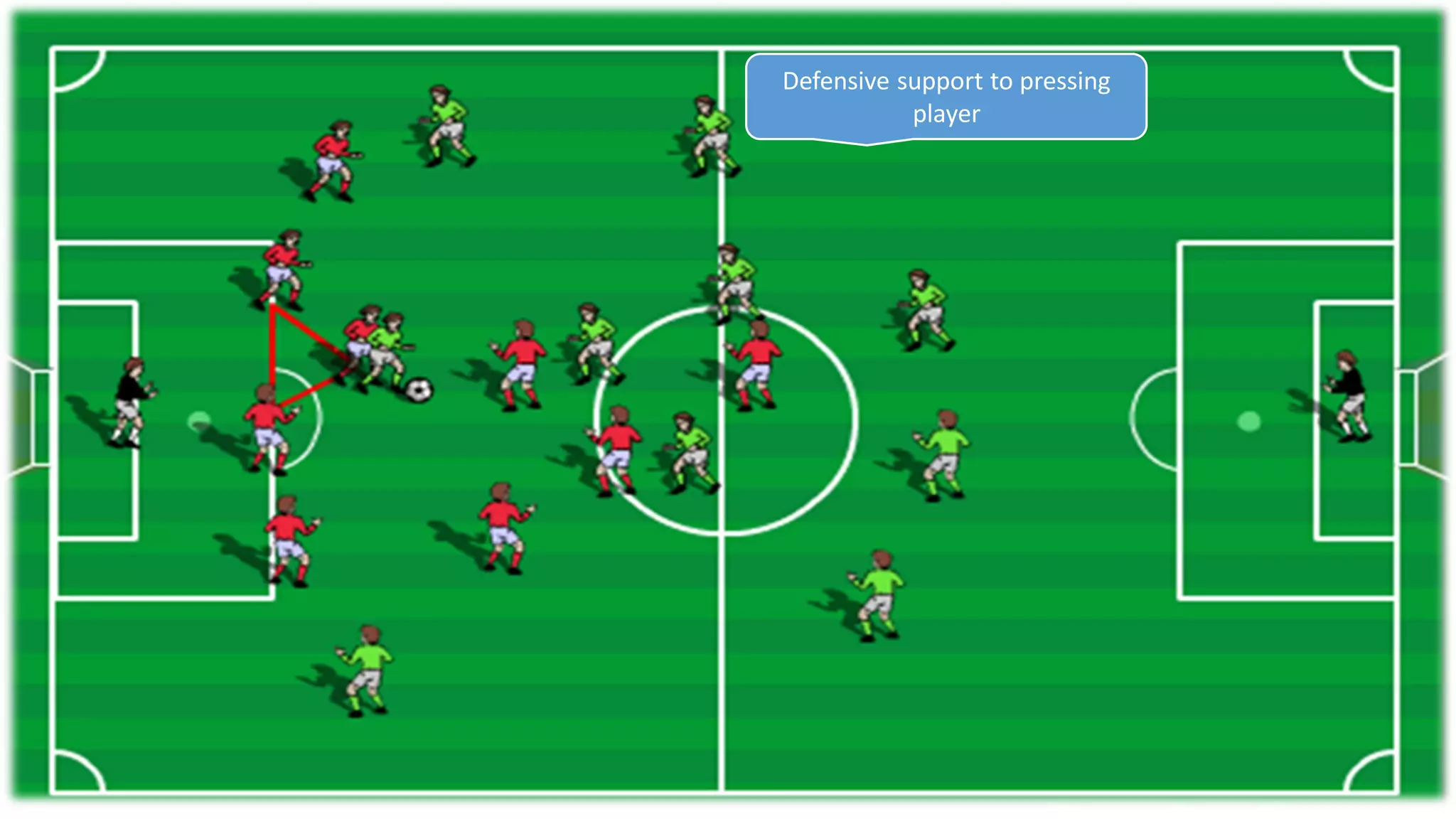
Defensive support to pressing
player
Protect space near goal.
Create numerical and
positional superiority.
Make impossible the
opponent's play in areas
close to goal. Mark potential
shot takers.
Provide balance to attacking
transition.
Decrease space in width.
Close interior spaces.
Make impossible the shot at
goal in areas close to the
goal / within the penalty
area.
Maintain optimum depth.
"Shrink" after clearance to
the edge of the area.
Defensive support to pressing
player
Ofansive
Transition
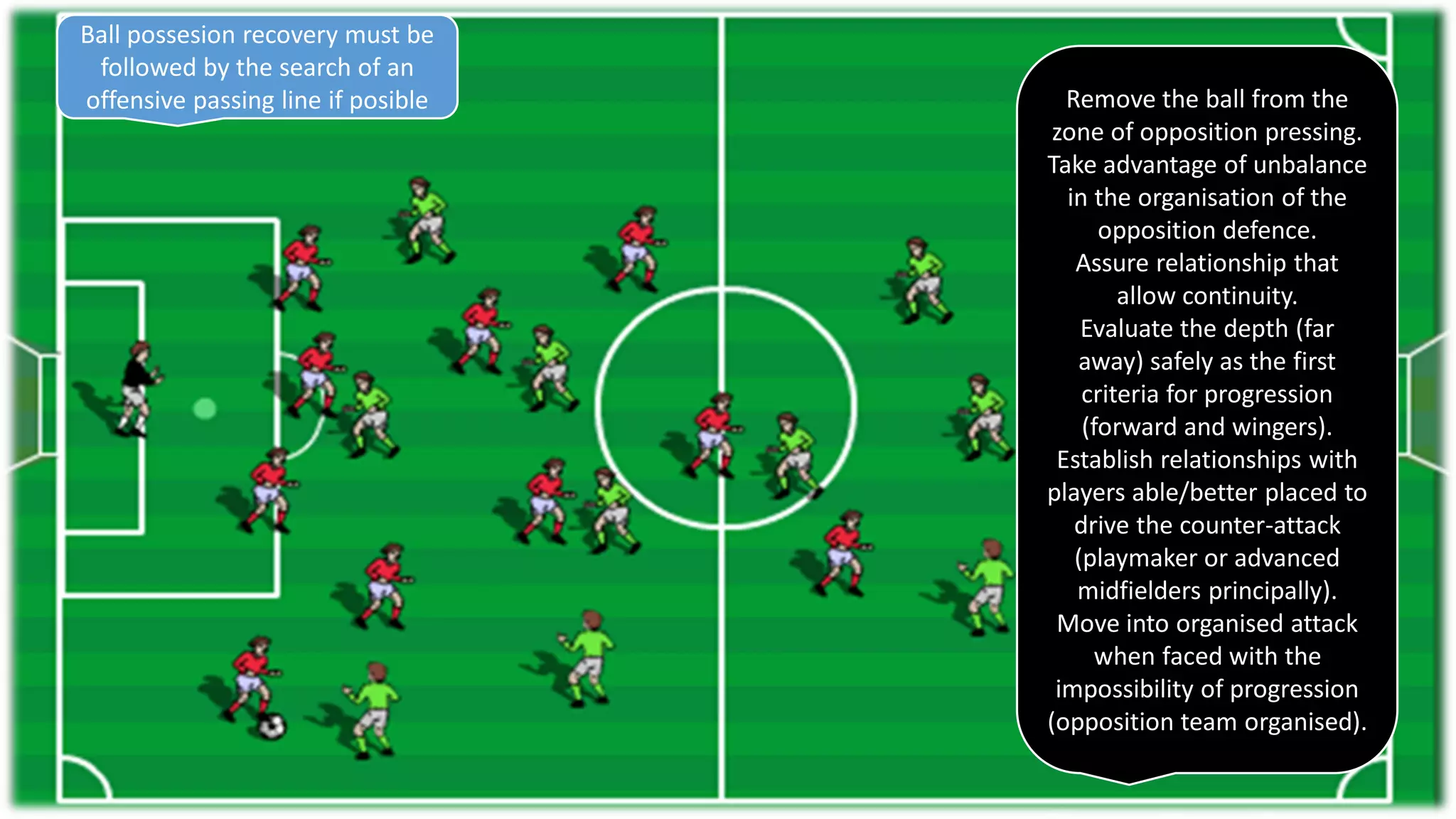
"Our Idea of transition from defense to attack"
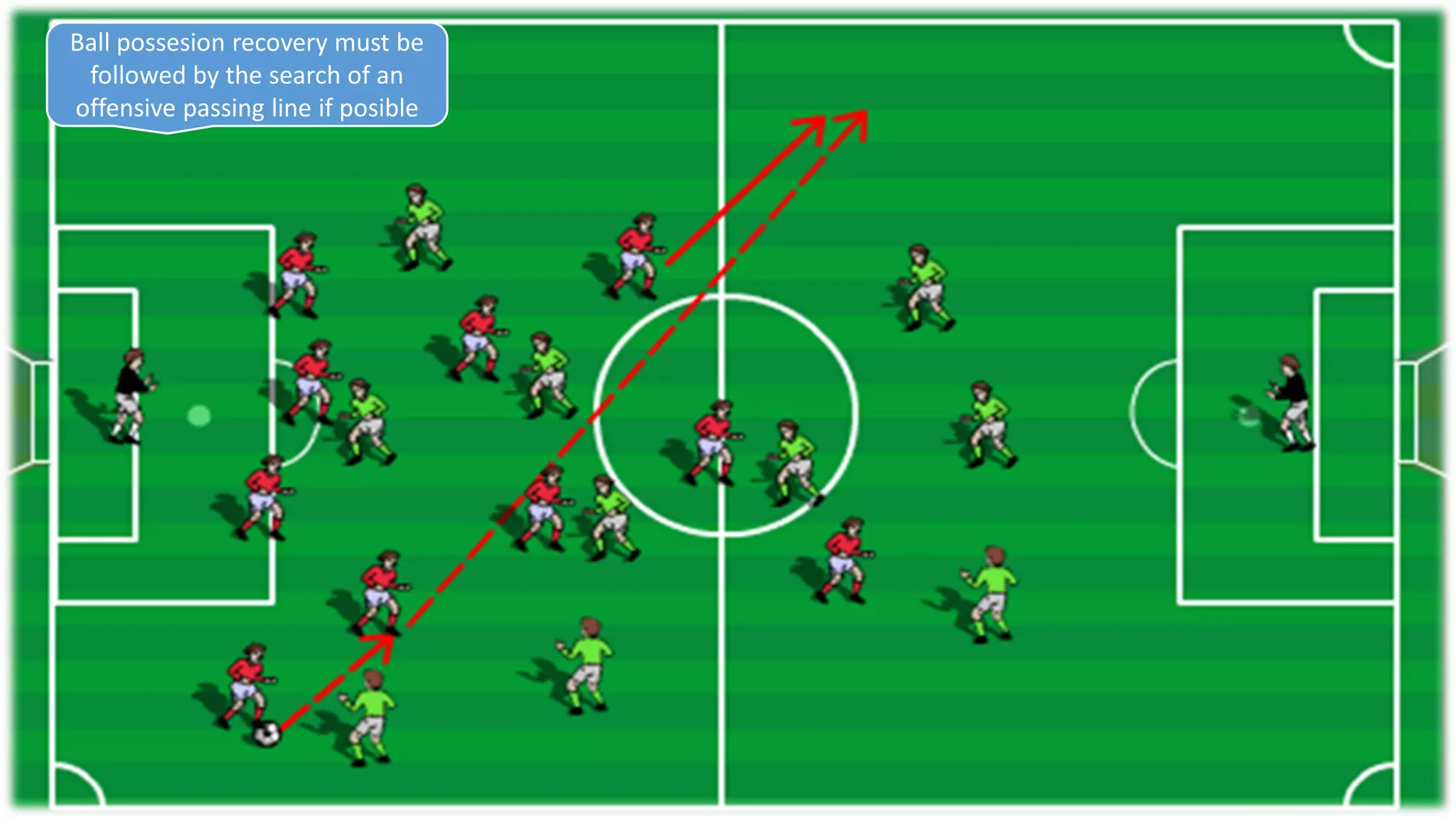
1. The first option must be the immediate search for the most offensive line
of pass possible and advance the team to maintain compactness and fight
for second balls if necessary.
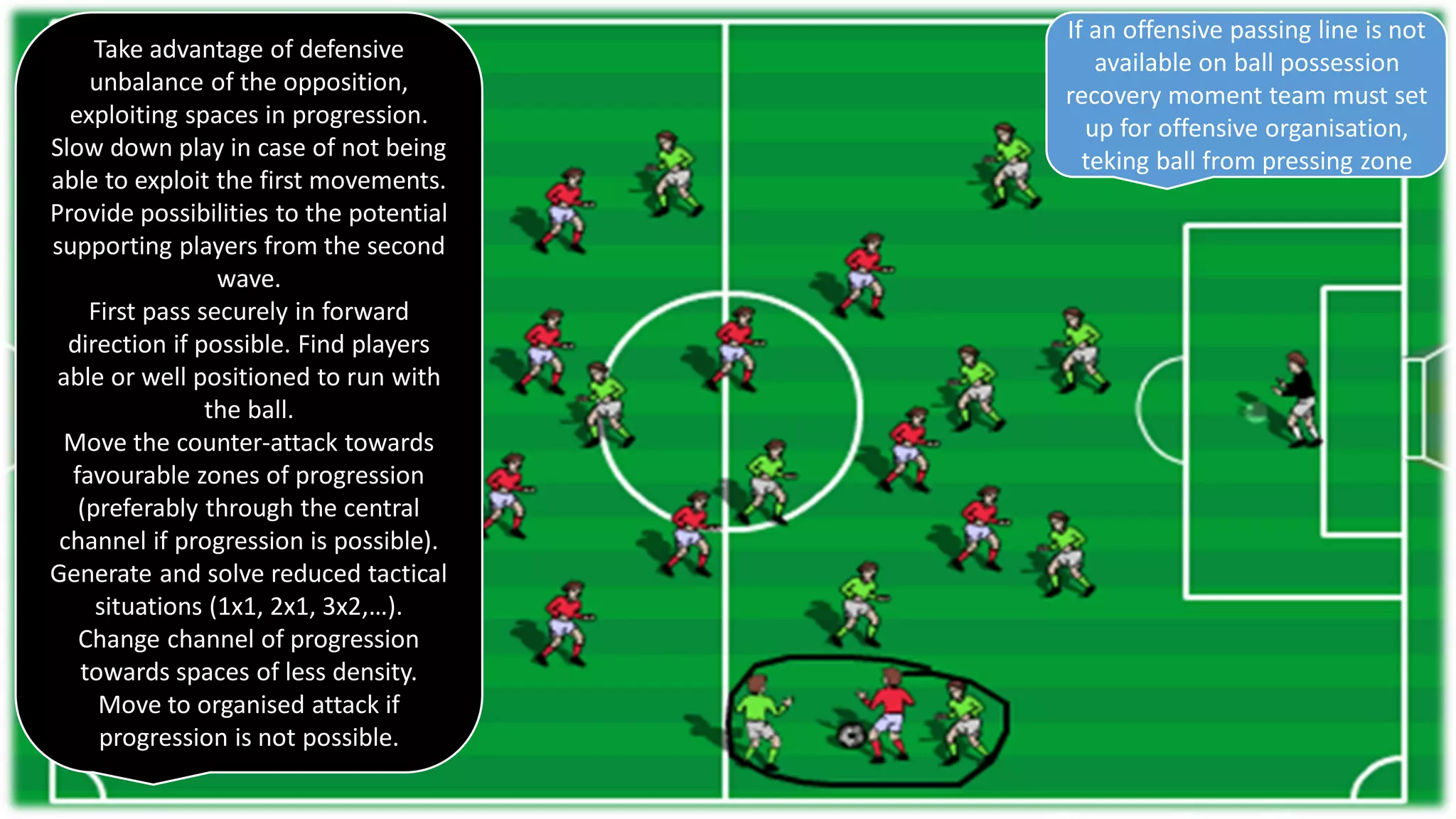
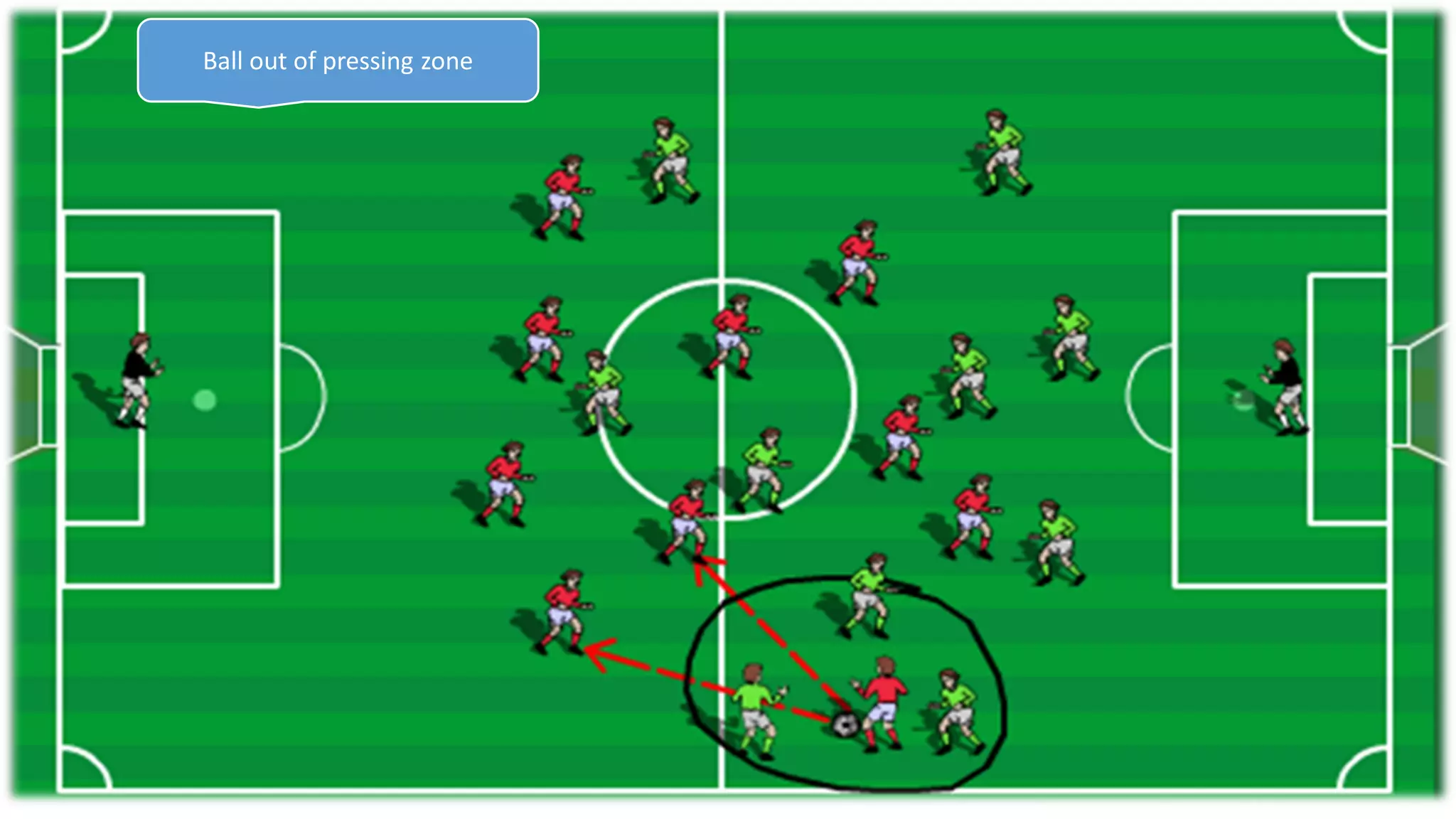
2. If no offensive passing line is available the player must try to take the ball
away from pressing zone using players behind ball line and fast change of
point of attack and start the phase of attacking process.
Ball possesion recovery must be
followed by the search of an
offensive passing line if posible Remove the ball from the
zone of opposition pressing.
Take advantage of unbalance
in the organisation of the
opposition defence.
Assure relationship that
allow continuity.
Evaluate the depth (far
away) safely as the first
criteria for progression
(forward and wingers).
Establish relationships with
players able/better placed to
drive the counter-attack
(playmaker or advanced
midfielders principally).
Move into organised attack
when faced with the
impossibility of progression
(opposition team organised).
Ball possesion recovery must be
followed by the search of an
offensive passing line if posible
Ball possesion recovery must be
followed by the search of an
offensive passing line if posible
Do not braeak the team. All
players must move in the
direction of the ball
Reduce as fast es possible the
distance between lines
If an offensive passing line is not
available on ball possession
recovery moment team must set
up for offensive organisation,
teking ball from pressing zone
Take advantage of defensive
unbalance of the opposition,
exploiting spaces in progression.
Slow down play in case of not being
able to exploit the first movements.
Provide possibilities to the potential
supporting players from the second
wave.
First pass securely in forward
direction if possible. Find players
able or well positioned to run with
the ball.
Move the counter-attack towards
favourable zones of progression
(preferably through the central
channel if progression is possible).
Generate and solve reduced tactical
situations (1x1, 2x1, 3x2,…).
Change channel of progression
towards spaces of less density.
Move to organised attack if
progression is not possible.
Ball out of pressing zone
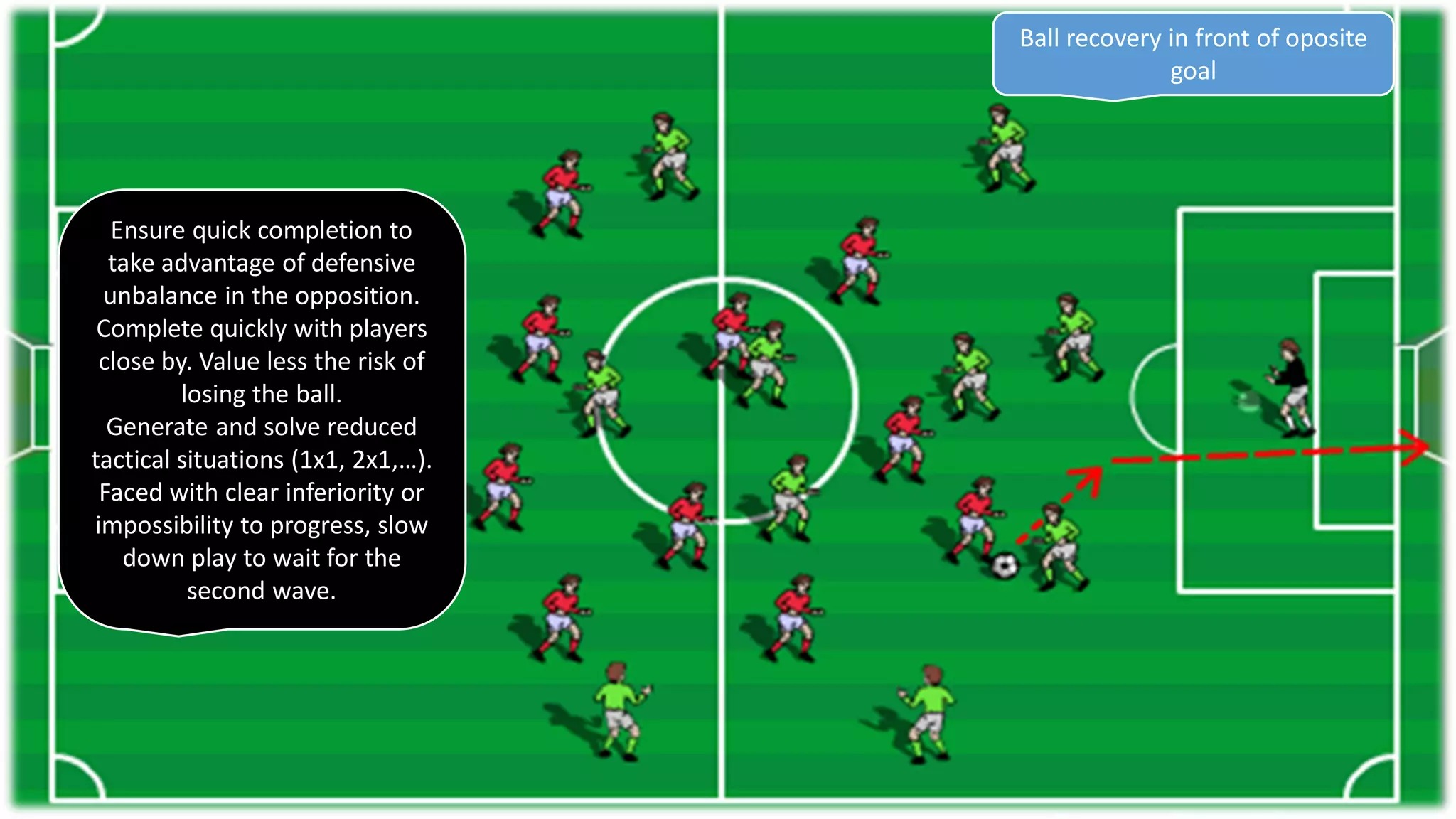
Ball recovery in front of oposite
goal
Ensure quick completion to
take advantage of defensive
unbalance in the opposition.
Complete quickly with players
close by. Value less the risk of
losing the ball.
Generate and solve reduced
tactical situations (1x1, 2x1,…).
Faced with clear inferiority or
impossibility to progress, slow
down play to wait for the
second wave.
Thank you for your time

The model of play 1

  • 1.
    DZEVAD SARIC UEFA PROCOACH/TECHNICAL DIRECTOR
  • 3.
    "Our Idea ofPlaying Style" 1. Offensive style of play, with many space for players individual decision making and creativity. 2. Safe play in the construction of the attack, especially in the beginning of the construction of the attack. 3. 1st and 2nd phases of attack should be collective efforts with last phase of attack as an encouragement for individual efforts. 4. A team that keeps at all time a good defensive balance with players readapting their position to every ball movement. Zonal marking with occupation of vital spaces and active search for ball recovery. 5. Great control in game rhythms and clear distinction of the 4 moments of the game.
  • 4.
  • 6.
  • 7.
    "Our Idea ofAttack" 1. The first option must be always to search for an offensive passing line in order to be closer to the opposite goal, if possible finishing. 2. If not possible to find a good option for offensive line passing, the team must start the supported construction of the organized attack. 3. The first and second phase of the attack are collective, in the third phase is allowed individual creativity. 4. Safe play, without much risk, especially in own half of the field. 5. When initiating the construction in defensive sector it must be used a line of 4 players. 6. Create numerical superiority in own half. 7. All this possession game must be supported in basic triangle and diamond formations of passing lines.
  • 8.
    7. The ballpossession must be a meaningful one, not possession without a goal, the general strategy behind this ball possession must be connected with 2 situations; The 1st one must be to try to create a numerical superiority situation near the ball zone, when this is achieved players must immediately “fasten up” the game and try to progress in the field to unbalance defensive organization from opposition; 2nd one is related with the impossibility to achieve this “fasten up” of the game, so the collective strategy must turn into a change in point of attack strategy, taking the ball away from pressing zone in order to place players in opposite side of the field in a numerical superiority or equality and allowing them to produce the necessary actions to explore the “open spaces” in the defense.
  • 9.
    8. Team open(full-backs & wingers) and deep (wingers and forwards) to create spaces in the inside zones. 9. Optimum velocity in the circulation of the ball (jump one passing line if possible). 10. Supporting runs in the inside zones by players from back lines. 11. Show intention when in possession of the ball. 12. Defensive balance on the weak side with ball in one side channel. 13. In the last phase of attack the idea is to give maximum freedom for individual actions and promote the 1x1 challenge as many times possible. 14. When in crossing situations the team must approach the finishing zone (box) placing at least 3 players inside and 1 players setting up for delay balls or second ball challenge. 15. All attack complete with the shot on goal.
  • 10.
    With one attackerin the midle we can easily converting our sistem of play in 1:4:2:3:1 or 1:4:4:1:1 Triangles and Diamonds created
  • 11.
    Attacker in themidle has the task to adapt himself to give support to midifield or to approach attacker and make line of twoo in offense
  • 12.
    Open Line of4 to start the 1st phase of construction
  • 13.
  • 14.
  • 15.
  • 16.
    Possibility to receivein wide area occupying space left by the full-back
  • 17.
    For long ballcloas the team and concentrate players
  • 18.
    For long ball concentrationof players in ball zone
  • 19.
    For long ball concentrationof players in ball zone
  • 20.
    Ball in defensive line BasicPositioning from LM and RM
  • 21.
    Situation when CDon left side has ball
  • 22.
    Situation when CDon right side has ball
  • 23.
    Ball in defensive line BasicPositioning from CD
  • 24.
    CD must controlthe game rhytham by choosing short or long pasing lines Ball in defensive line
  • 25.
    Ball in defensive line Cerefulwith the passing for DM because this player is with his back to the game and it is necessary a lot of communitation The quality of the pass will determinate where and how the player will face the game
  • 26.
    Ball in defensive line Midfieldersneed to create space for ball reception by adjusting their positioning to the ball movement...
  • 27.
    Ball in defensive line Ballis in possess of LD LM goining in the midle
  • 28.
    Ball in defensive line Ballis in possess of LD LM stay on the line
  • 29.
    Ball in defensive line Ballis in possess of LD DM balance in defensive
  • 30.
    Ball in defensive line Ballis in possess of LD LM making false move
  • 31.
    When opposite defensiveline is very high in the field explore the back of defense thru long pass and positional changes Ball in defensive line
  • 32.
  • 33.
  • 34.
    LD giving supportfor change of point of attack
  • 35.
    LD going incrosing zone
  • 36.
    Ball in midleline When MD has ball, first option nead to be pass forward Favour numerical and positional superiorities in opposition half. Create conducive conditions to unbalance in zones near opposition goal. In lateral channels, full- back and winger at different widths and depths. Triangle with advanced midfielders or forwards. Optimum speed in circulation of the ball. Changes of direction and changes of play if progress is not possible, maintain defensive width.
  • 37.
    Ball in midleline When MD has ball, find oposite LM with long pass
  • 38.
    Ball in midleline When MD has ball, another attacker nead to run in space
  • 39.
    Ball in midleline When MD has ball, attackers nead to move itself in space
  • 40.
    When LM hasball, attackers and LM on other side nead to move itself in space Ball in midle line
  • 41.
    Ball in midleline When LM has ball, LD run in space behind bag for crossing
  • 42.
    Ball in offansiveline When FS has ball, LM, other FS and one MD running in free space Complete situations of attack with efficiency. Guarantee continuity by picking up clearances. Incorporate the greatest number of players into the area in a staggered manner, Normally 3 players (forwards and opposite winger). 4 players (wingers and forwards) if the full-back crosses. Appear at the optimum moment to shoot while running. Occupy different shooting positions. Try to complete actions.
  • 43.
  • 44.
    "Our Idea oftransition from attack to defense" 1. When ball possession is lost its an obligation from players near to this zone to react immediately and prevent the long pass / counter attack construction from opposition. The first 5 seconds after the ball possession lost are crucial to prevent easy construction from adversary, it's not necessarily important to win back the ball but it is important to create troubles to opposition to make easier the work from players away from this pressing zone. 2. While this is happening the player outside this pressing zone must reorganize themselves into the defensive structure of the team and rebalance the security of the team. If not achieved the ball recovery in this first moment team must regroup and start defensive organized process.
  • 45.
    Losing ball possessionwith our offensive style of football, will bring some difficulties and its important to know where is our weak points
  • 46.
    The space betweencentral defenders and lateral defenders, space in the midle is a particulary weak point
  • 47.
    Player (s) nearball must adopt an agressive behavior to prevent the long pass.Firs 5” is essential to prevent counter-attack. This behaviour occurs when the team manages to have several players in the zone where the loss of the ball happens, and are able to intervene immediately. Normally seen after loss in the completion phase or in the creation of completion situations in the side channel, where more players accumulate and the touchline limits the pitch and facilitates pressing.
  • 48.
    If Player (s)lose possession in midle, players behid the ball should not lose their positioning and they should try to delay the offensive game from opposition This behaviour occurs when at the time of the loss of the ball there exists a numerical or positional inferiority in the area of the ball, and stopping the progression of the opponent is prioritized, to give the team time to regroup. Normally occurs after loss in the creation of completion situations in the central channel, where better chances of progression and linking up exist for the opposition team.
  • 49.
    Defender maintains asecure distance from attacker and tries to route him to the sideline
  • 50.
    Losing a ballin front of goal Prevent successful completion by opposition. Reduction of spaces in diagonal towards the centre (tunnel). Guide counter-attack to the side channels. Make the shot at goal impossible in zones close to /inside the area. Mark the player in situation of cross. Drop-back quickly the maximum number of players to structure the low block.
  • 51.
  • 52.
    "Our Idea ofdefense" 1. The first basic principle must be the positioning of as many players possible behind ball line and in front of our goal . 2. When in defensive process the team must position itself according to zonal defense principles and have, at least, 3 completely defined defensive lines with a minimum of 9 players distribution. 3. The zonal defense must be done according to some references which are the occupation of the vital spaces of the field (central space and surrounding of the ball) and the maximum length of the team must be approximately 1/2 of the field and the maximum width 2/3 of the field. 4. Another essential skill is the capacity to communicate and establish adaptation to the opposition style of play. 5. Discipline and collective work in defense. 6. Verbal communication.
  • 53.
    7. Defensive linemust maintain itself as the security zone and place as many players possible in central zone of defense. When ball is played into side line of our defense there are 2 situations for players to evaluate and react according to it. On one hand, if the ball is played into the back of the defense the central defender closer to this position must give cover to the lateral defender and try to sweep the play. On the other hand, if the ball is played into the position of the opposition attacker the lateral defender must react to this, approaching him and trying to delay the play, secure the central position and giving time for midfielder to approach and giving him the defensive support, in this situation the central defender must stay in central zone and not approach to much to the lateral defender.
  • 54.
    Maintain the teamcompact when in defensive process. General references: 2/3 Width ½ Length
  • 55.
    Move the teamin relation to the ball. Working together
  • 56.
    PRESSING AGAINST OPPOSITION TEAMIN 4-2 STRUCTURE Condition the opponent to play direct. If not achieved, guide the construction of play of the opponent towards favourable areas for recovery. Impede the player on the ball from passing comfortably. Force an error. Harass the player on the ball. Prevent being overlapped and provoke its error. Fix potential receivers of the ball. Prevent them from receiving to provoke the long pass. Otherwise: make it difficult to control, do not let turn or prevent progression. Individual marking at time of pressing
  • 58.
    Central long ballplayed in the air, the reference for 2nd ball fight must be the construction of a pentagon around the player who is heading the ball covering all the space around him
  • 59.
    Lateral long ballplayed in the air, the reference for 2nd ball fight must be the construction of a romb around the player who is heading the ball covering all the space around him
  • 60.
    Force CD toplay ball on the side. Close central space
  • 61.
    Press and closingof short passing lines Secend line of defensive cover to ensure balance and compactness in team
  • 62.
    Bad cover ofthis passing line will give chance to explore space and make easier opposition advance in the ground
  • 64.
    Organised defence inthe middle block Prevent creation of situations of numerical superiority in spaces near the goal. Show own numerical superiority if possible. Avoid being overwhelmed or overtaken by penetrating supporting runs. Detect favourable times to move to a pressing defence. Keep the defensive unit wide and with reduced depth. "Shrink" in back pass, maintain when pressed and drop-back if the opponent can play with depth. Harass the holder of the ball, avoiding being overrun. Fix nearby players and monitor the ones further away.
  • 65.
    Defensive support topressing player
  • 66.
    Long ball forthe Winger in the back of LD
  • 67.
  • 68.
    Ball in Winger CDgoes in ball possession and DM covers central space
  • 69.
    Ball crosed andplayed away from defender tem must move forward but also in the ball direction
  • 70.
    Defensive support topressing player Protect space near goal. Create numerical and positional superiority. Make impossible the opponent's play in areas close to goal. Mark potential shot takers. Provide balance to attacking transition. Decrease space in width. Close interior spaces. Make impossible the shot at goal in areas close to the goal / within the penalty area. Maintain optimum depth. "Shrink" after clearance to the edge of the area.
  • 71.
    Defensive support topressing player
  • 72.
  • 73.
    "Our Idea oftransition from defense to attack" 1. The first option must be the immediate search for the most offensive line of pass possible and advance the team to maintain compactness and fight for second balls if necessary. 2. If no offensive passing line is available the player must try to take the ball away from pressing zone using players behind ball line and fast change of point of attack and start the phase of attacking process.
  • 74.
    Ball possesion recoverymust be followed by the search of an offensive passing line if posible Remove the ball from the zone of opposition pressing. Take advantage of unbalance in the organisation of the opposition defence. Assure relationship that allow continuity. Evaluate the depth (far away) safely as the first criteria for progression (forward and wingers). Establish relationships with players able/better placed to drive the counter-attack (playmaker or advanced midfielders principally). Move into organised attack when faced with the impossibility of progression (opposition team organised).
  • 75.
    Ball possesion recoverymust be followed by the search of an offensive passing line if posible
  • 76.
    Ball possesion recoverymust be followed by the search of an offensive passing line if posible
  • 77.
    Do not braeakthe team. All players must move in the direction of the ball
  • 78.
    Reduce as fastes possible the distance between lines
  • 79.
    If an offensivepassing line is not available on ball possession recovery moment team must set up for offensive organisation, teking ball from pressing zone Take advantage of defensive unbalance of the opposition, exploiting spaces in progression. Slow down play in case of not being able to exploit the first movements. Provide possibilities to the potential supporting players from the second wave. First pass securely in forward direction if possible. Find players able or well positioned to run with the ball. Move the counter-attack towards favourable zones of progression (preferably through the central channel if progression is possible). Generate and solve reduced tactical situations (1x1, 2x1, 3x2,…). Change channel of progression towards spaces of less density. Move to organised attack if progression is not possible.
  • 80.
    Ball out ofpressing zone
  • 81.
    Ball recovery infront of oposite goal Ensure quick completion to take advantage of defensive unbalance in the opposition. Complete quickly with players close by. Value less the risk of losing the ball. Generate and solve reduced tactical situations (1x1, 2x1,…). Faced with clear inferiority or impossibility to progress, slow down play to wait for the second wave.
  • 82.
    Thank you foryour time