FC Barcelona Notes “A new idea”
NSCAA Baltimore Convention 2016
Lecturer: Joan Villa; Head of Methodology
Note: Some spots are missing as I tried to keep up with the notes.
Francisco Seirulo-lo
- 2 years head of methodology with Joan Villa
- Fitness coach
Methodology:
- The effort
o Develop specific trainings that require a high discipline and attention in every
session
Why do we do it?
- History demands it
- We strive for excellence
- We want to transcend and leave an imprint
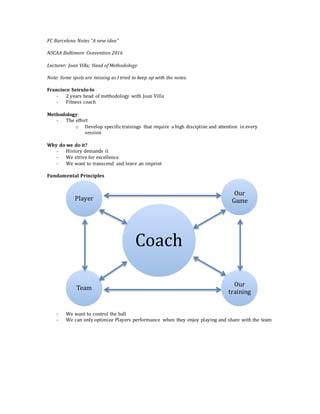
Fundamental Principles
- We want to control the ball
- We can only optimize Players performance when they enjoy playing and share with the team
Coach
Player
Our
Game
Our
training
Team
Our Terminology (Personally my favorite slide from Presentation)
WE SPEAK OF….. WE DON’T SPEAK OF….
Optimize Improve
Phase Possession Attack
Phase Recovery Defend
Create Destroy
Enjoy, Learn, Compete Only win
Recover the ball Steal the ball
To be better Humiliate, Belittle
Competitiveness Aggresiveness
Empathy Selfishness
Assertiveness Passivity, Aggressiveness
Adversary, Opponent Enemy
Traditional Perspective of Football
This line of thinking divides what is one thing………
THE ACT OF PLAYING!!!!
With this concept, we divide, individualize, and specialize
Attack
Yes
No
Transition
Defend
No
Yes
Goal
Counter Attack
Goal
Phase
Spaces
Ball defines it
(reference):
-Where is the
ball?
-Who has the
ball?
“Our Game” is not an association of plays but:
- A Stochastic sequence of phase spaces
Each Phase Space depends on: The previous Phase space + new and unexpected elements
- T0 + New and Unexpected elements= T1
- T1 + New and Unexpected elements= T2
These new elements are the dynamic interplay between movement of teammates and opponents on
the field.
This is to see, understand, and analyze every space to anticipate the subsequent phase, since each
one of them is related to the previous and next one. All of them, at the same time are interrelated.
Left
Side
Left
Center
Right
Center
Right
Side
Definition
Control
B Well
Being
Alarm
T0
T1
T2
Our
Goal
Conformation of Phase Spaces
Location or Situation:
- Zones A, B, C, D
- Hallways LS, LC, RC, RS
- Where is the ball?
- Who has the ball?
Functional distances:
- Intervention
- Mutual Help
- Cooperation
Trajectories:
- Of the players
o Supports (7 types identified) Ps: wish he had gone more in depth on this.
o Unmark
- Of the ball
Orientation:
- Directionality
- Profiles
- Rhythm (TIME)
o As the ball is in A, B, C, D and LS, LC, RC, RS
Organization:
- Superiorities in each space (around the ball)
o Numerical
o Positional
o Qualitative
o Dynamic
Self Organization: (I judged by self organization, he meant restarting the play when pressure on the
ball becomes high)
- T0= Prescribed organization (desired) + Unexpected situation
- T1=Prescribed Organization + Unexpected situation
- Unexpected Situation= Self organization= New Prescribed organization
This Self organization:
- Must emerge from:
o Coach’s information
o Decisions made by players in the field
- Must resolve:
o A certain situation and return to another new prescribed organization
o New Prescription situation will be different and will allow domination and control
of the game
Traditional Game:
- More or less linked through time (T)
- Each of them with a specific number of players involved…
- That depend on the opponents position and where they allow us to play the ball
Our Game:
- A succession of Phase spaces
o That interacts with each other in TIME (T0->T1->T2….)
o All players involved (Teammates and opponents)
…This in turn compliments the interactions between our players, always having the Ball as a
reference (where is it? Who has it? What can we do with it?)
These interactions are in relation to:
- The location and situation on the field (of players and the ball)
- Distances between players and the ball
- The trajectories of Players and the ball
- Orientation of players and the game
And they result in….
- Organization of all components of our team to achieve superiority in every moment of the
game in regards to opposing team
It is based on understanding and interpreting the game from the concept of succession of phase
spaces. This allows us:
- To be more Efficient: less physical work of the player, their runs are shorter and more
profitable…
- To be more Effective: Domination of the game at all times to be superior than the opponent,
win and make as many scoring opportunities as possible
It is not where some players attack and some players defend, but to play and participate ALL players
at every moment and at each point on the field
In each action oh phase space, there are 11 players involved in our team (10+1 Yes, goal keeper
included) versus 1, 2, 3, 4…players of the opposing team because in each phase space all of our
players have a mission to perform in the global organization of our game.
Fundamentals
- High individualand collective technical quality
o Constant contact with ball since initiation stage
o Work on coordination aspects (with and without ball)
o Technical contents (What?) in each of the stages of the formation process (When?)
o Concepts and guidance (How?) for the improvement of all of the technical contents
o Why? Because historically Barcelona’s game has been associated to technical
excellence, plasticity and spectacle
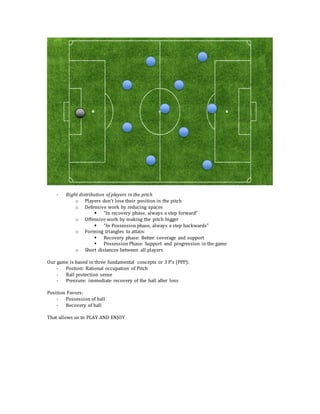
- Right distribution of players in the pitch
o Players don’t lose their position in the pitch
o Defensive work by reducing spaces
 “In recovery phase, always a step forward”
o Offensive work by making the pitch bigger
 “In Possession phase, always a step backwards”
o Forming triangles to attain:
 Recovery phase: Better coverage and support
 Possession Phase: Support and progression in the game
o Short distances between all players
Our game is based in three fundamental concepts or 3 P’s (PPP):
- Postion: Rational occupation of Pitch
- Ball protection sense
- Pressure: immediate recovery of the ball after loss
Position Favors:
- Possession of ball
- Recovery of ball
That allows us to PLAY AND ENJOY
- A Sense of protecting the ball
o “The team that has the ball owns the game”
o The best defense is:
 Do not lose the ball
 Do not lose position
o Alternate short or long passes during the game
 Too many short passes means more pressure from opponents team and
losing the ball
 Too many long passes mean constantly losing the ball (lack of precision)
- Players mobility without the ball
o Creation, owning and taking advantage of free spaces
o Objectives:
 Being able to receive the ball in the right conditions to play it
 Enable the teammate who has the ball to make the best decision
 Facilitate the teams joint tactical actions
 Making difficult the opposing teams defensive actions
o Statistically Barcelona players run more than most opposing teams, however for us:
“What’s important is not running, but knowing how to run.”
- Functional unity of players as a team
o With the ball the whole team plays and enjoys
o Without the ball the whole team Runs.
o Understanding team behavior as a higher order system rather than the sum of each
player’s work.
o It is all an ongoing process, uninterrupted (Continuum of Complexity)
- Games interpretation and comprehension!!!
o Cognition: “Learn to see, perceive, and decide”
 Perception and management of Space (E)
 Management of Time (T) and control the rhythm of the game
 Identify and interpret the game situation (teammates, Opponents, ball, and
intentions)
o Action or effective and efficient execution
 Monitoring and evaluation of action
 Concept: Before, During, and After
- Individual and collective participation
o “The Ball always runs more than the players”
o Pay Special attention to: Pass, control, and dribbling
 Precision
 Speed of the execution
 Each time the game demands more speed and intensity
- Individual qualities at the service of the team
o Selfish= No
o Team spirit= Yes
o Personal contribution to the team= Yes
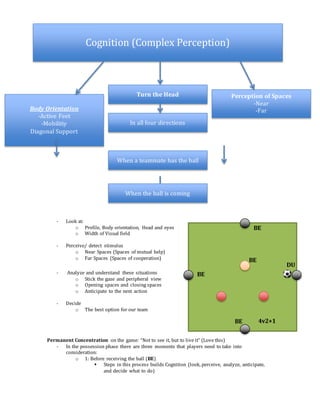
- Look at:
o Profile, Body orientation, Head and eyes
o Width of Visual field
- Perceive/ detect stimulus
o Near Spaces (Spaces of mutual help)
o Far Spaces (Spaces of cooperation)
- Analyze and understand these situations
o Stick the gaze and peripheral view
o Opening spaces and closing spaces
o Anticipate to the next action
- Decide
o The best option for our team
Permanent Concentration on the game: “Not to see it, but to live it” (Love this)
- In the possession phase there are three moments that players need to take into
consideration:
o 1: Before receiving the ball (BE)
 Steps in this process builds Cognition (look, perceive, analyze, anticipate,
and decide what to do)
Cognition (Complex Perception)
Turn the Head
Body Orientation
-Active Feet
-Mobilitiy
Diagonal Support
Perception of Spaces
-Near
-Far
In all four directions
When a teammate has the ball
When the ball is coming
s
4v2+1
BE
BE
BE
BE
DU
o 2: In possession of the ball (contact with the ball) (DU)
 Execute: it goes from possessor to receptor
 Technical action that the player does with the ball
o 3: After passing the ball (AF)
 Mobility: it goes from possessor to receptor
 “PASS AND MOVE”
Phase spaces Dimensioned
Phase
- Possession (with the ball)
- Recovery (without the ball)
Space
- Field zones occupied by players in each situation with respect to the ball
o Intervention
o Mutual Help
o Cooperation
Dimensioned: Dimensions we give each of these players
Stability of the Team
A) The location and situation in the field (of players and the ball)
B) Distances between players and respect the ball
C) The trajectories of players and the ball
D) Orientation of players and the game
E) Organization of all components of our team to achieve superiority in every moment of the
game regarding the opposing team
Reorganization or Self- Organization
- The self-organization must be built with information from coach + specific criteria decided by some
players when they occur to resolve this particular situation and return to the organizations
prescribed
Possession Phase Concepts
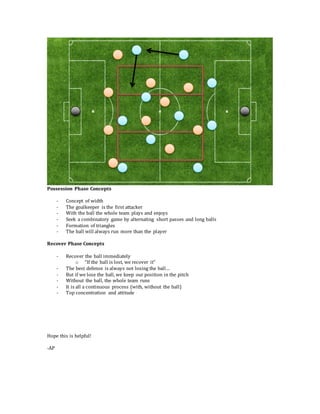
- Concept of width
- The goalkeeper is the first attacker
- With the ball the whole team plays and enjoys
- Seek a combinatory game by alternating short passes and long balls
- Formation of triangles
- The ball will always run more than the player
Recover Phase Concepts
- Recover the ball immediately
o “If the ball is lost, we recover it”
- The best defense is always not losing the ball…
- But if we lose the ball, we keep our position in the pitch
- Without the ball, the whole team runs
- It is all a continuous process (with, without the ball)
- Top concentration and attitude
Hope this is helpful!
-AP

FC Barcelona Development Presentation (Notes)

  • 1.
    FC Barcelona Notes“A new idea” NSCAA Baltimore Convention 2016 Lecturer: Joan Villa; Head of Methodology Note: Some spots are missing as I tried to keep up with the notes. Francisco Seirulo-lo - 2 years head of methodology with Joan Villa - Fitness coach Methodology: - The effort o Develop specific trainings that require a high discipline and attention in every session Why do we do it? - History demands it - We strive for excellence - We want to transcend and leave an imprint Fundamental Principles - We want to control the ball - We can only optimize Players performance when they enjoy playing and share with the team Coach Player Our Game Our training Team
  • 2.
    Our Terminology (Personallymy favorite slide from Presentation) WE SPEAK OF….. WE DON’T SPEAK OF…. Optimize Improve Phase Possession Attack Phase Recovery Defend Create Destroy Enjoy, Learn, Compete Only win Recover the ball Steal the ball To be better Humiliate, Belittle Competitiveness Aggresiveness Empathy Selfishness Assertiveness Passivity, Aggressiveness Adversary, Opponent Enemy Traditional Perspective of Football This line of thinking divides what is one thing……… THE ACT OF PLAYING!!!! With this concept, we divide, individualize, and specialize Attack Yes No Transition Defend No Yes Goal Counter Attack Goal
  • 3.
    Phase Spaces Ball defines it (reference): -Whereis the ball? -Who has the ball? “Our Game” is not an association of plays but: - A Stochastic sequence of phase spaces Each Phase Space depends on: The previous Phase space + new and unexpected elements - T0 + New and Unexpected elements= T1 - T1 + New and Unexpected elements= T2 These new elements are the dynamic interplay between movement of teammates and opponents on the field. This is to see, understand, and analyze every space to anticipate the subsequent phase, since each one of them is related to the previous and next one. All of them, at the same time are interrelated. Left Side Left Center Right Center Right Side Definition Control B Well Being Alarm T0 T1 T2 Our Goal
  • 4.
    Conformation of PhaseSpaces Location or Situation: - Zones A, B, C, D - Hallways LS, LC, RC, RS - Where is the ball? - Who has the ball? Functional distances: - Intervention - Mutual Help - Cooperation Trajectories: - Of the players o Supports (7 types identified) Ps: wish he had gone more in depth on this. o Unmark - Of the ball Orientation: - Directionality - Profiles - Rhythm (TIME) o As the ball is in A, B, C, D and LS, LC, RC, RS Organization: - Superiorities in each space (around the ball) o Numerical o Positional o Qualitative o Dynamic Self Organization: (I judged by self organization, he meant restarting the play when pressure on the ball becomes high) - T0= Prescribed organization (desired) + Unexpected situation - T1=Prescribed Organization + Unexpected situation - Unexpected Situation= Self organization= New Prescribed organization This Self organization: - Must emerge from: o Coach’s information o Decisions made by players in the field - Must resolve: o A certain situation and return to another new prescribed organization o New Prescription situation will be different and will allow domination and control of the game
  • 5.
    Traditional Game: - Moreor less linked through time (T) - Each of them with a specific number of players involved… - That depend on the opponents position and where they allow us to play the ball Our Game: - A succession of Phase spaces o That interacts with each other in TIME (T0->T1->T2….) o All players involved (Teammates and opponents) …This in turn compliments the interactions between our players, always having the Ball as a reference (where is it? Who has it? What can we do with it?) These interactions are in relation to: - The location and situation on the field (of players and the ball) - Distances between players and the ball - The trajectories of Players and the ball - Orientation of players and the game And they result in…. - Organization of all components of our team to achieve superiority in every moment of the game in regards to opposing team It is based on understanding and interpreting the game from the concept of succession of phase spaces. This allows us: - To be more Efficient: less physical work of the player, their runs are shorter and more profitable… - To be more Effective: Domination of the game at all times to be superior than the opponent, win and make as many scoring opportunities as possible It is not where some players attack and some players defend, but to play and participate ALL players at every moment and at each point on the field In each action oh phase space, there are 11 players involved in our team (10+1 Yes, goal keeper included) versus 1, 2, 3, 4…players of the opposing team because in each phase space all of our players have a mission to perform in the global organization of our game. Fundamentals - High individualand collective technical quality o Constant contact with ball since initiation stage o Work on coordination aspects (with and without ball) o Technical contents (What?) in each of the stages of the formation process (When?) o Concepts and guidance (How?) for the improvement of all of the technical contents o Why? Because historically Barcelona’s game has been associated to technical excellence, plasticity and spectacle
  • 6.
    - Right distributionof players in the pitch o Players don’t lose their position in the pitch o Defensive work by reducing spaces  “In recovery phase, always a step forward” o Offensive work by making the pitch bigger  “In Possession phase, always a step backwards” o Forming triangles to attain:  Recovery phase: Better coverage and support  Possession Phase: Support and progression in the game o Short distances between all players Our game is based in three fundamental concepts or 3 P’s (PPP): - Postion: Rational occupation of Pitch - Ball protection sense - Pressure: immediate recovery of the ball after loss Position Favors: - Possession of ball - Recovery of ball That allows us to PLAY AND ENJOY
  • 7.
    - A Senseof protecting the ball o “The team that has the ball owns the game” o The best defense is:  Do not lose the ball  Do not lose position o Alternate short or long passes during the game  Too many short passes means more pressure from opponents team and losing the ball  Too many long passes mean constantly losing the ball (lack of precision) - Players mobility without the ball o Creation, owning and taking advantage of free spaces o Objectives:  Being able to receive the ball in the right conditions to play it  Enable the teammate who has the ball to make the best decision  Facilitate the teams joint tactical actions  Making difficult the opposing teams defensive actions o Statistically Barcelona players run more than most opposing teams, however for us: “What’s important is not running, but knowing how to run.” - Functional unity of players as a team o With the ball the whole team plays and enjoys o Without the ball the whole team Runs. o Understanding team behavior as a higher order system rather than the sum of each player’s work. o It is all an ongoing process, uninterrupted (Continuum of Complexity) - Games interpretation and comprehension!!! o Cognition: “Learn to see, perceive, and decide”  Perception and management of Space (E)  Management of Time (T) and control the rhythm of the game  Identify and interpret the game situation (teammates, Opponents, ball, and intentions) o Action or effective and efficient execution  Monitoring and evaluation of action  Concept: Before, During, and After - Individual and collective participation o “The Ball always runs more than the players” o Pay Special attention to: Pass, control, and dribbling  Precision  Speed of the execution  Each time the game demands more speed and intensity - Individual qualities at the service of the team o Selfish= No o Team spirit= Yes o Personal contribution to the team= Yes
  • 8.
    - Look at: oProfile, Body orientation, Head and eyes o Width of Visual field - Perceive/ detect stimulus o Near Spaces (Spaces of mutual help) o Far Spaces (Spaces of cooperation) - Analyze and understand these situations o Stick the gaze and peripheral view o Opening spaces and closing spaces o Anticipate to the next action - Decide o The best option for our team Permanent Concentration on the game: “Not to see it, but to live it” (Love this) - In the possession phase there are three moments that players need to take into consideration: o 1: Before receiving the ball (BE)  Steps in this process builds Cognition (look, perceive, analyze, anticipate, and decide what to do) Cognition (Complex Perception) Turn the Head Body Orientation -Active Feet -Mobilitiy Diagonal Support Perception of Spaces -Near -Far In all four directions When a teammate has the ball When the ball is coming s 4v2+1 BE BE BE BE DU
  • 9.
    o 2: Inpossession of the ball (contact with the ball) (DU)  Execute: it goes from possessor to receptor  Technical action that the player does with the ball o 3: After passing the ball (AF)  Mobility: it goes from possessor to receptor  “PASS AND MOVE” Phase spaces Dimensioned Phase - Possession (with the ball) - Recovery (without the ball) Space - Field zones occupied by players in each situation with respect to the ball o Intervention o Mutual Help o Cooperation Dimensioned: Dimensions we give each of these players Stability of the Team A) The location and situation in the field (of players and the ball) B) Distances between players and respect the ball C) The trajectories of players and the ball D) Orientation of players and the game E) Organization of all components of our team to achieve superiority in every moment of the game regarding the opposing team Reorganization or Self- Organization - The self-organization must be built with information from coach + specific criteria decided by some players when they occur to resolve this particular situation and return to the organizations prescribed
  • 10.
    Possession Phase Concepts -Concept of width - The goalkeeper is the first attacker - With the ball the whole team plays and enjoys - Seek a combinatory game by alternating short passes and long balls - Formation of triangles - The ball will always run more than the player Recover Phase Concepts - Recover the ball immediately o “If the ball is lost, we recover it” - The best defense is always not losing the ball… - But if we lose the ball, we keep our position in the pitch - Without the ball, the whole team runs - It is all a continuous process (with, without the ball) - Top concentration and attitude Hope this is helpful! -AP