The mobile ecosystem
&
technological strategies
Ivano Malavolta
DISIM | University of L’Aquila
Roadmap

The mobile ecosystem

Development
strategies
Roadmap

The mobile ecosystem
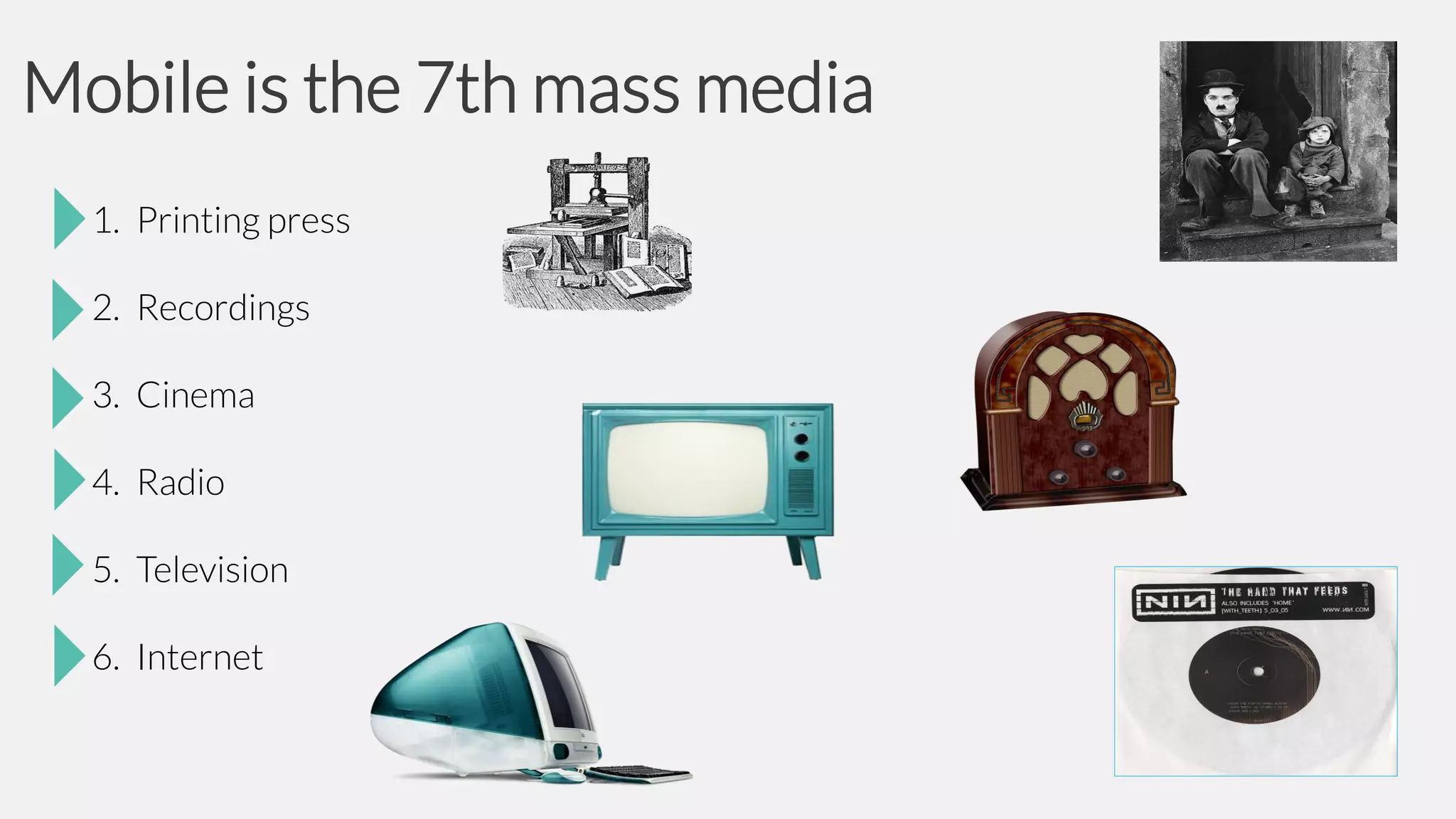
Mobile is the 7th mass media
1. Printing press
2. Recordings
3. Cinema
4. Radio
5. Television
6. Internet
Mobile is the 7th mass media
Mobile is the LARGEST ,

most available
mass medium
TO MANKIND
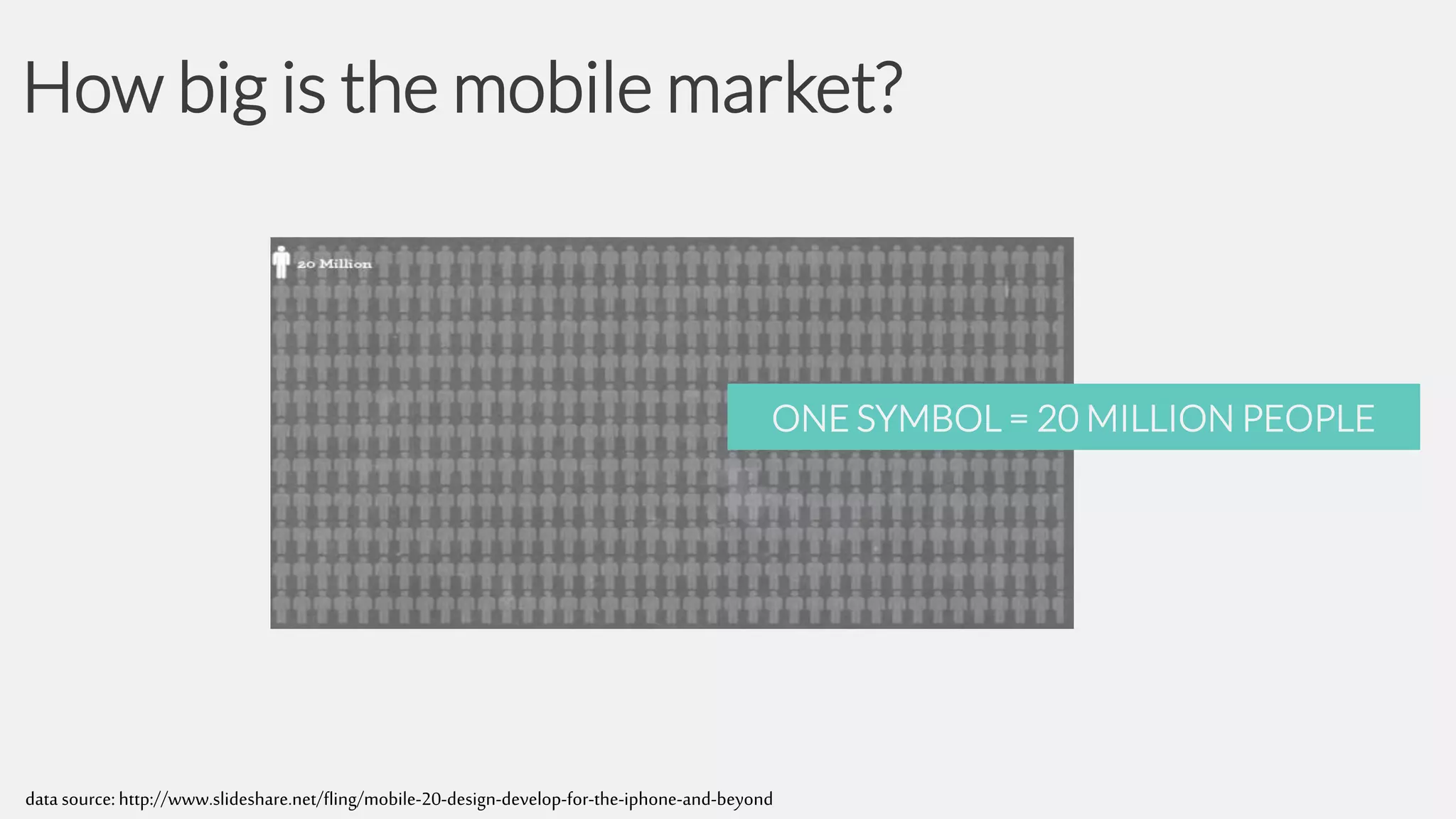
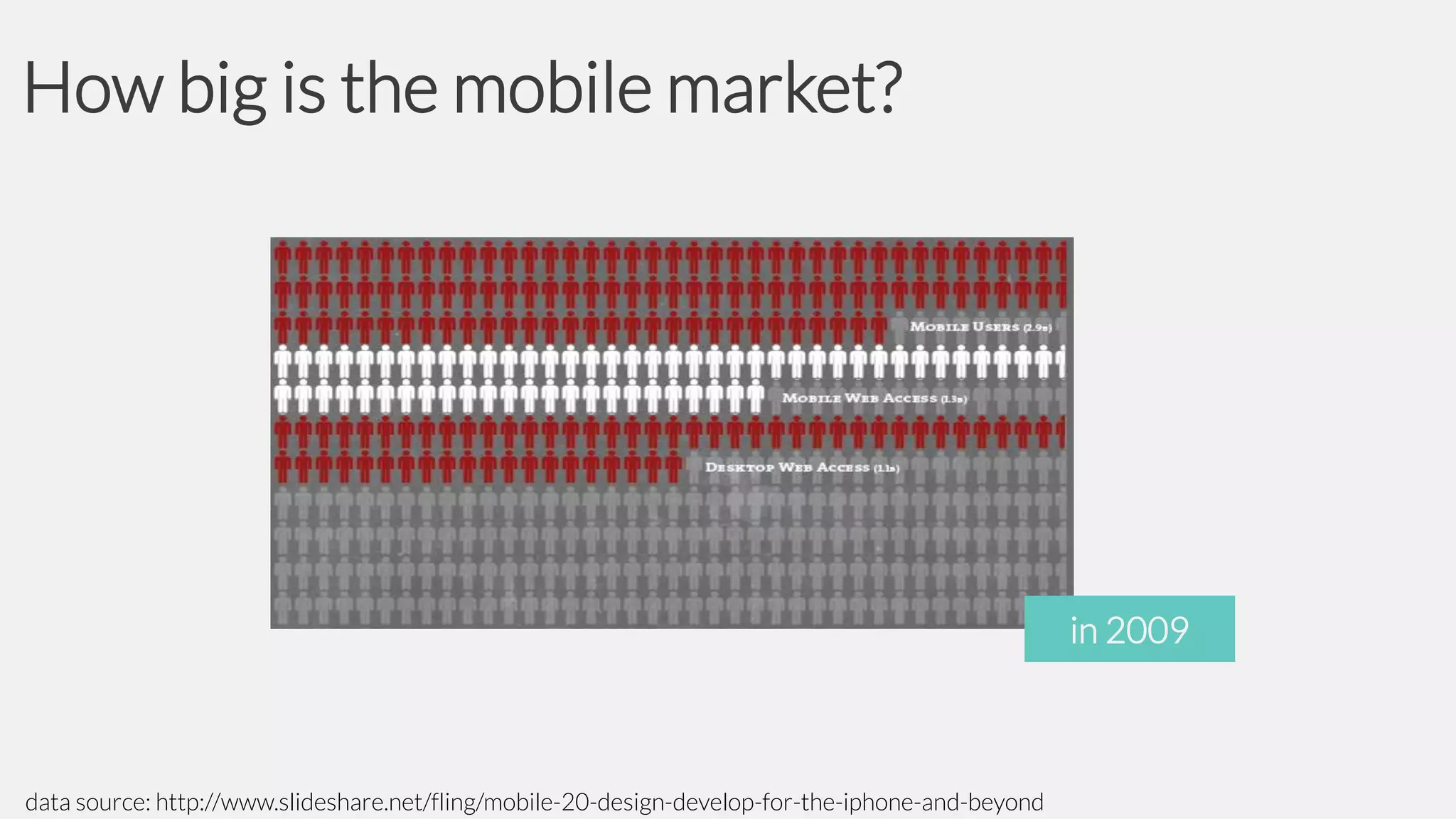
How big is the mobile market?

ONE SYMBOL = 20 MILLION PEOPLE

data source: http://www.slideshare.net/fling/mobile-20-design-develop-for-the-iphone-and-beyond
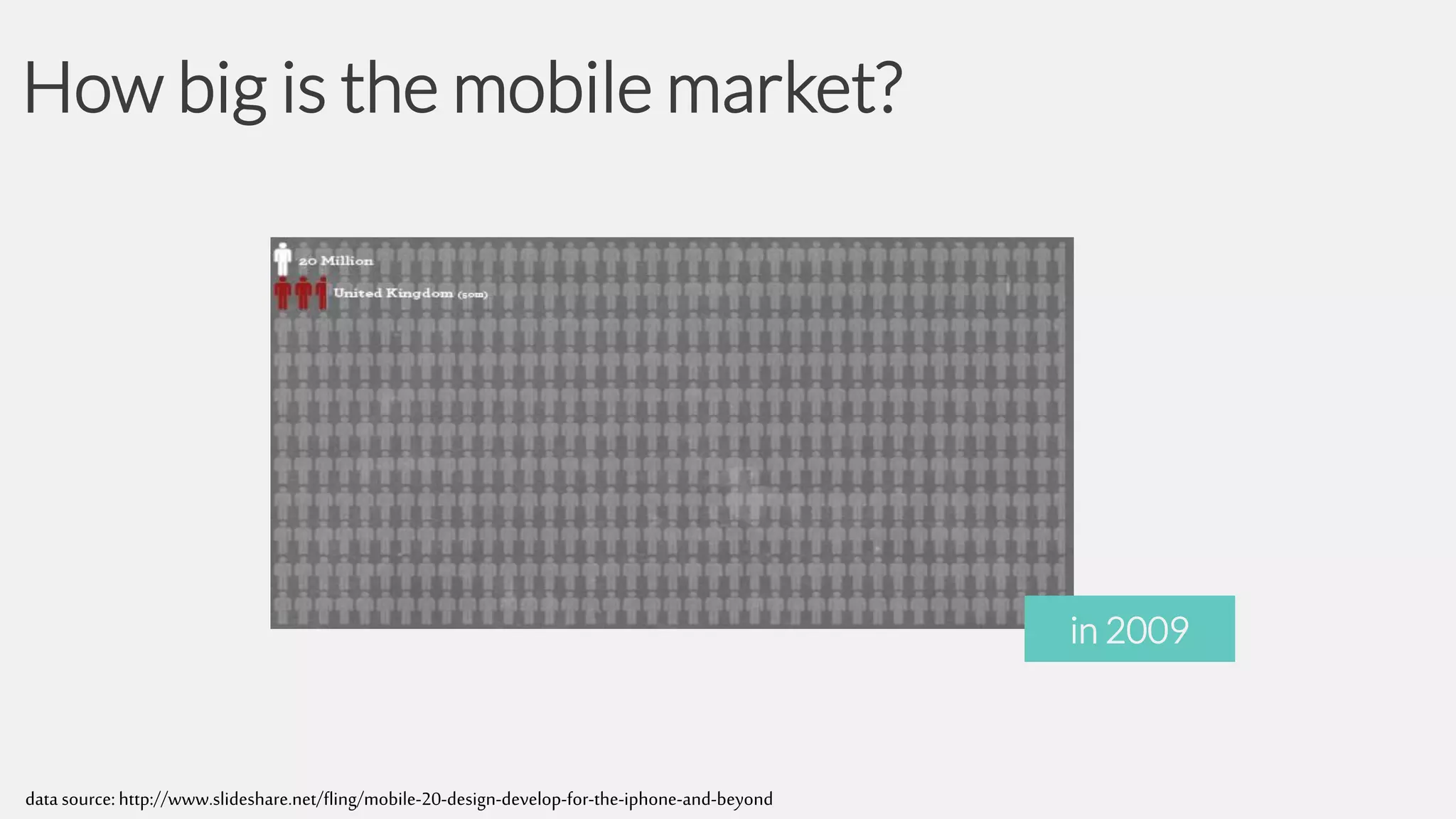
How big is the mobile market?

in 2009

data source: http://www.slideshare.net/fling/mobile-20-design-develop-for-the-iphone-and-beyond
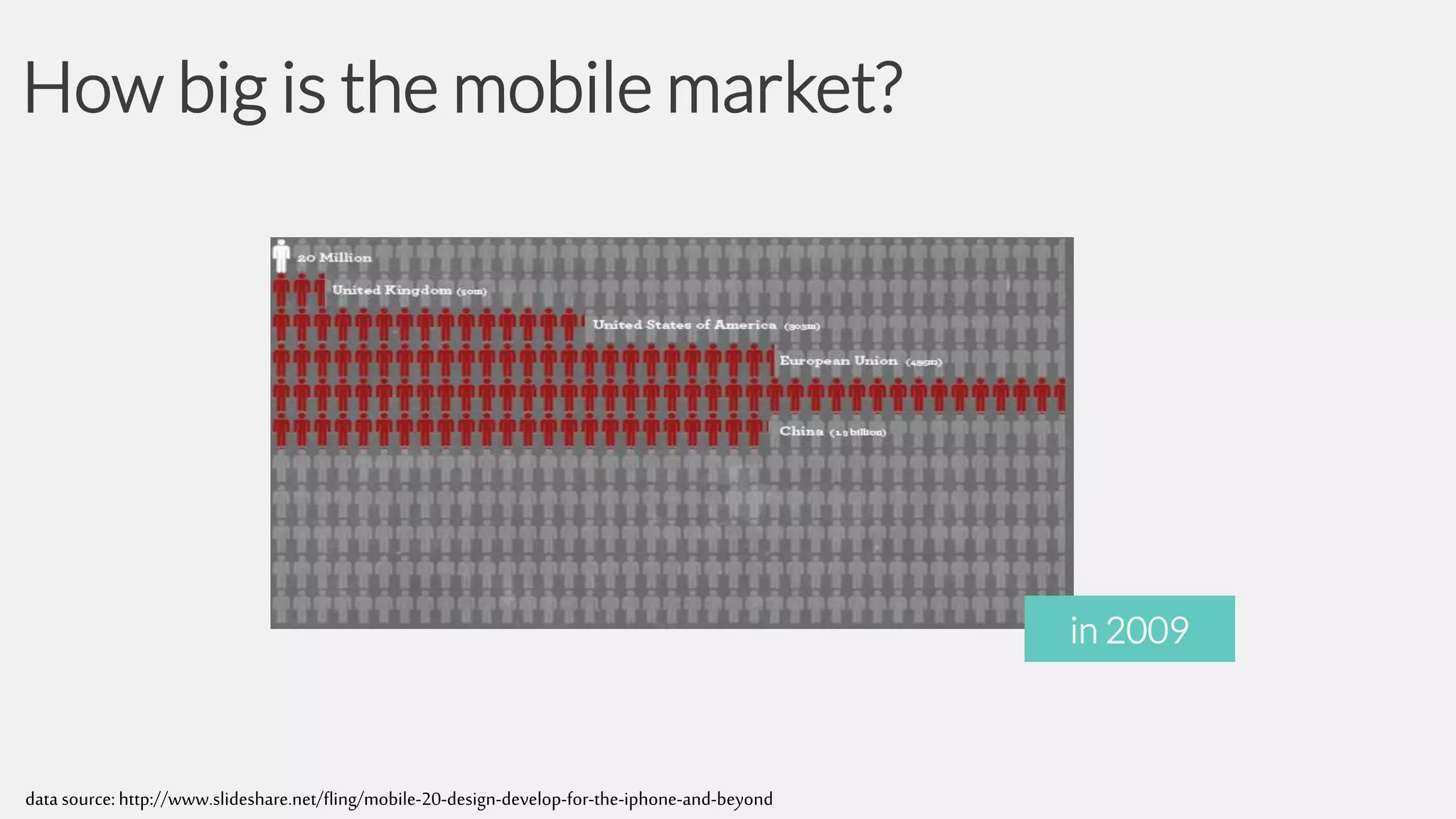
How big is the mobile market?

in 2009

data source: http://www.slideshare.net/fling/mobile-20-design-develop-for-the-iphone-and-beyond
How big is the mobile market?

in 2009

data source: http://www.slideshare.net/fling/mobile-20-design-develop-for-the-iphone-and-beyond
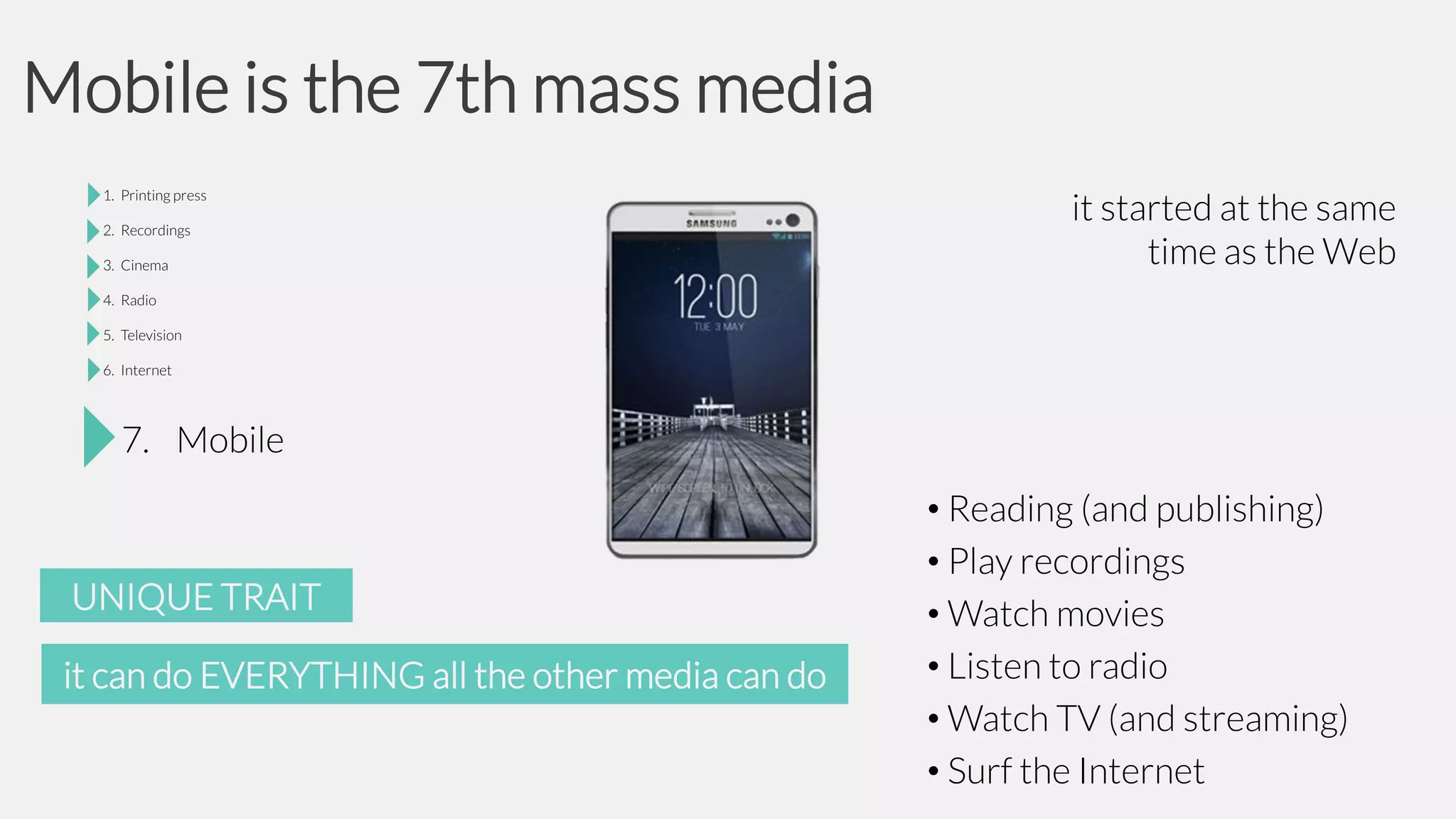
Mobile is the 7th mass media
it started at the same
time as the Web

7. Mobile

UNIQUE TRAIT
it can do EVERYTHING all the other media can do

• Reading (and publishing)
• Play recordings
• Watch movies
• Listen to radio
• Watch TV (and streaming)
• Surf the Internet
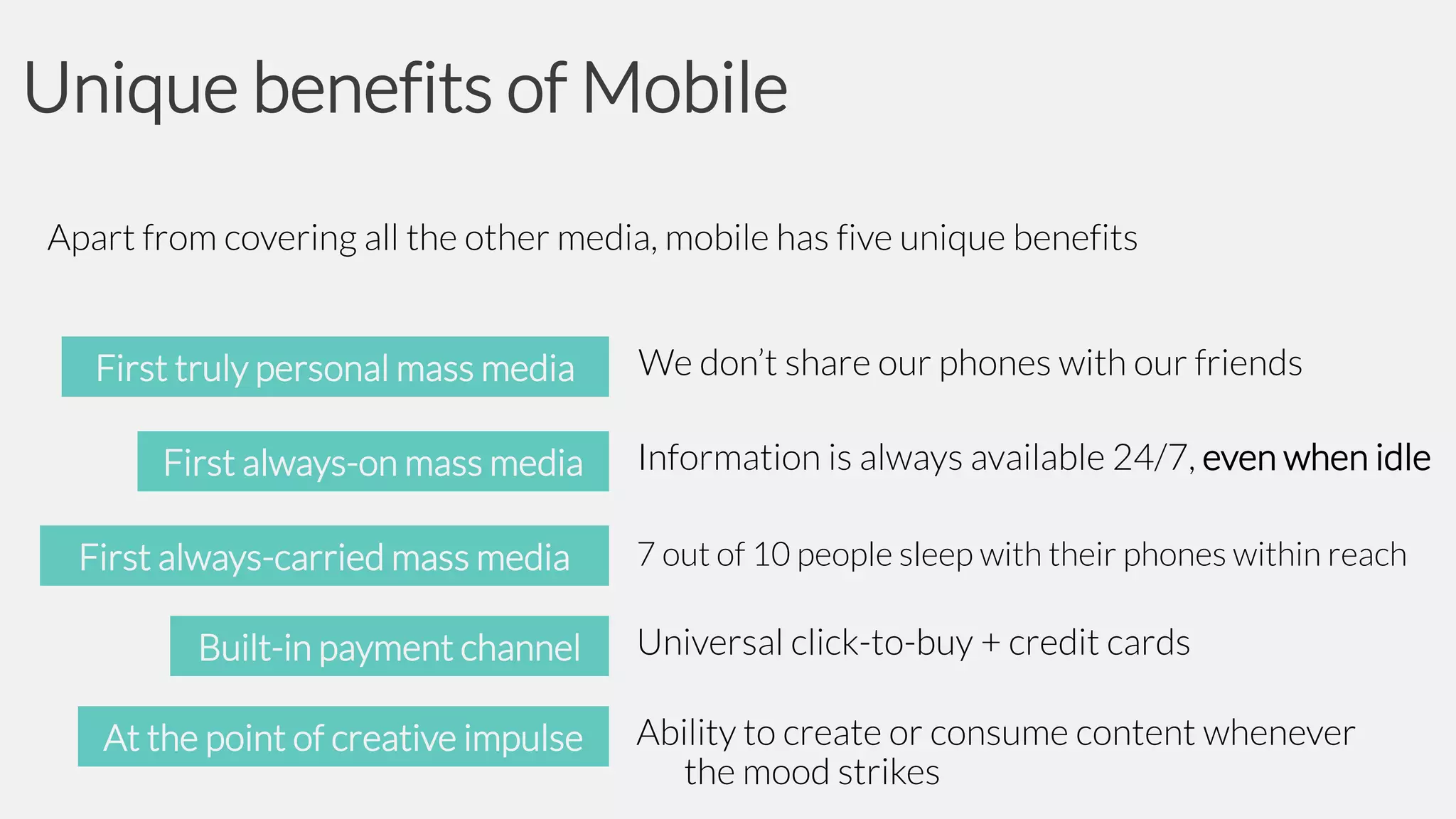
Unique benefits of Mobile
Apart from covering all the other media, mobile has five unique benefits
First truly personal mass media
First always-on mass media
First always-carried mass media
Built-in payment channel
At the point of creative impulse

We don’t share our phones with our friends
Information is always available 24/7, even when idle
7 out of 10 people sleep with their phones within reach

Universal click-to-buy + credit cards
Ability to create or consume content whenever
the mood strikes
Context
CONTEXT CONTEXT CONTEXT CONTEXT CONTEXT CONTEXT CONTEXT
CONTEXT CONTEXT CONTEXT CONTEXT CONTEXT add
CONTEXT CONTEXT
Mobile apps have the amazing capability to
CONTEXT CONTEXT CONTEXT CONTEXT CONTEXT CONTEXT CONTEXT
CONTEXT

CONTEXT CONTEXT CONTEXT CONTEXT CONTEXT CONTEXT CONTEXT
to information, adding immediate relevance
to what we are doing right here, right now
CONTEXT CONTEXT CONTEXT CONTEXT CONTEXT CONTEXT CONTEXT
The mobile golden rule
If you can unlock the state of mind of your users and start thinking in their context,
understanding how a mobile experience will add value to their lives, you will have
the ever-elusive…

KILLER

APP
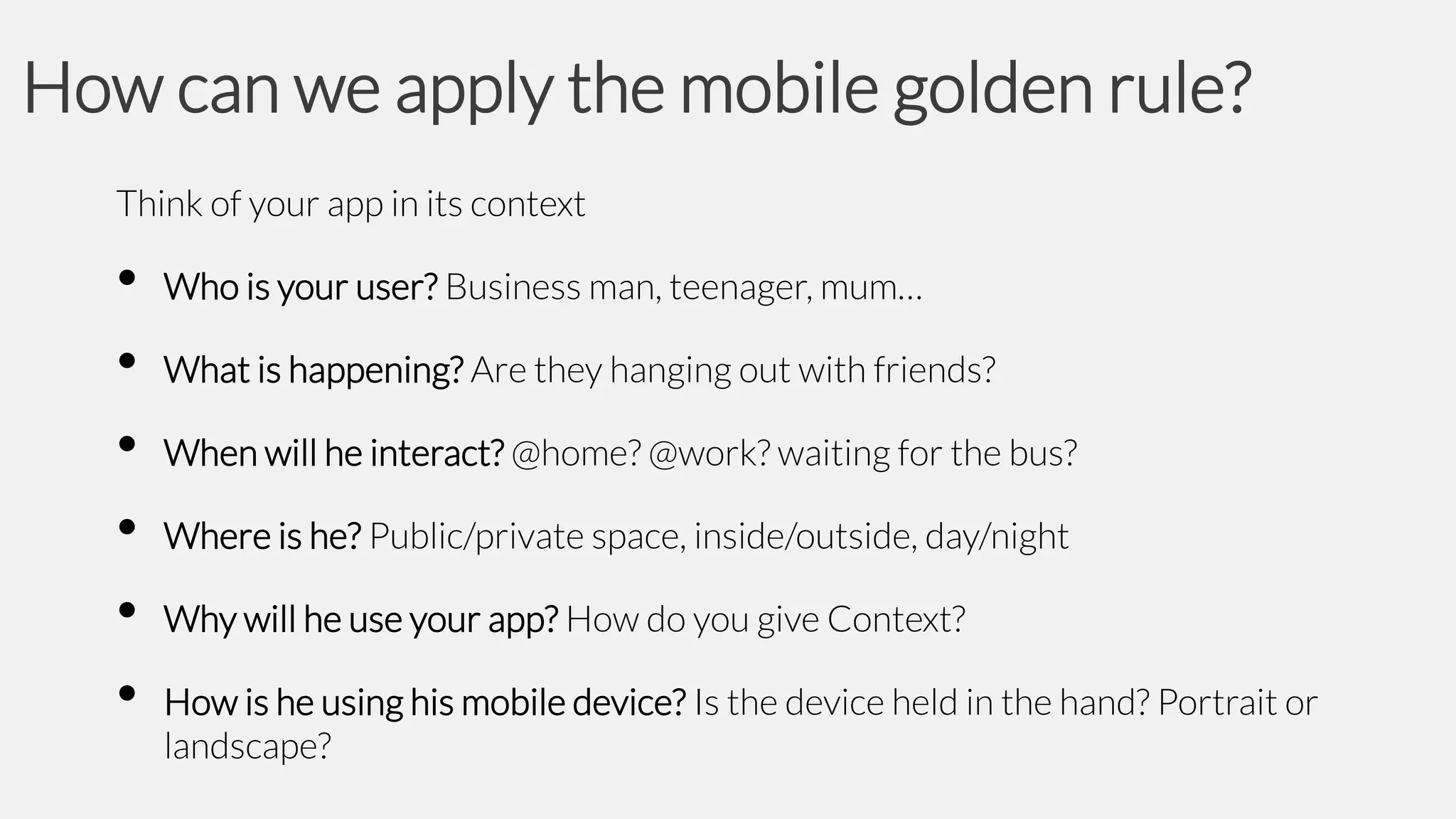
How can we apply the mobile golden rule?
Think of your app in its context

•
•
•
•
•
•

Who is your user? Business man, teenager, mum…
What is happening? Are they hanging out with friends?

When will he interact? @home? @work? waiting for the bus?
Where is he? Public/private space, inside/outside, day/night

Why will he use your app? How do you give Context?
How is he using his mobile device? Is the device held in the hand? Portrait or
landscape?
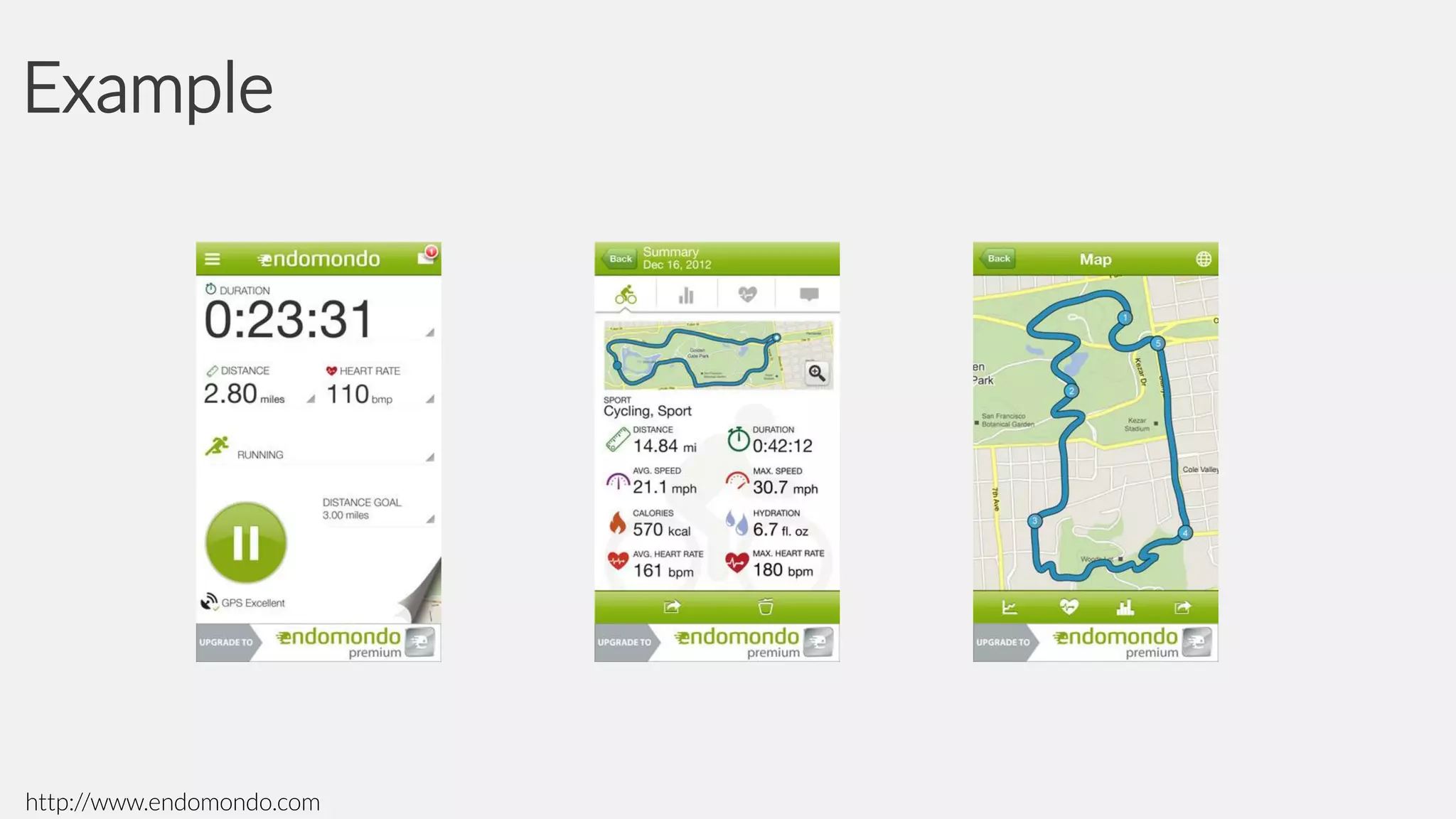
Example

http://www.endomondo.com
Roadmap

The mobile ecosystem

Development
strategies
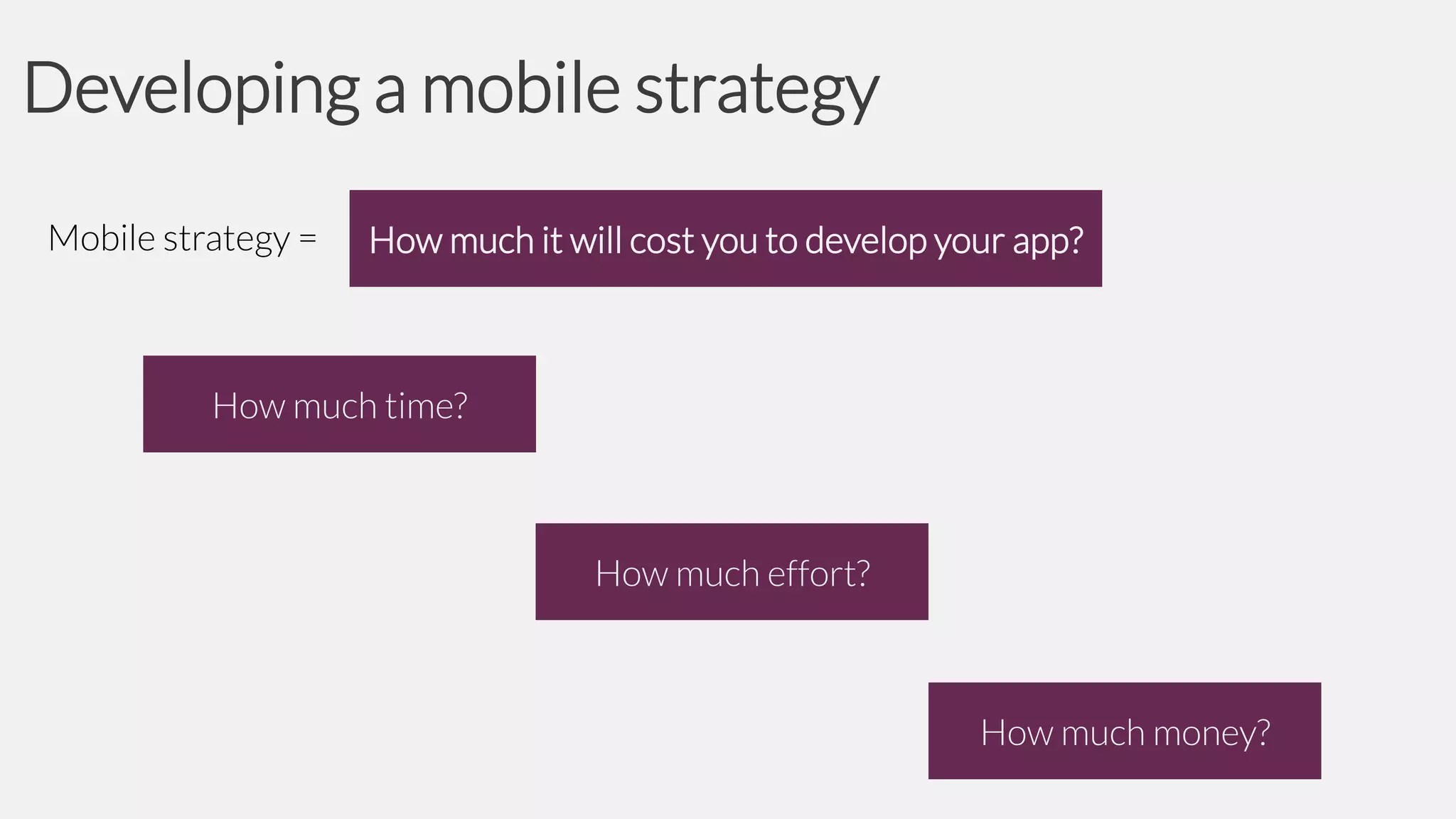
Developing a mobile strategy
Mobile strategy =

How much it will cost you to develop your app?

How much time?

How much effort?

How much money?
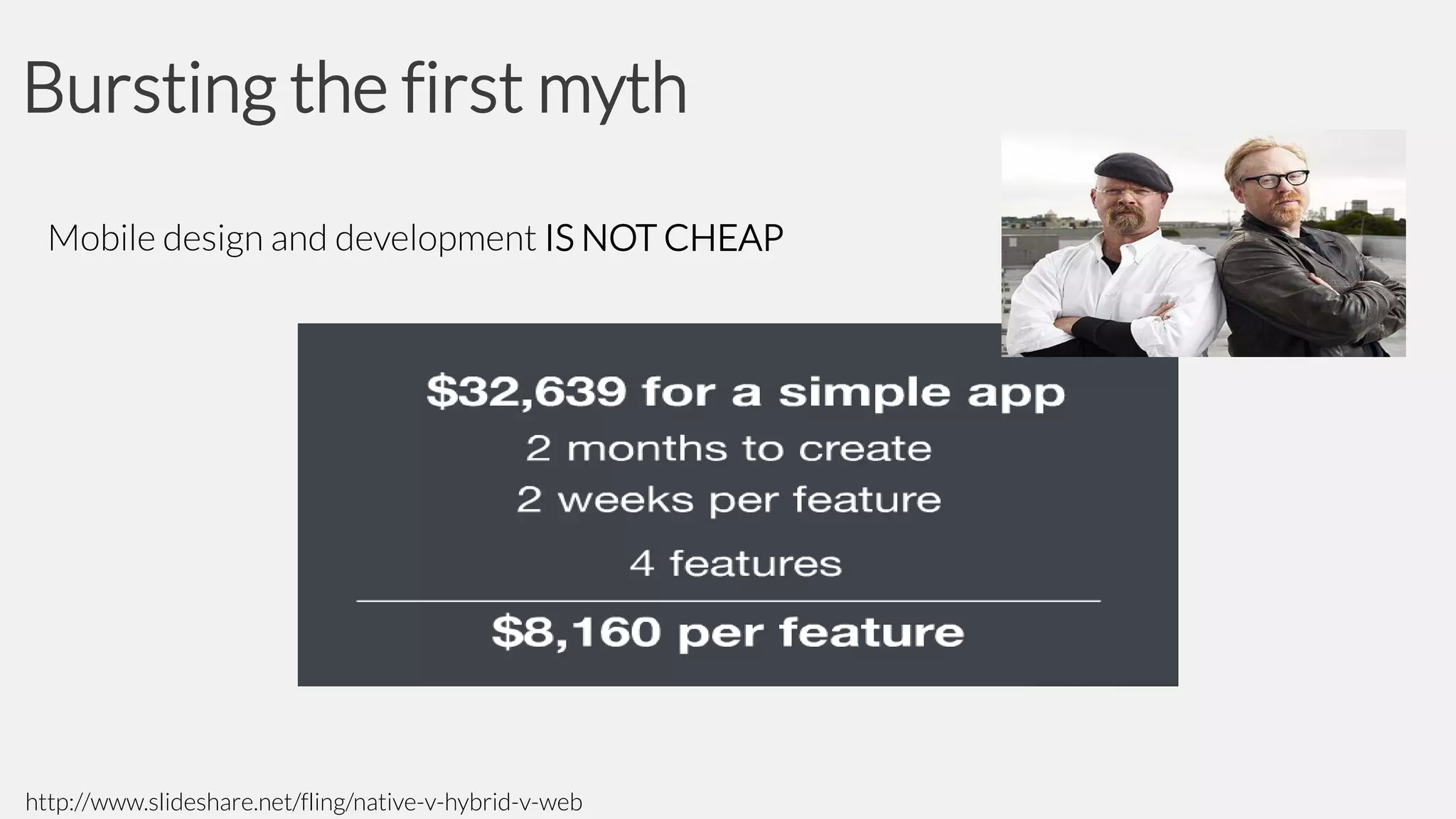
Bursting the first myth
Mobile design and development IS NOT CHEAP

http://www.slideshare.net/fling/native-v-hybrid-v-web
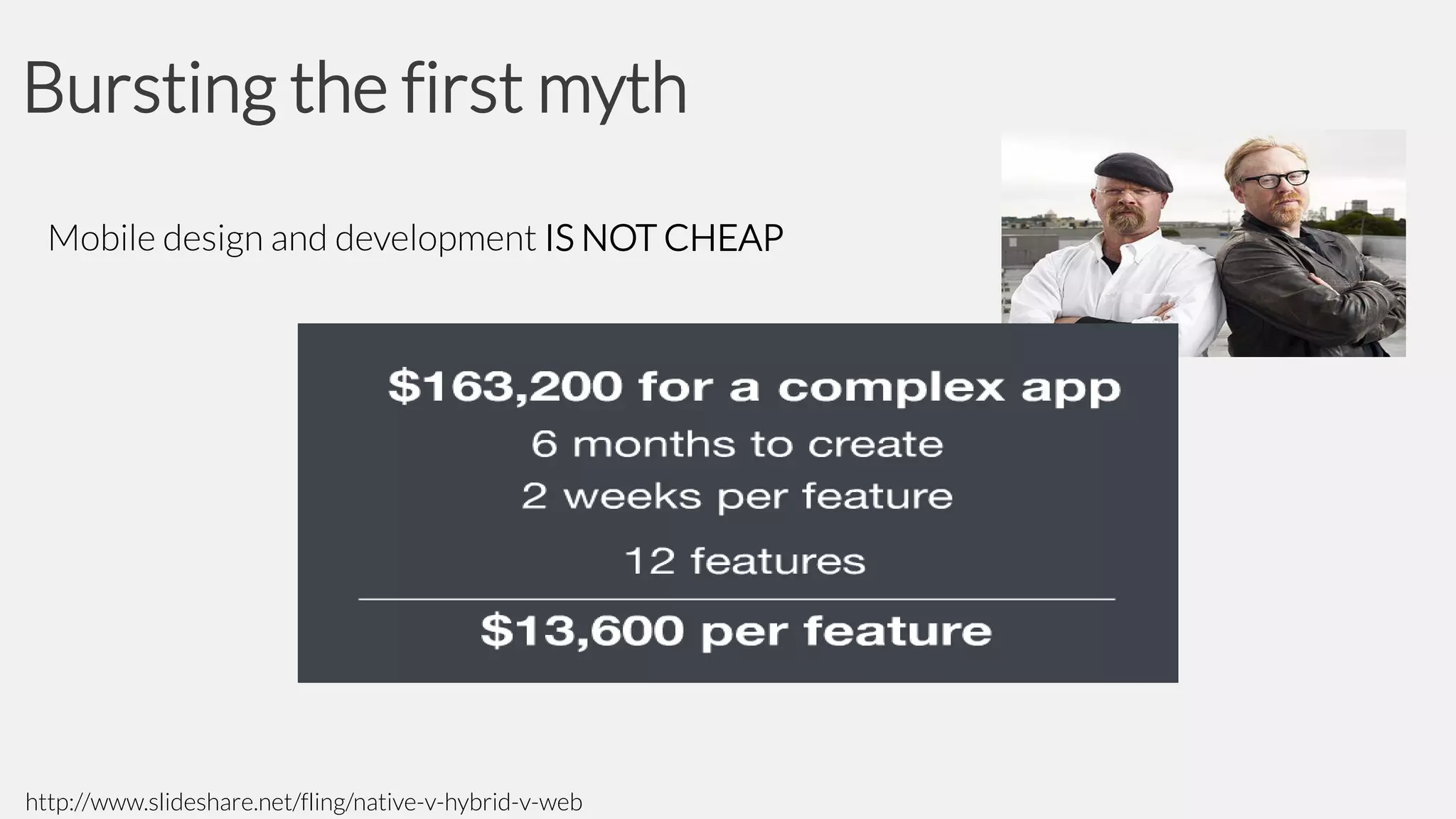
Bursting the first myth
Mobile design and development IS NOT CHEAP

http://www.slideshare.net/fling/native-v-hybrid-v-web
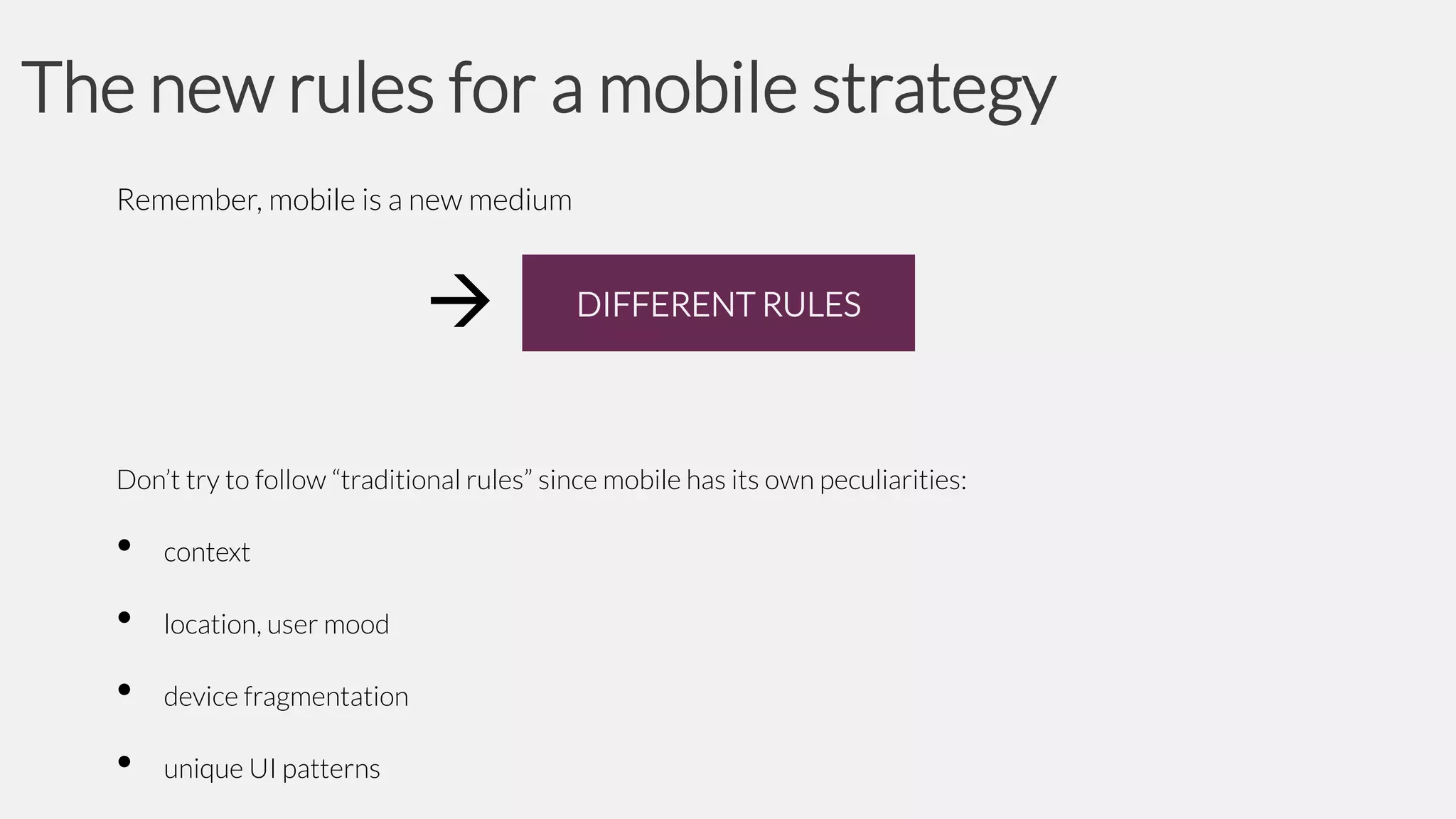
The new rules for a mobile strategy
Remember, mobile is a new medium



DIFFERENT RULES

Don’t try to follow “traditional rules” since mobile has its own peculiarities:

•

context

•

location, user mood

•

device fragmentation

•

unique UI patterns
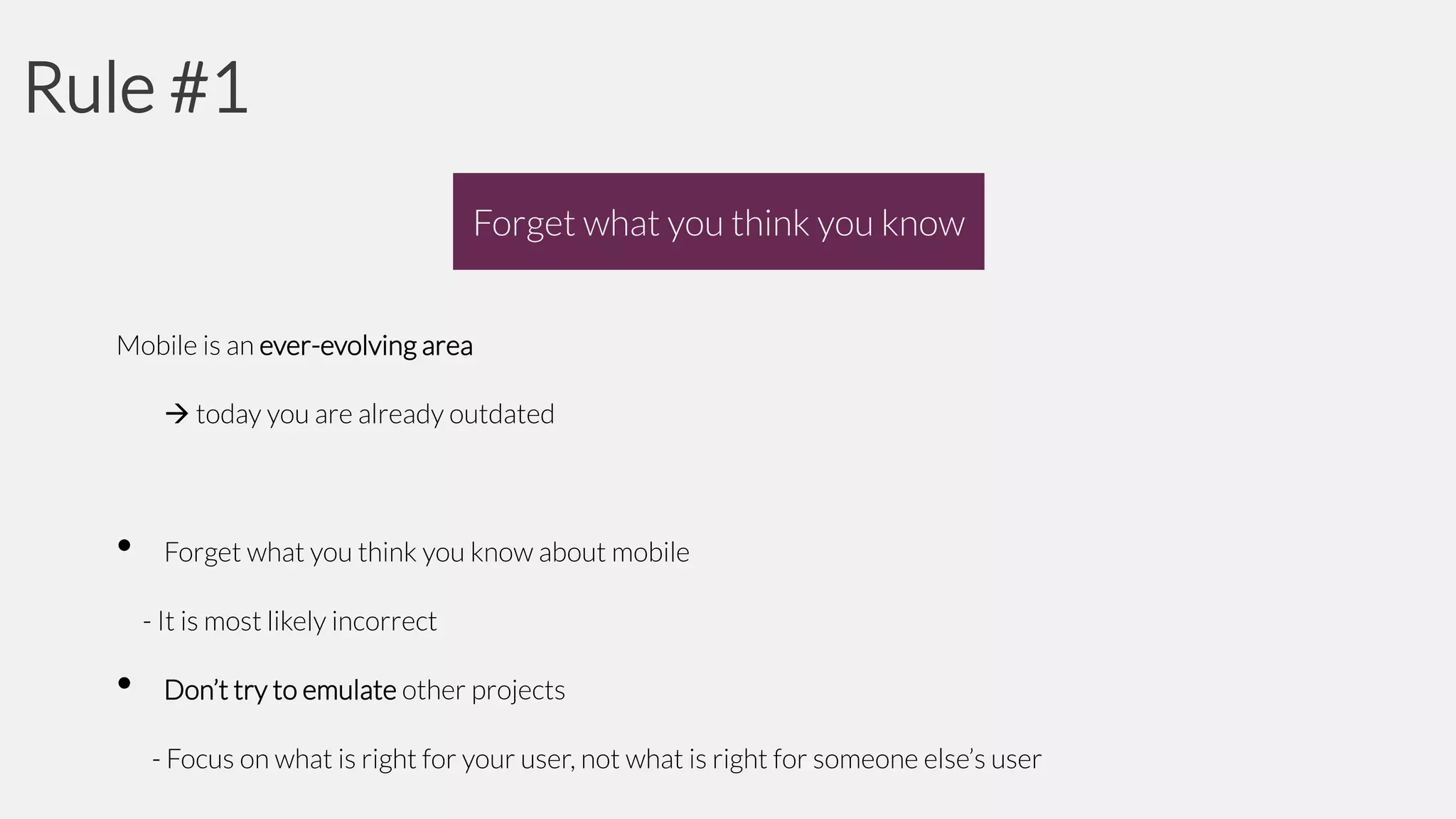
Rule #1
Forget what you think you know
Mobile is an ever-evolving area
 today you are already outdated

•

Forget what you think you know about mobile
- It is most likely incorrect

•

Don’t try to emulate other projects

- Focus on what is right for your user, not what is right for someone else’s user
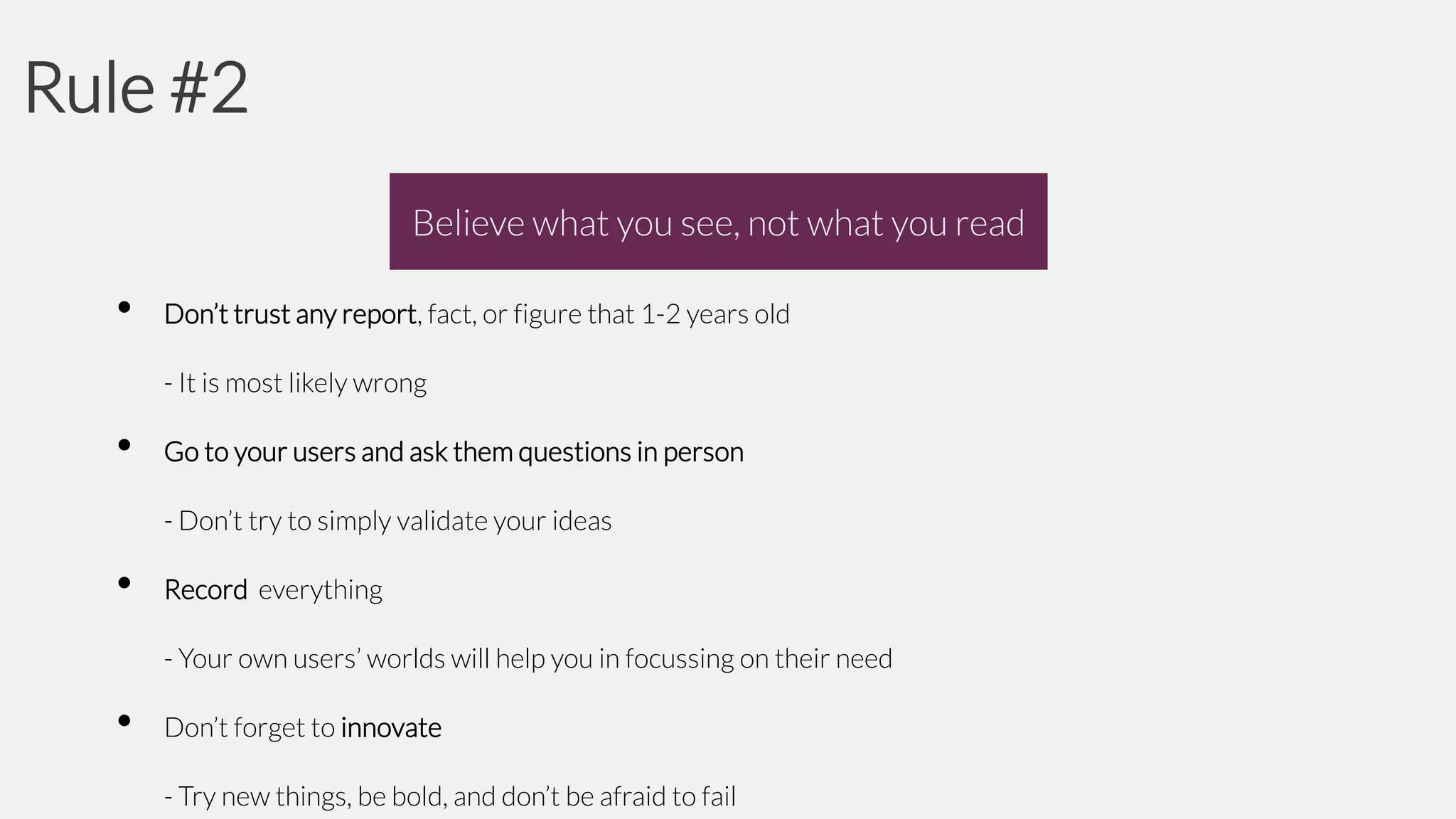
Rule #2
Believe what you see, not what you read

•

Don’t trust any report, fact, or figure that 1-2 years old
- It is most likely wrong

•

Go to your users and ask them questions in person
- Don’t try to simply validate your ideas

•

Record everything

- Your own users’ worlds will help you in focussing on their need

•

Don’t forget to innovate

- Try new things, be bold, and don’t be afraid to fail
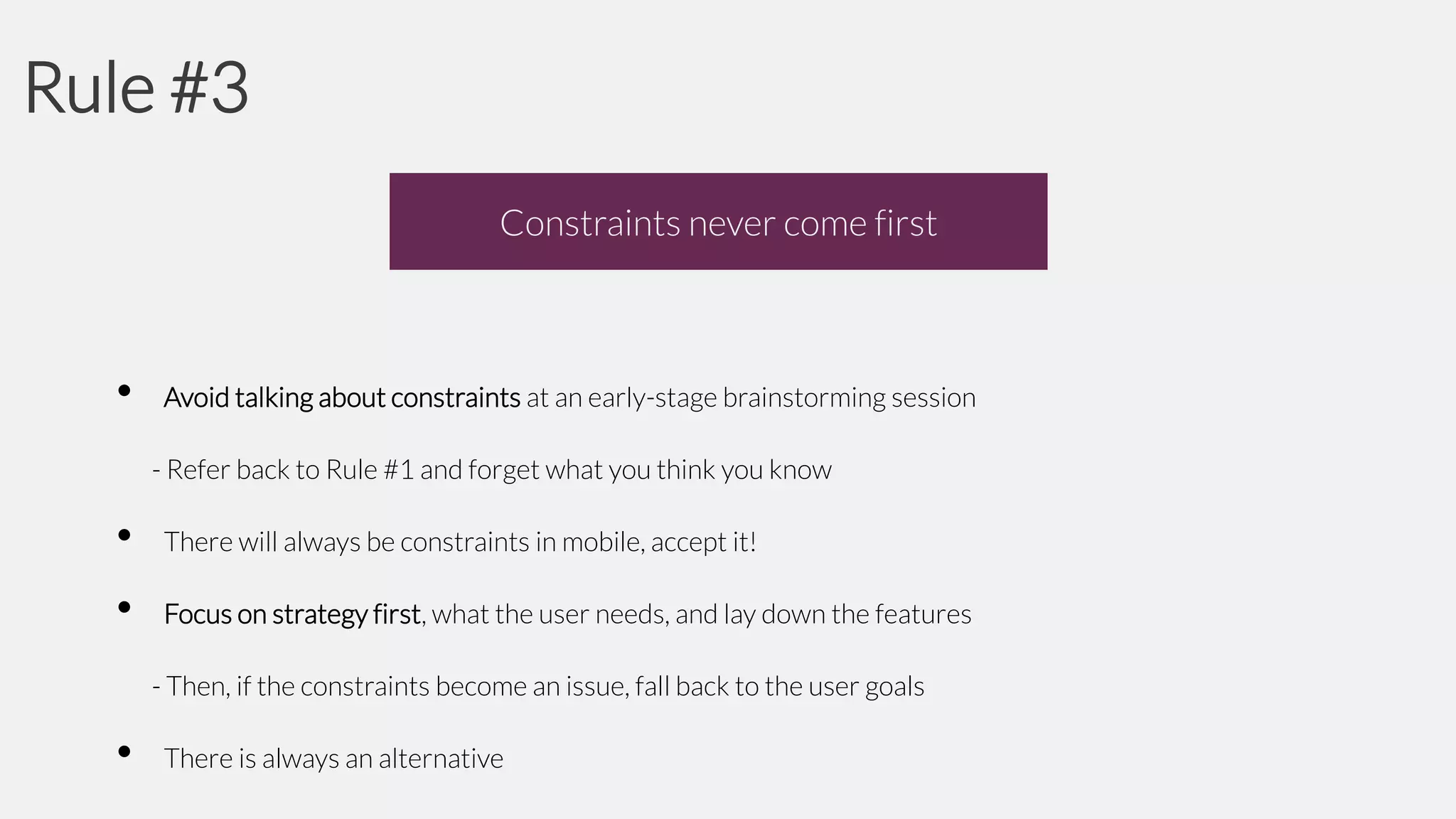
Rule #3
Constraints never come first

•

Avoid talking about constraints at an early-stage brainstorming session
- Refer back to Rule #1 and forget what you think you know

•

There will always be constraints in mobile, accept it!

•

Focus on strategy first, what the user needs, and lay down the features
- Then, if the constraints become an issue, fall back to the user goals

•

There is always an alternative
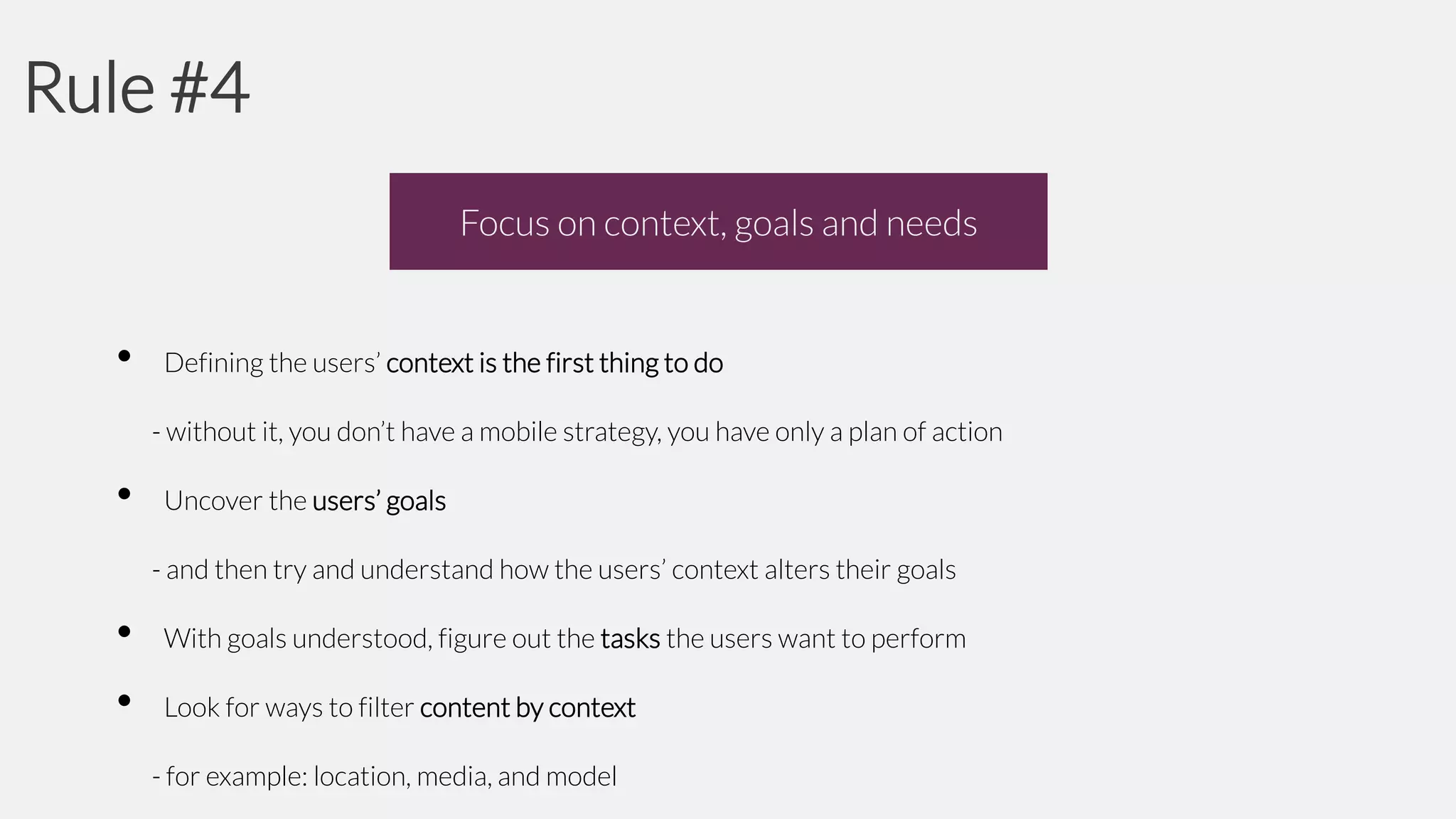
Rule #4
Focus on context, goals and needs

•

Defining the users’ context is the first thing to do
- without it, you don’t have a mobile strategy, you have only a plan of action

•

Uncover the users’ goals
- and then try and understand how the users’ context alters their goals

•
•

With goals understood, figure out the tasks the users want to perform
Look for ways to filter content by context
- for example: location, media, and model
Rule #5
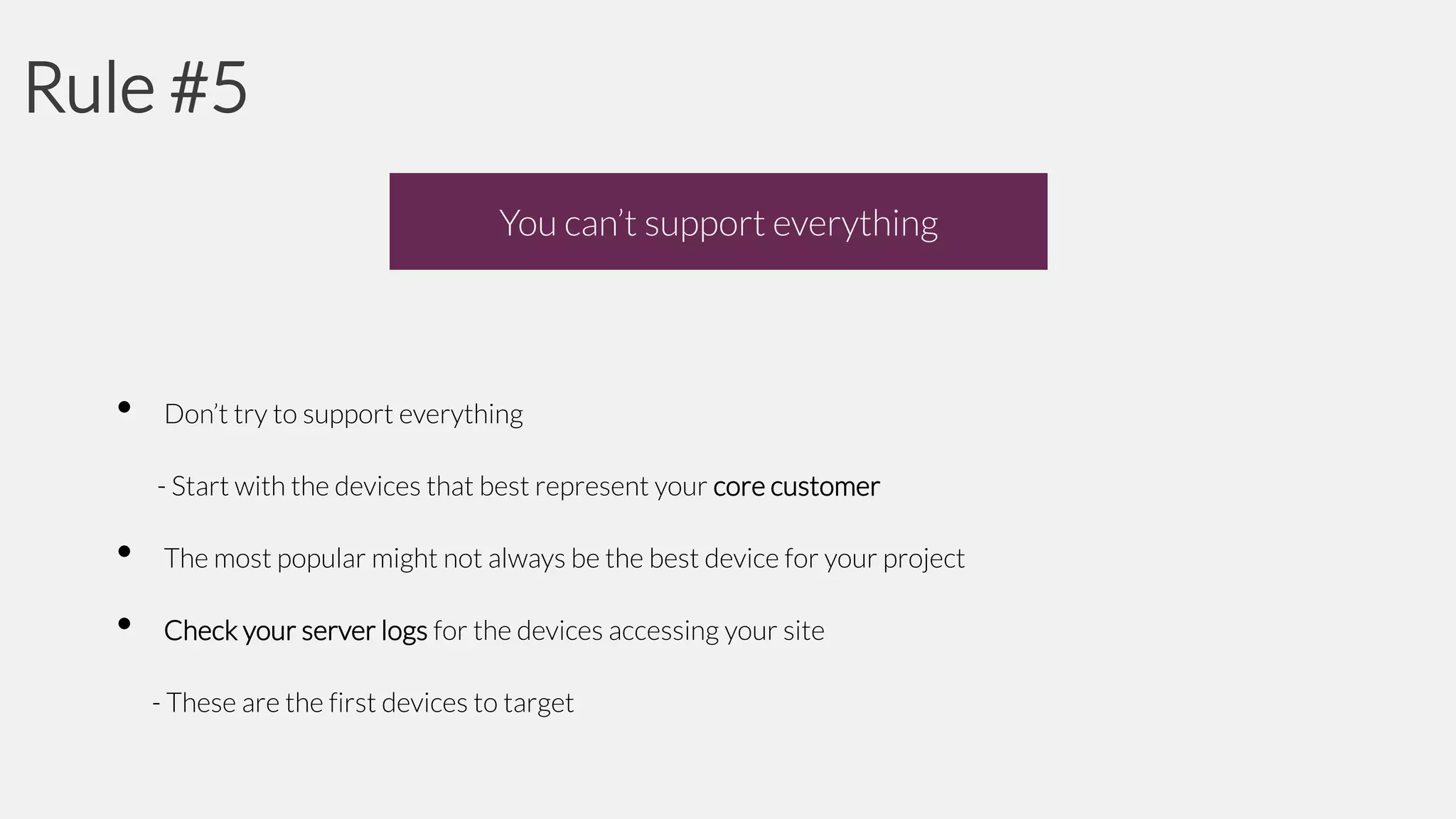
You can’t support everything

•

Don’t try to support everything
- Start with the devices that best represent your core customer

•

The most popular might not always be the best device for your project

•

Check your server logs for the devices accessing your site
- These are the first devices to target
Rule #6
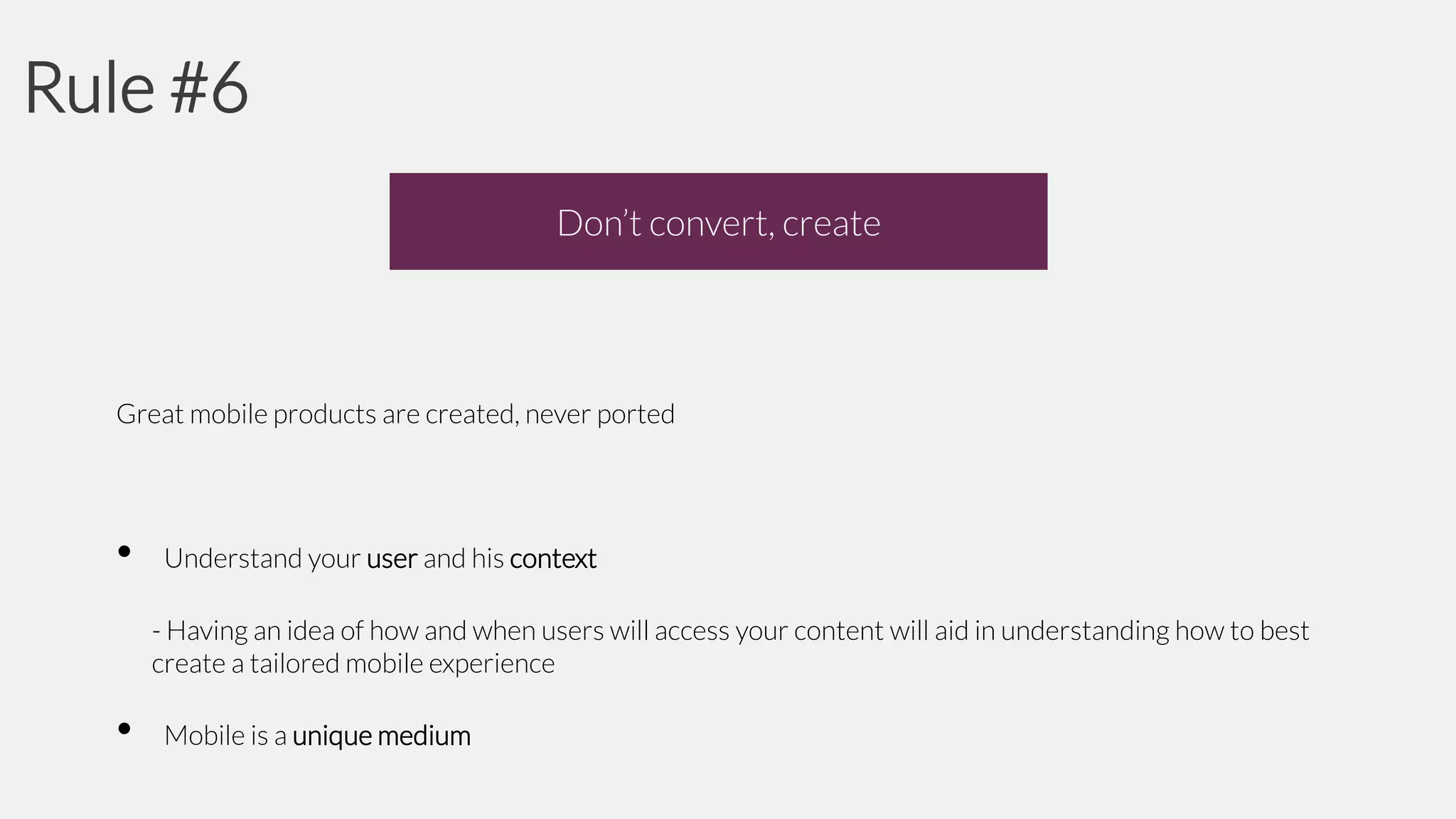
Don’t convert, create

Great mobile products are created, never ported

•

Understand your user and his context
- Having an idea of how and when users will access your content will aid in understanding how to best
create a tailored mobile experience

•

Mobile is a unique medium
Rule #7
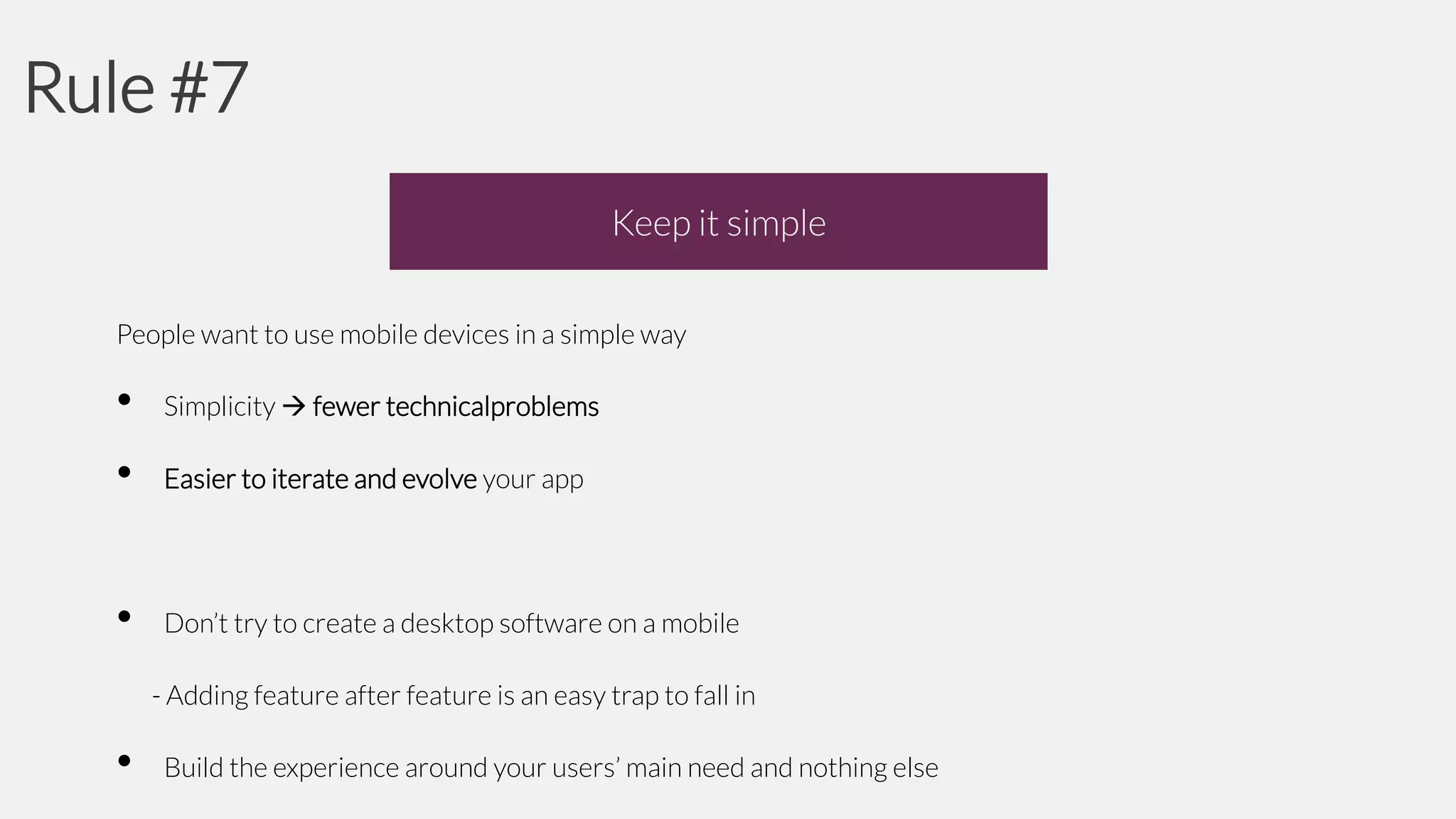
Keep it simple
People want to use mobile devices in a simple way

•

Simplicity  fewer technicalproblems

•

Easier to iterate and evolve your app

•

Don’t try to create a desktop software on a mobile
- Adding feature after feature is an easy trap to fall in

•

Build the experience around your users’ main need and nothing else
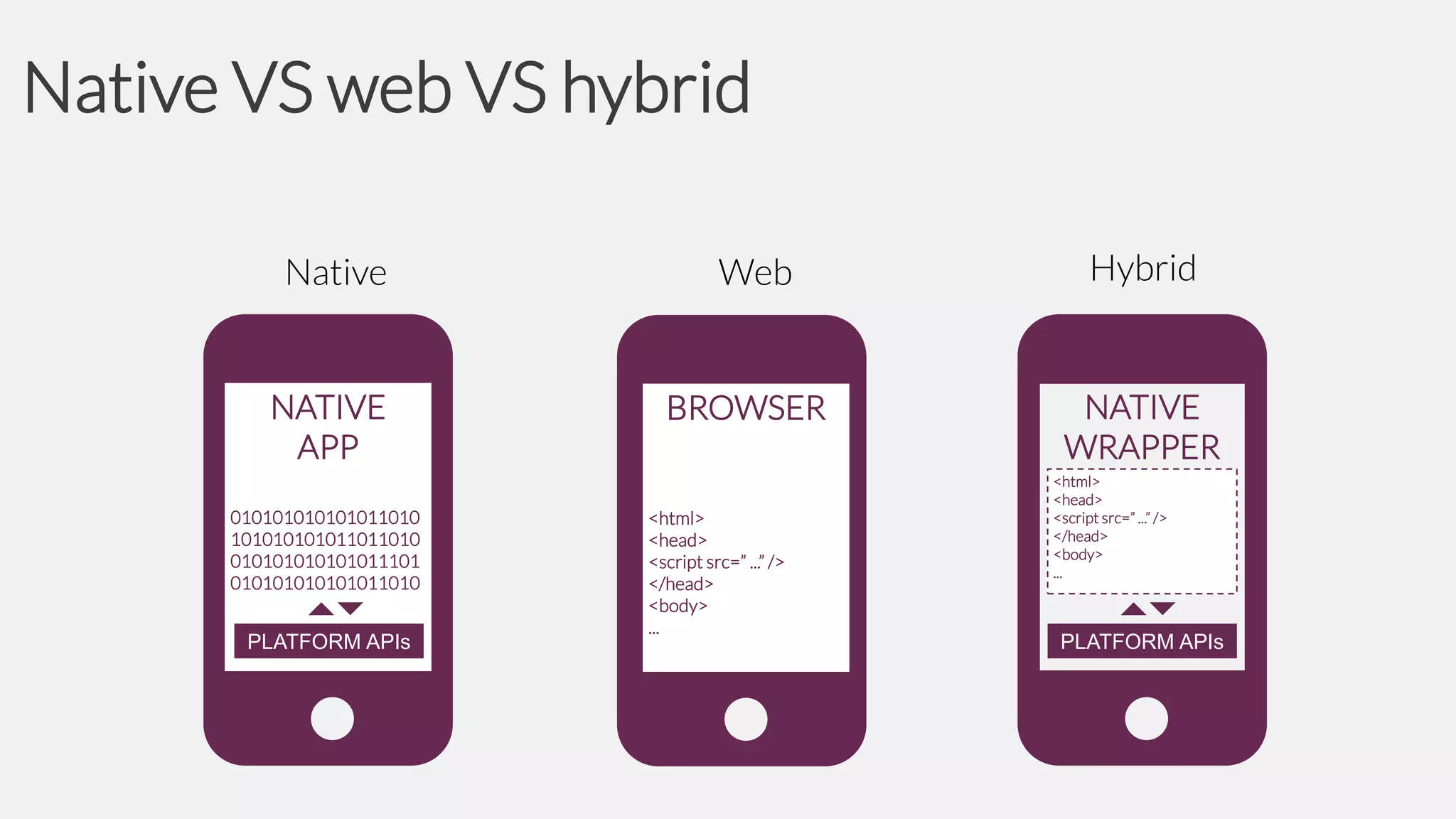
Native VS web VS hybrid
Native

Web

Hybrid

NATIVE
APP

BROWSER

NATIVE
WRAPPER

010101010101011010
101010101011011010
010101010101011101
010101010101011010

PLATFORM APIs

<html>
<head>
<script src=” ...” />
</head>
<body>
...

<html>
<head>
<script src=” ...” />
</head>
<body>
...

PLATFORM APIs
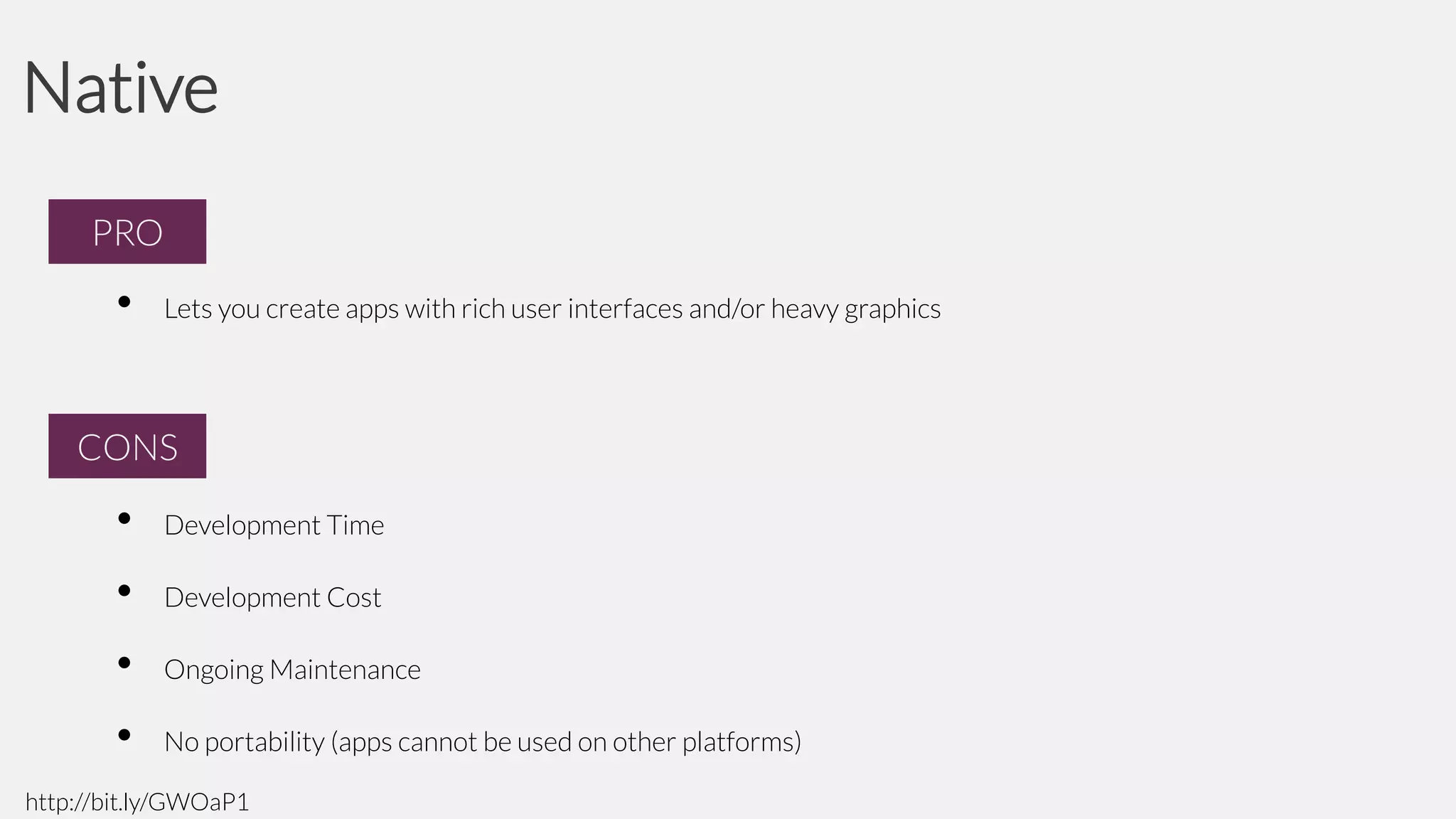
Native
PRO
PRO

•

Lets you create apps with rich user interfaces and/or heavy graphics

CONS
CONS

•

Development Time

•

Development Cost

•

Ongoing Maintenance

•

No portability (apps cannot be used on other platforms)

http://bit.ly/GWOaP1
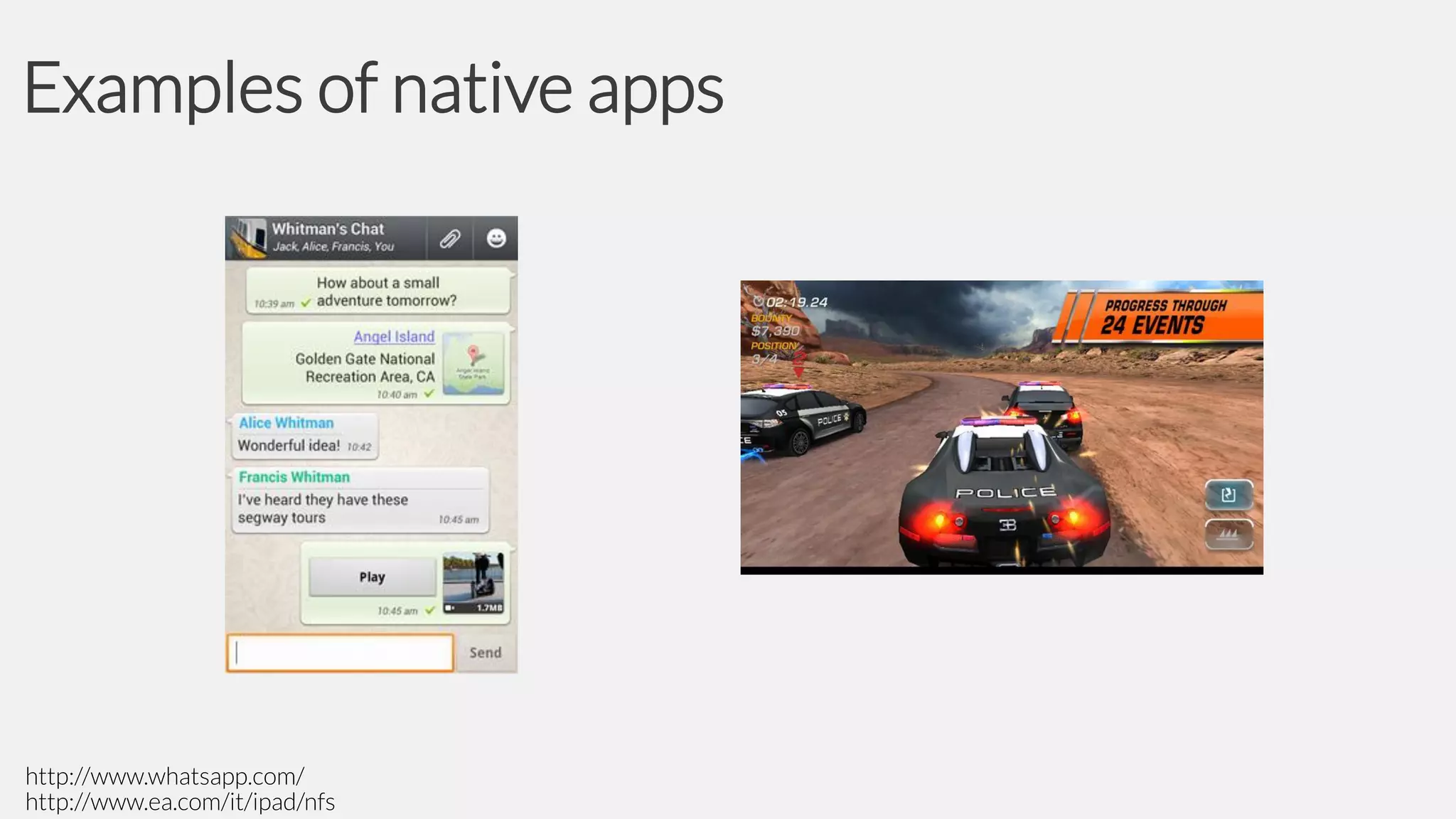
Examples of native apps

http://www.whatsapp.com/
http://www.ea.com/it/ipad/nfs‎
Web
PRO
PRO

•

Offers fast development, simple maintenance, and full application portability

•

One mobile web app works on any platform

CONS
CONS

•

Can’t handle heavy graphics

•

Can’t access camera or microphone

http://bit.ly/GWOaP1
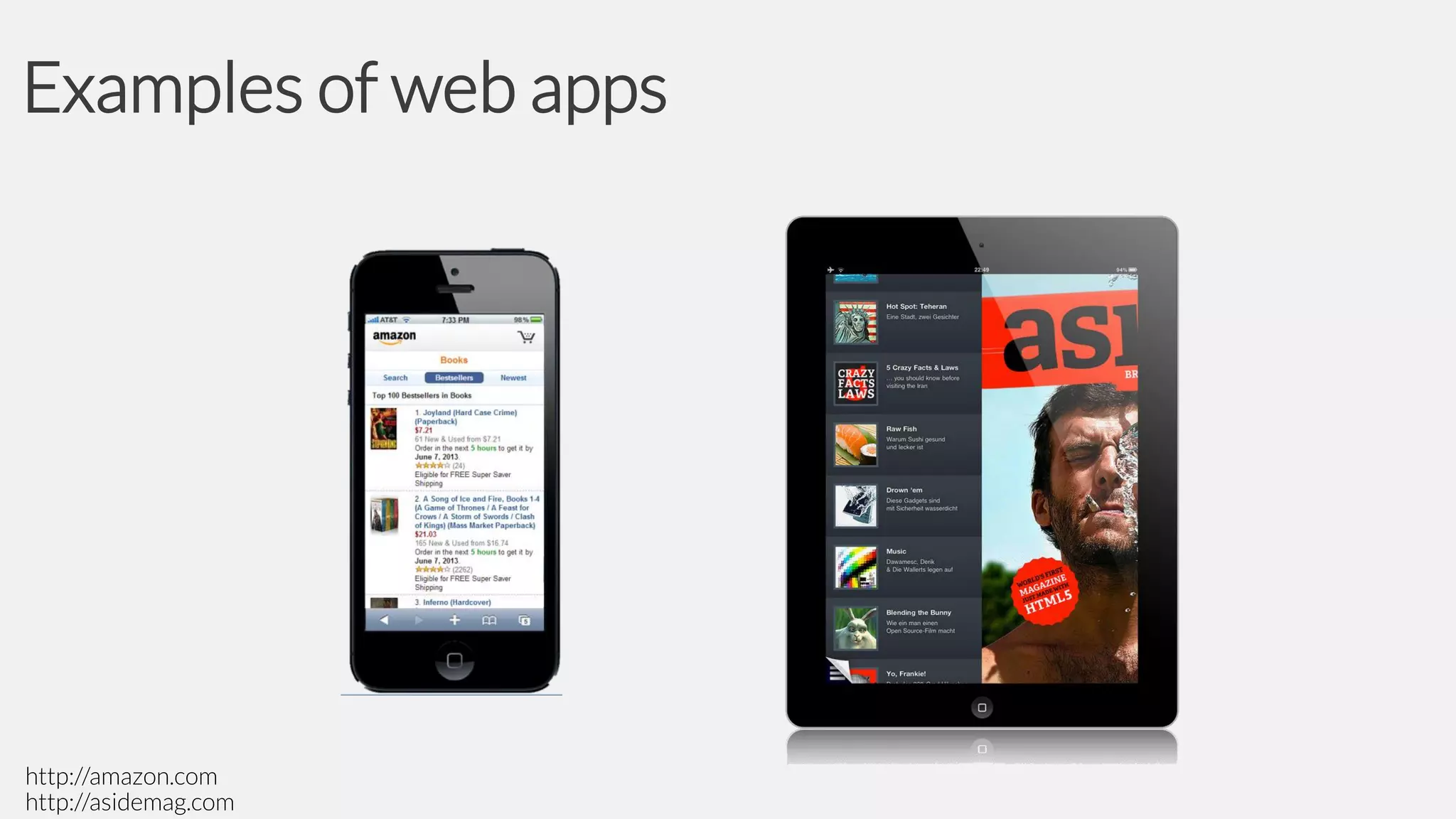
Examples of web apps

http://amazon.com
http://asidemag.com
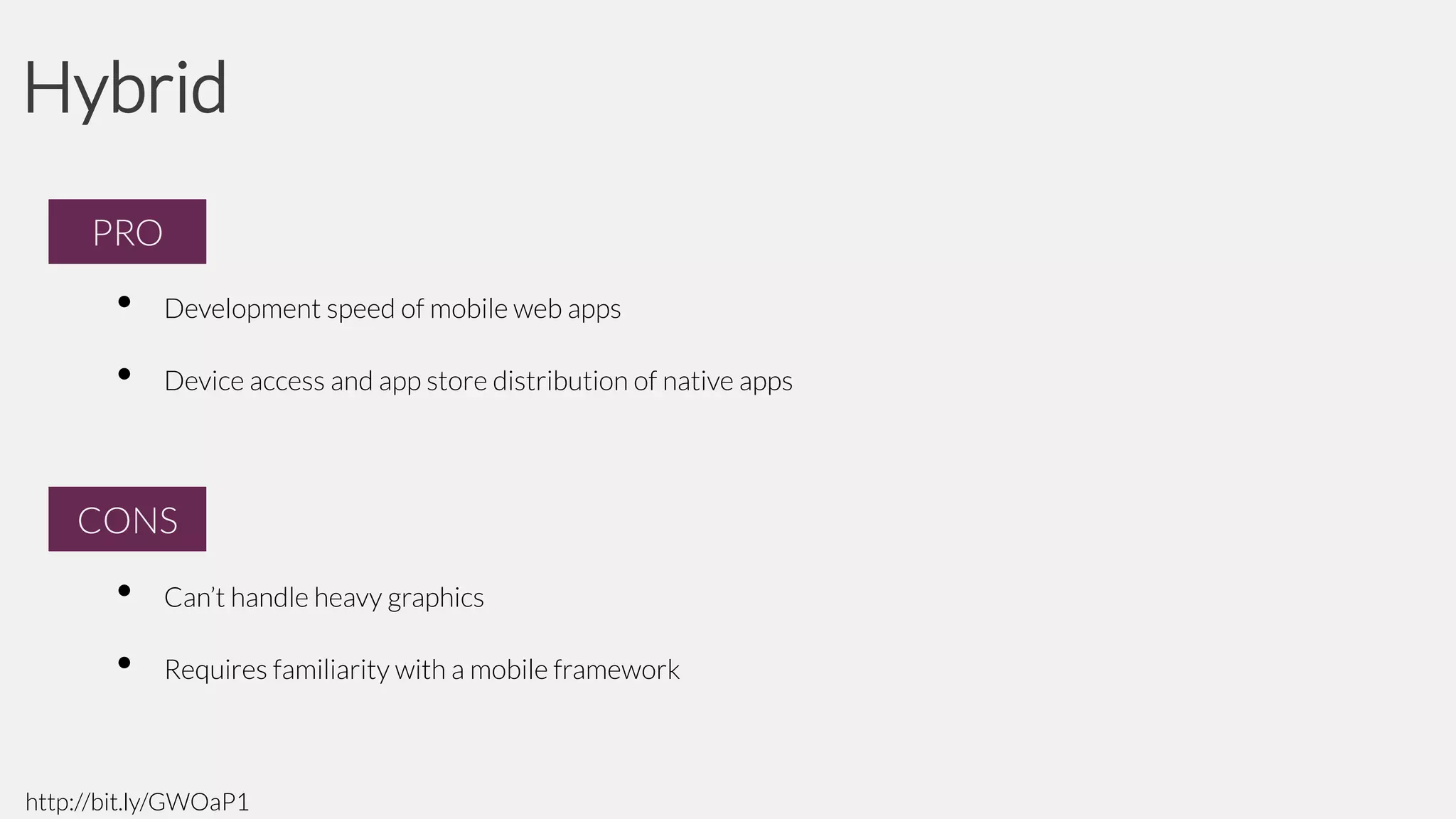
Hybrid
PRO
PRO

•

Development speed of mobile web apps

•

Device access and app store distribution of native apps

CONS
CONS

•

Can’t handle heavy graphics

•

Requires familiarity with a mobile framework

http://bit.ly/GWOaP1
Examples of hybrid apps

http://flipboard.com
http://www.gmail.com
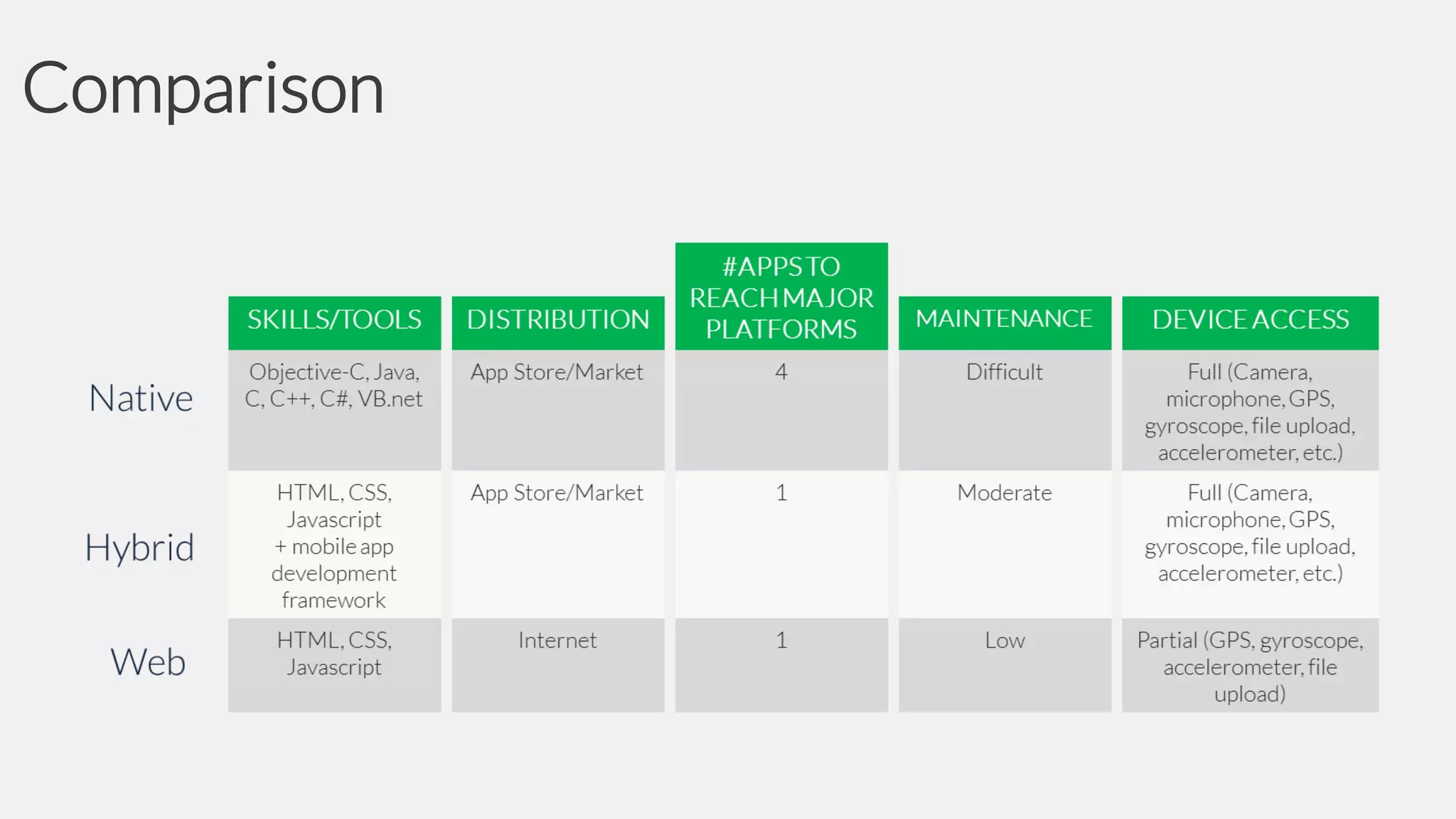
Comparison
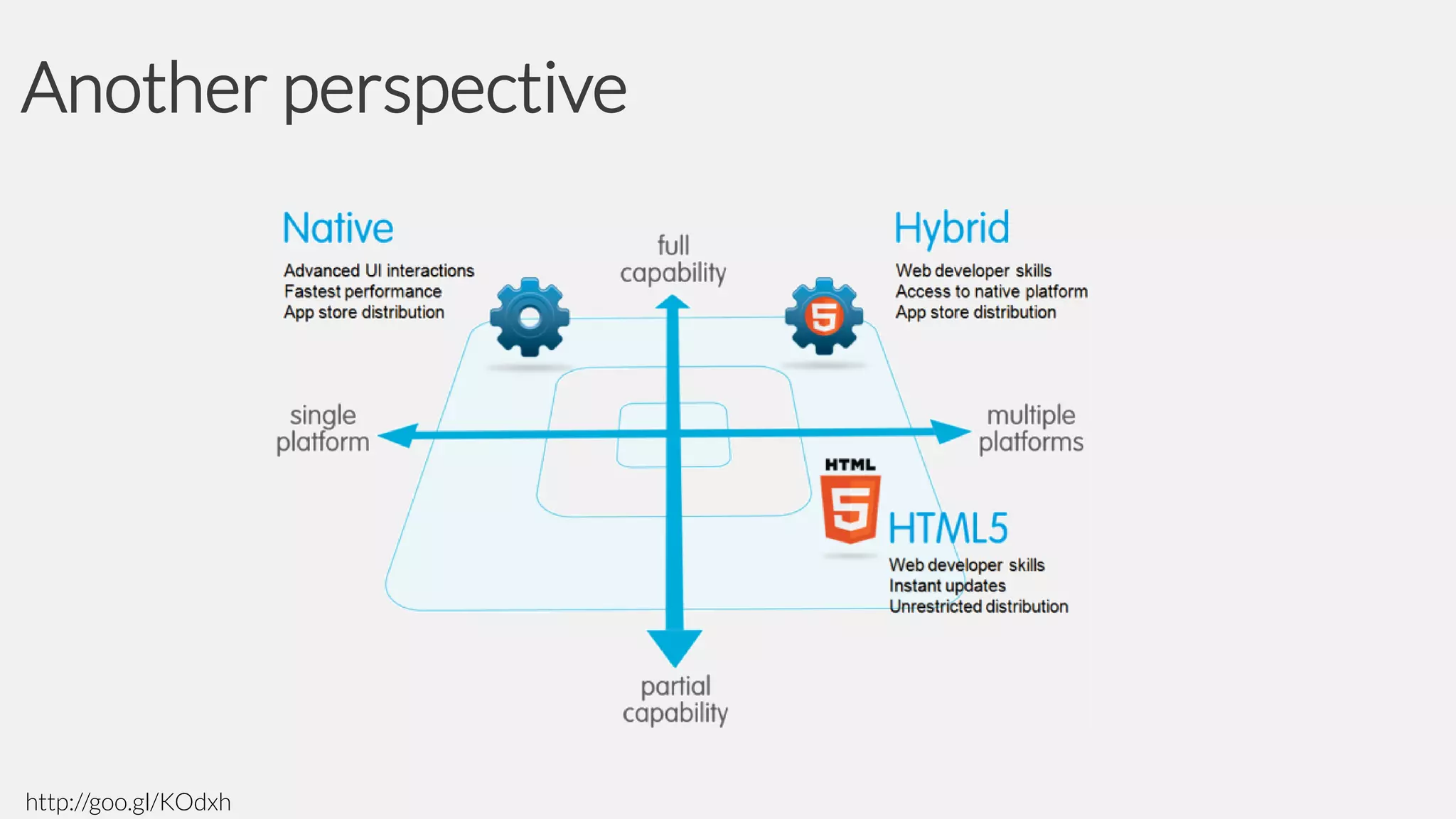
Another perspective

http://goo.gl/KOdxh
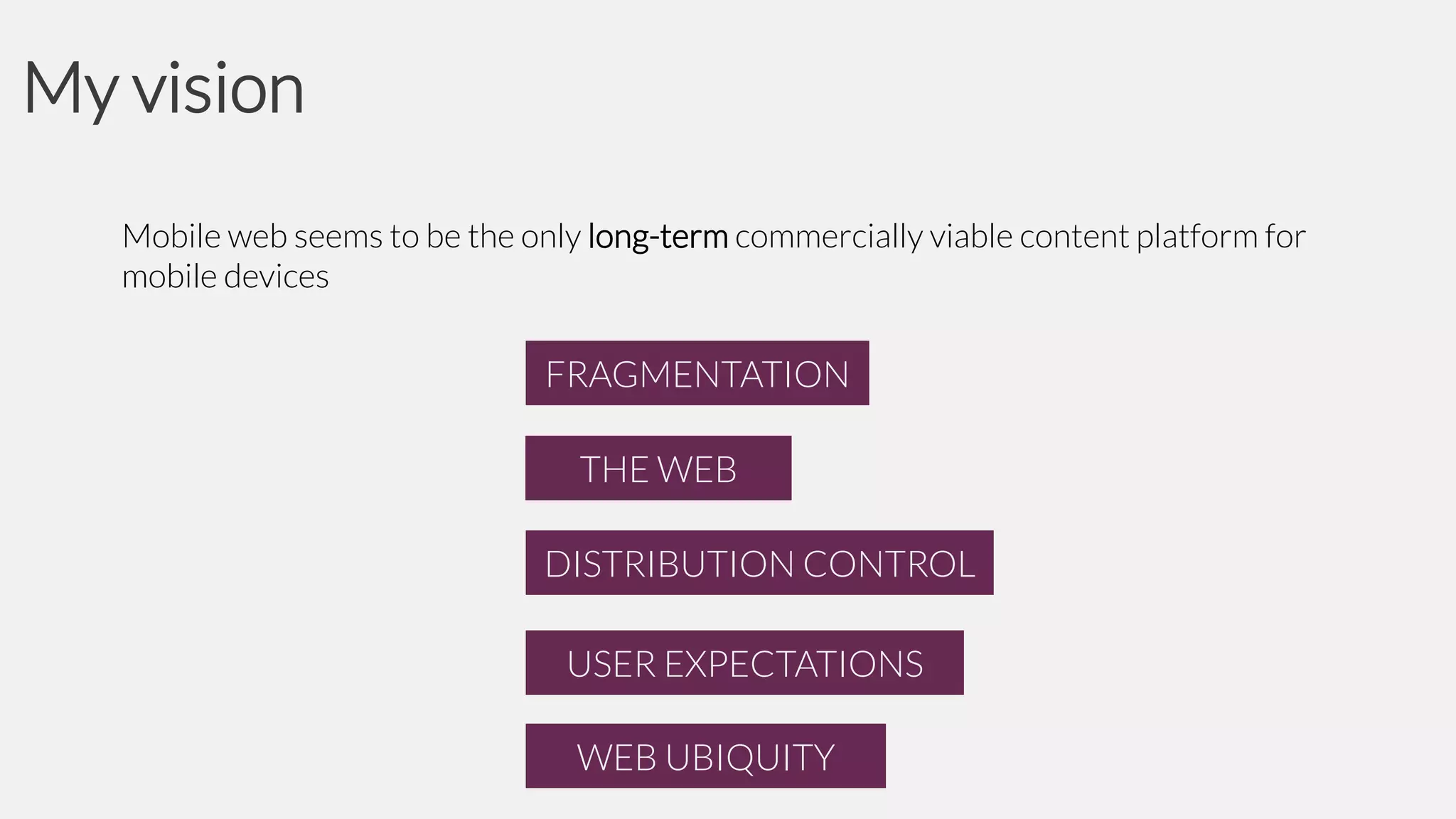
My vision
Mobile web seems to be the only long-term commercially viable content platform for
mobile devices

FRAGMENTATION
THE WEB
DISTRIBUTION CONTROL
USER EXPECTATIONS
WEB UBIQUITY
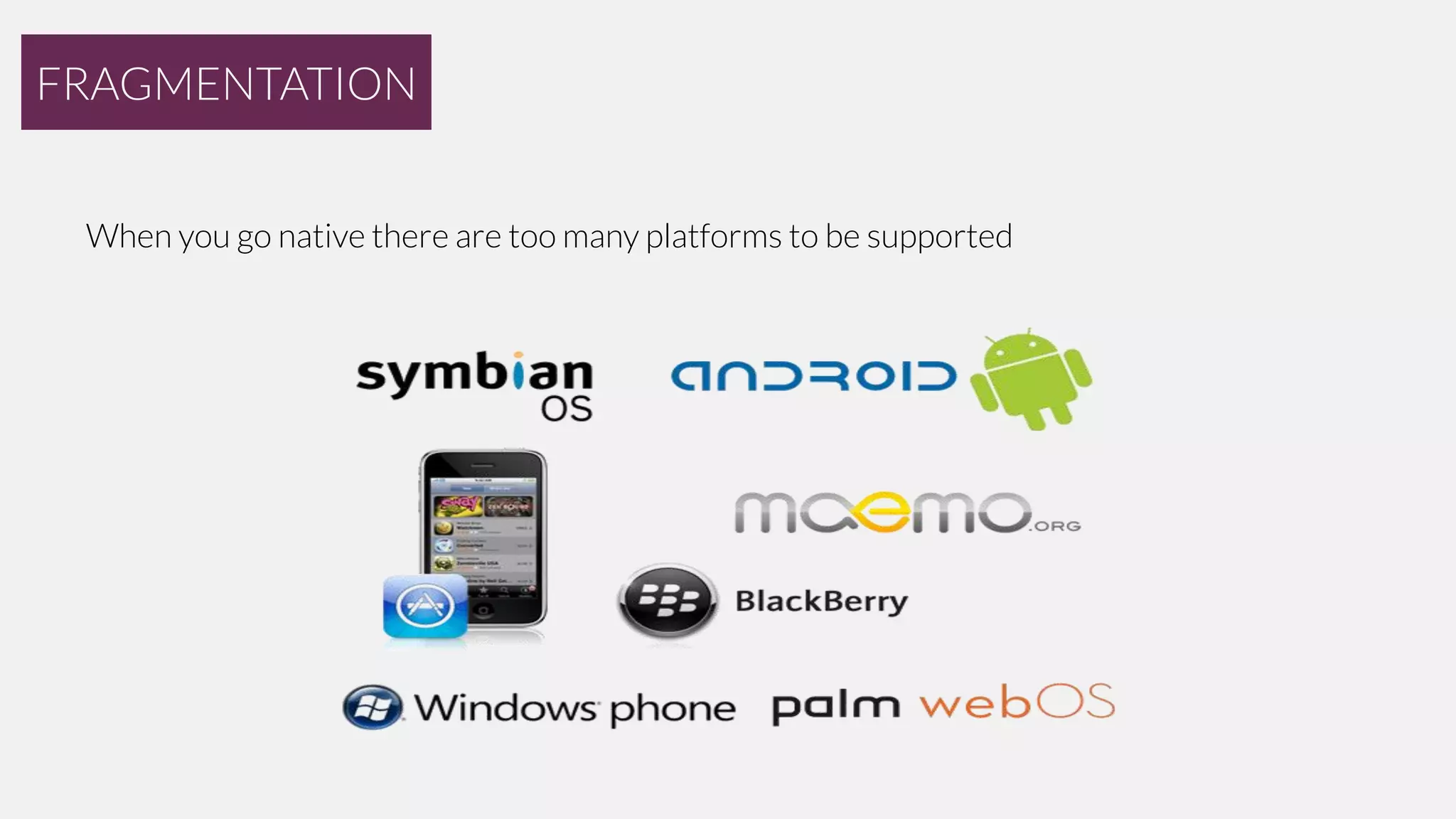
FRAGMENTATION
When you go native there are too many platforms to be supported
THE WEB
The only medium for information and services that lasts from over 15 years

The web is an advanced technology

•
•
•
•
•

webGL
Local storage management
Positioning & mapping
Real-time data
Push, ...
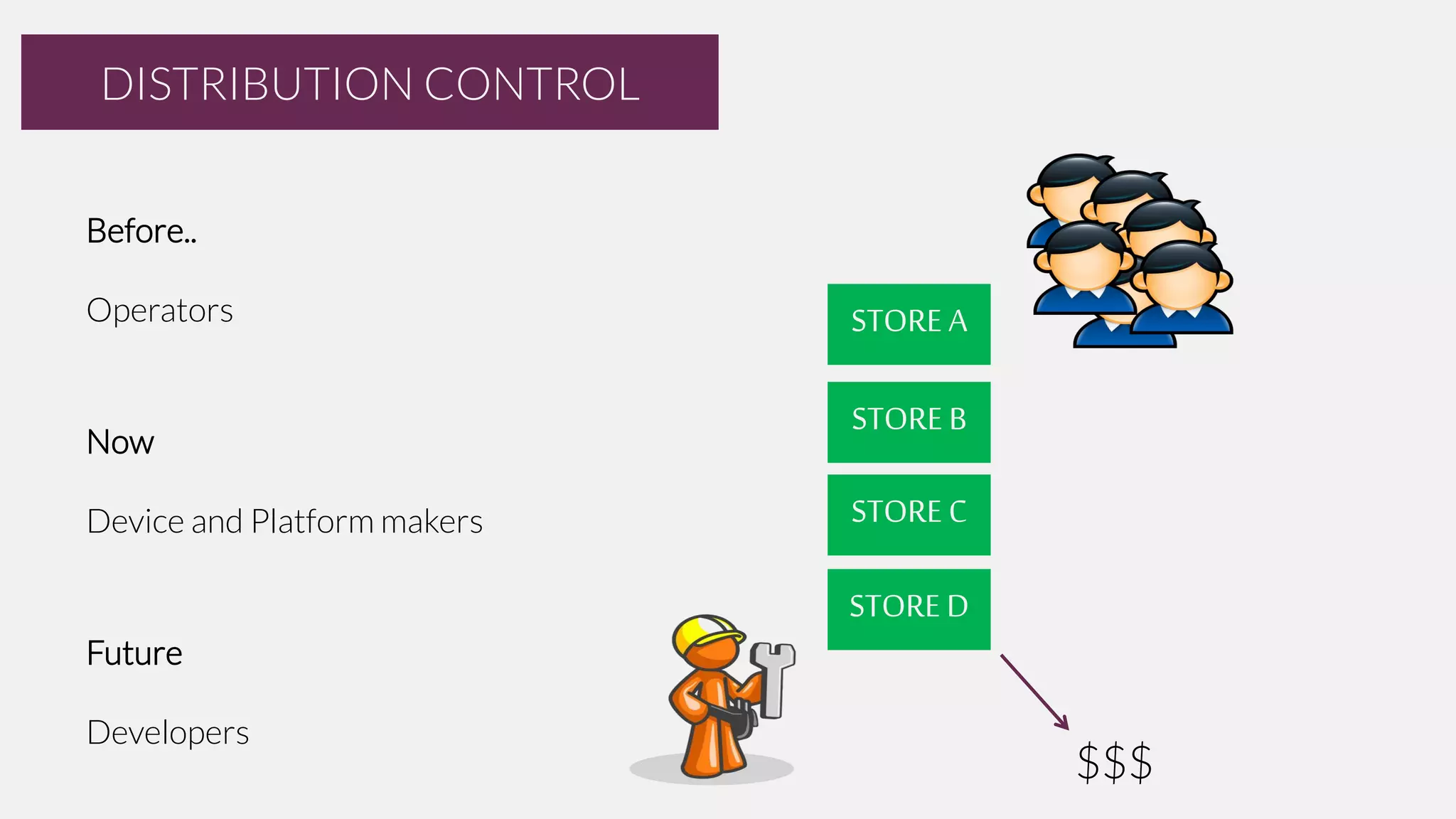
DISTRIBUTION CONTROL
Before..
Operators

Now
Device and Platform makers

STORE A
STORE B
STORE C
STORE D

Future

Developers

$$$
USER EXPECTATIONS
Users expect things to just work

 they don’t care about what platform they have

they simply expect that your app will be available for their device

 YOU HAVE TO BE CROSS-PLATFORM
WEB UBIQUITY
The web is the only platform that

•
•
•

works across devices
apps share the same set of standards
the same app can work also on a desktop
Conclusion
Mobile app technologies are constantly moving targets...
- new OSs, new versions of OSs, new UI patterns, new frameworks, etc.

Choosing between native vs web vs hybrid depends on a lot of factors, such as

•
•
•

Which type of app are you creating?

When do you need it?
What are your skills?
Contact

Ivano Malavolta | DISIM
+ 39 380 70 21 600

iivanoo
ivano.malavolta@univaq.it
www.ivanomalavolta.com

The mobile ecosystem & technological strategies

  • 1.
    The mobile ecosystem & technologicalstrategies Ivano Malavolta DISIM | University of L’Aquila
  • 2.
  • 3.
  • 4.
    Mobile is the7th mass media 1. Printing press 2. Recordings 3. Cinema 4. Radio 5. Television 6. Internet
  • 5.
    Mobile is the7th mass media Mobile is the LARGEST , most available mass medium TO MANKIND
  • 6.
    How big isthe mobile market? ONE SYMBOL = 20 MILLION PEOPLE data source: http://www.slideshare.net/fling/mobile-20-design-develop-for-the-iphone-and-beyond
  • 7.
    How big isthe mobile market? in 2009 data source: http://www.slideshare.net/fling/mobile-20-design-develop-for-the-iphone-and-beyond
  • 8.
    How big isthe mobile market? in 2009 data source: http://www.slideshare.net/fling/mobile-20-design-develop-for-the-iphone-and-beyond
  • 9.
    How big isthe mobile market? in 2009 data source: http://www.slideshare.net/fling/mobile-20-design-develop-for-the-iphone-and-beyond
  • 10.
    Mobile is the7th mass media it started at the same time as the Web 7. Mobile UNIQUE TRAIT it can do EVERYTHING all the other media can do • Reading (and publishing) • Play recordings • Watch movies • Listen to radio • Watch TV (and streaming) • Surf the Internet
  • 11.
    Unique benefits ofMobile Apart from covering all the other media, mobile has five unique benefits First truly personal mass media First always-on mass media First always-carried mass media Built-in payment channel At the point of creative impulse We don’t share our phones with our friends Information is always available 24/7, even when idle 7 out of 10 people sleep with their phones within reach Universal click-to-buy + credit cards Ability to create or consume content whenever the mood strikes
  • 12.
    Context CONTEXT CONTEXT CONTEXTCONTEXT CONTEXT CONTEXT CONTEXT CONTEXT CONTEXT CONTEXT CONTEXT CONTEXT CONTEXT CONTEXT CONTEXT CONTEXT CONTEXT CONTEXT CONTEXT add CONTEXT CONTEXT Mobile apps have the amazing capability to CONTEXT CONTEXT CONTEXT CONTEXT CONTEXT CONTEXT CONTEXT CONTEXT CONTEXT CONTEXT CONTEXT CONTEXT CONTEXT CONTEXT CONTEXT to information, adding immediate relevance to what we are doing right here, right now CONTEXT CONTEXT CONTEXT CONTEXT CONTEXT CONTEXT CONTEXT CONTEXT CONTEXT CONTEXT CONTEXT CONTEXT CONTEXT CONTEXT CONTEXT CONTEXT CONTEXT CONTEXT CONTEXT CONTEXT CONTEXT
  • 13.
    The mobile goldenrule If you can unlock the state of mind of your users and start thinking in their context, understanding how a mobile experience will add value to their lives, you will have the ever-elusive… KILLER APP
  • 14.
    How can weapply the mobile golden rule? Think of your app in its context • • • • • • Who is your user? Business man, teenager, mum… What is happening? Are they hanging out with friends? When will he interact? @home? @work? waiting for the bus? Where is he? Public/private space, inside/outside, day/night Why will he use your app? How do you give Context? How is he using his mobile device? Is the device held in the hand? Portrait or landscape?
  • 15.
  • 16.
  • 17.
    Developing a mobilestrategy Mobile strategy = How much it will cost you to develop your app? How much time? How much effort? How much money?
  • 18.
    Bursting the firstmyth Mobile design and development IS NOT CHEAP http://www.slideshare.net/fling/native-v-hybrid-v-web
  • 19.
    Bursting the firstmyth Mobile design and development IS NOT CHEAP http://www.slideshare.net/fling/native-v-hybrid-v-web
  • 20.
    The new rulesfor a mobile strategy Remember, mobile is a new medium  DIFFERENT RULES Don’t try to follow “traditional rules” since mobile has its own peculiarities: • context • location, user mood • device fragmentation • unique UI patterns
  • 21.
    Rule #1 Forget whatyou think you know Mobile is an ever-evolving area  today you are already outdated • Forget what you think you know about mobile - It is most likely incorrect • Don’t try to emulate other projects - Focus on what is right for your user, not what is right for someone else’s user
  • 22.
    Rule #2 Believe whatyou see, not what you read • Don’t trust any report, fact, or figure that 1-2 years old - It is most likely wrong • Go to your users and ask them questions in person - Don’t try to simply validate your ideas • Record everything - Your own users’ worlds will help you in focussing on their need • Don’t forget to innovate - Try new things, be bold, and don’t be afraid to fail
  • 23.
    Rule #3 Constraints nevercome first • Avoid talking about constraints at an early-stage brainstorming session - Refer back to Rule #1 and forget what you think you know • There will always be constraints in mobile, accept it! • Focus on strategy first, what the user needs, and lay down the features - Then, if the constraints become an issue, fall back to the user goals • There is always an alternative
  • 24.
    Rule #4 Focus oncontext, goals and needs • Defining the users’ context is the first thing to do - without it, you don’t have a mobile strategy, you have only a plan of action • Uncover the users’ goals - and then try and understand how the users’ context alters their goals • • With goals understood, figure out the tasks the users want to perform Look for ways to filter content by context - for example: location, media, and model
  • 25.
    Rule #5 You can’tsupport everything • Don’t try to support everything - Start with the devices that best represent your core customer • The most popular might not always be the best device for your project • Check your server logs for the devices accessing your site - These are the first devices to target
  • 26.
    Rule #6 Don’t convert,create Great mobile products are created, never ported • Understand your user and his context - Having an idea of how and when users will access your content will aid in understanding how to best create a tailored mobile experience • Mobile is a unique medium
  • 27.
    Rule #7 Keep itsimple People want to use mobile devices in a simple way • Simplicity  fewer technicalproblems • Easier to iterate and evolve your app • Don’t try to create a desktop software on a mobile - Adding feature after feature is an easy trap to fall in • Build the experience around your users’ main need and nothing else
  • 28.
    Native VS webVS hybrid Native Web Hybrid NATIVE APP BROWSER NATIVE WRAPPER 010101010101011010 101010101011011010 010101010101011101 010101010101011010 PLATFORM APIs <html> <head> <script src=” ...” /> </head> <body> ... <html> <head> <script src=” ...” /> </head> <body> ... PLATFORM APIs
  • 29.
    Native PRO PRO • Lets you createapps with rich user interfaces and/or heavy graphics CONS CONS • Development Time • Development Cost • Ongoing Maintenance • No portability (apps cannot be used on other platforms) http://bit.ly/GWOaP1
  • 30.
    Examples of nativeapps http://www.whatsapp.com/ http://www.ea.com/it/ipad/nfs‎
  • 31.
    Web PRO PRO • Offers fast development,simple maintenance, and full application portability • One mobile web app works on any platform CONS CONS • Can’t handle heavy graphics • Can’t access camera or microphone http://bit.ly/GWOaP1
  • 32.
    Examples of webapps http://amazon.com http://asidemag.com
  • 33.
    Hybrid PRO PRO • Development speed ofmobile web apps • Device access and app store distribution of native apps CONS CONS • Can’t handle heavy graphics • Requires familiarity with a mobile framework http://bit.ly/GWOaP1
  • 34.
    Examples of hybridapps http://flipboard.com http://www.gmail.com
  • 35.
  • 36.
  • 37.
    My vision Mobile webseems to be the only long-term commercially viable content platform for mobile devices FRAGMENTATION THE WEB DISTRIBUTION CONTROL USER EXPECTATIONS WEB UBIQUITY
  • 38.
    FRAGMENTATION When you gonative there are too many platforms to be supported
  • 39.
    THE WEB The onlymedium for information and services that lasts from over 15 years The web is an advanced technology • • • • • webGL Local storage management Positioning & mapping Real-time data Push, ...
  • 40.
    DISTRIBUTION CONTROL Before.. Operators Now Device andPlatform makers STORE A STORE B STORE C STORE D Future Developers $$$
  • 41.
    USER EXPECTATIONS Users expectthings to just work  they don’t care about what platform they have they simply expect that your app will be available for their device  YOU HAVE TO BE CROSS-PLATFORM
  • 42.
    WEB UBIQUITY The webis the only platform that • • • works across devices apps share the same set of standards the same app can work also on a desktop
  • 43.
    Conclusion Mobile app technologiesare constantly moving targets... - new OSs, new versions of OSs, new UI patterns, new frameworks, etc. Choosing between native vs web vs hybrid depends on a lot of factors, such as • • • Which type of app are you creating? When do you need it? What are your skills?
  • 44.
    Contact Ivano Malavolta |DISIM + 39 380 70 21 600 iivanoo ivano.malavolta@univaq.it www.ivanomalavolta.com