Ivano Malavolta
AADL
VRIJE
UNIVERSITEIT
AMSTERDAM
Outline of this lecture
• Part 1: Basics on AADLv2 core
– Syntax, semantics of the language
• Part 2: Example
– The radar illustrative example
Basics on AADL
Outline
1. AADL key modeling constructs
1. Software components
2. Execution platform components
3. Properties
4. Modelling large scale systems
2. Tool support
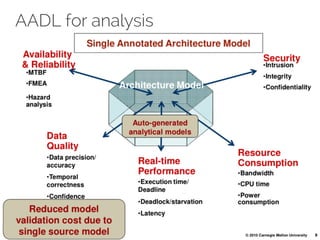
AADL for analysis
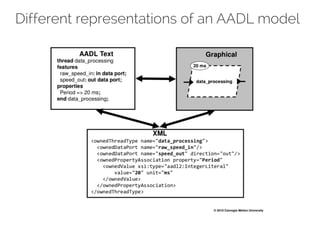
Different representations of an AADL model
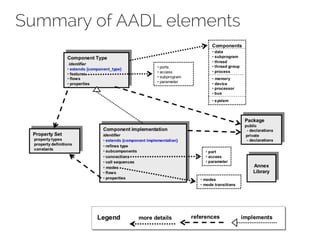
Summary of AADL elements
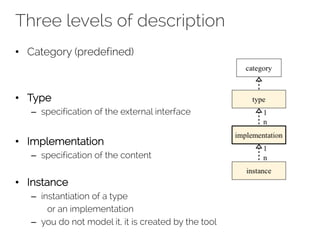
Three levels of description
• Category (predefined)
• Type
– specification of the external interface
• Implementation
– specification of the content
• Instance
– instantiation of a type
or an implementation
– you do not model it, it is created by the tool
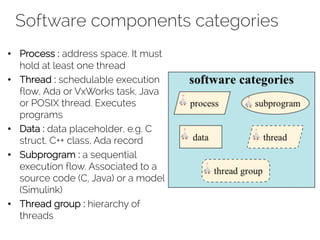
Software components categories
• Process : address space. It must
hold at least one thread
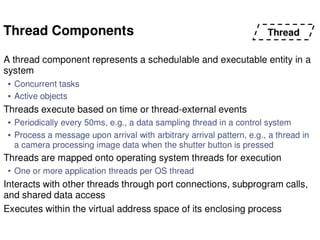
• Thread : schedulable execution
flow, Ada or VxWorks task, Java
or POSIX thread. Executes
programs
• Data : data placeholder, e.g. C
struct, C++ class, Ada record
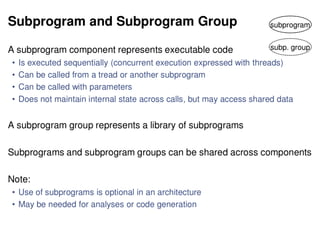
• Subprogram : a sequential
execution flow. Associated to a
source code (C, Java) or a model
(Simulink)
• Thread group : hierarchy of
threads
Software components
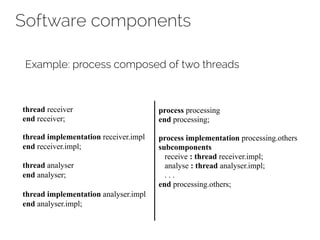
Example: process composed of two threads
thread receiver
end receiver;
thread implementation receiver.impl
end receiver.impl;
thread analyser
end analyser;
thread implementation analyser.impl
end analyser.impl;
process processing
end processing;
process implementation processing.others
subcomponents
receive : thread receiver.impl;
analyse : thread analyser.impl;
. . .
end processing.others;
Software components
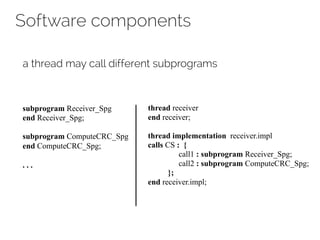
a thread may call different subprograms
thread receiver
end receiver;
thread implementation receiver.impl
calls CS : {
call1 : subprogram Receiver_Spg;
call2 : subprogram ComputeCRC_Spg;
};
end receiver.impl;
subprogram Receiver_Spg
end Receiver_Spg;
subprogram ComputeCRC_Spg
end ComputeCRC_Spg;
. . .
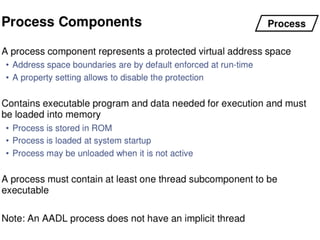
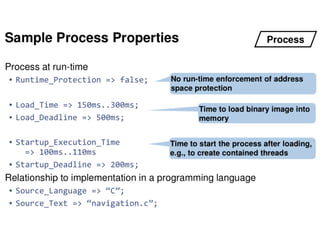
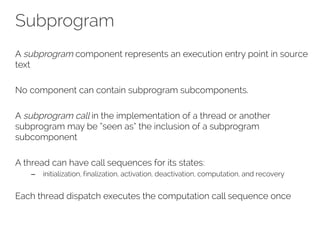
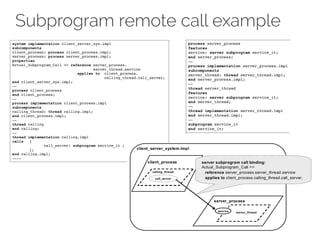
Subprogram
A subprogram component represents an execution entry point in source
text
No component can contain subprogram subcomponents.
A subprogram call in the implementation of a thread or another
subprogram may be “seen as” the inclusion of a subprogram
subcomponent
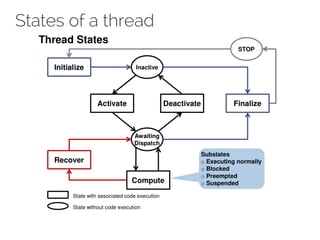
A thread can have call sequences for its states:
– initialization, finalization, activation, deactivation, computation, and recovery
Each thread dispatch executes the computation call sequence once
States of a thread
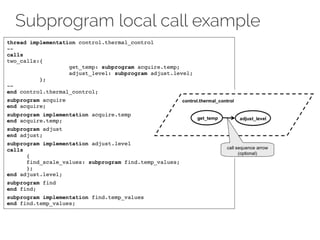
Subprogram local call example
Subprogram remote call example
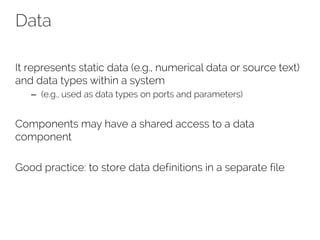
Data
It represents static data (e.g., numerical data or source text)
and data types within a system
– (e.g., used as data types on ports and parameters)
Components may have a shared access to a data
component
Good practice: to store data definitions in a separate file
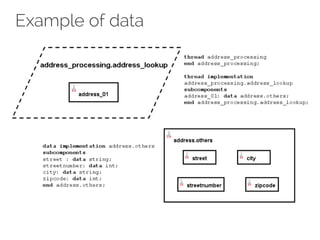
Example of data
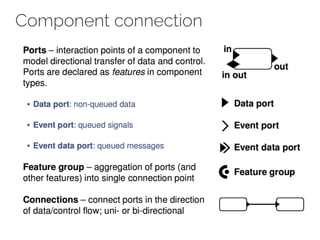
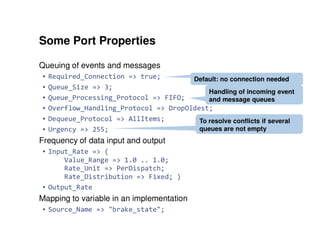
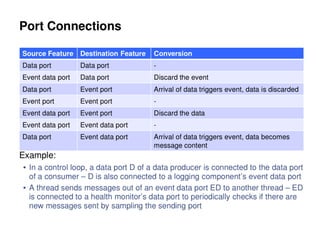
Component connection
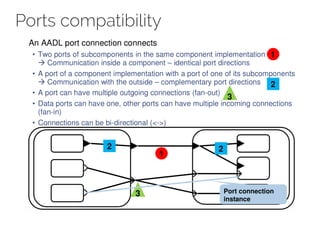
Ports compatibility
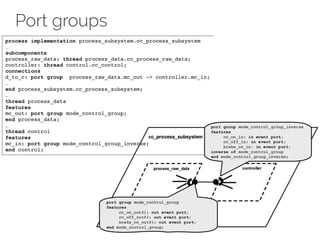
Port groups
Modes
A mode represents an operational state of a system
A mode of a component can influence:
– property values
– activation of specific subcomponents
– existence of connections
Example - Modes of a cruise controller:
{initialize, disengaged, engaged}
Modes transitions
Mode transitions represent configuration changes as reaction
to events
– Triggered through ports (from outside or from a subcomponent)
– Triggered internally by implementation software
– Triggered internally in an execution platform component or a
device
• Note: Modes are not intended for modeling detailed
internal behavior of threads or subprograms ( AADL
Behavior Annex)
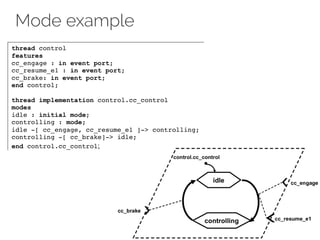
Mode example
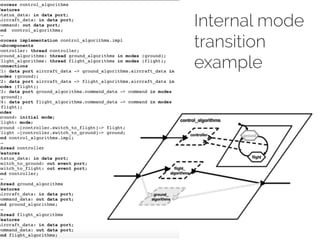
Internal mode
transition
example
Outline
1. AADL key modeling constructs
1. Software components
2. Execution platform components
3. Properties
4. Modelling large scale systems
2. Tool support
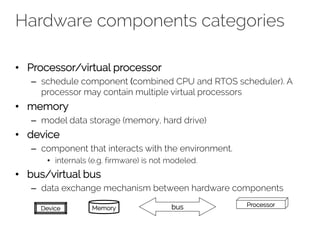
Hardware components categories
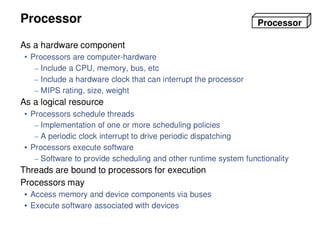
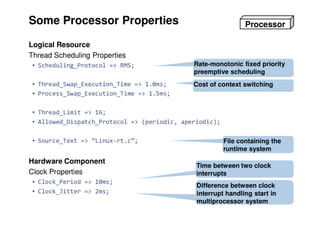
• Processor/virtual processor
– schedule component (combined CPU and RTOS scheduler). A
processor may contain multiple virtual processors
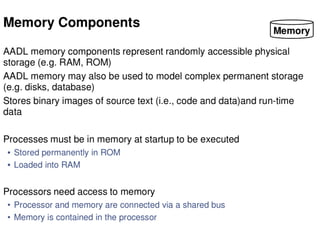
• memory
– model data storage (memory, hard drive)
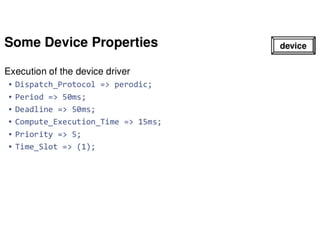
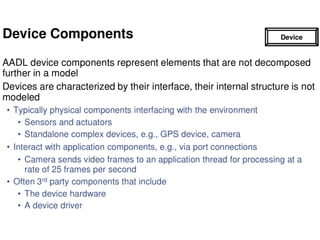
• device
– component that interacts with the environment.
• internals (e.g. firmware) is not modeled.
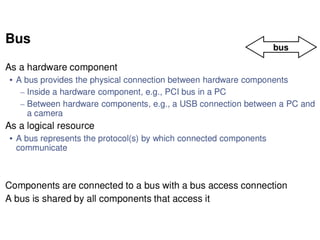
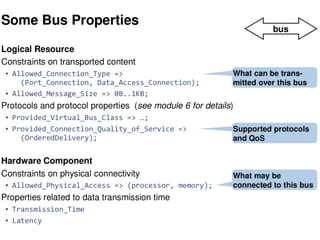
• bus/virtual bus
– data exchange mechanism between hardware components
Device Memory bus Processor
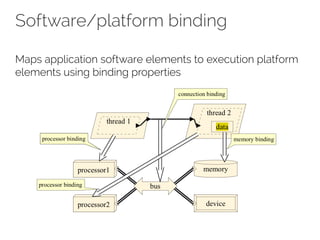
Software/platform binding
Maps application software elements to execution platform
elements using binding properties
Software/platform binding
• Actual_Processor_Binding
– Specify which processor schedules and executes a thread or
executes a (kernel mode) device driver
• Actual_Memory_Binding
– Specify the memory components in which executable code
(process components) and data (data component) reside
• Actual_Connection_Binding
– Specify the communication channels that are used by logical
connections (see next section)
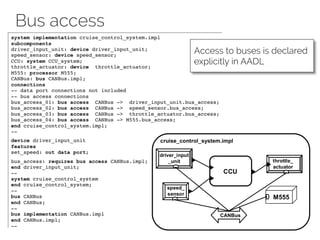
Bus access
Access to buses is declared
explicitly in AADL
Outline
1. AADL key modeling constructs
1. Software components
2. Execution platform components
3. Properties
4. Modelling large scale systems
2. Tool support
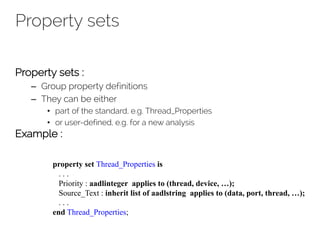
Property sets
Property sets :
– Group property definitions
– They can be either
• part of the standard, e.g. Thread_Properties
• or user-defined, e.g. for a new analysis
Example :
property set Thread_Properties is
. . .
Priority : aadlinteger applies to (thread, device, …);
Source_Text : inherit list of aadlstring applies to (data, port, thread, …);
. . .
end Thread_Properties;
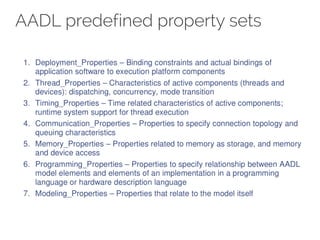
AADL predefined property sets
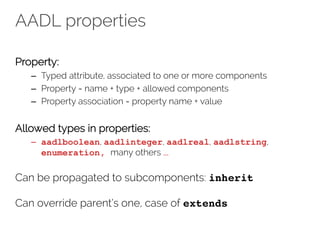
AADL properties
Property:
– Typed attribute, associated to one or more components
– Property = name + type + allowed components
– Property association = property name + value
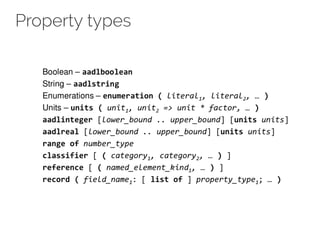
Allowed types in properties:
– aadlboolean, aadlinteger, aadlreal, aadlstring,
enumeration, many others …
Can be propagated to subcomponents: inherit
Can override parent’s one, case of extends
Property types
AADL properties
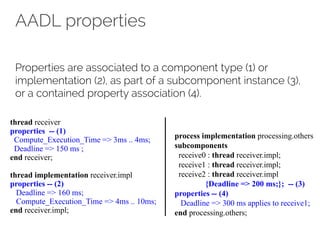
Properties are associated to a component type (1) or
implementation (2), as part of a subcomponent instance (3),
or a contained property association (4).
process implementation processing.others
subcomponents
receive0 : thread receiver.impl;
receive1 : thread receiver.impl;
receive2 : thread receiver.impl
{Deadline => 200 ms;}; -- (3)
properties -- (4)
Deadline => 300 ms applies to receive1;
end processing.others;
thread receiver
properties -- (1)
Compute_Execution_Time => 3ms .. 4ms;
Deadline => 150 ms ;
end receiver;
thread implementation receiver.impl
properties -- (2)
Deadline => 160 ms;
Compute_Execution_Time => 4ms .. 10ms;
end receiver.impl;
Measurement units
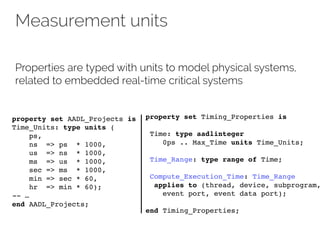
Properties are typed with units to model physical systems,
related to embedded real-time critical systems
property set AADL_Projects is
Time_Units: type units (
ps,
ns => ps * 1000,
us => ns * 1000,
ms => us * 1000,
sec => ms * 1000,
min => sec * 60,
hr => min * 60);
-- …
end AADL_Projects;
property set Timing_Properties is
Time: type aadlinteger
0ps .. Max_Time units Time_Units;
Time_Range: type range of Time;
Compute_Execution_Time: Time_Range
applies to (thread, device, subprogram,
event port, event data port);
end Timing_Properties;
Outline
1. AADL key modeling constructs
1. Software components
2. Execution platform components
3. Properties
4. Modelling large scale systems
2. Tool support
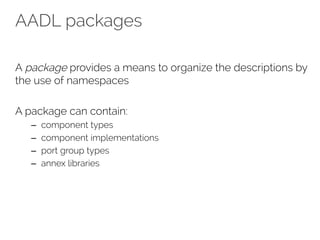
AADL packages
A package provides a means to organize the descriptions by
the use of namespaces
A package can contain:
– component types
– component implementations
– port group types
– annex libraries
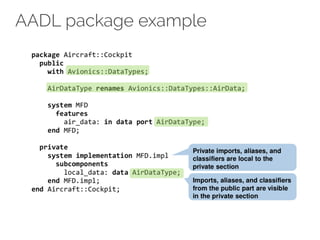
AADL package example
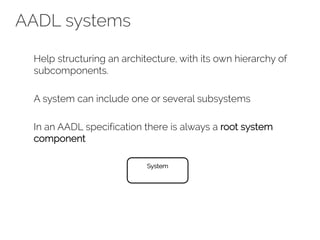
AADL systems
Help structuring an architecture, with its own hierarchy of
subcomponents.
A system can include one or several subsystems
In an AADL specification there is always a root system
component
System
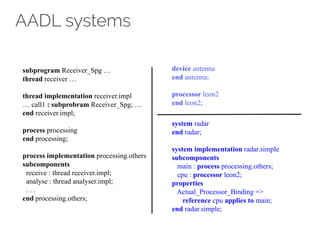
subprogram Receiver_Spg …
thread receiver …
thread implementation receiver.impl
… call1 : subprobram Receiver_Spg; …
end receiver.impl;
process processing
end processing;
process implementation processing.others
subcomponents
receive : thread receiver.impl;
analyse : thread analyser.impl;
. . .
end processing.others;
AADL systems
system radar
end radar;
system implementation radar.simple
subcomponents
main : process processing.others;
cpu : processor leon2;
properties
Actual_Processor_Binding =>
reference cpu applies to main;
end radar.simple;
device antenna
end antenna;
processor leon2
end leon2;
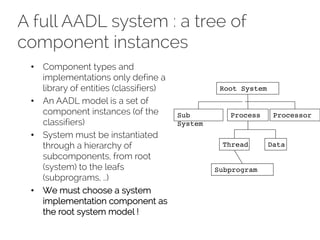
A full AADL system : a tree of
component instances
• Component types and
implementations only define a
library of entities (classifiers)
• An AADL model is a set of
component instances (of the
classifiers)
• System must be instantiated
through a hierarchy of
subcomponents, from root
(system) to the leafs
(subprograms, ..)
• We must choose a system
implementation component as
the root system model !
Root System
Sub
System
Process Processor
Thread Data
Subprogram
About subcomponents
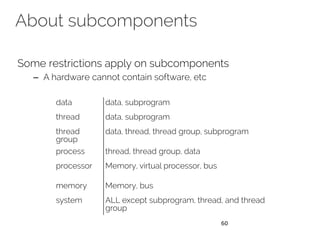
Some restrictions apply on subcomponents
– A hardware cannot contain software, etc
data data, subprogram
thread data, subprogram
thread
group
data, thread, thread group, subprogram
process thread, thread group, data
processor Memory, virtual processor, bus
memory Memory, bus
system ALL except subprogram, thread, and thread
group
60
System instances
Component types and implementations are “only” blueprints
A system instance represents the runtime architecture of an
operational physical system
Composed of software components + execution platform
XML for storing system instances
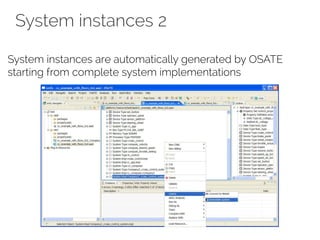
System instances 2
System instances are automatically generated by OSATE
starting from complete system implementations
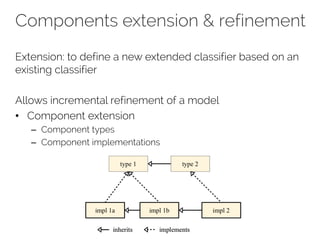
Components extension & refinement
Extension: to define a new extended classifier based on an
existing classifier
Allows incremental refinement of a model
• Component extension
– Component types
– Component implementations
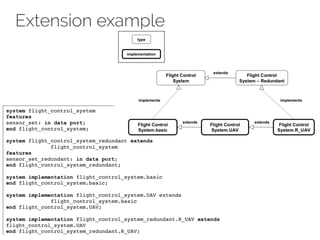
Extension example
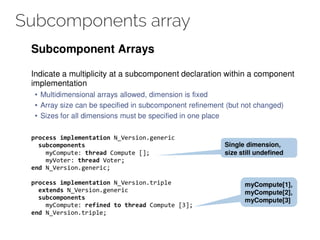
Subcomponents array
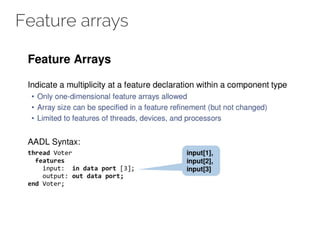
Feature arrays
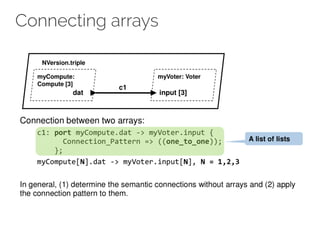
Connecting arrays
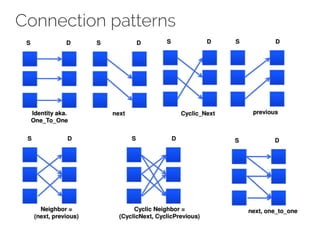
Connection patterns
Outline
1. AADL key modeling constructs
1. AADL components
2. Properties
3. Component connection
2. AADL: tool support
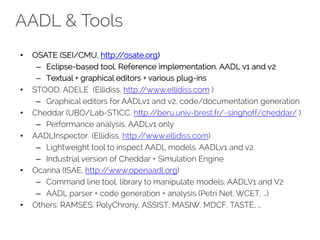
AADL & Tools
• OSATE (SEI/CMU, http://osate.org)
– Eclipse-based tool. Reference implementation. AADL v1 and v2
– Textual + graphical editors + various plug-ins
• STOOD, ADELE (Ellidiss, http://www.ellidiss.com )
– Graphical editors for AADLv1 and v2, code/documentation generation
• Cheddar (UBO/Lab-STICC, http://beru.univ-brest.fr/~singhoff/cheddar/ )
– Performance analysis, AADLv1 only
• AADLInspector (Ellidiss, http://www.ellidiss.com)
– Lightweight tool to inspect AADL models. AADLv1 and v2
– Industrial version of Cheddar + Simulation Engine
• Ocarina (ISAE, http://www.openaadl.org)
– Command line tool, library to manipulate models. AADLV1 and V2
– AADL parser + code generation + analysis (Petri Net, WCET, …)
• Others: RAMSES, PolyChrony, ASSIST, MASIW, MDCF, TASTE, …
Example
Example
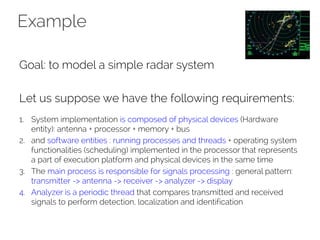
Goal: to model a simple radar system
Let us suppose we have the following requirements:
1. System implementation is composed of physical devices (Hardware
entity): antenna + processor + memory + bus
2. and software entities : running processes and threads + operating system
functionalities (scheduling) implemented in the processor that represents
a part of execution platform and physical devices in the same time
3. The main process is responsible for signals processing : general pattern:
transmitter -> antenna -> receiver -> analyzer -> display
4. Analyzer is a periodic thread that compares transmitted and received
signals to perform detection, localization and identification
Radar case study
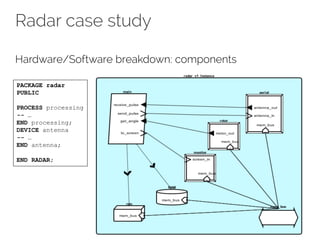
Hardware/Software breakdown: components
PACKAGE radar
PUBLIC
PROCESS processing
-- …
END processing;
DEVICE antenna
-- …
END antenna;
END RADAR;
Radar case study
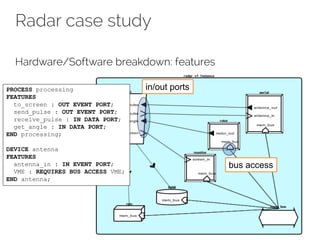
Hardware/Software breakdown: features
in/out ports
bus access
PROCESS processing
FEATURES
to_screen : OUT EVENT PORT;
send_pulse : OUT EVENT PORT;
receive_pulse : IN DATA PORT;
get_angle : IN DATA PORT;
END processing;
DEVICE antenna
FEATURES
antenna_in : IN EVENT PORT;
VME : REQUIRES BUS ACCESS VME;
END antenna;
Radar case study
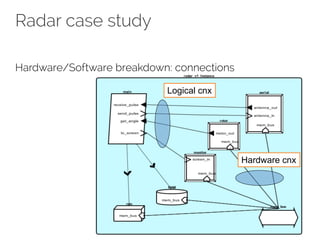
Hardware/Software breakdown: connections
Logical cnx
Hardware cnx
Radar case study
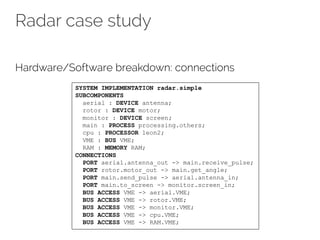
Hardware/Software breakdown: connections
SYSTEM IMPLEMENTATION radar.simple
SUBCOMPONENTS
aerial : DEVICE antenna;
rotor : DEVICE motor;
monitor : DEVICE screen;
main : PROCESS processing.others;
cpu : PROCESSOR leon2;
VME : BUS VME;
RAM : MEMORY RAM;
CONNECTIONS
PORT aerial.antenna_out -> main.receive_pulse;
PORT rotor.motor_out -> main.get_angle;
PORT main.send_pulse -> aerial.antenna_in;
PORT main.to_screen -> monitor.screen_in;
BUS ACCESS VME -> aerial.VME;
BUS ACCESS VME -> rotor.VME;
BUS ACCESS VME -> monitor.VME;
BUS ACCESS VME -> cpu.VME;
BUS ACCESS VME -> RAM.VME;
Radar case study
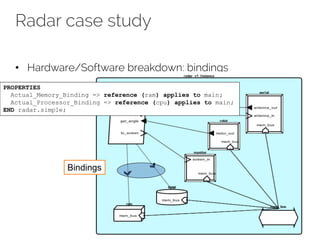
• Hardware/Software breakdown: bindings
Bindings
PROPERTIES
Actual_Memory_Binding => reference (ram) applies to main;
Actual_Processor_Binding => reference (cpu) applies to main;
END radar.simple;
Radar case study
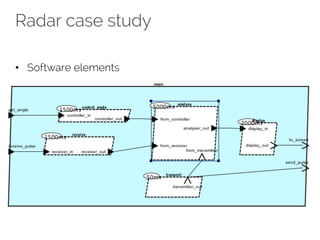
• Software elements
Radar case study
• Software elements
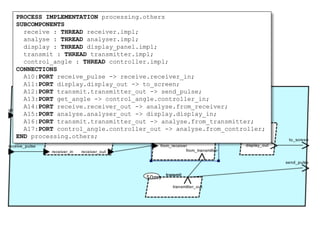
PROCESS IMPLEMENTATION processing.others
SUBCOMPONENTS
receive : THREAD receiver.impl;
analyse : THREAD analyser.impl;
display : THREAD display_panel.impl;
transmit : THREAD transmitter.impl;
control_angle : THREAD controller.impl;
CONNECTIONS
A10:PORT receive_pulse -> receive.receiver_in;
A11:PORT display.display_out -> to_screen;
A12:PORT transmit.transmitter_out -> send_pulse;
A13:PORT get_angle -> control_angle.controller_in;
A14:PORT receive.receiver_out -> analyse.from_receiver;
A15:PORT analyse.analyser_out -> display.display_in;
A16:PORT transmit.transmitter_out -> analyse.from_transmitter;
A17:PORT control_angle.controller_out -> analyse.from_controller;
END processing.others;
Radar case study
• Software elements
PROCESS IMPLEMENTATION processing.others
SUBCOMPONENTS
receive : THREAD receiver.impl;
analyse : THREAD analyser.impl;
display : THREAD display_panel.impl;
transmit : THREAD transmitter.impl;
control_angle : THREAD controller.impl;
CONNECTIONS
A10:PORT receive_pulse -> receive.receiver_in;
A11:PORT display.display_out -> to_screen;
A12:PORT transmit.transmitter_out -> send_pulse;
A13:PORT get_angle -> control_angle.controller_in;
A14:PORT receive.receiver_out -> analyse.from_receiver;
A15:PORT analyse.analyser_out -> display.display_in;
A16:PORT transmit.transmitter_out -> analyse.from_transmitter;
A17:PORT control_angle.controller_out -> analyse.from_controller;
END processing.others;
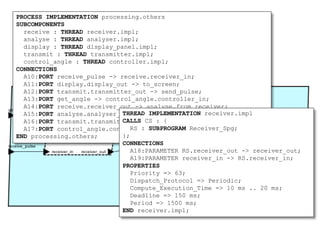
THREAD IMPLEMENTATION receiver.impl
CALLS CS : {
RS : SUBPROGRAM Receiver_Spg;
};
CONNECTIONS
A18:PARAMETER RS.receiver_out -> receiver_out;
A19:PARAMETER receiver_in -> RS.receiver_in;
PROPERTIES
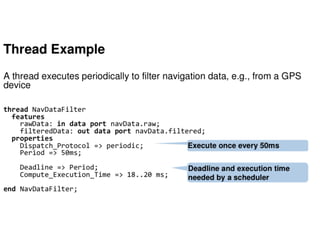
Priority => 63;
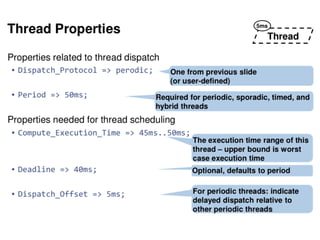
Dispatch_Protocol => Periodic;
Compute_Execution_Time => 10 ms .. 20 ms;
Deadline => 150 ms;
Period => 1500 ms;
END receiver.impl;
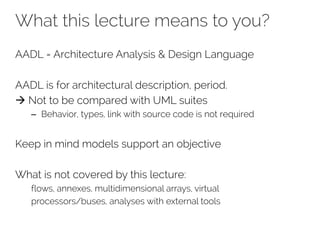
What this lecture means to you?
AADL = Architecture Analysis & Design Language
AADL is for architectural description, period.
à Not to be compared with UML suites
– Behavior, types, link with source code is not required
Keep in mind models support an objective
What is not covered by this lecture:
flows, annexes, multidimensional arrays, virtual
processors/buses, analyses with external tools
Suggested readings
1. The SAE Architecture Analysis & Design Language (AADL) Standard.
Peter H. Feiler, January 2008. [Introduction to the language]
2. The Architecture Analysis & Design Language (AADL): An
Introduction, Peter H. Feiler David P. Gluch John J. Hudak, February
2006. [Use this as reference manual]
3. OSATE plugin: SEI validation plugins. SEI. [AADL analysis in general]
4. Developing AADL Models for Control Systems: A Practitioner’s
Guide. John Hudak Peter Feiler. July 2007. [Flow latency analysis]
5. http://www.informit.com/articles/article.aspx?p=1959953
[Simple running example]
Links
Tool:
• http://osate.org
– examples have been tested on OSATE v2.2.1
Example projects (other than the ones on Schoology):
1. https://github.com/yoogx/AADLib
2. https://github.com/osate/examples
3. http://www.santoslab.org/pub/high-assurance/module-
aadl/slides/AADL-Isolette.pdf
Acknowledgements
Parts of this lecture have been elaborated from:
• AADLv2, a Domain Specific Language for the Modeling, the Analysis
and the Generation of Real-Time Embedded Systems. Frank Singhoff
and Jerome Hugues, MODELS 2014 tutorial.
• SAE AADL V2: An Overview. Peter Feiler. © 2010 Carnegie Mellon
University.
• Overview of AADL Syntax. J-P. Rosen, J-F. Tilman. AADL Workshop
2005.
Contact
Ivano Malavolta |
Assistant professor
Vrije Universiteit Amsterdam
iivanoo
i.malavolta@vu.nl
www.ivanomalavolta.com

[2017/2018] AADL - Architecture Analysis and Design Language

  • 1.
  • 2.
    Outline of thislecture • Part 1: Basics on AADLv2 core – Syntax, semantics of the language • Part 2: Example – The radar illustrative example
  • 3.
  • 4.
    Outline 1. AADL keymodeling constructs 1. Software components 2. Execution platform components 3. Properties 4. Modelling large scale systems 2. Tool support
  • 5.
  • 6.
  • 7.
  • 8.
    Three levels ofdescription • Category (predefined) • Type – specification of the external interface • Implementation – specification of the content • Instance – instantiation of a type or an implementation – you do not model it, it is created by the tool
  • 9.
    Software components categories •Process : address space. It must hold at least one thread • Thread : schedulable execution flow, Ada or VxWorks task, Java or POSIX thread. Executes programs • Data : data placeholder, e.g. C struct, C++ class, Ada record • Subprogram : a sequential execution flow. Associated to a source code (C, Java) or a model (Simulink) • Thread group : hierarchy of threads
  • 10.
    Software components Example: processcomposed of two threads thread receiver end receiver; thread implementation receiver.impl end receiver.impl; thread analyser end analyser; thread implementation analyser.impl end analyser.impl; process processing end processing; process implementation processing.others subcomponents receive : thread receiver.impl; analyse : thread analyser.impl; . . . end processing.others;
  • 11.
    Software components a threadmay call different subprograms thread receiver end receiver; thread implementation receiver.impl calls CS : { call1 : subprogram Receiver_Spg; call2 : subprogram ComputeCRC_Spg; }; end receiver.impl; subprogram Receiver_Spg end Receiver_Spg; subprogram ComputeCRC_Spg end ComputeCRC_Spg; . . .
  • 19.
    Subprogram A subprogram componentrepresents an execution entry point in source text No component can contain subprogram subcomponents. A subprogram call in the implementation of a thread or another subprogram may be “seen as” the inclusion of a subprogram subcomponent A thread can have call sequences for its states: – initialization, finalization, activation, deactivation, computation, and recovery Each thread dispatch executes the computation call sequence once
  • 20.
  • 21.
  • 22.
  • 23.
    Data It represents staticdata (e.g., numerical data or source text) and data types within a system – (e.g., used as data types on ports and parameters) Components may have a shared access to a data component Good practice: to store data definitions in a separate file
  • 24.
  • 25.
  • 28.
  • 29.
  • 30.
    Modes A mode representsan operational state of a system A mode of a component can influence: – property values – activation of specific subcomponents – existence of connections Example - Modes of a cruise controller: {initialize, disengaged, engaged}
  • 31.
    Modes transitions Mode transitionsrepresent configuration changes as reaction to events – Triggered through ports (from outside or from a subcomponent) – Triggered internally by implementation software – Triggered internally in an execution platform component or a device • Note: Modes are not intended for modeling detailed internal behavior of threads or subprograms ( AADL Behavior Annex)
  • 32.
  • 33.
  • 34.
    Outline 1. AADL keymodeling constructs 1. Software components 2. Execution platform components 3. Properties 4. Modelling large scale systems 2. Tool support
  • 35.
    Hardware components categories •Processor/virtual processor – schedule component (combined CPU and RTOS scheduler). A processor may contain multiple virtual processors • memory – model data storage (memory, hard drive) • device – component that interacts with the environment. • internals (e.g. firmware) is not modeled. • bus/virtual bus – data exchange mechanism between hardware components Device Memory bus Processor
  • 43.
    Software/platform binding Maps applicationsoftware elements to execution platform elements using binding properties
  • 44.
    Software/platform binding • Actual_Processor_Binding –Specify which processor schedules and executes a thread or executes a (kernel mode) device driver • Actual_Memory_Binding – Specify the memory components in which executable code (process components) and data (data component) reside • Actual_Connection_Binding – Specify the communication channels that are used by logical connections (see next section)
  • 45.
    Bus access Access tobuses is declared explicitly in AADL
  • 47.
    Outline 1. AADL keymodeling constructs 1. Software components 2. Execution platform components 3. Properties 4. Modelling large scale systems 2. Tool support
  • 48.
    Property sets Property sets: – Group property definitions – They can be either • part of the standard, e.g. Thread_Properties • or user-defined, e.g. for a new analysis Example : property set Thread_Properties is . . . Priority : aadlinteger applies to (thread, device, …); Source_Text : inherit list of aadlstring applies to (data, port, thread, …); . . . end Thread_Properties;
  • 49.
  • 50.
    AADL properties Property: – Typedattribute, associated to one or more components – Property = name + type + allowed components – Property association = property name + value Allowed types in properties: – aadlboolean, aadlinteger, aadlreal, aadlstring, enumeration, many others … Can be propagated to subcomponents: inherit Can override parent’s one, case of extends
  • 51.
  • 52.
    AADL properties Properties areassociated to a component type (1) or implementation (2), as part of a subcomponent instance (3), or a contained property association (4). process implementation processing.others subcomponents receive0 : thread receiver.impl; receive1 : thread receiver.impl; receive2 : thread receiver.impl {Deadline => 200 ms;}; -- (3) properties -- (4) Deadline => 300 ms applies to receive1; end processing.others; thread receiver properties -- (1) Compute_Execution_Time => 3ms .. 4ms; Deadline => 150 ms ; end receiver; thread implementation receiver.impl properties -- (2) Deadline => 160 ms; Compute_Execution_Time => 4ms .. 10ms; end receiver.impl;
  • 53.
    Measurement units Properties aretyped with units to model physical systems, related to embedded real-time critical systems property set AADL_Projects is Time_Units: type units ( ps, ns => ps * 1000, us => ns * 1000, ms => us * 1000, sec => ms * 1000, min => sec * 60, hr => min * 60); -- … end AADL_Projects; property set Timing_Properties is Time: type aadlinteger 0ps .. Max_Time units Time_Units; Time_Range: type range of Time; Compute_Execution_Time: Time_Range applies to (thread, device, subprogram, event port, event data port); end Timing_Properties;
  • 54.
    Outline 1. AADL keymodeling constructs 1. Software components 2. Execution platform components 3. Properties 4. Modelling large scale systems 2. Tool support
  • 55.
    AADL packages A packageprovides a means to organize the descriptions by the use of namespaces A package can contain: – component types – component implementations – port group types – annex libraries
  • 56.
  • 57.
    AADL systems Help structuringan architecture, with its own hierarchy of subcomponents. A system can include one or several subsystems In an AADL specification there is always a root system component System
  • 58.
    subprogram Receiver_Spg … threadreceiver … thread implementation receiver.impl … call1 : subprobram Receiver_Spg; … end receiver.impl; process processing end processing; process implementation processing.others subcomponents receive : thread receiver.impl; analyse : thread analyser.impl; . . . end processing.others; AADL systems system radar end radar; system implementation radar.simple subcomponents main : process processing.others; cpu : processor leon2; properties Actual_Processor_Binding => reference cpu applies to main; end radar.simple; device antenna end antenna; processor leon2 end leon2;
  • 59.
    A full AADLsystem : a tree of component instances • Component types and implementations only define a library of entities (classifiers) • An AADL model is a set of component instances (of the classifiers) • System must be instantiated through a hierarchy of subcomponents, from root (system) to the leafs (subprograms, ..) • We must choose a system implementation component as the root system model ! Root System Sub System Process Processor Thread Data Subprogram
  • 60.
    About subcomponents Some restrictionsapply on subcomponents – A hardware cannot contain software, etc data data, subprogram thread data, subprogram thread group data, thread, thread group, subprogram process thread, thread group, data processor Memory, virtual processor, bus memory Memory, bus system ALL except subprogram, thread, and thread group 60
  • 61.
    System instances Component typesand implementations are “only” blueprints A system instance represents the runtime architecture of an operational physical system Composed of software components + execution platform XML for storing system instances
  • 62.
    System instances 2 Systeminstances are automatically generated by OSATE starting from complete system implementations
  • 63.
    Components extension &refinement Extension: to define a new extended classifier based on an existing classifier Allows incremental refinement of a model • Component extension – Component types – Component implementations
  • 64.
  • 65.
  • 66.
  • 67.
  • 68.
  • 69.
    Outline 1. AADL keymodeling constructs 1. AADL components 2. Properties 3. Component connection 2. AADL: tool support
  • 70.
    AADL & Tools •OSATE (SEI/CMU, http://osate.org) – Eclipse-based tool. Reference implementation. AADL v1 and v2 – Textual + graphical editors + various plug-ins • STOOD, ADELE (Ellidiss, http://www.ellidiss.com ) – Graphical editors for AADLv1 and v2, code/documentation generation • Cheddar (UBO/Lab-STICC, http://beru.univ-brest.fr/~singhoff/cheddar/ ) – Performance analysis, AADLv1 only • AADLInspector (Ellidiss, http://www.ellidiss.com) – Lightweight tool to inspect AADL models. AADLv1 and v2 – Industrial version of Cheddar + Simulation Engine • Ocarina (ISAE, http://www.openaadl.org) – Command line tool, library to manipulate models. AADLV1 and V2 – AADL parser + code generation + analysis (Petri Net, WCET, …) • Others: RAMSES, PolyChrony, ASSIST, MASIW, MDCF, TASTE, …
  • 71.
  • 72.
    Example Goal: to modela simple radar system Let us suppose we have the following requirements: 1. System implementation is composed of physical devices (Hardware entity): antenna + processor + memory + bus 2. and software entities : running processes and threads + operating system functionalities (scheduling) implemented in the processor that represents a part of execution platform and physical devices in the same time 3. The main process is responsible for signals processing : general pattern: transmitter -> antenna -> receiver -> analyzer -> display 4. Analyzer is a periodic thread that compares transmitted and received signals to perform detection, localization and identification
  • 73.
    Radar case study Hardware/Softwarebreakdown: components PACKAGE radar PUBLIC PROCESS processing -- … END processing; DEVICE antenna -- … END antenna; END RADAR;
  • 74.
    Radar case study Hardware/Softwarebreakdown: features in/out ports bus access PROCESS processing FEATURES to_screen : OUT EVENT PORT; send_pulse : OUT EVENT PORT; receive_pulse : IN DATA PORT; get_angle : IN DATA PORT; END processing; DEVICE antenna FEATURES antenna_in : IN EVENT PORT; VME : REQUIRES BUS ACCESS VME; END antenna;
  • 75.
    Radar case study Hardware/Softwarebreakdown: connections Logical cnx Hardware cnx
  • 76.
    Radar case study Hardware/Softwarebreakdown: connections SYSTEM IMPLEMENTATION radar.simple SUBCOMPONENTS aerial : DEVICE antenna; rotor : DEVICE motor; monitor : DEVICE screen; main : PROCESS processing.others; cpu : PROCESSOR leon2; VME : BUS VME; RAM : MEMORY RAM; CONNECTIONS PORT aerial.antenna_out -> main.receive_pulse; PORT rotor.motor_out -> main.get_angle; PORT main.send_pulse -> aerial.antenna_in; PORT main.to_screen -> monitor.screen_in; BUS ACCESS VME -> aerial.VME; BUS ACCESS VME -> rotor.VME; BUS ACCESS VME -> monitor.VME; BUS ACCESS VME -> cpu.VME; BUS ACCESS VME -> RAM.VME;
  • 77.
    Radar case study •Hardware/Software breakdown: bindings Bindings PROPERTIES Actual_Memory_Binding => reference (ram) applies to main; Actual_Processor_Binding => reference (cpu) applies to main; END radar.simple;
  • 78.
    Radar case study •Software elements
  • 79.
    Radar case study •Software elements PROCESS IMPLEMENTATION processing.others SUBCOMPONENTS receive : THREAD receiver.impl; analyse : THREAD analyser.impl; display : THREAD display_panel.impl; transmit : THREAD transmitter.impl; control_angle : THREAD controller.impl; CONNECTIONS A10:PORT receive_pulse -> receive.receiver_in; A11:PORT display.display_out -> to_screen; A12:PORT transmit.transmitter_out -> send_pulse; A13:PORT get_angle -> control_angle.controller_in; A14:PORT receive.receiver_out -> analyse.from_receiver; A15:PORT analyse.analyser_out -> display.display_in; A16:PORT transmit.transmitter_out -> analyse.from_transmitter; A17:PORT control_angle.controller_out -> analyse.from_controller; END processing.others;
  • 80.
    Radar case study •Software elements PROCESS IMPLEMENTATION processing.others SUBCOMPONENTS receive : THREAD receiver.impl; analyse : THREAD analyser.impl; display : THREAD display_panel.impl; transmit : THREAD transmitter.impl; control_angle : THREAD controller.impl; CONNECTIONS A10:PORT receive_pulse -> receive.receiver_in; A11:PORT display.display_out -> to_screen; A12:PORT transmit.transmitter_out -> send_pulse; A13:PORT get_angle -> control_angle.controller_in; A14:PORT receive.receiver_out -> analyse.from_receiver; A15:PORT analyse.analyser_out -> display.display_in; A16:PORT transmit.transmitter_out -> analyse.from_transmitter; A17:PORT control_angle.controller_out -> analyse.from_controller; END processing.others; THREAD IMPLEMENTATION receiver.impl CALLS CS : { RS : SUBPROGRAM Receiver_Spg; }; CONNECTIONS A18:PARAMETER RS.receiver_out -> receiver_out; A19:PARAMETER receiver_in -> RS.receiver_in; PROPERTIES Priority => 63; Dispatch_Protocol => Periodic; Compute_Execution_Time => 10 ms .. 20 ms; Deadline => 150 ms; Period => 1500 ms; END receiver.impl;
  • 81.
    What this lecturemeans to you? AADL = Architecture Analysis & Design Language AADL is for architectural description, period. à Not to be compared with UML suites – Behavior, types, link with source code is not required Keep in mind models support an objective What is not covered by this lecture: flows, annexes, multidimensional arrays, virtual processors/buses, analyses with external tools
  • 82.
    Suggested readings 1. TheSAE Architecture Analysis & Design Language (AADL) Standard. Peter H. Feiler, January 2008. [Introduction to the language] 2. The Architecture Analysis & Design Language (AADL): An Introduction, Peter H. Feiler David P. Gluch John J. Hudak, February 2006. [Use this as reference manual] 3. OSATE plugin: SEI validation plugins. SEI. [AADL analysis in general] 4. Developing AADL Models for Control Systems: A Practitioner’s Guide. John Hudak Peter Feiler. July 2007. [Flow latency analysis] 5. http://www.informit.com/articles/article.aspx?p=1959953 [Simple running example]
  • 83.
    Links Tool: • http://osate.org – exampleshave been tested on OSATE v2.2.1 Example projects (other than the ones on Schoology): 1. https://github.com/yoogx/AADLib 2. https://github.com/osate/examples 3. http://www.santoslab.org/pub/high-assurance/module- aadl/slides/AADL-Isolette.pdf
  • 84.
    Acknowledgements Parts of thislecture have been elaborated from: • AADLv2, a Domain Specific Language for the Modeling, the Analysis and the Generation of Real-Time Embedded Systems. Frank Singhoff and Jerome Hugues, MODELS 2014 tutorial. • SAE AADL V2: An Overview. Peter Feiler. © 2010 Carnegie Mellon University. • Overview of AADL Syntax. J-P. Rosen, J-F. Tilman. AADL Workshop 2005.
  • 85.
    Contact Ivano Malavolta | Assistantprofessor Vrije Universiteit Amsterdam iivanoo i.malavolta@vu.nl www.ivanomalavolta.com