Metacognition: Thinking
About Thinking
Chapter 2
Lesson 1: Metacognition and
Metacognitive Knowledge
Learning objectives:
● Explain metacognition and metacognitive
knowledge;
● Determine metacognitive knowledge required in
a specific competency;
● Apply concepts learned in assessing work and
outputs
Metacognition I am sure
my answer
is correct
Am I
understanding
the message
the author has
written?
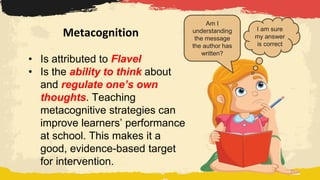
• Is attributed to Flavel
• Is the ability to think about
and regulate one’s own
thoughts. Teaching
metacognitive strategies can
improve learners’ performance
at school. This makes it a
good, evidence-based target
for intervention.
Metacognition I am sure
my
answer is
correct
Am I
understanding
the message
the author has
written?
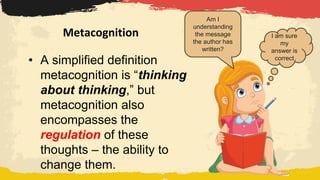
• A simplified definition
metacognition is “thinking
about thinking,” but
metacognition also
encompasses the
regulation of these
thoughts – the ability to
change them.
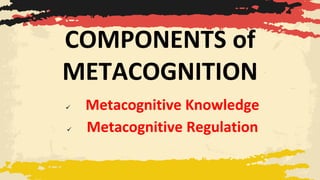
COMPONENTS of
METACOGNITION
✓ Metacognitive Knowledge
✓ Metacognitive Regulation
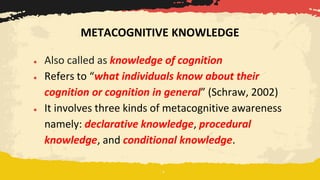
● Also called as knowledge of cognition
● Refers to “what individuals know about their
cognition or cognition in general” (Schraw, 2002)
● It involves three kinds of metacognitive awareness
namely: declarative knowledge, procedural
knowledge, and conditional knowledge.
METACOGNITIVE KNOWLEDGE
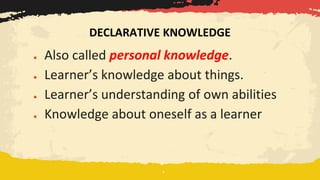
● Also called personal knowledge.
● Learner’s knowledge about things.
● Learner’s understanding of own abilities
● Knowledge about oneself as a learner
DECLARATIVE KNOWLEDGE
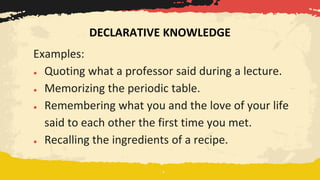
Examples:
● Quoting what a professor said during a lecture.
● Memorizing the periodic table.
● Remembering what you and the love of your life
said to each other the first time you met.
● Recalling the ingredients of a recipe.
DECLARATIVE KNOWLEDGE
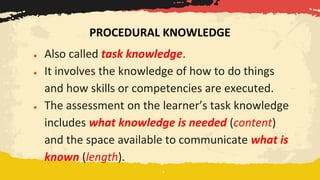
● Also called task knowledge.
● It involves the knowledge of how to do things
and how skills or competencies are executed.
● The assessment on the learner’s task knowledge
includes what knowledge is needed (content)
and the space available to communicate what is
known (length).
PROCEDURAL KNOWLEDGE
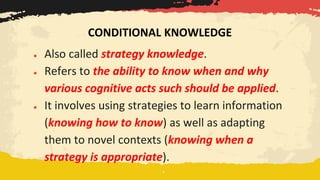
● Also called strategy knowledge.
● Refers to the ability to know when and why
various cognitive acts such should be applied.
● It involves using strategies to learn information
(knowing how to know) as well as adapting
them to novel contexts (knowing when a
strategy is appropriate).
CONDITIONAL KNOWLEDGE
● Metacognitive knowledge is the result of an
individual’s metacognitive experiences.
● Metacognitive experiences are experiences that
“an individual has through which knowledge is
attained, or through regulation occurs” (Flavell,
1979)
● Similarly, metacognitive knowledge depends so
much on the learner’s metamemory.
● Metamemory is the knowledge of what memory
is, how it works, and how to remember things.
● Through instruction and individual effort,
metamemory develops over time.
Identify if the following thoughts are more declarative,
procedural, or conditional knowledge.
1. I know that the context of this problem is not suited to the
theory.
2. There are three ways to solve this problem.
3. Mount Kanlaon erupted last June 3, 2024.
4. ROYGBIV makes it easy for me to remember the colors of the
rainbow.
5. This is an irregular verb, thus adding –ed to the word to make
it past tense does not apply.
● Metacognition is one’s awareness of his or her thinking and
the ability to control it while processing a task.
● It involves metacognitive knowledge, which comprises by:
declarative (knowledge about things), procedural (knowledge
of processes), and conditional knowledge (knowledge of what
is appropriate for the context or situation.
● These components of knowledge are influenced by
metacognitive experiences and metamemory.
In Summary
Lesson 2: Metacognitive
Regulation and Control
Learning objectives:
● Explain the meaning of metacognitive regulation;
● Determine dominant approach in learning and studying;
● Analyze the relationship among the three metacognitive
processes;
● Operationalize metacognitive processes in a given
situation or context.
● Metacognitive regulation is the second component of
metacognition.
● While metacognitive knowledge refers to the learners’ knowledge
or beliefs about the factors that affect cognitive skills.
● Metacognitive regulation pertains to the ability of the learners to
track of (monitor) and assess their knowledge or learning.
● It includes their ability to find out what, when, and how to use a
particular skill for a given task.
● Self-regulation is essential in metacognition.
METACOGNITIVE REGULATION
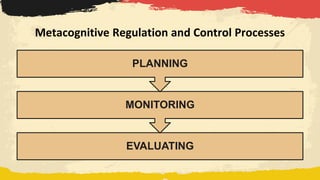
Metacognitive Regulation and Control Processes
EVALUATING
MONITORING
PLANNING
● Involves the selection of appropriate strategies and the
allocation of resources that affect performance (Schraw,
2002).
● Together with setting goals, planning is considered a
central part of students’ ability to control their learning
processes and to learn outcomes through deliberate
self-regulatory decisions and actions.
PLANNING
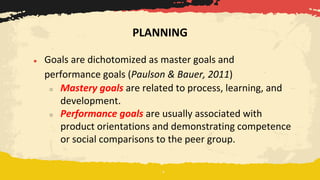
● Goals are dichotomized as master goals and
performance goals (Paulson & Bauer, 2011)
○ Mastery goals are related to process, learning, and
development.
○ Performance goals are usually associated with
product orientations and demonstrating competence
or social comparisons to the peer group.
PLANNING
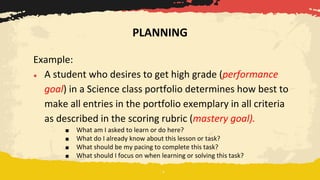
Example:
● A student who desires to get high grade (performance
goal) in a Science class portfolio determines how best to
make all entries in the portfolio exemplary in all criteria
as described in the scoring rubric (mastery goal).
■ What am I asked to learn or do here?
■ What do I already know about this lesson or task?
■ What should be my pacing to complete this task?
■ What should I focus on when learning or solving this task?
PLANNING
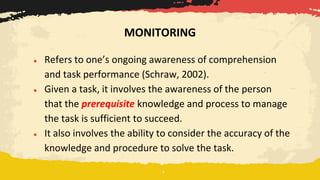
● Refers to one’s ongoing awareness of comprehension
and task performance (Schraw, 2002).
● Given a task, it involves the awareness of the person
that the prerequisite knowledge and process to manage
the task is sufficient to succeed.
● It also involves the ability to consider the accuracy of the
knowledge and procedure to solve the task.
MONITORING
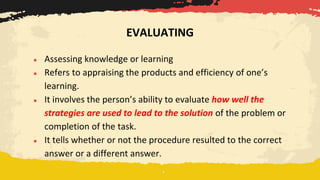
● Assessing knowledge or learning
● Refers to appraising the products and efficiency of one’s
learning.
● It involves the person’s ability to evaluate how well the
strategies are used to lead to the solution of the problem or
completion of the task.
● It tells whether or not the procedure resulted to the correct
answer or a different answer.
EVALUATING
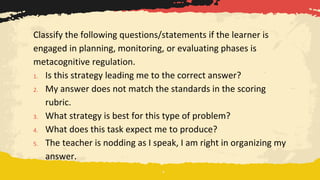
Classify the following questions/statements if the learner is
engaged in planning, monitoring, or evaluating phases is
metacognitive regulation.
1. Is this strategy leading me to the correct answer?
2. My answer does not match the standards in the scoring
rubric.
3. What strategy is best for this type of problem?
4. What does this task expect me to produce?
5. The teacher is nodding as I speak, I am right in organizing my
answer.
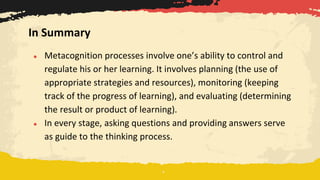
● Metacognition processes involve one’s ability to control and
regulate his or her learning. It involves planning (the use of
appropriate strategies and resources), monitoring (keeping
track of the progress of learning), and evaluating (determining
the result or product of learning).
● In every stage, asking questions and providing answers serve
as guide to the thinking process.
In Summary
Lesson 3: Metacognitive
Instruction
Learning objectives:
● Identify metacognitive strategies for a particular
lesson; and
● Operationalize metacognitive processes in a
given situation/context.
● Metacognitive strategies facilitates how learners learn.
● According to studies, metacognitive teaching practices
enhance the learners’ capabilities to transfer their
competencies in learning new tasks in new contexts
(Palinscar & Brown, 1984; Schoenfeld, 1991)
● Metacognitive teaching practices make learners aware
of their strengths and weaknesses as they learn.
METACOGNITIVE STRATEGIES
● Graphic organizers
● Think aloud
● Journalizing
● Error analysis
● Wrapper
● Peer Mentoring
METACOGNITIVE TEACHING STRATEGIES:
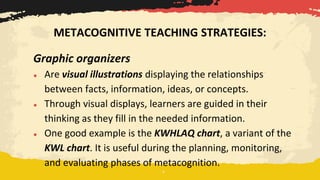
Graphic organizers
● Are visual illustrations displaying the relationships
between facts, information, ideas, or concepts.
● Through visual displays, learners are guided in their
thinking as they fill in the needed information.
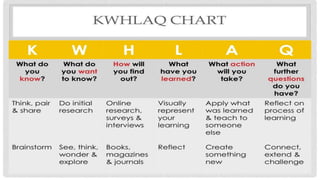
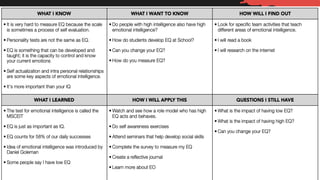
● One good example is the KWHLAQ chart, a variant of the
KWL chart. It is useful during the planning, monitoring,
and evaluating phases of metacognition.
METACOGNITIVE TEACHING STRATEGIES:
Think aloud
● Helps learners to think aloud about their thinking as they
undertake a task.
● The learners report their thoughts while they do it.
● With the help of a more knowledgeable learner, the errors
in thinking and the inadequacy of declarative, procedural,
and conditional knowledge can be pointed out, giving the
learner increased self-awareness during learning.
METACOGNITIVE TEACHING STRATEGIES:
Journalizing
● Can be used together with think aloud.
● In a journal, learners write what was in their mind when
they selected an answer and the reasons for their choice.
Later, they will write about their realizations where they
were wrong and what should have been considered in
answering. Finally, they resolve on what to do the next
time a similar situation/problem arises.
METACOGNITIVE TEACHING STRATEGIES:
Error analysis
● Is a “systematic approach for using feedback
metacognitively to improve one’s future performance”
(Hopeman, 2002).
● Asking the learners where they are correct and wrong
provides avenues for them to evaluate their thinking.
● It results in a learner’s metacognitive knowledge of own
mistakes and making use of them to improve future
performance.
METACOGNITIVE TEACHING STRATEGIES:
Wrapper
● Is an activity that fosters learners’ metacognition before,
during, and after a class.
● In a reading class, before the selection is read, the teacher
asks about the theme of the selection based on the story
title. While reading the selection, learners are asked if their
assumptions were true. After reading, the learners are
asked what made them comprehend or not comprehend
the story.
METACOGNITIVE TEACHING STRATEGIES:
Peer Mentoring
● Is a proven metacognitive strategy as many learners learn
best when studying with peers who are more informed
and skilled than them.
● Novice learners, by observing their more skilled peers, can
learn from the metacognitive strategies of their peer
mentors.
● The use of cooperative learning strategies is helpful
towards this goal.
METACOGNITIVE TEACHING STRATEGIES:
Metacognitive knowledge includes
the ability to identify what we do
and do not know, metacognitive
regulation involves the actions we
take in order to learn.
1. To process their thinking, Mr. Santos asks learners who failed to
get the answer correctly to identify the reason how and why they
went wrong.
2. Mr. Valdez groups his learners into two, with each member
inquiring how the other has arrived at the measures to combat air
pollution.
3. Miss Cordero assigns the EPP learners to reflect on the learnings in
class, and what these meant to them as a member of the family.
Identify the metacognitive teaching strategy used
based on the description given.
4. Mrs. Mercado asks Mathematics learners, “Give me one
significant lesson you derived from this lesson.
5. At the beginning of the Social Studies class, Miss Dizon uses
a matrix to elicit learners’ prior knowledge about the topic
for discussion.
Identify the metacognitive teaching strategy used
based on the description given.
Slidesgo
Flaticon Freepik
CREDITS: This presentation template was created by Slidesgo, and includes
icons by Flaticon, and infographics & images by Freepik
Thanks!

Chapter 2 - Facilitating Learner-Centered Teaching

  • 1.
  • 2.
    Lesson 1: Metacognitionand Metacognitive Knowledge
  • 3.
    Learning objectives: ● Explainmetacognition and metacognitive knowledge; ● Determine metacognitive knowledge required in a specific competency; ● Apply concepts learned in assessing work and outputs
  • 4.
    Metacognition I amsure my answer is correct Am I understanding the message the author has written? • Is attributed to Flavel • Is the ability to think about and regulate one’s own thoughts. Teaching metacognitive strategies can improve learners’ performance at school. This makes it a good, evidence-based target for intervention.
  • 5.
    Metacognition I amsure my answer is correct Am I understanding the message the author has written? • A simplified definition metacognition is “thinking about thinking,” but metacognition also encompasses the regulation of these thoughts – the ability to change them.
  • 6.
    COMPONENTS of METACOGNITION ✓ MetacognitiveKnowledge ✓ Metacognitive Regulation
  • 7.
    ● Also calledas knowledge of cognition ● Refers to “what individuals know about their cognition or cognition in general” (Schraw, 2002) ● It involves three kinds of metacognitive awareness namely: declarative knowledge, procedural knowledge, and conditional knowledge. METACOGNITIVE KNOWLEDGE
  • 8.
    ● Also calledpersonal knowledge. ● Learner’s knowledge about things. ● Learner’s understanding of own abilities ● Knowledge about oneself as a learner DECLARATIVE KNOWLEDGE
  • 9.
    Examples: ● Quoting whata professor said during a lecture. ● Memorizing the periodic table. ● Remembering what you and the love of your life said to each other the first time you met. ● Recalling the ingredients of a recipe. DECLARATIVE KNOWLEDGE
  • 10.
    ● Also calledtask knowledge. ● It involves the knowledge of how to do things and how skills or competencies are executed. ● The assessment on the learner’s task knowledge includes what knowledge is needed (content) and the space available to communicate what is known (length). PROCEDURAL KNOWLEDGE
  • 11.
    ● Also calledstrategy knowledge. ● Refers to the ability to know when and why various cognitive acts such should be applied. ● It involves using strategies to learn information (knowing how to know) as well as adapting them to novel contexts (knowing when a strategy is appropriate). CONDITIONAL KNOWLEDGE
  • 12.
    ● Metacognitive knowledgeis the result of an individual’s metacognitive experiences. ● Metacognitive experiences are experiences that “an individual has through which knowledge is attained, or through regulation occurs” (Flavell, 1979)
  • 13.
    ● Similarly, metacognitiveknowledge depends so much on the learner’s metamemory. ● Metamemory is the knowledge of what memory is, how it works, and how to remember things. ● Through instruction and individual effort, metamemory develops over time.
  • 14.
    Identify if thefollowing thoughts are more declarative, procedural, or conditional knowledge. 1. I know that the context of this problem is not suited to the theory. 2. There are three ways to solve this problem. 3. Mount Kanlaon erupted last June 3, 2024. 4. ROYGBIV makes it easy for me to remember the colors of the rainbow. 5. This is an irregular verb, thus adding –ed to the word to make it past tense does not apply.
  • 15.
    ● Metacognition isone’s awareness of his or her thinking and the ability to control it while processing a task. ● It involves metacognitive knowledge, which comprises by: declarative (knowledge about things), procedural (knowledge of processes), and conditional knowledge (knowledge of what is appropriate for the context or situation. ● These components of knowledge are influenced by metacognitive experiences and metamemory. In Summary
  • 16.
  • 17.
    Learning objectives: ● Explainthe meaning of metacognitive regulation; ● Determine dominant approach in learning and studying; ● Analyze the relationship among the three metacognitive processes; ● Operationalize metacognitive processes in a given situation or context.
  • 18.
    ● Metacognitive regulationis the second component of metacognition. ● While metacognitive knowledge refers to the learners’ knowledge or beliefs about the factors that affect cognitive skills. ● Metacognitive regulation pertains to the ability of the learners to track of (monitor) and assess their knowledge or learning. ● It includes their ability to find out what, when, and how to use a particular skill for a given task. ● Self-regulation is essential in metacognition. METACOGNITIVE REGULATION
  • 19.
    Metacognitive Regulation andControl Processes EVALUATING MONITORING PLANNING
  • 20.
    ● Involves theselection of appropriate strategies and the allocation of resources that affect performance (Schraw, 2002). ● Together with setting goals, planning is considered a central part of students’ ability to control their learning processes and to learn outcomes through deliberate self-regulatory decisions and actions. PLANNING
  • 21.
    ● Goals aredichotomized as master goals and performance goals (Paulson & Bauer, 2011) ○ Mastery goals are related to process, learning, and development. ○ Performance goals are usually associated with product orientations and demonstrating competence or social comparisons to the peer group. PLANNING
  • 22.
    Example: ● A studentwho desires to get high grade (performance goal) in a Science class portfolio determines how best to make all entries in the portfolio exemplary in all criteria as described in the scoring rubric (mastery goal). ■ What am I asked to learn or do here? ■ What do I already know about this lesson or task? ■ What should be my pacing to complete this task? ■ What should I focus on when learning or solving this task? PLANNING
  • 23.
    ● Refers toone’s ongoing awareness of comprehension and task performance (Schraw, 2002). ● Given a task, it involves the awareness of the person that the prerequisite knowledge and process to manage the task is sufficient to succeed. ● It also involves the ability to consider the accuracy of the knowledge and procedure to solve the task. MONITORING
  • 24.
    ● Assessing knowledgeor learning ● Refers to appraising the products and efficiency of one’s learning. ● It involves the person’s ability to evaluate how well the strategies are used to lead to the solution of the problem or completion of the task. ● It tells whether or not the procedure resulted to the correct answer or a different answer. EVALUATING
  • 25.
    Classify the followingquestions/statements if the learner is engaged in planning, monitoring, or evaluating phases is metacognitive regulation. 1. Is this strategy leading me to the correct answer? 2. My answer does not match the standards in the scoring rubric. 3. What strategy is best for this type of problem? 4. What does this task expect me to produce? 5. The teacher is nodding as I speak, I am right in organizing my answer.
  • 26.
    ● Metacognition processesinvolve one’s ability to control and regulate his or her learning. It involves planning (the use of appropriate strategies and resources), monitoring (keeping track of the progress of learning), and evaluating (determining the result or product of learning). ● In every stage, asking questions and providing answers serve as guide to the thinking process. In Summary
  • 27.
  • 28.
    Learning objectives: ● Identifymetacognitive strategies for a particular lesson; and ● Operationalize metacognitive processes in a given situation/context.
  • 29.
    ● Metacognitive strategiesfacilitates how learners learn. ● According to studies, metacognitive teaching practices enhance the learners’ capabilities to transfer their competencies in learning new tasks in new contexts (Palinscar & Brown, 1984; Schoenfeld, 1991) ● Metacognitive teaching practices make learners aware of their strengths and weaknesses as they learn. METACOGNITIVE STRATEGIES
  • 30.
    ● Graphic organizers ●Think aloud ● Journalizing ● Error analysis ● Wrapper ● Peer Mentoring METACOGNITIVE TEACHING STRATEGIES:
  • 31.
    Graphic organizers ● Arevisual illustrations displaying the relationships between facts, information, ideas, or concepts. ● Through visual displays, learners are guided in their thinking as they fill in the needed information. ● One good example is the KWHLAQ chart, a variant of the KWL chart. It is useful during the planning, monitoring, and evaluating phases of metacognition. METACOGNITIVE TEACHING STRATEGIES:
  • 34.
    Think aloud ● Helpslearners to think aloud about their thinking as they undertake a task. ● The learners report their thoughts while they do it. ● With the help of a more knowledgeable learner, the errors in thinking and the inadequacy of declarative, procedural, and conditional knowledge can be pointed out, giving the learner increased self-awareness during learning. METACOGNITIVE TEACHING STRATEGIES:
  • 35.
    Journalizing ● Can beused together with think aloud. ● In a journal, learners write what was in their mind when they selected an answer and the reasons for their choice. Later, they will write about their realizations where they were wrong and what should have been considered in answering. Finally, they resolve on what to do the next time a similar situation/problem arises. METACOGNITIVE TEACHING STRATEGIES:
  • 36.
    Error analysis ● Isa “systematic approach for using feedback metacognitively to improve one’s future performance” (Hopeman, 2002). ● Asking the learners where they are correct and wrong provides avenues for them to evaluate their thinking. ● It results in a learner’s metacognitive knowledge of own mistakes and making use of them to improve future performance. METACOGNITIVE TEACHING STRATEGIES:
  • 37.
    Wrapper ● Is anactivity that fosters learners’ metacognition before, during, and after a class. ● In a reading class, before the selection is read, the teacher asks about the theme of the selection based on the story title. While reading the selection, learners are asked if their assumptions were true. After reading, the learners are asked what made them comprehend or not comprehend the story. METACOGNITIVE TEACHING STRATEGIES:
  • 38.
    Peer Mentoring ● Isa proven metacognitive strategy as many learners learn best when studying with peers who are more informed and skilled than them. ● Novice learners, by observing their more skilled peers, can learn from the metacognitive strategies of their peer mentors. ● The use of cooperative learning strategies is helpful towards this goal. METACOGNITIVE TEACHING STRATEGIES:
  • 39.
    Metacognitive knowledge includes theability to identify what we do and do not know, metacognitive regulation involves the actions we take in order to learn.
  • 40.
    1. To processtheir thinking, Mr. Santos asks learners who failed to get the answer correctly to identify the reason how and why they went wrong. 2. Mr. Valdez groups his learners into two, with each member inquiring how the other has arrived at the measures to combat air pollution. 3. Miss Cordero assigns the EPP learners to reflect on the learnings in class, and what these meant to them as a member of the family. Identify the metacognitive teaching strategy used based on the description given.
  • 41.
    4. Mrs. Mercadoasks Mathematics learners, “Give me one significant lesson you derived from this lesson. 5. At the beginning of the Social Studies class, Miss Dizon uses a matrix to elicit learners’ prior knowledge about the topic for discussion. Identify the metacognitive teaching strategy used based on the description given.
  • 42.
    Slidesgo Flaticon Freepik CREDITS: Thispresentation template was created by Slidesgo, and includes icons by Flaticon, and infographics & images by Freepik Thanks!