Module 1:
metacognition
FACILITATING LEARNER-CENTERED TEACHING
Learning outcomes:
•Explain metacognition in your own
words
•Apply metacognitive strategies in your
own quest for learning as a novice or an
expert learner
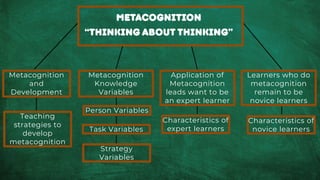
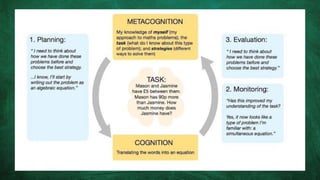
Metacognition
“thinking about thinking”
Metacognition
and
Development
Metacognition
Knowledge
Variables
Application of
Metacognition
leads want to be
an expert learner
Learners who do
metacognition
remain to be
novice learners
Teaching
strategies to
develop
metacognition
Person Variables
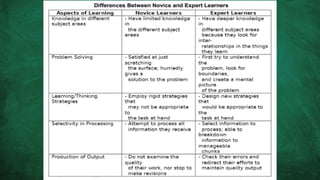
Task Variables
Characteristics of
expert learners
Strategy
Variables
Characteristics of
novice learners
“if you teach person what to learn,
you are preparing that person for
the past. If you teach a person how
to learn, you are preparing that
person for the future”
-Cyril Houle
The most important goal of education
is to teach students how to learn on
their own.
The term "metacognition" was coined
by John Flavell. According to Flavell
(1979, 1987), metacognition consists
of both metacognitive knowledge and
metacognitive experiences or
regulation.
Metacognitive Knowledge
• The learner’s knowledge of their
own cognitive abilities
• The learner’s knowledge of
particular tasks
• The learner’s knowledge of
different strategies that are
available to them and when they
are appropriate to the tak.
Metacognitive Experience or Regulation
• Refers to a person’s awareness and feelings
elicited in a problem-solving situation
(e.g., feelings of knowing), and
metacognitive skills are believed to play a
role in many types of cognitive activity
such as oral communication of
information , reading comprehension,
attention and memory.
METACOGNITION
• "thinking about thinking" or "learning how to learn“
• higher-order thinking which involves active awareness
and control over the cognitive processes engaged in
• Metacognitive knowledge refers to acquired knowledge
about cognitive processes, knowledge that can be used
to control cognitive processes
• Metacognitive knowledge has three categories:
knowledge of person variables, task variables, and
strategy variables
PERSON VARIABLES
• how one views himself as a learner and
thinker knowledge about
• how human beings learn and process
information, as well as individual
knowledge of one's own learning processes
EXAMPLE
PERSON VARIABLES
You may be aware that you study more effectively if
you study very early in the morning than late in the
evening, and that you work better in a quiet library
rather than at home where there are a lot of things
that make it hard for you to focus and concentrate
TASK VARIABLES
• knowledge about the nature of the task as
well as the type of processing demands that
it will place upon the individual
• knowing what exactly needs to be
accomplished, gauging its difficulty and
knowing the kind of effort it will demand
from you
EXAMPLES
TASK VARIABLES
You may be aware that it takes more time for
you to read and comprehend a book in
educational philosophy than it is for you to
read and comprehend a novel.
STRATEGY VARIABLES
• awareness of the strategy you are using to
learn a topic and evaluating whether this
strategy is effective
• Terms like meta-attention and meta-
memory are related to strategy variables
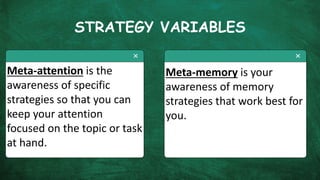
STRATEGY VARIABLES
Meta-attention is the
awareness of specific
strategies so that you can
keep your attention
focused on the topic or task
at hand.
Meta-memory is your
awareness of memory
strategies that work best for
you.
Omrod (2019)
includes the
following in the
practice of
metacognition:
Omrod (2019) includes
the following in the
practice of
metacognition:
• Knowing the limits of one's
own learning and memory
capacities
• Knowing what learning tasks
one can realistically
accomplish within a certain
amount of time
• Knowing which learning
strategies are effective and
which are not
• Planning an approach to a
learning task that is likely to
be successful
Omrod (2019) includes
the following in the
practice of
metacognition:
• Using effective learning
strategies to process and learn
new material
• Monitoring one's own knowledge
and comprehension. In other
words, knowing when information
has been successfully learned and
when it's not
• Using effective strategies for
retrieval of previously stored
information
• Knowledge is said to be
metacognitive if it is keenly used
in a purposeful manner to ensure
that a goal is met
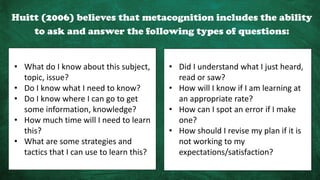
Huitt (2006) believes that metacognition includes the ability
to ask and answer the following types of questions:
• What do I know about this subject,
topic, issue?
• Do I know what I need to know?
• Do I know where I can go to get
some information, knowledge?
• How much time will I need to learn
this?
• What are some strategies and
tactics that I can use to learn this?
• Did I understand what I just heard,
read or saw?
• How will I know if I am learning at
an appropriate rate?
• How can I spot an error if I make
one?
• How should I revise my plan if it is
not working to my
expectations/satisfaction?
Metacognitive Strategies to Facilitate
Learning
• Metacognitive awareness was evident in
preschoolers and in students as young as eight years
old (Fang & Cox, n.d.)
• Children already have the capacity to be more aware
and reflective of their own learning not many have
been taught and encouraged to apply metacognition
Metacognitive Strategies to Facilitate
Learning
• Integrate more activities that would build your
students' capacity to reflect on their own
characteristics as learners (self-knowledge), the tasks
they are to do (task knowledge) and the strategies
that they can use to learn (strategic knowledge)
• Metacognition involves knowledge and skills which
you and your students can learn and master
Examples of teaching strategies to
develop metacognition
1. Have students monitor their own
learning and thinking. (Example: have a
student monitor a peer's
learning/thinking/behaving in dyad)
2. Teach students study or learning
strategies (TQLR and PQ4R) 1.
Examples of teaching strategies to
develop metacognition
TQLR — This can be taught to younger
students (primary grades). It is a
metacognitive strategy before listening to
a story or presentation.
Examples of teaching strategies to
develop metacognition
PQ4R —This is usually for older students in
the intermediate levels and onwards. This
strategy is used to study a unit or chapter.
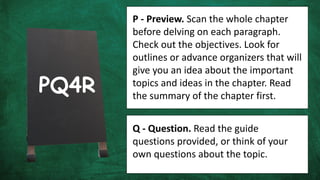
P - Preview. Scan the whole chapter
before delving on each paragraph.
Check out the objectives. Look for
outlines or advance organizers that will
give you an idea about the important
topics and ideas in the chapter. Read
the summary of the chapter first.
PQ4R
P - Preview. Scan the whole chapter
before delving on each paragraph.
Check out the objectives. Look for
outlines or advance organizers that will
give you an idea about the important
topics and ideas in the chapter. Read
the summary of the chapter first.
Q - Question. Read the guide
questions provided, or think of your
own questions about the topic.
PQ4R
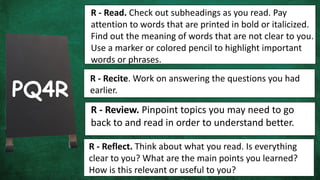
R - Read. Check out subheadings as you read. Pay
attention to words that are printed in bold or italicized.
Find out the meaning of words that are not clear to you.
Use a marker or colored pencil to highlight important
words or phrases.
R - Recite. Work on answering the questions you had
earlier.
PQ4R
R - Review. Pinpoint topics you may need to go
back to and read in order to understand better.
R - Reflect. Think about what you read. Is everything
clear to you? What are the main points you learned?
How is this relevant or useful to you?
Examples of teaching strategies to
develop metacognition
3. Have students make predictions about
information to be presented next based on
what they have read.
4. Have students relate ideas to existing
knowledge structures. (It is important to
have relevant knowledge structures well
learned.)
Examples of teaching strategies to
develop metacognition
5. Have students develop questions; ask questions of
themselves, about what's going on around them (Have
you asked a good question today?)
6. Help students to know when to ask for help. (He/she must
be able to self-monitor; require students to show how
they have attempted to deal with the problem of their
own.)
7. Show students how to transfer knowledge, attitudes,
values, skills to other situations or tasks.
Novice and Expert Learners
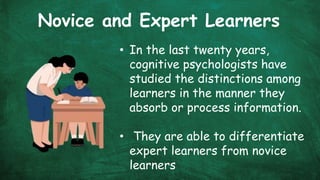
• In the last twenty years,
cognitive psychologists have
studied the distinctions among
learners in the manner they
absorb or process information.
• They are able to differentiate
expert learners from novice
learners
Novice and Expert Learners
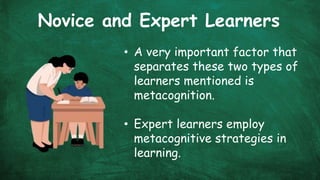
• A very important factor that
separates these two types of
learners mentioned is
metacognition.
• Expert learners employ
metacognitive strategies in
learning.
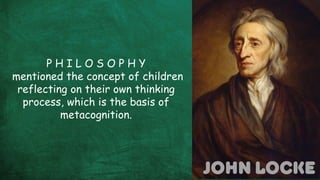
John locke
P H I L O S O P H Y
mentioned the concept of children
reflecting on their own thinking
process, which is the basis of
metacognition.
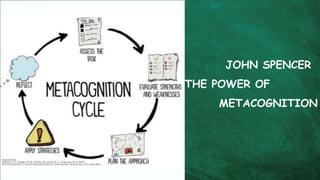
JOHN SPENCER
THE POWER OF
METACOGNITION
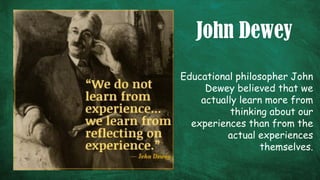
John Dewey
Educational philosopher John
Dewey believed that we
actually learn more from
thinking about our
experiences than from the
actual experiences
themselves.
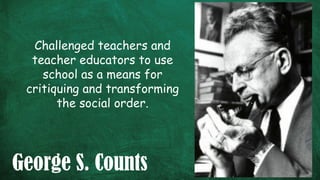
George S. Counts
Challenged teachers and
teacher educators to use
school as a means for
critiquing and transforming
the social order.
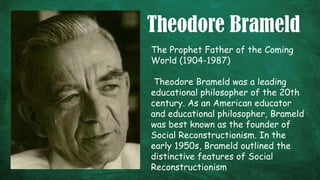
Theodore Brameld
The Prophet Father of the Coming
World (1904-1987)
Theodore Brameld was a leading
educational philosopher of the 20th
century. As an American educator
and educational philosopher, Brameld
was best known as the founder of
Social Reconstructionism. In the
early 1950s, Brameld outlined the
distinctive features of Social
Reconstructionism
FEATURES OF SOCIAL RECONSTRUCTIONISM
• believed in a commitment to building a new culture in which
the common people would emerge as the leaders of society.
• he felt that the working people should control all principal
institutions and resources if the world is to become
genuinely democratic.
• believed in a commitment to building a new culture in
which the common people would emerge as the leaders of
society.
• he felt that the working people should control all principal
institutions and resources if the world is to become
genuinely democratic.
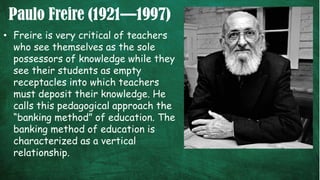
Paulo Freire (1921—1997)
• Freire is very critical of teachers
who see themselves as the sole
possessors of knowledge while they
see their students as empty
receptacles into which teachers
must deposit their knowledge. He
calls this pedagogical approach the
“banking method” of education. The
banking method of education is
characterized as a vertical
relationship.
Thank you
very much!

PPT-MODULE 1-METACOGNITION-ED7- BSESCIENCE .pdf

  • 1.
  • 2.
    Learning outcomes: •Explain metacognitionin your own words •Apply metacognitive strategies in your own quest for learning as a novice or an expert learner
  • 3.
    Metacognition “thinking about thinking” Metacognition and Development Metacognition Knowledge Variables Applicationof Metacognition leads want to be an expert learner Learners who do metacognition remain to be novice learners Teaching strategies to develop metacognition Person Variables Task Variables Characteristics of expert learners Strategy Variables Characteristics of novice learners
  • 4.
    “if you teachperson what to learn, you are preparing that person for the past. If you teach a person how to learn, you are preparing that person for the future” -Cyril Houle
  • 5.
    The most importantgoal of education is to teach students how to learn on their own.
  • 6.
    The term "metacognition"was coined by John Flavell. According to Flavell (1979, 1987), metacognition consists of both metacognitive knowledge and metacognitive experiences or regulation.
  • 7.
    Metacognitive Knowledge • Thelearner’s knowledge of their own cognitive abilities • The learner’s knowledge of particular tasks • The learner’s knowledge of different strategies that are available to them and when they are appropriate to the tak.
  • 8.
    Metacognitive Experience orRegulation • Refers to a person’s awareness and feelings elicited in a problem-solving situation (e.g., feelings of knowing), and metacognitive skills are believed to play a role in many types of cognitive activity such as oral communication of information , reading comprehension, attention and memory.
  • 9.
    METACOGNITION • "thinking aboutthinking" or "learning how to learn“ • higher-order thinking which involves active awareness and control over the cognitive processes engaged in • Metacognitive knowledge refers to acquired knowledge about cognitive processes, knowledge that can be used to control cognitive processes • Metacognitive knowledge has three categories: knowledge of person variables, task variables, and strategy variables
  • 10.
    PERSON VARIABLES • howone views himself as a learner and thinker knowledge about • how human beings learn and process information, as well as individual knowledge of one's own learning processes
  • 11.
    EXAMPLE PERSON VARIABLES You maybe aware that you study more effectively if you study very early in the morning than late in the evening, and that you work better in a quiet library rather than at home where there are a lot of things that make it hard for you to focus and concentrate
  • 12.
    TASK VARIABLES • knowledgeabout the nature of the task as well as the type of processing demands that it will place upon the individual • knowing what exactly needs to be accomplished, gauging its difficulty and knowing the kind of effort it will demand from you
  • 13.
    EXAMPLES TASK VARIABLES You maybe aware that it takes more time for you to read and comprehend a book in educational philosophy than it is for you to read and comprehend a novel.
  • 14.
    STRATEGY VARIABLES • awarenessof the strategy you are using to learn a topic and evaluating whether this strategy is effective • Terms like meta-attention and meta- memory are related to strategy variables
  • 15.
    STRATEGY VARIABLES Meta-attention isthe awareness of specific strategies so that you can keep your attention focused on the topic or task at hand. Meta-memory is your awareness of memory strategies that work best for you.
  • 16.
    Omrod (2019) includes the followingin the practice of metacognition:
  • 17.
    Omrod (2019) includes thefollowing in the practice of metacognition: • Knowing the limits of one's own learning and memory capacities • Knowing what learning tasks one can realistically accomplish within a certain amount of time • Knowing which learning strategies are effective and which are not • Planning an approach to a learning task that is likely to be successful
  • 18.
    Omrod (2019) includes thefollowing in the practice of metacognition: • Using effective learning strategies to process and learn new material • Monitoring one's own knowledge and comprehension. In other words, knowing when information has been successfully learned and when it's not • Using effective strategies for retrieval of previously stored information • Knowledge is said to be metacognitive if it is keenly used in a purposeful manner to ensure that a goal is met
  • 19.
    Huitt (2006) believesthat metacognition includes the ability to ask and answer the following types of questions: • What do I know about this subject, topic, issue? • Do I know what I need to know? • Do I know where I can go to get some information, knowledge? • How much time will I need to learn this? • What are some strategies and tactics that I can use to learn this? • Did I understand what I just heard, read or saw? • How will I know if I am learning at an appropriate rate? • How can I spot an error if I make one? • How should I revise my plan if it is not working to my expectations/satisfaction?
  • 20.
    Metacognitive Strategies toFacilitate Learning • Metacognitive awareness was evident in preschoolers and in students as young as eight years old (Fang & Cox, n.d.) • Children already have the capacity to be more aware and reflective of their own learning not many have been taught and encouraged to apply metacognition
  • 21.
    Metacognitive Strategies toFacilitate Learning • Integrate more activities that would build your students' capacity to reflect on their own characteristics as learners (self-knowledge), the tasks they are to do (task knowledge) and the strategies that they can use to learn (strategic knowledge) • Metacognition involves knowledge and skills which you and your students can learn and master
  • 22.
    Examples of teachingstrategies to develop metacognition 1. Have students monitor their own learning and thinking. (Example: have a student monitor a peer's learning/thinking/behaving in dyad) 2. Teach students study or learning strategies (TQLR and PQ4R) 1.
  • 23.
    Examples of teachingstrategies to develop metacognition TQLR — This can be taught to younger students (primary grades). It is a metacognitive strategy before listening to a story or presentation.
  • 24.
    Examples of teachingstrategies to develop metacognition PQ4R —This is usually for older students in the intermediate levels and onwards. This strategy is used to study a unit or chapter.
  • 25.
    P - Preview.Scan the whole chapter before delving on each paragraph. Check out the objectives. Look for outlines or advance organizers that will give you an idea about the important topics and ideas in the chapter. Read the summary of the chapter first. PQ4R
  • 26.
    P - Preview.Scan the whole chapter before delving on each paragraph. Check out the objectives. Look for outlines or advance organizers that will give you an idea about the important topics and ideas in the chapter. Read the summary of the chapter first. Q - Question. Read the guide questions provided, or think of your own questions about the topic. PQ4R
  • 27.
    R - Read.Check out subheadings as you read. Pay attention to words that are printed in bold or italicized. Find out the meaning of words that are not clear to you. Use a marker or colored pencil to highlight important words or phrases. R - Recite. Work on answering the questions you had earlier. PQ4R R - Review. Pinpoint topics you may need to go back to and read in order to understand better. R - Reflect. Think about what you read. Is everything clear to you? What are the main points you learned? How is this relevant or useful to you?
  • 28.
    Examples of teachingstrategies to develop metacognition 3. Have students make predictions about information to be presented next based on what they have read. 4. Have students relate ideas to existing knowledge structures. (It is important to have relevant knowledge structures well learned.)
  • 29.
    Examples of teachingstrategies to develop metacognition 5. Have students develop questions; ask questions of themselves, about what's going on around them (Have you asked a good question today?) 6. Help students to know when to ask for help. (He/she must be able to self-monitor; require students to show how they have attempted to deal with the problem of their own.) 7. Show students how to transfer knowledge, attitudes, values, skills to other situations or tasks.
  • 30.
    Novice and ExpertLearners • In the last twenty years, cognitive psychologists have studied the distinctions among learners in the manner they absorb or process information. • They are able to differentiate expert learners from novice learners
  • 31.
    Novice and ExpertLearners • A very important factor that separates these two types of learners mentioned is metacognition. • Expert learners employ metacognitive strategies in learning.
  • 33.
    John locke P HI L O S O P H Y mentioned the concept of children reflecting on their own thinking process, which is the basis of metacognition.
  • 34.
    JOHN SPENCER THE POWEROF METACOGNITION
  • 36.
    John Dewey Educational philosopherJohn Dewey believed that we actually learn more from thinking about our experiences than from the actual experiences themselves.
  • 37.
    George S. Counts Challengedteachers and teacher educators to use school as a means for critiquing and transforming the social order.
  • 38.
    Theodore Brameld The ProphetFather of the Coming World (1904-1987) Theodore Brameld was a leading educational philosopher of the 20th century. As an American educator and educational philosopher, Brameld was best known as the founder of Social Reconstructionism. In the early 1950s, Brameld outlined the distinctive features of Social Reconstructionism
  • 39.
    FEATURES OF SOCIALRECONSTRUCTIONISM • believed in a commitment to building a new culture in which the common people would emerge as the leaders of society. • he felt that the working people should control all principal institutions and resources if the world is to become genuinely democratic. • believed in a commitment to building a new culture in which the common people would emerge as the leaders of society. • he felt that the working people should control all principal institutions and resources if the world is to become genuinely democratic.
  • 40.
    Paulo Freire (1921—1997) •Freire is very critical of teachers who see themselves as the sole possessors of knowledge while they see their students as empty receptacles into which teachers must deposit their knowledge. He calls this pedagogical approach the “banking method” of education. The banking method of education is characterized as a vertical relationship.
  • 41.