Digital vs
Offset Print
Which one to choose?
packagingtips
pakfactory.com
Intro
Often times, especially if you are new to printing & packaging, you
expect a certain color or quality to be produced exactly what is
expected on the screen. The fact of the matter is, printing output
cannot 100% match from what we see on the monitor based on the
RGB vs CMYK color output theory.
In this guide, you will learn how to effectively choose the right
type of print for your packaging and understand the differences
in output based on artwork objective, cost, and options.
packagingtips 02
pakfactory.com
What is Digital Print?
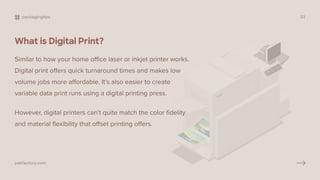
Similar to how your home office laser or inkjet printer works.
Digital print offers quick turnaround times and makes low
volume jobs more affordable. It’s also easier to create
variable data print runs using a digital printing press.
However, digital printers can’t quite match the color fidelity
and material flexibility that offset printing offers.
packagingtips 03
pakfactory.com
What is Offset Print?
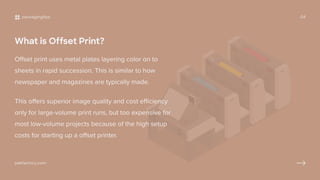
Offset print uses metal plates layering color on to
sheets in rapid succession. This is similar to how
newspaper and magazines are typically made.
This offers superior image quality and cost efficiency
only for large-volume print runs, but too expensive for
most low-volume projects because of the high setup
costs for starting up a offset printer.
packagingtips 04
pakfactory.com
Which print method to choose?
Based on Material
Rigid: Typically requires offset printing as rigid packaging are often
used for luxury packaging. If you’re going to print on luxury boxes,
you should print in offset to get the best quality possible.
Corrugated: Benefits from both digital and offset print.
Offset is preferred for designs that require additional
processes such as Spot UV and Foil Stamping, however
you must order 1000+ to justify its higher price.
packagingtips 05
pakfactory.com
Paperboard: For smaller runs and simpler designs, digital
print is the way to go if you are looking to save costs.
However, paperboard packaging in the cosmetic,
pharmaceutical and retail packaging space typically
requires offset print for its higher quality print.
Why? Offset provides a clearer and more vivid printing
output for smaller texts and designs as well as other
special finishes that would further enchance the look of
your product packaging.
packagingtips 06
pakfactory.com
Which to choose? Part 2.
Turnaround Time
For any small run projects that only require simple printing, its generally a
good choice to use digital print as this has the fastest turnaround time.
For large runs projects that require special finishes, its often a good choice to
use offset print, however the turnaround time is much longer than digital print.
packagingtips 07
pakfactory.com
Which to choose? Part 3.
Quality Color Depth and Options
Although offset print can be more expensive and have longer turnaround
time, it does out perform digital print when it comes to print quality,
brightness and color depth.
Offset printers have the ability to use the Pantone Matching Color System
to perfectly match colors, where as digital printers can only approximate
these colors using color calibration. Offset can also print white ink on kraft
paper while digital cannot.
packagingtips 08
pakfactory.com
Offset produces the clean, crisp, attractive color output that
you see in retail stores while digital produces great quality for
simpler designs (perfect for e-commerce packaging).
Offset printing also allows for a greater variety of coatings,
including matte & gloss laminate, UV, soft touch, and AQ coating
while digital cannot.
packagingtips 09
pakfactory.com
Which to choose? Part 4.
Prototyping
Digital and offset printing can complement one in another in
most packaigng orders.
It is much easier and more cost-effective, for instance, to use digital printing
to create packaging prototypes and then put the final packaging product
through full production-grade offset printing.
It is recommended to request a physical CTP proof to verify printing
instead. Prototyping in offset is possible but requires more time and cost.
packagingtips 10
pakfactory.com
Which to choose? Part 5.
Quantity
For paperboard and rigid boxes, no matter the
quantity, offset print is the best option.
For corrugated, any order amount of 500 boxes or less
should consider digital for cost-effectiveness and offset
for 2000 boxes and up due to better print quality.
packagingtips 11
pakfactory.com
packagingtips
Thanks for reading!
Feel free to ask any questions you may have on this topic
in the comments!
pakfactory.com
Share if you found this useful!

Offset vs Digital

  • 1.
    Digital vs Offset Print Whichone to choose? packagingtips pakfactory.com
  • 2.
    Intro Often times, especiallyif you are new to printing & packaging, you expect a certain color or quality to be produced exactly what is expected on the screen. The fact of the matter is, printing output cannot 100% match from what we see on the monitor based on the RGB vs CMYK color output theory. In this guide, you will learn how to effectively choose the right type of print for your packaging and understand the differences in output based on artwork objective, cost, and options. packagingtips 02 pakfactory.com
  • 3.
    What is DigitalPrint? Similar to how your home office laser or inkjet printer works. Digital print offers quick turnaround times and makes low volume jobs more affordable. It’s also easier to create variable data print runs using a digital printing press. However, digital printers can’t quite match the color fidelity and material flexibility that offset printing offers. packagingtips 03 pakfactory.com
  • 4.
    What is OffsetPrint? Offset print uses metal plates layering color on to sheets in rapid succession. This is similar to how newspaper and magazines are typically made. This offers superior image quality and cost efficiency only for large-volume print runs, but too expensive for most low-volume projects because of the high setup costs for starting up a offset printer. packagingtips 04 pakfactory.com
  • 5.
    Which print methodto choose? Based on Material Rigid: Typically requires offset printing as rigid packaging are often used for luxury packaging. If you’re going to print on luxury boxes, you should print in offset to get the best quality possible. Corrugated: Benefits from both digital and offset print. Offset is preferred for designs that require additional processes such as Spot UV and Foil Stamping, however you must order 1000+ to justify its higher price. packagingtips 05 pakfactory.com
  • 6.
    Paperboard: For smallerruns and simpler designs, digital print is the way to go if you are looking to save costs. However, paperboard packaging in the cosmetic, pharmaceutical and retail packaging space typically requires offset print for its higher quality print. Why? Offset provides a clearer and more vivid printing output for smaller texts and designs as well as other special finishes that would further enchance the look of your product packaging. packagingtips 06 pakfactory.com
  • 7.
    Which to choose?Part 2. Turnaround Time For any small run projects that only require simple printing, its generally a good choice to use digital print as this has the fastest turnaround time. For large runs projects that require special finishes, its often a good choice to use offset print, however the turnaround time is much longer than digital print. packagingtips 07 pakfactory.com
  • 8.
    Which to choose?Part 3. Quality Color Depth and Options Although offset print can be more expensive and have longer turnaround time, it does out perform digital print when it comes to print quality, brightness and color depth. Offset printers have the ability to use the Pantone Matching Color System to perfectly match colors, where as digital printers can only approximate these colors using color calibration. Offset can also print white ink on kraft paper while digital cannot. packagingtips 08 pakfactory.com
  • 9.
    Offset produces theclean, crisp, attractive color output that you see in retail stores while digital produces great quality for simpler designs (perfect for e-commerce packaging). Offset printing also allows for a greater variety of coatings, including matte & gloss laminate, UV, soft touch, and AQ coating while digital cannot. packagingtips 09 pakfactory.com
  • 10.
    Which to choose?Part 4. Prototyping Digital and offset printing can complement one in another in most packaigng orders. It is much easier and more cost-effective, for instance, to use digital printing to create packaging prototypes and then put the final packaging product through full production-grade offset printing. It is recommended to request a physical CTP proof to verify printing instead. Prototyping in offset is possible but requires more time and cost. packagingtips 10 pakfactory.com
  • 11.
    Which to choose?Part 5. Quantity For paperboard and rigid boxes, no matter the quantity, offset print is the best option. For corrugated, any order amount of 500 boxes or less should consider digital for cost-effectiveness and offset for 2000 boxes and up due to better print quality. packagingtips 11 pakfactory.com
  • 12.
    packagingtips Thanks for reading! Feelfree to ask any questions you may have on this topic in the comments! pakfactory.com Share if you found this useful!