CORRUGATED BOX
Prepared By
Sneha A. Chavan
Department Of Pharmaceutics
M pharm !st year II semester
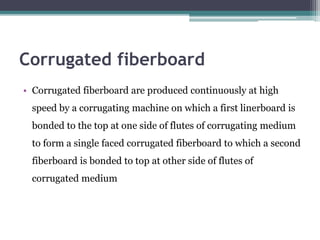
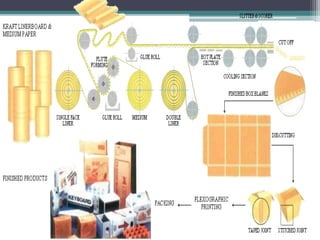
Corrugated fiberboard
• Corrugated fiberboard are produced continuously at high
speed by a corrugating machine on which a first linerboard is
bonded to the top at one side of flutes of corrugating medium
to form a single faced corrugated fiberboard to which a second
fiberboard is bonded to top at other side of flutes of
corrugated medium
Corrugated vs. Cardboard
Corrugated Board
• Made of 3 or more layers of
liner board with a “corrugated”
inner medium that is referred
to as “Fluting”
• Multiple Flute Sizes
• Multiple Strengths
Cardboard
• Chipboard that is formed in a
single layer using fiber. Does
not have “fluting”
• Multiple Point Sizes
• Different Finishes
• Different Grades
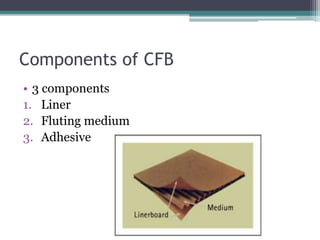
Components of CFB
• 3 components
1. Liner
2. Fluting medium
3. Adhesive
1.Liner
• Kraft paper of above 80 GSM to 250 GSM is used for making
liner.
• Outer most liner used for box should be of maximum
grammage.
• Function of liner
I. Resist hazard like puncture, burst, abrasion, tear etc.
II. Properly held the fluting medium when once combined.
III. Be amenable to printing.
IV. Resist moisture or water either outside or inside depending
on nature of product packed.
• Water proof paper such as bitumen, sandwiched, poly-coated
or wax coated are also used for liner
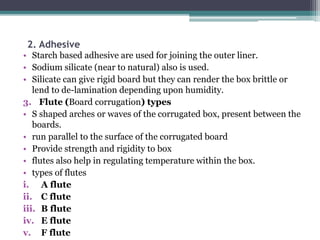
2. Adhesive
• Starch based adhesive are used for joining the outer liner.
• Sodium silicate (near to natural) also is used.
• Silicate can give rigid board but they can render the box brittle or
lend to de-lamination depending upon humidity.
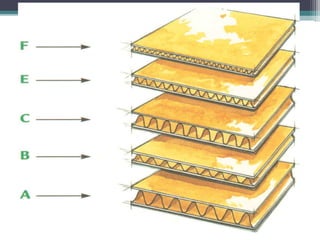
3. Flute (Board corrugation) types
• S shaped arches or waves of the corrugated box, present between the
boards.
• run parallel to the surface of the corrugated board
• Provide strength and rigidity to box
• flutes also help in regulating temperature within the box.
• types of flutes
i. A flute
ii. C flute
iii. B flute
iv. E flute
v. F flute
A flute
- high top to
bottom
compression
- good stacking
strength
- excellent
cushioning for
product
protection
B flute
- thickness of 1/8".
- 40-50 flutes per
foot.
- high resistance to
flat crush
- excellent printing
surface
- scores and slots
easily
- greater crush
resistance and
stacking strength
- second highest
arch size
- adapt well to
automatic
equipment
- used in the
packing of canned
goods and displays
C flute
- thickness of
11/64“
- 39-40 flutes per
foot.
- good printing
surface
- good top to
bottom
compression
- good resistance to
flat crush
- forms a medium
between type A flute
and type B flute.
- used in the
packaging of
furniture, glass and
dairy.
F flute
- good alternative to paperboard
application
- superior printing surface
- high resistance to flat crush
(similar to E)
- consumer goods shelf packaging
(most applicable)
E flute
- thickness of 1/16"
- 94 flutes per foot.
- best crush resistance
- outstanding printing surface
- mostly used for consumer goods
shelf packaging
- makes the board extra thin in turn
reducing its weight and size.
- excellent choice for printing
purposes, making it a good choice
for die cut custom boxes
specifications of a corrugated box
The format of specifications of a corrugated box will look like this :-
<Paper weight><outer liner paper>/<walls of the box with its flute
type>/<inner liner paper>
1. Paper Weight:
• specified in the terms of grams per square meter
• standard cartons, the paper used is of 125 gsm to 150 gsm.
• box is used for heavy duty purposes such as export, paper weighing
300 gsm is used
Cont…
2. Outer liner:
• The paper outside the box is called the outer liner paper.
• the outer liner paper is generally made up of virgin craft paper.
• But these days, the composition also contains about 12 % of recycled
material.
3. Inner Liner:
• Inner liner paper is the one which is used on the inside of the box.
• completely made up of recycled material, virgin board, a mixture of
newspaper waste and more as such.
• may not seem as appealing and strong as the outer liner paper
• advantage of
a. reducing the weight of the box,
b. being environment friendly and
c. fully recyclable.
Box structure
• Two main component :-
I. Linerboard
II. Medium
• Both are made up of special kind of heavy paper called
containerboard
• Four type of combined board
i. Single face
ii. Single wall
iii. Double wall
iv. Triple wall
Cont…
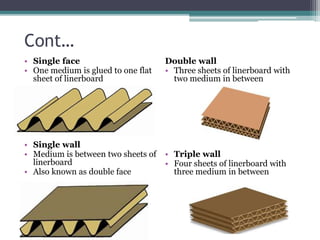
• Single face
• One medium is glued to one flat
sheet of linerboard
• Single wall
• Medium is between two sheets of
linerboard
• Also known as double face
Double wall
• Three sheets of linerboard with
two medium in between
• Triple wall
• Four sheets of linerboard with
three medium in between
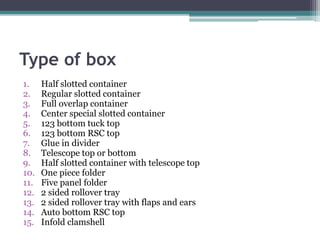
Type of box
1. Half slotted container
2. Regular slotted container
3. Full overlap container
4. Center special slotted container
5. 123 bottom tuck top
6. 123 bottom RSC top
7. Glue in divider
8. Telescope top or bottom
9. Half slotted container with telescope top
10. One piece folder
11. Five panel folder
12. 2 sided rollover tray
13. 2 sided rollover tray with flaps and ears
14. Auto bottom RSC top
15. Infold clamshell
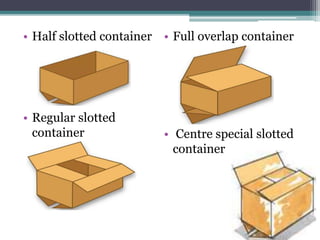
• Half slotted container
• Regular slotted
container
• Full overlap container
• Centre special slotted
container
• 123 bottom tuck top
• 123 bottom RSC top
• Glue in divider
• Telescope top or
bottom
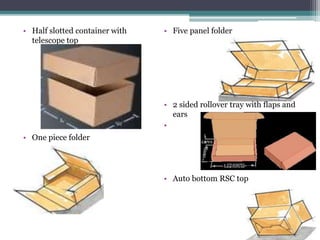
• Half slotted container with
telescope top
• One piece folder
• Five panel folder
• 2 sided rollover tray with flaps and
ears
•
• Auto bottom RSC top
Box dimension
• Given in sequence of length,
breadth and height
(internationally)
• Also given in length, width and
depth
• Dimension specified for either
inside or outside of box
• Inside dimension determined to
ensure proper fit for product
being shipped or stored
• Palletizing and distributing the
boxes depend on outside
dimension
BOX CLOSURE
• Adhesive water based or Hot melt adhesive- applied manually or by machine.
starch based adhesives is the choice of a corrugator as it is economic. starch work as a
medium for molds, lichens & fungus so to prevent it antifungals are added in it before
use.
• Staples- for effective closing staples should be applied in 45 deg angle. pins are
made up of steel, nickel, brass etc.
• Box sealing tape, pressure-sensitive-taps are available in various widths i.e. 36, 48,
and 72 mm widths and several thicknesses. BOPP and PET are used as a backings.
• Taping is done either manually or by semi automatic machine.
• Filament tape, pressure-sensitive
• Water activated gummed paper- it consist of a heavy paper in which adhesive is
applied and dried, when water is applied to it adhesive tackiness and binding ability
is again generated. Reinforced water activated gummed tape
• Strapping- used for unitizing, made up of plastic (PP,PE,PET,PVC), metal (SS steel)
etc. and available various width.
• Shrink wrap- it is a thin film of LLDPE, LDPE etc. which shrinks with the
application of heat resulting in wrapping a box from all sides.it is costlier amongst all
as it needs hot tunnel and material consumption will be more. However, the packed
box will be protected from environment as it will work as a barrier.
• ADVANTAGE OF CFB
a) Effective cushioning material
b) Easy to fabricate
c) Easy to storing
d) Easy to disposal
e) More pilfer proof
f) No strapping necessary
g) Safe for human handling
h) Could be made specially water
resistant
i) Printing and advertising advantage
j) No self generating fungus
k) Desired in export market
l) Suitable for self service store display
 DISADVANTAGE OF CFB
 The base Kraft paper not of desired
standard
 Improper warehousing
 Supply of moist and damp material
when hurry
 De - lamination of layer
 Use of unspecified adhesive and water
proofing agent
Failure in CFB during export
A. Adhesive failure
• Result in delamination of flute and liner which may occur due to
i. Lower solid content
ii. Lower GSM coating
iii. Poor quality adhesive
 solution
 stringent quality for adhesive
 Bond strength determination by pin adhesion test gives the bonding
strength of adhesive
B. Joint failure
occur due to
i. Stitching (staples) :- failure due to corrosion of stapler and poor
manufacturing practice
ii. Adhesive tape failure :- failure occur due to poor shear properties
of adhesive tape or poor tensile property of tape.
Recycling of CFB
• Collection
• Sorting
• Shredding and pulping
• Filtering, conterminal removal and De-Inking
• Finishing for reuse
Quality Control Test
• Flat crush resistance test
(Concora test)
• applies to single wall and single
faced corrugated
• v
• Box compression test
Cont…
• Edge crush test • Ring crush test
Cont…
• Cobb Tester
• determine water absorption
property of corrugated fiber
board
• Puncture Resistance Test
• measuring the energy required
to puncture it.
• Measuring range 0 to 36
Newton meter
Cont…
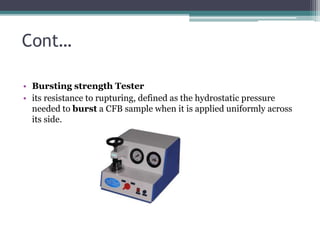
• Bursting strength Tester
• its resistance to rupturing, defined as the hydrostatic pressure
needed to burst a CFB sample when it is applied uniformly across
its side.
Reference
• Textbook of pharmaceutical packaging technology, Atul Kaushik,
Bhaskar Chaurasia, Virendra Dhakar, page no. 280 - 291
• Pharmaceutical packaging technology, U.K. Jain, D.C. Goupale, S.
Nayak, page no. 215 – 224
• http://www.worldoftest.com/paper-cardboard-testing

Corrugated box

  • 1.
    CORRUGATED BOX Prepared By SnehaA. Chavan Department Of Pharmaceutics M pharm !st year II semester
  • 2.
    Corrugated fiberboard • Corrugatedfiberboard are produced continuously at high speed by a corrugating machine on which a first linerboard is bonded to the top at one side of flutes of corrugating medium to form a single faced corrugated fiberboard to which a second fiberboard is bonded to top at other side of flutes of corrugated medium
  • 3.
    Corrugated vs. Cardboard CorrugatedBoard • Made of 3 or more layers of liner board with a “corrugated” inner medium that is referred to as “Fluting” • Multiple Flute Sizes • Multiple Strengths Cardboard • Chipboard that is formed in a single layer using fiber. Does not have “fluting” • Multiple Point Sizes • Different Finishes • Different Grades
  • 4.
    Components of CFB •3 components 1. Liner 2. Fluting medium 3. Adhesive
  • 5.
    1.Liner • Kraft paperof above 80 GSM to 250 GSM is used for making liner. • Outer most liner used for box should be of maximum grammage. • Function of liner I. Resist hazard like puncture, burst, abrasion, tear etc. II. Properly held the fluting medium when once combined. III. Be amenable to printing. IV. Resist moisture or water either outside or inside depending on nature of product packed. • Water proof paper such as bitumen, sandwiched, poly-coated or wax coated are also used for liner
  • 6.
    2. Adhesive • Starchbased adhesive are used for joining the outer liner. • Sodium silicate (near to natural) also is used. • Silicate can give rigid board but they can render the box brittle or lend to de-lamination depending upon humidity. 3. Flute (Board corrugation) types • S shaped arches or waves of the corrugated box, present between the boards. • run parallel to the surface of the corrugated board • Provide strength and rigidity to box • flutes also help in regulating temperature within the box. • types of flutes i. A flute ii. C flute iii. B flute iv. E flute v. F flute
  • 7.
    A flute - hightop to bottom compression - good stacking strength - excellent cushioning for product protection B flute - thickness of 1/8". - 40-50 flutes per foot. - high resistance to flat crush - excellent printing surface - scores and slots easily - greater crush resistance and stacking strength - second highest arch size - adapt well to automatic equipment - used in the packing of canned goods and displays C flute - thickness of 11/64“ - 39-40 flutes per foot. - good printing surface - good top to bottom compression - good resistance to flat crush - forms a medium between type A flute and type B flute. - used in the packaging of furniture, glass and dairy.
  • 8.
    F flute - goodalternative to paperboard application - superior printing surface - high resistance to flat crush (similar to E) - consumer goods shelf packaging (most applicable) E flute - thickness of 1/16" - 94 flutes per foot. - best crush resistance - outstanding printing surface - mostly used for consumer goods shelf packaging - makes the board extra thin in turn reducing its weight and size. - excellent choice for printing purposes, making it a good choice for die cut custom boxes
  • 10.
    specifications of acorrugated box The format of specifications of a corrugated box will look like this :- <Paper weight><outer liner paper>/<walls of the box with its flute type>/<inner liner paper> 1. Paper Weight: • specified in the terms of grams per square meter • standard cartons, the paper used is of 125 gsm to 150 gsm. • box is used for heavy duty purposes such as export, paper weighing 300 gsm is used
  • 11.
    Cont… 2. Outer liner: •The paper outside the box is called the outer liner paper. • the outer liner paper is generally made up of virgin craft paper. • But these days, the composition also contains about 12 % of recycled material. 3. Inner Liner: • Inner liner paper is the one which is used on the inside of the box. • completely made up of recycled material, virgin board, a mixture of newspaper waste and more as such. • may not seem as appealing and strong as the outer liner paper • advantage of a. reducing the weight of the box, b. being environment friendly and c. fully recyclable.
  • 12.
    Box structure • Twomain component :- I. Linerboard II. Medium • Both are made up of special kind of heavy paper called containerboard • Four type of combined board i. Single face ii. Single wall iii. Double wall iv. Triple wall
  • 13.
    Cont… • Single face •One medium is glued to one flat sheet of linerboard • Single wall • Medium is between two sheets of linerboard • Also known as double face Double wall • Three sheets of linerboard with two medium in between • Triple wall • Four sheets of linerboard with three medium in between
  • 14.
    Type of box 1.Half slotted container 2. Regular slotted container 3. Full overlap container 4. Center special slotted container 5. 123 bottom tuck top 6. 123 bottom RSC top 7. Glue in divider 8. Telescope top or bottom 9. Half slotted container with telescope top 10. One piece folder 11. Five panel folder 12. 2 sided rollover tray 13. 2 sided rollover tray with flaps and ears 14. Auto bottom RSC top 15. Infold clamshell
  • 15.
    • Half slottedcontainer • Regular slotted container • Full overlap container • Centre special slotted container
  • 16.
    • 123 bottomtuck top • 123 bottom RSC top • Glue in divider • Telescope top or bottom
  • 17.
    • Half slottedcontainer with telescope top • One piece folder • Five panel folder • 2 sided rollover tray with flaps and ears • • Auto bottom RSC top
  • 18.
    Box dimension • Givenin sequence of length, breadth and height (internationally) • Also given in length, width and depth • Dimension specified for either inside or outside of box • Inside dimension determined to ensure proper fit for product being shipped or stored • Palletizing and distributing the boxes depend on outside dimension
  • 21.
    BOX CLOSURE • Adhesivewater based or Hot melt adhesive- applied manually or by machine. starch based adhesives is the choice of a corrugator as it is economic. starch work as a medium for molds, lichens & fungus so to prevent it antifungals are added in it before use. • Staples- for effective closing staples should be applied in 45 deg angle. pins are made up of steel, nickel, brass etc. • Box sealing tape, pressure-sensitive-taps are available in various widths i.e. 36, 48, and 72 mm widths and several thicknesses. BOPP and PET are used as a backings. • Taping is done either manually or by semi automatic machine. • Filament tape, pressure-sensitive • Water activated gummed paper- it consist of a heavy paper in which adhesive is applied and dried, when water is applied to it adhesive tackiness and binding ability is again generated. Reinforced water activated gummed tape • Strapping- used for unitizing, made up of plastic (PP,PE,PET,PVC), metal (SS steel) etc. and available various width. • Shrink wrap- it is a thin film of LLDPE, LDPE etc. which shrinks with the application of heat resulting in wrapping a box from all sides.it is costlier amongst all as it needs hot tunnel and material consumption will be more. However, the packed box will be protected from environment as it will work as a barrier.
  • 22.
    • ADVANTAGE OFCFB a) Effective cushioning material b) Easy to fabricate c) Easy to storing d) Easy to disposal e) More pilfer proof f) No strapping necessary g) Safe for human handling h) Could be made specially water resistant i) Printing and advertising advantage j) No self generating fungus k) Desired in export market l) Suitable for self service store display  DISADVANTAGE OF CFB  The base Kraft paper not of desired standard  Improper warehousing  Supply of moist and damp material when hurry  De - lamination of layer  Use of unspecified adhesive and water proofing agent
  • 23.
    Failure in CFBduring export A. Adhesive failure • Result in delamination of flute and liner which may occur due to i. Lower solid content ii. Lower GSM coating iii. Poor quality adhesive  solution  stringent quality for adhesive  Bond strength determination by pin adhesion test gives the bonding strength of adhesive B. Joint failure occur due to i. Stitching (staples) :- failure due to corrosion of stapler and poor manufacturing practice ii. Adhesive tape failure :- failure occur due to poor shear properties of adhesive tape or poor tensile property of tape.
  • 24.
    Recycling of CFB •Collection • Sorting • Shredding and pulping • Filtering, conterminal removal and De-Inking • Finishing for reuse
  • 25.
    Quality Control Test •Flat crush resistance test (Concora test) • applies to single wall and single faced corrugated • v • Box compression test
  • 26.
    Cont… • Edge crushtest • Ring crush test
  • 27.
    Cont… • Cobb Tester •determine water absorption property of corrugated fiber board • Puncture Resistance Test • measuring the energy required to puncture it. • Measuring range 0 to 36 Newton meter
  • 28.
    Cont… • Bursting strengthTester • its resistance to rupturing, defined as the hydrostatic pressure needed to burst a CFB sample when it is applied uniformly across its side.
  • 29.
    Reference • Textbook ofpharmaceutical packaging technology, Atul Kaushik, Bhaskar Chaurasia, Virendra Dhakar, page no. 280 - 291 • Pharmaceutical packaging technology, U.K. Jain, D.C. Goupale, S. Nayak, page no. 215 – 224 • http://www.worldoftest.com/paper-cardboard-testing

Editor's Notes

  • #4 Cardboard is a depreciated term not commonly used among paper and packaging professionals.