SOCIAL SCIENCE CLIL ENGLISH CLASS Structure of an oral presentation
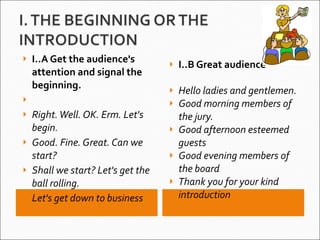
I..A Get the audience's attention and signal the beginning.   Right. Well. OK. Erm. Let's begin. Good. Fine. Great. Can we start? Shall we start? Let's get the ball rolling. Let's get down to business I..B Great audience Hello ladies and gentlemen. Good morning members of the jury. Good afternoon esteemed guests Good evening members of the board Thank you for your kind introduction
I..C Introduce oneself, (name, position)  Good afternoon ladies and gentlemen, let me introduce myself. Good morning everyone, I'd like to start by introducing myself. My name is... I am a student at  Good morning, my name is. I am a student at………. I.D Give title and introduce subject I plan to speak about... Today I'm going to talk about... The subject of my presentation is... The theme of my talk is... I've been asked to give you an overview of... I have chosen to speak about this because... I was asked to speak about X because... I will not speak about... I have limited my speech to My talk will last about 15 minutes I will speak for 15 minutes.
What exactly are you going to speak about? Situate the subject in time and place, in relation to the audience and/or its importance.    Have you estimated the time it will take? It is useful to give the listeners some idea of how long you will speak so as to maintain their attention better I plan to speak about... Today I'm going to talk about... The subject of my presentation is... The theme of my talk is... I've been asked to give you an overview of... I have chosen to speak about this because... I was asked to speak about X because... I will not speak about... I have limited my speech to My talk will last about 15 minutes I will speak for 15 minutes.
At some point you should ask a question or somehow try to determine the attitude and knowledge of the audience. How do they feel about the subject?  I.E Give your objectives (purpose, aim, goals) My purpose in doing this paper is to give you a solid background on the subject of…… What I would like to do today is to explain, to Ilustrate….. to give you the essential background information on... to outline... to have a look at... if there is one thing I'd like to get across to you today it is that…   I.F Announce your outline.   I have broken my speech down/up into X parts. I have divided my presentation (up) into Y parts. In the first part I give a few basic definitions. In the next section I will explain In part three, I am going to show... In the last part I would like/want to give a practical example ...  
Now let us turn to point one. Let us now move on to the second part, which is, as I said earlier….
II.A Content. II.B Quantity   II.C Sequencing your ideas. II.D Keeping the audience's attention II.E Signposting or signaling where you are. II.F Listing information There are three things we have to consider: one, two, and three. Now let us look at the first aspect which is... First of all,… In the place…first  II.G Linking ideas, sections/making transitions II.H To be clear and concrete.  To give an example: Now let's take an example. An example of this can be found... To illustrate this… Let's see this through an example. For example, For instance, To rephrase: Let me rephrase that, In other words Another way of saying the same thing is That is to say To summarize: To summarize To sum up, Let me summarize by saying
III.A Content I'd like to summarize/sum up At this stage I would like to run through/over the main points... So, as we have seen today.... As I have tried to explain  In conclusion I would like to say that... My final comments concern... I would like to finish by reminding everyone that... Finally As a conclusion I'd be happy to answer any questions.... If there are any questions please feel free to ask. Thank you very much for your attention and if there are any suggestions or comments    
SUMMARY CREATING INTEREST AND ESTABLISHING A RELATIONSHIP WITH THE AUDIENCE Rhetorical questions How can we explain this? Emphasizing/highlighting The important thing to remember is... BODY LANGUAGE


Oral presentation

  • 1.
    SOCIAL SCIENCE CLILENGLISH CLASS Structure of an oral presentation
  • 2.
    I..A Get theaudience's attention and signal the beginning.   Right. Well. OK. Erm. Let's begin. Good. Fine. Great. Can we start? Shall we start? Let's get the ball rolling. Let's get down to business I..B Great audience Hello ladies and gentlemen. Good morning members of the jury. Good afternoon esteemed guests Good evening members of the board Thank you for your kind introduction
  • 3.
    I..C Introduce oneself,(name, position) Good afternoon ladies and gentlemen, let me introduce myself. Good morning everyone, I'd like to start by introducing myself. My name is... I am a student at Good morning, my name is. I am a student at………. I.D Give title and introduce subject I plan to speak about... Today I'm going to talk about... The subject of my presentation is... The theme of my talk is... I've been asked to give you an overview of... I have chosen to speak about this because... I was asked to speak about X because... I will not speak about... I have limited my speech to My talk will last about 15 minutes I will speak for 15 minutes.
  • 4.
    What exactly areyou going to speak about? Situate the subject in time and place, in relation to the audience and/or its importance.   Have you estimated the time it will take? It is useful to give the listeners some idea of how long you will speak so as to maintain their attention better I plan to speak about... Today I'm going to talk about... The subject of my presentation is... The theme of my talk is... I've been asked to give you an overview of... I have chosen to speak about this because... I was asked to speak about X because... I will not speak about... I have limited my speech to My talk will last about 15 minutes I will speak for 15 minutes.
  • 5.
    At some pointyou should ask a question or somehow try to determine the attitude and knowledge of the audience. How do they feel about the subject? I.E Give your objectives (purpose, aim, goals) My purpose in doing this paper is to give you a solid background on the subject of…… What I would like to do today is to explain, to Ilustrate….. to give you the essential background information on... to outline... to have a look at... if there is one thing I'd like to get across to you today it is that…   I.F Announce your outline.   I have broken my speech down/up into X parts. I have divided my presentation (up) into Y parts. In the first part I give a few basic definitions. In the next section I will explain In part three, I am going to show... In the last part I would like/want to give a practical example ...  
  • 6.
    Now let usturn to point one. Let us now move on to the second part, which is, as I said earlier….
  • 7.
    II.A Content. II.BQuantity   II.C Sequencing your ideas. II.D Keeping the audience's attention II.E Signposting or signaling where you are. II.F Listing information There are three things we have to consider: one, two, and three. Now let us look at the first aspect which is... First of all,… In the place…first II.G Linking ideas, sections/making transitions II.H To be clear and concrete. To give an example: Now let's take an example. An example of this can be found... To illustrate this… Let's see this through an example. For example, For instance, To rephrase: Let me rephrase that, In other words Another way of saying the same thing is That is to say To summarize: To summarize To sum up, Let me summarize by saying
  • 8.
    III.A Content I'dlike to summarize/sum up At this stage I would like to run through/over the main points... So, as we have seen today.... As I have tried to explain In conclusion I would like to say that... My final comments concern... I would like to finish by reminding everyone that... Finally As a conclusion I'd be happy to answer any questions.... If there are any questions please feel free to ask. Thank you very much for your attention and if there are any suggestions or comments    
  • 9.
    SUMMARY CREATING INTERESTAND ESTABLISHING A RELATIONSHIP WITH THE AUDIENCE Rhetorical questions How can we explain this? Emphasizing/highlighting The important thing to remember is... BODY LANGUAGE
  • 10.
  • 11.