



What to do to prepare for 
an OSHA Audit
Meet the Moderator 
Sasha Laferte
Meet the Speaker 
Rick Foote
Talk to us on 
Twitter: 
@Triumvirate 
#OSHA
OSHA Has Been Busy 
• OSHA Conducted 92,000 inspections 
• There were over 188,000 violations cited 
• There was approximately $240 million in 
penalties
Top 10 Violations 
1. Hazard Communication 
2. Respiratory Protection 
3. Electrical ‐ Wiring and 
Equipment 
4. Powered Industrial Trucks 
5. Lockout/Tagout
Top 10 Violations 
6. General Machine Guarding 
7. Electrical Systems Design 
(General) 
8. Personal Protective 
Equipment (General) 
9. Fall protection (Guarding 
Floor/Wall Openings and 
Holes) 
10. Exit routes
Are you ready for OSHA to 
knock at the door?
OSHA Inspections: 
Preparation is Key!
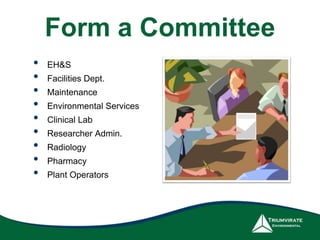
Form a Committee 
• EH&S 
• Facilities Dept. 
• Maintenance 
• Environmental Services 
• Clinical Lab 
• Researcher Admin. 
• Radiology 
• Pharmacy 
• Plant Operators
Organize Internal Resources 
• Preparedness Coordinating Committee 
• Facility Program Managers/Experts 
• Facility Inspector Escorts 
• Logistics and Planning 
• Roles & Responsibilities 
• Communications
Inspection Preparedness 
Coordinating Committee 
• Organizes and facilitates the Opening 
Conference 
• Works out schedule with the inspectors 
• Coordinates inspections with 
department/program managers 
• Conducts daily debriefings 
• Organizes and facilitates the Closing 
Conference
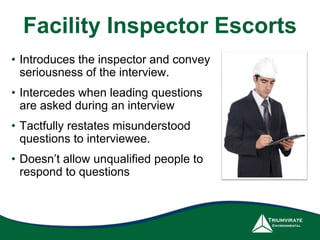
Facility Inspector Escorts 
• Introduces the inspector and convey 
seriousness of the interview. 
• Intercedes when leading questions 
are asked during an interview 
• Tactfully restates misunderstood 
questions to interviewee. 
• Doesn’t allow unqualified people to 
respond to questions
OSHA Inspections - Tips 
• Be Prepared! 
• Maintain up-to-date plans and records 
• Know where documents are; be able to produce them in a 
timely manner 
• Have a Preparedness Plan 
• Records and Documentation Review 
• Assemble materials requested by OSHA 
• Identify conference room (do not use offices) for records 
review 
• Offer only requested documents for specific locations 
• Make duplicate copies of records that they copy
The Inspection
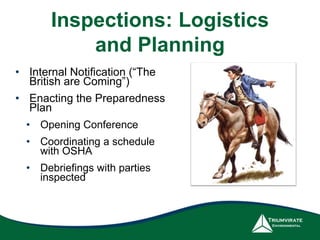
Inspections: Logistics 
and Planning 
• Internal Notification (“The 
British are Coming”) 
• Enacting the Preparedness 
Plan 
• Opening Conference 
• Coordinating a schedule 
with OSHA 
• Debriefings with parties 
inspected
Opening Conference 
• State that the group has been assembled to help 
facilitate the inspectors’ review & provide an open 
communication channel with key facility officials 
• Outline positive working relationship with OSHA 
inspectors 
• Discuss how important compliance is to your facility 
• Who in upper management is involved and how 
often your department meets with them 
• Obtain an understanding of inspection scope
Guidelines: Site Inspection 
• Identify nature and scope of inspection 
• Accompany each inspector at all times 
• Cooperate, but do not offer information not 
requested 
• Duplicate all records copied 
• Take good notes, photographs, split samples 
• Monitor employee interviews 
• Conduct an exit interview for each area to 
get an idea of what they found
Facility Escort Guidelines 
• Restate unclear answers from the 
interviewee to the OSHA inspector. 
• Stay by the inspectors side 
• Take notes 
• During and shortly after the interview 
• Of issues that the inspector notes during the 
inspection 
• Of questions that could not be answered
Taking care of business 
• Fixing Potential Violations 
• As issues are found 
• Prior to OSHA entry 
• Before OSHA finishes for the day 
• Behind the Scenes During the Inspection 
• OSHA Location during the day 
• Fielding questions
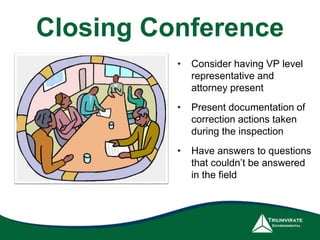
Closing Conference 
• Consider having VP level 
representative and 
attorney present 
• Present documentation of 
correction actions taken 
during the inspection 
• Have answers to questions 
that couldn’t be answered 
in the field
More Guidelines 
• Take notes 
• Don’t attempt to deal with hypothetical situations 
• “Fix” simple deficiencies along the way 
• Make a copy of anything given to the inspectors 
• Seek approval for all photos requested by the 
inspectors; take duplicate photos 
• Likewise, take duplicate samples
Guidelines Continued… 
• Don’t offer an opinion or agree/disagree with 
the inspectors 
• Do talk about sports, music, general topics 
• Don’t be their “buddy” or confidant 
• Don’t sign anything 
• Keep them from harm’s way (no confined 
space entry or near high hazard areas)
Guidelines Continued… 
• Don’t offer information unless specifically asked 
• Don’t argue with the inspectors 
• Don’t complain about the regulations 
• Don’t be pushed into giving an answer if you don’t 
know…say that you don’t know 
• Don’t be evasive. Answer directly and succinctly 
• Don’t lie to the inspectors or misrepresent what 
really happens in your area 
• Don’t engage in speculation
Training Requirements
OSHA Regulations Requiring Training 
• 1910.38 - Emergency Action 
Plans 
• 1910.39 - Fire Prevention 
Plans 
• 1910.66 - Powered Platforms 
for Building Maintenance 
• 1910.95 – Occupational 
Noise Exposure 
• 1910.106 – Flammable and 
Combustible Liquids 
• 1910.109 - Explosive and 
Blasting Agents 
• 1910.110 - Storage and 
Handling of Liquefied 
Petroleum Gases 
• 1910.111 - Storage and 
Handling of Anhydrous 
Ammonia 
• 1910.119 - Process Safety 
Management of Highly 
Hazardous Chemicals 
• 1910.120 - Hazardous Waste 
Operations and Emergency 
Response
OSHA Regulations Requiring Training 
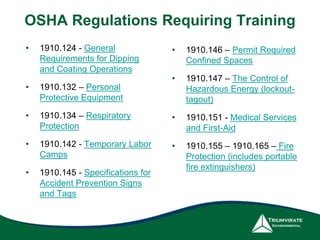
• 1910.124 - General 
Requirements for Dipping 
and Coating Operations 
• 1910.132 – Personal 
Protective Equipment 
• 1910.134 – Respiratory 
Protection 
• 1910.142 - Temporary Labor 
Camps 
• 1910.145 - Specifications for 
Accident Prevention Signs 
and Tags 
• 1910.146 – Permit Required 
Confined Spaces 
• 1910.147 – The Control of 
Hazardous Energy (lockout-tagout) 
• 1910.151 - Medical Services 
and First-Aid 
• 1910.155 – 1910.165 – Fire 
Protection (includes portable 
fire extinguishers)
OSHA Regulations Requiring Training 
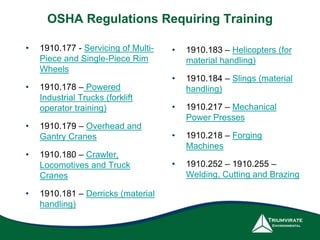
• 1910.177 - Servicing of Multi- 
Piece and Single-Piece Rim 
Wheels 
• 1910.178 – Powered 
Industrial Trucks (forklift 
operator training) 
• 1910.179 – Overhead and 
Gantry Cranes 
• 1910.180 – Crawler, 
Locomotives and Truck 
Cranes 
• 1910.181 – Derricks (material 
handling) 
• 1910.183 – Helicopters (for 
material handling) 
• 1910.184 – Slings (material 
handling) 
• 1910.217 – Mechanical 
Power Presses 
• 1910.218 – Forging 
Machines 
• 1910.252 – 1910.255 – 
Welding, Cutting and Brazing
OSHA Regulations Requiring Training 
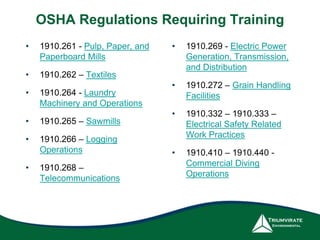
• 1910.261 - Pulp, Paper, and 
Paperboard Mills 
• 1910.262 – Textiles 
• 1910.264 - Laundry 
Machinery and Operations 
• 1910.265 – Sawmills 
• 1910.266 – Logging 
Operations 
• 1910.268 – 
Telecommunications 
• 1910.269 - Electric Power 
Generation, Transmission, 
and Distribution 
• 1910.272 – Grain Handling 
Facilities 
• 1910.332 – 1910.333 – 
Electrical Safety Related 
Work Practices 
• 1910.410 – 1910.440 - 
Commercial Diving 
Operations
OSHA Regulations Requiring Training 
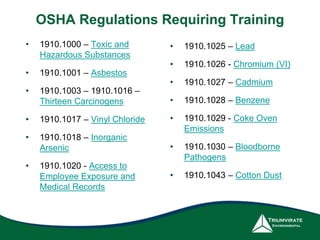
• 1910.1000 – Toxic and 
Hazardous Substances 
• 1910.1001 – Asbestos 
• 1910.1003 – 1910.1016 – 
Thirteen Carcinogens 
• 1910.1017 – Vinyl Chloride 
• 1910.1018 – Inorganic 
Arsenic 
• 1910.1020 - Access to 
Employee Exposure and 
Medical Records 
• 1910.1025 – Lead 
• 1910.1026 - Chromium (VI) 
• 1910.1027 – Cadmium 
• 1910.1028 – Benzene 
• 1910.1029 - Coke Oven 
Emissions 
• 1910.1030 – Bloodborne 
Pathogens 
• 1910.1043 – Cotton Dust
OSHA Regulations Requiring Training 
• 1910.1044 - 1,2-Dibromo-3- 
Chloropropane 
• 1910.1045 - Acrylonitrile 
(Vinyl Cyanide) 
• 1910.1047 - Ethylene Oxide 
• 1910.1048 – Formaldehyde 
• 1910.1050 – 
Methylenedianiline 
• 1910.1051 - 1,3-Butadiene 
• 1910.1052 - Methylene 
Chloride 
• 1910.1096 – Ionizing 
Radiation 
• 1910.1200 – Hazard 
Communication 
• 1910.1450 - Occupational 
Exposure to Hazardous 
Chemicals in Laboratories
Preparedness
Be Ready! 
• Develop an OSHA 
compliance calendar 
• Ensure all of the required 
written plans are up to date 
• Develop a training matrix 
• Keep records organized 
and ready for inspection
Be Ready! 
• Review the OSHA 300 Log 
• Conduct internal 
inspections 
• Involve employees to get 
their buy-in 
• Enforce programs such as 
personal protective 
equipment, safety devices, 
etc..
Industrial Client 
• We did a survey to help identify potential 
OSHA compliance issues and to train 
employees on what to do when they arrive 
• We identified numerous issues that needed 
to addressed by client 
• OSHA did a site visit several months later 
and the facility was found to have no 
violations in there program
Higher Education Client 
• The client was visited by OSHA regarding an 
employee compliant 
• We assisted the client with responding to the 
complaint and then correcting the issue 
• We also trained the staff on what to do when 
OSHA comes back onsite 
• OSHA did a follow up inspection and 
commended them for the thoroughness of 
the response
Questions? 
Rick Foote 
rfoote@triumvirate.com 
617-686-6184
Upcoming Webinars 
• Waste Minimization for Industrial 
Organizations 11/6 
• In-depth Waste Stream Analysis for 
Healthcare Institutions 11/12 
• Preventing Liability with Lab 
Decommissioning 11/19 
View all upcoming webinars at 
http://www.triumvirate.com/training/events
Thank You! 
1-888-TEI-WOWS www.triumvirate.com
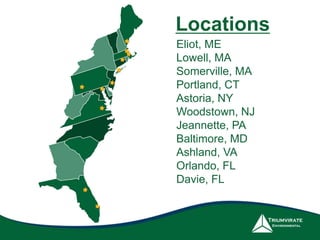
Locations 
Eliot, ME 
Lowell, MA 
Somerville, MA 
Portland, CT 
Astoria, NY 
Woodstown, NJ 
Jeannette, PA 
Baltimore, MD 
Ashland, VA 
Orlando, FL 
Davie, FL

What To Do When OSHA Comes Knocking: Webinar

  • 1.
    What to doto prepare for an OSHA Audit
  • 2.
    Meet the Moderator Sasha Laferte
  • 3.
    Meet the Speaker Rick Foote
  • 4.
    Talk to uson Twitter: @Triumvirate #OSHA
  • 5.
    OSHA Has BeenBusy • OSHA Conducted 92,000 inspections • There were over 188,000 violations cited • There was approximately $240 million in penalties
  • 6.
    Top 10 Violations 1. Hazard Communication 2. Respiratory Protection 3. Electrical ‐ Wiring and Equipment 4. Powered Industrial Trucks 5. Lockout/Tagout
  • 7.
    Top 10 Violations 6. General Machine Guarding 7. Electrical Systems Design (General) 8. Personal Protective Equipment (General) 9. Fall protection (Guarding Floor/Wall Openings and Holes) 10. Exit routes
  • 8.
    Are you readyfor OSHA to knock at the door?
  • 9.
  • 10.
    Form a Committee • EH&S • Facilities Dept. • Maintenance • Environmental Services • Clinical Lab • Researcher Admin. • Radiology • Pharmacy • Plant Operators
  • 11.
    Organize Internal Resources • Preparedness Coordinating Committee • Facility Program Managers/Experts • Facility Inspector Escorts • Logistics and Planning • Roles & Responsibilities • Communications
  • 12.
    Inspection Preparedness CoordinatingCommittee • Organizes and facilitates the Opening Conference • Works out schedule with the inspectors • Coordinates inspections with department/program managers • Conducts daily debriefings • Organizes and facilitates the Closing Conference
  • 13.
    Facility Inspector Escorts • Introduces the inspector and convey seriousness of the interview. • Intercedes when leading questions are asked during an interview • Tactfully restates misunderstood questions to interviewee. • Doesn’t allow unqualified people to respond to questions
  • 14.
    OSHA Inspections -Tips • Be Prepared! • Maintain up-to-date plans and records • Know where documents are; be able to produce them in a timely manner • Have a Preparedness Plan • Records and Documentation Review • Assemble materials requested by OSHA • Identify conference room (do not use offices) for records review • Offer only requested documents for specific locations • Make duplicate copies of records that they copy
  • 15.
  • 16.
    Inspections: Logistics andPlanning • Internal Notification (“The British are Coming”) • Enacting the Preparedness Plan • Opening Conference • Coordinating a schedule with OSHA • Debriefings with parties inspected
  • 17.
    Opening Conference •State that the group has been assembled to help facilitate the inspectors’ review & provide an open communication channel with key facility officials • Outline positive working relationship with OSHA inspectors • Discuss how important compliance is to your facility • Who in upper management is involved and how often your department meets with them • Obtain an understanding of inspection scope
  • 18.
    Guidelines: Site Inspection • Identify nature and scope of inspection • Accompany each inspector at all times • Cooperate, but do not offer information not requested • Duplicate all records copied • Take good notes, photographs, split samples • Monitor employee interviews • Conduct an exit interview for each area to get an idea of what they found
  • 19.
    Facility Escort Guidelines • Restate unclear answers from the interviewee to the OSHA inspector. • Stay by the inspectors side • Take notes • During and shortly after the interview • Of issues that the inspector notes during the inspection • Of questions that could not be answered
  • 20.
    Taking care ofbusiness • Fixing Potential Violations • As issues are found • Prior to OSHA entry • Before OSHA finishes for the day • Behind the Scenes During the Inspection • OSHA Location during the day • Fielding questions
  • 21.
    Closing Conference •Consider having VP level representative and attorney present • Present documentation of correction actions taken during the inspection • Have answers to questions that couldn’t be answered in the field
  • 22.
    More Guidelines •Take notes • Don’t attempt to deal with hypothetical situations • “Fix” simple deficiencies along the way • Make a copy of anything given to the inspectors • Seek approval for all photos requested by the inspectors; take duplicate photos • Likewise, take duplicate samples
  • 23.
    Guidelines Continued… •Don’t offer an opinion or agree/disagree with the inspectors • Do talk about sports, music, general topics • Don’t be their “buddy” or confidant • Don’t sign anything • Keep them from harm’s way (no confined space entry or near high hazard areas)
  • 24.
    Guidelines Continued… •Don’t offer information unless specifically asked • Don’t argue with the inspectors • Don’t complain about the regulations • Don’t be pushed into giving an answer if you don’t know…say that you don’t know • Don’t be evasive. Answer directly and succinctly • Don’t lie to the inspectors or misrepresent what really happens in your area • Don’t engage in speculation
  • 25.
  • 26.
    OSHA Regulations RequiringTraining • 1910.38 - Emergency Action Plans • 1910.39 - Fire Prevention Plans • 1910.66 - Powered Platforms for Building Maintenance • 1910.95 – Occupational Noise Exposure • 1910.106 – Flammable and Combustible Liquids • 1910.109 - Explosive and Blasting Agents • 1910.110 - Storage and Handling of Liquefied Petroleum Gases • 1910.111 - Storage and Handling of Anhydrous Ammonia • 1910.119 - Process Safety Management of Highly Hazardous Chemicals • 1910.120 - Hazardous Waste Operations and Emergency Response
  • 27.
    OSHA Regulations RequiringTraining • 1910.124 - General Requirements for Dipping and Coating Operations • 1910.132 – Personal Protective Equipment • 1910.134 – Respiratory Protection • 1910.142 - Temporary Labor Camps • 1910.145 - Specifications for Accident Prevention Signs and Tags • 1910.146 – Permit Required Confined Spaces • 1910.147 – The Control of Hazardous Energy (lockout-tagout) • 1910.151 - Medical Services and First-Aid • 1910.155 – 1910.165 – Fire Protection (includes portable fire extinguishers)
  • 28.
    OSHA Regulations RequiringTraining • 1910.177 - Servicing of Multi- Piece and Single-Piece Rim Wheels • 1910.178 – Powered Industrial Trucks (forklift operator training) • 1910.179 – Overhead and Gantry Cranes • 1910.180 – Crawler, Locomotives and Truck Cranes • 1910.181 – Derricks (material handling) • 1910.183 – Helicopters (for material handling) • 1910.184 – Slings (material handling) • 1910.217 – Mechanical Power Presses • 1910.218 – Forging Machines • 1910.252 – 1910.255 – Welding, Cutting and Brazing
  • 29.
    OSHA Regulations RequiringTraining • 1910.261 - Pulp, Paper, and Paperboard Mills • 1910.262 – Textiles • 1910.264 - Laundry Machinery and Operations • 1910.265 – Sawmills • 1910.266 – Logging Operations • 1910.268 – Telecommunications • 1910.269 - Electric Power Generation, Transmission, and Distribution • 1910.272 – Grain Handling Facilities • 1910.332 – 1910.333 – Electrical Safety Related Work Practices • 1910.410 – 1910.440 - Commercial Diving Operations
  • 30.
    OSHA Regulations RequiringTraining • 1910.1000 – Toxic and Hazardous Substances • 1910.1001 – Asbestos • 1910.1003 – 1910.1016 – Thirteen Carcinogens • 1910.1017 – Vinyl Chloride • 1910.1018 – Inorganic Arsenic • 1910.1020 - Access to Employee Exposure and Medical Records • 1910.1025 – Lead • 1910.1026 - Chromium (VI) • 1910.1027 – Cadmium • 1910.1028 – Benzene • 1910.1029 - Coke Oven Emissions • 1910.1030 – Bloodborne Pathogens • 1910.1043 – Cotton Dust
  • 31.
    OSHA Regulations RequiringTraining • 1910.1044 - 1,2-Dibromo-3- Chloropropane • 1910.1045 - Acrylonitrile (Vinyl Cyanide) • 1910.1047 - Ethylene Oxide • 1910.1048 – Formaldehyde • 1910.1050 – Methylenedianiline • 1910.1051 - 1,3-Butadiene • 1910.1052 - Methylene Chloride • 1910.1096 – Ionizing Radiation • 1910.1200 – Hazard Communication • 1910.1450 - Occupational Exposure to Hazardous Chemicals in Laboratories
  • 32.
  • 33.
    Be Ready! •Develop an OSHA compliance calendar • Ensure all of the required written plans are up to date • Develop a training matrix • Keep records organized and ready for inspection
  • 34.
    Be Ready! •Review the OSHA 300 Log • Conduct internal inspections • Involve employees to get their buy-in • Enforce programs such as personal protective equipment, safety devices, etc..
  • 35.
    Industrial Client •We did a survey to help identify potential OSHA compliance issues and to train employees on what to do when they arrive • We identified numerous issues that needed to addressed by client • OSHA did a site visit several months later and the facility was found to have no violations in there program
  • 36.
    Higher Education Client • The client was visited by OSHA regarding an employee compliant • We assisted the client with responding to the complaint and then correcting the issue • We also trained the staff on what to do when OSHA comes back onsite • OSHA did a follow up inspection and commended them for the thoroughness of the response
  • 37.
    Questions? Rick Foote rfoote@triumvirate.com 617-686-6184
  • 38.
    Upcoming Webinars •Waste Minimization for Industrial Organizations 11/6 • In-depth Waste Stream Analysis for Healthcare Institutions 11/12 • Preventing Liability with Lab Decommissioning 11/19 View all upcoming webinars at http://www.triumvirate.com/training/events
  • 39.
    Thank You! 1-888-TEI-WOWSwww.triumvirate.com
  • 40.
    Locations Eliot, ME Lowell, MA Somerville, MA Portland, CT Astoria, NY Woodstown, NJ Jeannette, PA Baltimore, MD Ashland, VA Orlando, FL Davie, FL