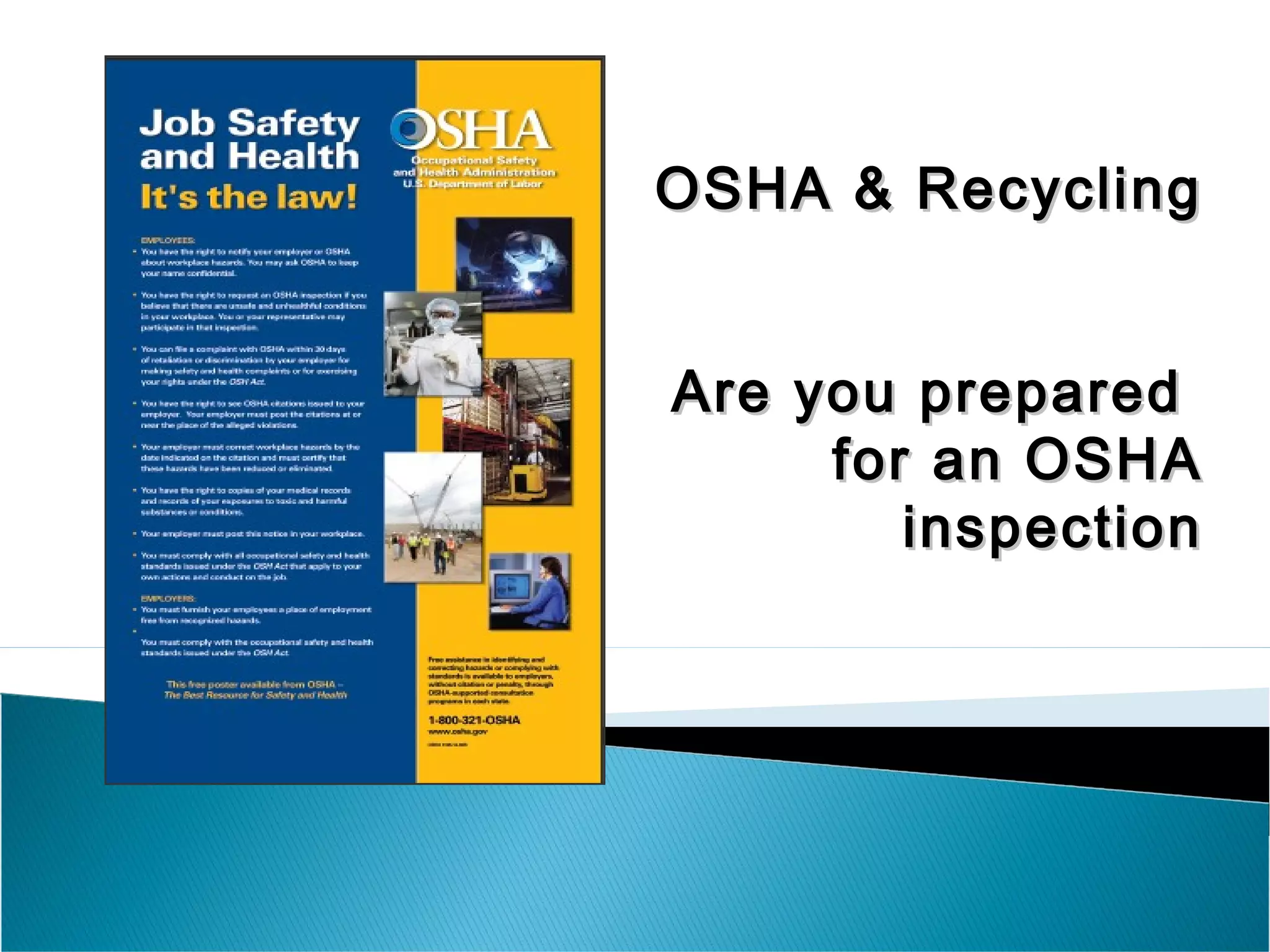
OOSSHHAA && RReeccyycclliinngg 
AArree yyoouu pprreeppaarreedd 
ffoorr aann OOSSHHAA 
iinnssppeeccttiioonn
Exposures 
 OSHA inspections 
◦ Be prepared 
◦ Anyone have experience with an OSHA inspection 
 Recycling Industry – some exposures 
◦ Hazard Communications GHS 12/1/2013 
◦ Fork lift & end loader use 
◦ Personal protection equipment 
◦ Machine guarding & lock out / tag out 
◦ Confined space 
◦ Slips and falls 
◦ Heat exhaustion 
2
OSHA Statistics 
 2014 budget – Federal $552M 
◦ Over 4,000 fatalities per year 
◦ Inspections done in 2013 
 Federal 39,228 
 State 50,436 
 OSHA inspections has been steady for at least five years 
 OSHA violations increased more than fivefold from 2007 to 2010 
 Some top cited standards for general industry 
◦ Hazard Communications - GHS 
◦ Scaffolding 
◦ PPE - Respiratory protection 
◦ Lock out / Tag out 
◦ Machine guarding 
3
Citations 
 From Recycling Today 
◦ Failure to train for use of PPE – proposed $51,800 
◦ No confined space policy , no enforced lock out / tag out 
 $400,000 fine & placed in severe violator program 
◦ IL recycling company – $64,000 
 OSHA statistics for recycling services 
◦ 20 deaths per 100,000 workers 
◦ 5 times greater than all other general industries 
 Conveyors and bailers 
◦ Amputation and pinched 
 End loaders / fork lifts – used in your businesses 
 15% of all fatalities in the Midwest were stuck buy – KC office #7 
4
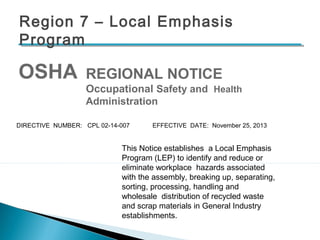
Region 7 – Local Emphasis 
Program 
5 
OSHA REGIONAL NOTICE 
Occupational Safety and Health 
Administration 
DIRECTIVE NUMBER: CPL 02-14-007 EFFECTIVE DATE: November 25, 2013 
This Notice establishes a Local Emphasis 
Program (LEP) to identify and reduce or 
eliminate workplace hazards associated 
with the assembly, breaking up, separating, 
sorting, processing, handling and 
wholesale distribution of recycled waste 
and scrap materials in General Industry 
establishments.
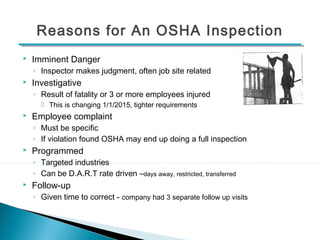
Reasons for An OSHA Inspection 
 Imminent Danger 
◦ Inspector makes judgment, often job site related 
 Investigative 
◦ Result of fatality or 3 or more employees injured 
 This is changing 1/1/2015, tighter requirements 
 Employee complaint 
◦ Must be specific 
◦ If violation found OSHA may end up doing a full inspection 
 Programmed 
◦ Targeted industries 
◦ Can be D.A.R.T rate driven –days away, restricted, transferred 
 Follow-up 
◦ Given time to correct - company had 3 separate follow up visits 
6
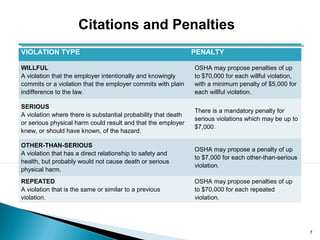
VIOLATION TYPE PENALTY 
WILLFUL 
A violation that the employer intentionally and knowingly 
commits or a violation that the employer commits with plain 
indifference to the law. 
OSHA may propose penalties of up 
to $70,000 for each willful violation, 
with a minimum penalty of $5,000 for 
each willful violation. 
SERIOUS 
A violation where there is substantial probability that death 
or serious physical harm could result and that the employer 
knew, or should have known, of the hazard. 
There is a mandatory penalty for 
serious violations which may be up to 
$7,000. 
OTHER-THAN-SERIOUS 
A violation that has a direct relationship to safety and 
health, but probably would not cause death or serious 
physical harm. 
OSHA may propose a penalty of up 
to $7,000 for each other-than-serious 
violation. 
REPEATED 
A violation that is the same or similar to a previous 
violation. 
OSHA may propose penalties of up 
to $70,000 for each repeated 
violation. 
7 
Citations and Penalties
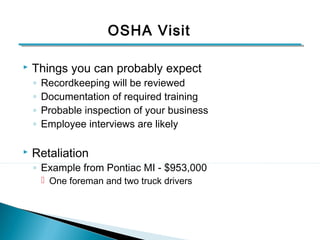
OSHA Visit 
 Things you can probably expect 
◦ Recordkeeping will be reviewed 
◦ Documentation of required training 
◦ Probable inspection of your business 
◦ Employee interviews are likely 
 Retaliation 
◦ Example from Pontiac MI - $953,000 
 One foreman and two truck drivers 
8
Recordkeeping 
 Who has to keep 
 10 employees or more 
 defined – if at anytime in the previous year you have had 10 full time, part time, temporary or seasonal (for entire 
company) 
◦ OSHA logs last 5 years 
 Keep for easy access 
◦ 300a gets posted annually & 301 is best or equivalent 
◦ New reporting rules 1/1/2015 
◦ Medical surveillance 
 Any industrial hygiene testing – noise / air quality 
◦ MSDS (GHS) books – now safety data sheet 
 The Globally Harmonized System of Classification and Labeling of Chemicals 
9
Documentation & Training 
 Written programs for your exposures 
◦ Need to have policy established 
◦ The policy must be actively used 
 Accountability for enforcement of polices 
 Training needs to be on-going 
◦ New hires 
◦ Refresher – varies by type of exposure 
◦ Documented 
 May look only at paperwork / policies 
◦ If missing training programs - !!! 
10
 Invite inspector in 
◦ Examine the credentials- you can call regional office 
◦ Ask for the purpose of the visit 
◦ Provide a room with privacy for inspector 
 If you have outside support contact them 
 Determine how to handle inspection 
◦ Train for a visit 
◦ Provide someone to go with the inspector 
 This person should know all written safety programs 
 Operations of facility – to answer questions 
11 
How to Interact with OSHA
 Are they there for specific issue 
 Do not chit – chat 
◦ Answer only those questions when asked 
◦ Make sure management person knows employer's rights 
 If there is a fix – do it right away 
 Take before and after pictures 
 If inspector takes a photo/ video – do the same 
 Take good notes during post inspection conference 
12 
How to Interact with OSHA
Interviews 
 Be prepared 
◦ Inspections result when something is identified 
◦ Can happen before OSHA walks through the door 
◦ Preplanning ** 
 Interviews with employees 
◦ This will probably happen 
◦ Can not interfere 
 Manager & owners - cannot be part of the discussion 
 Temporary employees 
◦ Treated as if a regular employee 
◦ Including all training and safety policies 
13
Site Inspection 
 OSHA – walk through 
◦ They will look for physical hazards 
 OSHA Will observe employee behavior 
 Evaluate non-compliance 
 With your representative during walk through 
 Conversations with employees should not disrupt 
 Anything said can be used as evidence 
◦ Know your rights under the law 
◦ Employee complaint – walk direct to area of concern 
14
 Provide workplace free from recognized hazards 
 Understand what regulations are for your industry 
 Provide training required 
◦ enforce and keep training records 
 Keep OSHA logs - records of injuries and illnesses 
 Meet requirements for hearing tests / air quality 
 Provide and pay for PPE 
15 
Be prepared
The OSHA SST Plan 
 Site Specific Targeting – 2014 no official list 
◦ It is the OSHA list with priorities - 23,000, 1,900 , 117 
◦ Based on D.A.R.T rates 
 Days Away - Restricted - transferred (as report on OSHA 300) 
 ( N/E ) times 200,000 
 N- number of cases with days away from work 
 E – total numbers of hours worked by all employees 
◦ What is good & what is not 
 A DART of 15 or higher – general industry you are on the list 
 Manufacturing – 7 or higher 
◦ 30 employees working full time ( 2,000 hours), 5 cases 
◦ (5/60,000) * 200,000 = 17 
16
For more information 
 I have several documents I can email you 
◦ How to interact with an OSHA inspector 
◦ Managing an OSHA inspection 
◦ OSHA SST document for 2014 
◦ Preparing for an OSHA visit 
◦ NEW OSHA reporting requirements 
◦ Send email to : mark.hermann@molyneaux.com 
17

OSHA Solid Waste Presentation

  • 1.
    OOSSHHAA && RReeccyycclliinngg AArree yyoouu pprreeppaarreedd ffoorr aann OOSSHHAA iinnssppeeccttiioonn
  • 2.
    Exposures  OSHAinspections ◦ Be prepared ◦ Anyone have experience with an OSHA inspection  Recycling Industry – some exposures ◦ Hazard Communications GHS 12/1/2013 ◦ Fork lift & end loader use ◦ Personal protection equipment ◦ Machine guarding & lock out / tag out ◦ Confined space ◦ Slips and falls ◦ Heat exhaustion 2
  • 3.
    OSHA Statistics 2014 budget – Federal $552M ◦ Over 4,000 fatalities per year ◦ Inspections done in 2013  Federal 39,228  State 50,436  OSHA inspections has been steady for at least five years  OSHA violations increased more than fivefold from 2007 to 2010  Some top cited standards for general industry ◦ Hazard Communications - GHS ◦ Scaffolding ◦ PPE - Respiratory protection ◦ Lock out / Tag out ◦ Machine guarding 3
  • 4.
    Citations  FromRecycling Today ◦ Failure to train for use of PPE – proposed $51,800 ◦ No confined space policy , no enforced lock out / tag out  $400,000 fine & placed in severe violator program ◦ IL recycling company – $64,000  OSHA statistics for recycling services ◦ 20 deaths per 100,000 workers ◦ 5 times greater than all other general industries  Conveyors and bailers ◦ Amputation and pinched  End loaders / fork lifts – used in your businesses  15% of all fatalities in the Midwest were stuck buy – KC office #7 4
  • 5.
    Region 7 –Local Emphasis Program 5 OSHA REGIONAL NOTICE Occupational Safety and Health Administration DIRECTIVE NUMBER: CPL 02-14-007 EFFECTIVE DATE: November 25, 2013 This Notice establishes a Local Emphasis Program (LEP) to identify and reduce or eliminate workplace hazards associated with the assembly, breaking up, separating, sorting, processing, handling and wholesale distribution of recycled waste and scrap materials in General Industry establishments.
  • 6.
    Reasons for AnOSHA Inspection  Imminent Danger ◦ Inspector makes judgment, often job site related  Investigative ◦ Result of fatality or 3 or more employees injured  This is changing 1/1/2015, tighter requirements  Employee complaint ◦ Must be specific ◦ If violation found OSHA may end up doing a full inspection  Programmed ◦ Targeted industries ◦ Can be D.A.R.T rate driven –days away, restricted, transferred  Follow-up ◦ Given time to correct - company had 3 separate follow up visits 6
  • 7.
    VIOLATION TYPE PENALTY WILLFUL A violation that the employer intentionally and knowingly commits or a violation that the employer commits with plain indifference to the law. OSHA may propose penalties of up to $70,000 for each willful violation, with a minimum penalty of $5,000 for each willful violation. SERIOUS A violation where there is substantial probability that death or serious physical harm could result and that the employer knew, or should have known, of the hazard. There is a mandatory penalty for serious violations which may be up to $7,000. OTHER-THAN-SERIOUS A violation that has a direct relationship to safety and health, but probably would not cause death or serious physical harm. OSHA may propose a penalty of up to $7,000 for each other-than-serious violation. REPEATED A violation that is the same or similar to a previous violation. OSHA may propose penalties of up to $70,000 for each repeated violation. 7 Citations and Penalties
  • 8.
    OSHA Visit Things you can probably expect ◦ Recordkeeping will be reviewed ◦ Documentation of required training ◦ Probable inspection of your business ◦ Employee interviews are likely  Retaliation ◦ Example from Pontiac MI - $953,000  One foreman and two truck drivers 8
  • 9.
    Recordkeeping  Whohas to keep  10 employees or more  defined – if at anytime in the previous year you have had 10 full time, part time, temporary or seasonal (for entire company) ◦ OSHA logs last 5 years  Keep for easy access ◦ 300a gets posted annually & 301 is best or equivalent ◦ New reporting rules 1/1/2015 ◦ Medical surveillance  Any industrial hygiene testing – noise / air quality ◦ MSDS (GHS) books – now safety data sheet  The Globally Harmonized System of Classification and Labeling of Chemicals 9
  • 10.
    Documentation & Training  Written programs for your exposures ◦ Need to have policy established ◦ The policy must be actively used  Accountability for enforcement of polices  Training needs to be on-going ◦ New hires ◦ Refresher – varies by type of exposure ◦ Documented  May look only at paperwork / policies ◦ If missing training programs - !!! 10
  • 11.
     Invite inspectorin ◦ Examine the credentials- you can call regional office ◦ Ask for the purpose of the visit ◦ Provide a room with privacy for inspector  If you have outside support contact them  Determine how to handle inspection ◦ Train for a visit ◦ Provide someone to go with the inspector  This person should know all written safety programs  Operations of facility – to answer questions 11 How to Interact with OSHA
  • 12.
     Are theythere for specific issue  Do not chit – chat ◦ Answer only those questions when asked ◦ Make sure management person knows employer's rights  If there is a fix – do it right away  Take before and after pictures  If inspector takes a photo/ video – do the same  Take good notes during post inspection conference 12 How to Interact with OSHA
  • 13.
    Interviews  Beprepared ◦ Inspections result when something is identified ◦ Can happen before OSHA walks through the door ◦ Preplanning **  Interviews with employees ◦ This will probably happen ◦ Can not interfere  Manager & owners - cannot be part of the discussion  Temporary employees ◦ Treated as if a regular employee ◦ Including all training and safety policies 13
  • 14.
    Site Inspection OSHA – walk through ◦ They will look for physical hazards  OSHA Will observe employee behavior  Evaluate non-compliance  With your representative during walk through  Conversations with employees should not disrupt  Anything said can be used as evidence ◦ Know your rights under the law ◦ Employee complaint – walk direct to area of concern 14
  • 15.
     Provide workplacefree from recognized hazards  Understand what regulations are for your industry  Provide training required ◦ enforce and keep training records  Keep OSHA logs - records of injuries and illnesses  Meet requirements for hearing tests / air quality  Provide and pay for PPE 15 Be prepared
  • 16.
    The OSHA SSTPlan  Site Specific Targeting – 2014 no official list ◦ It is the OSHA list with priorities - 23,000, 1,900 , 117 ◦ Based on D.A.R.T rates  Days Away - Restricted - transferred (as report on OSHA 300)  ( N/E ) times 200,000  N- number of cases with days away from work  E – total numbers of hours worked by all employees ◦ What is good & what is not  A DART of 15 or higher – general industry you are on the list  Manufacturing – 7 or higher ◦ 30 employees working full time ( 2,000 hours), 5 cases ◦ (5/60,000) * 200,000 = 17 16
  • 17.
    For more information  I have several documents I can email you ◦ How to interact with an OSHA inspector ◦ Managing an OSHA inspection ◦ OSHA SST document for 2014 ◦ Preparing for an OSHA visit ◦ NEW OSHA reporting requirements ◦ Send email to : mark.hermann@molyneaux.com 17

Editor's Notes

  • #2 Helping manage risk manage issue in recycle industry over 20 years Looking at issues that impact profitability OSHA always been there but now more than ever do what is right anyway protecting the greatest asset you have Should not be afraid if OSHA, but they are there to enforce standards And it can cost big money Aware of company in the Midwest that is dealing with over $1M in fines Less than 200 employees Your best approach is to be prepared
  • #3 What was experience like Anyone heard of the OSHA , Site specific Target list – more on that later. I called them and 10 days later they got inspected I think it was a planned by OSHA 50 employees Two days of doing the inspection & about $8,000, after reductions Fines are not tax deductible I look at it this way $8,000 fine, 6% pre-tax profit means over $125,000 needed in revenue to pay for that fine Heat exhaustion – probably going to be a new area of emphasis for all classifications. Signs and short story of case, several days in hospital and long recovery time $52,000 total for WC case, $20K medical
  • #4 These are national statistics Inspections remain steady but fines are increasing Point out Iowa just hired for 2014 4 or 5 more inspectors They are looking at all types of risks but there are emphasis programs Missouri has new emphasis on the recycle industry OSHA has a section on their web site specifically for recycling In red the ones that are listed on the OSHA website How many have done their training for GHS, the new name and procedures for MSDS ( now SDS – safety data sheets) Air quality , LO/TO and machine guarding are on the OSHA radar
  • #5 OHIO plastics recycler – read off sheet Brought on complaint by employee – proved to be totally false Metal recycler – fatality in Illinois , getting inside a piece of equipment. not properly trained along with 4 other workers who were exposed to same risk Conveyor not guarded and no LO/TO procedure Another company with two locations in IL They were on SST list – over 12 serious , 2 repeats ( from previous inspections) Not removing damaged equipment, Had been cited at another location for similar issues, Example $4,000 fine for not replacing a power cord on hand grinder, they had used tape to repair
  • #6 IOWA is a state run OSHA program meet federal OSHA , ability to target local needs Show document from OSHA regional news KC office for KC & St Louis area offices focusing on safety issues in the recycle industry Scope – for general industry where scrap & waste materials are assembled, broken up , sorted and distributed Background Scrap recycling has grown exponentially in the last decade OSHA data from last 54 inspections in Missouri shows: 128 serious violations and an average of 3.8 total violations per inspection
  • #7 imminent danger Guy on ladder – inspector drive by – was in QC times a few years ago, on a step he should not be on, he is over 6 feet not wearing proper clothing for working out doors OSHA would see this as immanent danger Investigative – part of the reason OSHA has hired more field staff More about DART latter 3 follow up visits started with employee complaint which had no validity
  • #8 Just a quick look at what the cost is for the main types of penalties It can be much more than fines Negotiate , make case for less than serious violation Serious – reduce citation to other than serious Serious can go to willful if you get cited again
  • #9 If all records & training are perfect you may be done but if not inspection probable Heard comments by owners that they are upset over an employee making problems about safety in the shop. If an employee has concerns address them Company is MI fires three employees for not doing as requested. Of the total $600K was punitive damages, $200K for each person
  • #10 So being prepared starts with record keeping, this is a must. Who needs to keep OSHA logs The OSHA report form 300a & 301 ( or first report of injury) and DART rate New rules on what is required to report to OSHA, some in just 8 hours You need to be up to speed on this I have several documents I can send you that gives you the general guideline Be proactive If you have a dusty environment – probably should be testing air quality Noise is good idea to do too, depends on your type of operation, inside or out
  • #11 Use documentation to keep on ALL training Even tool box talks If not on one of their lists, you can shorten an OSHA when you have all your documentation in place
  • #12 Have a written policy on what to do if OSHA visits
  • #14 manage the process of an OSHA inspection Present the company in the most favorable light When having OSHA doing a walk through take them through the same orientation as any other visitor It must be part of your normal visitor procedures Instructions on alarms, what they mean, evacuation procedures, use of PPE and even a video. Interviews should be short and not disruptive
  • #15 Orientation process is very important to develop for visitors I do not see this enough Know your rights under the law If employee complaint – take direct to work station or issue, do not need to walk through entire building unless that is the only way to location