The Iron Lady
Group Project
Plot Synopsis

Influences Of
the Iron Lady

Leadership
Theories

Motivational
Theories

Organizational
Culture

Effectiveness

Power and
Position

Implications
To H+SC
References
Plot Synopsis/History
•
•

•

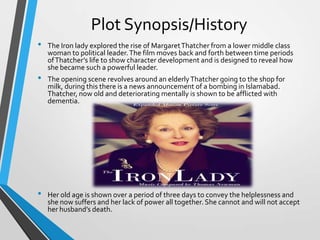
The Iron lady explored the rise of Margaret Thatcher from a lower middle class
woman to political leader. The film moves back and forth between time periods
of Thatcher’s life to show character development and is designed to reveal how
she became such a powerful leader.
The opening scene revolves around an elderly Thatcher going to the shop for
milk, during this there is a news announcement of a bombing in Islamabad.
Thatcher, now old and deteriorating mentally is shown to be afflicted with
dementia.

Her old age is shown over a period of three days to convey the helplessness and
she now suffers and her lack of power all together. She cannot and will not accept
her husband’s death.
Leadership
•

•

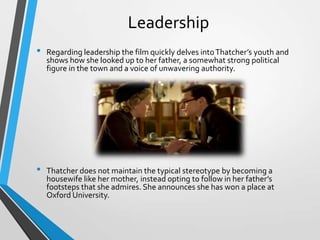
Regarding leadership the film quickly delves into Thatcher’s youth and
shows how she looked up to her father, a somewhat strong political
figure in the town and a voice of unwavering authority.

Thatcher does not maintain the typical stereotype by becoming a
housewife like her mother, instead opting to follow in her father’s
footsteps that she admires. She announces she has won a place at
Oxford University.
Identity
•

•
•
•

The film then proceeds to highlight the struggle of branching
out into politics and the problems a young lower middle class
Thatcher faces.
The conservative party is dominated by rich and somewhat
upper class characters. After more developments including the
marriage proposal from Denis Thatcher she ultimately rises to
leader of the Conservative party.
Interestingly, the film depicts the great changes Thatcher had
to undergo to appear more presentable and lady like in order
to win.
After this there are further flashbacks showing the many
problems she faced such as the miner’s strikes, Brixton
riot, bombings which nearly claimed her life and the build up to
the Falkland’s war.
Identity
•
•

•

After the relative success of the war the film moves into Thatcher’s
later political life and her subsequent fall from grace.
Her adamant refusal to move the UK into greater European
integration and more riots in the face of the community charge
reveal the gradual loss of party support and confidence.

Ultimately this leads to a show of no confidence within her cabinet
and strained relationships followed by a leadership challenge by
Michael Hesletine. The next scenes show Thatcher leaving 10
Downing street with her husband and how it still affects her in the
present.
The Iron Lady

•

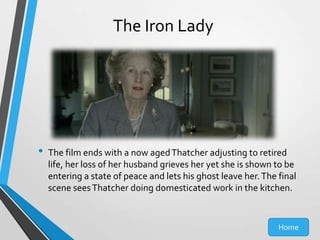
The film ends with a now aged Thatcher adjusting to retired
life, her loss of her husband grieves her yet she is shown to be
entering a state of peace and lets his ghost leave her. The final
scene sees Thatcher doing domesticated work in the kitchen.

Home
Influences Of the Iron Lady
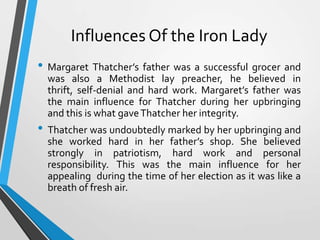
• Margaret Thatcher’s father was a successful grocer and
was also a Methodist lay preacher, he believed in
thrift, self-denial and hard work. Margaret’s father was
the main influence for Thatcher during her upbringing
and this is what gave Thatcher her integrity.

• Thatcher was undoubtedly marked by her upbringing and
she worked hard in her father’s shop. She believed
strongly in patriotism, hard work and personal
responsibility. This was the main influence for her
appealing during the time of her election as it was like a
breath of fresh air.
Influences Of the Iron Lady
•
•

•

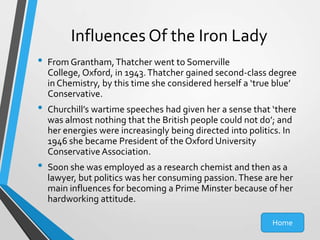
From Grantham, Thatcher went to Somerville
College, Oxford, in 1943. Thatcher gained second-class degree
in Chemistry, by this time she considered herself a ‘true blue’
Conservative.
Churchill’s wartime speeches had given her a sense that ‘there
was almost nothing that the British people could not do’; and
her energies were increasingly being directed into politics. In
1946 she became President of the Oxford University
Conservative Association.
Soon she was employed as a research chemist and then as a
lawyer, but politics was her consuming passion. These are her
main influences for becoming a Prime Minster because of her
hardworking attitude.
Home
•

•

Leadership Theories
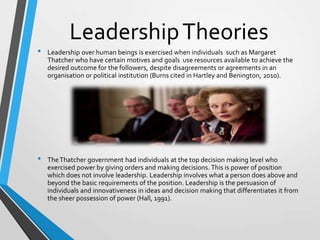
Leadership over human beings is exercised when individuals such as Margaret
Thatcher who have certain motives and goals use resources available to achieve the
desired outcome for the followers, despite disagreements or agreements in an
organisation or political institution (Burns cited in Hartley and Benington, 2010).

The Thatcher government had individuals at the top decision making level who
exercised power by giving orders and making decisions. This is power of position
which does not involve leadership. Leadership involves what a person does above and
beyond the basic requirements of the position. Leadership is the persuasion of
individuals and innovativeness in ideas and decision making that differentiates it from
the sheer possession of power (Hall, 1991).
Charismatic Leadership
•

•
•
•

Charismatic leaders are self- confidant, have qualities which set them apart from
others especially personality while their presence instil hope in teams and among
followers.

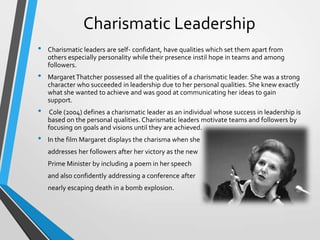
Margaret Thatcher possessed all the qualities of a charismatic leader. She was a strong
character who succeeded in leadership due to her personal qualities. She knew exactly
what she wanted to achieve and was good at communicating her ideas to gain
support.
Cole (2004) defines a charismatic leader as an individual whose success in leadership is
based on the personal qualities. Charismatic leaders motivate teams and followers by
focusing on goals and visions until they are achieved.
In the film Margaret displays the charisma when she
addresses her followers after her victory as the new
Prime Minister by including a poem in her speech
and also confidently addressing a conference after
nearly escaping death in a bomb explosion.
Transactional Leadership
•

•

•
•

It was evident in the film that Margaret Thatcher exhibited a transactional
style of leadership. Mckimm and Phillips (2009) suggest that transactional
leadership takes place within a hierarchical structure like Margaret Thatcher`s
government in which she had power and authority over those beneath her but
was accountable to the parliament.
Her relationship with others was primarily defined through the nature of
transactions occurring within the government. Transactional leaders make
team members achieve organisational objectives through rewards and
punishment. Her relationship with her closest colleagues became so strained
that reprimands were issued.
This was demonstrated in the film when she dismissed three cabinet ministers
in an attempt to build a cabinet in line with her economic thinking.
Transactional leadership is centred on the idea that team members agree to
obey the leader. One of the ministers released a statement that he had been
dismissed because he was against the government`s economic policy.
Authoritarian-Autocratic Leadership
•

•

•

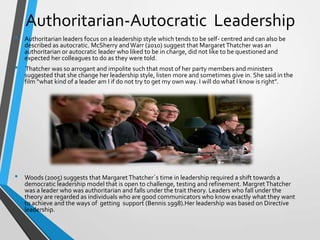
Authoritarian leaders focus on a leadership style which tends to be self- centred and can also be
described as autocratic. McSherry and Warr (2010) suggest that Margaret Thatcher was an
authoritarian or autocratic leader who liked to be in charge, did not like to be questioned and
expected her colleagues to do as they were told.

Thatcher was so arrogant and impolite such that most of her party members and ministers
suggested that she change her leadership style, listen more and sometimes give in. She said in the
film “what kind of a leader am I if do not try to get my own way. I will do what I know is right”.

Woods (2005) suggests that Margaret Thatcher`s time in leadership required a shift towards a
democratic leadership model that is open to challenge, testing and refinement. Margret Thatcher
was a leader who was authoritarian and falls under the trait theory. Leaders who fall under the
theory are regarded as individuals who are good communicators who know exactly what they want
to achieve and the ways of getting support (Bennis 1998).Her leadership was based on Directive
leadership.
Authoritarian-Autocratic
Leadership
•

•
•
•
•

The way of leadership can be effective in decision-making and achieving goals. This
was evident in the film as she made the decision to go to war in the Faulkland Islands.
On the other hand it can lead to lack of morale in teams and a feeling of not being
valued and rebellion from subordinates. Authoritarian leaders can end up being
unpopular in teams due to the autocratic style of leadership. Margret Thatcher had to
resign after her leadership was challenged and due the decline in support after serving
two terms. Authoritarian leaders tend to focus on personal opinions and goals if they
believe they are being true to their own values, this was Margret Thatcher`s downfall.
Under democratic leadership she could have created an environment in which:
• people are encouraged and supported
• people look for ways of superseding difference through dialogue
• people are active contributors

It was evident in the film that Margaret Thatcher had a strained relationship with her
closest colleagues. She failed to meet most of the factors that are associated with an
effective leader. Her leadership behaviour impacted upon their behaviour and
attitude. Leadership is a dynamic process and there is no one style of leadership that is
successful at all times. She could have adopted different leadership styles in different
situations (Cole and Kelly, 2004; Hall,1991).

Home
Motivational Theories.
•

•

With reference from the film “Iron Lady” it could be said that there cannot be
change without effective leadership. Poor leadership can be one of the causes
of
de-motivation which in turn can lead to poor production, low
productivity, strikes and disputes over pay among others suggests (Burns
1978).
However it is significant to be aware that every leader requires to be motivated
and that each leader’s motivation can differ with that of others. In the film it is
clear that Britain as a nation was going through tough times during the era that
Thatcher came into power and that there were problems for instance on
economic growth , strikes ,unemployment and gender issues among others. It
could be argued that motivation is significant if high productivity and better
quality of work with less wastage is to be realised.
Motivational theories
•

•

Motivation is hard to define but Rubin and McNeil , (1985)
cited in (Gross,2001) suggest that it is an idea used to
describe the reasons within an individual which stimulate
, maintain and direct behaviour towards a goal. Geen(1995)
would agree with Rubin and McNeil (1985) as he contends
that ‘motivation refers ,in general sense ,to processes
involved in the initiation, direction , and energization of
individual behaviour ‘.
In the film the Prime minister’s goals and the motivational
system were tailored to the situations that affected Britain at
the time. It can be deduced from the above definitions that
motivation has a strong connection with human nature and
to better understand the link ,motivational theories would
be helpful.
Motivational Theories
•

•

The two approaches in understanding motivational theories are either through
content theories (what makes people tick) or process theories (how people
behave).

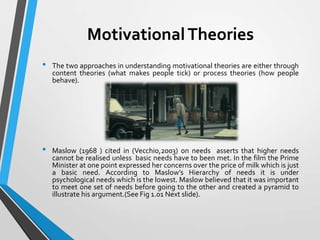
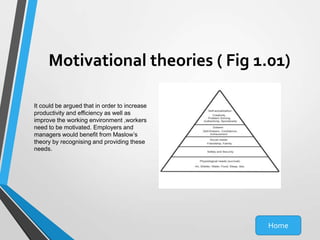
Maslow (1968 ) cited in (Vecchio,2003) on needs asserts that higher needs
cannot be realised unless basic needs have to been met. In the film the Prime
Minister at one point expressed her concerns over the price of milk which is just
a basic need. According to Maslow’s Hierarchy of needs it is under
psychological needs which is the lowest. Maslow believed that it was important
to meet one set of needs before going to the other and created a pyramid to
illustrate his argument.(See Fig 1.01 Next slide).
Motivational theories ( Fig 1.01)
It could be argued that in order to increase
productivity and efficiency as well as
improve the working environment ,workers
need to be motivated. Employers and
managers would benefit from Maslow’s
theory by recognising and providing these
needs.

Home
Organizational Culture of Thatcher’s
Conservative Party
•

•

According to Business dictionary.com organisational culture is made up with unique
values and behaviours that are unique to the organisation. It also suggests that
organisational culture is controlled by written rules and unwritten rules(What is
organizational culture, n.d.). This applies to Margaret Thatcher as the rules that she
and the tory party set, are followed by the public. This means that the organisational
culture of the Conservative party influences the countries culture.
In the film we watched about the charismatic leader Margaret Thatcher, we noticed
that the organisational culture in the Conservative party changed due to Margaret
Thatcher. At first the organisational culture of the Government, due to Labour being
in charge, was more left wing and believed in things such as socialism
furthermore, there were not many female MPs and woman were not taken seriously.
Organizational Culture of
Thatcher’s Conservative Party
•

•

However, as Margaret Thatcher came into power she became the first lady to
run the country. The organisational culture of the Government changed as there
was an increase in female MPs, furthermore, women were given more respect
leading to them being given more power after Thatcher’s reign.

The Conservative party beliefs involve believing in personal responsibility of
the individual in society furthermore believing in personal wealth and property.
A key part of their culture is believing in society being a free market and that
Government should be involved in business (Political Ideologies and
parties, 2010).
Organizational culture in Health
and Social Care
•

In health and social care, practitioners must share the same
values in an organisation in order for practitioners to avoid
problems. This is true as if all practitioners share the same
values they can all strive together to achieve their goal as an
organization. This is evident in the Iron Lady as when every MP
had the same values in the tory cabinet they led England to its
biggest economic boom in decades in the late 80s, however
due to people having different values in the organization
resulted in Margaret Thatcher’s resignation as many MPs
challenged her leadership.
Four Types of Organizational
Culture
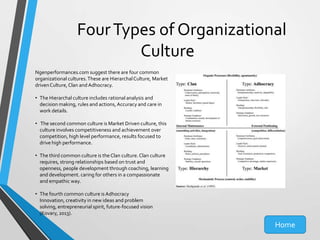
Ngenperformances.com suggest there are four common
organizational cultures. These are Hierarchal Culture, Market
driven Culture, Clan and Adhocracy.
• The Hierarchal culture includes rational analysis and
decision making, rules and actions, Accuracy and care in
work details.
• The second common culture is Market Driven culture, this
culture involves competitiveness and achievement over
competition, high level performance, results focused to
drive high performance.
• The third common culture is the Clan culture. Clan culture
requires, strong relationships based on trust and
openness, people development through coaching, learning
and development. caring for others in a compassionate
and empathic way.
• The fourth common culture is Adhocracy
Innovation, creativity in new ideas and problem
solving, entrepreneurial spirit, future-focused vision
(Kovary, 2013).

Home
The Effectiveness Of Margaret Thatcher
•

•
•
•

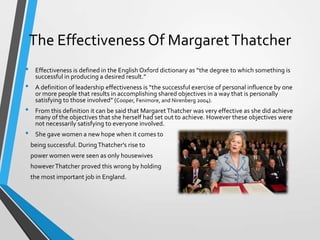
Effectiveness is defined in the English Oxford dictionary as “the degree to which something is
successful in producing a desired result.”

A definition of leadership effectiveness is “the successful exercise of personal influence by one
or more people that results in accomplishing shared objectives in a way that is personally
satisfying to those involved” (Cooper, Fenimore, and Nirenberg 2004).
From this definition it can be said that Margaret Thatcher was very effective as she did achieve
many of the objectives that she herself had set out to achieve. However these objectives were
not necessarily satisfying to everyone involved.
She gave women a new hope when it comes to
being successful. During Thatcher's rise to
power women were seen as only housewives
however Thatcher proved this wrong by holding
the most important job in England.
The Effectiveness Of Margaret
Thatcher
•

•

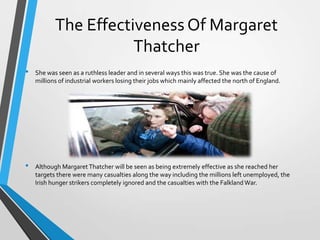
She was seen as a ruthless leader and in several ways this was true. She was the cause of
millions of industrial workers losing their jobs which mainly affected the north of England.

Although Margaret Thatcher will be seen as being extremely effective as she reached her
targets there were many casualties along the way including the millions left unemployed, the
Irish hunger strikers completely ignored and the casualties with the Falkland War.
The Effectiveness Of Margaret
Thatcher
•

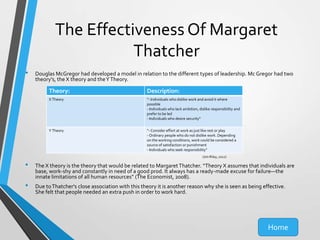
Douglas McGregor had developed a model in relation to the different types of leadership. Mc Gregor had two
theory's, the X theory and the Y Theory.

Theory:

Description:

X Theory

“- Individuals who dislike work and avoid it where
possible
- Individuals who lack ambition, dislike responsibility and
prefer to be led
- Individuals who desire security”

Y Theory

“- Consider effort at work as just like rest or play
- Ordinary people who do not dislike work. Depending
on the working conditions, work could be considered a
source of satisfaction or punishment
- Individuals who seek responsibility”
(Jim Riley, 2012)

•
•

The X theory is the theory that would be related to Margaret Thatcher. “Theory X assumes that individuals are
base, work-shy and constantly in need of a good prod. It always has a ready-made excuse for failure—the
innate limitations of all human resources” (The Economist, 2008).
Due to Thatcher's close association with this theory it is another reason why she is seen as being effective.
She felt that people needed an extra push in order to work hard.

Home
Power and Position
Power

•

•

Power means the ability to control people, happenings, actions and procedures.
It is used by leaders to achieve targets, purposes, objectives and ambitions.
Wagner (1983) mentions power as the capacity that an individual has to influence
behaviour, values and attitudes, so that other individuals will conform and obey
and act in agreement with the leader’s demands and achieving set goals.
Richmond (1977) says that effectiveness is influenced by the leader's power.
Power may be perceived in either a positive or negative way dependent on how
the individual leader approaches different matters.
The Iron Lady asks questions about the effect of power on family and
identity, but it never doubts that Margaret Thatcher went into politics for the
right reasons. The film endorses her belief that "one must matter” and that
politics is the way to realise such an ambition. Thatcher grasped her power by
being an advocate of privatising state-owned industries and utilities, reforming
trade unions, lowering taxes and reducing social expenditure across the board.
Thatcher's policies succeeded in reducing inflation, but unemployment
dramatically increased during her years in power. This has led to The Iron Lady
being accused of de-politicization, but in fact the film’s retreat itself serves the
ideological agenda of a leader who famously proclaimed that “there’s no such
thing as society.”
Power Styles
According to Robbins et al (2009) power has 7 different styles:1. Reward

•

This is where the leader offers a reward to their followers for completing
tasks. This could be closely linked to transactional leadership as the
followers are rewarded for their work. This form of power allows
followers to feel that they are appreciated for what they have achieved.
Thus motivating them to work in a specific manner, to achieve the
targets set. However, this may result in followers expecting a reward
constantly. Leaders need to prevent followers becoming accustomed to
rewards because if they are not given a reward it can cause negative
impact on their performance. In the film Thatcher struggles with the
Conservative old guard accounted for much of her appeal. Thatcher’s
presentation of herself as someone intolerant of vested interests of all
kinds allowed her to strike an “egalitarian tone” that, in turn, enabled the
Conservatives to reinvent themselves as a populist party. Thatcher’s
political policies were what motivated her to pursue them, what their
effects were rewards to her followers promoting independence and hard
work (Aitken 2013).
Power Styles
2. Coercive

•
•

Coercive power is based on fear, as the followers act to avoid punishment. This
form of power can ensure that the task and goal is met effectively. On the other
hand, goals can only be met due to the psychological control the leader has, the
followers will never willing trust or be loyal to a leader that uses this power style.
Thatcher caused people to thrive due to the fear of being disciplined. This is not a
positive style of power, as it further demonstrates the power
struggles, leadership examples and inequalities, affecting the structure of the
government. People were scared of her.

3. Legitimate

•

Legitimate power is when the followers believe that the leader has ‘the right’ to
instruct them and they have an obligation to follow. The positive impact of this
style is that the followers believe that the leader is correct. Hence, they will
follow all instructions accordingly. If Thatcher makes the wrong decisions the
followers will believe them to be sustainable, they will not question her
judgements but will act upon it.
Power Styles
4. Formal

•

Similarly to legitimate power, formal power is based on the individual’s position
within an organisation. The higher an individual is within the organisation
strongly correlates to the amount of authority they have over others. This form of
power can become problematic if the leader begins to implement the wrong
procedures, which in affect can disempower the followers. Thatcher and her
party both make use of this power style, as both are deemed to have high ranking
within the government. However, she uses authority and position to try to
benefit others; utilises her authority to gain control to further her position.

5. Expert

•

Expert power is when the followers believe an individual has the knowledge and
skills, which qualifies them as a leader. The encouraging impact of this style is
that the expert knowledge can be passed on to the followers and they can
develop, by becoming self-actualised. For example, passed on her
knowledge, this led to divulging the information to other people, the public, and
the other parties which affected them. Arguably, the knowledge and skills passed
on to the followers could indeed be misused. This can be seen throughout the
film in relation to her character as she uses the skills and knowledge she has
gained to expose the vulnerabilities of others.
Power Styles
6. Referent

•

This form of power is when followers believe that the leader possesses qualities
that they admire and would like to possess themselves. Therefore they wish to
work alongside the leader to gain these qualities, enabling them to develop as an
individual. Thatcher appears to have some qualities that followers admire i.e.
determination, courage, stamina, motivation, sacrifice, dedication and
inspiration. These qualities are recognised by the public as ideal characteristics
needed to enable to progress as a leader.

7. Personal

•

Personal power is where a leader does not need a formal position to lead as it is
based upon the individual’s characteristics. The constructive impact of this style is
that the leader already has the personal qualities to lead. Therefore they are
valued, respected and have the capacity to become a positive leader. Thatcher is
a prime example of an individual who maintains her dominant characteristics
even when questioned and hated for her high status people still respect and value
her as a leader. On her rise to power, she had to overcome not only sexism, but
class prejudice as the daughter of a Grantham grocer, she came from outside this
made the Conservative Party have high but different expectations for her.

Home
Thatcher's Implications To Health and
Social Care
•

•

Thatcher made implications to healthcare during her reign.
She wanted the patients interest to be put first, and business
managers to be given the power to give opinion on public
services. She stated that, ‘there was little sensitivity to the
preferences and convenience of patients,’ which shows why
she wanted to make changes to the NHS system.
Thatcher introduced The White Paper, ‘Working for Patients’
which aimed to put the patient first and give them multiple
choices of their care. However, due to health services
becoming privatised, the relationship between the state and
citizen was eroded as the working class in society couldn’t
afford to pay for private help, limiting their choice of service.
•

•

Thatcher's Implications To Health
and Social Care
In 1988 Thatcher did a review on the current NHS system which
influenced her to make changes to the policy. This was due to capacity
issues in hospitals and the quality of care given. She created an Act
named the National Health Service and Community Act that would grant
hospitals to be their own governing body, and health authorities
wouldn’t run hospitals but would have to purchase care from hospitals.
Thatcher encouraged the community to use private healthcare and
created insurance premiums to persuade the public.
However, changing the NHS system created problems for the working
class, and fragmented the system as healthcare became too expensive
and health trusts became privatised. For example, the cost of health
doubled from 6% to 12%, the ambulance services were no longer
provided by health authorities and became privatised, Primary and
Secondary care started working against each other and so on.
Thatcher's implications to health
and social care
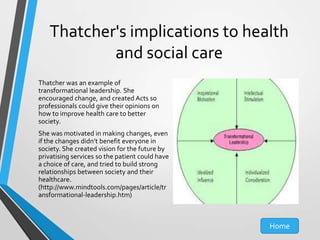
Thatcher was an example of
transformational leadership. She
encouraged change, and created Acts so
professionals could give their opinions on
how to improve health care to better
society.
She was motivated in making changes, even
if the changes didn’t benefit everyone in
society. She created vision for the future by
privatising services so the patient could have
a choice of care, and tried to build strong
relationships between society and their
healthcare.
(http://www.mindtools.com/pages/article/tr
ansformational-leadership.htm)

Home
•
•
•
•
•
•
•
•

References
Bennis, P.,1998. On Becoming a Leader. London:Arrow
Burns.M.J., 1978 . Leadership. New York: Harper and Row

Cole, G., 2004. Management Theory and Practice 6th Edition London
Thomson
Cole, G.A and Kelly, P. 2004. Management Theory and Practice. 7th ed.
Hampshire: Cengage Learning.
Cooper, James Fenimore., and John Nirenberg.. (2004). Leadership
Effectiveness.Available:
http://www.sagepub.com/northouse6e/study/materials/reference/refere
nce6.4.pdf. Last accessed 19th Jan 2014.
Geen, G. R. 1995. Human motivation: A social psychological approach.
Pacific Grove, CA: Brooks/Cole.
Gross.R., 2001. Psychology: The Science of Mind and Behaviour. London:
Hodder and Stoughton
Hall, R.H. 1991. Organisations: Structures, Processes and Outcomes. 5th
ed. London: Prentice Hall International Ltd.
References
•
•
•
•
•
•
•
•
•
•

Hartley, J and Benington, J. 2010. Leadership for Healthcare. Bristol: The Policy Press.
Jonathan Aitken, J.A. 2013. Margaret Thatcher: Power and Personality. Edition Bloomsbury
Continuum.
Kovary, G. (2013, August 22). Types of work cultures. Retrieved from ngenperformance.com:
McGregor, D., 1960. The Human Side of Enterprise New York: McGraw Hill
McGregory.D.,1960. The Human Side of Enterprise. New York :McGraw-Hill
Mckimm, J. and Phillips, K. Eds. 2009. Leadership and Management in Intergrated Services.
Exeter: Learning Matters Ltd
McSherry, R. and Warr, J. Eds. 2010. Health care Organisations: Managing, Leading and
Collaborating. Berkshire: Open University Press.
Oxford English Dictionary. (n/a). Effectiveness. Available:
http://www.oxforddictionaries.com/definition/english/effectiveness. Last accessed 17th Jan
2014.
Polictical Ideologies and parties. (2010, March 18). Retrieved from Mpac.org.uk:
http://www.mpacuk.org/vote/political-ideologies-and-national-parties.html
Riley, J. (2012). Motivation Theory. Available:
http://www.tutor2u.net/business/people/motivation_theory_mcgregor.asp. Last accessed
17th Jan 2014
References
•
•
•
•

•

The Economist. (2008). Theories X and Y. Available:
http://www.economist.com/node/12370445. Last accessed 17th Jan 2014.
The Iron Lady | Film | The Guardian . 2014. [ONLINE] Available at:
http://www.theguardian.com/film/movie/140396/iron-lady. [Accessed 23
January 2014].
Vecchio.P.R., 2003.Organizational behavior : core concepts. Ohio :
Thomson South-Western
Virginia P.Richmond, John P. Wagner, James C. McCroskey. The Impact of
Perceptions of leadership Style, Use of Power, and Conflict Management
Style on Organisational Outcomes. Communication
Quarterly, Vol.31, No.1,Winter. 1983. (online) Available at:
http://www.jamescmccroskey.com/publications/113.pdf. [Accessed 23
January 2014].
Woods, P.A., 2005. Democratic Leadership in Education. London: Sage
Publications.

Home

The Iron Lady Project-11

  • 1.
    The Iron Lady GroupProject Plot Synopsis Influences Of the Iron Lady Leadership Theories Motivational Theories Organizational Culture Effectiveness Power and Position Implications To H+SC References
  • 2.
    Plot Synopsis/History • • • The Ironlady explored the rise of Margaret Thatcher from a lower middle class woman to political leader. The film moves back and forth between time periods of Thatcher’s life to show character development and is designed to reveal how she became such a powerful leader. The opening scene revolves around an elderly Thatcher going to the shop for milk, during this there is a news announcement of a bombing in Islamabad. Thatcher, now old and deteriorating mentally is shown to be afflicted with dementia. Her old age is shown over a period of three days to convey the helplessness and she now suffers and her lack of power all together. She cannot and will not accept her husband’s death.
  • 3.
    Leadership • • Regarding leadership thefilm quickly delves into Thatcher’s youth and shows how she looked up to her father, a somewhat strong political figure in the town and a voice of unwavering authority. Thatcher does not maintain the typical stereotype by becoming a housewife like her mother, instead opting to follow in her father’s footsteps that she admires. She announces she has won a place at Oxford University.
  • 4.
    Identity • • • • The film thenproceeds to highlight the struggle of branching out into politics and the problems a young lower middle class Thatcher faces. The conservative party is dominated by rich and somewhat upper class characters. After more developments including the marriage proposal from Denis Thatcher she ultimately rises to leader of the Conservative party. Interestingly, the film depicts the great changes Thatcher had to undergo to appear more presentable and lady like in order to win. After this there are further flashbacks showing the many problems she faced such as the miner’s strikes, Brixton riot, bombings which nearly claimed her life and the build up to the Falkland’s war.
  • 5.
    Identity • • • After the relativesuccess of the war the film moves into Thatcher’s later political life and her subsequent fall from grace. Her adamant refusal to move the UK into greater European integration and more riots in the face of the community charge reveal the gradual loss of party support and confidence. Ultimately this leads to a show of no confidence within her cabinet and strained relationships followed by a leadership challenge by Michael Hesletine. The next scenes show Thatcher leaving 10 Downing street with her husband and how it still affects her in the present.
  • 6.
    The Iron Lady • Thefilm ends with a now aged Thatcher adjusting to retired life, her loss of her husband grieves her yet she is shown to be entering a state of peace and lets his ghost leave her. The final scene sees Thatcher doing domesticated work in the kitchen. Home
  • 7.
    Influences Of theIron Lady • Margaret Thatcher’s father was a successful grocer and was also a Methodist lay preacher, he believed in thrift, self-denial and hard work. Margaret’s father was the main influence for Thatcher during her upbringing and this is what gave Thatcher her integrity. • Thatcher was undoubtedly marked by her upbringing and she worked hard in her father’s shop. She believed strongly in patriotism, hard work and personal responsibility. This was the main influence for her appealing during the time of her election as it was like a breath of fresh air.
  • 8.
    Influences Of theIron Lady • • • From Grantham, Thatcher went to Somerville College, Oxford, in 1943. Thatcher gained second-class degree in Chemistry, by this time she considered herself a ‘true blue’ Conservative. Churchill’s wartime speeches had given her a sense that ‘there was almost nothing that the British people could not do’; and her energies were increasingly being directed into politics. In 1946 she became President of the Oxford University Conservative Association. Soon she was employed as a research chemist and then as a lawyer, but politics was her consuming passion. These are her main influences for becoming a Prime Minster because of her hardworking attitude. Home
  • 9.
    • • Leadership Theories Leadership overhuman beings is exercised when individuals such as Margaret Thatcher who have certain motives and goals use resources available to achieve the desired outcome for the followers, despite disagreements or agreements in an organisation or political institution (Burns cited in Hartley and Benington, 2010). The Thatcher government had individuals at the top decision making level who exercised power by giving orders and making decisions. This is power of position which does not involve leadership. Leadership involves what a person does above and beyond the basic requirements of the position. Leadership is the persuasion of individuals and innovativeness in ideas and decision making that differentiates it from the sheer possession of power (Hall, 1991).
  • 10.
    Charismatic Leadership • • • • Charismatic leadersare self- confidant, have qualities which set them apart from others especially personality while their presence instil hope in teams and among followers. Margaret Thatcher possessed all the qualities of a charismatic leader. She was a strong character who succeeded in leadership due to her personal qualities. She knew exactly what she wanted to achieve and was good at communicating her ideas to gain support. Cole (2004) defines a charismatic leader as an individual whose success in leadership is based on the personal qualities. Charismatic leaders motivate teams and followers by focusing on goals and visions until they are achieved. In the film Margaret displays the charisma when she addresses her followers after her victory as the new Prime Minister by including a poem in her speech and also confidently addressing a conference after nearly escaping death in a bomb explosion.
  • 11.
    Transactional Leadership • • • • It wasevident in the film that Margaret Thatcher exhibited a transactional style of leadership. Mckimm and Phillips (2009) suggest that transactional leadership takes place within a hierarchical structure like Margaret Thatcher`s government in which she had power and authority over those beneath her but was accountable to the parliament. Her relationship with others was primarily defined through the nature of transactions occurring within the government. Transactional leaders make team members achieve organisational objectives through rewards and punishment. Her relationship with her closest colleagues became so strained that reprimands were issued. This was demonstrated in the film when she dismissed three cabinet ministers in an attempt to build a cabinet in line with her economic thinking. Transactional leadership is centred on the idea that team members agree to obey the leader. One of the ministers released a statement that he had been dismissed because he was against the government`s economic policy.
  • 12.
    Authoritarian-Autocratic Leadership • • • Authoritarian leadersfocus on a leadership style which tends to be self- centred and can also be described as autocratic. McSherry and Warr (2010) suggest that Margaret Thatcher was an authoritarian or autocratic leader who liked to be in charge, did not like to be questioned and expected her colleagues to do as they were told. Thatcher was so arrogant and impolite such that most of her party members and ministers suggested that she change her leadership style, listen more and sometimes give in. She said in the film “what kind of a leader am I if do not try to get my own way. I will do what I know is right”. Woods (2005) suggests that Margaret Thatcher`s time in leadership required a shift towards a democratic leadership model that is open to challenge, testing and refinement. Margret Thatcher was a leader who was authoritarian and falls under the trait theory. Leaders who fall under the theory are regarded as individuals who are good communicators who know exactly what they want to achieve and the ways of getting support (Bennis 1998).Her leadership was based on Directive leadership.
  • 13.
    Authoritarian-Autocratic Leadership • • • • • The way ofleadership can be effective in decision-making and achieving goals. This was evident in the film as she made the decision to go to war in the Faulkland Islands. On the other hand it can lead to lack of morale in teams and a feeling of not being valued and rebellion from subordinates. Authoritarian leaders can end up being unpopular in teams due to the autocratic style of leadership. Margret Thatcher had to resign after her leadership was challenged and due the decline in support after serving two terms. Authoritarian leaders tend to focus on personal opinions and goals if they believe they are being true to their own values, this was Margret Thatcher`s downfall. Under democratic leadership she could have created an environment in which: • people are encouraged and supported • people look for ways of superseding difference through dialogue • people are active contributors It was evident in the film that Margaret Thatcher had a strained relationship with her closest colleagues. She failed to meet most of the factors that are associated with an effective leader. Her leadership behaviour impacted upon their behaviour and attitude. Leadership is a dynamic process and there is no one style of leadership that is successful at all times. She could have adopted different leadership styles in different situations (Cole and Kelly, 2004; Hall,1991). Home
  • 14.
    Motivational Theories. • • With referencefrom the film “Iron Lady” it could be said that there cannot be change without effective leadership. Poor leadership can be one of the causes of de-motivation which in turn can lead to poor production, low productivity, strikes and disputes over pay among others suggests (Burns 1978). However it is significant to be aware that every leader requires to be motivated and that each leader’s motivation can differ with that of others. In the film it is clear that Britain as a nation was going through tough times during the era that Thatcher came into power and that there were problems for instance on economic growth , strikes ,unemployment and gender issues among others. It could be argued that motivation is significant if high productivity and better quality of work with less wastage is to be realised.
  • 15.
    Motivational theories • • Motivation ishard to define but Rubin and McNeil , (1985) cited in (Gross,2001) suggest that it is an idea used to describe the reasons within an individual which stimulate , maintain and direct behaviour towards a goal. Geen(1995) would agree with Rubin and McNeil (1985) as he contends that ‘motivation refers ,in general sense ,to processes involved in the initiation, direction , and energization of individual behaviour ‘. In the film the Prime minister’s goals and the motivational system were tailored to the situations that affected Britain at the time. It can be deduced from the above definitions that motivation has a strong connection with human nature and to better understand the link ,motivational theories would be helpful.
  • 16.
    Motivational Theories • • The twoapproaches in understanding motivational theories are either through content theories (what makes people tick) or process theories (how people behave). Maslow (1968 ) cited in (Vecchio,2003) on needs asserts that higher needs cannot be realised unless basic needs have to been met. In the film the Prime Minister at one point expressed her concerns over the price of milk which is just a basic need. According to Maslow’s Hierarchy of needs it is under psychological needs which is the lowest. Maslow believed that it was important to meet one set of needs before going to the other and created a pyramid to illustrate his argument.(See Fig 1.01 Next slide).
  • 17.
    Motivational theories (Fig 1.01) It could be argued that in order to increase productivity and efficiency as well as improve the working environment ,workers need to be motivated. Employers and managers would benefit from Maslow’s theory by recognising and providing these needs. Home
  • 18.
    Organizational Culture ofThatcher’s Conservative Party • • According to Business dictionary.com organisational culture is made up with unique values and behaviours that are unique to the organisation. It also suggests that organisational culture is controlled by written rules and unwritten rules(What is organizational culture, n.d.). This applies to Margaret Thatcher as the rules that she and the tory party set, are followed by the public. This means that the organisational culture of the Conservative party influences the countries culture. In the film we watched about the charismatic leader Margaret Thatcher, we noticed that the organisational culture in the Conservative party changed due to Margaret Thatcher. At first the organisational culture of the Government, due to Labour being in charge, was more left wing and believed in things such as socialism furthermore, there were not many female MPs and woman were not taken seriously.
  • 19.
    Organizational Culture of Thatcher’sConservative Party • • However, as Margaret Thatcher came into power she became the first lady to run the country. The organisational culture of the Government changed as there was an increase in female MPs, furthermore, women were given more respect leading to them being given more power after Thatcher’s reign. The Conservative party beliefs involve believing in personal responsibility of the individual in society furthermore believing in personal wealth and property. A key part of their culture is believing in society being a free market and that Government should be involved in business (Political Ideologies and parties, 2010).
  • 20.
    Organizational culture inHealth and Social Care • In health and social care, practitioners must share the same values in an organisation in order for practitioners to avoid problems. This is true as if all practitioners share the same values they can all strive together to achieve their goal as an organization. This is evident in the Iron Lady as when every MP had the same values in the tory cabinet they led England to its biggest economic boom in decades in the late 80s, however due to people having different values in the organization resulted in Margaret Thatcher’s resignation as many MPs challenged her leadership.
  • 21.
    Four Types ofOrganizational Culture Ngenperformances.com suggest there are four common organizational cultures. These are Hierarchal Culture, Market driven Culture, Clan and Adhocracy. • The Hierarchal culture includes rational analysis and decision making, rules and actions, Accuracy and care in work details. • The second common culture is Market Driven culture, this culture involves competitiveness and achievement over competition, high level performance, results focused to drive high performance. • The third common culture is the Clan culture. Clan culture requires, strong relationships based on trust and openness, people development through coaching, learning and development. caring for others in a compassionate and empathic way. • The fourth common culture is Adhocracy Innovation, creativity in new ideas and problem solving, entrepreneurial spirit, future-focused vision (Kovary, 2013). Home
  • 22.
    The Effectiveness OfMargaret Thatcher • • • • Effectiveness is defined in the English Oxford dictionary as “the degree to which something is successful in producing a desired result.” A definition of leadership effectiveness is “the successful exercise of personal influence by one or more people that results in accomplishing shared objectives in a way that is personally satisfying to those involved” (Cooper, Fenimore, and Nirenberg 2004). From this definition it can be said that Margaret Thatcher was very effective as she did achieve many of the objectives that she herself had set out to achieve. However these objectives were not necessarily satisfying to everyone involved. She gave women a new hope when it comes to being successful. During Thatcher's rise to power women were seen as only housewives however Thatcher proved this wrong by holding the most important job in England.
  • 23.
    The Effectiveness OfMargaret Thatcher • • She was seen as a ruthless leader and in several ways this was true. She was the cause of millions of industrial workers losing their jobs which mainly affected the north of England. Although Margaret Thatcher will be seen as being extremely effective as she reached her targets there were many casualties along the way including the millions left unemployed, the Irish hunger strikers completely ignored and the casualties with the Falkland War.
  • 24.
    The Effectiveness OfMargaret Thatcher • Douglas McGregor had developed a model in relation to the different types of leadership. Mc Gregor had two theory's, the X theory and the Y Theory. Theory: Description: X Theory “- Individuals who dislike work and avoid it where possible - Individuals who lack ambition, dislike responsibility and prefer to be led - Individuals who desire security” Y Theory “- Consider effort at work as just like rest or play - Ordinary people who do not dislike work. Depending on the working conditions, work could be considered a source of satisfaction or punishment - Individuals who seek responsibility” (Jim Riley, 2012) • • The X theory is the theory that would be related to Margaret Thatcher. “Theory X assumes that individuals are base, work-shy and constantly in need of a good prod. It always has a ready-made excuse for failure—the innate limitations of all human resources” (The Economist, 2008). Due to Thatcher's close association with this theory it is another reason why she is seen as being effective. She felt that people needed an extra push in order to work hard. Home
  • 25.
    Power and Position Power • • Powermeans the ability to control people, happenings, actions and procedures. It is used by leaders to achieve targets, purposes, objectives and ambitions. Wagner (1983) mentions power as the capacity that an individual has to influence behaviour, values and attitudes, so that other individuals will conform and obey and act in agreement with the leader’s demands and achieving set goals. Richmond (1977) says that effectiveness is influenced by the leader's power. Power may be perceived in either a positive or negative way dependent on how the individual leader approaches different matters. The Iron Lady asks questions about the effect of power on family and identity, but it never doubts that Margaret Thatcher went into politics for the right reasons. The film endorses her belief that "one must matter” and that politics is the way to realise such an ambition. Thatcher grasped her power by being an advocate of privatising state-owned industries and utilities, reforming trade unions, lowering taxes and reducing social expenditure across the board. Thatcher's policies succeeded in reducing inflation, but unemployment dramatically increased during her years in power. This has led to The Iron Lady being accused of de-politicization, but in fact the film’s retreat itself serves the ideological agenda of a leader who famously proclaimed that “there’s no such thing as society.”
  • 26.
    Power Styles According toRobbins et al (2009) power has 7 different styles:1. Reward • This is where the leader offers a reward to their followers for completing tasks. This could be closely linked to transactional leadership as the followers are rewarded for their work. This form of power allows followers to feel that they are appreciated for what they have achieved. Thus motivating them to work in a specific manner, to achieve the targets set. However, this may result in followers expecting a reward constantly. Leaders need to prevent followers becoming accustomed to rewards because if they are not given a reward it can cause negative impact on their performance. In the film Thatcher struggles with the Conservative old guard accounted for much of her appeal. Thatcher’s presentation of herself as someone intolerant of vested interests of all kinds allowed her to strike an “egalitarian tone” that, in turn, enabled the Conservatives to reinvent themselves as a populist party. Thatcher’s political policies were what motivated her to pursue them, what their effects were rewards to her followers promoting independence and hard work (Aitken 2013).
  • 27.
    Power Styles 2. Coercive • • Coercivepower is based on fear, as the followers act to avoid punishment. This form of power can ensure that the task and goal is met effectively. On the other hand, goals can only be met due to the psychological control the leader has, the followers will never willing trust or be loyal to a leader that uses this power style. Thatcher caused people to thrive due to the fear of being disciplined. This is not a positive style of power, as it further demonstrates the power struggles, leadership examples and inequalities, affecting the structure of the government. People were scared of her. 3. Legitimate • Legitimate power is when the followers believe that the leader has ‘the right’ to instruct them and they have an obligation to follow. The positive impact of this style is that the followers believe that the leader is correct. Hence, they will follow all instructions accordingly. If Thatcher makes the wrong decisions the followers will believe them to be sustainable, they will not question her judgements but will act upon it.
  • 28.
    Power Styles 4. Formal • Similarlyto legitimate power, formal power is based on the individual’s position within an organisation. The higher an individual is within the organisation strongly correlates to the amount of authority they have over others. This form of power can become problematic if the leader begins to implement the wrong procedures, which in affect can disempower the followers. Thatcher and her party both make use of this power style, as both are deemed to have high ranking within the government. However, she uses authority and position to try to benefit others; utilises her authority to gain control to further her position. 5. Expert • Expert power is when the followers believe an individual has the knowledge and skills, which qualifies them as a leader. The encouraging impact of this style is that the expert knowledge can be passed on to the followers and they can develop, by becoming self-actualised. For example, passed on her knowledge, this led to divulging the information to other people, the public, and the other parties which affected them. Arguably, the knowledge and skills passed on to the followers could indeed be misused. This can be seen throughout the film in relation to her character as she uses the skills and knowledge she has gained to expose the vulnerabilities of others.
  • 29.
    Power Styles 6. Referent • Thisform of power is when followers believe that the leader possesses qualities that they admire and would like to possess themselves. Therefore they wish to work alongside the leader to gain these qualities, enabling them to develop as an individual. Thatcher appears to have some qualities that followers admire i.e. determination, courage, stamina, motivation, sacrifice, dedication and inspiration. These qualities are recognised by the public as ideal characteristics needed to enable to progress as a leader. 7. Personal • Personal power is where a leader does not need a formal position to lead as it is based upon the individual’s characteristics. The constructive impact of this style is that the leader already has the personal qualities to lead. Therefore they are valued, respected and have the capacity to become a positive leader. Thatcher is a prime example of an individual who maintains her dominant characteristics even when questioned and hated for her high status people still respect and value her as a leader. On her rise to power, she had to overcome not only sexism, but class prejudice as the daughter of a Grantham grocer, she came from outside this made the Conservative Party have high but different expectations for her. Home
  • 30.
    Thatcher's Implications ToHealth and Social Care • • Thatcher made implications to healthcare during her reign. She wanted the patients interest to be put first, and business managers to be given the power to give opinion on public services. She stated that, ‘there was little sensitivity to the preferences and convenience of patients,’ which shows why she wanted to make changes to the NHS system. Thatcher introduced The White Paper, ‘Working for Patients’ which aimed to put the patient first and give them multiple choices of their care. However, due to health services becoming privatised, the relationship between the state and citizen was eroded as the working class in society couldn’t afford to pay for private help, limiting their choice of service.
  • 31.
    • • Thatcher's Implications ToHealth and Social Care In 1988 Thatcher did a review on the current NHS system which influenced her to make changes to the policy. This was due to capacity issues in hospitals and the quality of care given. She created an Act named the National Health Service and Community Act that would grant hospitals to be their own governing body, and health authorities wouldn’t run hospitals but would have to purchase care from hospitals. Thatcher encouraged the community to use private healthcare and created insurance premiums to persuade the public. However, changing the NHS system created problems for the working class, and fragmented the system as healthcare became too expensive and health trusts became privatised. For example, the cost of health doubled from 6% to 12%, the ambulance services were no longer provided by health authorities and became privatised, Primary and Secondary care started working against each other and so on.
  • 32.
    Thatcher's implications tohealth and social care Thatcher was an example of transformational leadership. She encouraged change, and created Acts so professionals could give their opinions on how to improve health care to better society. She was motivated in making changes, even if the changes didn’t benefit everyone in society. She created vision for the future by privatising services so the patient could have a choice of care, and tried to build strong relationships between society and their healthcare. (http://www.mindtools.com/pages/article/tr ansformational-leadership.htm) Home
  • 33.
    • • • • • • • • References Bennis, P.,1998. OnBecoming a Leader. London:Arrow Burns.M.J., 1978 . Leadership. New York: Harper and Row Cole, G., 2004. Management Theory and Practice 6th Edition London Thomson Cole, G.A and Kelly, P. 2004. Management Theory and Practice. 7th ed. Hampshire: Cengage Learning. Cooper, James Fenimore., and John Nirenberg.. (2004). Leadership Effectiveness.Available: http://www.sagepub.com/northouse6e/study/materials/reference/refere nce6.4.pdf. Last accessed 19th Jan 2014. Geen, G. R. 1995. Human motivation: A social psychological approach. Pacific Grove, CA: Brooks/Cole. Gross.R., 2001. Psychology: The Science of Mind and Behaviour. London: Hodder and Stoughton Hall, R.H. 1991. Organisations: Structures, Processes and Outcomes. 5th ed. London: Prentice Hall International Ltd.
  • 34.
    References • • • • • • • • • • Hartley, J andBenington, J. 2010. Leadership for Healthcare. Bristol: The Policy Press. Jonathan Aitken, J.A. 2013. Margaret Thatcher: Power and Personality. Edition Bloomsbury Continuum. Kovary, G. (2013, August 22). Types of work cultures. Retrieved from ngenperformance.com: McGregor, D., 1960. The Human Side of Enterprise New York: McGraw Hill McGregory.D.,1960. The Human Side of Enterprise. New York :McGraw-Hill Mckimm, J. and Phillips, K. Eds. 2009. Leadership and Management in Intergrated Services. Exeter: Learning Matters Ltd McSherry, R. and Warr, J. Eds. 2010. Health care Organisations: Managing, Leading and Collaborating. Berkshire: Open University Press. Oxford English Dictionary. (n/a). Effectiveness. Available: http://www.oxforddictionaries.com/definition/english/effectiveness. Last accessed 17th Jan 2014. Polictical Ideologies and parties. (2010, March 18). Retrieved from Mpac.org.uk: http://www.mpacuk.org/vote/political-ideologies-and-national-parties.html Riley, J. (2012). Motivation Theory. Available: http://www.tutor2u.net/business/people/motivation_theory_mcgregor.asp. Last accessed 17th Jan 2014
  • 35.
    References • • • • • The Economist. (2008).Theories X and Y. Available: http://www.economist.com/node/12370445. Last accessed 17th Jan 2014. The Iron Lady | Film | The Guardian . 2014. [ONLINE] Available at: http://www.theguardian.com/film/movie/140396/iron-lady. [Accessed 23 January 2014]. Vecchio.P.R., 2003.Organizational behavior : core concepts. Ohio : Thomson South-Western Virginia P.Richmond, John P. Wagner, James C. McCroskey. The Impact of Perceptions of leadership Style, Use of Power, and Conflict Management Style on Organisational Outcomes. Communication Quarterly, Vol.31, No.1,Winter. 1983. (online) Available at: http://www.jamescmccroskey.com/publications/113.pdf. [Accessed 23 January 2014]. Woods, P.A., 2005. Democratic Leadership in Education. London: Sage Publications. Home