1
PUBLIC SECTOR FINANCIAL
MANAGEMENT
2
Course Title
Course Title
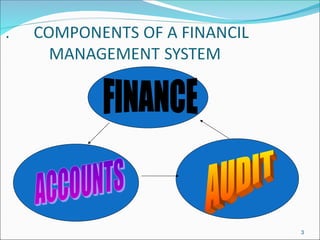
3
4
Responsibility of the Drawing and
Disbursing Officer
 High standards of financial propriety
 Financial Economy
 Observance of Financial Rules and Regulations
 Expenditure within limits of authorised grants
5
PURPOSE OF FINANCIAL MANAGEMENT
 To prevent and detect errors and irregularities
 To guard against loss and wastage of public
money and stores
 To apply prescribed systemic checks effectively
Financial Control in Pakistan
 Doctrine of accountability is essentially a
British concept and is mainly confined to the
countries of the British Commonwealth. It
implies:
 Supreme Authority of the legislation to levy taxes
and approve budget of the government.
 Appointment of Principal Accounting Officer.
 Submission of Appropriation Accounts/ Finance
Accounts.
 An independent audit of the Accounts.
 Appointment by the legislature of a select
committee, the Public Accounts Committee.
6
Accountability Process.
 The Legislature
 The Executive.
 The Controller General of Accounts.
 The Auditor-General of Pakistan.
 The Public Accounts Committee.
7
8
LEGAL FRAMEWORK
 FINANCIAL PROCEDURE UNDER THE
CONSTITUTION
 GENERAL FINANCIAL RULES,
 TREASURY RULES
 DELEGATION of FINANCIAL POWERS RULES,
2001,
 AGP ORDINANCE,2001;
 CGA ORDINANCE<2001.
BUDGET
 An annual budget is the intended
financial plan for a single fiscal year.
 It represents how Government plans to spend
revenue according to certain set priorities.
 A budget document describes planned
activities, funding source and cost.
9
Financial Procedure under the
Constitution
What is a Budget?
 The term Budget is actually derived from a
French word BOUGETTE which means a
sack or pouch or leather bag.
The word “Budget” comes from budjet, a
middle English word for King’s bag
containing the money necessary for public
expenditure.
 Represent the resources available to King
for public use.
 Expended according to State priorities.
Budget Cycle
• Budget formulation
– Executive drafts budget
• Budget enactment
– Minister of Finance presents budget to Provincial
Assembly, debates and approves
• Budget Execution
– Government agencies & departments implement
programme and spend the money
• Budget auditing and assessment
– Agencies and departments report on expenditure
– Auditor General (Supreme Audit Institutions – SAIs)
11
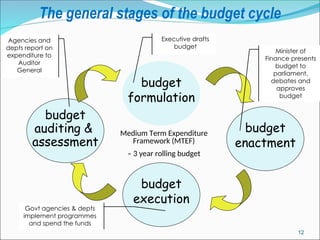
The general stages of the budget cycle
budget
formulation
budget
enactment
budget
execution
budget
auditing &
assessment
Medium Term Expenditure
Framework (MTEF)
– 3 year rolling budget
Executive drafts
budget
Minister of
Finance presents
budget to
parliament,
debates and
approves
budget
Govt agencies & depts
implement programmes
and spend the funds
Agencies and
depts report on
expenditure to
Auditor
General
12
 Consolidated Fund
 Public Account
 Charged Expenditure
 Voted Expenditure
 Annual Budget Statement
 Authentication of Budget
 Schedule of Authorized Expenditure
13
Budget Terminology
Budget Terminology
 Supplementary Budget Statement
 Excess Budget Statement
 Token Grant
 Votes on Account
 Supplementary Grant
 Permanent Budget
 Temporary Budget
14
15
• New item statement (NIS)
• Developmental Expenditure
• Revenue Receipts and Revenue
Expenditure
• Capital Receipts and Capital
Expenditure
16
PROVINCIAL COSOLIDATED FUND
All revenues received by the provincial
Government, all loans raised by that Government,
and all moneys received by it in repayment of any
loan
-Article-118 (1)
17
Public Account
Public Account
All moneys received by or on behalf of the
Provincial Government, other than the
Consolidated Fund, or deposited with the
High Court or any other court established
under the authority of that government shall
constitute Public Account of the Provincial
Government Article: 118(2)
Custody of Consolidated Fund and
Public Account
The Custody of Provincial Consolidated Fund,
the payment of moneys into that Fund, the
withdrawal of money there from, the
custody of other moneys received by or on
behalf of the Provincial Government, their
payment into, and
18
withdrawal from the Public Account shall be regulated
by
Act of the Provincial Assembly or, until provision in
that
behalf is so made, by rules made by the Governor.
Article
119
19
Annual Budget Statement:
Government shall in respect of each financial year
Cause to be laid before the Provincial Assembly,
 A statement of estimated receipts and expenditure for that year;
 Annual Budget Statement should show separately :
 Charged Expenditure; and
 Voted Expenditure
 Approved by the Provincial Assembly before the start of the financial year.
Article 120
20
Charged Expenditure
Remuneration payable to the Governor and
other expenditure to his office;
Judges of the High Court,
Speaker and the Deputy Speaker of the
Provincial Assembly,
Administrative expenses including
remuneration payable to the officers and
staff of the High Court and Secretariat
Provincial Assembly
21
Charged Expenditure (Cont.)
The sums required to satisfy any judgment or decree
against the Province by any court or tribunal,
The debt charges for which the Provincial Government is
liable, including interest, repayment or amortization of
capital, and other expenditure in connection with raising
of loans, and the service and redemption of debt on the
security of the Provincial Consolidated Fund
Any other sums declared by the Constitution or the act of
the Provincial Assembly to be so charged.
(Article:121)
22
Procedure relating to Annual Budget
Statement
Annual Budget Statement
relating to expenditure charged upon Provincial
Consolidated Fund may be discussed in but shall
not be submitted to the vote of the Provincial
Assembly Article 122(1)
So much of the Annual Budget Statement relating
to other expenditure, shall be submitted to the
Provincial Assembly in the form of demands
23
Voted Expenditure Article: 122(2)
for grants, the Assembly shall have power
to assent to, or refuse to assent to, any
demand , or to assent to any demand
subject to a reduction of the amount
specified therein.
24
Demand for Grant
The Form in which expenditure other than
charged is submitted to the Provincial Assembly
No demand for a grant shall be submitted to the
Provincial Assembly except on the
recommendations of the Provincial Government
(Article: 122(3)
25
Authentication of Budget
The Chief Minister shall authenticate by his signature a
schedule specifying--
a) the grants made or deemed to have been made by
the Provincial Assembly under Article 122 and
b) the several sums required to meet the
expenditure charged upon the Provincial
Consolidated Consolidated Fund but not
exceeding the sum shown in the statement
previously laid before the Provincial Assembly
Article 123 (1)
26
Authentication of Budget (Cont.)
c) The Schedule so authenticated shall be laid
before the Provincial Assembly, but shall not
be open to discussion or vote thereon.
d) Subject to the Constitution, no expenditure
from the Provincial Consolidated Fund shall
be deemed to be duly authorized unless it is
specified in the schedule so authenticated
and such Schedule is laid before the
Provincial Assembly
(Article
123(2,3))
27
28
Supplementary Budget Statement.
 A statement regarding additional funds under a
specific/particular object not provided in the original
budget.
 Prepared and approved during the
currency of the financial year.
 Government has the power to authorize
expenditure from the Consolidated Fund.
 The provision of Articles 120 to 123 shall
apply to this statement as they apply to Annual
Budget Statement. Article-124
TokenGrant
A nominal amount included in the
Schedule of Authorised Expenditure
relating to a Supplementary Budget
Statement, of a financial year, for new
service, the expenditure for which is
proposed to be met out by re-appropriation
from the savings in the Grant.
29
30
Excess Budget Statement.
 Statement of the amounts spent in excess of the
authorized budget for a particular year.
 Based on the recommendations of the Public Accounts
Committee on the Appropriation Accounts.
 Prepared and approved after the close of the Financial
Year.
 The provision of Articles 120-123 shall apply to this
statement as they apply to Annual Budget
Statement and Supplementary Budget Statement.
Article- 124
Provincial Assembly has power to make
any grant in advance in respect of
estimated expenditure for a part of any
financial year not exceeding four months
pending completion of the procedure
prescribed in the Constitution for voting
of such grant and authentication of the
schedule of expenditure.
(Article 125)
31
Votes on Account
Votes on Account
Financial Powers of the Provincial Government
when the Assemblies stand dissolved
Provincial Government may authorize
expenditure from the Consolidated Fund for
a period not exceeding four months in any
financial year pending completion of the
procedure prescribed in the Constitution
. Article
126
32
Budget Calendar
33
 Sufficient lead time needs to be allowed to
prepare,review, and revise the
Budget.
 To ensure this a budget calendar should
be prepared and followed.
 A Budget calendar lists each step in the
preparation of budget and the time
allowed for completion.
34
35
Policy setting and issue of Budget
Call Circular
Call Circular
a) Section (I) contains forms, instructions and
procedures for Departmental Strategic Overview
and Strategic Allocation of Ceilings to “outputs
(services) under MTBF and the format of the
Book “Medium Term Budget Estimates for Service
Delivery ” to be prepared by
the Administrative Departments and submitted to
the respective Budget Officers of Finance
Department within the stipulated time period.
36
b) Section (II)
This section contains Budget Preparation Forms (BM
FORMS), Guidelines & Procedures for
Revised Estimates of the current year & Budget
Estimates of the next financial year in respect of
current expenditure & receipts. These forms are intended
to be filled by the Spending Units/DDOs according to the
ceilings provided to them by their respective
Administrative Departments. Departments shall ensure
the timely receipt of these forms from the Spending
Units/DDOs and
forward the same to respective Budget Officers of
Finance Departments within the stipulated time period.
37
Revised Estimates
Revised Estimates
 An estimate of the probable expenditure
during the year of execution.
 Prepared during the year of execution based
on actual expenditure recorded during the
year.
38
Excess/Surrender
 All anticipated Savings must be
surrendered to the Govt. immediately as
they are foreseen but not later than 15th
May, each year. Savings from funds
provided after 15th
May, must be
surrendered but not later than 30th
June.
39
Excess
Excess (i.e. Expenditure for which no provision
has been made in the current year’s original
budget) should not normally be incurred.
Where:
Budgetary factors have changed abnormally or
have been under-estimated it is possible for the
PAO to re-allocate funds, provided they are
available from the saving arising in the same
grant.
40
Provided that the:
• Re-appropriation is not to and from the
establishment budget
• Re-appropriation is authorized before the
expiry of the financial year to which the
Budget relates
• Amount re-appropriated does not exceed any
financial limits as determined by the FD/Deptt:
Excess (Cont)
Excess (Cont)
41
Additional funds to meet an excess may be
provided by:
a) Re-appropriation; or
b) Supplementary grant, if the necessary funds
cannot be arranged by re-appropriation.
Excess (Cont)
Excess (Cont)
42
The transfer of funds from one unit to
another unit to meet excess expenditure
anticipated under a unit.
It is within the same grant
a)
a) Re-appropriation
Re-appropriation
43
Means an amount included in the Schedule
of Authorised Expenditure relating to a
Supplementary Budget Statement.
b)
b) Supplementary Grant
Supplementary Grant
44
Schedule of New Expenditure provides for
the following types of expenditure:
a) Expenditure relating to a new service.
b) Increased expenditure as a consequence
of the re-organization or addition to any
existing service,
c) Expenditure on additional establishment to
be employed during the year;
New item statement (NIS)
Schedule of New Expenditure (SNE)
45
d) Expenditure on grants and contributions to be
made for the first time, and any increase in
the existing grants
e) Expenses on original works
New item statement (NIS)
Schedule of New Expenditure (SNE)
Permanent Budget
Expenditure, on permanent activities, other
than temporary expenditure, constitutes the
Permanent Budget
46
47
Developmental Expenditure
Developmental Expenditure shall mean:
The Expenditure included in the
developmental plan;
The Expenditure for an original work;
The Expenditure for a new service or an
expansion in an existing service and
Any expenditure declared by Govt. to be
development expenditure
48
Development Expenditure (Cont)
• Activities conducted and managed distinctly
as individual projects, with finite start and
end dates and clearly specified
deliverables.
• Development Projects
• Typically involve the construction or
improvement of physical assets or
• The Development of Human Resources
49
Principal Accounting Officer
 Administrative Secretary is the Principal
Accounting Officer of his/her Department, its
attached departments and subordinate offices
and ensures that the funds controlled by
him/her are spent in accordance with the
rules laid down by Finance Department
The Principal Accounting Officer shall be
responsible for ensuring:-
a. That the funds allotted to his/her
department are spent for the purpose for
which funds are allotted
b. That the funds are spent in accordance with
the relevant rules and regulations, and
c. That the actual expenditure does not exceed
the Budget allocation. He/she will be
personally answerable for laxity in matters
of control over expenditure.
50
Principal Accounting Officer
(Contd.)
Delegation of Powers under the
Financial Rules 2001
 Delegation of financial powers under the
Financial Rules lays down parameters in relation
to conferment of financial powers to
administrative departments as well as officers of
various categories and limits on exercise of these
powers.
 Notified vide No. SO(FR)FD/1-9/2001 dated 16-10-
2001
51
Controller General of Accounts
Ordinance,2001
The functions of the Controller General shall be--
 (a) to prepare and maintain the accounts of the
Federation, the Provinces and district governments in
such forms and in accordance with such methods and
principles as the Auditor-General may, with the
approval of the President, prescribe from time to time;
 (b) to authorize payments and withdrawals from the
Consolidated Fund and Public Account of the Federal
and Provincial Governments against approved
budgetary provisions after pre-audited checks as
 the Auditor-General may, from time to time, prescribe;
52
 (c) to prepare and maintain accounts of such
organizations and authorities established, set up
or controlled by the Federation or Provinces as
may be assigned to him by the President or, as
the case may be, the Governor of a Province
 (d) to lay down the principles governing the
internal financial control for Government
departments in consultation with the Ministry of
Finance and the Provincial Finance departments
as the case may be.
 (e) to render advice on accounting Procedure for
new scheme, programmes or activities
undertaken by the Government concerned;
53
 (f) to submit accounts compiled by him on any other
person responsible in that behalf, after the close of
each financial year, to the Auditor-General, for the
purpose of Federation and of each Province within
the time-frame prescribed by the Auditor-General;
 (g) to provide, to the Federal Government or, as the
case may be, the Provincial Government or, District
Government such information as such Governments
may from time to time require;
 (h) develop and maintain an efficient system of
pension, provident funds and other retirement
benefits in consultation with the
concernedGovernment;
54
Auditor-General of Pakistan
The Auditor-General of Pakistan, Head of
the Supreme Audit Institution (SAI),
is appointed by the President of Pakistan.
(Article-
168)
55
. Functions of the Auditor General
 The Auditor General shall in relation to:
a) The accounts of the Federation and of the
Provinces;
and
b) the accounts of any Authority or body
established by the Federation or a Province,
perform such functions and exercise such powers as
may be determined by or under Act of Parliament
Article 169
56
FUNCTIONS of the Auditor General
With Respect to Audit
a. Audit all the Expenditure from the Consolidated Fund
of the Federation and each Province.
b. Audit all transaction of the Federation and of the
Provinces relating to Public Account.
c. Audit all trading, manufacturing, and profit and loss
accounts and balance sheets and other subsidiary
accounts kept by Order of the President or of the
Governor of a Province in any Federal/Provincial
department.
d. Audit the accounts of any authority or body
established by the Federation or a Province, and in
each case to report on the expenditure, transactions or
accounts so audited Section 8 of
AGP Ord 2001
57
Continue
e. Audit all the receipts which are payable into
the Consolidated Fund or Public Account of
the Federal, each Province and in the
Accounts of each District Government.
f. Audit the Receipts and Expenditure of
holders of authorities substantially financed
by Loans and Grants.
g. Audit companies and Corporations
established in the Public Sector
(Section-8,9,12 and 15)
58
59
Reports of the Auditor-General
Reports of the Auditor-General of Pakistan relating
to Accounts of:
 The Federation shall be submitted to the
President who shall cause them to be laid before the
National Assembly,
 The Province shall be submitted to the
Governor of the Province, who shall cause them to
be laid before the Provincial Assembly.
(Article 171)
60
• Composition:
• 12 members to be elected by the National
Assembly.
• Finance Minister-Ex-Officio Member.
• Chairman.
(Rule 183 of the Rules of Procedure and
Conduct of Business in the National Assembly,1992)
• Functions:
Public Accounts Committee shall:
• Examine the Appropriation Account, Finance
Account and report of the Auditor-General on these
reports.
• Examine the statement of accounts showing
the income and expenditure of the
state,autonomous and semi-autonomous bodies.
• Submits its report to National Assembly in
specified time.
(Rule 184)
Public Accounts Committee in Pakistan
Thank You
61
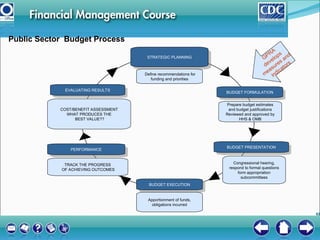
Public Sector Budget Process
STRATEGIC PLANNING
PERFORMANCE
BUDGET FORMULATION
EVALUATING RESULTS
BUDGET PRESENTATION
BUDGET EXECUTION
COST/BENEFIT ASSESSMENT
WHAT PRODUCES THE
BEST VALUE??
Congressional hearing,
respond to formal questions
form appropriation
subcommittees
Define recommendations for
funding and priorities
TRACK THE PROGRESS
OF ACHIEVING OUTCOMES
Apportionment of funds,
obligations incurred
GPRA
develops
m
easures and
indicators
Prepare budget estimates
and budget justifications
Reviewed and approved by
HHS & OMB
62
63
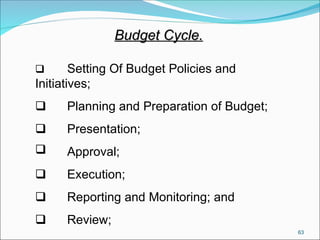
Budget Cycle.
Budget Cycle.
 Setting Of Budget Policies and
Initiatives;
 Planning and Preparation of Budget;
 Presentation;
 Approval;
 Execution;
 Reporting and Monitoring; and
 Review;
64
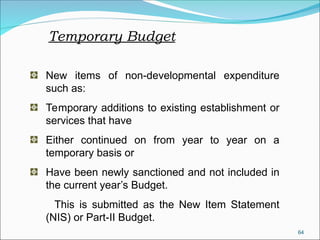
Temporary Budget
New items of non-developmental expenditure
such as:
Temporary additions to existing establishment or
services that have
Either continued on from year to year on a
temporary basis or
Have been newly sanctioned and not included in
the current year’s Budget.
This is submitted as the New Item Statement
(NIS) or Part-II Budget.
65
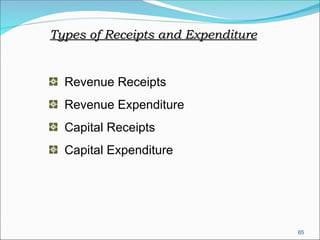
Revenue Receipts
Revenue Expenditure
Capital Receipts
Capital Expenditure
Types of Receipts and Expenditure
66
Revenue Receipts
Revenue Receipts
The income derived from Taxes, Duties, Fee for
Services rendered, Land revenue from
Government estates, fines penalties, Royalty, Net
Hydel Profit, Federal Grants, User Charges and
Cess etc.
Revenue Expenditure
Expenditure met out of Revenue
Expenditure incurred on pay and
allowances of the Government servants,
essential items of daily use in offices,
minor/major repairs of Government assets,
Commodities and Services, purchase of
durable goods, mark up or loan, subsidy on
wheat and any other expenditure
sanctioned or declared by the Government
as such.
67
68
Capital Receipts
Income from:
• The sale of immovable property
• The disposal of Capital Assets
• The sale of investments
• Loans; and
• Grants and other receipts of a non-
recurring nature.
69
Capital Expenditure
Capital Expenditure mean the
Expenditure for:
• The acquisition of immovable property;
• The execution of original works;
• The purchase of investments;
• The acquisition of capital assets; and
• Any grant or contribution of a non-
recurring nature;

Financial Management Abdus Siddique sb.ppt

  • 1.
  • 2.
  • 3.
  • 4.
    4 Responsibility of theDrawing and Disbursing Officer  High standards of financial propriety  Financial Economy  Observance of Financial Rules and Regulations  Expenditure within limits of authorised grants
  • 5.
    5 PURPOSE OF FINANCIALMANAGEMENT  To prevent and detect errors and irregularities  To guard against loss and wastage of public money and stores  To apply prescribed systemic checks effectively
  • 6.
    Financial Control inPakistan  Doctrine of accountability is essentially a British concept and is mainly confined to the countries of the British Commonwealth. It implies:  Supreme Authority of the legislation to levy taxes and approve budget of the government.  Appointment of Principal Accounting Officer.  Submission of Appropriation Accounts/ Finance Accounts.  An independent audit of the Accounts.  Appointment by the legislature of a select committee, the Public Accounts Committee. 6
  • 7.
    Accountability Process.  TheLegislature  The Executive.  The Controller General of Accounts.  The Auditor-General of Pakistan.  The Public Accounts Committee. 7
  • 8.
    8 LEGAL FRAMEWORK  FINANCIALPROCEDURE UNDER THE CONSTITUTION  GENERAL FINANCIAL RULES,  TREASURY RULES  DELEGATION of FINANCIAL POWERS RULES, 2001,  AGP ORDINANCE,2001;  CGA ORDINANCE<2001.
  • 9.
    BUDGET  An annualbudget is the intended financial plan for a single fiscal year.  It represents how Government plans to spend revenue according to certain set priorities.  A budget document describes planned activities, funding source and cost. 9 Financial Procedure under the Constitution
  • 10.
    What is aBudget?  The term Budget is actually derived from a French word BOUGETTE which means a sack or pouch or leather bag. The word “Budget” comes from budjet, a middle English word for King’s bag containing the money necessary for public expenditure.  Represent the resources available to King for public use.  Expended according to State priorities.
  • 11.
    Budget Cycle • Budgetformulation – Executive drafts budget • Budget enactment – Minister of Finance presents budget to Provincial Assembly, debates and approves • Budget Execution – Government agencies & departments implement programme and spend the money • Budget auditing and assessment – Agencies and departments report on expenditure – Auditor General (Supreme Audit Institutions – SAIs) 11
  • 12.
    The general stagesof the budget cycle budget formulation budget enactment budget execution budget auditing & assessment Medium Term Expenditure Framework (MTEF) – 3 year rolling budget Executive drafts budget Minister of Finance presents budget to parliament, debates and approves budget Govt agencies & depts implement programmes and spend the funds Agencies and depts report on expenditure to Auditor General 12
  • 13.
     Consolidated Fund Public Account  Charged Expenditure  Voted Expenditure  Annual Budget Statement  Authentication of Budget  Schedule of Authorized Expenditure 13 Budget Terminology Budget Terminology
  • 14.
     Supplementary BudgetStatement  Excess Budget Statement  Token Grant  Votes on Account  Supplementary Grant  Permanent Budget  Temporary Budget 14
  • 15.
    15 • New itemstatement (NIS) • Developmental Expenditure • Revenue Receipts and Revenue Expenditure • Capital Receipts and Capital Expenditure
  • 16.
    16 PROVINCIAL COSOLIDATED FUND PROVINCIALCOSOLIDATED FUND All revenues received by the provincial Government, all loans raised by that Government, and all moneys received by it in repayment of any loan -Article-118 (1)
  • 17.
    17 Public Account Public Account Allmoneys received by or on behalf of the Provincial Government, other than the Consolidated Fund, or deposited with the High Court or any other court established under the authority of that government shall constitute Public Account of the Provincial Government Article: 118(2)
  • 18.
    Custody of ConsolidatedFund and Public Account The Custody of Provincial Consolidated Fund, the payment of moneys into that Fund, the withdrawal of money there from, the custody of other moneys received by or on behalf of the Provincial Government, their payment into, and 18
  • 19.
    withdrawal from thePublic Account shall be regulated by Act of the Provincial Assembly or, until provision in that behalf is so made, by rules made by the Governor. Article 119 19
  • 20.
    Annual Budget Statement: Governmentshall in respect of each financial year Cause to be laid before the Provincial Assembly,  A statement of estimated receipts and expenditure for that year;  Annual Budget Statement should show separately :  Charged Expenditure; and  Voted Expenditure  Approved by the Provincial Assembly before the start of the financial year. Article 120 20
  • 21.
    Charged Expenditure Remuneration payableto the Governor and other expenditure to his office; Judges of the High Court, Speaker and the Deputy Speaker of the Provincial Assembly, Administrative expenses including remuneration payable to the officers and staff of the High Court and Secretariat Provincial Assembly 21
  • 22.
    Charged Expenditure (Cont.) Thesums required to satisfy any judgment or decree against the Province by any court or tribunal, The debt charges for which the Provincial Government is liable, including interest, repayment or amortization of capital, and other expenditure in connection with raising of loans, and the service and redemption of debt on the security of the Provincial Consolidated Fund Any other sums declared by the Constitution or the act of the Provincial Assembly to be so charged. (Article:121) 22
  • 23.
    Procedure relating toAnnual Budget Statement Annual Budget Statement relating to expenditure charged upon Provincial Consolidated Fund may be discussed in but shall not be submitted to the vote of the Provincial Assembly Article 122(1) So much of the Annual Budget Statement relating to other expenditure, shall be submitted to the Provincial Assembly in the form of demands 23
  • 24.
    Voted Expenditure Article:122(2) for grants, the Assembly shall have power to assent to, or refuse to assent to, any demand , or to assent to any demand subject to a reduction of the amount specified therein. 24
  • 25.
    Demand for Grant TheForm in which expenditure other than charged is submitted to the Provincial Assembly No demand for a grant shall be submitted to the Provincial Assembly except on the recommendations of the Provincial Government (Article: 122(3) 25
  • 26.
    Authentication of Budget TheChief Minister shall authenticate by his signature a schedule specifying-- a) the grants made or deemed to have been made by the Provincial Assembly under Article 122 and b) the several sums required to meet the expenditure charged upon the Provincial Consolidated Consolidated Fund but not exceeding the sum shown in the statement previously laid before the Provincial Assembly Article 123 (1) 26
  • 27.
    Authentication of Budget(Cont.) c) The Schedule so authenticated shall be laid before the Provincial Assembly, but shall not be open to discussion or vote thereon. d) Subject to the Constitution, no expenditure from the Provincial Consolidated Fund shall be deemed to be duly authorized unless it is specified in the schedule so authenticated and such Schedule is laid before the Provincial Assembly (Article 123(2,3)) 27
  • 28.
    28 Supplementary Budget Statement. SupplementaryBudget Statement.  A statement regarding additional funds under a specific/particular object not provided in the original budget.  Prepared and approved during the currency of the financial year.  Government has the power to authorize expenditure from the Consolidated Fund.  The provision of Articles 120 to 123 shall apply to this statement as they apply to Annual Budget Statement. Article-124
  • 29.
    TokenGrant A nominal amountincluded in the Schedule of Authorised Expenditure relating to a Supplementary Budget Statement, of a financial year, for new service, the expenditure for which is proposed to be met out by re-appropriation from the savings in the Grant. 29
  • 30.
    30 Excess Budget Statement. ExcessBudget Statement.  Statement of the amounts spent in excess of the authorized budget for a particular year.  Based on the recommendations of the Public Accounts Committee on the Appropriation Accounts.  Prepared and approved after the close of the Financial Year.  The provision of Articles 120-123 shall apply to this statement as they apply to Annual Budget Statement and Supplementary Budget Statement. Article- 124
  • 31.
    Provincial Assembly haspower to make any grant in advance in respect of estimated expenditure for a part of any financial year not exceeding four months pending completion of the procedure prescribed in the Constitution for voting of such grant and authentication of the schedule of expenditure. (Article 125) 31 Votes on Account Votes on Account
  • 32.
    Financial Powers ofthe Provincial Government when the Assemblies stand dissolved Provincial Government may authorize expenditure from the Consolidated Fund for a period not exceeding four months in any financial year pending completion of the procedure prescribed in the Constitution . Article 126 32
  • 33.
  • 34.
     Sufficient leadtime needs to be allowed to prepare,review, and revise the Budget.  To ensure this a budget calendar should be prepared and followed.  A Budget calendar lists each step in the preparation of budget and the time allowed for completion. 34
  • 35.
    35 Policy setting andissue of Budget Policy setting and issue of Budget Call Circular Call Circular a) Section (I) contains forms, instructions and procedures for Departmental Strategic Overview and Strategic Allocation of Ceilings to “outputs (services) under MTBF and the format of the Book “Medium Term Budget Estimates for Service Delivery ” to be prepared by the Administrative Departments and submitted to the respective Budget Officers of Finance Department within the stipulated time period.
  • 36.
    36 b) Section (II) Thissection contains Budget Preparation Forms (BM FORMS), Guidelines & Procedures for Revised Estimates of the current year & Budget Estimates of the next financial year in respect of current expenditure & receipts. These forms are intended to be filled by the Spending Units/DDOs according to the ceilings provided to them by their respective Administrative Departments. Departments shall ensure the timely receipt of these forms from the Spending Units/DDOs and forward the same to respective Budget Officers of Finance Departments within the stipulated time period.
  • 37.
    37 Revised Estimates Revised Estimates An estimate of the probable expenditure during the year of execution.  Prepared during the year of execution based on actual expenditure recorded during the year.
  • 38.
    38 Excess/Surrender  All anticipatedSavings must be surrendered to the Govt. immediately as they are foreseen but not later than 15th May, each year. Savings from funds provided after 15th May, must be surrendered but not later than 30th June.
  • 39.
    39 Excess Excess (i.e. Expenditurefor which no provision has been made in the current year’s original budget) should not normally be incurred. Where: Budgetary factors have changed abnormally or have been under-estimated it is possible for the PAO to re-allocate funds, provided they are available from the saving arising in the same grant.
  • 40.
    40 Provided that the: •Re-appropriation is not to and from the establishment budget • Re-appropriation is authorized before the expiry of the financial year to which the Budget relates • Amount re-appropriated does not exceed any financial limits as determined by the FD/Deptt: Excess (Cont) Excess (Cont)
  • 41.
    41 Additional funds tomeet an excess may be provided by: a) Re-appropriation; or b) Supplementary grant, if the necessary funds cannot be arranged by re-appropriation. Excess (Cont) Excess (Cont)
  • 42.
    42 The transfer offunds from one unit to another unit to meet excess expenditure anticipated under a unit. It is within the same grant a) a) Re-appropriation Re-appropriation
  • 43.
    43 Means an amountincluded in the Schedule of Authorised Expenditure relating to a Supplementary Budget Statement. b) b) Supplementary Grant Supplementary Grant
  • 44.
    44 Schedule of NewExpenditure provides for the following types of expenditure: a) Expenditure relating to a new service. b) Increased expenditure as a consequence of the re-organization or addition to any existing service, c) Expenditure on additional establishment to be employed during the year; New item statement (NIS) New item statement (NIS) Schedule of New Expenditure (SNE) Schedule of New Expenditure (SNE)
  • 45.
    45 d) Expenditure ongrants and contributions to be made for the first time, and any increase in the existing grants e) Expenses on original works New item statement (NIS) New item statement (NIS) Schedule of New Expenditure (SNE) Schedule of New Expenditure (SNE)
  • 46.
    Permanent Budget Expenditure, onpermanent activities, other than temporary expenditure, constitutes the Permanent Budget 46
  • 47.
    47 Developmental Expenditure Developmental Expenditureshall mean: The Expenditure included in the developmental plan; The Expenditure for an original work; The Expenditure for a new service or an expansion in an existing service and Any expenditure declared by Govt. to be development expenditure
  • 48.
    48 Development Expenditure (Cont) •Activities conducted and managed distinctly as individual projects, with finite start and end dates and clearly specified deliverables. • Development Projects • Typically involve the construction or improvement of physical assets or • The Development of Human Resources
  • 49.
    49 Principal Accounting Officer Administrative Secretary is the Principal Accounting Officer of his/her Department, its attached departments and subordinate offices and ensures that the funds controlled by him/her are spent in accordance with the rules laid down by Finance Department
  • 50.
    The Principal AccountingOfficer shall be responsible for ensuring:- a. That the funds allotted to his/her department are spent for the purpose for which funds are allotted b. That the funds are spent in accordance with the relevant rules and regulations, and c. That the actual expenditure does not exceed the Budget allocation. He/she will be personally answerable for laxity in matters of control over expenditure. 50 Principal Accounting Officer (Contd.)
  • 51.
    Delegation of Powersunder the Financial Rules 2001  Delegation of financial powers under the Financial Rules lays down parameters in relation to conferment of financial powers to administrative departments as well as officers of various categories and limits on exercise of these powers.  Notified vide No. SO(FR)FD/1-9/2001 dated 16-10- 2001 51
  • 52.
    Controller General ofAccounts Ordinance,2001 The functions of the Controller General shall be--  (a) to prepare and maintain the accounts of the Federation, the Provinces and district governments in such forms and in accordance with such methods and principles as the Auditor-General may, with the approval of the President, prescribe from time to time;  (b) to authorize payments and withdrawals from the Consolidated Fund and Public Account of the Federal and Provincial Governments against approved budgetary provisions after pre-audited checks as  the Auditor-General may, from time to time, prescribe; 52
  • 53.
     (c) toprepare and maintain accounts of such organizations and authorities established, set up or controlled by the Federation or Provinces as may be assigned to him by the President or, as the case may be, the Governor of a Province  (d) to lay down the principles governing the internal financial control for Government departments in consultation with the Ministry of Finance and the Provincial Finance departments as the case may be.  (e) to render advice on accounting Procedure for new scheme, programmes or activities undertaken by the Government concerned; 53
  • 54.
     (f) tosubmit accounts compiled by him on any other person responsible in that behalf, after the close of each financial year, to the Auditor-General, for the purpose of Federation and of each Province within the time-frame prescribed by the Auditor-General;  (g) to provide, to the Federal Government or, as the case may be, the Provincial Government or, District Government such information as such Governments may from time to time require;  (h) develop and maintain an efficient system of pension, provident funds and other retirement benefits in consultation with the concernedGovernment; 54
  • 55.
    Auditor-General of Pakistan TheAuditor-General of Pakistan, Head of the Supreme Audit Institution (SAI), is appointed by the President of Pakistan. (Article- 168) 55
  • 56.
    . Functions ofthe Auditor General  The Auditor General shall in relation to: a) The accounts of the Federation and of the Provinces; and b) the accounts of any Authority or body established by the Federation or a Province, perform such functions and exercise such powers as may be determined by or under Act of Parliament Article 169 56
  • 57.
    FUNCTIONS of theAuditor General With Respect to Audit a. Audit all the Expenditure from the Consolidated Fund of the Federation and each Province. b. Audit all transaction of the Federation and of the Provinces relating to Public Account. c. Audit all trading, manufacturing, and profit and loss accounts and balance sheets and other subsidiary accounts kept by Order of the President or of the Governor of a Province in any Federal/Provincial department. d. Audit the accounts of any authority or body established by the Federation or a Province, and in each case to report on the expenditure, transactions or accounts so audited Section 8 of AGP Ord 2001 57
  • 58.
    Continue e. Audit allthe receipts which are payable into the Consolidated Fund or Public Account of the Federal, each Province and in the Accounts of each District Government. f. Audit the Receipts and Expenditure of holders of authorities substantially financed by Loans and Grants. g. Audit companies and Corporations established in the Public Sector (Section-8,9,12 and 15) 58
  • 59.
    59 Reports of theAuditor-General Reports of the Auditor-General Reports of the Auditor-General of Pakistan relating to Accounts of:  The Federation shall be submitted to the President who shall cause them to be laid before the National Assembly,  The Province shall be submitted to the Governor of the Province, who shall cause them to be laid before the Provincial Assembly. (Article 171)
  • 60.
    60 • Composition: • 12members to be elected by the National Assembly. • Finance Minister-Ex-Officio Member. • Chairman. (Rule 183 of the Rules of Procedure and Conduct of Business in the National Assembly,1992) • Functions: Public Accounts Committee shall: • Examine the Appropriation Account, Finance Account and report of the Auditor-General on these reports. • Examine the statement of accounts showing the income and expenditure of the state,autonomous and semi-autonomous bodies. • Submits its report to National Assembly in specified time. (Rule 184) Public Accounts Committee in Pakistan Public Accounts Committee in Pakistan
  • 61.
  • 62.
    Public Sector BudgetProcess STRATEGIC PLANNING PERFORMANCE BUDGET FORMULATION EVALUATING RESULTS BUDGET PRESENTATION BUDGET EXECUTION COST/BENEFIT ASSESSMENT WHAT PRODUCES THE BEST VALUE?? Congressional hearing, respond to formal questions form appropriation subcommittees Define recommendations for funding and priorities TRACK THE PROGRESS OF ACHIEVING OUTCOMES Apportionment of funds, obligations incurred GPRA develops m easures and indicators Prepare budget estimates and budget justifications Reviewed and approved by HHS & OMB 62
  • 63.
    63 Budget Cycle. Budget Cycle. Setting Of Budget Policies and Initiatives;  Planning and Preparation of Budget;  Presentation;  Approval;  Execution;  Reporting and Monitoring; and  Review;
  • 64.
    64 Temporary Budget New itemsof non-developmental expenditure such as: Temporary additions to existing establishment or services that have Either continued on from year to year on a temporary basis or Have been newly sanctioned and not included in the current year’s Budget. This is submitted as the New Item Statement (NIS) or Part-II Budget.
  • 65.
    65 Revenue Receipts Revenue Expenditure CapitalReceipts Capital Expenditure Types of Receipts and Expenditure Types of Receipts and Expenditure
  • 66.
    66 Revenue Receipts Revenue Receipts Theincome derived from Taxes, Duties, Fee for Services rendered, Land revenue from Government estates, fines penalties, Royalty, Net Hydel Profit, Federal Grants, User Charges and Cess etc.
  • 67.
    Revenue Expenditure Expenditure metout of Revenue Expenditure incurred on pay and allowances of the Government servants, essential items of daily use in offices, minor/major repairs of Government assets, Commodities and Services, purchase of durable goods, mark up or loan, subsidy on wheat and any other expenditure sanctioned or declared by the Government as such. 67
  • 68.
    68 Capital Receipts Income from: •The sale of immovable property • The disposal of Capital Assets • The sale of investments • Loans; and • Grants and other receipts of a non- recurring nature.
  • 69.
    69 Capital Expenditure Capital Expendituremean the Expenditure for: • The acquisition of immovable property; • The execution of original works; • The purchase of investments; • The acquisition of capital assets; and • Any grant or contribution of a non- recurring nature;

Editor's Notes

  • #62 The Federal budget process can be described as a process that never stops. This slide illustrates the six phases of the budget cycle beginning with strategic planning, budget formulation, budget presentation, budget execution, performance and future strategic direction.