The State of the Internet and Politics, 2010Overview of Pew Internet Project ResearchDCI GroupApril 14, 2011
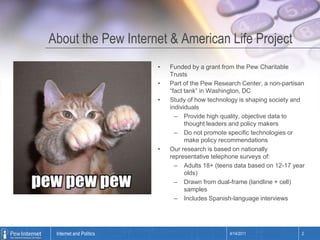
About the Pew Internet & American Life ProjectFunded by a grant from the Pew Charitable TrustsPart of the Pew Research Center, a non-partisan “fact tank” in Washington, DCStudy of how technology is shaping society and individualsProvide high quality, objective data to thought leaders and policy makersDo not promote specific technologies or make policy recommendationsOur research is based on nationally representative telephone surveys of:Adults 18+ (teens data based on 12-17 year olds)Drawn from dual-frame (landline + cell) samplesIncludes Spanish-language interviews4/14/20112Internet and Politics
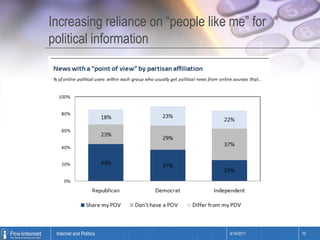
Key takeaways from our 2010 researchMore than half of all adults took part in info seeking or political action using online tools in the 2010 midterms, and the internet continues to grow as a source of political news“If you’re on, you’re in”. Interest in politics + access to basic social media tools = engagement via social media (regardless of age or political affiliation)As in other venues (e.g. health, general news consumption) we see a reliance on “people like me” to help evaluate info and make decisionsLed by young adults, mobile politics began to play a more prominent role4/14/20113Internet and Politics
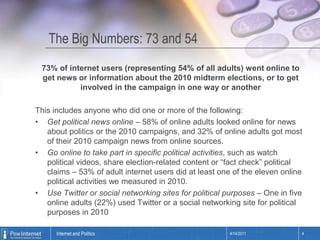
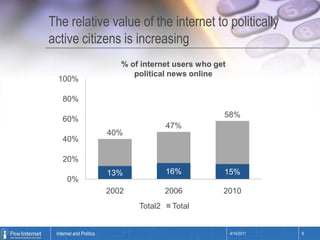
The Big Numbers: 73 and 5473% of internet users (representing 54% of all adults) went online to get news or information about the 2010 midterm elections, or to get involved in the campaign in one way or anotherThis includes anyone who did one or more of the following:Get political news online – 58% of online adults looked online for news about politics or the 2010 campaigns, and 32% of online adults got most of their 2010 campaign news from online sources.Go online to take part in specific political activities, such as watch political videos, share election-related content or “fact check” political claims – 53% of adult internet users did at least one of the eleven online political activities we measured in 2010.Use Twitter or social networking sites for political purposes – One in five online adults (22%) used Twitter or a social networking site for political purposes in 20104/14/20114Internet and Politics
Themes for 2010: As we see every year, the internet’s role in politics is “bigger but different”
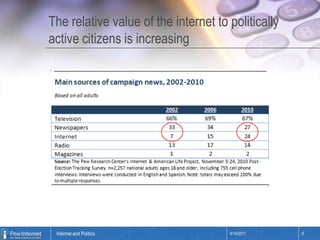
The relative value of the internet to politically active citizens is increasing4/14/20116Internet and Politics
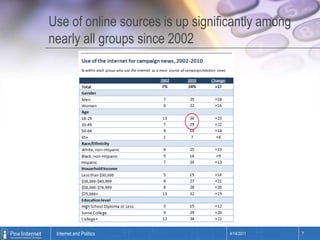
Use of online sources is up significantly among nearly all groups since 20024/14/20117Internet and Politics
The relative value of the internet to politically active citizens is increasing% of internet users who get political news online4/14/20118Internet and Politics
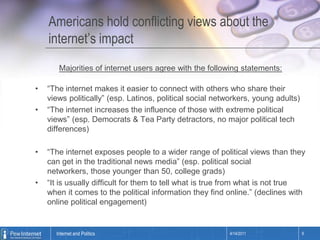
Americans hold conflicting views about the internet’s impactMajorities of internet users agree with the following statements:“The internet makes it easier to connect with others who share their views politically” (esp. Latinos, political social networkers, young adults)“The internet increases the influence of those with extreme political views” (esp. Democrats & Tea Party detractors, no major political tech differences)“The internet exposes people to a wider range of political views than they can get in the traditional news media” (esp. political social networkers, those younger than 50, college grads)“It is usually difficult for them to tell what is true from what is not true when it comes to the political information they find online.” (declines with online political engagement)4/14/20119Internet and Politics
Increasing reliance on “people like me” for political information4/14/201110Internet and Politics
Themes for 2010: The changing face of politically-engaged social networkers
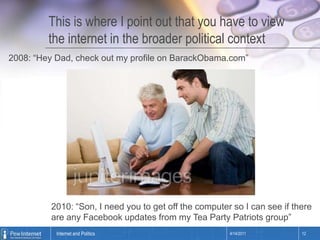
This is where I point out that you have to view the internet in the broader political context2008: “Hey Dad, check out my profile on BarackObama.com”2010: “Son, I need you to get off the computer so I can see if there are any Facebookupdates from my Tea Party Patriots group”4/14/201112Internet and Politics
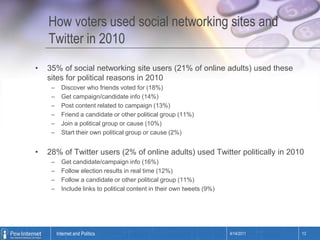
How voters used social networking sites and Twitter in 201035% of social networking site users (21% of online adults) used these sites for political reasons in 2010Discover who friends voted for (18%)Get campaign/candidate info (14%)Post content related to campaign (13%)Friend a candidate or other political group (11%)Join a political group or cause (10%)Start their own political group or cause (2%)28% of Twitter users (2% of online adults) used Twitter politically in 2010Get candidate/campaign info (16%)Follow election results in real time (12%)Follow a candidate or other political group (11%)Include links to political content in their own tweets (9%)4/14/201113Internet and Politics
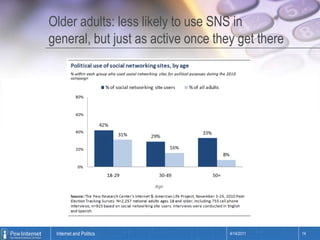
Older adults: less likely to use SNS in general, but just as active once they get there4/14/201114Internet and Politics
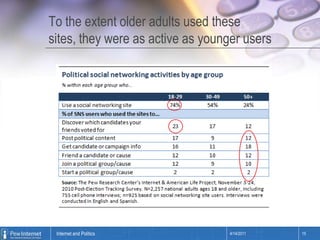
To the extent older adults used these sites, they were as active as younger users4/14/201115Internet and Politics
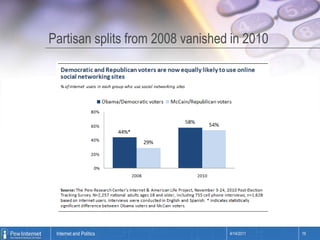
Partisan splits from 2008 vanished in 20104/14/201116Internet and Politics
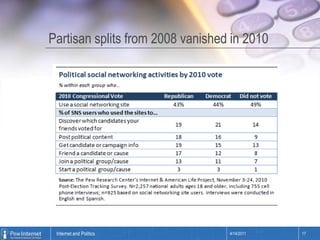
Partisan splits from 2008 vanished in 20104/14/201117Internet and Politics
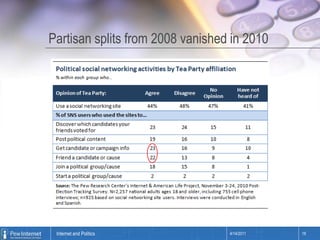
Partisan splits from 2008 vanished in 20104/14/201118Internet and Politics
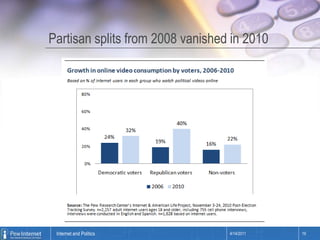
Partisan splits from 2008 vanished in 20104/14/201119Internet and Politics
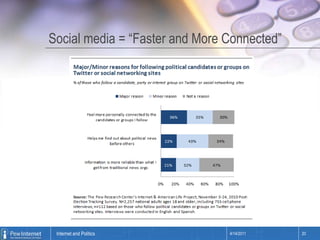
Social media = “Faster and More Connected”4/14/201120Internet and Politics
Themes for 2010: The emergence of mobile politics
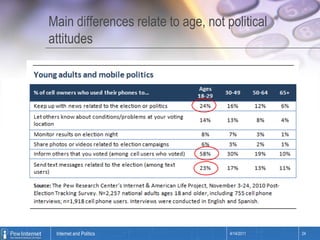
Mobile politics26% of all American adults used their cell phones for political purposes in 2010:14% used their cell phones to tell others that they voted12% used their cell phones to keep up with news about the election or politics10% sent text messages relating to the election to friends, family members and others6% used their cells to let others know about conditions at their local voting stations on election day4% used their phones to monitor results of the election as they occurred3% used their cells to shoot and share photos or videos related to the election1% used a cell-phone app that provided updates from a candidate or group about election news1% contributed money by text message to a candidate or group connected to the election like a party or interest group.Demographic groups with high usage rates include young adults, African-Americans and those with some college experience or a college degree4/14/201122Internet and Politics
No clear partisan splits in the “mobile political user” groupVoting was evenly split (44%/44%) between Republican and Democratic candidatesParty ID mirrors overall population, as does political ideology27% Republican35% Democrat32% IndependentEvenly split on attitudes towards Tea Party movement34% agree/strongly agree32% disagree/strongly disagreeWent to polls in greater numbers than overall population, although one in five say they did not voteDemocrats and Republicans engaged w/ their phones in similar ways, with Democratic voters a bit more likely to:Text message others about the campaignInform others that they voted using their cell phones4/14/201123Internet and Politics
Main differences relate to age, not political attitudes4/14/201124Internet and Politics
Open for comments/questions!name: Aaron Smithtitle: Senior Research Specialistemail: asmith@pewinternet.orgweb: www.pewinternet.orgtwitter: @aaron_w_smith, @pew_internet4/14/201125Internet and Politics

The Internet's Role in the 2010 Midterm Elections

  • 1.
    The State ofthe Internet and Politics, 2010Overview of Pew Internet Project ResearchDCI GroupApril 14, 2011
  • 2.
    About the PewInternet & American Life ProjectFunded by a grant from the Pew Charitable TrustsPart of the Pew Research Center, a non-partisan “fact tank” in Washington, DCStudy of how technology is shaping society and individualsProvide high quality, objective data to thought leaders and policy makersDo not promote specific technologies or make policy recommendationsOur research is based on nationally representative telephone surveys of:Adults 18+ (teens data based on 12-17 year olds)Drawn from dual-frame (landline + cell) samplesIncludes Spanish-language interviews4/14/20112Internet and Politics
  • 3.
    Key takeaways fromour 2010 researchMore than half of all adults took part in info seeking or political action using online tools in the 2010 midterms, and the internet continues to grow as a source of political news“If you’re on, you’re in”. Interest in politics + access to basic social media tools = engagement via social media (regardless of age or political affiliation)As in other venues (e.g. health, general news consumption) we see a reliance on “people like me” to help evaluate info and make decisionsLed by young adults, mobile politics began to play a more prominent role4/14/20113Internet and Politics
  • 4.
    The Big Numbers:73 and 5473% of internet users (representing 54% of all adults) went online to get news or information about the 2010 midterm elections, or to get involved in the campaign in one way or anotherThis includes anyone who did one or more of the following:Get political news online – 58% of online adults looked online for news about politics or the 2010 campaigns, and 32% of online adults got most of their 2010 campaign news from online sources.Go online to take part in specific political activities, such as watch political videos, share election-related content or “fact check” political claims – 53% of adult internet users did at least one of the eleven online political activities we measured in 2010.Use Twitter or social networking sites for political purposes – One in five online adults (22%) used Twitter or a social networking site for political purposes in 20104/14/20114Internet and Politics
  • 5.
    Themes for 2010:As we see every year, the internet’s role in politics is “bigger but different”
  • 6.
    The relative valueof the internet to politically active citizens is increasing4/14/20116Internet and Politics
  • 7.
    Use of onlinesources is up significantly among nearly all groups since 20024/14/20117Internet and Politics
  • 8.
    The relative valueof the internet to politically active citizens is increasing% of internet users who get political news online4/14/20118Internet and Politics
  • 9.
    Americans hold conflictingviews about the internet’s impactMajorities of internet users agree with the following statements:“The internet makes it easier to connect with others who share their views politically” (esp. Latinos, political social networkers, young adults)“The internet increases the influence of those with extreme political views” (esp. Democrats & Tea Party detractors, no major political tech differences)“The internet exposes people to a wider range of political views than they can get in the traditional news media” (esp. political social networkers, those younger than 50, college grads)“It is usually difficult for them to tell what is true from what is not true when it comes to the political information they find online.” (declines with online political engagement)4/14/20119Internet and Politics
  • 10.
    Increasing reliance on“people like me” for political information4/14/201110Internet and Politics
  • 11.
    Themes for 2010:The changing face of politically-engaged social networkers
  • 12.
    This is whereI point out that you have to view the internet in the broader political context2008: “Hey Dad, check out my profile on BarackObama.com”2010: “Son, I need you to get off the computer so I can see if there are any Facebookupdates from my Tea Party Patriots group”4/14/201112Internet and Politics
  • 13.
    How voters usedsocial networking sites and Twitter in 201035% of social networking site users (21% of online adults) used these sites for political reasons in 2010Discover who friends voted for (18%)Get campaign/candidate info (14%)Post content related to campaign (13%)Friend a candidate or other political group (11%)Join a political group or cause (10%)Start their own political group or cause (2%)28% of Twitter users (2% of online adults) used Twitter politically in 2010Get candidate/campaign info (16%)Follow election results in real time (12%)Follow a candidate or other political group (11%)Include links to political content in their own tweets (9%)4/14/201113Internet and Politics
  • 14.
    Older adults: lesslikely to use SNS in general, but just as active once they get there4/14/201114Internet and Politics
  • 15.
    To the extentolder adults used these sites, they were as active as younger users4/14/201115Internet and Politics
  • 16.
    Partisan splits from2008 vanished in 20104/14/201116Internet and Politics
  • 17.
    Partisan splits from2008 vanished in 20104/14/201117Internet and Politics
  • 18.
    Partisan splits from2008 vanished in 20104/14/201118Internet and Politics
  • 19.
    Partisan splits from2008 vanished in 20104/14/201119Internet and Politics
  • 20.
    Social media =“Faster and More Connected”4/14/201120Internet and Politics
  • 21.
    Themes for 2010:The emergence of mobile politics
  • 22.
    Mobile politics26% ofall American adults used their cell phones for political purposes in 2010:14% used their cell phones to tell others that they voted12% used their cell phones to keep up with news about the election or politics10% sent text messages relating to the election to friends, family members and others6% used their cells to let others know about conditions at their local voting stations on election day4% used their phones to monitor results of the election as they occurred3% used their cells to shoot and share photos or videos related to the election1% used a cell-phone app that provided updates from a candidate or group about election news1% contributed money by text message to a candidate or group connected to the election like a party or interest group.Demographic groups with high usage rates include young adults, African-Americans and those with some college experience or a college degree4/14/201122Internet and Politics
  • 23.
    No clear partisansplits in the “mobile political user” groupVoting was evenly split (44%/44%) between Republican and Democratic candidatesParty ID mirrors overall population, as does political ideology27% Republican35% Democrat32% IndependentEvenly split on attitudes towards Tea Party movement34% agree/strongly agree32% disagree/strongly disagreeWent to polls in greater numbers than overall population, although one in five say they did not voteDemocrats and Republicans engaged w/ their phones in similar ways, with Democratic voters a bit more likely to:Text message others about the campaignInform others that they voted using their cell phones4/14/201123Internet and Politics
  • 24.
    Main differences relateto age, not political attitudes4/14/201124Internet and Politics
  • 25.
    Open for comments/questions!name:Aaron Smithtitle: Senior Research Specialistemail: asmith@pewinternet.orgweb: www.pewinternet.orgtwitter: @aaron_w_smith, @pew_internet4/14/201125Internet and Politics