Aimed at the Interior Ministry of Spain

                                TECHNOLOGY PROGRESS

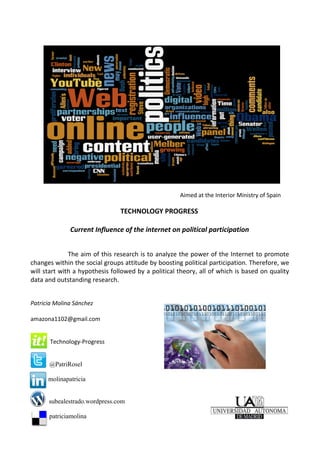
              Current Influence of the internet on political participation


              The aim of this research is to analyze the power of the Internet to promote
changes within the social groups attitude by boosting political participation. Therefore, we
will start with a hypothesis followed by a political theory, all of which is based on quality
data and outstanding research.


Patricia Molina Sánchez

amazona1102@gmail.com


       Technology-Progress


      @PatriRosel

      molinapatricia


      subealestrado.wordpress.com

      patriciamolina
Current Influence of the internet on political participation.             By Patricia Molina


                                   TECHNOLOGY PROGRESS

                     Current Influence of the internet on political participation


  Hypothesis

Due to its new features, the Internet promotes the political participation of the citizens.

   Theory


       We are facing a very powerful tool, the Internet, which day after day is driving to change
every aspect of our society and of course politics. As we will note in this theory, the power of the
Internet has managed to influence three of the main factors of the political phenomena. The
individual, the collective and the state.

It is important to note how the Internet is becoming a fundamental tool when it comes to politics,
given that in the last few years every single political campaign has resorted to the Internet in order
to achieve a greater efficiency when transmitting any message to the voters. Furthermore, it is a
means of easy access, used by more than half of the citizens because of its low cost and availability
24 hours a day, 365 days a year.


Through the Internet the political knowledge of the citizens has increased, as it offers access to
new channels and diverse opinions that incite the reader to reflect and contrast different views.

On the other hand, the decision making process can improve thanks to the production of a wide
range of documents so the citizens can freely participate all together in the political debates, as
they are not subject to the “pressure groups” who always try to influence the decisions of the
crowd in their favor.


       After regarding at the results of the CIS [ Centro de Investigaciones Sociológicas (Center for
Sociologic research)] survey, we observe that its data reveals that:
- The Internet is an everyday mean for more than the 50% of the Spanish population;
- Once the most frequent activities developed went online, they acquired a communicative,
recreational and commercial nature;
- The political uses of the Internet however, are much les frequent. 45% of the net users have
looked up current issues while less than the 20% have gone to the web for some political party.
32% have received an email with political content.
The use of the Internet has a positive side on the participation, regardless of people’s interests in
politics, the users with skills for the networks do not need motivation or interest in politics or to
contribute –unless in an online activity- since they constantly receive a
Current Influence of the internet on political participation.              By Patricia Molina


stimulus of political participation or follow unconsciously the publications of political interest that
supporters can express through the use of Twitter or Facebook friends, etc.

        The most critical citizens reject the traditional and hierarchical ways of participation and
prefer horizontal activities that implies low intake and removal costs. In this scenario, it is
remarkable for the use of internet to offer an alternative way of carrying through political
activities beyond the traditional institutions and, therefore, to make use of new instruments.
Firstly, some of the internet characteristics encourage certain activities, since through the
network, anyone can access and increase the availability of information on particular issues of
interest. At the same time, the internet is able to make contact with other people or even
organisations without the physical and temporal limitations of ‘the offline world’.Thus, this feature
promotes mobilization towards any specific topic. Moreover, horizontal online exchanges
contribute to enhance a major autonomy for those citizens who intend to get mobilized and
organised, so further more, it would promote the implication of individuals and groups from
outside the majority political system.
Secondly, those Internet features mentioned above have also contributed to the adaptation of
certain [political] actors to the web, in a faster and more efficient way. With respect to social
movements, we refer to the pioneers/front-runners in making use of the new technologies as
compared to the political parties and institutions of the representative democracy.

   Conclusion


       It is a matter of fact that thanks to the internet, the citizens are better and more informed at
all levels, and the wider the knowledge the greater the participation. This has always been the
desirable situation since someone’s decision-making process is likely to be freer if they are handed
more information. Our politicians should take this factor very seriously when they try to promote
themselves or organize electoral campaigns. Furthermore, they must take into account that the
Internet is, on one hand a vehicle for transmitting knowledge and information to the citizen in a
vertical way, from the parties to the crowds; and on the other hand, the citizens use makes this, in
a horizontal way, a means for transmitting the information between themselves thanks to the
social networks, groups organization, etc.


   References


   •   Routledge Handbook of Internet Politics. Edited by Andrew Chadwick &
       Philip N. Howard.
   •  La política en la era de internet. By Ramon Cotarelo; Ed.Tirant lo Blanch.
Current Influence of the internet on political participation.      By Patricia Molina
•   Revista Arbor del CSIC.


Current Influence of the internet on political participation.       By Patricia Molina


   •   Journalist Resource; Birds of a Feather Tweet Together: Integrating Network and
       Content Analyses to Examine Cross-Ideology Exposure on Twitter.
   •    academia.edu. Online Political Participation: Slacktivism or Efficiency Increased
       Activism?.
   •   The Guardian Activate: London 2013. How is the internet changing political
       participation? - video.
   •   Political activities on the Internet: Slacktivism or political participation by
       other means? By Henrik Serup Christensen.
   •   El kit de la lucha en Internet. By Margarita Padilla

Technology progress

  • 1.
    Aimed at theInterior Ministry of Spain TECHNOLOGY PROGRESS Current Influence of the internet on political participation The aim of this research is to analyze the power of the Internet to promote changes within the social groups attitude by boosting political participation. Therefore, we will start with a hypothesis followed by a political theory, all of which is based on quality data and outstanding research. Patricia Molina Sánchez amazona1102@gmail.com Technology-Progress @PatriRosel molinapatricia subealestrado.wordpress.com patriciamolina
  • 2.
    Current Influence ofthe internet on political participation. By Patricia Molina TECHNOLOGY PROGRESS Current Influence of the internet on political participation Hypothesis Due to its new features, the Internet promotes the political participation of the citizens. Theory We are facing a very powerful tool, the Internet, which day after day is driving to change every aspect of our society and of course politics. As we will note in this theory, the power of the Internet has managed to influence three of the main factors of the political phenomena. The individual, the collective and the state. It is important to note how the Internet is becoming a fundamental tool when it comes to politics, given that in the last few years every single political campaign has resorted to the Internet in order to achieve a greater efficiency when transmitting any message to the voters. Furthermore, it is a means of easy access, used by more than half of the citizens because of its low cost and availability 24 hours a day, 365 days a year. Through the Internet the political knowledge of the citizens has increased, as it offers access to new channels and diverse opinions that incite the reader to reflect and contrast different views. On the other hand, the decision making process can improve thanks to the production of a wide range of documents so the citizens can freely participate all together in the political debates, as they are not subject to the “pressure groups” who always try to influence the decisions of the crowd in their favor. After regarding at the results of the CIS [ Centro de Investigaciones Sociológicas (Center for Sociologic research)] survey, we observe that its data reveals that: - The Internet is an everyday mean for more than the 50% of the Spanish population; - Once the most frequent activities developed went online, they acquired a communicative, recreational and commercial nature; - The political uses of the Internet however, are much les frequent. 45% of the net users have looked up current issues while less than the 20% have gone to the web for some political party. 32% have received an email with political content. The use of the Internet has a positive side on the participation, regardless of people’s interests in
  • 3.
    politics, the userswith skills for the networks do not need motivation or interest in politics or to contribute –unless in an online activity- since they constantly receive a Current Influence of the internet on political participation. By Patricia Molina stimulus of political participation or follow unconsciously the publications of political interest that supporters can express through the use of Twitter or Facebook friends, etc. The most critical citizens reject the traditional and hierarchical ways of participation and prefer horizontal activities that implies low intake and removal costs. In this scenario, it is remarkable for the use of internet to offer an alternative way of carrying through political activities beyond the traditional institutions and, therefore, to make use of new instruments. Firstly, some of the internet characteristics encourage certain activities, since through the network, anyone can access and increase the availability of information on particular issues of interest. At the same time, the internet is able to make contact with other people or even organisations without the physical and temporal limitations of ‘the offline world’.Thus, this feature promotes mobilization towards any specific topic. Moreover, horizontal online exchanges contribute to enhance a major autonomy for those citizens who intend to get mobilized and organised, so further more, it would promote the implication of individuals and groups from outside the majority political system. Secondly, those Internet features mentioned above have also contributed to the adaptation of certain [political] actors to the web, in a faster and more efficient way. With respect to social movements, we refer to the pioneers/front-runners in making use of the new technologies as compared to the political parties and institutions of the representative democracy. Conclusion It is a matter of fact that thanks to the internet, the citizens are better and more informed at all levels, and the wider the knowledge the greater the participation. This has always been the desirable situation since someone’s decision-making process is likely to be freer if they are handed more information. Our politicians should take this factor very seriously when they try to promote themselves or organize electoral campaigns. Furthermore, they must take into account that the Internet is, on one hand a vehicle for transmitting knowledge and information to the citizen in a vertical way, from the parties to the crowds; and on the other hand, the citizens use makes this, in a horizontal way, a means for transmitting the information between themselves thanks to the social networks, groups organization, etc. References • Routledge Handbook of Internet Politics. Edited by Andrew Chadwick & Philip N. Howard. • La política en la era de internet. By Ramon Cotarelo; Ed.Tirant lo Blanch. Current Influence of the internet on political participation. By Patricia Molina
  • 4.
    Revista Arbor del CSIC. Current Influence of the internet on political participation. By Patricia Molina • Journalist Resource; Birds of a Feather Tweet Together: Integrating Network and Content Analyses to Examine Cross-Ideology Exposure on Twitter. • academia.edu. Online Political Participation: Slacktivism or Efficiency Increased Activism?. • The Guardian Activate: London 2013. How is the internet changing political participation? - video. • Political activities on the Internet: Slacktivism or political participation by other means? By Henrik Serup Christensen. • El kit de la lucha en Internet. By Margarita Padilla