

















































C. S. Lewis:
“We read to know we
are not alone.”
Literature is a
powerful way of
teaching
Character/Values.
This is what the
Master Teacher did.
stories
Mark 4:2
HE TAUGHT THEM MANY THINGS IN
PARABLES.
Mark 4:33
WITH MANY SUCH PARABLES HE
SPOKE THE WORD TO THEM…
Mark 4:34
HE DID NOT SPEAK TO THEM
WITHOUT A PARABLE
Matthew 22:1
AND AGAIN, JESUS SPOKE TO THEM
IN PARABLES
Matthew 13:34
ALL THIS JESUS SAID TO THE CROWDS IN
PARABLES; INDEED HE SAID NOTHING TO
THEM WITHOUT A PARABLE.
Mark 4:33
WITH MANY SUCH PARABLES HE
SPOKE THE WORD TO THEM…
“Tell me a fact and I’ll learn. Tell me
the truth and I’ll believe. But tell me
a story and it will live in my heart
forever.”
– Indian Proverb
Once upon a time, long ago and far away
(or perhaps not so long ago), teachers did
not use fancy PowerPoint presentations,
overhead projectors, or even chalkboards.
They simply shared their knowledge
through stories.
The power of stories has been
recognized for centuries, and even
today, in Hollywood and beyond,
storytelling is a multi-million dollar
business.
Before our formal education begins, we are
already learning from
Aesop’s fables,
fairy tales, or
family history.
Stories are a powerful
structure for organizing
and transmitting
information, and for
creating meaning in our
lives and environments.
NATURE OF STORIES
Stories can bring abstract
principles to life by giving
them concrete form.
What Research says:
Stories engage our thinking, our
emotions, and can even lead to the
creation of mental imagery
(Green & Brock, 2000)
Individuals listening to stories react
to them almost automatically,
participating, in a sense, in the action
of the narrative.
(e.g., Polichak & Gerrig, 2002)
Students are awake,
following along, wanting to
find out what happens next
and how the story ends.
Bruner (1986)
PURPOSE OF
STORIES
1. sparking student interest
2. aiding the flow of lectures
3. making material memorable
4. overcoming student resistance or
anxiety
5. building rapport between the
instructor and the students, or among
students themselves
TODAY WE ADD:
6. teach values and form character
Stories Create Interest
Stories Provide a Structure
for Remembering Course
Material
Stories Are a Familiar and
Accessible Form of Sharing
Information
Telling a Story From Experience
Can Create a More Personal
Student-Teacher Connection
FINDING AND
SELECTING STORIES
* current events
* history
* television programs
* classic literature or drama, and
* personal experience (your own and
others)
Some Tips:
have a folder or notebook for
teaching stories
make a habit of clipping
relevant newspaper stories
make notes about events
that are perfect illustrations
Do not be afraid to use
stories from fiction,
especially well-known fiction.
e.g.
Aesop’s Fables
Parables of Jesus
Popular Hollywood Movies
and more
EVERYBODY LOVES STORIES.
EVERYBODY!
What Experts in Character
Education Say:
Reading has been shown to increase
empathy especially when books are read
about people who are different from us.
Use stories to ask,
“How would you feel if that happened to
you?”
or
“How do you think the character felt
when that happened to them?”
Picture books can be great empathy
builders.
Help young readers identify the emotions
that are visible on the characters’ faces.
This is a great way to expand a child’s
feelings vocabulary beyond mad, sad and
happy.
Reading can help children think about
problem-solving.
A great way to explore values is to ask
young readers,
“How would you solve that problem?”
or
“What would you do if you were in that
situation?”
Reading to children is a great way to share
values that are important to you.
Take some time to reflect on your own
values.
Research and choose books to read to
your children that are in line with your
values.
Then, discuss those values with your
children and share why they are
important to you.
Reading together can be a
relationship builder as children grow
up.
IMPORTANT NOTES
Preview books carefully.
Set a purpose for your reading.
Draw attention to the point of the
story.
Encourage your students to think
critically.
Discuss the book to solidify its
essential message.
SOME
EXAMPLES
BOOKS TO TEACH
KINDNESS
Preschoolers &
Early Grades
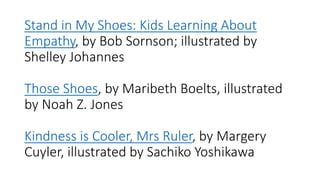
Stand​ in My Shoes: Kids Learning About
Empathy, by Bob Sornson; illustrated by
Shelley Johannes
Those Shoes, by Maribeth Boelts, illustrated
by Noah Z. Jones
Kindness is Cooler, Mrs Ruler, by Margery
Cuyler, illustrated by Sachiko Yoshikawa
What Does It Mean To Be Kind?, by Rana
DiOrio, illustrated by Stéphane Jorisch
Ordinary Mary's Extraordinary Deed, by Emily
Pearson, illustrated by Fumi Kosaka
Each Kindness, by Jacqueline Woodson,
illustrated by E.B. Lewis
The Invisible Boy, by Trudy Ludwig, illustrated
by Patrice Barton
Heartprints, by P.K. Hallinan
Middle Grades
Charlotte's Web, by E.B. White, illustrated by
Garth Williams
Wonder, by RJ Palacio
Kindness: A Treasury of Buddhist Wisdom for
Children and Parents, by Sarah Conover and
Valerie Wahl
Teens
Freak the Mighty by Rodman Philbrick
Rules, by Cynthia Lord
BOOKS ABOUT
BULLYING
Preschoolers &
Early Grades
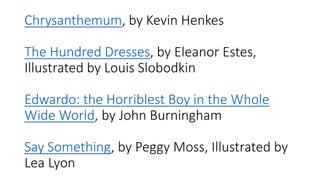
Chrysanthemum, by Kevin Henkes
The Hundred Dresses, by Eleanor Estes,
Illustrated by Louis Slobodkin
Edwardo: the Horriblest Boy in the Whole
Wide World, by John Burningham
Say Something, by Peggy Moss, Illustrated by
Lea Lyon
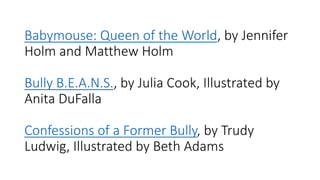
Babymouse: Queen of the World, by Jennifer
Holm and Matthew Holm
Bully B.E.A.N.S., by Julia Cook, Illustrated by
Anita DuFalla
Confessions of a Former Bully, by Trudy
Ludwig, Illustrated by Beth Adams
Middle Grades
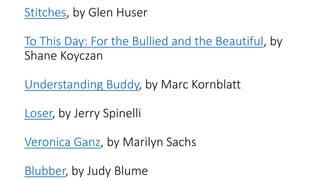
Stitches, by Glen Huser
To This Day: For the Bullied and the Beautiful, by
Shane Koyczan
Understanding Buddy, by Marc Kornblatt
Loser, by Jerry Spinelli
Veronica Ganz, by Marilyn Sachs
Blubber, by Judy Blume
Teens
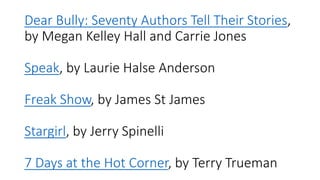
Dear Bully: Seventy Authors Tell Their Stories,
by Megan Kelley Hall and Carrie Jones
Speak, by Laurie Halse Anderson
Freak Show, by James St James
Stargirl, by Jerry Spinelli
7 Days at the Hot Corner, by Terry Trueman
Books on listening to others' views
Books about respecting differences
Books to Teach Respect
Books to Teach Responsibility
Some Tips to Help Children
Fall in Love with Reading
Model good
reading behavior.
If kids see you reading,
they will be more likely
to pick up a book
themselves.
Reading out
loud helps kids bring
the words to life.
Make them proudly
own a library card.
All reading is good
reading.
Let kids know that
reading is great no
matter what they're
interested in.
Create a reading
nook.
Read with friends.
A book club with
friends can give kids
a way to share and
learn about different
views.
Keep books around.
If there's always a book
within reach, kids will
be more likely to pick
one up and read, even
for a few minutes at a
time.
A gift that keeps
giving.
Friends and family
can give the gift of
books for a birthday
or a holiday.
Character Education Through Literature: Teaching Techniques Using Stories

Character Education Through Literature: Teaching Techniques Using Stories