
Evolving IGN’s new APIs with
            Scala


                  Manish Pandit
                  Oct 4th, 2012
About me


             Manish Pandit
      Director of Engineering, IGN
             @lobster1234
       linkedin.com/in/mpandit
About IGN
We are a leading online media and services company
obsessed with gaming and entertainment.

56MM Monthly Unique Views
737MM Monthly Page Views
20MM Monthly Video Views
My Objective
Is:
To get you excited about building APIs in Scala

Isn't:
To incite a functional vs. imperative, or Scala vs.
____ debate
Agenda
•   APIs at IGN
•   API Evolution
•   Why Scala
•   API Development with Scala
•   Monitoring, Maintaining, Evolving
•   Performance Management
APIs at IGN
• Offer SOA advantages
• Isolate the back end systems from the FE
• IGN is going where the audience is, fast
  – Mobile Devices, Consoles, TVs, Aggregators
• APIs are a specialized skillset
• Expand the development to outside
  developers
APIs at IGN : Numbers
• ~5 Billion requests a month
• Average Response time of under 20ms on
  cache misses
• 17 APIs between Social, OAuth, and Content
• Hardest hit APIs doing about 25K RPM at peak
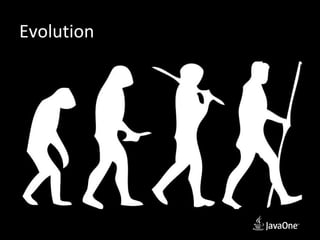
Evolution
The API Evolution : V1 [2006]
• The CMS and the desktop site calling Java
  Services, which wrapped Oracle DB calls
  behind Hibernate.
• Caching with Memcache
  – Near-far Cache Architecture to address hot spots
• Not all content types were supported
• Schema was still too complex
The API Evolution : V2 [2009]
• Rails based Content API, Java based Social API
  –   Standards around request/response
  –   Automated Testing
  –   MongoDB NoSQL storage to simplify the schema
  –   Solr
• Video and Blogs served by V2 API
• Games and Articles still used V1
• Mixed-infrastructure with Rails and Java
  echosystem
• Performance sucked royally
The API Evolution : V3 [2012]
• A fresh look at the APIs and IGN’s direction
• First attempt to
  – Integrate all content types
  – Open up the APIs to external consumers
  – Evolve the CMS, traditionally a monolithic system
  – ElasticSearch
  – Varnish Response Caching
• A learning opportunity for traditional Java
  stack engineers
API Development
• MVC Model for APIs
  – View, which marshals/unmarshals request and
    response data
  – Controller, which picks the right model to serve
    the request
  – Model, which has the necessary logic to talk to the
    database, or other APIs to fetch data
Why Scala
• Performance tied to cores than processor
  speed, i.e. concurrency
• Ideal for API development – (relatively) simple
  to handle concurrency and immutability
• JVM based = Performance
• Re-use Java toolkits and libraries
• Concise, expressive code (1:2.5 with Java)
• Actor model makes the difficult parts easy
Why Scala
•   Richer Collections API
•   Traits enabling Mix-Ins and behavior re-use
•   Statically Typed w/Type inference
•   Functional
•   Growing developer community
•   REPL
•   Culture – learning, hacking and achieving
The Biggest Reason
• Just makes sense
The Biggest Reason
• Just makes sense
  – Pattern matching
  – Implicit conversions
  – Control abstractions for collection mapping,
    filtering, iterating
  – Guaranteed Singletons at the classloader level
  – Almost non-existent boilerplate
  ….Productive, and fun!
Picking up Scala : Week 1
• Scala for Java Developers fast-tracked the
  learning
• Syntax Familiarity
• Java without semicolons?
     def total(nums: List[Int]) :Int = {
       var sum:Int=0
       for(num<-nums) {
         sum+=num
       }
       sum
     }
Picking up Scala : Week 4
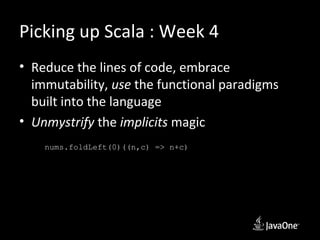
• Reduce the lines of code, embrace
  immutability, use the functional paradigms
  built into the language
• Unmystrify the implicits magic
    nums.foldLeft(0)((n,c) => n+c)
Picking up Scala : Today
• Focus on immutability
• Think functional – with the knowledge gained
  from using the functional aspects of the
  language, build control abstractions
• Keep learning and applying
API Components
•   Scalatra (View, Controller)
•   Lift-MongoRecord for MongoDB (Model)
•   Casbah for MongoDB
•   Play! Anorm for MySQL
•   Actors for tasks like syndication
•   Maven for Builds
•   MongoDB for persistance
Other API Components
•   Varnish Cache
•   Elasticsearch
•   Yammer Metrics (ping, healthcheck)
•   Swagger (self-documenting RESTful APIs)
•   3Scale for Partner APIs
•   IntelliJ IDEA and Eclipse with ScalaIDE
Challenges with Scala
• Learning Curve depends on the culture
  • TPS Cover Sheets, vs. Hack Nights


• Scala is what you make of it
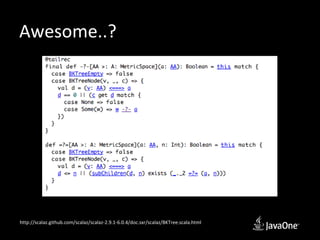
Awesome..?


http://scalaz.github.com/scalaz/scalaz-2.9.1-6.0.4/doc.sxr/scalaz/BKTree.scala.html
Challenges with Scala
• Scala is what you make of it
  – Middle ground – simple is beautiful
• Tooling not as rich as Java
  – Changing with Typesafe investing in ScalaIDE
Challenges with Scala
• Slow compilation based on the source
  – How well the code matches up to the JVM
    constructs
• No (binary) compatibility of dependencies for
  the major releases (2.8, 2.9, 2.10(?))
• Monitoring
  – No native instrumentation agents as they exist for
    Java
API Development : Deploying
• Continuous Deployment
  • Jenkins hooks to github
  • Pushes artifact(s) to Nexus
  • Fabric to push code to production (to be
    automated)
API Performance Management
• As far as Scala goes, the tips are not much
  different than Java
  – GC Tuning
  – Avoid shared state
  – Parallel collections
API Performance Management
• For the overall APIs, the performance tuning has
  many knobs to work around with
  – Stateless services
  – Async calls with Akka Agents
  – Response level cache
• Keep an eye on the database and network
  –   Control the payload size
  –   Use reasonable defaults
  –   Allow field filtering
  –   Paginate your response
Monitoring and Maintenance
• Newrelic
  – JVM stats, SQL trace
  – Supports Scala via annotations, but not as rich as
    Java
• Typesafe Console for Akka
Future of APIs at IGN
• Opening up the APIs
• Tests, tests, tests..
• Move towards simplifying the stack
  – sbt vs. maven
  – Typesafe stack
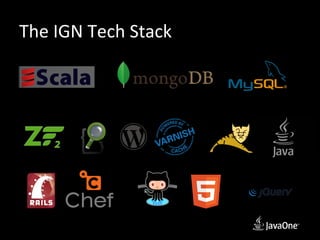
The IGN Tech Stack
Resources
• Do NOT use scaladoc as your 1st reference, at
  least initially
• StackOverflow
• Twitter’s Scala School
• Online blogs and tutorials
• Book: Scala for the Impatient
• Scala Meetup Groups in your area
• Coursera course on FP by Martin Odersky
Questions

Evolving IGN’s New APIs with Scala

  • 1.
    Evolving IGN’s newAPIs with Scala Manish Pandit Oct 4th, 2012
  • 2.
    About me Manish Pandit Director of Engineering, IGN @lobster1234 linkedin.com/in/mpandit
  • 3.
    About IGN We area leading online media and services company obsessed with gaming and entertainment. 56MM Monthly Unique Views 737MM Monthly Page Views 20MM Monthly Video Views
  • 4.
    My Objective Is: To getyou excited about building APIs in Scala Isn't: To incite a functional vs. imperative, or Scala vs. ____ debate
  • 5.
    Agenda • APIs at IGN • API Evolution • Why Scala • API Development with Scala • Monitoring, Maintaining, Evolving • Performance Management
  • 6.
    APIs at IGN •Offer SOA advantages • Isolate the back end systems from the FE • IGN is going where the audience is, fast – Mobile Devices, Consoles, TVs, Aggregators • APIs are a specialized skillset • Expand the development to outside developers
  • 7.
    APIs at IGN: Numbers • ~5 Billion requests a month • Average Response time of under 20ms on cache misses • 17 APIs between Social, OAuth, and Content • Hardest hit APIs doing about 25K RPM at peak
  • 8.
  • 9.
    The API Evolution: V1 [2006] • The CMS and the desktop site calling Java Services, which wrapped Oracle DB calls behind Hibernate. • Caching with Memcache – Near-far Cache Architecture to address hot spots • Not all content types were supported • Schema was still too complex
  • 10.
    The API Evolution: V2 [2009] • Rails based Content API, Java based Social API – Standards around request/response – Automated Testing – MongoDB NoSQL storage to simplify the schema – Solr • Video and Blogs served by V2 API • Games and Articles still used V1 • Mixed-infrastructure with Rails and Java echosystem • Performance sucked royally
  • 11.
    The API Evolution: V3 [2012] • A fresh look at the APIs and IGN’s direction • First attempt to – Integrate all content types – Open up the APIs to external consumers – Evolve the CMS, traditionally a monolithic system – ElasticSearch – Varnish Response Caching • A learning opportunity for traditional Java stack engineers
  • 12.
    API Development • MVCModel for APIs – View, which marshals/unmarshals request and response data – Controller, which picks the right model to serve the request – Model, which has the necessary logic to talk to the database, or other APIs to fetch data
  • 13.
    Why Scala • Performancetied to cores than processor speed, i.e. concurrency • Ideal for API development – (relatively) simple to handle concurrency and immutability • JVM based = Performance • Re-use Java toolkits and libraries • Concise, expressive code (1:2.5 with Java) • Actor model makes the difficult parts easy
  • 14.
    Why Scala • Richer Collections API • Traits enabling Mix-Ins and behavior re-use • Statically Typed w/Type inference • Functional • Growing developer community • REPL • Culture – learning, hacking and achieving
  • 15.
    The Biggest Reason •Just makes sense
  • 16.
    The Biggest Reason •Just makes sense – Pattern matching – Implicit conversions – Control abstractions for collection mapping, filtering, iterating – Guaranteed Singletons at the classloader level – Almost non-existent boilerplate ….Productive, and fun!
  • 17.
    Picking up Scala: Week 1 • Scala for Java Developers fast-tracked the learning • Syntax Familiarity • Java without semicolons? def total(nums: List[Int]) :Int = { var sum:Int=0 for(num<-nums) { sum+=num } sum }
  • 18.
    Picking up Scala: Week 4 • Reduce the lines of code, embrace immutability, use the functional paradigms built into the language • Unmystrify the implicits magic nums.foldLeft(0)((n,c) => n+c)
  • 19.
    Picking up Scala: Today • Focus on immutability • Think functional – with the knowledge gained from using the functional aspects of the language, build control abstractions • Keep learning and applying
  • 20.
    API Components • Scalatra (View, Controller) • Lift-MongoRecord for MongoDB (Model) • Casbah for MongoDB • Play! Anorm for MySQL • Actors for tasks like syndication • Maven for Builds • MongoDB for persistance
  • 21.
    Other API Components • Varnish Cache • Elasticsearch • Yammer Metrics (ping, healthcheck) • Swagger (self-documenting RESTful APIs) • 3Scale for Partner APIs • IntelliJ IDEA and Eclipse with ScalaIDE
  • 22.
    Challenges with Scala •Learning Curve depends on the culture • TPS Cover Sheets, vs. Hack Nights • Scala is what you make of it
  • 23.
  • 24.
    Challenges with Scala •Scala is what you make of it – Middle ground – simple is beautiful • Tooling not as rich as Java – Changing with Typesafe investing in ScalaIDE
  • 25.
    Challenges with Scala •Slow compilation based on the source – How well the code matches up to the JVM constructs • No (binary) compatibility of dependencies for the major releases (2.8, 2.9, 2.10(?)) • Monitoring – No native instrumentation agents as they exist for Java
  • 26.
    API Development :Deploying • Continuous Deployment • Jenkins hooks to github • Pushes artifact(s) to Nexus • Fabric to push code to production (to be automated)
  • 27.
    API Performance Management •As far as Scala goes, the tips are not much different than Java – GC Tuning – Avoid shared state – Parallel collections
  • 28.
    API Performance Management •For the overall APIs, the performance tuning has many knobs to work around with – Stateless services – Async calls with Akka Agents – Response level cache • Keep an eye on the database and network – Control the payload size – Use reasonable defaults – Allow field filtering – Paginate your response
  • 29.
    Monitoring and Maintenance •Newrelic – JVM stats, SQL trace – Supports Scala via annotations, but not as rich as Java • Typesafe Console for Akka
  • 30.
    Future of APIsat IGN • Opening up the APIs • Tests, tests, tests.. • Move towards simplifying the stack – sbt vs. maven – Typesafe stack
  • 31.
  • 32.
    Resources • Do NOTuse scaladoc as your 1st reference, at least initially • StackOverflow • Twitter’s Scala School • Online blogs and tutorials • Book: Scala for the Impatient • Scala Meetup Groups in your area • Coursera course on FP by Martin Odersky
  • 33.