Download as PDF, PPTX
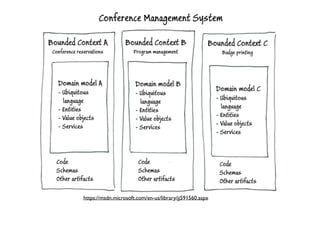
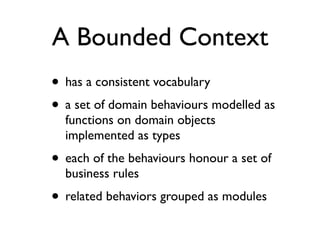
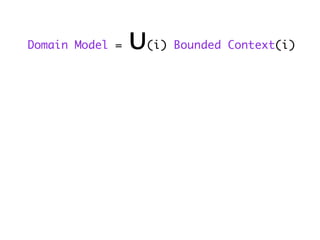
![Domain Model = ∪(i) Bounded Context(i)
Bounded Context = { m[T1,T2,..] | T(i) ∈ Types }
• a module parameterised
on a set of types](https://image.slidesharecdn.com/algebradomainpdf-161014120337/85/An-Algebraic-Approach-to-Functional-Domain-Modeling-19-320.jpg)
![Domain Model = ∪(i) Bounded Context(i)
Bounded Context = { m[T1,T2,..] | T(i) ∈ Types }
Module = { f(x) | p(x) ∈ Domain Rules }
• domain function
• on an object of type x
• composes with other functions
• closed under composition
• business rules](https://image.slidesharecdn.com/algebradomainpdf-161014120337/85/An-Algebraic-Approach-to-Functional-Domain-Modeling-20-320.jpg)
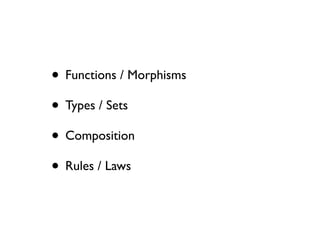
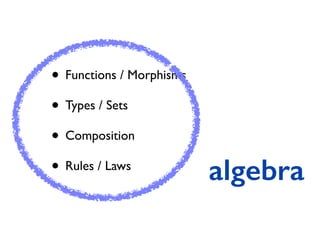
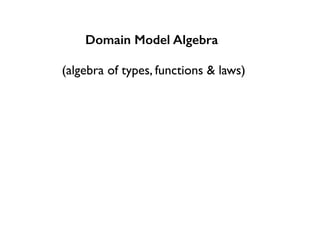
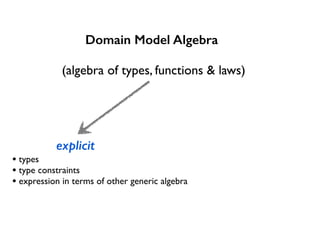
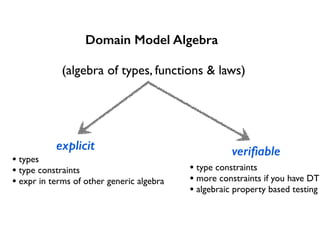
![do trade
process
execution
place
order
Solution Domain
...
behaviors
Functions
([Type] => Type)](https://image.slidesharecdn.com/algebradomainpdf-161014120337/85/An-Algebraic-Approach-to-Functional-Domain-Modeling-31-320.jpg)
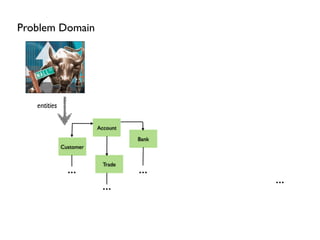
![Bank
Account
Trade
Customer
...
...
...
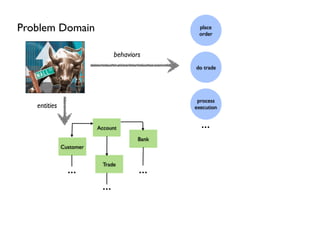
do trade
process
execution
place
order
Solution Domain
...
entities
behaviors
functions
([Type] => Type)
algebraic data type](https://image.slidesharecdn.com/algebradomainpdf-161014120337/85/An-Algebraic-Approach-to-Functional-Domain-Modeling-32-320.jpg)
![Bank
Account
Trade
Customer
...
...
...
do trade
process
execution
place
order
Solution Domain
...
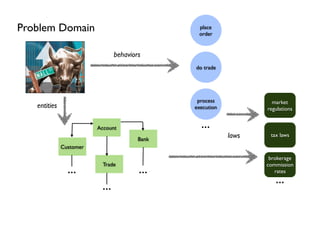
market
regulations
tax laws
brokerage
commission
rates
...
entities
behaviors
laws
functions
([Type] => Type)
algebraic data type business rules / invariants](https://image.slidesharecdn.com/algebradomainpdf-161014120337/85/An-Algebraic-Approach-to-Functional-Domain-Modeling-33-320.jpg)
![Bank
Account
Trade
Customer
...
...
...
do trade
process
execution
place
order
Solution Domain
...
market
regulations
tax laws
brokerage
commission
rates
...
entities
behaviors
laws
functions
([Type] => Type)
algebraic data type business rules / invariants
Monoid
Monad
...](https://image.slidesharecdn.com/algebradomainpdf-161014120337/85/An-Algebraic-Approach-to-Functional-Domain-Modeling-34-320.jpg)
![Bank
Account
Trade
Customer
...
...
...
do trade
process
execution
place
order
Solution Domain
...
market
regulations
tax laws
brokerage
commission
rates
...
entities
behaviors
laws
functions
([Type] => Type)
algebraic data type business rules / invariants
Monoid
Monad
...
Domain Algebra](https://image.slidesharecdn.com/algebradomainpdf-161014120337/85/An-Algebraic-Approach-to-Functional-Domain-Modeling-35-320.jpg)
![Domain Model = ∪(i) Bounded Context(i)
Bounded Context = { m[T1,T2,..] | T(i) ∈ Types }
Module = { f(x) | p(x) ∈ Domain Rules }
• domain function
• on an object of type x
• composes with other functions
• closed under composition
• business rules
Domain Algebra
Domain Algebra](https://image.slidesharecdn.com/algebradomainpdf-161014120337/85/An-Algebraic-Approach-to-Functional-Domain-Modeling-36-320.jpg)
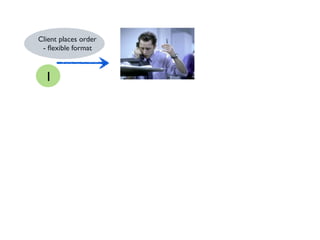
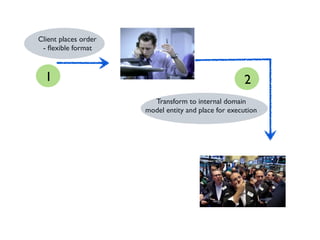
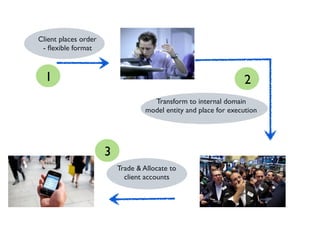
![def clientOrders: ClientOrderSheet => List[Order]
def execute: Market => Account => Order => List[Execution]
def allocate: List[Account] => Execution => List[Trade]](https://image.slidesharecdn.com/algebradomainpdf-161014120337/85/An-Algebraic-Approach-to-Functional-Domain-Modeling-40-320.jpg)
![def clientOrders: ClientOrderSheet => List[Order]
def execute[Account <: BrokerAccount]: Market => Account
=> Order => List[Execution]
def allocate[Account <: TradingAccount]: List[Account]
=> Execution => List[Trade]](https://image.slidesharecdn.com/algebradomainpdf-161014120337/85/An-Algebraic-Approach-to-Functional-Domain-Modeling-41-320.jpg)
![def clientOrders: ClientOrderSheet => List[Order]
def execute: Market => Account => Order => List[Execution]
def allocate: List[Account] => Execution => List[Trade]
Types out of thin air No implementation till now
Type names resonate domain language](https://image.slidesharecdn.com/algebradomainpdf-161014120337/85/An-Algebraic-Approach-to-Functional-Domain-Modeling-42-320.jpg)
![def clientOrders: ClientOrderSheet => List[Order]
def execute: Market => Account => Order => List[Execution]
def allocate: List[Account] => Execution => List[Trade]
•Types (domain entities)
• Functions operating on types (domain behaviors)
• Laws (business rules)](https://image.slidesharecdn.com/algebradomainpdf-161014120337/85/An-Algebraic-Approach-to-Functional-Domain-Modeling-43-320.jpg)
![def clientOrders: ClientOrderSheet => List[Order]
def execute: Market => Account => Order => List[Execution]
def allocate: List[Account] => Execution => List[Trade]
•Types (domain entities)
• Functions operating on types (domain behaviors)
• Laws (business rules)
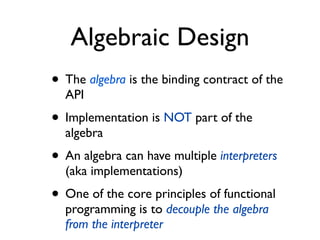
Algebra of the API](https://image.slidesharecdn.com/algebradomainpdf-161014120337/85/An-Algebraic-Approach-to-Functional-Domain-Modeling-44-320.jpg)
![trait Trading[Account, Trade, ClientOrderSheet, Order,
Execution, Market] {
def clientOrders: ClientOrderSheet => List[Order]
def execute: Market => Account => Order => List[Execution]
def allocate: List[Account] => Execution => List[Trade]
def tradeGeneration(market: Market, broker: Account,
clientAccounts: List[Account]) = ???
}
parameterized on typesmodule](https://image.slidesharecdn.com/algebradomainpdf-161014120337/85/An-Algebraic-Approach-to-Functional-Domain-Modeling-45-320.jpg)
![def clientOrders: ClientOrderSheet => List[Order]
def execute: Market => Account => Order => List[Execution]
def allocate: List[Account] => Execution => List[Trade]
let’s do some algebra ..](https://image.slidesharecdn.com/algebradomainpdf-161014120337/85/An-Algebraic-Approach-to-Functional-Domain-Modeling-47-320.jpg)
![def clientOrders: ClientOrderSheet => List[Order]
def execute(m: Market, broker: Account): Order => List[Execution]
def allocate(accounts: List[Account]): Execution => List[Trade]
let’s do some algebra ..](https://image.slidesharecdn.com/algebradomainpdf-161014120337/85/An-Algebraic-Approach-to-Functional-Domain-Modeling-48-320.jpg)
![def clientOrders: ClientOrderSheet => List[Order]
def execute(m: Market, broker: Account): Order => List[Execution]
def allocate(accounts: List[Account]): Execution => List[Trade]
let’s do some algebra ..](https://image.slidesharecdn.com/algebradomainpdf-161014120337/85/An-Algebraic-Approach-to-Functional-Domain-Modeling-49-320.jpg)
![def clientOrders: ClientOrderSheet => List[Order]
def execute(m: Market, broker: Account): Order => List[Execution]
def allocate(accounts: List[Account]): Execution => List[Trade]
let’s do some algebra ..](https://image.slidesharecdn.com/algebradomainpdf-161014120337/85/An-Algebraic-Approach-to-Functional-Domain-Modeling-50-320.jpg)
![def clientOrders: ClientOrderSheet => List[Order]
def execute(m: Market, broker: Account): Order => List[Execution]
def allocate(accounts: List[Account]): Execution => List[Trade]
let’s do some algebra ..](https://image.slidesharecdn.com/algebradomainpdf-161014120337/85/An-Algebraic-Approach-to-Functional-Domain-Modeling-51-320.jpg)
![def clientOrders: ClientOrderSheet => List[Order]
def execute(m: Market, broker: Account): Order => List[Execution]
def allocate(accounts: List[Account]): Execution => List[Trade]
let’s do some algebra ..](https://image.slidesharecdn.com/algebradomainpdf-161014120337/85/An-Algebraic-Approach-to-Functional-Domain-Modeling-52-320.jpg)
![def f: A => List[B]
def g: B => List[C]
def h: C => List[D]
.. a problem of composition ..](https://image.slidesharecdn.com/algebradomainpdf-161014120337/85/An-Algebraic-Approach-to-Functional-Domain-Modeling-53-320.jpg)
![.. a problem of composition
with effects ..
def f: A => List[B]
def g: B => List[C]
def h: C => List[D]](https://image.slidesharecdn.com/algebradomainpdf-161014120337/85/An-Algebraic-Approach-to-Functional-Domain-Modeling-54-320.jpg)
![def f[M: Monad]: A => M[B]
def g[M: Monad]: B => M[C]
def h[M: Monad]: C => M[D]
.. a problem of composition with effects
that can be generalized ..](https://image.slidesharecdn.com/algebradomainpdf-161014120337/85/An-Algebraic-Approach-to-Functional-Domain-Modeling-55-320.jpg)
![case class Kleisli[M[_], A, B](run: A => M[B]) {
def andThen[C](f: B => M[C])
(implicit M: Monad[M]): Kleisli[M, A, C] =
Kleisli((a: A) => M.flatMap(run(a))(f))
}
.. function composition with Effects ..
It’s a Kleisli !](https://image.slidesharecdn.com/algebradomainpdf-161014120337/85/An-Algebraic-Approach-to-Functional-Domain-Modeling-56-320.jpg)
![def clientOrders: Kleisli[List, ClientOrderSheet, Order]
def execute(m: Market, b: Account): Kleisli[List, Order, Execution]
def allocate(acts: List[Account]): Kleisli[List, Execution, Trade]
Follow the types
.. function composition with Effects ..
def clientOrders: ClientOrderSheet => List[Order]
def execute(m: Market, broker: Account): Order => List[Execution]
def allocate(accounts: List[Account]): Execution => List[Trade]](https://image.slidesharecdn.com/algebradomainpdf-161014120337/85/An-Algebraic-Approach-to-Functional-Domain-Modeling-57-320.jpg)
![def clientOrders: Kleisli[List, ClientOrderSheet, Order]
def execute(m: Market, b: Account): Kleisli[List, Order, Execution]
def allocate(acts: List[Account]): Kleisli[List, Execution, Trade]
Domain algebra composed with the categorical
algebra of a Kleisli Arrow
.. function composition with Effects ..](https://image.slidesharecdn.com/algebradomainpdf-161014120337/85/An-Algebraic-Approach-to-Functional-Domain-Modeling-58-320.jpg)
![def clientOrders: Kleisli[List, ClientOrderSheet, Order]
def execute(m: Market, b: Account): Kleisli[List, Order, Execution]
def allocate(acts: List[Account]): Kleisli[List, Execution, Trade]
.. that implements the semantics of our domain
algebraically ..
.. function composition with Effects ..](https://image.slidesharecdn.com/algebradomainpdf-161014120337/85/An-Algebraic-Approach-to-Functional-Domain-Modeling-59-320.jpg)
![def tradeGeneration(
market: Market,
broker: Account,
clientAccounts: List[Account]) = {
clientOrders andThen
execute(market, broker) andThen
allocate(clientAccounts)
}
Implementation follows the specification
.. the complete trade generation logic ..](https://image.slidesharecdn.com/algebradomainpdf-161014120337/85/An-Algebraic-Approach-to-Functional-Domain-Modeling-60-320.jpg)
![def tradeGeneration(
market: Market,
broker: Account,
clientAccounts: List[Account]) = {
clientOrders andThen
execute(market, broker) andThen
allocate(clientAccounts)
}
Implementation follows the specification and we
get the Ubiquitous Language for free :-)
.. the complete trade generation logic ..](https://image.slidesharecdn.com/algebradomainpdf-161014120337/85/An-Algebraic-Approach-to-Functional-Domain-Modeling-61-320.jpg)
![def clientOrders: Kleisli[List, ClientOrderSheet, Order]
def execute(m: Market, b: Account): Kleisli[List, Order, Execution]
def allocate(acts: List[Account]): Kleisli[List, Execution, Trade]
.. our algebra still doesn’t allow customisable
handling of errors that may occur within our
domain behaviors ..
.. function composition with Effects ..](https://image.slidesharecdn.com/algebradomainpdf-161014120337/85/An-Algebraic-Approach-to-Functional-Domain-Modeling-63-320.jpg)
![def clientOrders: Kleisli[List, ClientOrderSheet, Order]
return type constructor](https://image.slidesharecdn.com/algebradomainpdf-161014120337/85/An-Algebraic-Approach-to-Functional-Domain-Modeling-65-320.jpg)
![def clientOrders: Kleisli[List, ClientOrderSheet, Order]
return type constructor
What happens in case the operation fails ?](https://image.slidesharecdn.com/algebradomainpdf-161014120337/85/An-Algebraic-Approach-to-Functional-Domain-Modeling-66-320.jpg)
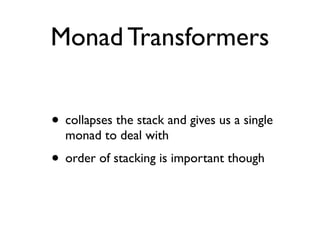
![Error handling as an
Effect
• pure and functional
• with an explicit and published algebra
• stackable with existing effects
def clientOrders: Kleisli[List, ClientOrderSheet, Order]](https://image.slidesharecdn.com/algebradomainpdf-161014120337/85/An-Algebraic-Approach-to-Functional-Domain-Modeling-67-320.jpg)
![def clientOrders: Kleisli[List, ClientOrderSheet, Order]
.. stacking of effects ..
M[List[_]]](https://image.slidesharecdn.com/algebradomainpdf-161014120337/85/An-Algebraic-Approach-to-Functional-Domain-Modeling-68-320.jpg)
![def clientOrders: Kleisli[List, ClientOrderSheet, Order]
.. stacking of effects ..
M[List[_]]: M is a Monad](https://image.slidesharecdn.com/algebradomainpdf-161014120337/85/An-Algebraic-Approach-to-Functional-Domain-Modeling-69-320.jpg)
![type Response[A] = String / Option[A]
val count: Response[Int] = some(10).right
for {
maybeCount <- count
} yield {
for {
c <- maybeCount
// use c
} yield c
}
Monad Transformers](https://image.slidesharecdn.com/algebradomainpdf-161014120337/85/An-Algebraic-Approach-to-Functional-Domain-Modeling-70-320.jpg)
![type Response[A] = String / Option[A]
val count: Response[Int] = some(10).right
for {
maybeCount <- count
} yield {
for {
c <- maybeCount
// use c
} yield c
}
type Error[A] = String / A
type Response[A] = OptionT[Error, A]
val count: Response[Int] = 10.point[Response]
for{
c <- count
// use c : c is an Int here
} yield (())
Monad Transformers](https://image.slidesharecdn.com/algebradomainpdf-161014120337/85/An-Algebraic-Approach-to-Functional-Domain-Modeling-71-320.jpg)
![type Response[A] = String / Option[A]
val count: Response[Int] = some(10).right
for {
maybeCount <- count
} yield {
for {
c <- maybeCount
// use c
} yield c
}
type Error[A] = String / A
type Response[A] = OptionT[Error, A]
val count: Response[Int] = 10.point[Response]
for{
c <- count
// use c : c is an Int here
} yield (())
Monad Transformers
richer algebra](https://image.slidesharecdn.com/algebradomainpdf-161014120337/85/An-Algebraic-Approach-to-Functional-Domain-Modeling-72-320.jpg)
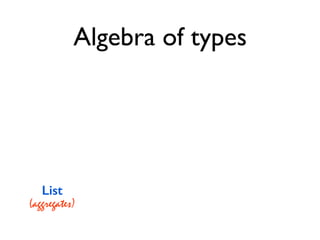
![def clientOrders: Kleisli[List, ClientOrderSheet, Order]
.. stacking of effects ..
case class ListT[M[_], A] (run: M[List[A]]) { //..](https://image.slidesharecdn.com/algebradomainpdf-161014120337/85/An-Algebraic-Approach-to-Functional-Domain-Modeling-74-320.jpg)
![type StringOr[A] = String / A
type Valid[A] = ListT[StringOr, A]
def clientOrders: Kleisli[Valid, ClientOrderSheet, Order]
def execute(m: Market, b: Account): Kleisli[Valid, Order, Execution]
def allocate(acts: List[Account]): Kleisli[Valid, Execution, Trade]
.. a small change in algebra, a huge step
for our domain model ..](https://image.slidesharecdn.com/algebradomainpdf-161014120337/85/An-Algebraic-Approach-to-Functional-Domain-Modeling-75-320.jpg)
![def execute(market: Market, brokerAccount: Account) =
kleisli[List, Order, Execution] { order =>
order.items.map { item =>
Execution(brokerAccount, market, ..)
}
}](https://image.slidesharecdn.com/algebradomainpdf-161014120337/85/An-Algebraic-Approach-to-Functional-Domain-Modeling-76-320.jpg)
![private def makeExecution(brokerAccount: Account,
item: LineItem, market: Market): String / Execution = //..
def execute(market: Market, brokerAccount: Account) =
kleisli[Valid, Order, Execution] { order =>
listT[StringOr](
order.items.map { item =>
makeExecution(brokerAccount, market, ..)
}.sequenceU
)
}](https://image.slidesharecdn.com/algebradomainpdf-161014120337/85/An-Algebraic-Approach-to-Functional-Domain-Modeling-77-320.jpg)
![def clientOrders: Kleisli[List, ClientOrderSheet, Order]
def execute(m: Market, b: Account): Kleisli[List, Order, Execution]
def allocate(acts: List[Account]): Kleisli[List, Execution, Trade]
.. the algebra ..](https://image.slidesharecdn.com/algebradomainpdf-161014120337/85/An-Algebraic-Approach-to-Functional-Domain-Modeling-88-320.jpg)
![def clientOrders: Kleisli[List, ClientOrderSheet, Order]
def execute(m: Market, b: Account): Kleisli[List, Order, Execution]
def allocate(acts: List[Account]): Kleisli[List, Execution, Trade]
.. the algebra ..
functions](https://image.slidesharecdn.com/algebradomainpdf-161014120337/85/An-Algebraic-Approach-to-Functional-Domain-Modeling-89-320.jpg)
![.. the algebra ..
def clientOrders: Kleisli[List, ClientOrderSheet, Order]
def execute(m: Market, b: Account): Kleisli[List, Order, Execution]
def allocate(acts: List[Account]): Kleisli[List, Execution, Trade]
types](https://image.slidesharecdn.com/algebradomainpdf-161014120337/85/An-Algebraic-Approach-to-Functional-Domain-Modeling-90-320.jpg)
![.. the algebra ..
composition
def tradeGeneration(market: Market, broker: Account,
clientAccounts: List[Account]) = {
clientOrders andThen
execute(market, broker) andThen
allocate(clientAccounts)
}](https://image.slidesharecdn.com/algebradomainpdf-161014120337/85/An-Algebraic-Approach-to-Functional-Domain-Modeling-91-320.jpg)
![.. the algebra ..
trait OrderLaw {
def sizeLaw: Seq[ClientOrder] => Seq[Order] => Boolean =
{ cos => orders =>
cos.size == orders.size
}
def lineItemLaw: Seq[ClientOrder] => Seq[Order] => Boolean =
{ cos => orders =>
cos.map(instrumentsInClientOrder).sum ==
orders.map(_.items.size).sum
}
}
laws of the algebra
(domain rules)](https://image.slidesharecdn.com/algebradomainpdf-161014120337/85/An-Algebraic-Approach-to-Functional-Domain-Modeling-92-320.jpg)
![.. domain rules verification ..
property("Check Client Order laws") =
forAll((cos: Set[ClientOrder]) => {
val orders = for {
os <- clientOrders.run(cos.toList)
} yield os
sizeLaw(cos.toSeq)(orders) == true
lineItemLaw(cos.toSeq)(orders) == true
})
property based testing FTW ..](https://image.slidesharecdn.com/algebradomainpdf-161014120337/85/An-Algebraic-Approach-to-Functional-Domain-Modeling-94-320.jpg)


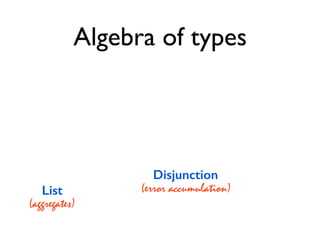
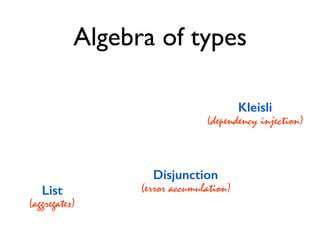
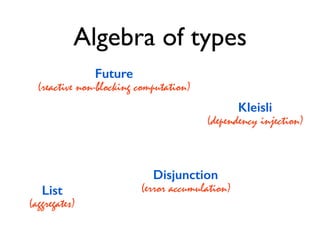
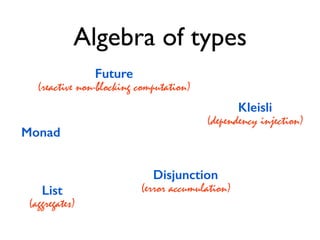
An algebraic approach to functional domain modeling is presented where: 1. The domain model is represented as a collection of functions operating on algebraic data types that represent domain entities. 2. These functions are organized into bounded contexts that group related behaviors and are parameterized on types. 3. The domain model is defined as an algebra of types, functions, and laws/rules through a domain algebra. This algebra can then have multiple implementations. 4. An example domain algebra for a trading system is defined using Kleisli arrows to model functions with effects like ordering and execution. The complete trade generation logic is implemented by composing these functions algebraically.


