ACT III
Act III Scene 1
                 ď‚–
ď‚™ Comic relief:
  ď‚– a clown is mincing words with a few musicians,
    then has a little wordplay with Cassio
ď‚™ Iago enters, and Cassio tells him that he
  means to speak to Desdemona, so that she
  may clear things up with Othello.
ď‚™ Emilia comes out, and bids Cassio to come in
  and speak with Desdemona about his
  tarnished reputation.
Analysis: Othello’s
       Uniqueness
             ď‚–
ď‚™ Othello is unlike other Shakespearean
  dramas for two reasons:
  ď‚– the scarcity of comic relief, which only appears
    briefly at the beginning of this short scene.
  ď‚– there are no subplots running through Othello as
    there are in most Shakespearean plays as a whole.
ď‚™ Both of these differences make Othello one of
  Shakespeare's most focused, intense
  tragedies.
Act III Scene 2
                   ď‚–
ď‚™ Othello gives Iago some letters that need to be
  delivered back to Venice
ď‚™ Iago is in turn supposed to give the letters to a ship's
  pilot who is sailing back to Venice.
Act III Scene 3
ď‚™ Read III.3.1130-1132
ď‚™ Desdemona decides that she wants to advocate
  for Cassio.            ď‚–
ď‚™ She tells Emilia so, and that she believes Cassio
  is a good person, and has been wronged in this
  case
ď‚™ Iago seizes on this opportunity to play on
  Othello's insecurities, and make Cassio seem
  guilty
ď‚™ Othello then speaks to Desdemona, and
  Desdemona expresses her concern for Cassio
ď‚™ She is persistent in his suit, which Othello is not
  too pleased about.
Act III Scene 3
ď‚™ Iago then plays on Othello's insecurities about
  Desdemona, and gets Othello to believe,
  through insinuation, that there is something
                         ď‚–
  going on between Desdemona and Cassio.
ď‚™ Othello seizes on this, and then Iago works at
  building up his suspicions.
ď‚™ Othello begins to doubt his wife, as Iago lets his
  insinuations gain the force of an accusation
  against her.
ď‚™ Othello begins to voice his insecurities when it
  comes to Desdemona, and himself as well.
ď‚™ Desdemona enters and Othello admits that he is
  troubled, though he will not state the cause.
ď‚™ Watch movie scene
Act III Scene 3
ď‚™   Read III.3.1132-1134
ď‚™   Desdemona drops the handkerchief that Othello gave her on their
    honeymoon
ď‚™

ď‚™
                                   ď‚–
    Emilia knew that her husband had wanted it for something, so she
    doesn't feel too guilty about taking it.
    Emilia gives it to Iago, who decides to use the handkerchief for his
    own devices.
ď‚™   Othello re-enters, and tells Iago that he now doubts his wife
ď‚™   Othello demands proof so Iago sets about making stories up about
    Cassio talking in his sleep
ď‚™   He says that Cassio has the handkerchief that Othello gave to
    Desdemona.
ď‚™   Othello is incensed to hear that Desdemona would give away
    something so valuable, and is persuaded by Iago's insinuations and
    claims to believe that Desdemona is guilty.
ď‚™   Othello then swears to have Cassio dead, and to be revenged upon
    Desdemona for the non-existent affair.
ď‚™   Watch movie scene
Analysis: Desdemona
             ď‚–
ď‚™ Desdemona's choice of words to describe Cassio
  is unfortunate:
  ď‚– she calls him a "suitor," not meaning it in a romantic
    sense, although Othello could certainly take it that
    way.
ď‚™ Desdemona binds her reputation to Cassio's in
  an unfortunate way
ď‚™ She says that if Cassio is wrong, "I have no
  judgment in an honest face".
ď‚™ Of course Desdemona means well, but she
  gambles too much on another person's honor.
Analysis: Jealousy
               ď‚–
ď‚™ Jealousy is soon addressed specifically by Iago.
ď‚™ "It is the green-eyed monster," Iago tells him
ď‚™ The "green-eyed monster" becomes a symbol
  representing Othello's dark feelings, a specter
  lurking in his mind and beginning to steer his
  behavior.
ď‚™ Iago's speech is also deeply ironic, since it points out
  Othello's flaws, and the root of his tragedy
ď‚™ Othello has no idea of the significance of these
  statements, and so neglects to take them to heart.
Analysis: Insecure
ď‚™ Othello is deeply insecure about his personal qualities
  and his marriage
ď‚™ Insecurity becomes a theme that weakens his resolve not
  to doubt Desdemona.        ď‚–
ď‚™ Othello uses his black skin as a symbol for how poorly
  spoken and unattractive he thinks he is.
ď‚™ All of his claims are very much beside the point; his
  words are actually more complex and beautiful than
  those spoken by any other character in the play.
ď‚™ Because he begins to believe that Desdemona cannot
  love him, he starts to believe her guilty of infidelity.
ď‚™ The leap is great, but it is all a product of Othello's own
  insecurities and his incorrect conception of himself,
  another theme of the play.
ď‚™ How Othello sees himself directly influences how he
  views Desdemona's love
Analysis: Imagery
ď‚™ Othello begins to use the black/ white imagery found
  throughout the play, to express his grief and rage at
  Desdemona's alleged treachery.
                              ď‚–
ď‚™ "My name, that was as fresh as Dian's visage, is now
  begrimed and black as mine own face," Othello says.
ď‚™ Although the allegations against Desdemona are personally
  hurtful to him, Othello focuses more on the public
  ramifications, rather than the private
ď‚™ There is great irony in this concern, since this rumored
  betrayal is a private one, and also since Othello's name is
  highly regarded, because nothing has really happened.
ď‚™ Iago's "proofs" also rely on the animal imagery which has run
  throughout the play
ď‚™ he makes Desdemona and Cassio seem like lustful lovers, by
  describing them as "prime as goats, as hot as monkeys" (400).
ď‚™ This comparison is calculated, since Iago knows that thinking
  of Desdemona as lusting after another man disturbs Othello
  greatly.
Analysis: Handkerchief
            ď‚–
ď‚™ The handkerchief, the most crucial symbol
  and object in the play.
ď‚™ The handkerchief, to Desdemona, symbolizes
  Othello's love, since it was his first gift to her.
ď‚™ Othello thinks that the handkerchief, quite
  literally, is Desdemona's love
ď‚™ When she has lost it, that must clearly mean
  that she does not love him any longer.
ď‚™ The handkerchief also becomes a symbol of
  Desdemona's alleged betrayal
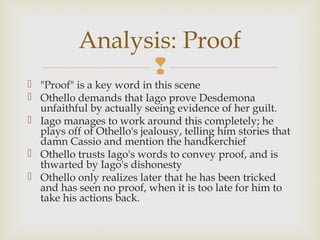
Analysis: Proof
                 ď‚–
ď‚™ "Proof" is a key word in this scene
ď‚™ Othello demands that Iago prove Desdemona
  unfaithful by actually seeing evidence of her guilt.
ď‚™ Iago manages to work around this completely; he
  plays off of Othello's jealousy, telling him stories that
  damn Cassio and mention the handkerchief
ď‚™ Othello trusts Iago's words to convey proof, and is
  thwarted by Iago's dishonesty
ď‚™ Othello only realizes later that he has been tricked
  and has seen no proof, when it is too late for him to
  take his actions back.
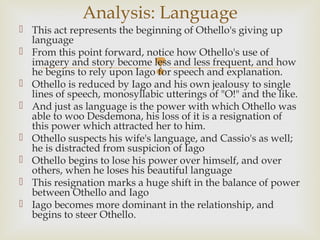
Analysis: Language
ď‚™ This act represents the beginning of Othello's giving up
  language
ď‚™ From this point forward, notice how Othello's use of
                              ď‚–
  imagery and story become less and less frequent, and how
  he begins to rely upon Iago for speech and explanation.
ď‚™ Othello is reduced by Iago and his own jealousy to single
  lines of speech, monosyllabic utterings of "O!" and the like.
ď‚™ And just as language is the power with which Othello was
  able to woo Desdemona, his loss of it is a resignation of
  this power which attracted her to him.
ď‚™ Othello suspects his wife's language, and Cassio's as well;
  he is distracted from suspicion of Iago
ď‚™ Othello begins to lose his power over himself, and over
  others, when he loses his beautiful language
ď‚™ This resignation marks a huge shift in the balance of power
  between Othello and Iago
ď‚™ Iago becomes more dominant in the relationship, and
  begins to steer Othello.
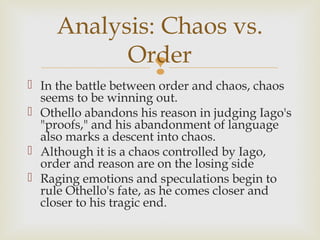
Analysis: Chaos vs.
           Order
              ď‚–
ď‚™ In the battle between order and chaos, chaos
  seems to be winning out.
ď‚™ Othello abandons his reason in judging Iago's
  "proofs," and his abandonment of language
  also marks a descent into chaos.
ď‚™ Although it is a chaos controlled by Iago,
  order and reason are on the losing side
ď‚™ Raging emotions and speculations begin to
  rule Othello's fate, as he comes closer and
  closer to his tragic end.
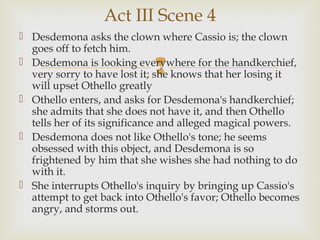
Act III Scene 4
ď‚™ Desdemona asks the clown where Cassio is; the clown
  goes off to fetch him.

                            ď‚–
ď‚™ Desdemona is looking everywhere for the handkerchief,
  very sorry to have lost it; she knows that her losing it
  will upset Othello greatly
ď‚™ Othello enters, and asks for Desdemona's handkerchief;
  she admits that she does not have it, and then Othello
  tells her of its significance and alleged magical powers.
ď‚™ Desdemona does not like Othello's tone; he seems
  obsessed with this object, and Desdemona is so
  frightened by him that she wishes she had nothing to do
  with it.
ď‚™ She interrupts Othello's inquiry by bringing up Cassio's
  attempt to get back into Othello's favor; Othello becomes
  angry, and storms out.
Act III Scene 4
ď‚™ Cassio then enters, with Iago and laments that
  his suit is not successful, and that Othello does
                         ď‚–
  not seem likely to take him back.
ď‚™ Desdemona is sorry for this, since she knows
  that Cassio is a man of worth
ď‚™ She tells Cassio and Iago that Othello has been
  acting strange, and is upset, and Iago goes to
  look for him, feigning concern.
ď‚™ Emilia thinks that Othello's change has
  something to do with Desdemona, or Othello's
  jealous nature
Act III Scene 4
                 ď‚–
ď‚™ Read III.4.1136-1137
ď‚™ Bianca comes in, and Cassio asks her to copy
  the handkerchief that he found in his room
ď‚™ It is Desdemona's handkerchief, though
  Cassio has no idea.
ď‚™ He claims he does not love her, and gets
  angry at her for allegedly suspecting that the
  handkerchief is a gift of another woman.
ď‚™ Bianca is not disturbed, and leaves with the
  handkerchief.
ď‚™ Watch movie scene
Analysis: Double Meanings
ď‚™ Othello's words often have a double meaning
ď‚™ When he is describing Desdemona's hand, he says it is
                           ď‚–
  "moist" and "hot“ an allusion to a lustful nature.
ď‚™ He says she is of a "liberal heart"; this could mean a
  generous heart, but could also be indicating
  Desdemona's supposed licentiousness.
ď‚™ "Here's a young and sweating devil here, who constantly
  rebels," Othello says; the metaphor speaks badly of
  Desdemona, and betrays his distrust of her.
ď‚™ In the next breath, he says, "tis a good hand"; the
  juxtaposition of the two statements shows Othello trying
  not to betray his disappointment
ď‚™ He is deeply disturbed, and seems to be questioning and
  examining her to prove that she really is the harlot
Analysis: Magic Hanky
            ď‚–
ď‚™ Here, Othello finally elaborates upon the
  handkerchief's importance for Desdemona.
ď‚™ "There's magic in the web of it," Othello says;
  he language is full of mystical, dark images
ď‚™ Othello reveals that he believes the
  handkerchief to literally symbolize
  Desdemona's affection
ď‚™ The irony is that although the handkerchief is
  lost, Desdemona still loves him.
ď‚™ The theme of appearance vs. reality appears
Analysis: Bianca
                 ď‚–
ď‚™ Cassio's behavior toward Bianca is in sharp contrast to the
  courtly politeness he shows Desdemona and Emilia.
ď‚™ This is because of Bianca's station as a courtesan; not
  regarded the same respect as ladies
ď‚™ Bianca proves to be as perceptive as Emilia and
  Desdemona, and even more realistic about matters of
  love.
ď‚™ The change in Cassio's tone and behavior around Bianca
  betray a cultural bias of the time toward women of certain
  stations
ď‚™ His behavior would not have been thought mean at the
  time, because of Bianca's lowly status.
ď‚–
ď‚™ Adapted from:
ď‚™ https://hhs-english-iv.wikispaces.com

Othello Act III Notes

  • 1.
  • 2.
    Act III Scene1 ď‚– ď‚™ Comic relief: ď‚– a clown is mincing words with a few musicians, then has a little wordplay with Cassio ď‚™ Iago enters, and Cassio tells him that he means to speak to Desdemona, so that she may clear things up with Othello. ď‚™ Emilia comes out, and bids Cassio to come in and speak with Desdemona about his tarnished reputation.
  • 3.
    Analysis: Othello’s Uniqueness   Othello is unlike other Shakespearean dramas for two reasons:  the scarcity of comic relief, which only appears briefly at the beginning of this short scene.  there are no subplots running through Othello as there are in most Shakespearean plays as a whole.  Both of these differences make Othello one of Shakespeare's most focused, intense tragedies.
  • 4.
    Act III Scene2 ď‚– ď‚™ Othello gives Iago some letters that need to be delivered back to Venice ď‚™ Iago is in turn supposed to give the letters to a ship's pilot who is sailing back to Venice.
  • 5.
    Act III Scene3 ď‚™ Read III.3.1130-1132 ď‚™ Desdemona decides that she wants to advocate for Cassio. ď‚– ď‚™ She tells Emilia so, and that she believes Cassio is a good person, and has been wronged in this case ď‚™ Iago seizes on this opportunity to play on Othello's insecurities, and make Cassio seem guilty ď‚™ Othello then speaks to Desdemona, and Desdemona expresses her concern for Cassio ď‚™ She is persistent in his suit, which Othello is not too pleased about.
  • 6.
    Act III Scene3 ď‚™ Iago then plays on Othello's insecurities about Desdemona, and gets Othello to believe, through insinuation, that there is something ď‚– going on between Desdemona and Cassio. ď‚™ Othello seizes on this, and then Iago works at building up his suspicions. ď‚™ Othello begins to doubt his wife, as Iago lets his insinuations gain the force of an accusation against her. ď‚™ Othello begins to voice his insecurities when it comes to Desdemona, and himself as well. ď‚™ Desdemona enters and Othello admits that he is troubled, though he will not state the cause. ď‚™ Watch movie scene
  • 7.
    Act III Scene3 ď‚™ Read III.3.1132-1134 ď‚™ Desdemona drops the handkerchief that Othello gave her on their honeymoon ď‚™ ď‚™ ď‚– Emilia knew that her husband had wanted it for something, so she doesn't feel too guilty about taking it. Emilia gives it to Iago, who decides to use the handkerchief for his own devices. ď‚™ Othello re-enters, and tells Iago that he now doubts his wife ď‚™ Othello demands proof so Iago sets about making stories up about Cassio talking in his sleep ď‚™ He says that Cassio has the handkerchief that Othello gave to Desdemona. ď‚™ Othello is incensed to hear that Desdemona would give away something so valuable, and is persuaded by Iago's insinuations and claims to believe that Desdemona is guilty. ď‚™ Othello then swears to have Cassio dead, and to be revenged upon Desdemona for the non-existent affair. ď‚™ Watch movie scene
  • 8.
    Analysis: Desdemona ď‚– ď‚™ Desdemona's choice of words to describe Cassio is unfortunate: ď‚– she calls him a "suitor," not meaning it in a romantic sense, although Othello could certainly take it that way. ď‚™ Desdemona binds her reputation to Cassio's in an unfortunate way ď‚™ She says that if Cassio is wrong, "I have no judgment in an honest face". ď‚™ Of course Desdemona means well, but she gambles too much on another person's honor.
  • 9.
    Analysis: Jealousy ď‚– ď‚™ Jealousy is soon addressed specifically by Iago. ď‚™ "It is the green-eyed monster," Iago tells him ď‚™ The "green-eyed monster" becomes a symbol representing Othello's dark feelings, a specter lurking in his mind and beginning to steer his behavior. ď‚™ Iago's speech is also deeply ironic, since it points out Othello's flaws, and the root of his tragedy ď‚™ Othello has no idea of the significance of these statements, and so neglects to take them to heart.
  • 10.
    Analysis: Insecure ď‚™ Othellois deeply insecure about his personal qualities and his marriage ď‚™ Insecurity becomes a theme that weakens his resolve not to doubt Desdemona. ď‚– ď‚™ Othello uses his black skin as a symbol for how poorly spoken and unattractive he thinks he is. ď‚™ All of his claims are very much beside the point; his words are actually more complex and beautiful than those spoken by any other character in the play. ď‚™ Because he begins to believe that Desdemona cannot love him, he starts to believe her guilty of infidelity. ď‚™ The leap is great, but it is all a product of Othello's own insecurities and his incorrect conception of himself, another theme of the play. ď‚™ How Othello sees himself directly influences how he views Desdemona's love
  • 11.
    Analysis: Imagery ď‚™ Othellobegins to use the black/ white imagery found throughout the play, to express his grief and rage at Desdemona's alleged treachery. ď‚– ď‚™ "My name, that was as fresh as Dian's visage, is now begrimed and black as mine own face," Othello says. ď‚™ Although the allegations against Desdemona are personally hurtful to him, Othello focuses more on the public ramifications, rather than the private ď‚™ There is great irony in this concern, since this rumored betrayal is a private one, and also since Othello's name is highly regarded, because nothing has really happened. ď‚™ Iago's "proofs" also rely on the animal imagery which has run throughout the play ď‚™ he makes Desdemona and Cassio seem like lustful lovers, by describing them as "prime as goats, as hot as monkeys" (400). ď‚™ This comparison is calculated, since Iago knows that thinking of Desdemona as lusting after another man disturbs Othello greatly.
  • 12.
    Analysis: Handkerchief ď‚– ď‚™ The handkerchief, the most crucial symbol and object in the play. ď‚™ The handkerchief, to Desdemona, symbolizes Othello's love, since it was his first gift to her. ď‚™ Othello thinks that the handkerchief, quite literally, is Desdemona's love ď‚™ When she has lost it, that must clearly mean that she does not love him any longer. ď‚™ The handkerchief also becomes a symbol of Desdemona's alleged betrayal
  • 13.
    Analysis: Proof ď‚– ď‚™ "Proof" is a key word in this scene ď‚™ Othello demands that Iago prove Desdemona unfaithful by actually seeing evidence of her guilt. ď‚™ Iago manages to work around this completely; he plays off of Othello's jealousy, telling him stories that damn Cassio and mention the handkerchief ď‚™ Othello trusts Iago's words to convey proof, and is thwarted by Iago's dishonesty ď‚™ Othello only realizes later that he has been tricked and has seen no proof, when it is too late for him to take his actions back.
  • 14.
    Analysis: Language ď‚™ Thisact represents the beginning of Othello's giving up language ď‚™ From this point forward, notice how Othello's use of ď‚– imagery and story become less and less frequent, and how he begins to rely upon Iago for speech and explanation. ď‚™ Othello is reduced by Iago and his own jealousy to single lines of speech, monosyllabic utterings of "O!" and the like. ď‚™ And just as language is the power with which Othello was able to woo Desdemona, his loss of it is a resignation of this power which attracted her to him. ď‚™ Othello suspects his wife's language, and Cassio's as well; he is distracted from suspicion of Iago ď‚™ Othello begins to lose his power over himself, and over others, when he loses his beautiful language ď‚™ This resignation marks a huge shift in the balance of power between Othello and Iago ď‚™ Iago becomes more dominant in the relationship, and begins to steer Othello.
  • 15.
    Analysis: Chaos vs. Order ď‚– ď‚™ In the battle between order and chaos, chaos seems to be winning out. ď‚™ Othello abandons his reason in judging Iago's "proofs," and his abandonment of language also marks a descent into chaos. ď‚™ Although it is a chaos controlled by Iago, order and reason are on the losing side ď‚™ Raging emotions and speculations begin to rule Othello's fate, as he comes closer and closer to his tragic end.
  • 16.
    Act III Scene4 ď‚™ Desdemona asks the clown where Cassio is; the clown goes off to fetch him. ď‚– ď‚™ Desdemona is looking everywhere for the handkerchief, very sorry to have lost it; she knows that her losing it will upset Othello greatly ď‚™ Othello enters, and asks for Desdemona's handkerchief; she admits that she does not have it, and then Othello tells her of its significance and alleged magical powers. ď‚™ Desdemona does not like Othello's tone; he seems obsessed with this object, and Desdemona is so frightened by him that she wishes she had nothing to do with it. ď‚™ She interrupts Othello's inquiry by bringing up Cassio's attempt to get back into Othello's favor; Othello becomes angry, and storms out.
  • 17.
    Act III Scene4 ď‚™ Cassio then enters, with Iago and laments that his suit is not successful, and that Othello does ď‚– not seem likely to take him back. ď‚™ Desdemona is sorry for this, since she knows that Cassio is a man of worth ď‚™ She tells Cassio and Iago that Othello has been acting strange, and is upset, and Iago goes to look for him, feigning concern. ď‚™ Emilia thinks that Othello's change has something to do with Desdemona, or Othello's jealous nature
  • 18.
    Act III Scene4 ď‚– ď‚™ Read III.4.1136-1137 ď‚™ Bianca comes in, and Cassio asks her to copy the handkerchief that he found in his room ď‚™ It is Desdemona's handkerchief, though Cassio has no idea. ď‚™ He claims he does not love her, and gets angry at her for allegedly suspecting that the handkerchief is a gift of another woman. ď‚™ Bianca is not disturbed, and leaves with the handkerchief. ď‚™ Watch movie scene
  • 19.
    Analysis: Double Meanings Othello's words often have a double meaning  When he is describing Desdemona's hand, he says it is  "moist" and "hot“ an allusion to a lustful nature.  He says she is of a "liberal heart"; this could mean a generous heart, but could also be indicating Desdemona's supposed licentiousness.  "Here's a young and sweating devil here, who constantly rebels," Othello says; the metaphor speaks badly of Desdemona, and betrays his distrust of her.  In the next breath, he says, "tis a good hand"; the juxtaposition of the two statements shows Othello trying not to betray his disappointment  He is deeply disturbed, and seems to be questioning and examining her to prove that she really is the harlot
  • 20.
    Analysis: Magic Hanky ď‚– ď‚™ Here, Othello finally elaborates upon the handkerchief's importance for Desdemona. ď‚™ "There's magic in the web of it," Othello says; he language is full of mystical, dark images ď‚™ Othello reveals that he believes the handkerchief to literally symbolize Desdemona's affection ď‚™ The irony is that although the handkerchief is lost, Desdemona still loves him. ď‚™ The theme of appearance vs. reality appears
  • 21.
    Analysis: Bianca ď‚– ď‚™ Cassio's behavior toward Bianca is in sharp contrast to the courtly politeness he shows Desdemona and Emilia. ď‚™ This is because of Bianca's station as a courtesan; not regarded the same respect as ladies ď‚™ Bianca proves to be as perceptive as Emilia and Desdemona, and even more realistic about matters of love. ď‚™ The change in Cassio's tone and behavior around Bianca betray a cultural bias of the time toward women of certain stations ď‚™ His behavior would not have been thought mean at the time, because of Bianca's lowly status.
  • 22.
    ď‚– ď‚™ Adapted from: ď‚™https://hhs-english-iv.wikispaces.com