1
The Great Dis-Content
Tackling Content in a Website Redesign
2
ANDREA ZOELLNER
EDITORIAL AND WEB CONSULTANT


@andreazoellner
www.andreazoellner.com
3
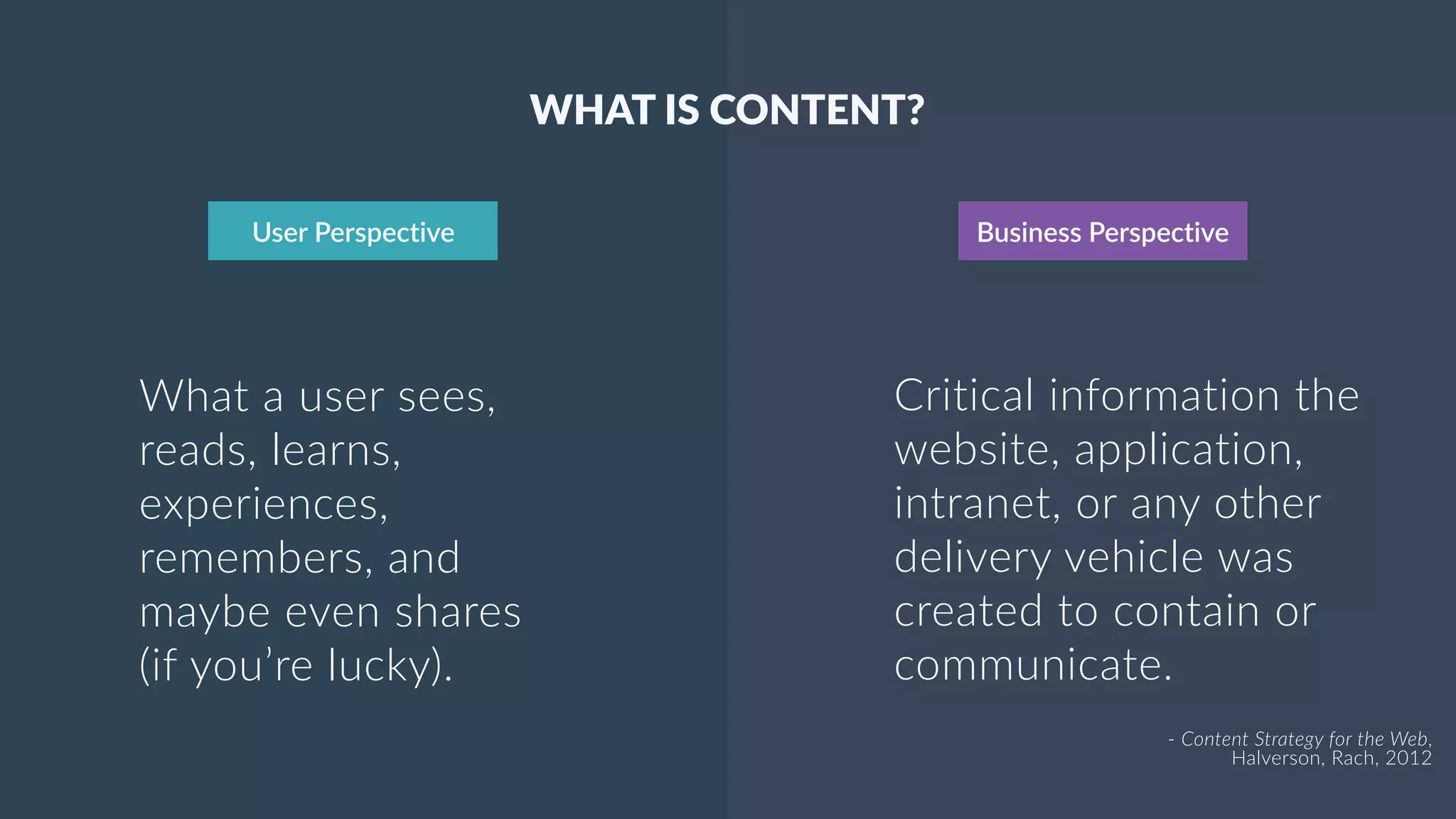
User Perspective Business Perspective
What a user sees,
reads, learns,
experiences,
remembers, and
maybe even shares
(if you’re lucky).
WHAT IS CONTENT?
Critical information the
website, application,
intranet, or any other
delivery vehicle was
created to contain or
communicate.
- Content Strategy for the Web, 

Halverson, Rach, 2012
4
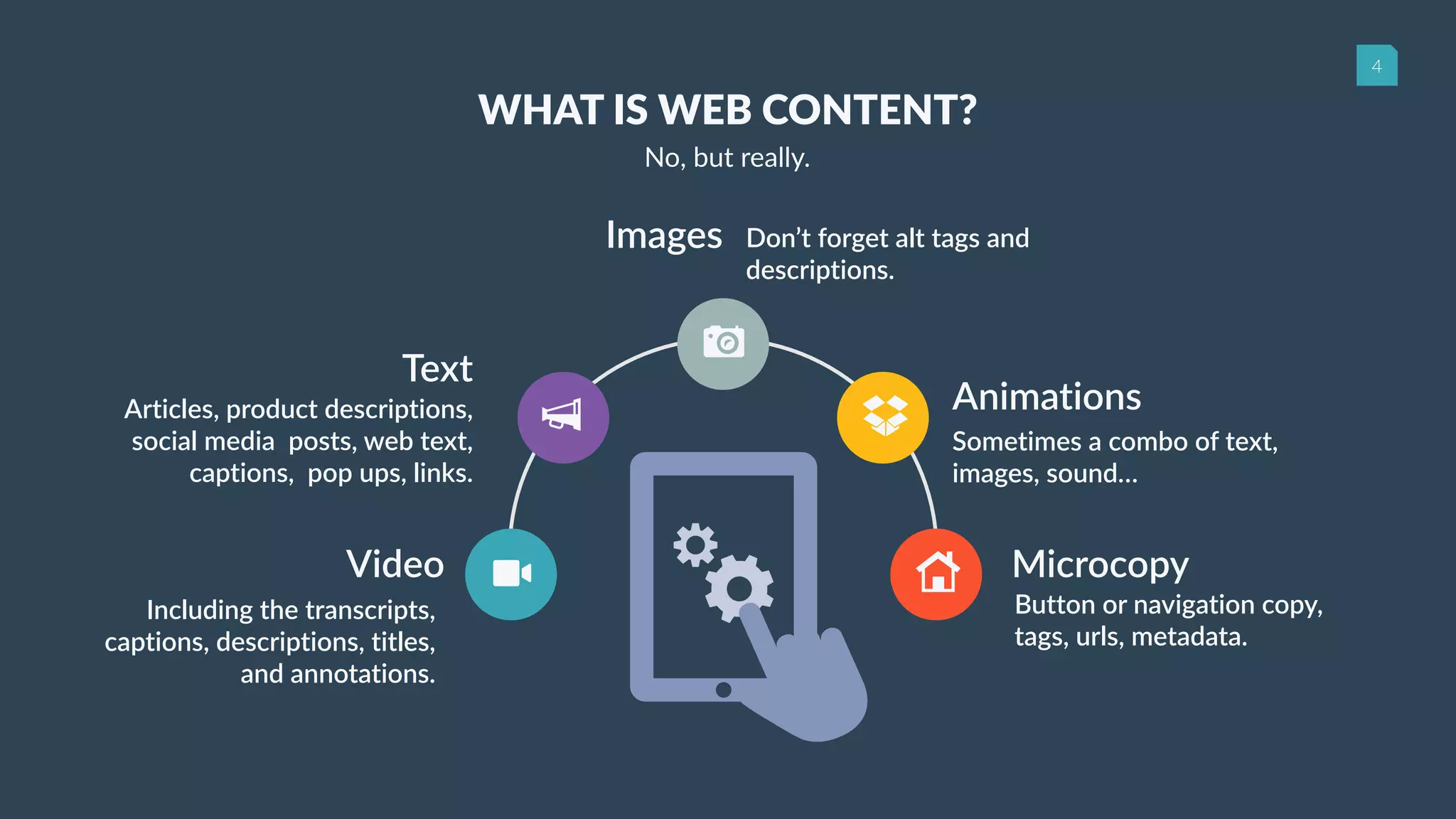
Text
Video
Including the transcripts,
captions, descriptions, titles,
and annotations.
Animations
Sometimes a combo of text,
images, sound…
Microcopy
Button or navigation copy,
tags, urls, metadata.
Images
WHAT IS WEB CONTENT?
No, but really.
Articles, product descriptions,
social media posts, web text,
captions, pop ups, links.
Don’t forget alt tags and
descriptions.
5
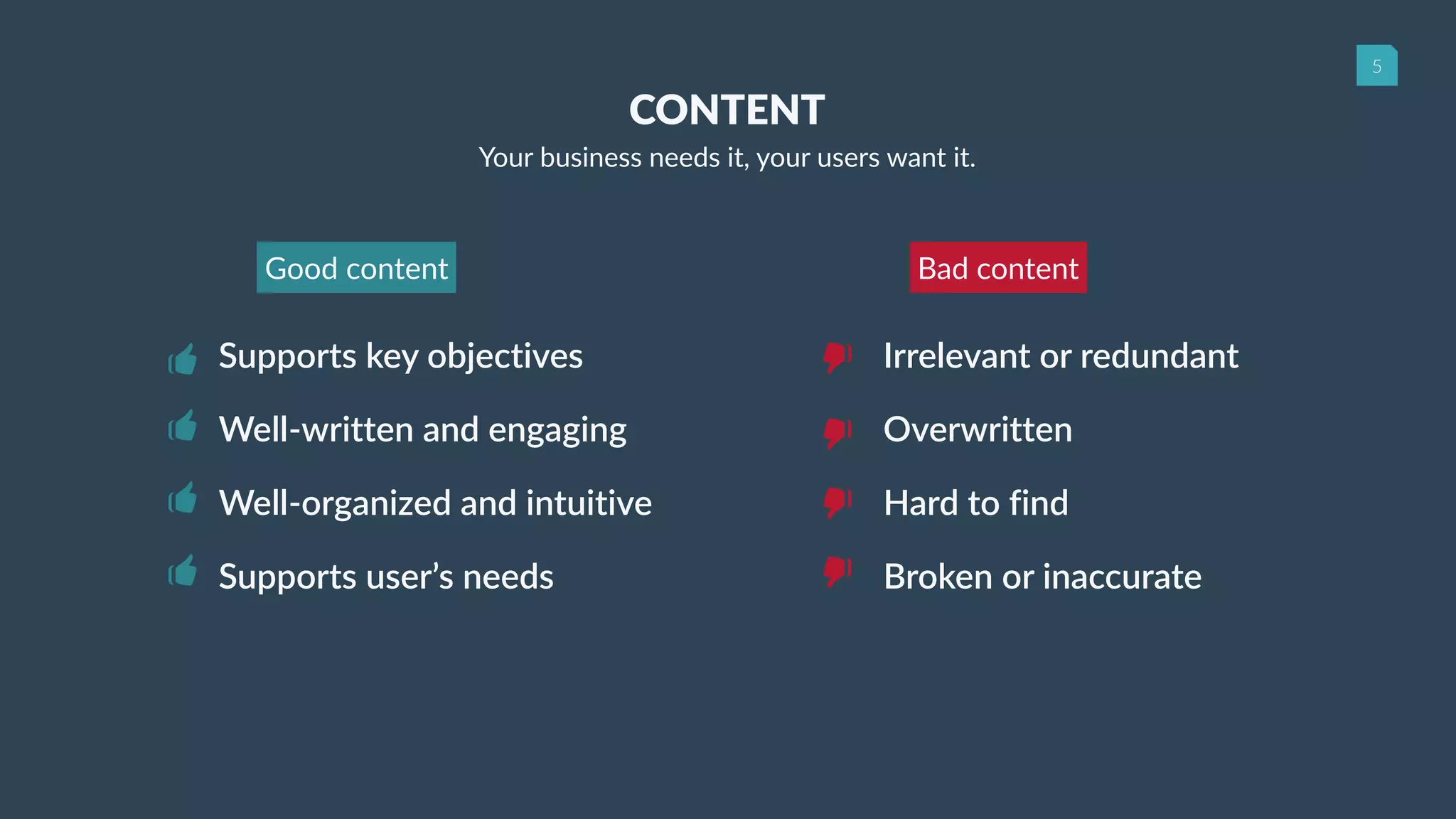
Supports key objectives
Well-written and engaging
Well-organized and intuitive
Supports user’s needs
Irrelevant or redundant
Overwritten
Hard to find
Broken or inaccurate
Good content Bad content
CONTENT
Your business needs it, your users want it.
6
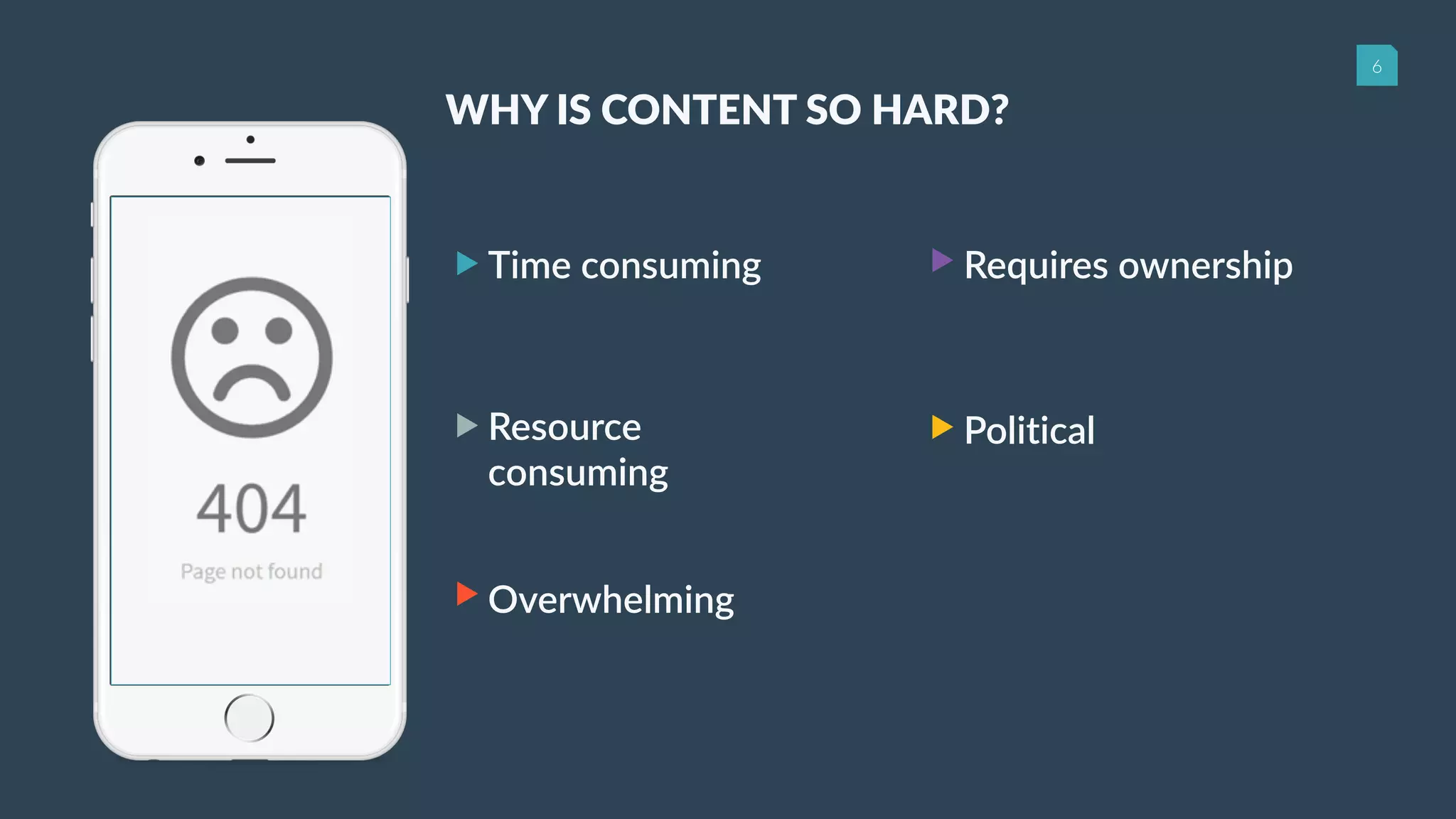
WHY IS CONTENT SO HARD?
Time consuming
Resource
consuming
Requires ownership
Political
Overwhelming
7
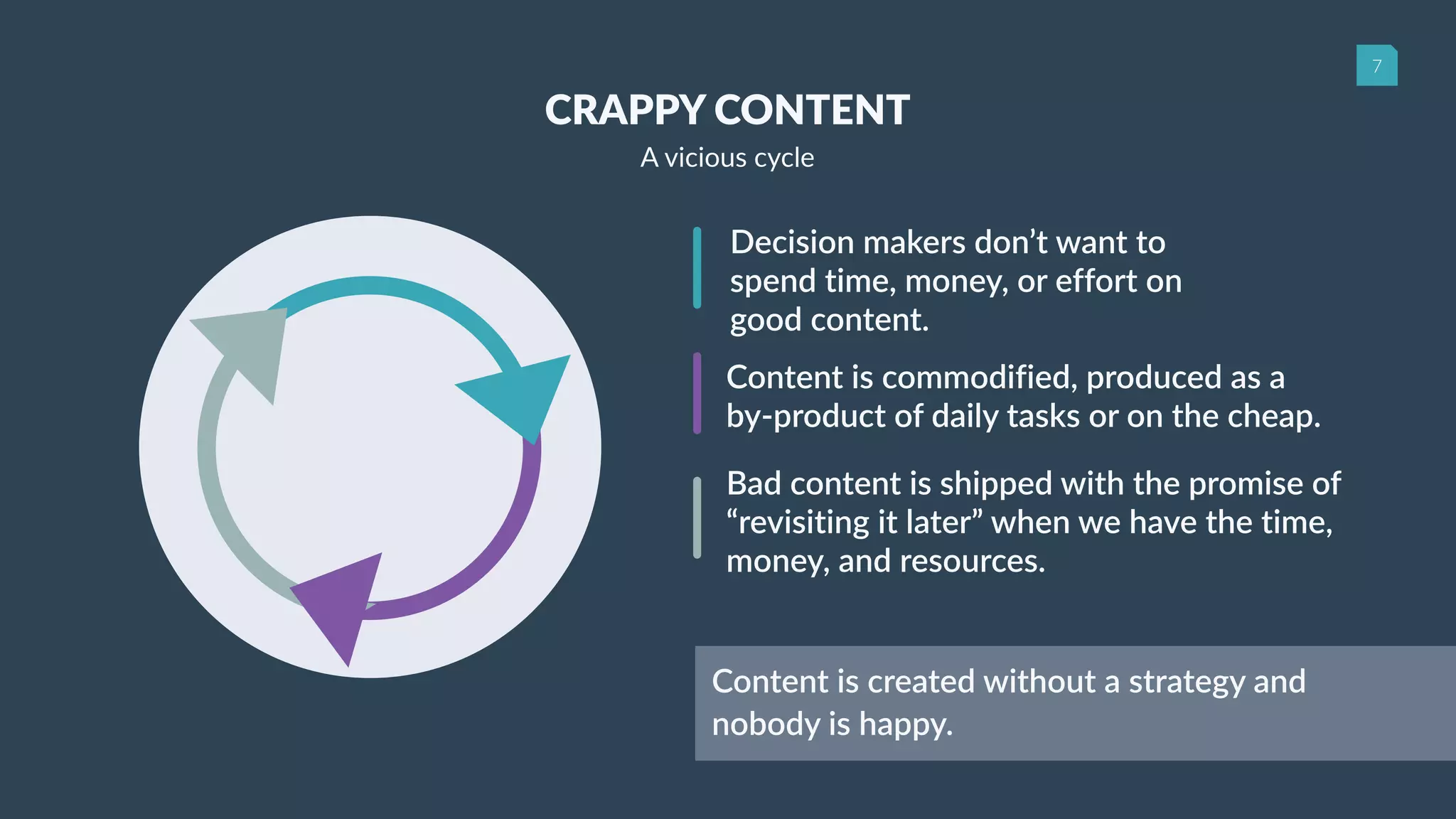
Decision makers don’t want to
spend time, money, or effort on
good content.
Content is commodified, produced as a
by-product of daily tasks or on the cheap.
Bad content is shipped with the promise of
“revisiting it later” when we have the time,
money, and resources.
Content is created without a strategy and
nobody is happy.
CRAPPY CONTENT
A vicious cycle
8
www.louistwelve.com
WHY IS CONTENT still SO HARD?
“I don’t have time to make it better”
“I’m not sure what we need”
“The demands for content are non-stop”
“I don’t know how to create good content”
“I don’t have anyone to create it”
“No one is in charge of content”
“Content requests get stuck in bottlenecks”
9
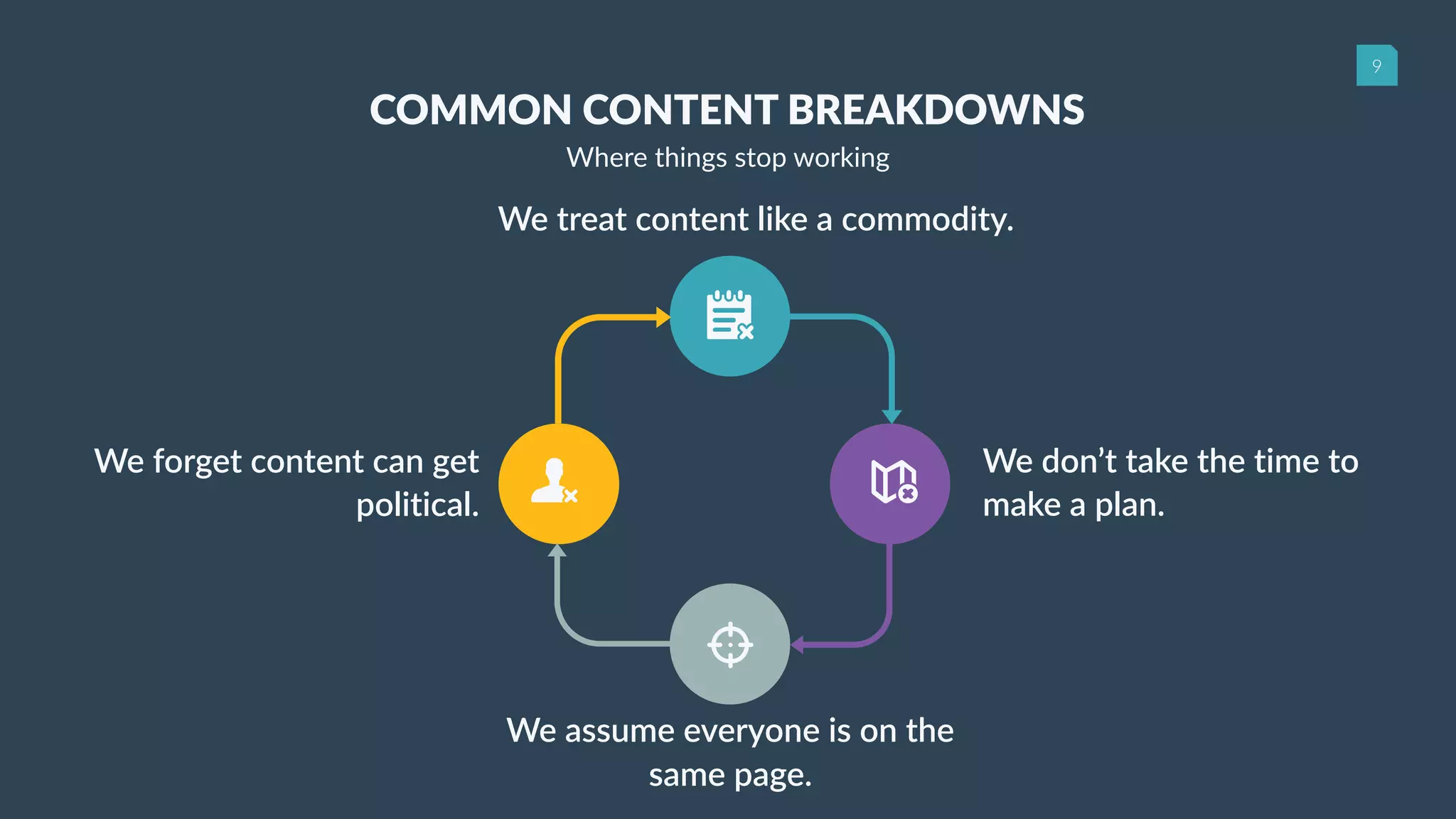
We forget content can get
political.
We treat content like a commodity.
We don’t take the time to
make a plan.
We assume everyone is on the
same page.
COMMON CONTENT BREAKDOWNS
Where things stop working
10
WE TREAT CONTENT LIKE A COMMODITY
▪ Rely on automatic content aggregation (algorithms, RSS feeds, syndication)
▪ Create as much content as possible
▪ Get users to generated content
▪ Sacrifice quality for price
Content requires real people and real resources.
Content that works for your business and matters to your users is not a commodity.
11
WE DON’T TAKE THE TIME TO MAKE A PLAN
▪ Creating content just because you can
▪ Buckling under the pressure to deliver, now
▪ Wanting to have something to show your boss, now
▪ Not stopping to ask questions
12
WE ASSUME EVERYONE IS ON THE SAME PAGE
Nobody likes to have extra work sprung on them.
Make sure you are communicating your plans throughout
the whole process. Agree on the scope and expectations so
no one is caught off guard.
Content creation is more like running a bakery than baking
a cake.
13
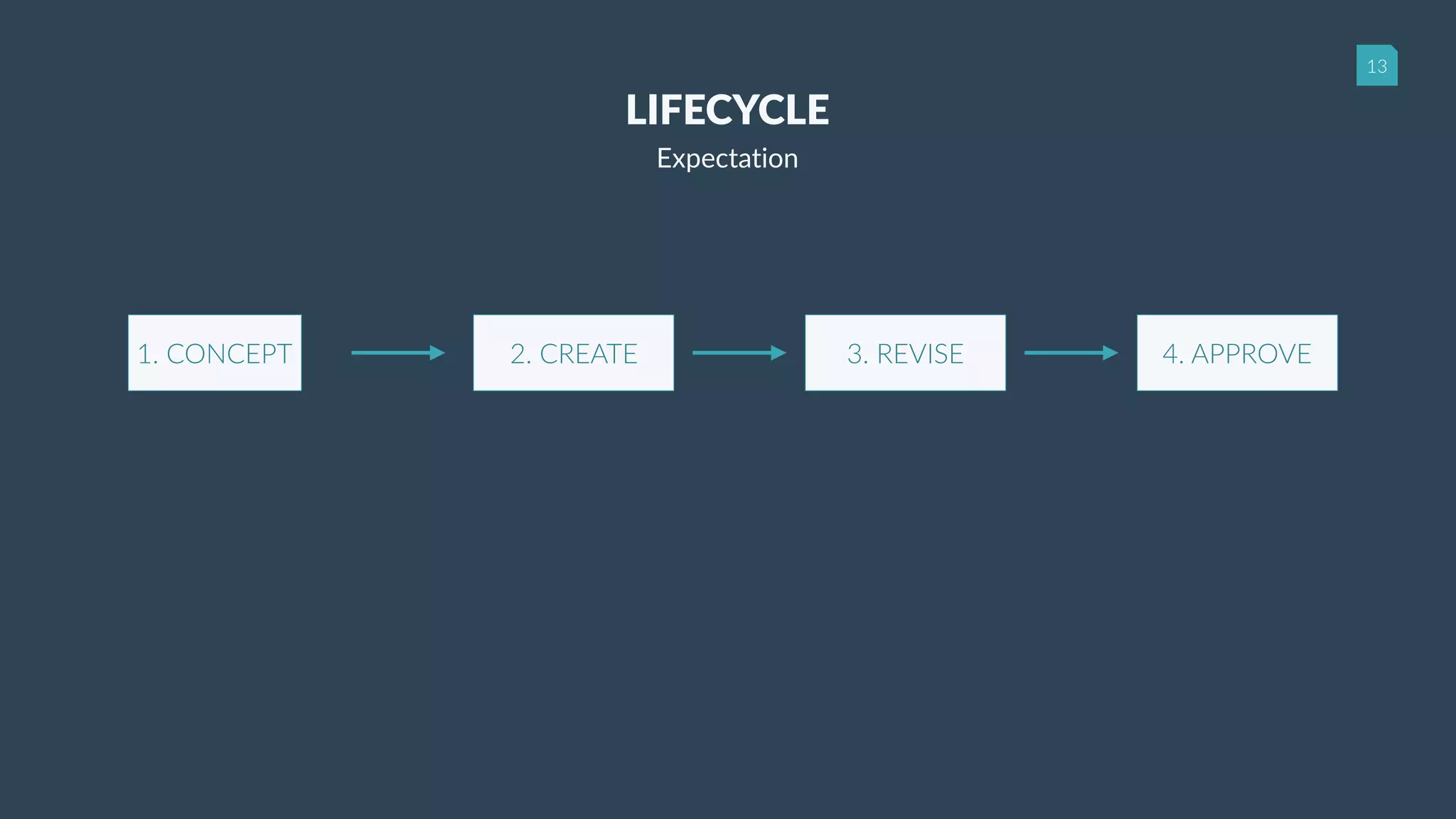
LIFECYCLE
Expectation
1. CONCEPT 2. CREATE 3. REVISE 4. APPROVE
14
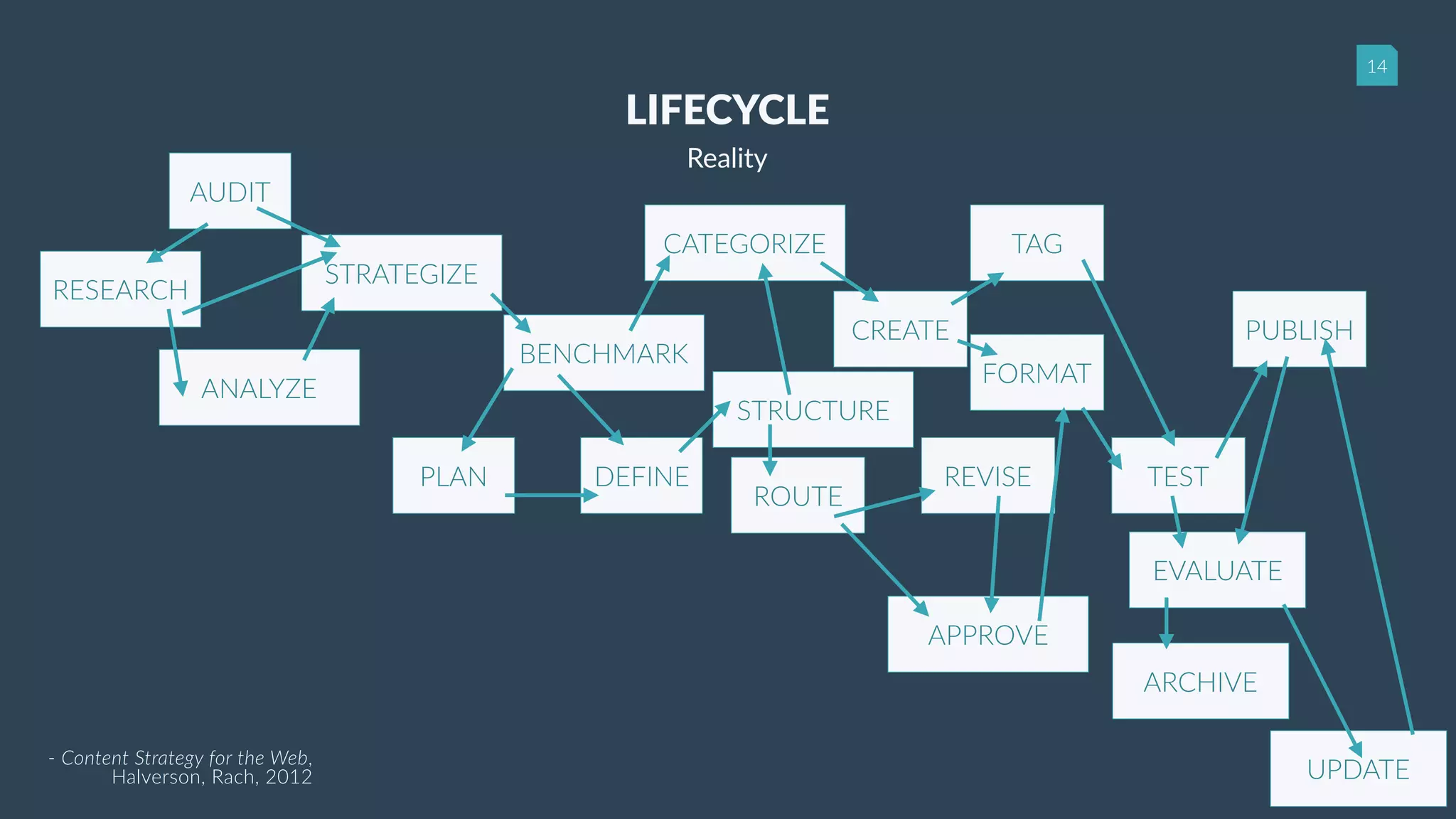
LIFECYCLE
AUDIT
RESEARCH
STRATEGIZE
BENCHMARK
ANALYZE
PLAN DEFINE
CATEGORIZE
CREATE
ROUTE
REVISE
APPROVE
TEST
FORMAT
TAG
PUBLISH
EVALUATE
ARCHIVE
UPDATE
STRUCTURE
Reality
- Content Strategy for the Web, 

Halverson, Rach, 2012
15
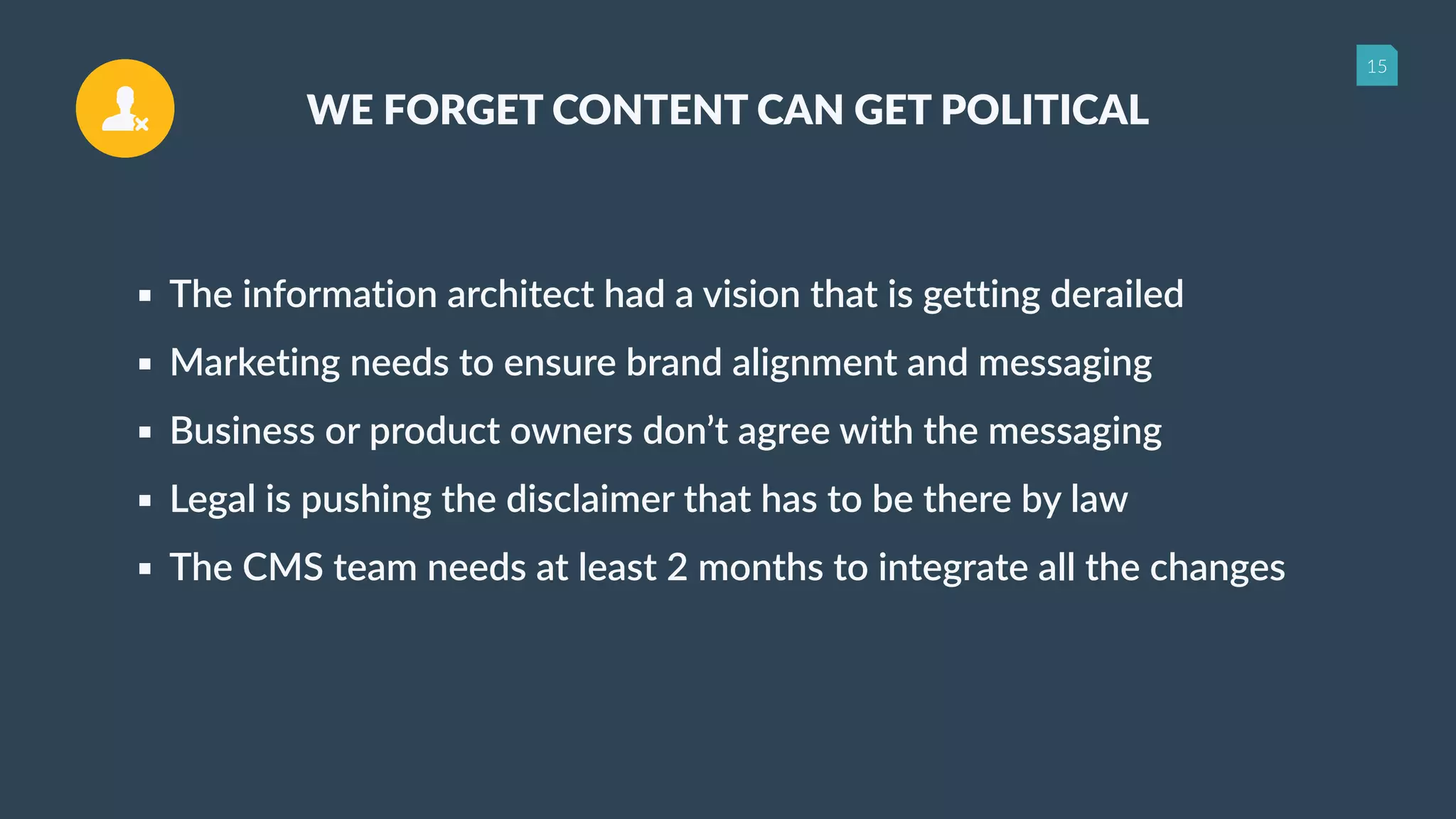
WE FORGET CONTENT CAN GET POLITICAL
▪ The information architect had a vision that is getting derailed
▪ Marketing needs to ensure brand alignment and messaging
▪ Business or product owners don’t agree with the messaging
▪ Legal is pushing the disclaimer that has to be there by law
▪ The CMS team needs at least 2 months to integrate all the changes
16
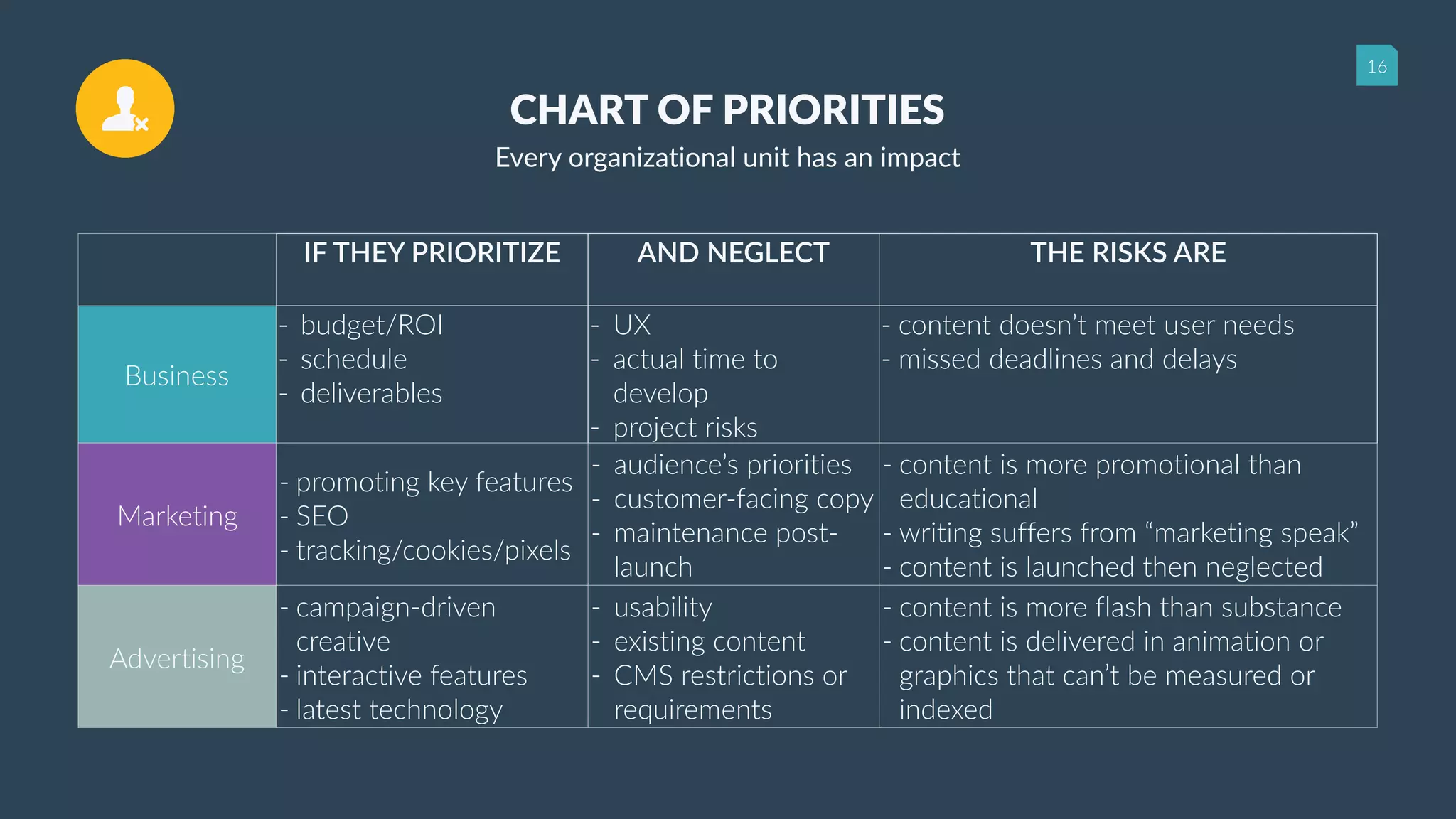
IF THEY PRIORITIZE AND NEGLECT THE RISKS ARE
Business
- budget/ROI
- schedule
- deliverables
- UX
- actual time to
develop
- project risks
- content doesn’t meet user needs
- missed deadlines and delays
Marketing
- promoting key features
- SEO
- tracking/cookies/pixels
- audience’s priorities
- customer-facing copy
- maintenance post-
launch
- content is more promotional than
educational
- writing suffers from “marketing speak”
- content is launched then neglected
Advertising
- campaign-driven
creative
- interactive features
- latest technology
- usability
- existing content
- CMS restrictions or
requirements
- content is more flash than substance
- content is delivered in animation or
graphics that can’t be measured or
indexed
CHART OF PRIORITIES
Every organizational unit has an impact
17
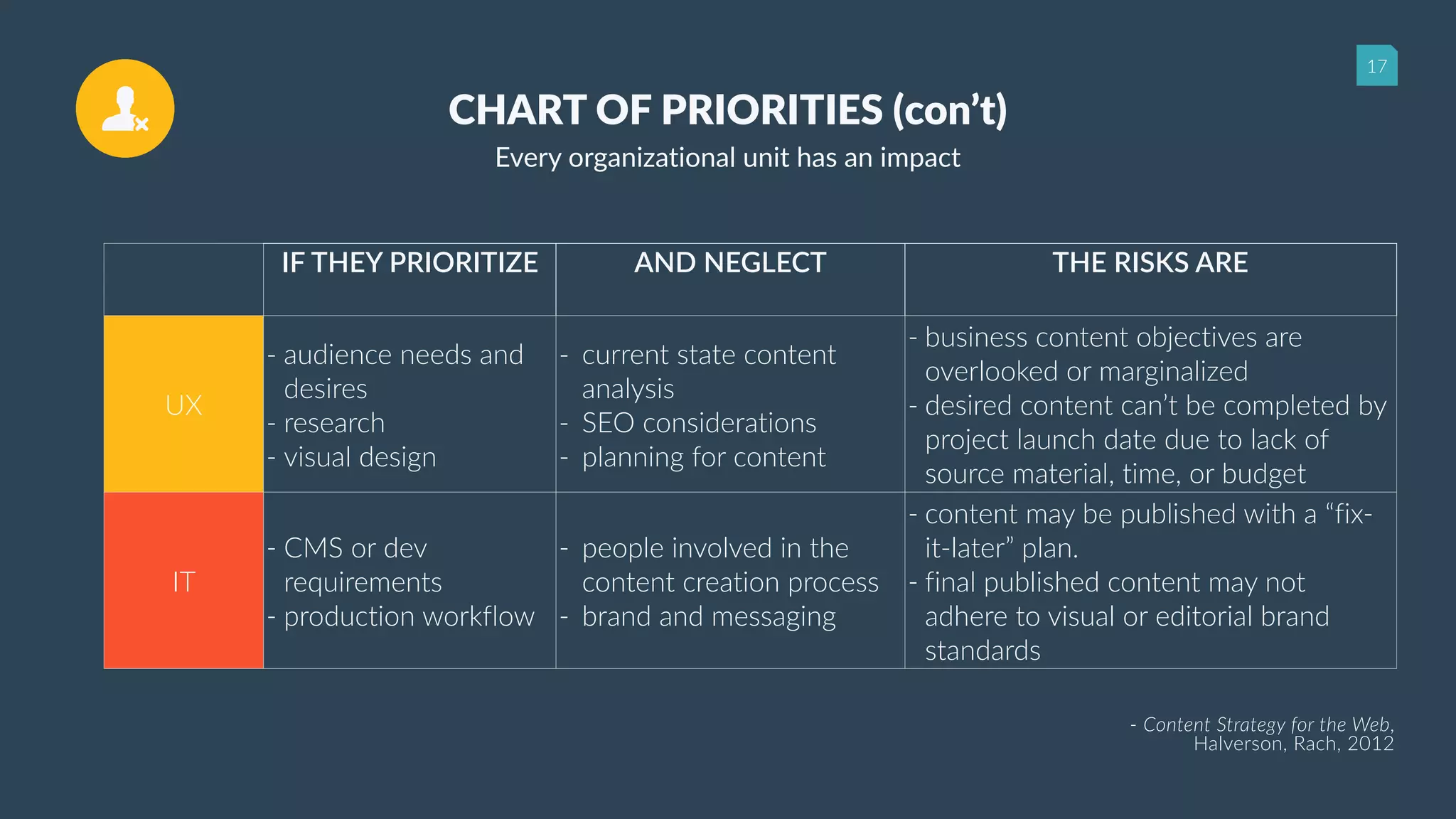
IF THEY PRIORITIZE AND NEGLECT THE RISKS ARE
UX
- audience needs and
desires
- research
- visual design
- current state content
analysis
- SEO considerations
- planning for content
- business content objectives are
overlooked or marginalized
- desired content can’t be completed by
project launch date due to lack of
source material, time, or budget
IT
- CMS or dev
requirements
- production workflow
- people involved in the
content creation process
- brand and messaging
- content may be published with a “fix-
it-later” plan.
- final published content may not
adhere to visual or editorial brand
standards
CHART OF PRIORITIES (con’t)
Every organizational unit has an impact
- Content Strategy for the Web, 

Halverson, Rach, 2012
18
A website redesign
is an opportunity to stop,
take inventory,
develop a strategy, and
create better content.
19
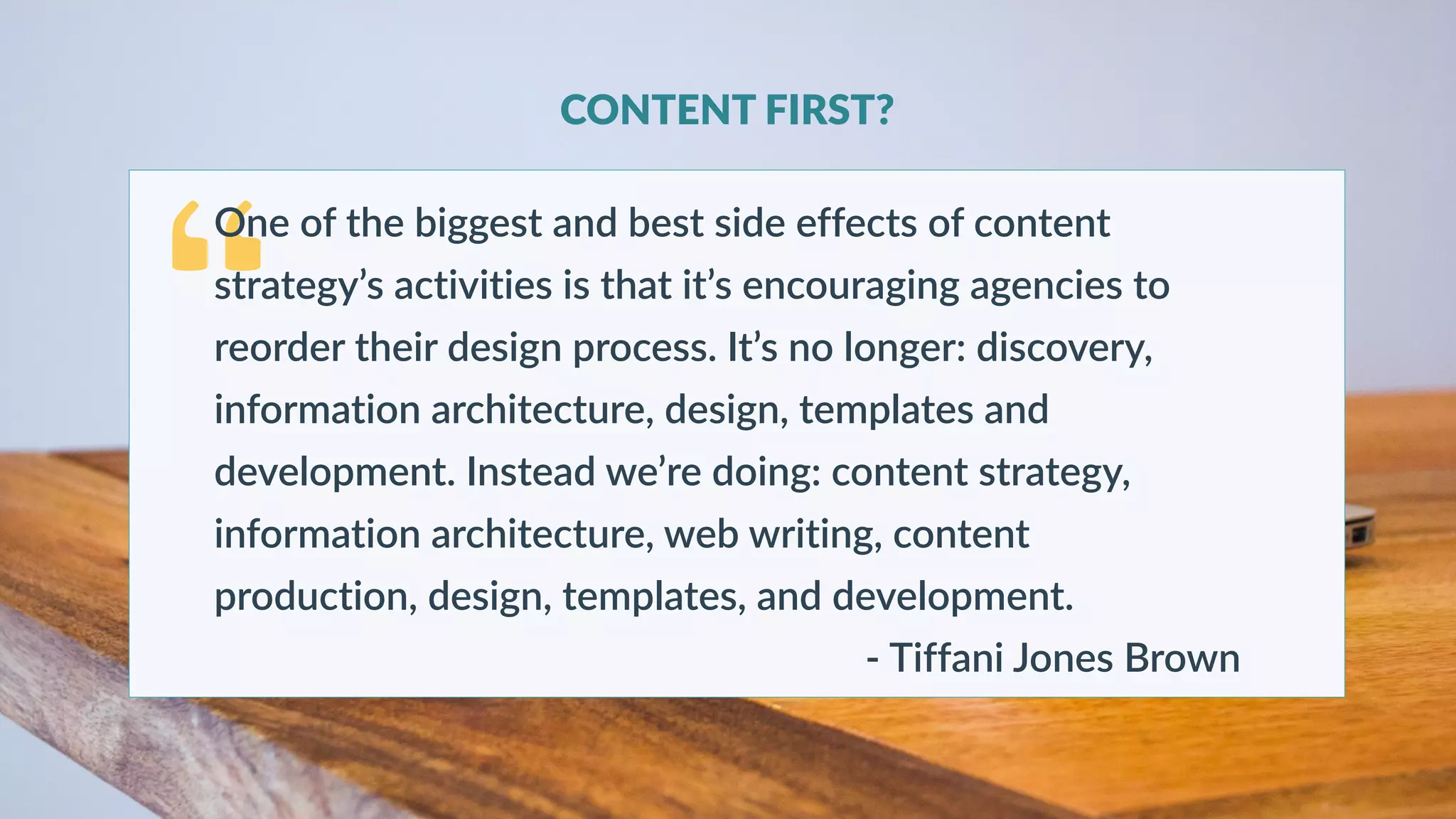
CONTENT FIRST?
“
One of the biggest and best side effects of content
strategy’s activities is that it’s encouraging agencies to
reorder their design process. It’s no longer: discovery,
information architecture, design, templates and
development. Instead we’re doing: content strategy,
information architecture, web writing, content
production, design, templates, and development.
- Tiffani Jones Brown
20
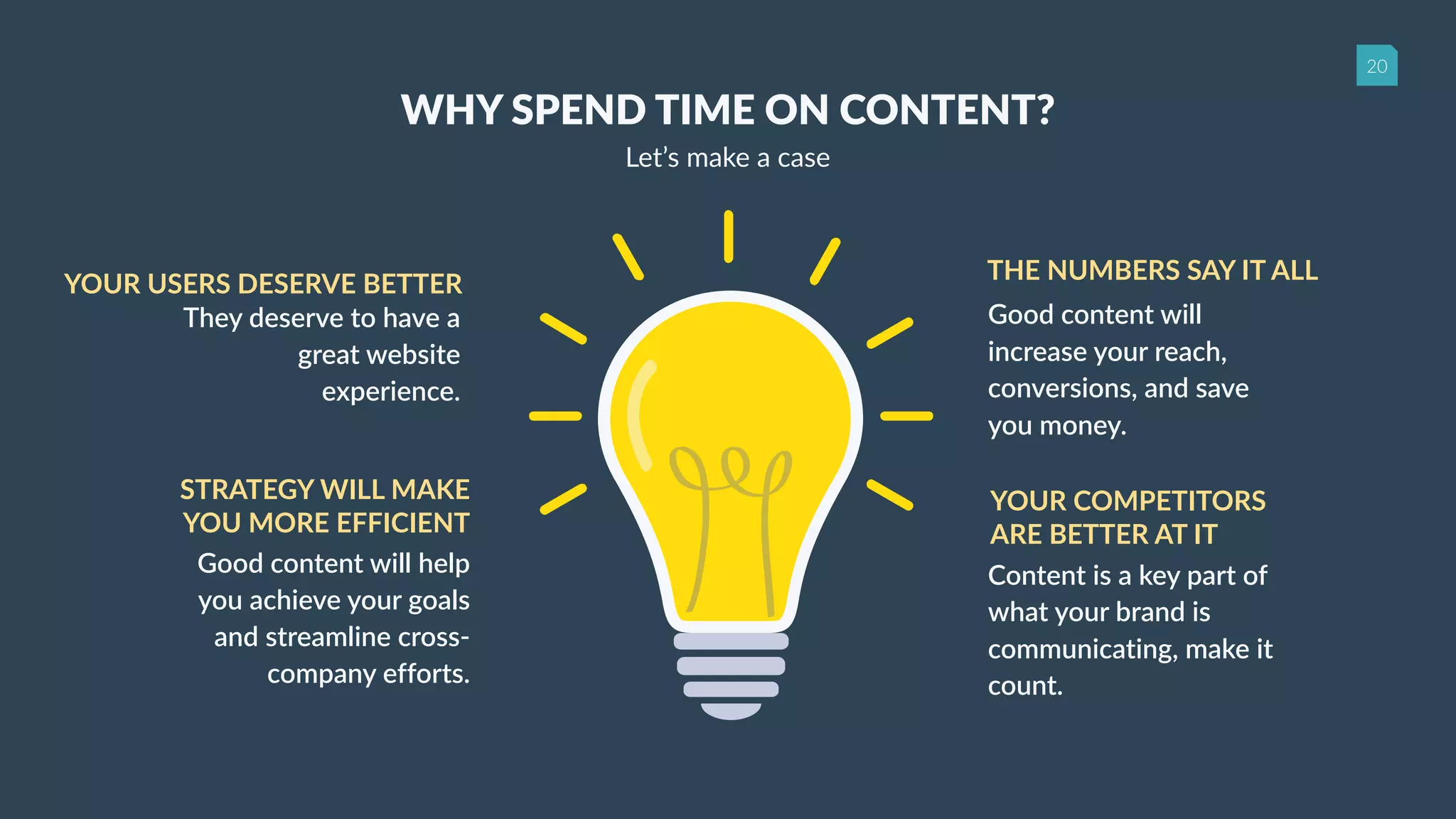
They deserve to have a
great website
experience.
YOUR USERS DESERVE BETTER
Content is a key part of
what your brand is
communicating, make it
count.
YOUR COMPETITORS
ARE BETTER AT IT
Good content will help
you achieve your goals
and streamline cross-
company efforts.
STRATEGY WILL MAKE
YOU MORE EFFICIENT
Good content will
increase your reach,
conversions, and save
you money.
THE NUMBERS SAY IT ALL
WHY SPEND TIME ON CONTENT?
Let’s make a case
21
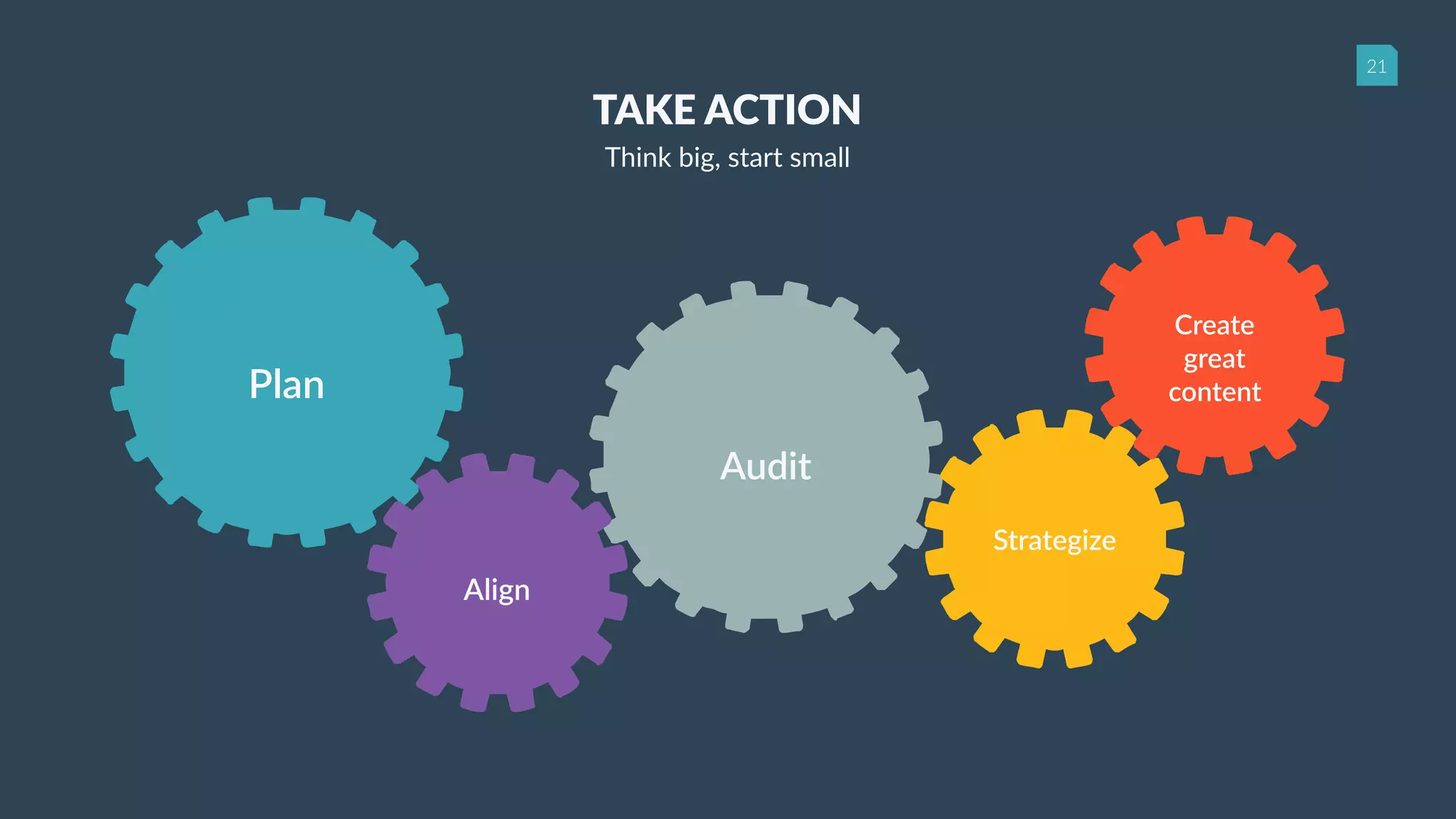
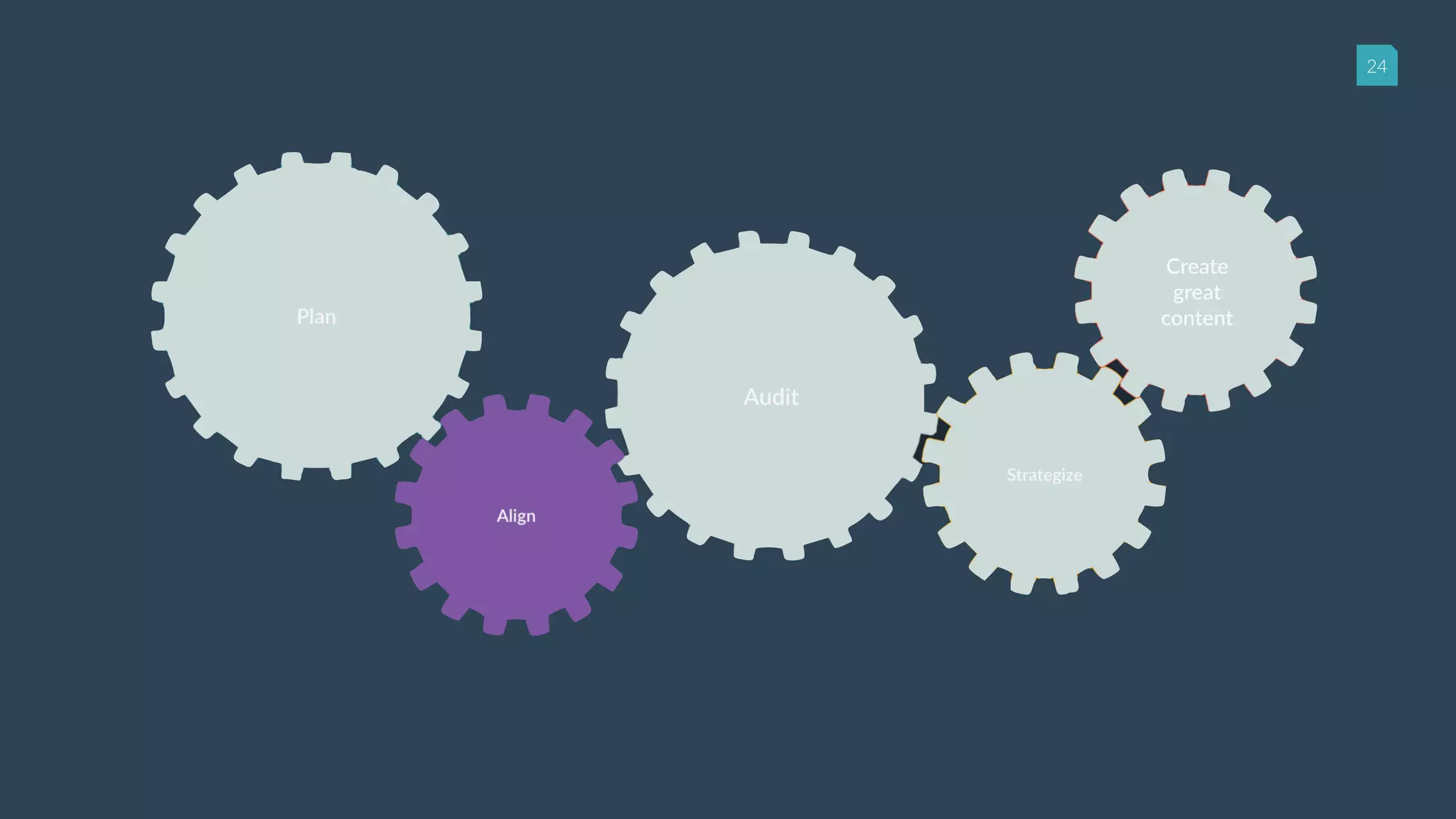
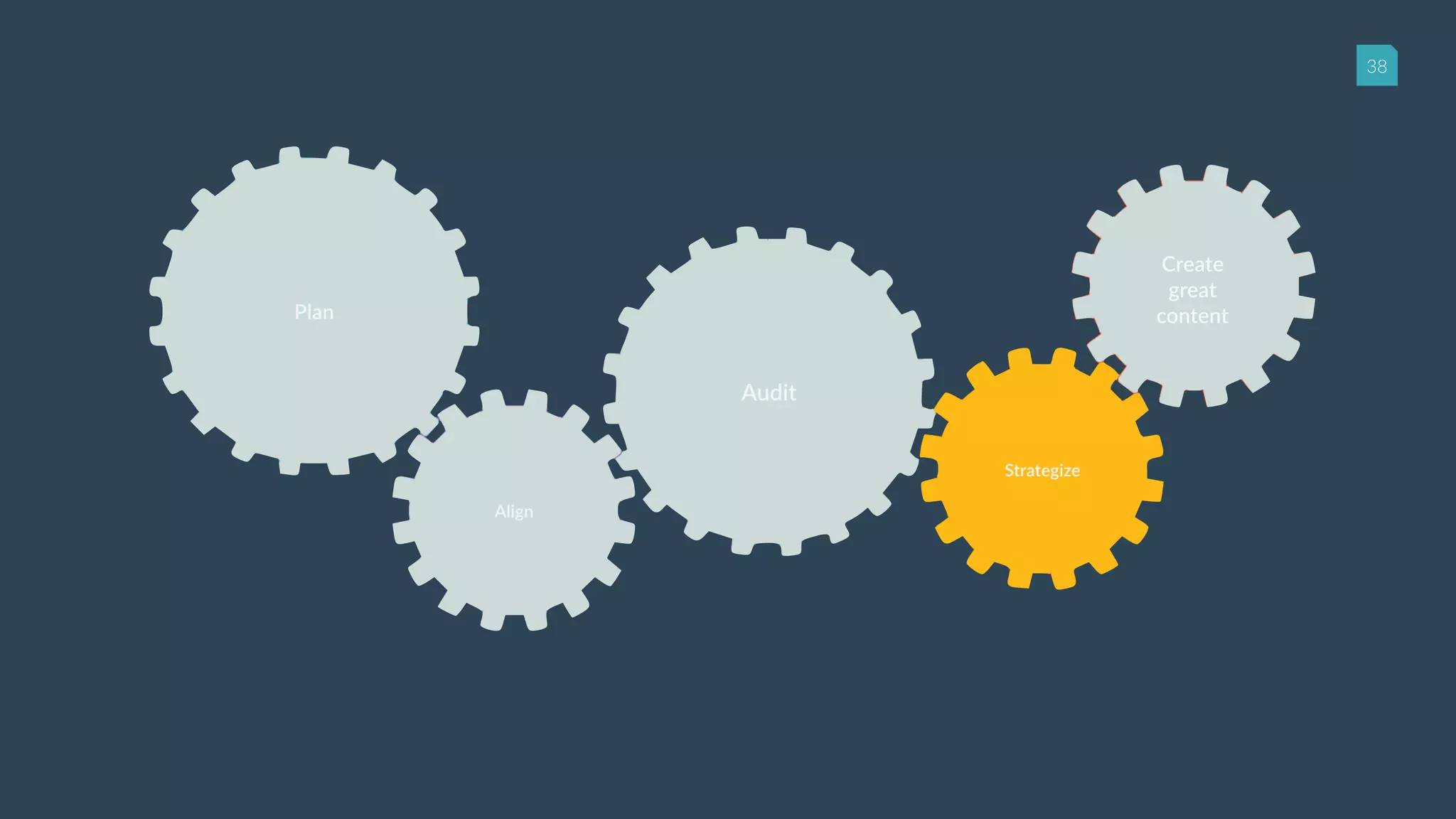
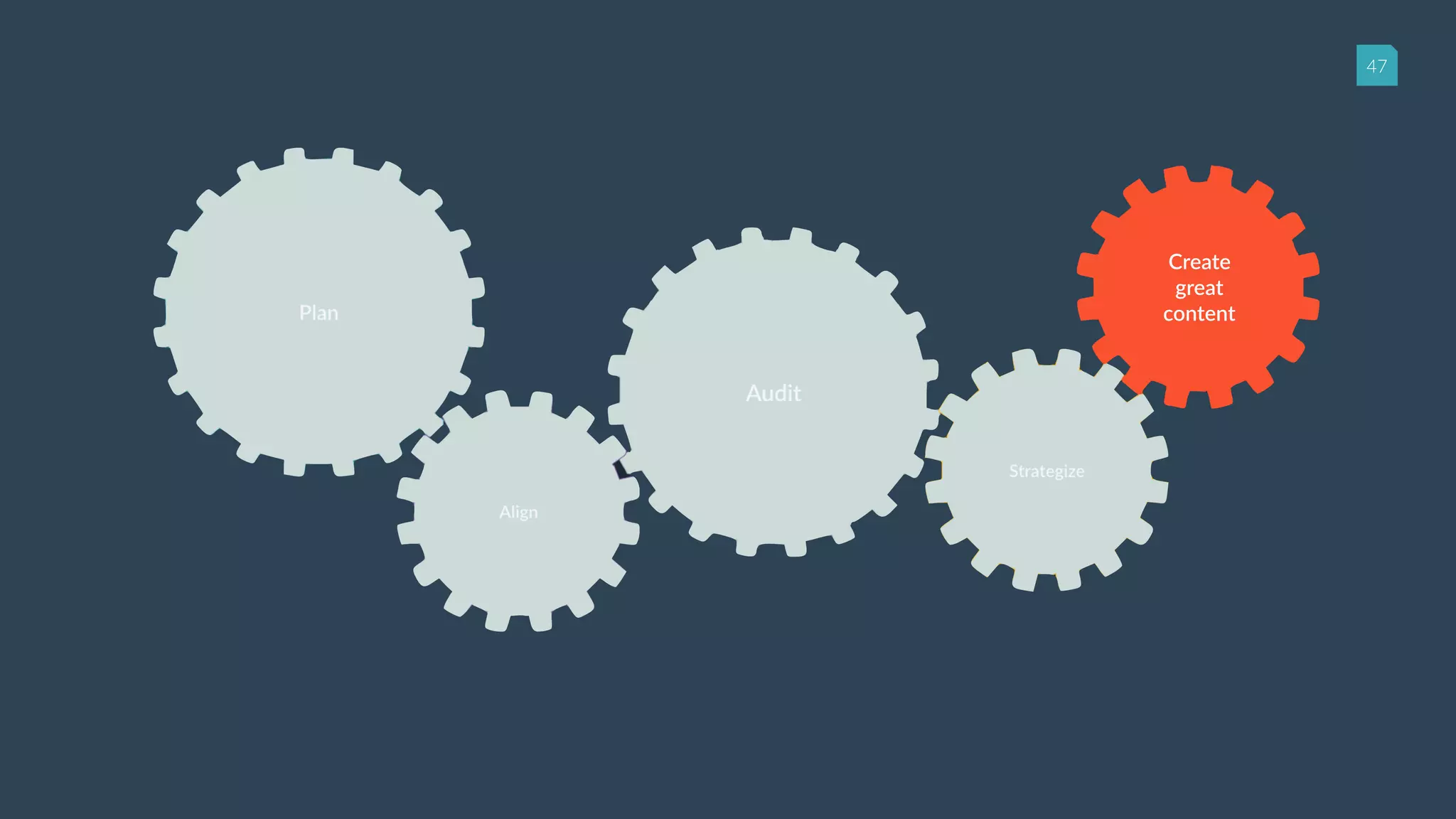
Plan
Audit
Win
Strategize
Align
TAKE ACTION
Think big, start small
Create
great
content
22
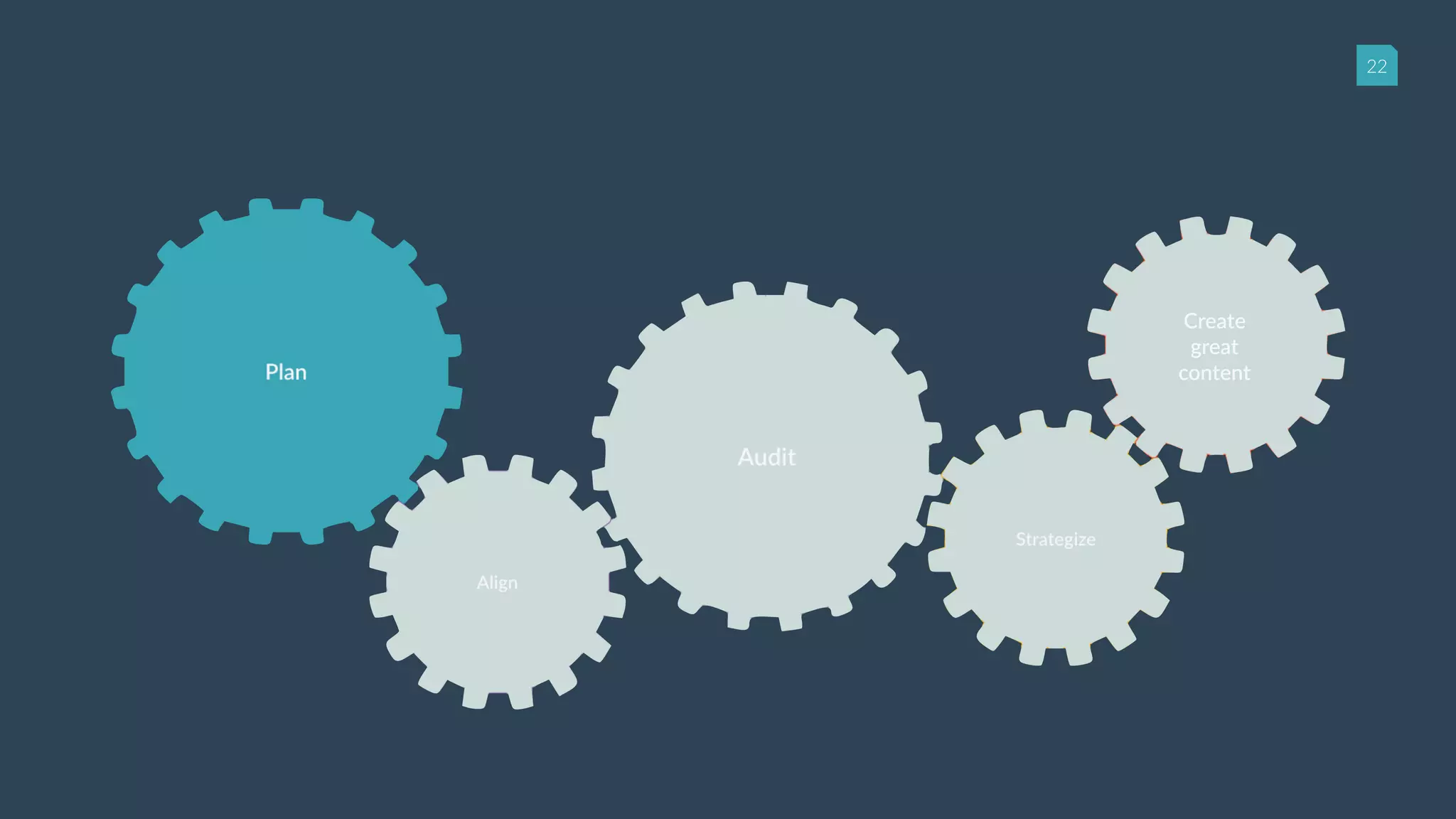
Create
great
content
23
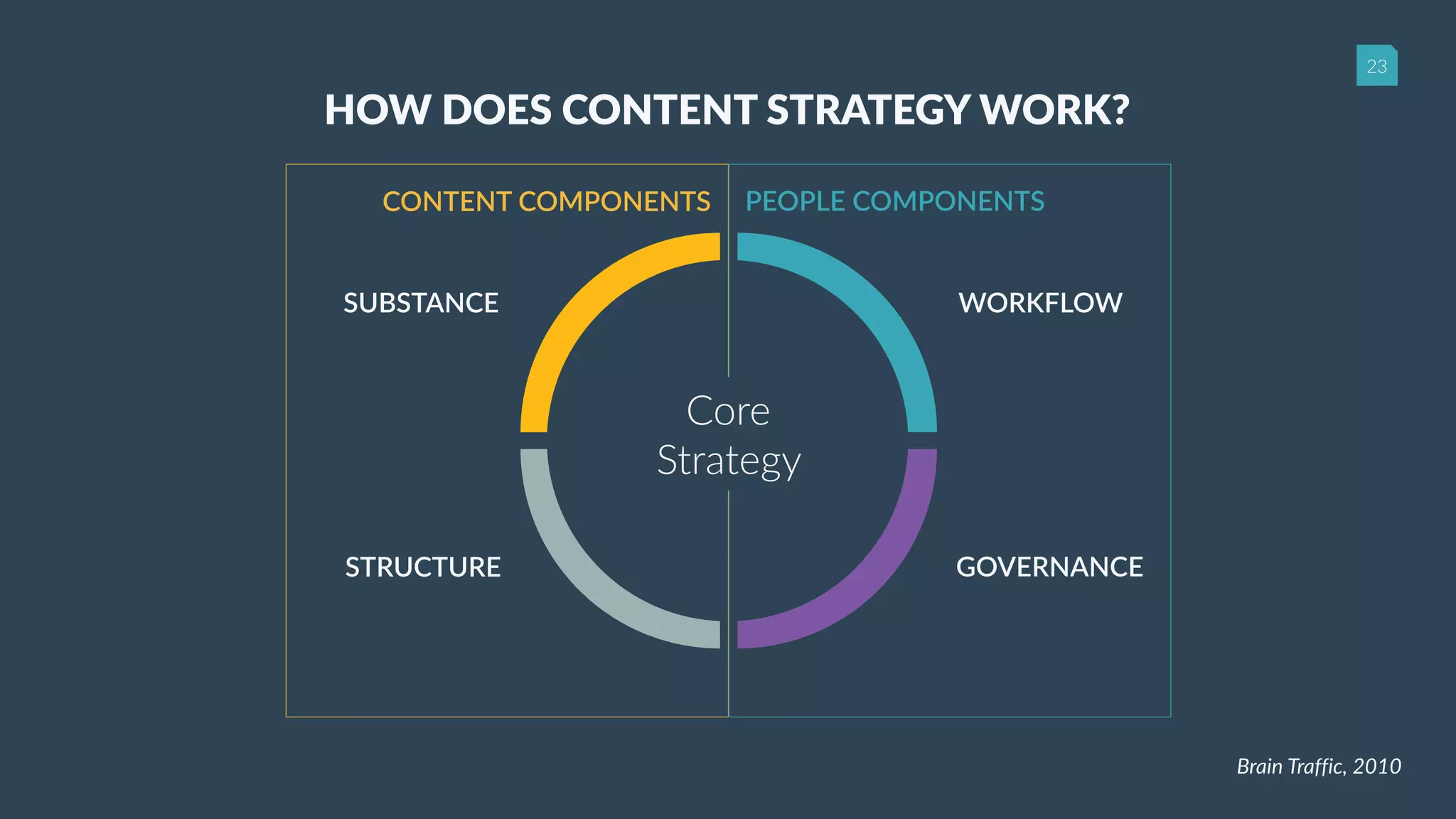
WORKFLOW
GOVERNANCE
SUBSTANCE
STRUCTURE
HOW DOES CONTENT STRATEGY WORK?
Brain Traffic, 2010
CONTENT COMPONENTS PEOPLE COMPONENTS
Core
Strategy
24
Create
great
content
25
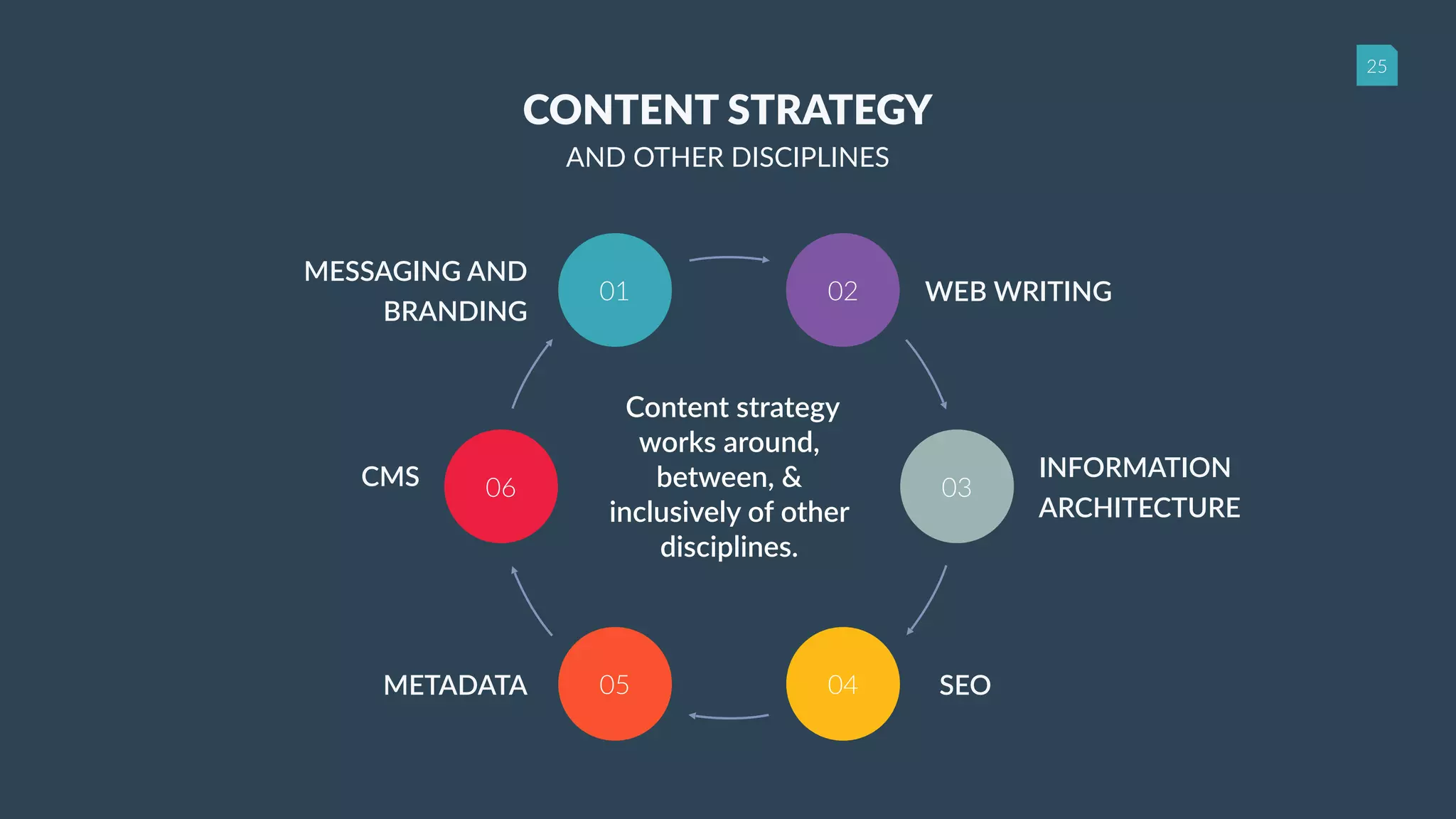
Content strategy
works around,
between, &
inclusively of other
disciplines.
02
0306
01
05 04
WEB WRITING
INFORMATION
ARCHITECTURE
SEO
MESSAGING AND
BRANDING
CMS
METADATA
CONTENT STRATEGY
AND OTHER DISCIPLINES
26
GATHER A TEAM
▪ Identify your stakeholders
▪ Convince them to participate
▪ Set the stage for alignment with a kickoff
▪ Get them engaged
▪ Keep them motivated
27
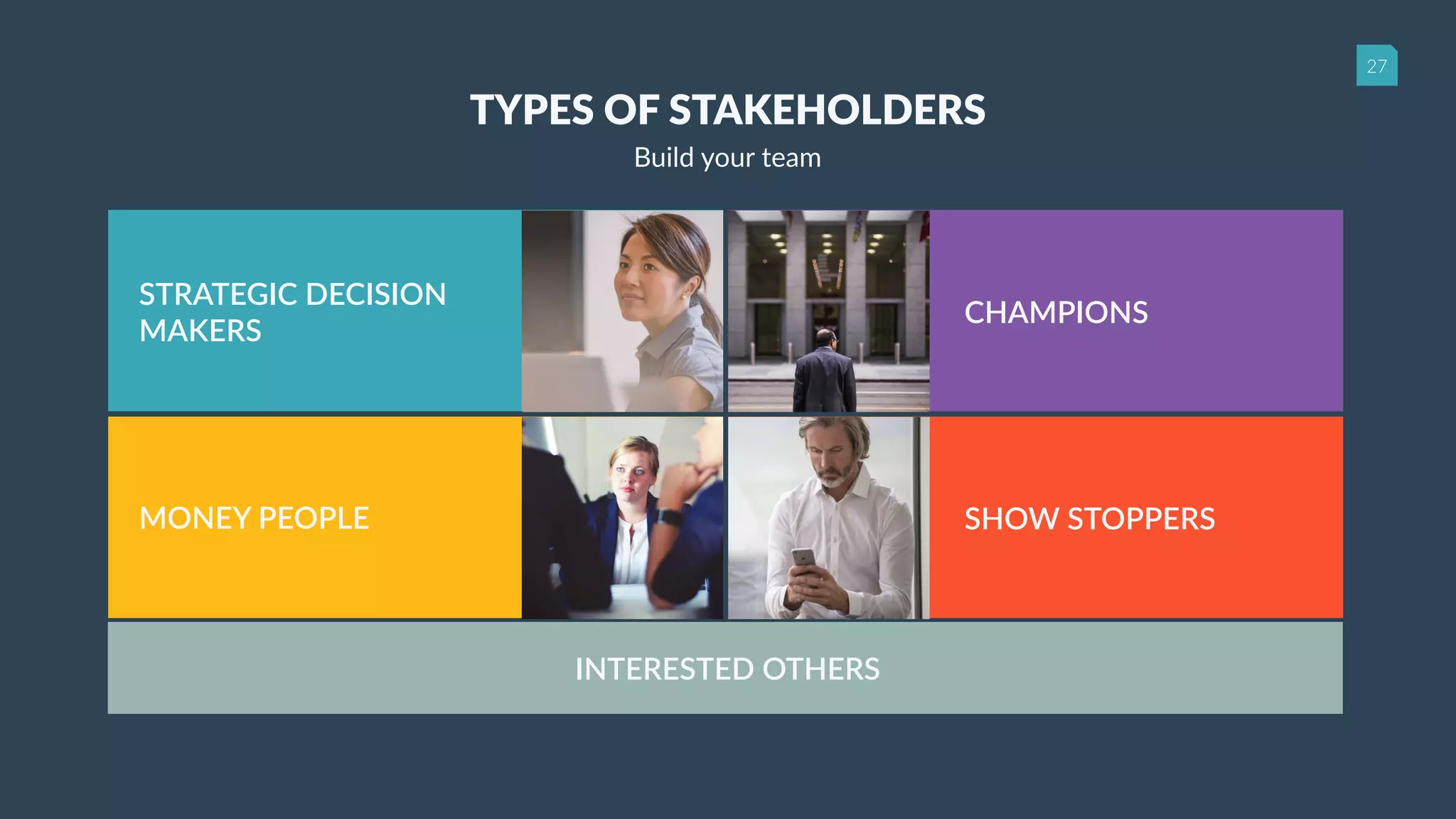
STRATEGIC DECISION
MAKERS
MONEY PEOPLE
CHAMPIONS
SHOW STOPPERS
TYPES OF STAKEHOLDERS
Build your team
INTERESTED OTHERS
28
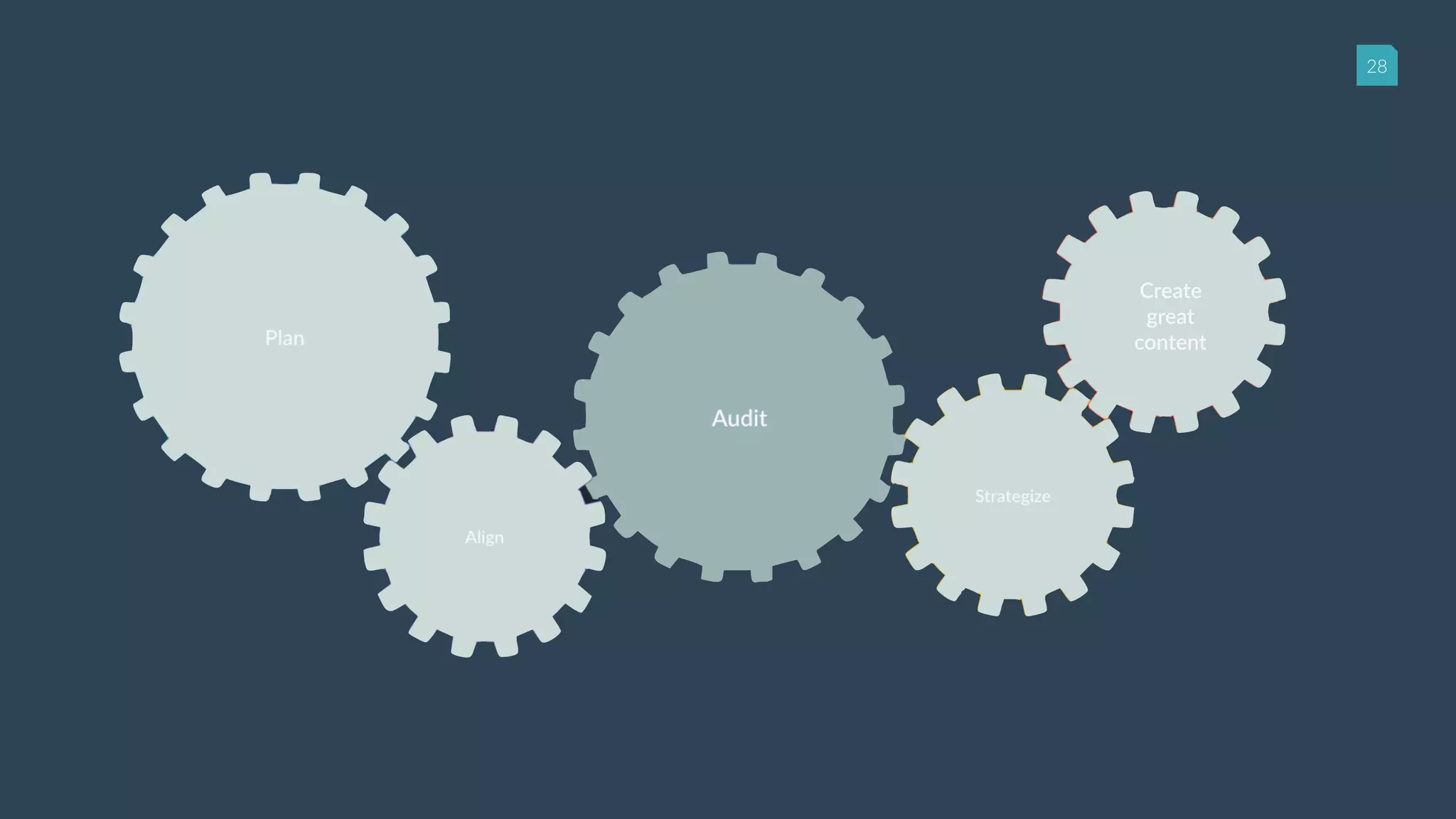
Create
great
content
29
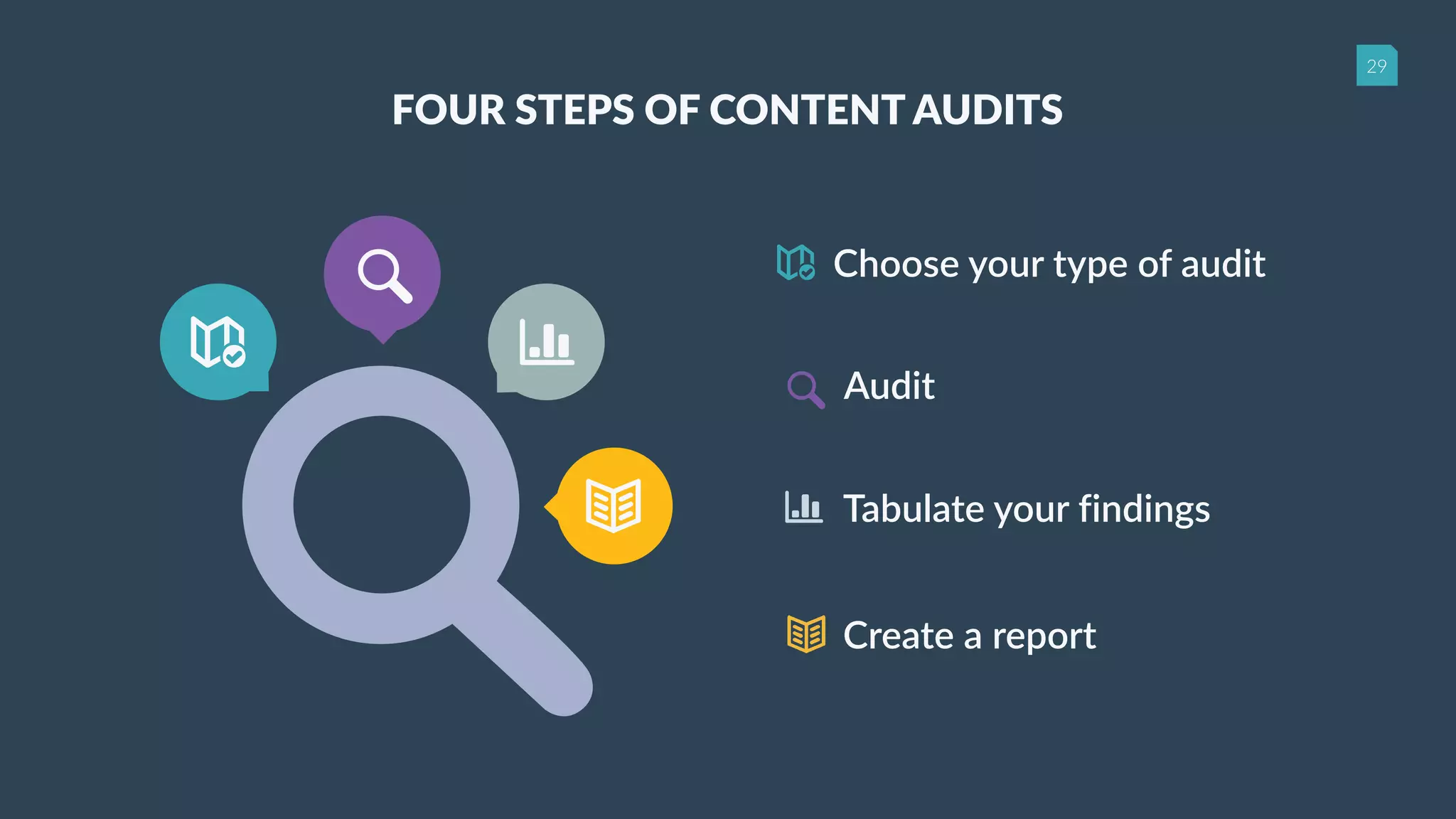
Choose your type of audit
Audit
Tabulate your findings
Create a report
FOUR STEPS OF CONTENT AUDITS
30
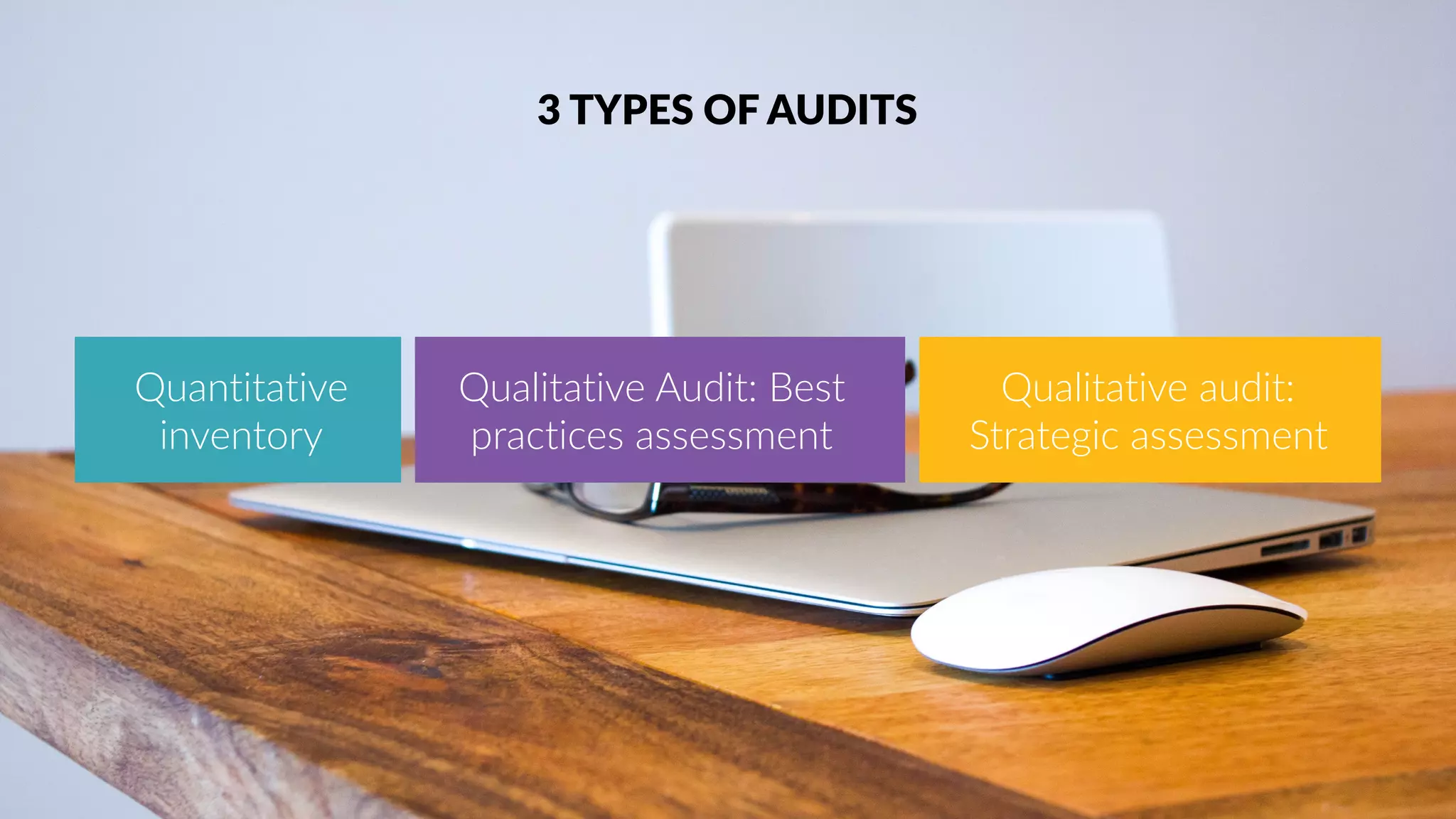
Quantitative
inventory
Qualitative Audit: Best
practices assessment
3 TYPES OF AUDITS
Qualitative audit:
Strategic assessment
31
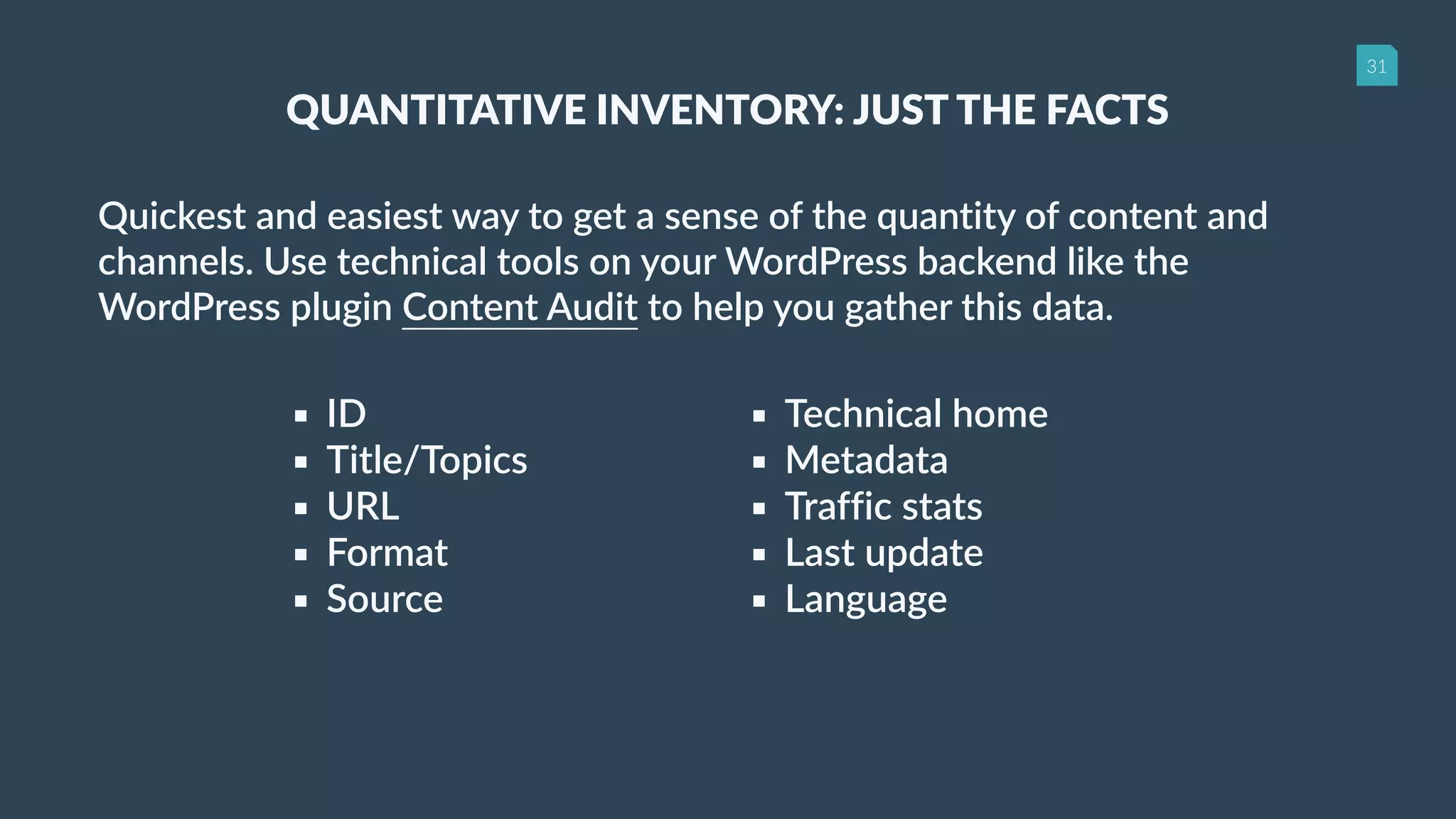
QUANTITATIVE INVENTORY: JUST THE FACTS
Quickest and easiest way to get a sense of the quantity of content and
channels. Use technical tools on your WordPress backend like the
WordPress plugin Content Audit to help you gather this data.
▪ ID
▪ Title/Topics
▪ URL
▪ Format
▪ Source
▪ Technical home
▪ Metadata
▪ Traffic stats
▪ Last update
▪ Language
32
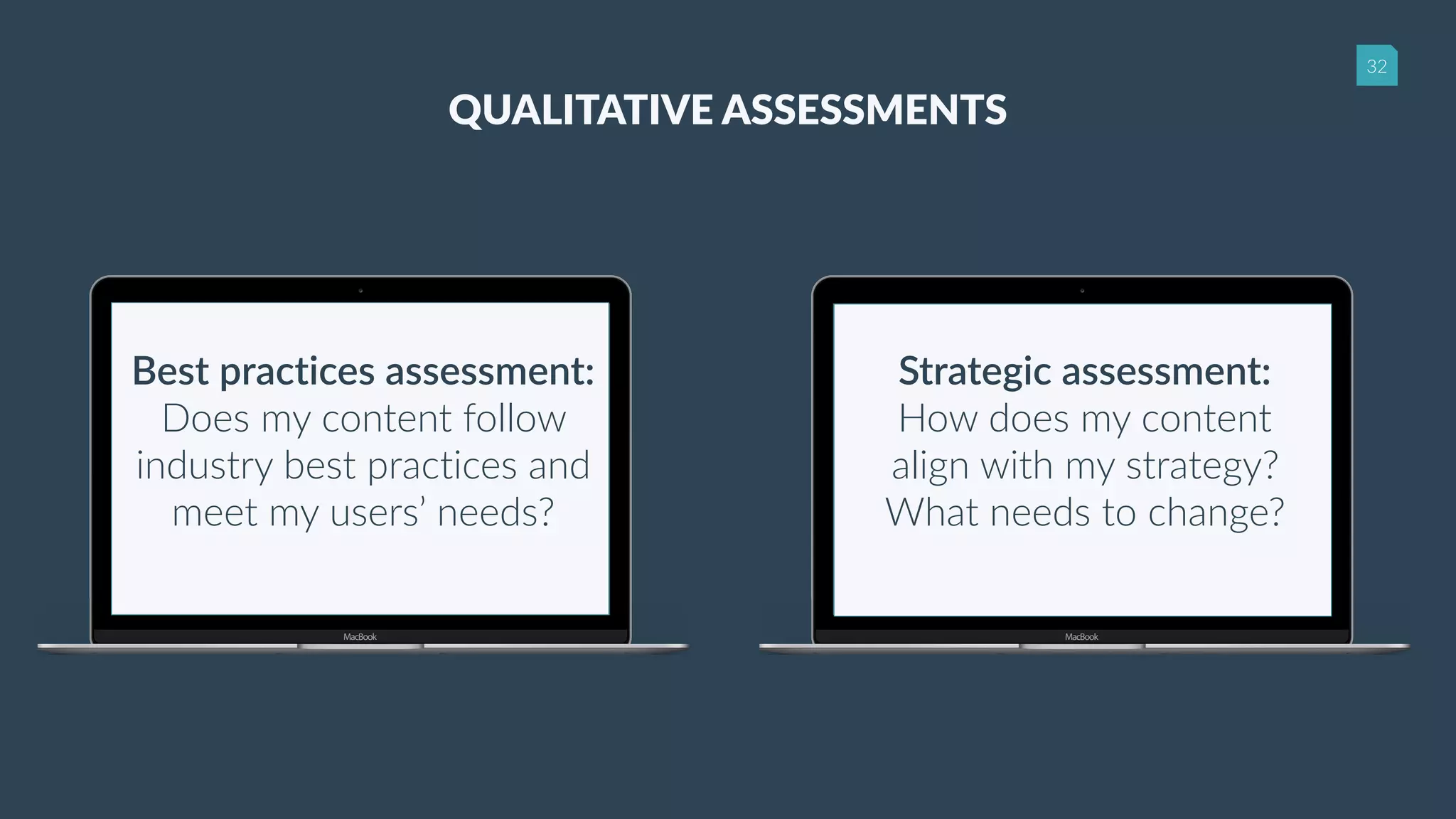
QUALITATIVE ASSESSMENTS
Best practices assessment:
Does my content follow
industry best practices and
meet my users’ needs?
Strategic assessment:
How does my content
align with my strategy?
What needs to change?
33
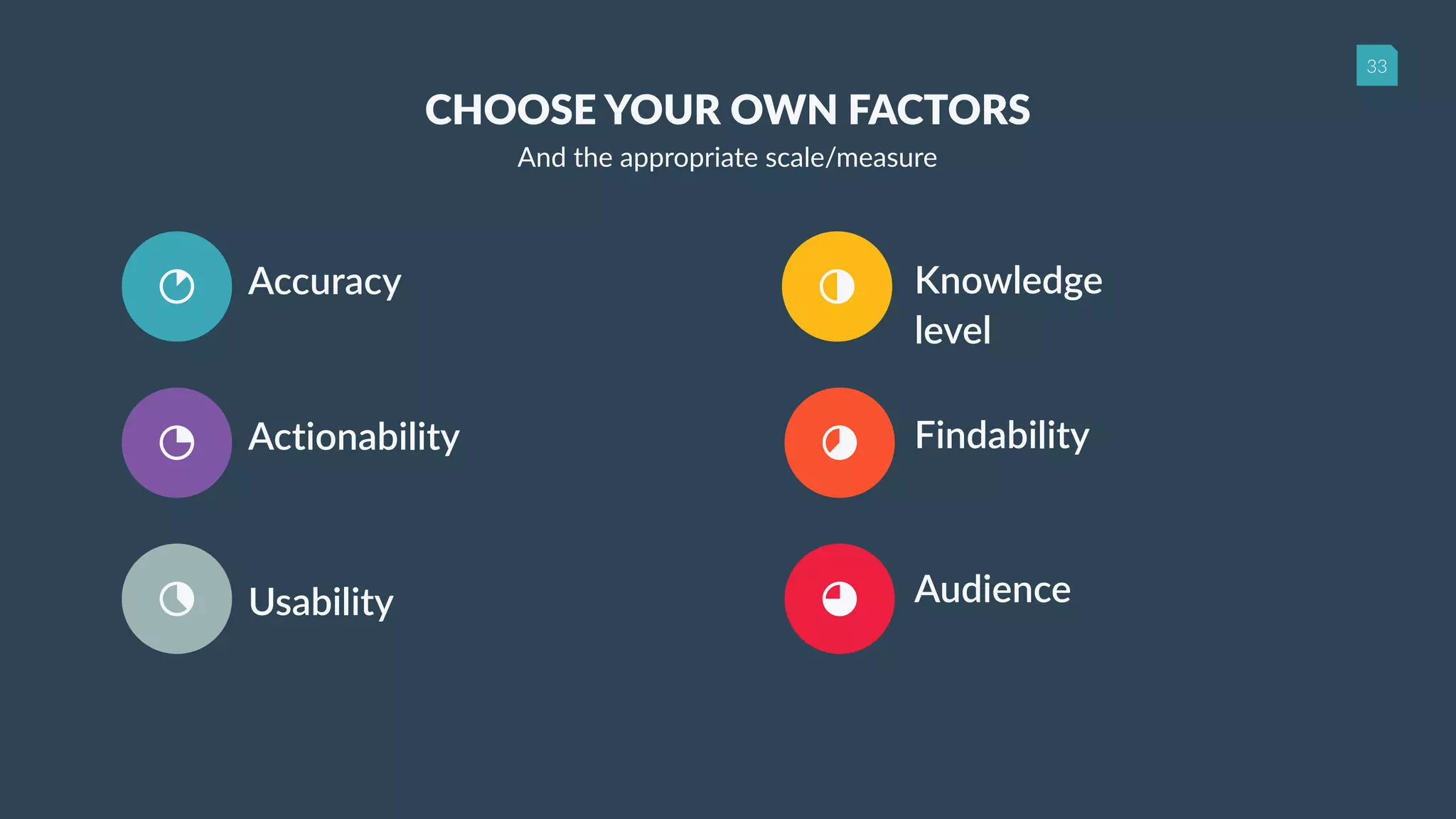
Knowledge
level
Findability
Audience
Accuracy
Actionability
Usability
CHOOSE YOUR OWN FACTORS
And the appropriate scale/measure
34
01 02 03
MESSAGE BUSINESS
VALUE
BRAND/TONE
STRATEGIC ASSESSMENT FACTORS
35
A NOTE ABOUT SPREADSHEETS
The basic spreadsheet Spreadsheet 2.0 Indexed Inventory
36
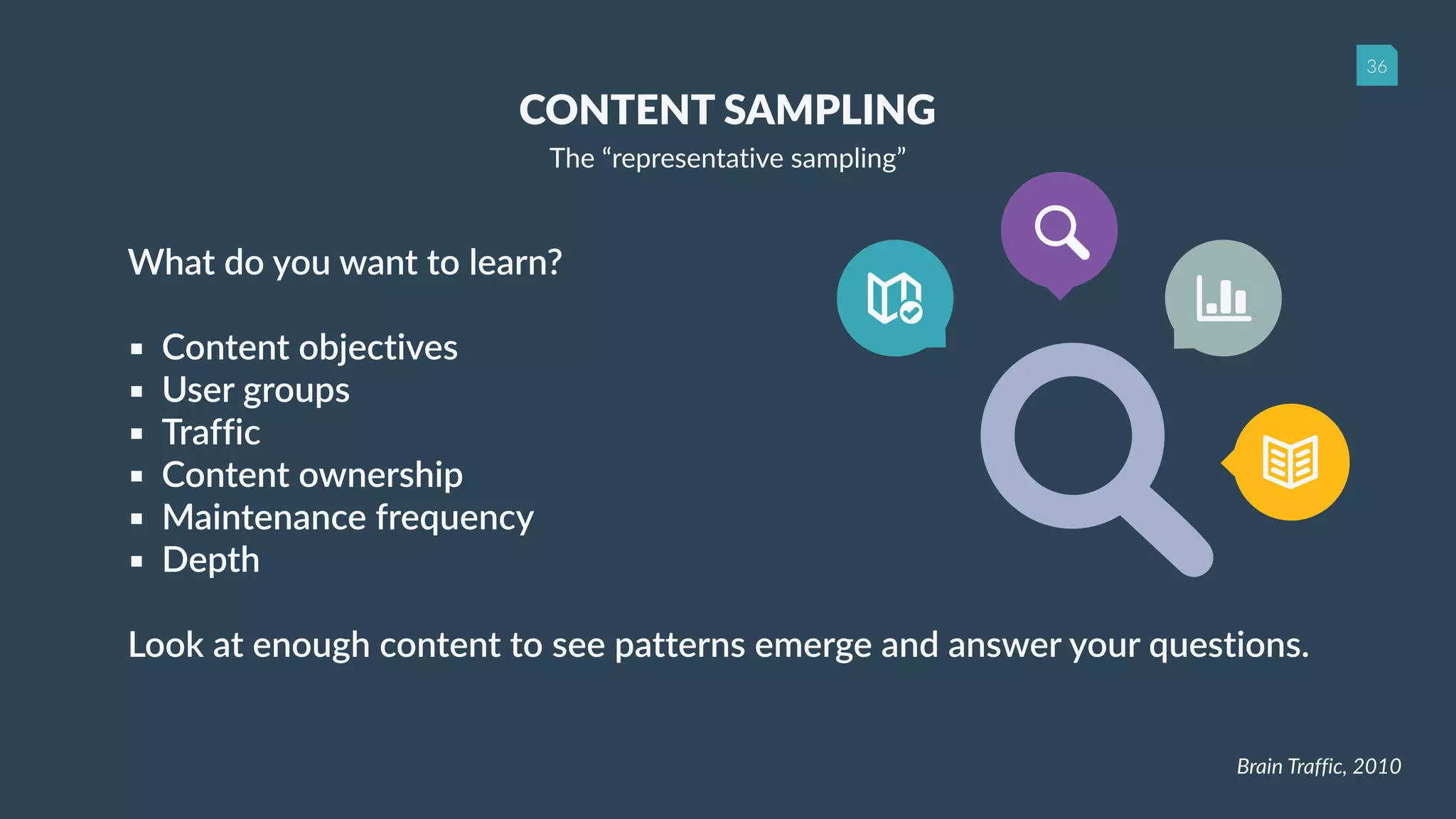
CONTENT SAMPLING
What do you want to learn?

▪ Content objectives
▪ User groups
▪ Traffic
▪ Content ownership
▪ Maintenance frequency
▪ Depth
Look at enough content to see patterns emerge and answer your questions.
The “representative sampling”
Brain Traffic, 2010
37
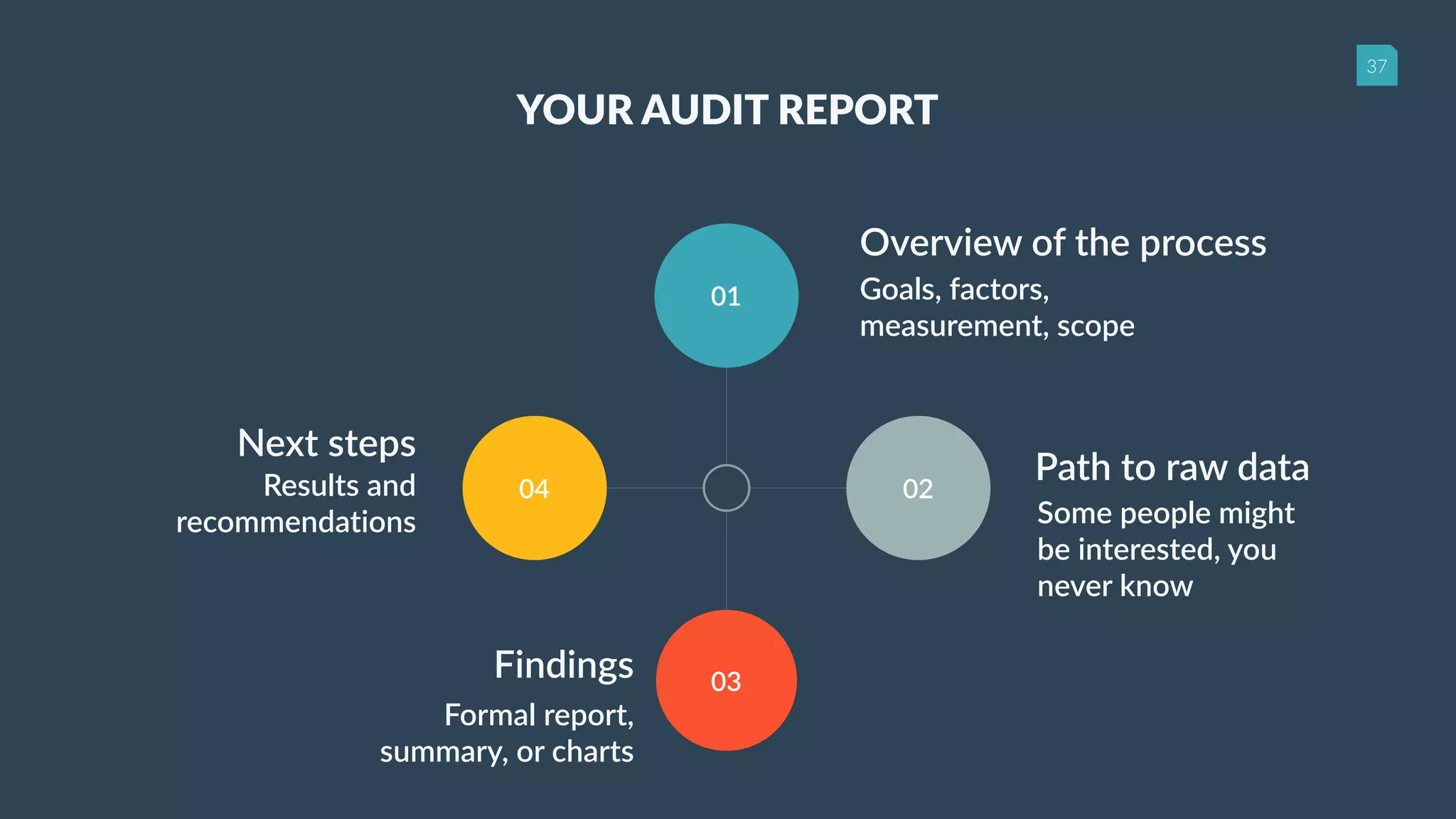
Overview of the process
Goals, factors,
measurement, scope
Path to raw data
Some people might
be interested, you
never know
Next steps
Results and
recommendations
Findings
Formal report,
summary, or charts
YOUR AUDIT REPORT
01
02
03
04
38
Create
great
content
39
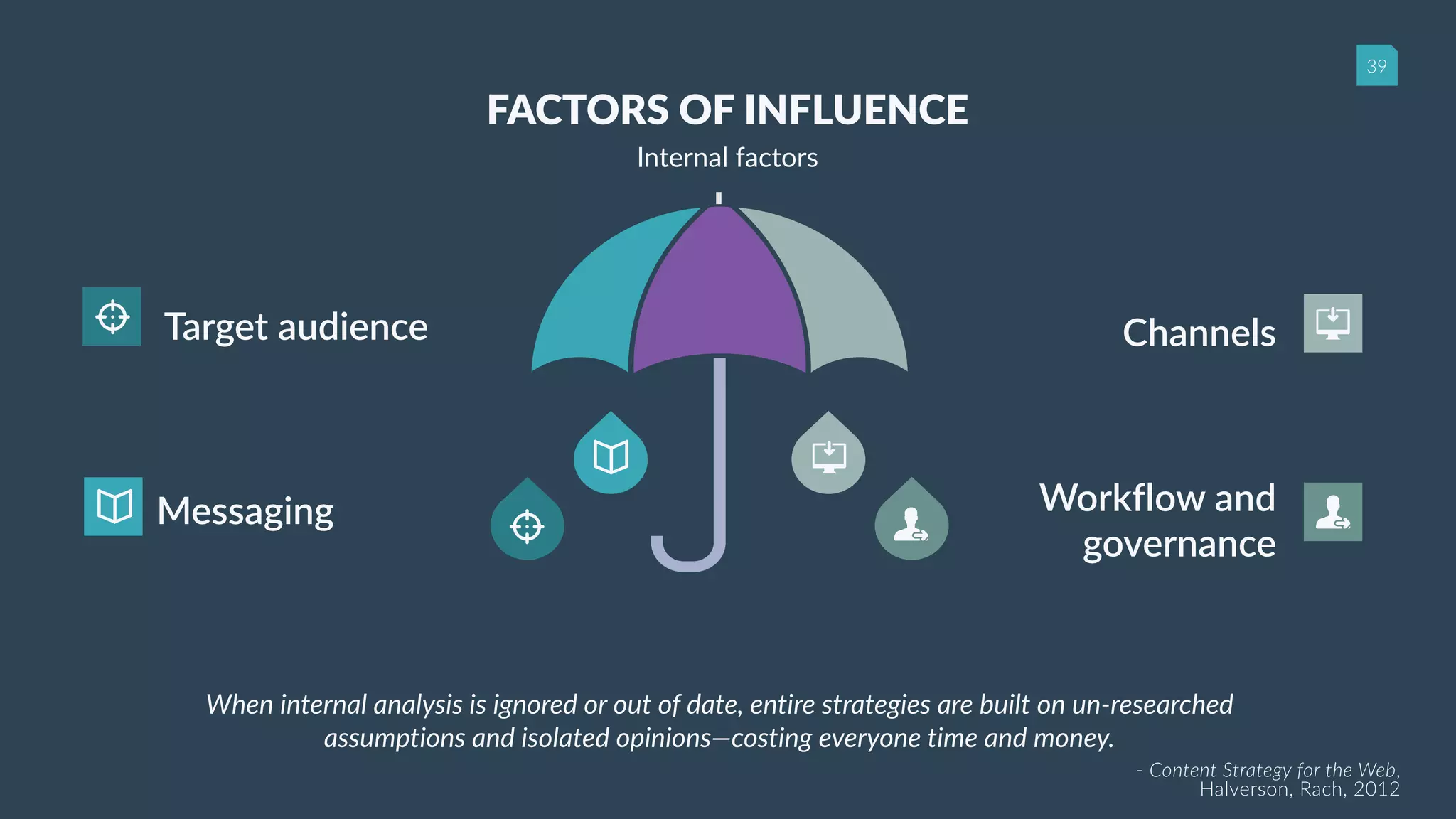
Target audience
Messaging
Channels
Workflow and
governance
FACTORS OF INFLUENCE
Internal factors
When internal analysis is ignored or out of date, entire strategies are built on un-researched
assumptions and isolated opinions—costing everyone time and money.
- Content Strategy for the Web, 

Halverson, Rach, 2012
40
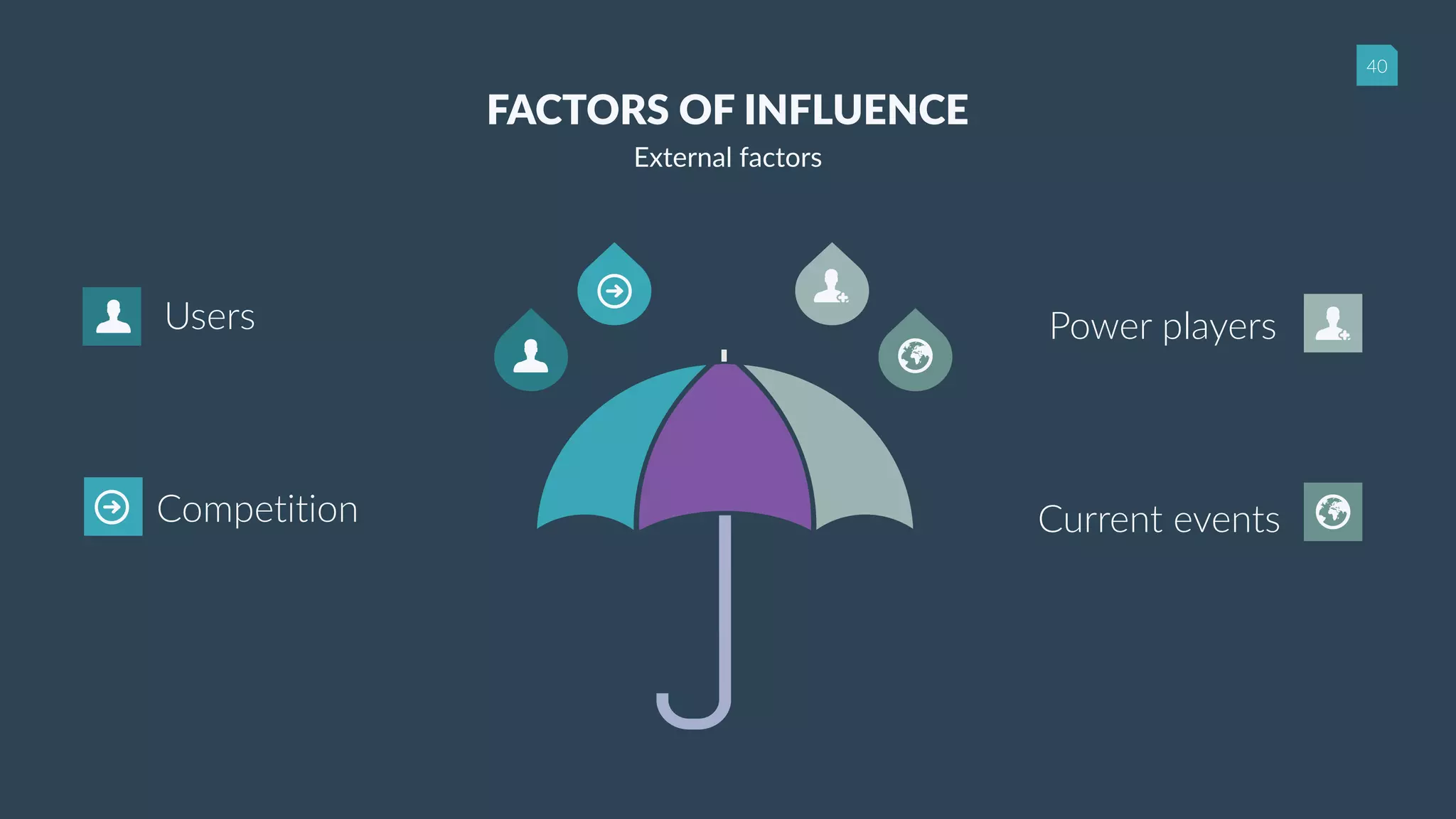
Users
Competition
Power players
Current events
FACTORS OF INFLUENCE
External factors
41
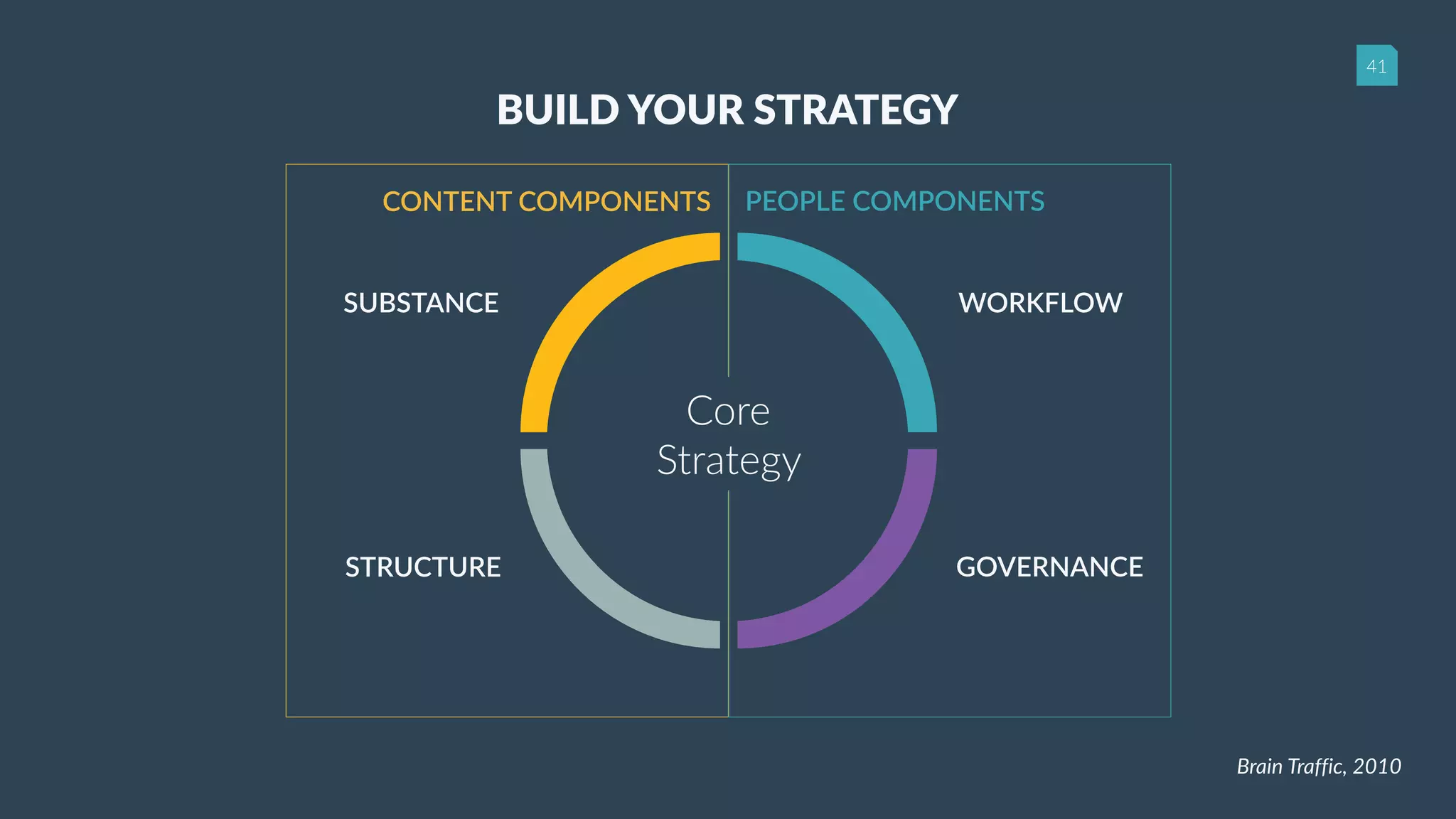
WORKFLOW
GOVERNANCE
SUBSTANCE
STRUCTURE
BUILD YOUR STRATEGY
Brain Traffic, 2010
CONTENT COMPONENTS PEOPLE COMPONENTS
Core
Strategy
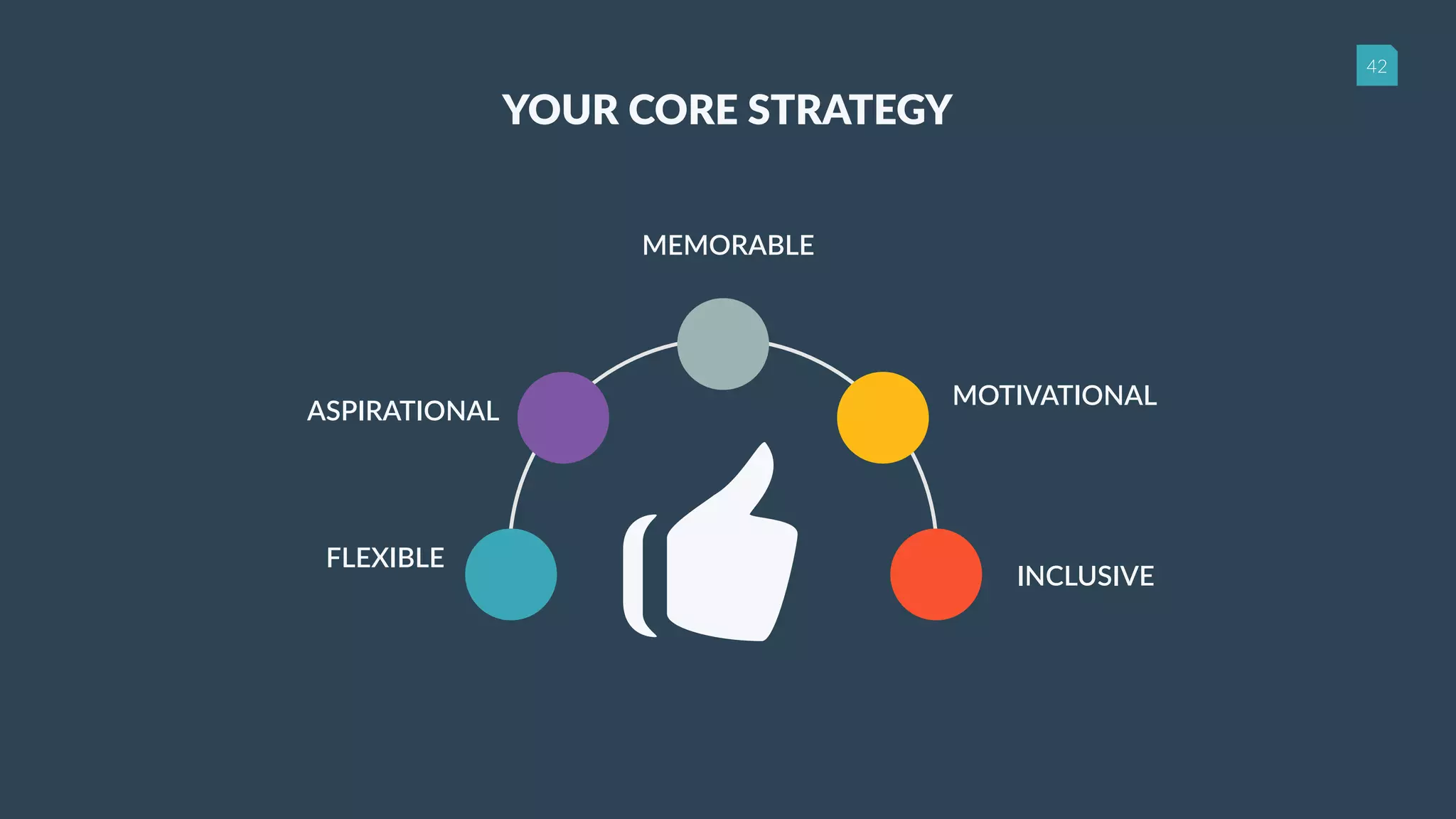
42
ASPIRATIONAL
FLEXIBLE
MOTIVATIONAL
INCLUSIVE
MEMORABLE
YOUR CORE STRATEGY
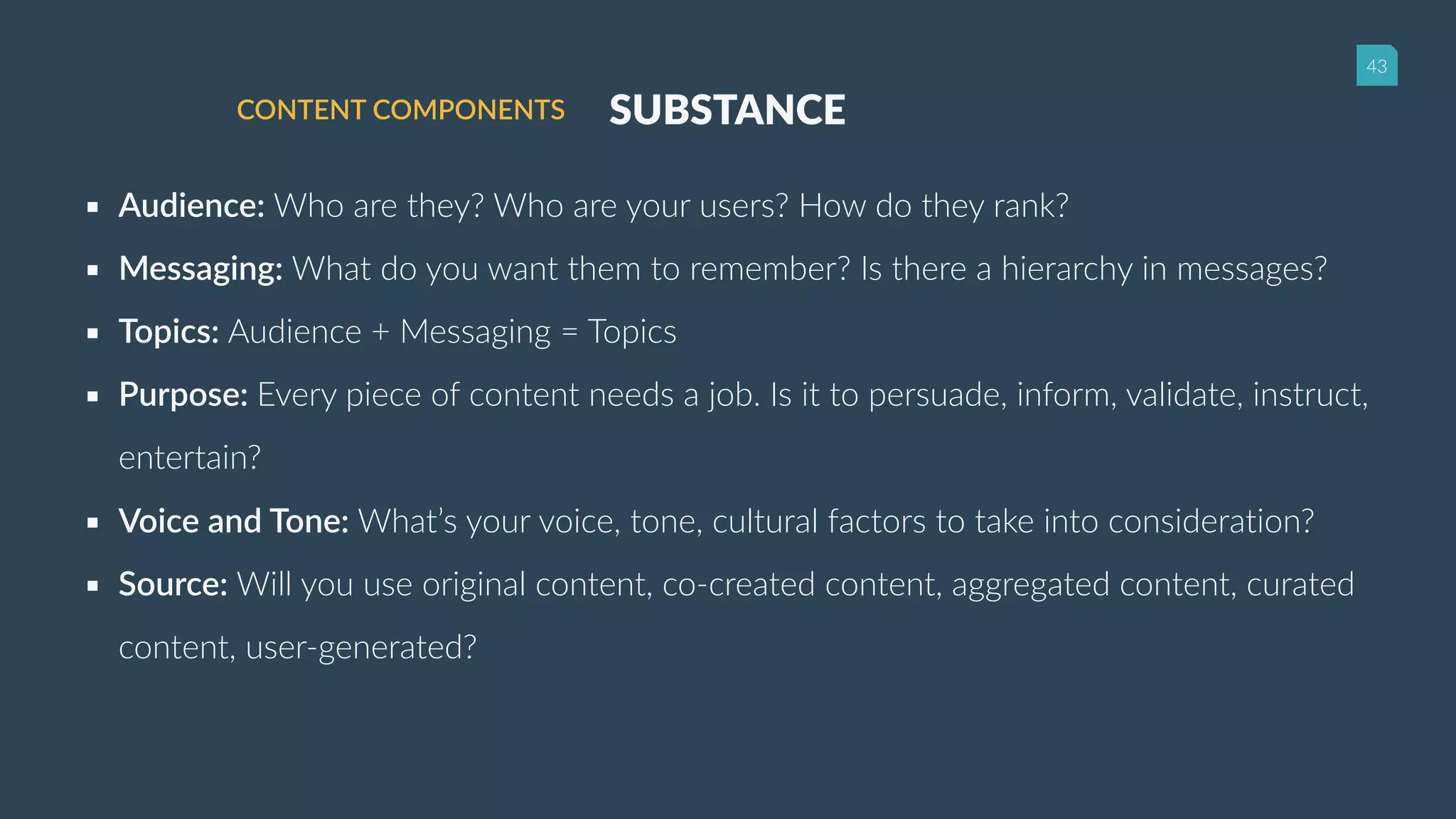
43
SUBSTANCECONTENT COMPONENTS
▪ Audience: Who are they? Who are your users? How do they rank?
▪ Messaging: What do you want them to remember? Is there a hierarchy in messages?
▪ Topics: Audience + Messaging = Topics
▪ Purpose: Every piece of content needs a job. Is it to persuade, inform, validate, instruct,
entertain?
▪ Voice and Tone: What’s your voice, tone, cultural factors to take into consideration?
▪ Source: Will you use original content, co-created content, aggregated content, curated
content, user-generated?
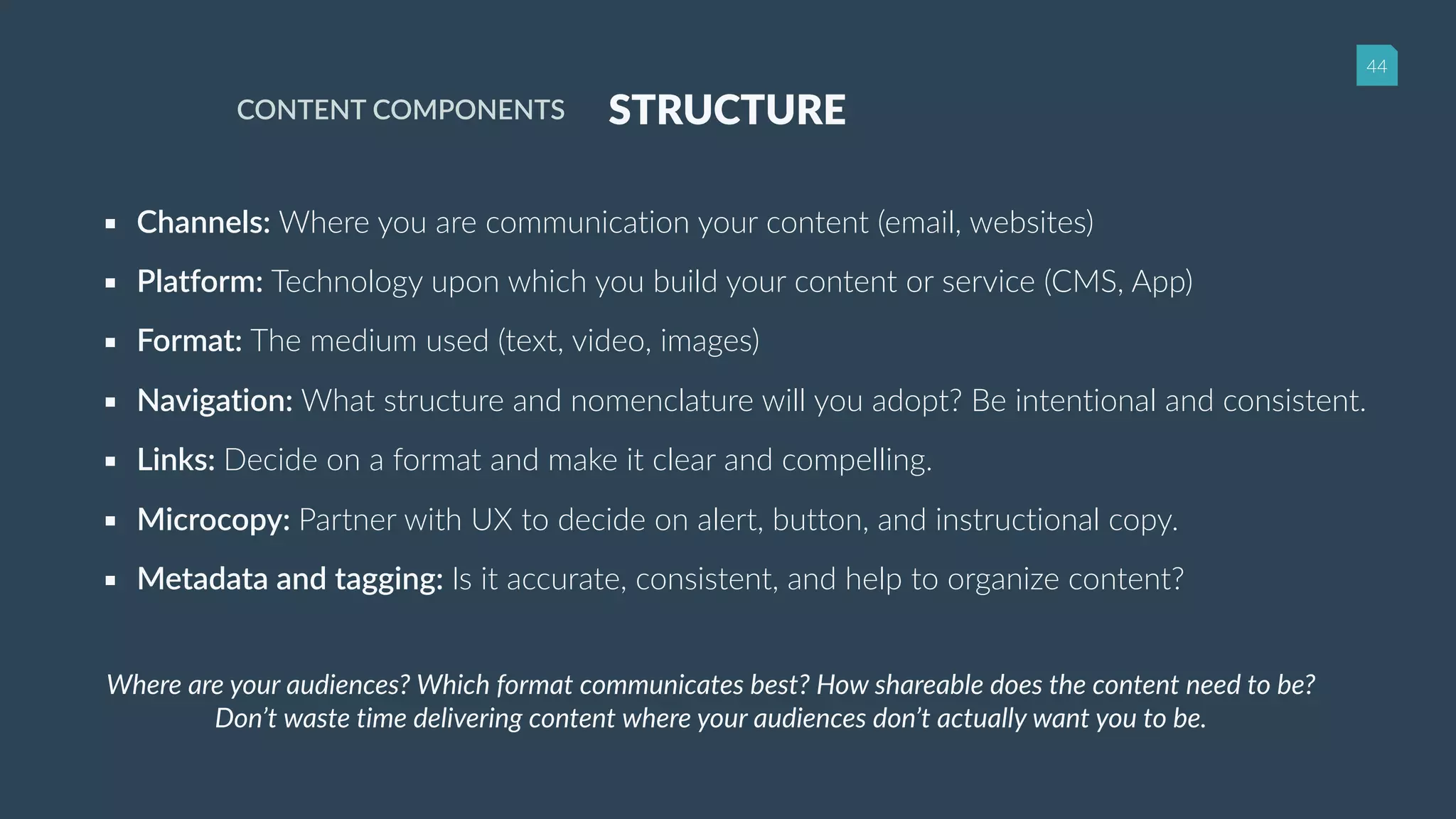
44
STRUCTURECONTENT COMPONENTS
▪ Channels: Where you are communication your content (email, websites)
▪ Platform: Technology upon which you build your content or service (CMS, App)
▪ Format: The medium used (text, video, images)
▪ Navigation: What structure and nomenclature will you adopt? Be intentional and consistent.
▪ Links: Decide on a format and make it clear and compelling.
▪ Microcopy: Partner with UX to decide on alert, button, and instructional copy.
▪ Metadata and tagging: Is it accurate, consistent, and help to organize content?
Where are your audiences? Which format communicates best? How shareable does the content need to be?
Don’t waste time delivering content where your audiences don’t actually want you to be.
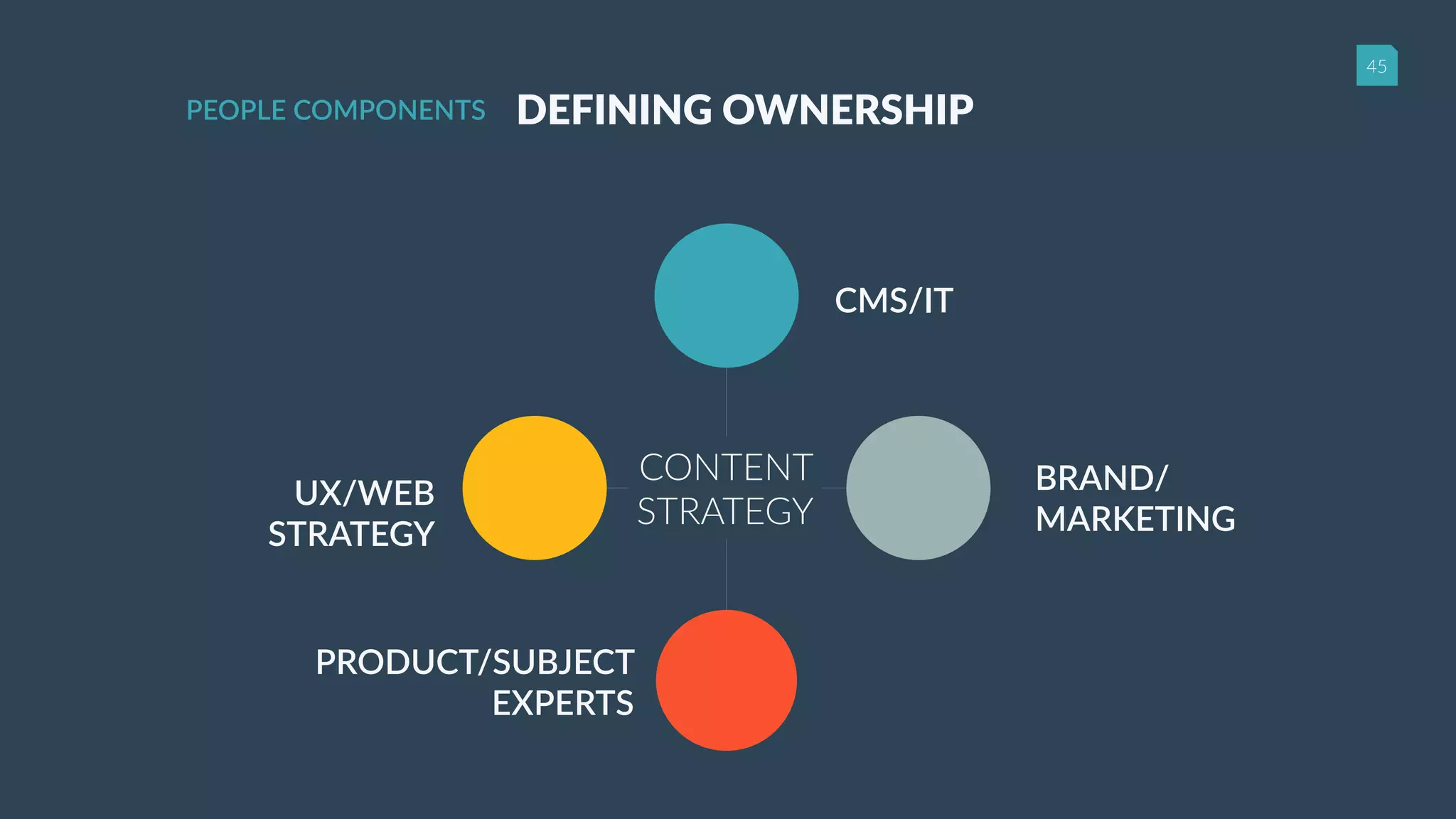
45
CMS/IT
BRAND/
MARKETING
UX/WEB
STRATEGY
PRODUCT/SUBJECT
EXPERTS
DEFINING OWNERSHIP
CONTENT
STRATEGY
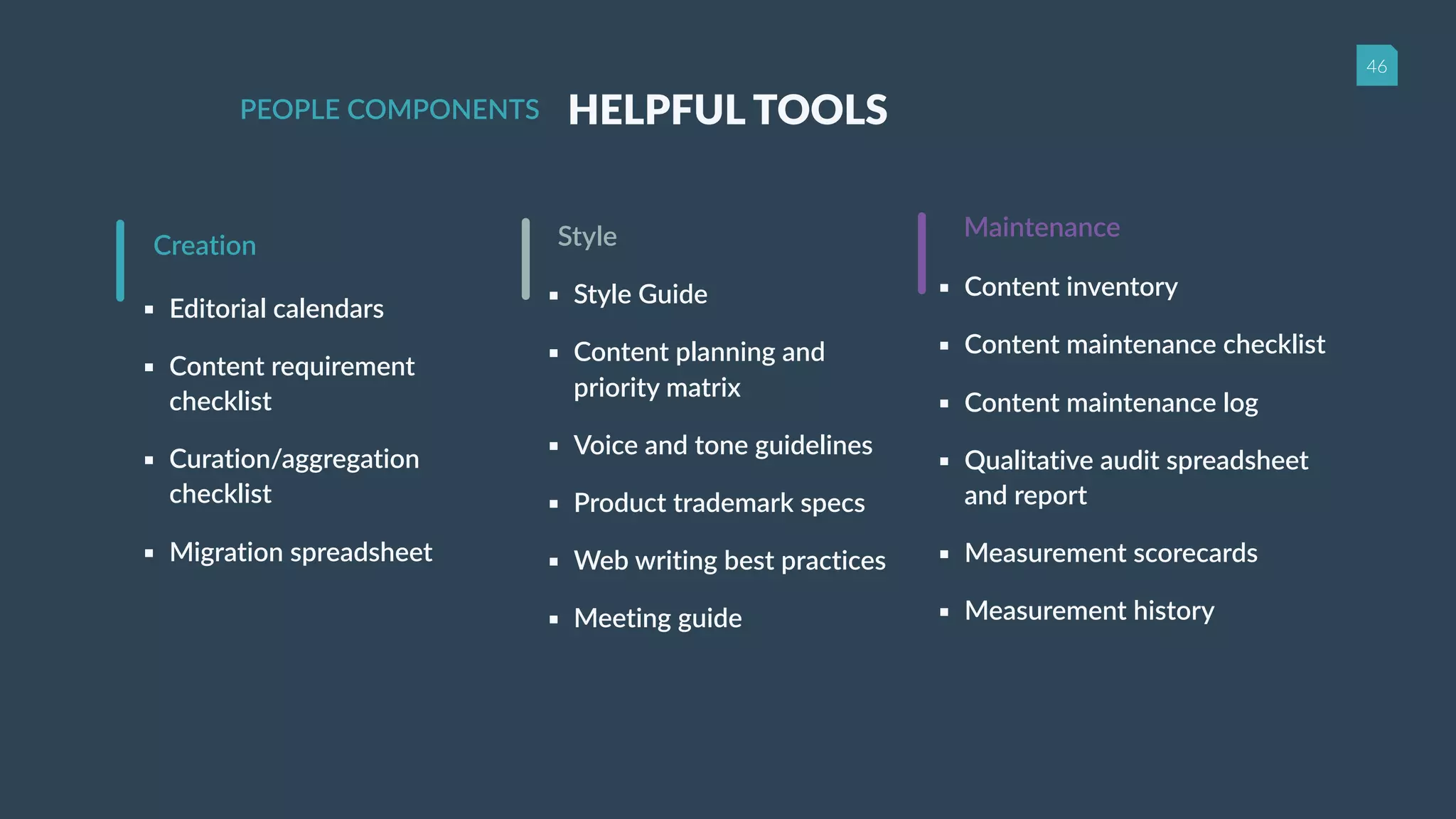
PEOPLE COMPONENTS
46
▪ Style Guide
▪ Content planning and
priority matrix
▪ Voice and tone guidelines
▪ Product trademark specs
▪ Web writing best practices
▪ Meeting guide
HELPFUL TOOLSPEOPLE COMPONENTS
▪ Editorial calendars
▪ Content requirement
checklist
▪ Curation/aggregation
checklist
▪ Migration spreadsheet
▪ Content inventory
▪ Content maintenance checklist
▪ Content maintenance log
▪ Qualitative audit spreadsheet
and report
▪ Measurement scorecards
▪ Measurement history
Style Maintenance
Creation
47
Create
great
content
48
THANK YOU!
@andreazoellner
www.andreazoellner.com

The Great Dis-Content: Tackling Content in a Website Redesign

  • 1.
    1 The Great Dis-Content TacklingContent in a Website Redesign
  • 2.
    2 ANDREA ZOELLNER EDITORIAL ANDWEB CONSULTANT 
 @andreazoellner www.andreazoellner.com
  • 3.
    3 User Perspective BusinessPerspective What a user sees, reads, learns, experiences, remembers, and maybe even shares (if you’re lucky). WHAT IS CONTENT? Critical information the website, application, intranet, or any other delivery vehicle was created to contain or communicate. - Content Strategy for the Web, 
 Halverson, Rach, 2012
  • 4.
    4 Text Video Including the transcripts, captions,descriptions, titles, and annotations. Animations Sometimes a combo of text, images, sound… Microcopy Button or navigation copy, tags, urls, metadata. Images WHAT IS WEB CONTENT? No, but really. Articles, product descriptions, social media posts, web text, captions, pop ups, links. Don’t forget alt tags and descriptions.
  • 5.
    5 Supports key objectives Well-writtenand engaging Well-organized and intuitive Supports user’s needs Irrelevant or redundant Overwritten Hard to find Broken or inaccurate Good content Bad content CONTENT Your business needs it, your users want it.
  • 6.
    6 WHY IS CONTENTSO HARD? Time consuming Resource consuming Requires ownership Political Overwhelming
  • 7.
    7 Decision makers don’twant to spend time, money, or effort on good content. Content is commodified, produced as a by-product of daily tasks or on the cheap. Bad content is shipped with the promise of “revisiting it later” when we have the time, money, and resources. Content is created without a strategy and nobody is happy. CRAPPY CONTENT A vicious cycle
  • 8.
    8 www.louistwelve.com WHY IS CONTENTstill SO HARD? “I don’t have time to make it better” “I’m not sure what we need” “The demands for content are non-stop” “I don’t know how to create good content” “I don’t have anyone to create it” “No one is in charge of content” “Content requests get stuck in bottlenecks”
  • 9.
    9 We forget contentcan get political. We treat content like a commodity. We don’t take the time to make a plan. We assume everyone is on the same page. COMMON CONTENT BREAKDOWNS Where things stop working
  • 10.
    10 WE TREAT CONTENTLIKE A COMMODITY ▪ Rely on automatic content aggregation (algorithms, RSS feeds, syndication) ▪ Create as much content as possible ▪ Get users to generated content ▪ Sacrifice quality for price Content requires real people and real resources. Content that works for your business and matters to your users is not a commodity.
  • 11.
    11 WE DON’T TAKETHE TIME TO MAKE A PLAN ▪ Creating content just because you can ▪ Buckling under the pressure to deliver, now ▪ Wanting to have something to show your boss, now ▪ Not stopping to ask questions
  • 12.
    12 WE ASSUME EVERYONEIS ON THE SAME PAGE Nobody likes to have extra work sprung on them. Make sure you are communicating your plans throughout the whole process. Agree on the scope and expectations so no one is caught off guard. Content creation is more like running a bakery than baking a cake.
  • 13.
    13 LIFECYCLE Expectation 1. CONCEPT 2.CREATE 3. REVISE 4. APPROVE
  • 14.
  • 15.
    15 WE FORGET CONTENTCAN GET POLITICAL ▪ The information architect had a vision that is getting derailed ▪ Marketing needs to ensure brand alignment and messaging ▪ Business or product owners don’t agree with the messaging ▪ Legal is pushing the disclaimer that has to be there by law ▪ The CMS team needs at least 2 months to integrate all the changes
  • 16.
    16 IF THEY PRIORITIZEAND NEGLECT THE RISKS ARE Business - budget/ROI - schedule - deliverables - UX - actual time to develop - project risks - content doesn’t meet user needs - missed deadlines and delays Marketing - promoting key features - SEO - tracking/cookies/pixels - audience’s priorities - customer-facing copy - maintenance post- launch - content is more promotional than educational - writing suffers from “marketing speak” - content is launched then neglected Advertising - campaign-driven creative - interactive features - latest technology - usability - existing content - CMS restrictions or requirements - content is more flash than substance - content is delivered in animation or graphics that can’t be measured or indexed CHART OF PRIORITIES Every organizational unit has an impact
  • 17.
    17 IF THEY PRIORITIZEAND NEGLECT THE RISKS ARE UX - audience needs and desires - research - visual design - current state content analysis - SEO considerations - planning for content - business content objectives are overlooked or marginalized - desired content can’t be completed by project launch date due to lack of source material, time, or budget IT - CMS or dev requirements - production workflow - people involved in the content creation process - brand and messaging - content may be published with a “fix- it-later” plan. - final published content may not adhere to visual or editorial brand standards CHART OF PRIORITIES (con’t) Every organizational unit has an impact - Content Strategy for the Web, 
 Halverson, Rach, 2012
  • 18.
    18 A website redesign isan opportunity to stop, take inventory, develop a strategy, and create better content.
  • 19.
    19 CONTENT FIRST? “ One ofthe biggest and best side effects of content strategy’s activities is that it’s encouraging agencies to reorder their design process. It’s no longer: discovery, information architecture, design, templates and development. Instead we’re doing: content strategy, information architecture, web writing, content production, design, templates, and development. - Tiffani Jones Brown
  • 20.
    20 They deserve tohave a great website experience. YOUR USERS DESERVE BETTER Content is a key part of what your brand is communicating, make it count. YOUR COMPETITORS ARE BETTER AT IT Good content will help you achieve your goals and streamline cross- company efforts. STRATEGY WILL MAKE YOU MORE EFFICIENT Good content will increase your reach, conversions, and save you money. THE NUMBERS SAY IT ALL WHY SPEND TIME ON CONTENT? Let’s make a case
  • 21.
  • 22.
  • 23.
    23 WORKFLOW GOVERNANCE SUBSTANCE STRUCTURE HOW DOES CONTENTSTRATEGY WORK? Brain Traffic, 2010 CONTENT COMPONENTS PEOPLE COMPONENTS Core Strategy
  • 24.
  • 25.
    25 Content strategy works around, between,& inclusively of other disciplines. 02 0306 01 05 04 WEB WRITING INFORMATION ARCHITECTURE SEO MESSAGING AND BRANDING CMS METADATA CONTENT STRATEGY AND OTHER DISCIPLINES
  • 26.
    26 GATHER A TEAM ▪Identify your stakeholders ▪ Convince them to participate ▪ Set the stage for alignment with a kickoff ▪ Get them engaged ▪ Keep them motivated
  • 27.
    27 STRATEGIC DECISION MAKERS MONEY PEOPLE CHAMPIONS SHOWSTOPPERS TYPES OF STAKEHOLDERS Build your team INTERESTED OTHERS
  • 28.
  • 29.
    29 Choose your typeof audit Audit Tabulate your findings Create a report FOUR STEPS OF CONTENT AUDITS
  • 30.
    30 Quantitative inventory Qualitative Audit: Best practicesassessment 3 TYPES OF AUDITS Qualitative audit: Strategic assessment
  • 31.
    31 QUANTITATIVE INVENTORY: JUSTTHE FACTS Quickest and easiest way to get a sense of the quantity of content and channels. Use technical tools on your WordPress backend like the WordPress plugin Content Audit to help you gather this data. ▪ ID ▪ Title/Topics ▪ URL ▪ Format ▪ Source ▪ Technical home ▪ Metadata ▪ Traffic stats ▪ Last update ▪ Language
  • 32.
    32 QUALITATIVE ASSESSMENTS Best practicesassessment: Does my content follow industry best practices and meet my users’ needs? Strategic assessment: How does my content align with my strategy? What needs to change?
  • 33.
  • 34.
    34 01 02 03 MESSAGEBUSINESS VALUE BRAND/TONE STRATEGIC ASSESSMENT FACTORS
  • 35.
    35 A NOTE ABOUTSPREADSHEETS The basic spreadsheet Spreadsheet 2.0 Indexed Inventory
  • 36.
    36 CONTENT SAMPLING What doyou want to learn?
 ▪ Content objectives ▪ User groups ▪ Traffic ▪ Content ownership ▪ Maintenance frequency ▪ Depth Look at enough content to see patterns emerge and answer your questions. The “representative sampling” Brain Traffic, 2010
  • 37.
    37 Overview of theprocess Goals, factors, measurement, scope Path to raw data Some people might be interested, you never know Next steps Results and recommendations Findings Formal report, summary, or charts YOUR AUDIT REPORT 01 02 03 04
  • 38.
  • 39.
    39 Target audience Messaging Channels Workflow and governance FACTORSOF INFLUENCE Internal factors When internal analysis is ignored or out of date, entire strategies are built on un-researched assumptions and isolated opinions—costing everyone time and money. - Content Strategy for the Web, 
 Halverson, Rach, 2012
  • 40.
  • 41.
    41 WORKFLOW GOVERNANCE SUBSTANCE STRUCTURE BUILD YOUR STRATEGY BrainTraffic, 2010 CONTENT COMPONENTS PEOPLE COMPONENTS Core Strategy
  • 42.
  • 43.
    43 SUBSTANCECONTENT COMPONENTS ▪ Audience:Who are they? Who are your users? How do they rank? ▪ Messaging: What do you want them to remember? Is there a hierarchy in messages? ▪ Topics: Audience + Messaging = Topics ▪ Purpose: Every piece of content needs a job. Is it to persuade, inform, validate, instruct, entertain? ▪ Voice and Tone: What’s your voice, tone, cultural factors to take into consideration? ▪ Source: Will you use original content, co-created content, aggregated content, curated content, user-generated?
  • 44.
    44 STRUCTURECONTENT COMPONENTS ▪ Channels:Where you are communication your content (email, websites) ▪ Platform: Technology upon which you build your content or service (CMS, App) ▪ Format: The medium used (text, video, images) ▪ Navigation: What structure and nomenclature will you adopt? Be intentional and consistent. ▪ Links: Decide on a format and make it clear and compelling. ▪ Microcopy: Partner with UX to decide on alert, button, and instructional copy. ▪ Metadata and tagging: Is it accurate, consistent, and help to organize content? Where are your audiences? Which format communicates best? How shareable does the content need to be? Don’t waste time delivering content where your audiences don’t actually want you to be.
  • 45.
  • 46.
    46 ▪ Style Guide ▪Content planning and priority matrix ▪ Voice and tone guidelines ▪ Product trademark specs ▪ Web writing best practices ▪ Meeting guide HELPFUL TOOLSPEOPLE COMPONENTS ▪ Editorial calendars ▪ Content requirement checklist ▪ Curation/aggregation checklist ▪ Migration spreadsheet ▪ Content inventory ▪ Content maintenance checklist ▪ Content maintenance log ▪ Qualitative audit spreadsheet and report ▪ Measurement scorecards ▪ Measurement history Style Maintenance Creation
  • 47.
  • 48.