The Great Aryan
By Adesh Katariya
plast.adesh@gmail.com
Arya
• Arya is a term meaning "noble" which was used as a
self-designation by Indian and Iranian or Indo-Iranian
people.
• The word was used by the Indic people of the Vedic
period in India as an ethnic label for themselves, as
well as to refer to the noble class and geographic
location known as Āryāvarta where Indo-
Aryan culture was based.
• The closely related Iranian people also used the term
as an ethnic label for themselves in
the Avesta scriptures, and the word forms
the etymological source of the country Iran.
Aryan
• It was believed in the 19th century that it was also a self-
designation used by all Proto-Indo-Europeans, a theory that
has now been abandoned..Scholars point out that, even in
ancient times, the idea of being an "Aryan" was religious,
cultural and linguistic, not racial.
• Drawing on misinterpreted references in the Rig Veda by
Western scholars in the 19th century, the term "Aryan" was
adopted as a racial category through the work of Arthur de
Gobineau, whose ideology of race was based on an idea of
blonde northern European "Aryans" who had migrated
across the world and founded all major civilizations, before
being degraded through racial mixture with local
populations.
• Through Houston Stewart Chamberlain,
Gobineau's ideas later influenced the Nazi racial
ideology, which also saw "Aryan peoples" as
innately superior to other putative racial
groups.
• The atrocities committed in the name of this
racial aryanism caused the term to be
abandoned by most academics; and, in present-
day academia, the term "Aryan" has been
replaced in most cases by the terms "Indo-
Iranian" and "Aryan" is now mostly limited to its
appearance in the term of the "Indo-Aryan
languages"
Etymology
The English word "Aryan" is borrowed from
the Sanskrit word ārya, आय, meaning
"noble" or "noble one".However, as a
translation of Latin Arianus (derived from
Old Persian ariya), Arian has "long been in
English language use".
It was reintroduced into English with the new
spelling by William Jones in the 18th
century.
Origins Theories
• Philologist J.P. Mallory argues that "As an
ethnic designation, the word [Aryan] is most
properly limited to the Indo-Iranians, and
most justly to the latter where it still gives its
name to the country Iran (from the Avestan
genitive plural airyanam through later Iranian
eran to iran).
• In ancient time, whole area of current India to
Iran was known as Aryabart ( Land of Aryans).
Sanskrit and Avestan
• In early Vedic literature, the
term Āryāvarta (Sanskrit: आयावत, abode of the
Aryans) was the name given to northern India, where
the Indo-Aryan culture was based.
• The Manusmṛti (2.22) gives the name Āryāvarta to
"the tract between the Himalaya and
the Vindhya ranges, from the Eastern (Bay of Bengal)
to the Western Sea (Arabian Sea)".
• Initially the term was used as a national name to
designate those who worshipped the Vedic deities
(especially Indra) and followed Vedic culture (e.g.
performance of sacrifice, Yajna)
• In early Vedic literature, the
term Āryāvarta (Sanskrit:
आयावत, abode of the
Aryans) was the name given
to northern India, where
the Indo-Aryan culture was
based. The Manusmṛti (2.22)
gives the name Āryāvarta to
"the tract between
the Himalaya and
the Vindhya ranges, from
the Eastern (Bay of Bengal)
to the Western Sea (Arabian
Sea)“.
• Initially the term was used
as a national name to
designate those who
worshipped the Vedic deities
(especially Indra) and
followed Vedic culture (e.g.
performance of
sacrifice, Yajna).
Proto-Indo-Iranian
The Sanskrit term comes from proto-Indo-
Iranian*arya-or *aryo-,the name used by the Indo-
Iranians to designate
themselves.The Zendairya 'venerable' and Old
Persian ariya are also derivates of *aryo-, and are
also self-designations.
• In Iranian languages, the original self-identifier
lives on in ethnic names like "Alans" and "Iron".
• Similarly, the name of Iran is the Persian word for
land/place of the Aryans.
Pre-Proto-Indo-Iranians
It has been postulated the Proto-Indo-European root word
is haerós with the meanings "members of one's own (ethnic)
group, peer, freeman" as well as the Indo-Iranian meaning of
Aryan. Derived from it were words like;
• the Hittite prefix arā- meaning member of one's own group,
peer, companion and friend;
• Old Irish aire meaning freeman and noble
• Gaulish personal names with Ario-
• Avestan airya- meaning Aryan, Iranian in the larger sense
• Old Indic ari- meaning attached to, faithful, devoted person
and kinsman
• Old Indic aryá- meaning kind, favourable, attached to and
devoted
• Old Indic árya- meaning Aryan, faithful to the Vedic religion.
Aryans Terminology In Indian/Sanskrit
literature
• In Sanskrit and related Indic languages, ārya means
"one who does noble deeds; a noble one".
• Āryāvarta "abode of the āryas" is a common name
for North India in Sanskrit literature. Manusmṛti (2.22)
gives the name to "the tract between
the Himalaya and the Vindhya ranges, from the
Eastern Sea to the Western Sea".
• The title ārya was used with various modifications
throughout the Indian Subcontinent. Kharavela, the
Emperor of Kalinga of around 1 BCE, is referred to as
an ārya in the Hathigumpha inscriptions of
the Udayagiri and Khandagiri
Caves in Bhubaneswar, Odisha.
Aryans Terminology In Indian/Sanskrit
literature
• The Gurjara-Pratihara rulers in the tenth century
were titled "Maharajadhiraja of Āryāvarta".
• Various Indian religions,
chiefly Hinduism, Jainism and Buddhism, use the
term ārya as an epithet of honour; a similar usage
is found in the name of Arya Samaj.
• In Ramayana and Mahabharata, ārya is used as
an honorific for many characters
including Hanuman.
In Iranian literature
• Unlike the several meanings connected with ārya- in Old
Indo-Aryan, the Old Persian term only has an ethnic
meaning.
• That is in contrast to Indian usage, in which several
secondary meanings evolved, the meaning of ar- as a
self-identifier is preserved in Iranian usage, hence the
word "Iran".
• The airya meant "Iranian", and Iranian anairya meant
and means "non-Iranian".
• Arya may also be found as an ethnonym in Iranian
languages, e.g., Alan and Persian Iran and Ossetian
Ir/Iron The name is itself equivalent to Aryan, where Iran
means "land of the Aryans,"and has been in use
since Sassanid times
• The Avesta clearly uses airya/airyan as an ethnic name
(Vd. 1; Yt. 13.143-44, etc.), where it appears in
expressions such as airyāfi; daiŋˊhāvō "Iranian lands,
peoples", airyō.šayanəm "land inhabited by Iranians",
and airyanəm vaējō vaŋhuyāfi; dāityayāfi; "Iranian
stretch of the good Dāityā", the river Oxus, the modern
Āmū Daryā. In ancient time, Gurjar lived in amu darya
region, This indicates that Gurjar are actual Arya.
• Old Persian sources also use this term for Iranians. Old
Persian which is a testament to the antiquity of the
Persian language and which is related to most of the
languages/dialects spoken in Iran including
modern Persian, the Kurdish languages,
and Gilaki makes it clear that Iranians referred to
themselves as Arya.
• The term "Airya/Airyan" appears in the royal Old
Persian inscriptions in three different contexts:
• As the name of the language of the Old Persian
version of the inscription of Darius I in Behistun
• As the ethnic background of Darius I in
inscriptions at Naqsh-e-Rostam and Susa (Dna,
Dse) and Xerxes I in the inscription
from Persepolis (Xph)
• As the definition of the God of the Aryans, Ahura
Mazdā, in the Elamite language version of the
Behistun inscription.
In Latin literature
• The word Arianus was used to designate Ariana, the area
comprising present Herat in the western part
of Afghanistan and ancient India.
• In 1601, Philemon Holland used 'Arianes' in his translation of
the Latin Arianus to designate the inhabitants of Ariana. This
was the first use of the form Arian verbatim in the English
language.
• In 1844 James Cowles Prichard first designated both the
Indians and the Iranians "Arians" under the false assumption
that the Iranians as well as the Indians self-designated
themselves Aria.
• The Iranians did use the form Airya as a designation for the
"Aryans," but Prichard had mistaken Aria (deriving from OPer.
Haravia) as a designation of the "Aryans" and associated
the Aria with the place-name Ariana (Av. Airyana), the
homeland of the Aryans.The form Aria as a designation of the
"Aryans" was, however, only preserved in the language of the
Indo-Aryans.
In European languages
• The term "Aryan" came to be used as the term for the newly
discovered Indo-European languages, and, by extension,
the original speakers of those languages. In the 19th century,
"language" was considered a property of "ethnicity", and thus the
speakers of the Indo-Iranian or Indo-European languages came to
be called the "Aryan race", as contradistinguished from what came
to be called the "Semitic race". By the late 19th century, among
some people, the notions of an "Aryan race" became closely linked
to Nordicism, which posited Northern European racial superiority
over all other peoples. This "master race" ideal engendered both
the "Aryanization" programs of Nazi Germany, in which the
classification of people as "Aryan" and "non-Aryan" was most
emphatically directed towards the exclusion of Jews.[55][note 6] By the
end of World War II, the word 'Aryan' had become associated by
many with the racial ideologies and atrocities committed by
the Nazis.
Arya history in Avestan
• The term Arya is used in ancient Persian texts, for
example in the behistun inscription from the 5th century
BCE, in which the Persian kings Darius the
Great and Xerxes are described as "Aryans of Aryan
stock" (arya arya chiça). The inscription also refers to the
deity Ahura Mazda as "the god of the Aryans", and to the
ancient Persian language as "Aryan".
• In this sense the word seems to have referred to the
elite culture of the ancient Iranians, including both
linguistic, cultural and religious aspects.
• The word also has a central place in the Zoroastrian
religion in which the "Aryan expanse" (Airyana Vaejah) is
described as the mythical homeland of the Iranian
people's and as the center of the world
Vedic Sanskrit
• The term Arya is used 36 times in 34 hymns in the Rigveda.
According to Talageri (2000, The Rig Veda. A Historical Analysis)
"the particular Vedic Aryans of the Rigveda were one section
among these Purus, who called themselves Bharatas." Thus it is
possible, according to Talageri, that at one point Arya did refer to
a specific tribe.
• While the word may ultimately derive from a tribal name, already
in the Rigveda it appears as a religious distinction, separating
those who sacrifice "properly" from those who do not belong to
the historical Vedic religion, presaging the usage in later
Hinduism where the term comes to denote religious
righteousness or piety. In RV 9.63.5, ârya "noble, pious,
righteous" is used as contrasting with árāvan "not liberal,
envious, hostile":
índraṃ várdhanto aptúraḥ kṛṇvánto víśvam âryam apaghnánto
árāvṇaḥ"[the Soma-drops], performing every noble work, active,
augmenting Indra's strength, driving away the godless ones."
(trans. Griffith)
Sanskrit Epics
• Arya and Anarya are primarily used in the moral
sense in the Hindu Epics.
• People are usually called Arya or Anarya based
on their behaviour.
• Arya is typically one who follows the Dharma.
• This is historically applicable for any person
living anywhere in Bharata Varsha or vast India.
Ramayana
• In the Ramayana, the term Arya can also apply to Raksasas or to
Ravana. In several instances, the Vanaras and Raksasas called
themselves Arya. The vanara's king Sugriva is called an Arya
(Ram: 505102712) and he also speaks of his brother Vali as an
Arya (Ram: 402402434). In another instance in the Ramayana,
Ravana regards himself and his ministers as Aryas (Ram: A logical
explanation is that, Ravana and his ministers belonged to the
highest varna (Ravana being a Brahmin), and Brahmins were
generally considered 'noble' of deed and hence called Arya
(noble).
• Thus, while Ravana was considered Arya (and regarded himself as
such), he was not really an Arya because he was not noble of
deeds. So, he is widely considered by Hindus as Anarya (non-
Arya).
• The Ramayana describes Rama as: arya sarva samascaiva
sadaiva priyadarsanah, meaning "Arya, who worked for the
equality of all and was dear to everyone.
Mahabharata
• In the Mahabharata, the terms Arya or Anarya are often
applied to people according to their
behaviour. Dushasana, who tried to disrobe Draupadi in
the Kaurava court, is called an "Anarya"
(Mbh:0020600253). Vidura, the son of a Dasi born
from Vyasa, was the only person in the assembly whose
behaviour is called "Arya", because he was the only one
who openly protested when Draupadi was being
disrobed by Dushasana.
• The Pandavas called themselves "Arya" in the
Mahabharata (0071670471) when they
killed Drona through deception.
• According to the Mahabharata, a person's behaviour
(not wealth or learning) determines if he can be called
an Arya. Also the whole Kuru clan was called as Anarya .
Religious point of Aryans
• The word ārya is often found in Hindu, Buddhist,
and Jain texts. In the Indian spiritual context it
can be applied to Rishis or to someone who has
mastered the four noble truths and entered
upon the spiritual path.
• According to J.L. Nehru, the religions of India
may be called collectively ārya dharma, a term
that includes the religions that originated in India
(e.g. Hinduism, Buddhism, Jainism and
possibly Sikhism).
Hinduism
• "O my Lord, a person who is chanting Your holy name, although
born of a low family like that of a Chandala, is situated on the
highest platform of self-realization. Such a person must have
performed all kinds of penances and sacrifices according to
Vedic literatures many, many times after taking bath in all the
holy places of pilgrimage. Such a person is considered to be the
best of the Arya family" (Bhagavata Purana 3.33.7).
• According to Swami Vivekananda, "A child materially born is not
an Arya; the child born in spirituality is an Arya." He further
elaborated, referring to the Manu Smriti: "Says our great law-
giver, Manu, giving the definition of an Arya, 'He is the Arya,
who is born through prayer.' Every child not born through prayer
is illegitimate, according to the great law-giver: "The child must
be prayed for. Those children that come with curses, that slip
into the world, just in a moment of inadvertence, because that
could not be prevented – what can we expect of such
progeny?..."(Swami Vivekananda, Complete Works vol.8)
Buddhism
• The word ārya (Pāli: ariya), in the sense "noble" or
"exalted", is very frequently used in Buddhist texts to
designate a spiritual warrior or hero, which use this term
much more often than Hindu or Jain texts.
Buddha's Dharma and Vinaya are the ariyassa
dhammavinayo.
• The Four Noble Truths are called the catvāry
āryasatyāni (Sanskrit) or cattāri ariyasaccāni (Pali).
The Noble Eightfold Path is called the āryamārga (Sanskrit,
also āryāṣṭāṅgikamārga) or ariyamagga (Pāli). Buddhists
themselves are called ariyapuggalas (Arya persons).
• In Buddhist texts, the āryas are those who have the
Buddhist śīla (Pāli sīla, meaning "virtue") and follow the
Buddhist path. Those who despise Buddhism are often
called "anāryas".
Current form of Aryans: Gurjar, Jat
Rajputs of India
• The Vedic Vayupurana describes a battle waged among the ancient Aryans.
It was as a result of this war that Anavs part of the Chandravanshi clan and
Gurtar ( Guzar ) of suryabanshi had to immigrate to wester Aryabart area
of modern Iran (Iran means "land of Aryans") to Tarim basin.
• It was in these regions, where the fertile soil of the mountainous country
is surrounded by the Turanian desert, that the prophet Zarathushtra
(Zoroaster) was said to have been born and gained his first
adherents. Avestan, the language of the oldest portions of
the Zoroastrian Avesta, was once called "old-iranic" which is related
to Sanskrit.
• Chandravansi known as Sythians ( Jats and Rajputs) and Suryabanshi
known as Guzar by Tibbetian , Yuezhi by Chineese , Tocharian by Romans
and Tushara by Indians, currently known as Gurjar in India and Gujjar in
Pakistan
Formation of Kushana Empire
• In 176 BC, the Yuezhi were driven from Tarim Besin to
westward by the Xiongnu, a fierce people of Magnolia.
• The Yuezhi under the leadership of the Kushanas came down
from Central Asia and swept away all earlier dynasties of the
Northwest in a great campaign of conquest. They established
an empire which extended from Central Asia right down to the
eastern Gangetic basin.
• In Bactria, they conquered the Scythians and the local Indo-
Greek kingdoms, the last remnants of Alexander the Great's
invasion force that had failed to take India.
• From this central location, the Kushan Empire became a
wealthy trading hub between the peoples of Han China,
Sassanid Persia and the Roman Empire.
• Roman gold and Chinese silk changed hands in the Kushan
Empire, at a very tidy profit for the middle-men.
Kushana Empire Map
Gurjars are Purest Aryans
• Gurjars are purest form of aryans as the survey depicts. All the
details are given in the book The People Of India By Herbert Risley,
W. Crooke.
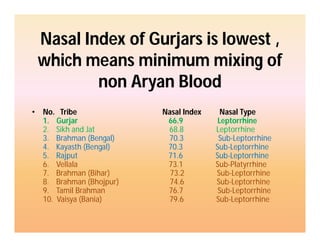
• The classification in general use is - leptorrhine (fine nose) if the
nasal index is < 70, mesorrhine is it is between 70-85 and
platyrrhine (broad-nosed) if it is > 85.
• The Indo-Aryan is comparable to the European, fopr the French of
Paris have a nasal index of 69.4 as measurd by Topinard [ Ris 28-9 ].
• According to Sir H.H.Risley, the nose of Sudras is very similar to that
of the lowest Negro types.
• The nasal index frequently reaches more than 100. The Paniyans of
Malabar have an average nasal index of 95, while certain individual
Kadias of Tamil Nad measured 115.
Nasal Index of Gurjars is lowest ,
which means minimum mixing of
non Aryan Blood
• No. Tribe Nasal Index Nasal Type
1. Gurjar 66.9 Leptorrhine
2. Sikh and Jat 68.8 Leptorrhine
3. Brahman (Bengal) 70.3 Sub-Leptorrhine
4. Kayasth (Bengal) 70.3 Sub-Leptorrhine
5. Rajput 71.6 Sub-Leptorrhine
6. Vellala 73.1 Sub-Platyrrhine
7. Brahman (Bihar) 73.2 Sub-Leptorrhine
8. Brahman (Bhojpur) 74.6 Sub-Leptorrhine
9. Tamil Brahman 76.7 Sub-Leptorrhine
10. Vaisya (Bania) 79.6 Sub-Leptorrhine
Aryan Practice : Khaps
• Khap is generally a unit of 12 villages or multiple of 12 i.e. 24,
60 or 84 villages of a particular clan or gotra of tribe or caste.
Khaps are generally found in North western India, among
Gurjara, Jats and Rajputs.
• Famous historian R S Sharma ascribes the formation of these
units of 12 villages or its multiples to the Gurjara Pratihara’s or
their feudatories rule in North Western India during the early
medieval period. He says what distinguished the Gurjara
Pratihara polity from that of contemporary Rastrakutas and
Palas was the imposition of clan aristocracies on old, settled
villages. He further says that Gujar imposed themselves as
dominant clans on settled villages.
Source : Research Article of Dr. Sushil Bhati
• The tribal practice that spoils should be distributed
among the members of the tribe led to the
apportionment of villages among the conquering
chiefs, some of them received them in units of 84.
• It implies that Khaps constitute the clan aristocracies
of Gurjara Pratihara empire system or polity.
• It also implies that Jat clans formed the bulk of
Gurjara Pratihara army along the clans of leading
Gurjara tribe. Arab traveler Al Masudi informs in his
book ‘Muruz-ul-zahab’ that Gurjara Pratihara had
four armies, each having 7 to 9 lakhs soldiers. Such
vast army of around 28-36 lakhs men is only possible
if all such clan aristocracies imposed on old, settled
villages are included in it.
• The upper doab of Ganga and Yamuna comprises the
Modern district of Saharanpur, Haridwar, Shamli,
Muzaffarnagar, Baghpat, Meerut, Hapur, Ghaziabad,
Bulandshahar and Gautam Budh Nagar.
• The Trans Yamuna region of East Delhi also fall in the upper
doab.Some major khaps of Upper Doab of Ganga and
Yamuna are as follows-
1. ‘Khubar’ Panwar Khap of Gurjaras comprising of 84 villages in
Saharanpur district.
2. Butar Khap of Gurjaras comprising of 52 villages in Saharanpur district.
3. Chokker khap of Gurjaras comprising of 24 villages in Saharanpur
district.
4. Kalsian Chauhan Khap of Gurjaras comprising of 84 Villages in
Khandhla- Kairana area in shamli district.
5. Baliyan Khap of Jats comprising of 84 villages in Shamli- Muzaffarnagar
area.
6. Malik Khap of Jats comprising of 45 villages in Shamli-Muzaffarpur area.
7. Rajput khap of 24 villages in Sardhana area of Meerut district.
8. Tomar Khap of Rajputs comprising of 12 Villages in
Meerut
9. Bhadana Khap of Gurjaras comprising of 12 villages
in Meerut
10. Chaprana Khap of Gurjaras comprising of 12
villages in Meerut-Baghpat area
11. Huna Khap of Gurjaras comprising of 12 villages in
Meerut-Hapur area
12. Salaklain khap of Jats comprising of 84 villages in
Baghpat district.
13. Bainsla Khap of Gurjaras comprising of 12 villages.
14. Kasana khap of Gurjaras comprising of 12 villages
15. Ahir khap of 24 villages in Bulanshahar district.
16. Bhati khap of Gurjaras comprising of 360
villages in Gautam Budh Nagar. 360 seem to be
traditional figure as we have only around 100
villages of this clan. In Medieval times Kaasnaa
and Dadri were their seats of power. 7 villages of
Bhati Rajputs are also found along with this
group in Gautam Budh Nagar district.
17. Nangdi Khap of Gurjaras comprising of 24
villages in Gautam Budh Nagar
18. Tomar Rajput Khap of 24 Villages in Dhaulana
area of Ghaziabad.
19. Dedha Khap of Gurjaras comprising of 24
villages in East Delhi.
Thanks

The great arya

  • 1.
    The Great Aryan ByAdesh Katariya plast.adesh@gmail.com
  • 2.
    Arya • Arya isa term meaning "noble" which was used as a self-designation by Indian and Iranian or Indo-Iranian people. • The word was used by the Indic people of the Vedic period in India as an ethnic label for themselves, as well as to refer to the noble class and geographic location known as Āryāvarta where Indo- Aryan culture was based. • The closely related Iranian people also used the term as an ethnic label for themselves in the Avesta scriptures, and the word forms the etymological source of the country Iran.
  • 3.
    Aryan • It wasbelieved in the 19th century that it was also a self- designation used by all Proto-Indo-Europeans, a theory that has now been abandoned..Scholars point out that, even in ancient times, the idea of being an "Aryan" was religious, cultural and linguistic, not racial. • Drawing on misinterpreted references in the Rig Veda by Western scholars in the 19th century, the term "Aryan" was adopted as a racial category through the work of Arthur de Gobineau, whose ideology of race was based on an idea of blonde northern European "Aryans" who had migrated across the world and founded all major civilizations, before being degraded through racial mixture with local populations.
  • 4.
    • Through HoustonStewart Chamberlain, Gobineau's ideas later influenced the Nazi racial ideology, which also saw "Aryan peoples" as innately superior to other putative racial groups. • The atrocities committed in the name of this racial aryanism caused the term to be abandoned by most academics; and, in present- day academia, the term "Aryan" has been replaced in most cases by the terms "Indo- Iranian" and "Aryan" is now mostly limited to its appearance in the term of the "Indo-Aryan languages"
  • 5.
    Etymology The English word"Aryan" is borrowed from the Sanskrit word ārya, आय, meaning "noble" or "noble one".However, as a translation of Latin Arianus (derived from Old Persian ariya), Arian has "long been in English language use". It was reintroduced into English with the new spelling by William Jones in the 18th century.
  • 6.
    Origins Theories • PhilologistJ.P. Mallory argues that "As an ethnic designation, the word [Aryan] is most properly limited to the Indo-Iranians, and most justly to the latter where it still gives its name to the country Iran (from the Avestan genitive plural airyanam through later Iranian eran to iran). • In ancient time, whole area of current India to Iran was known as Aryabart ( Land of Aryans).
  • 7.
    Sanskrit and Avestan •In early Vedic literature, the term Āryāvarta (Sanskrit: आयावत, abode of the Aryans) was the name given to northern India, where the Indo-Aryan culture was based. • The Manusmṛti (2.22) gives the name Āryāvarta to "the tract between the Himalaya and the Vindhya ranges, from the Eastern (Bay of Bengal) to the Western Sea (Arabian Sea)". • Initially the term was used as a national name to designate those who worshipped the Vedic deities (especially Indra) and followed Vedic culture (e.g. performance of sacrifice, Yajna)
  • 8.
    • In earlyVedic literature, the term Āryāvarta (Sanskrit: आयावत, abode of the Aryans) was the name given to northern India, where the Indo-Aryan culture was based. The Manusmṛti (2.22) gives the name Āryāvarta to "the tract between the Himalaya and the Vindhya ranges, from the Eastern (Bay of Bengal) to the Western Sea (Arabian Sea)“. • Initially the term was used as a national name to designate those who worshipped the Vedic deities (especially Indra) and followed Vedic culture (e.g. performance of sacrifice, Yajna).
  • 9.
    Proto-Indo-Iranian The Sanskrit termcomes from proto-Indo- Iranian*arya-or *aryo-,the name used by the Indo- Iranians to designate themselves.The Zendairya 'venerable' and Old Persian ariya are also derivates of *aryo-, and are also self-designations. • In Iranian languages, the original self-identifier lives on in ethnic names like "Alans" and "Iron". • Similarly, the name of Iran is the Persian word for land/place of the Aryans.
  • 10.
    Pre-Proto-Indo-Iranians It has beenpostulated the Proto-Indo-European root word is haerós with the meanings "members of one's own (ethnic) group, peer, freeman" as well as the Indo-Iranian meaning of Aryan. Derived from it were words like; • the Hittite prefix arā- meaning member of one's own group, peer, companion and friend; • Old Irish aire meaning freeman and noble • Gaulish personal names with Ario- • Avestan airya- meaning Aryan, Iranian in the larger sense • Old Indic ari- meaning attached to, faithful, devoted person and kinsman • Old Indic aryá- meaning kind, favourable, attached to and devoted • Old Indic árya- meaning Aryan, faithful to the Vedic religion.
  • 11.
    Aryans Terminology InIndian/Sanskrit literature • In Sanskrit and related Indic languages, ārya means "one who does noble deeds; a noble one". • Āryāvarta "abode of the āryas" is a common name for North India in Sanskrit literature. Manusmṛti (2.22) gives the name to "the tract between the Himalaya and the Vindhya ranges, from the Eastern Sea to the Western Sea". • The title ārya was used with various modifications throughout the Indian Subcontinent. Kharavela, the Emperor of Kalinga of around 1 BCE, is referred to as an ārya in the Hathigumpha inscriptions of the Udayagiri and Khandagiri Caves in Bhubaneswar, Odisha.
  • 12.
    Aryans Terminology InIndian/Sanskrit literature • The Gurjara-Pratihara rulers in the tenth century were titled "Maharajadhiraja of Āryāvarta". • Various Indian religions, chiefly Hinduism, Jainism and Buddhism, use the term ārya as an epithet of honour; a similar usage is found in the name of Arya Samaj. • In Ramayana and Mahabharata, ārya is used as an honorific for many characters including Hanuman.
  • 13.
    In Iranian literature •Unlike the several meanings connected with ārya- in Old Indo-Aryan, the Old Persian term only has an ethnic meaning. • That is in contrast to Indian usage, in which several secondary meanings evolved, the meaning of ar- as a self-identifier is preserved in Iranian usage, hence the word "Iran". • The airya meant "Iranian", and Iranian anairya meant and means "non-Iranian". • Arya may also be found as an ethnonym in Iranian languages, e.g., Alan and Persian Iran and Ossetian Ir/Iron The name is itself equivalent to Aryan, where Iran means "land of the Aryans,"and has been in use since Sassanid times
  • 14.
    • The Avestaclearly uses airya/airyan as an ethnic name (Vd. 1; Yt. 13.143-44, etc.), where it appears in expressions such as airyāfi; daiŋˊhāvō "Iranian lands, peoples", airyō.šayanəm "land inhabited by Iranians", and airyanəm vaējō vaŋhuyāfi; dāityayāfi; "Iranian stretch of the good Dāityā", the river Oxus, the modern Āmū Daryā. In ancient time, Gurjar lived in amu darya region, This indicates that Gurjar are actual Arya. • Old Persian sources also use this term for Iranians. Old Persian which is a testament to the antiquity of the Persian language and which is related to most of the languages/dialects spoken in Iran including modern Persian, the Kurdish languages, and Gilaki makes it clear that Iranians referred to themselves as Arya.
  • 15.
    • The term"Airya/Airyan" appears in the royal Old Persian inscriptions in three different contexts: • As the name of the language of the Old Persian version of the inscription of Darius I in Behistun • As the ethnic background of Darius I in inscriptions at Naqsh-e-Rostam and Susa (Dna, Dse) and Xerxes I in the inscription from Persepolis (Xph) • As the definition of the God of the Aryans, Ahura Mazdā, in the Elamite language version of the Behistun inscription.
  • 16.
    In Latin literature •The word Arianus was used to designate Ariana, the area comprising present Herat in the western part of Afghanistan and ancient India. • In 1601, Philemon Holland used 'Arianes' in his translation of the Latin Arianus to designate the inhabitants of Ariana. This was the first use of the form Arian verbatim in the English language. • In 1844 James Cowles Prichard first designated both the Indians and the Iranians "Arians" under the false assumption that the Iranians as well as the Indians self-designated themselves Aria. • The Iranians did use the form Airya as a designation for the "Aryans," but Prichard had mistaken Aria (deriving from OPer. Haravia) as a designation of the "Aryans" and associated the Aria with the place-name Ariana (Av. Airyana), the homeland of the Aryans.The form Aria as a designation of the "Aryans" was, however, only preserved in the language of the Indo-Aryans.
  • 17.
    In European languages •The term "Aryan" came to be used as the term for the newly discovered Indo-European languages, and, by extension, the original speakers of those languages. In the 19th century, "language" was considered a property of "ethnicity", and thus the speakers of the Indo-Iranian or Indo-European languages came to be called the "Aryan race", as contradistinguished from what came to be called the "Semitic race". By the late 19th century, among some people, the notions of an "Aryan race" became closely linked to Nordicism, which posited Northern European racial superiority over all other peoples. This "master race" ideal engendered both the "Aryanization" programs of Nazi Germany, in which the classification of people as "Aryan" and "non-Aryan" was most emphatically directed towards the exclusion of Jews.[55][note 6] By the end of World War II, the word 'Aryan' had become associated by many with the racial ideologies and atrocities committed by the Nazis.
  • 18.
    Arya history inAvestan • The term Arya is used in ancient Persian texts, for example in the behistun inscription from the 5th century BCE, in which the Persian kings Darius the Great and Xerxes are described as "Aryans of Aryan stock" (arya arya chiça). The inscription also refers to the deity Ahura Mazda as "the god of the Aryans", and to the ancient Persian language as "Aryan". • In this sense the word seems to have referred to the elite culture of the ancient Iranians, including both linguistic, cultural and religious aspects. • The word also has a central place in the Zoroastrian religion in which the "Aryan expanse" (Airyana Vaejah) is described as the mythical homeland of the Iranian people's and as the center of the world
  • 19.
    Vedic Sanskrit • Theterm Arya is used 36 times in 34 hymns in the Rigveda. According to Talageri (2000, The Rig Veda. A Historical Analysis) "the particular Vedic Aryans of the Rigveda were one section among these Purus, who called themselves Bharatas." Thus it is possible, according to Talageri, that at one point Arya did refer to a specific tribe. • While the word may ultimately derive from a tribal name, already in the Rigveda it appears as a religious distinction, separating those who sacrifice "properly" from those who do not belong to the historical Vedic religion, presaging the usage in later Hinduism where the term comes to denote religious righteousness or piety. In RV 9.63.5, ârya "noble, pious, righteous" is used as contrasting with árāvan "not liberal, envious, hostile": índraṃ várdhanto aptúraḥ kṛṇvánto víśvam âryam apaghnánto árāvṇaḥ"[the Soma-drops], performing every noble work, active, augmenting Indra's strength, driving away the godless ones." (trans. Griffith)
  • 20.
    Sanskrit Epics • Aryaand Anarya are primarily used in the moral sense in the Hindu Epics. • People are usually called Arya or Anarya based on their behaviour. • Arya is typically one who follows the Dharma. • This is historically applicable for any person living anywhere in Bharata Varsha or vast India.
  • 21.
    Ramayana • In theRamayana, the term Arya can also apply to Raksasas or to Ravana. In several instances, the Vanaras and Raksasas called themselves Arya. The vanara's king Sugriva is called an Arya (Ram: 505102712) and he also speaks of his brother Vali as an Arya (Ram: 402402434). In another instance in the Ramayana, Ravana regards himself and his ministers as Aryas (Ram: A logical explanation is that, Ravana and his ministers belonged to the highest varna (Ravana being a Brahmin), and Brahmins were generally considered 'noble' of deed and hence called Arya (noble). • Thus, while Ravana was considered Arya (and regarded himself as such), he was not really an Arya because he was not noble of deeds. So, he is widely considered by Hindus as Anarya (non- Arya). • The Ramayana describes Rama as: arya sarva samascaiva sadaiva priyadarsanah, meaning "Arya, who worked for the equality of all and was dear to everyone.
  • 22.
    Mahabharata • In theMahabharata, the terms Arya or Anarya are often applied to people according to their behaviour. Dushasana, who tried to disrobe Draupadi in the Kaurava court, is called an "Anarya" (Mbh:0020600253). Vidura, the son of a Dasi born from Vyasa, was the only person in the assembly whose behaviour is called "Arya", because he was the only one who openly protested when Draupadi was being disrobed by Dushasana. • The Pandavas called themselves "Arya" in the Mahabharata (0071670471) when they killed Drona through deception. • According to the Mahabharata, a person's behaviour (not wealth or learning) determines if he can be called an Arya. Also the whole Kuru clan was called as Anarya .
  • 23.
    Religious point ofAryans • The word ārya is often found in Hindu, Buddhist, and Jain texts. In the Indian spiritual context it can be applied to Rishis or to someone who has mastered the four noble truths and entered upon the spiritual path. • According to J.L. Nehru, the religions of India may be called collectively ārya dharma, a term that includes the religions that originated in India (e.g. Hinduism, Buddhism, Jainism and possibly Sikhism).
  • 24.
    Hinduism • "O myLord, a person who is chanting Your holy name, although born of a low family like that of a Chandala, is situated on the highest platform of self-realization. Such a person must have performed all kinds of penances and sacrifices according to Vedic literatures many, many times after taking bath in all the holy places of pilgrimage. Such a person is considered to be the best of the Arya family" (Bhagavata Purana 3.33.7). • According to Swami Vivekananda, "A child materially born is not an Arya; the child born in spirituality is an Arya." He further elaborated, referring to the Manu Smriti: "Says our great law- giver, Manu, giving the definition of an Arya, 'He is the Arya, who is born through prayer.' Every child not born through prayer is illegitimate, according to the great law-giver: "The child must be prayed for. Those children that come with curses, that slip into the world, just in a moment of inadvertence, because that could not be prevented – what can we expect of such progeny?..."(Swami Vivekananda, Complete Works vol.8)
  • 25.
    Buddhism • The wordārya (Pāli: ariya), in the sense "noble" or "exalted", is very frequently used in Buddhist texts to designate a spiritual warrior or hero, which use this term much more often than Hindu or Jain texts. Buddha's Dharma and Vinaya are the ariyassa dhammavinayo. • The Four Noble Truths are called the catvāry āryasatyāni (Sanskrit) or cattāri ariyasaccāni (Pali). The Noble Eightfold Path is called the āryamārga (Sanskrit, also āryāṣṭāṅgikamārga) or ariyamagga (Pāli). Buddhists themselves are called ariyapuggalas (Arya persons). • In Buddhist texts, the āryas are those who have the Buddhist śīla (Pāli sīla, meaning "virtue") and follow the Buddhist path. Those who despise Buddhism are often called "anāryas".
  • 26.
    Current form ofAryans: Gurjar, Jat Rajputs of India • The Vedic Vayupurana describes a battle waged among the ancient Aryans. It was as a result of this war that Anavs part of the Chandravanshi clan and Gurtar ( Guzar ) of suryabanshi had to immigrate to wester Aryabart area of modern Iran (Iran means "land of Aryans") to Tarim basin. • It was in these regions, where the fertile soil of the mountainous country is surrounded by the Turanian desert, that the prophet Zarathushtra (Zoroaster) was said to have been born and gained his first adherents. Avestan, the language of the oldest portions of the Zoroastrian Avesta, was once called "old-iranic" which is related to Sanskrit. • Chandravansi known as Sythians ( Jats and Rajputs) and Suryabanshi known as Guzar by Tibbetian , Yuezhi by Chineese , Tocharian by Romans and Tushara by Indians, currently known as Gurjar in India and Gujjar in Pakistan
  • 27.
    Formation of KushanaEmpire • In 176 BC, the Yuezhi were driven from Tarim Besin to westward by the Xiongnu, a fierce people of Magnolia. • The Yuezhi under the leadership of the Kushanas came down from Central Asia and swept away all earlier dynasties of the Northwest in a great campaign of conquest. They established an empire which extended from Central Asia right down to the eastern Gangetic basin. • In Bactria, they conquered the Scythians and the local Indo- Greek kingdoms, the last remnants of Alexander the Great's invasion force that had failed to take India. • From this central location, the Kushan Empire became a wealthy trading hub between the peoples of Han China, Sassanid Persia and the Roman Empire. • Roman gold and Chinese silk changed hands in the Kushan Empire, at a very tidy profit for the middle-men.
  • 28.
  • 29.
    Gurjars are PurestAryans • Gurjars are purest form of aryans as the survey depicts. All the details are given in the book The People Of India By Herbert Risley, W. Crooke. • The classification in general use is - leptorrhine (fine nose) if the nasal index is < 70, mesorrhine is it is between 70-85 and platyrrhine (broad-nosed) if it is > 85. • The Indo-Aryan is comparable to the European, fopr the French of Paris have a nasal index of 69.4 as measurd by Topinard [ Ris 28-9 ]. • According to Sir H.H.Risley, the nose of Sudras is very similar to that of the lowest Negro types. • The nasal index frequently reaches more than 100. The Paniyans of Malabar have an average nasal index of 95, while certain individual Kadias of Tamil Nad measured 115.
  • 30.
    Nasal Index ofGurjars is lowest , which means minimum mixing of non Aryan Blood • No. Tribe Nasal Index Nasal Type 1. Gurjar 66.9 Leptorrhine 2. Sikh and Jat 68.8 Leptorrhine 3. Brahman (Bengal) 70.3 Sub-Leptorrhine 4. Kayasth (Bengal) 70.3 Sub-Leptorrhine 5. Rajput 71.6 Sub-Leptorrhine 6. Vellala 73.1 Sub-Platyrrhine 7. Brahman (Bihar) 73.2 Sub-Leptorrhine 8. Brahman (Bhojpur) 74.6 Sub-Leptorrhine 9. Tamil Brahman 76.7 Sub-Leptorrhine 10. Vaisya (Bania) 79.6 Sub-Leptorrhine
  • 31.
    Aryan Practice :Khaps • Khap is generally a unit of 12 villages or multiple of 12 i.e. 24, 60 or 84 villages of a particular clan or gotra of tribe or caste. Khaps are generally found in North western India, among Gurjara, Jats and Rajputs. • Famous historian R S Sharma ascribes the formation of these units of 12 villages or its multiples to the Gurjara Pratihara’s or their feudatories rule in North Western India during the early medieval period. He says what distinguished the Gurjara Pratihara polity from that of contemporary Rastrakutas and Palas was the imposition of clan aristocracies on old, settled villages. He further says that Gujar imposed themselves as dominant clans on settled villages. Source : Research Article of Dr. Sushil Bhati
  • 32.
    • The tribalpractice that spoils should be distributed among the members of the tribe led to the apportionment of villages among the conquering chiefs, some of them received them in units of 84. • It implies that Khaps constitute the clan aristocracies of Gurjara Pratihara empire system or polity. • It also implies that Jat clans formed the bulk of Gurjara Pratihara army along the clans of leading Gurjara tribe. Arab traveler Al Masudi informs in his book ‘Muruz-ul-zahab’ that Gurjara Pratihara had four armies, each having 7 to 9 lakhs soldiers. Such vast army of around 28-36 lakhs men is only possible if all such clan aristocracies imposed on old, settled villages are included in it.
  • 33.
    • The upperdoab of Ganga and Yamuna comprises the Modern district of Saharanpur, Haridwar, Shamli, Muzaffarnagar, Baghpat, Meerut, Hapur, Ghaziabad, Bulandshahar and Gautam Budh Nagar. • The Trans Yamuna region of East Delhi also fall in the upper doab.Some major khaps of Upper Doab of Ganga and Yamuna are as follows- 1. ‘Khubar’ Panwar Khap of Gurjaras comprising of 84 villages in Saharanpur district. 2. Butar Khap of Gurjaras comprising of 52 villages in Saharanpur district. 3. Chokker khap of Gurjaras comprising of 24 villages in Saharanpur district. 4. Kalsian Chauhan Khap of Gurjaras comprising of 84 Villages in Khandhla- Kairana area in shamli district. 5. Baliyan Khap of Jats comprising of 84 villages in Shamli- Muzaffarnagar area. 6. Malik Khap of Jats comprising of 45 villages in Shamli-Muzaffarpur area. 7. Rajput khap of 24 villages in Sardhana area of Meerut district.
  • 34.
    8. Tomar Khapof Rajputs comprising of 12 Villages in Meerut 9. Bhadana Khap of Gurjaras comprising of 12 villages in Meerut 10. Chaprana Khap of Gurjaras comprising of 12 villages in Meerut-Baghpat area 11. Huna Khap of Gurjaras comprising of 12 villages in Meerut-Hapur area 12. Salaklain khap of Jats comprising of 84 villages in Baghpat district. 13. Bainsla Khap of Gurjaras comprising of 12 villages. 14. Kasana khap of Gurjaras comprising of 12 villages 15. Ahir khap of 24 villages in Bulanshahar district.
  • 35.
    16. Bhati khapof Gurjaras comprising of 360 villages in Gautam Budh Nagar. 360 seem to be traditional figure as we have only around 100 villages of this clan. In Medieval times Kaasnaa and Dadri were their seats of power. 7 villages of Bhati Rajputs are also found along with this group in Gautam Budh Nagar district. 17. Nangdi Khap of Gurjaras comprising of 24 villages in Gautam Budh Nagar 18. Tomar Rajput Khap of 24 Villages in Dhaulana area of Ghaziabad. 19. Dedha Khap of Gurjaras comprising of 24 villages in East Delhi.
  • 36.