Who were the Aryans and where
did they come from?
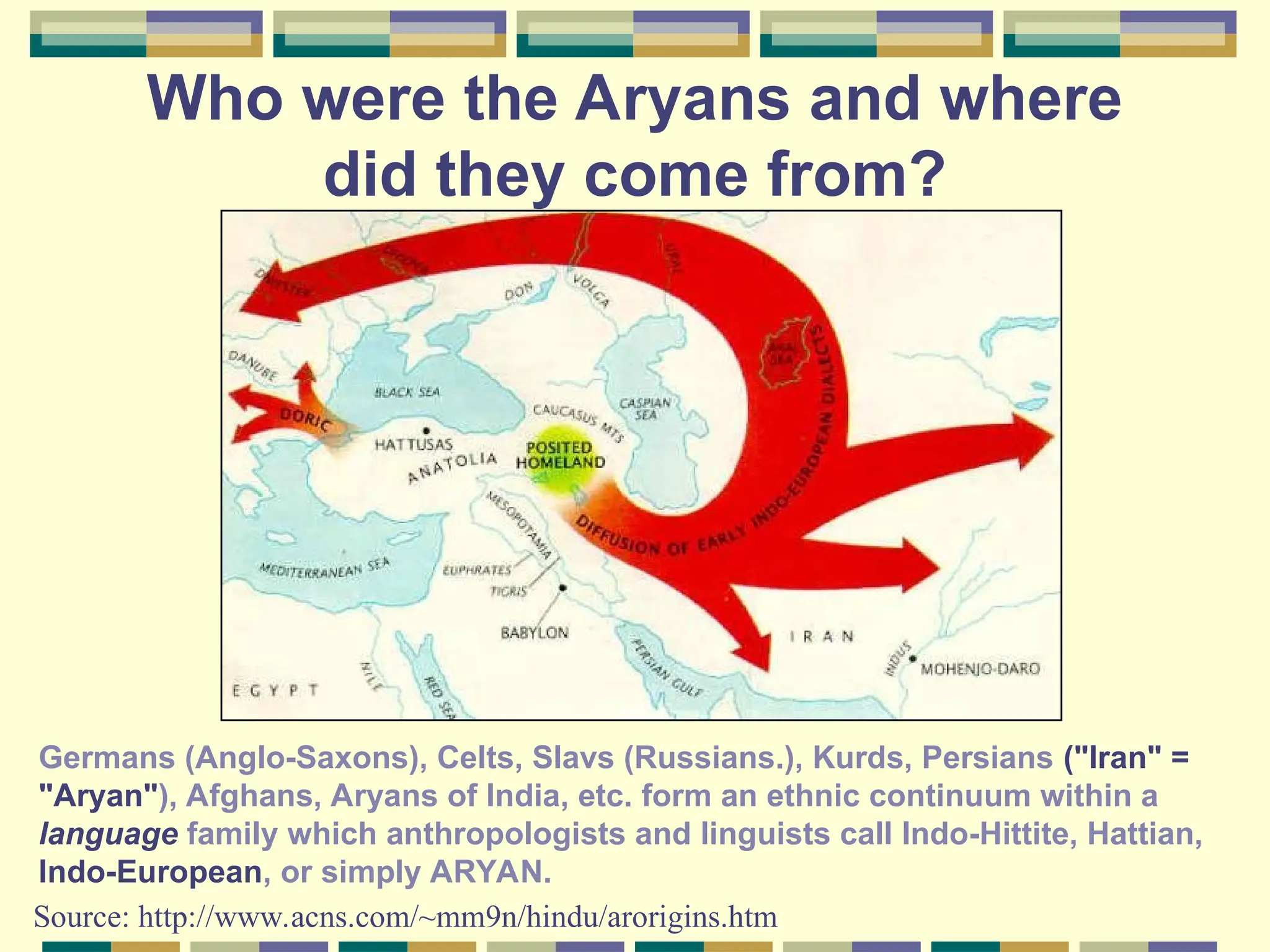
Germans (Anglo-Saxons), Celts, Slavs (Russians.), Kurds, Persians ("Iran" =
"Aryan"), Afghans, Aryans of India, etc. form an ethnic continuum within a
language family which anthropologists and linguists call Indo-Hittite, Hattian,
Indo-European, or simply ARYAN.
Source: http://www.acns.com/~mm9n/hindu/arorigins.htm
The word Aryan comes from the Sanskrit arya
meaning noble. Historians believe the original home
of the Aryans was in the lands south of the Ural
Mountains in what is now Kirghizstan.
The whole process of migration took place between 2000 to 1500 BC.
The Aryans were pastoral nomads, herding cattle. They entered India from the
northwest and initially settled in the land between the tributaries of the River
Indus. As time went on they went south and east along the river valleys and
occupied the land between the Himalayas in the north and the Vindhyas in the
south. This land, the land of the Aryans, was called Aryabarta.
Source: http://www.ssdec.nsw.edu.au/Asiaaccess/Vedic/wk2_1b.html
The Aryan Invasion Theory
When life became tough, because food was scarce or
the climate was unfavorable, the Aryans began to
move away in different directions. Some went to
Greece, some to Iran, and some to Afghanistan. From
Iran and Afghanistan some groups moved to India.
But, did they really “come from”
somewhere or where they always there?
A number of Indian nationals contest the theory that
the Aryans (and their Vedic texts and religion) were
invaders from outside of India
 They grant there there was an older, rather sophisticated
culture along the Indus River Valley
 They grant that there were and are two main language families
in India: Aryan in the north and Dravidian in the south
 One oft cited theorist (Frawley) contends that these two
peoples are not two distinct “races” entirely in competition
with one another, and that the religion that became “Hinduism”
draws as much from one culture as the other – there was a
mutual influence.
Yet other Indian nationals defend
the “Aryan Invasion Theory”
One source (Ninan) cites the sacred history
within the Vedic/Hindu texts in support of the
theory
Some (Jog) cite language theories relating
the Aryan Sanskrit to other (European)
languages outside of India
However, both these supports can be and have
been questioned by skeptics
Conclusions?
The Aryan Invasion Theory remains
contested and controversial
Critics cite the theory as a fabrication of 19th
century European linguists and historians (it
did originate with European scholars) to make
the European culture out to be superior to
that of the subcontinent (which the 19th
century Europeans had colonized)

Aryan history assignment project aryans.ppt

  • 1.
    Who were theAryans and where did they come from? Germans (Anglo-Saxons), Celts, Slavs (Russians.), Kurds, Persians ("Iran" = "Aryan"), Afghans, Aryans of India, etc. form an ethnic continuum within a language family which anthropologists and linguists call Indo-Hittite, Hattian, Indo-European, or simply ARYAN. Source: http://www.acns.com/~mm9n/hindu/arorigins.htm
  • 2.
    The word Aryancomes from the Sanskrit arya meaning noble. Historians believe the original home of the Aryans was in the lands south of the Ural Mountains in what is now Kirghizstan. The whole process of migration took place between 2000 to 1500 BC. The Aryans were pastoral nomads, herding cattle. They entered India from the northwest and initially settled in the land between the tributaries of the River Indus. As time went on they went south and east along the river valleys and occupied the land between the Himalayas in the north and the Vindhyas in the south. This land, the land of the Aryans, was called Aryabarta. Source: http://www.ssdec.nsw.edu.au/Asiaaccess/Vedic/wk2_1b.html The Aryan Invasion Theory When life became tough, because food was scarce or the climate was unfavorable, the Aryans began to move away in different directions. Some went to Greece, some to Iran, and some to Afghanistan. From Iran and Afghanistan some groups moved to India.
  • 3.
    But, did theyreally “come from” somewhere or where they always there? A number of Indian nationals contest the theory that the Aryans (and their Vedic texts and religion) were invaders from outside of India  They grant there there was an older, rather sophisticated culture along the Indus River Valley  They grant that there were and are two main language families in India: Aryan in the north and Dravidian in the south  One oft cited theorist (Frawley) contends that these two peoples are not two distinct “races” entirely in competition with one another, and that the religion that became “Hinduism” draws as much from one culture as the other – there was a mutual influence.
  • 4.
    Yet other Indiannationals defend the “Aryan Invasion Theory” One source (Ninan) cites the sacred history within the Vedic/Hindu texts in support of the theory Some (Jog) cite language theories relating the Aryan Sanskrit to other (European) languages outside of India However, both these supports can be and have been questioned by skeptics
  • 5.
    Conclusions? The Aryan InvasionTheory remains contested and controversial Critics cite the theory as a fabrication of 19th century European linguists and historians (it did originate with European scholars) to make the European culture out to be superior to that of the subcontinent (which the 19th century Europeans had colonized)