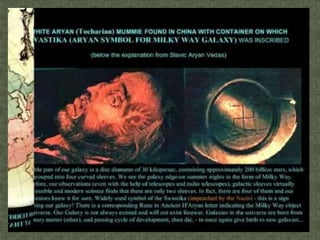
The Aryas(or Aryans – the name unfortunately associated with the
racist myth of the Nazi Third Reich) were the white people of Indo-
European origin.
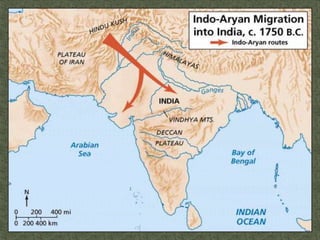
In the 2nd millenium B.C they came down from Plateau of Iran to the
remotest plains of Indus and the Ganges
 They were pastoral(rural) nomadic(travelling) people, whose tribes
began their migration between 1300 and 1100 BC
At this times the Indus Civilisation, Mohenjo-Daro and Harappa, were
already destroyed
They subjugated(under controlled) the dark skinned
natives(population) of this land
According to one thought, Aryans were indigenous inhabitant(resident)
of India and they laid down the foundation of Hindu culture and
civilization
There are no real evidences – archaeological, literary, linguistic or of any
other kind – for an Aryan invasion into India
Ancient “Aryavarta” which was the cradle(structure) of Aryan or Vedic
culture, which owes everything to the relentless efforts of the rishis and
sages of that era
The beliefs of the Aryas are essentialy based on four
Vedas(“Knowledge”), which set out the vedic religion practised by the
Brahmins.
These vedic texts are the most important literary(legendary)
monuments of the second millenium BC.
They include:
1. Rig Ved – It is a book of 1028 hymns to the various gods
2. Yajur Ved – It consists for the most parts of sacrificial formulas
3. Sama Ved – It sets the music sections of the Rig ved
4. Atharva Ved – It brings together a large number of magical and
divinatory texts
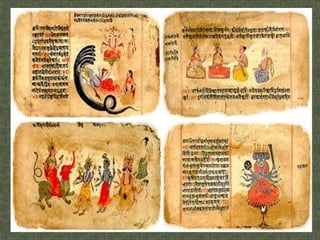
The earliest and most important of the Aryans compositions, the Rig
ved, which is a collection of hymns dedicated to the power residing in
the sacrificial ritual
The large collection of the sacred hymns in the vedas, together with a
respectable body of texts of another kind Upanishads, Shruti and
Puranas formed the basis of Aryan culture
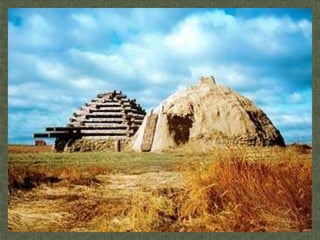
Though early aryans used bricks in the cities of Harappans, their
descendents chose to build their village settlements in timber, bamboo
and thatch which were readily and abundantly available of wooden
structures
Timber and bamboo dwellings were simpler and easier to maintain or
rebuild in case of damage by rains and floods
The most elementary of the huts was circular in plan, this being the
simplest to construct with bamboo and thatch
The wall was made of upright bamboos tied together with twisted
twigs(branches)
The roof was made by bending bamboo which took a domical or conical
shape, made watertight with overlapping thatch or grass
An addition was then made in the form of rectangular hut in front
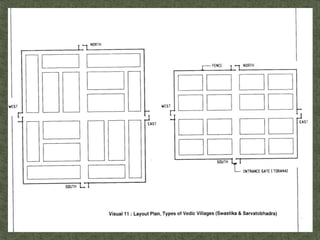
The huts were arranged in groups of threes and fours around an open
courtyard
Though these village structures were of temporary nature, the forms,
shaped by the early Aryan carpenter, contained the embryo(origin) of
much of the later Architecture of India, especially of the Hindu and
Buddhist places of worship
During this period, man’s primary concern was to define himself in
relation with the society, nature, environment, universe and cosmos
Circles are supposed to represent cosmos
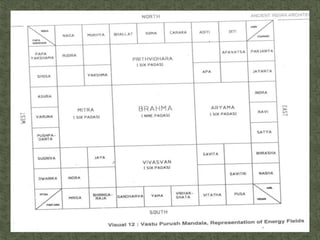
They were generated by ‘Vaastu Purush Mandala’, square showing
different energy fields
Aryans adopted a square grid as well as square plans to raise various
buildings
Vaastu means substance or built environment seen in relation with
environment
When these are in perfect harmony with each other, it is termed as
Purusha, the universe man representing energy, consciousness and
logical rationale in this constructive and creative universe
Mandala is oriented with sun god occupying crucial position in the
east, wind in the west, wealth god in the north and god of death in the
south
Thus, Vaastu-Purush-Mandala propounded (proposes) the principles,
which formed the basis of the harmonious structure in accordance with
the nature and accordingly was in conformity with the aspirations
needs of the vedic people
It provide guideline for planning villages and building abodes which
meant to be free of destructive elements and radiations
Homes, structures and abodes were cosmically balanced based strictly
upon the cardinal(key) principles of Vaastu Shastra
A perfect co-relation of all these elements is attempted while building
structure
They harmonized with “Panchmahabhutas”, the five elements,
1. Prithvi (earth)
2. Agni(fire)
3. Jal(water)
4. Aakash(space)
5. Vaayu(air)
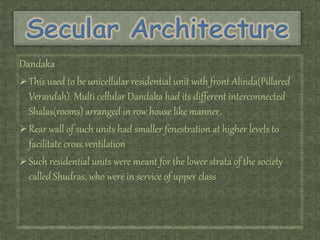
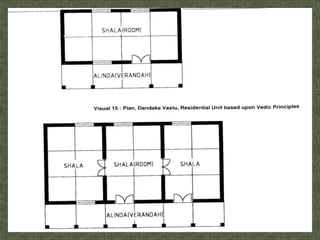
Dandaka
This used to be unicellular residential unit with front Alinda(Pillared
Verandah). Multi cellular Dandaka had its different interconnected
Shalas(rooms) arranged in row house like manner.
Rear wall of such units had smaller fenestration at higher levels to
facilitate cross ventilation
Such residential units were meant for the lower strata of the society
called Shudras, who were in service of upper class
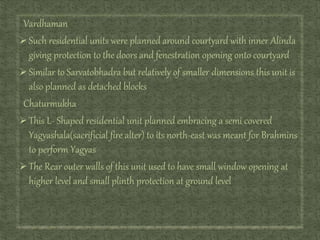
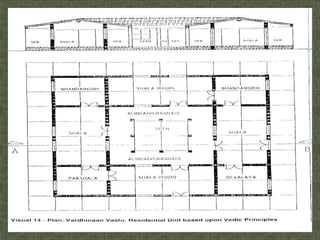
Vardhaman
Such residential units were planned around courtyard with inner Alinda
giving protection to the doors and fenestration opening onto courtyard
Similar to Sarvatobhadra but relatively of smaller dimensions this unit is
also planned as detached blocks
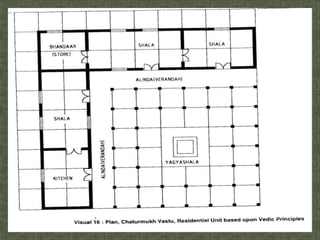
Chaturmukha
This L- Shaped residential unit planned embracing a semi covered
Yagyashala(sacrificial fire alter) to its north-east was meant for Brahmins
to perform Yagyas
The Rear outer walls of this unit used to have small window opening at
higher level and small plinth protection at ground level
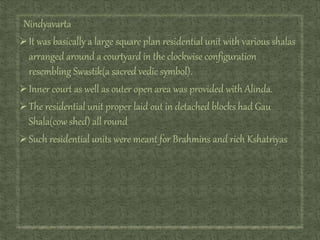
Nindyavarta
It was basically a large square plan residential unit with various shalas
arranged around a courtyard in the clockwise configuration
resembling Swastik(a sacred vedic symbol).
Inner court as well as outer open area was provided with Alinda.
The residential unit proper laid out in detached blocks had Gau
Shala(cow shed) all round
Such residential units were meant for Brahmins and rich Kshatriyas
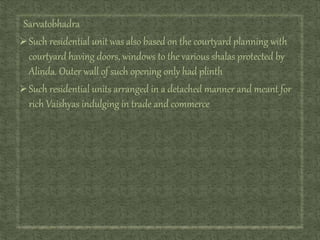
Sarvatobhadra
Such residential unit was also based on the courtyard planning with
courtyard having doors, windows to the various shalas protected by
Alinda. Outer wall of such opening only had plinth
Such residential units arranged in a detached manner and meant for
rich Vaishyas indulging in trade and commerce
Maulibhadra
This was the large residential unit planned in a U shaped manner
enclosing an open quadrangular courtyard surrounded by pillared
verandah
Outer Alinda was provided only in front of the main entrance door.
Such units are meant for the Kshatriyas which allows free access to the
rear of the house
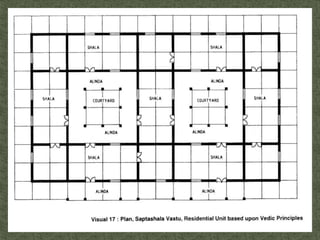
Saptshala
 This type of dwelling unit was a seven roomed structure grouped around two
open courtyard with inner pillared Alindas and ante rooms at the each
corner of the courtyard
 Outer wall had two small window fenestration in each of the shalas
 The inner walls of the shalas had a door and a window providing access to
the courtyard
 The various ante rooms served wide variety of purposes like Devalaya (shrine
cell), Paakshala (kitchen), Bhandargrih (store) etc.
Thank
You

Aryan Civilisation.pptx

  • 3.
    The Aryas(or Aryans– the name unfortunately associated with the racist myth of the Nazi Third Reich) were the white people of Indo- European origin. In the 2nd millenium B.C they came down from Plateau of Iran to the remotest plains of Indus and the Ganges  They were pastoral(rural) nomadic(travelling) people, whose tribes began their migration between 1300 and 1100 BC At this times the Indus Civilisation, Mohenjo-Daro and Harappa, were already destroyed
  • 5.
    They subjugated(under controlled)the dark skinned natives(population) of this land According to one thought, Aryans were indigenous inhabitant(resident) of India and they laid down the foundation of Hindu culture and civilization There are no real evidences – archaeological, literary, linguistic or of any other kind – for an Aryan invasion into India Ancient “Aryavarta” which was the cradle(structure) of Aryan or Vedic culture, which owes everything to the relentless efforts of the rishis and sages of that era
  • 7.
    The beliefs ofthe Aryas are essentialy based on four Vedas(“Knowledge”), which set out the vedic religion practised by the Brahmins. These vedic texts are the most important literary(legendary) monuments of the second millenium BC.
  • 8.
    They include: 1. RigVed – It is a book of 1028 hymns to the various gods 2. Yajur Ved – It consists for the most parts of sacrificial formulas 3. Sama Ved – It sets the music sections of the Rig ved 4. Atharva Ved – It brings together a large number of magical and divinatory texts
  • 9.
    The earliest andmost important of the Aryans compositions, the Rig ved, which is a collection of hymns dedicated to the power residing in the sacrificial ritual The large collection of the sacred hymns in the vedas, together with a respectable body of texts of another kind Upanishads, Shruti and Puranas formed the basis of Aryan culture
  • 11.
    Though early aryansused bricks in the cities of Harappans, their descendents chose to build their village settlements in timber, bamboo and thatch which were readily and abundantly available of wooden structures Timber and bamboo dwellings were simpler and easier to maintain or rebuild in case of damage by rains and floods The most elementary of the huts was circular in plan, this being the simplest to construct with bamboo and thatch
  • 13.
    The wall wasmade of upright bamboos tied together with twisted twigs(branches) The roof was made by bending bamboo which took a domical or conical shape, made watertight with overlapping thatch or grass An addition was then made in the form of rectangular hut in front The huts were arranged in groups of threes and fours around an open courtyard Though these village structures were of temporary nature, the forms, shaped by the early Aryan carpenter, contained the embryo(origin) of much of the later Architecture of India, especially of the Hindu and Buddhist places of worship
  • 14.
    During this period,man’s primary concern was to define himself in relation with the society, nature, environment, universe and cosmos Circles are supposed to represent cosmos They were generated by ‘Vaastu Purush Mandala’, square showing different energy fields Aryans adopted a square grid as well as square plans to raise various buildings Vaastu means substance or built environment seen in relation with environment
  • 17.
    When these arein perfect harmony with each other, it is termed as Purusha, the universe man representing energy, consciousness and logical rationale in this constructive and creative universe Mandala is oriented with sun god occupying crucial position in the east, wind in the west, wealth god in the north and god of death in the south Thus, Vaastu-Purush-Mandala propounded (proposes) the principles, which formed the basis of the harmonious structure in accordance with the nature and accordingly was in conformity with the aspirations needs of the vedic people
  • 18.
    It provide guidelinefor planning villages and building abodes which meant to be free of destructive elements and radiations Homes, structures and abodes were cosmically balanced based strictly upon the cardinal(key) principles of Vaastu Shastra A perfect co-relation of all these elements is attempted while building structure
  • 19.
    They harmonized with“Panchmahabhutas”, the five elements, 1. Prithvi (earth) 2. Agni(fire) 3. Jal(water) 4. Aakash(space) 5. Vaayu(air)
  • 21.
    Dandaka This used tobe unicellular residential unit with front Alinda(Pillared Verandah). Multi cellular Dandaka had its different interconnected Shalas(rooms) arranged in row house like manner. Rear wall of such units had smaller fenestration at higher levels to facilitate cross ventilation Such residential units were meant for the lower strata of the society called Shudras, who were in service of upper class
  • 23.
    Vardhaman Such residential unitswere planned around courtyard with inner Alinda giving protection to the doors and fenestration opening onto courtyard Similar to Sarvatobhadra but relatively of smaller dimensions this unit is also planned as detached blocks Chaturmukha This L- Shaped residential unit planned embracing a semi covered Yagyashala(sacrificial fire alter) to its north-east was meant for Brahmins to perform Yagyas The Rear outer walls of this unit used to have small window opening at higher level and small plinth protection at ground level
  • 26.
    Nindyavarta It was basicallya large square plan residential unit with various shalas arranged around a courtyard in the clockwise configuration resembling Swastik(a sacred vedic symbol). Inner court as well as outer open area was provided with Alinda. The residential unit proper laid out in detached blocks had Gau Shala(cow shed) all round Such residential units were meant for Brahmins and rich Kshatriyas
  • 27.
    Sarvatobhadra Such residential unitwas also based on the courtyard planning with courtyard having doors, windows to the various shalas protected by Alinda. Outer wall of such opening only had plinth Such residential units arranged in a detached manner and meant for rich Vaishyas indulging in trade and commerce
  • 29.
    Maulibhadra This was thelarge residential unit planned in a U shaped manner enclosing an open quadrangular courtyard surrounded by pillared verandah Outer Alinda was provided only in front of the main entrance door. Such units are meant for the Kshatriyas which allows free access to the rear of the house
  • 30.
    Saptshala  This typeof dwelling unit was a seven roomed structure grouped around two open courtyard with inner pillared Alindas and ante rooms at the each corner of the courtyard  Outer wall had two small window fenestration in each of the shalas  The inner walls of the shalas had a door and a window providing access to the courtyard  The various ante rooms served wide variety of purposes like Devalaya (shrine cell), Paakshala (kitchen), Bhandargrih (store) etc.
  • 32.