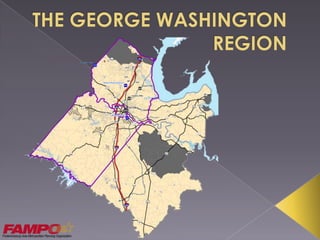
THE GEORGE WASHINGTON REGION
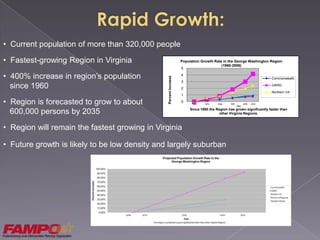
Rapid Growth:  Current population of more than 320,000 people
  Fastest-growing Region in Virginia
  400% increase in region’s population    since 1960 Region is forecasted to grow to about    600,000 persons by 2035 Region will remain the fastest growing in Virginia
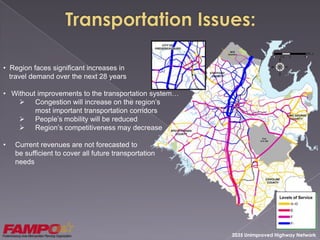
  Future growth is likely to be low density and largely suburbanTransportation Issues:  Region faces significant increases in    travel demand over the next 28 yearsWithout improvements to the transportation system…
 	Congestion will increase on the region’s  	most important transportation corridors
People’s mobility will be reduced
Region’s competitiveness may decrease
Current revenues are not forecasted to       be sufficient to cover all future transportation      needs2035 Unimproved Highway Network
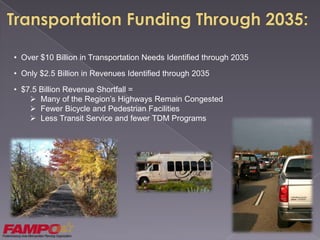
Transportation Funding Through 2035:  Over $10 Billion in Transportation Needs Identified through 2035
 Only $2.5 Billion in Revenues Identified through 2035
  $7.5 Billion Revenue Shortfall =
  Many of the Region’s Highways Remain Congested
 Fewer Bicycle and Pedestrian Facilities
 Less Transit Service and fewer TDM ProgramsFuture Policy Choices for Development and Investment:   Region is at a crossroads
Insufficient funds to meet future transportation 	system needsCurrent development policies – creating sprawl – 	will exacerbate issuesThree distinct policy directions are available as the 	region moves forward…  Option 1: Stay the Course
Option 2: Identify and Secure Additional Transportation Funding

The George Washington Region

  • 1.
  • 2.
    Rapid Growth: Current population of more than 320,000 people
  • 3.
    Fastest-growingRegion in Virginia
  • 4.
    400%increase in region’s population since 1960 Region is forecasted to grow to about 600,000 persons by 2035 Region will remain the fastest growing in Virginia
  • 5.
    Futuregrowth is likely to be low density and largely suburbanTransportation Issues: Region faces significant increases in travel demand over the next 28 yearsWithout improvements to the transportation system…
  • 6.
    Congestion willincrease on the region’s most important transportation corridors
  • 7.
  • 8.
  • 9.
    Current revenues arenot forecasted to be sufficient to cover all future transportation needs2035 Unimproved Highway Network
  • 10.
    Transportation Funding Through2035: Over $10 Billion in Transportation Needs Identified through 2035
  • 11.
    Only $2.5Billion in Revenues Identified through 2035
  • 12.
    $7.5Billion Revenue Shortfall =
  • 13.
    Manyof the Region’s Highways Remain Congested
  • 14.
    Fewer Bicycleand Pedestrian Facilities
  • 15.
    Less TransitService and fewer TDM ProgramsFuture Policy Choices for Development and Investment: Region is at a crossroads
  • 16.
    Insufficient funds tomeet future transportation system needsCurrent development policies – creating sprawl – will exacerbate issuesThree distinct policy directions are available as the region moves forward… Option 1: Stay the Course
  • 17.
    Option 2: Identifyand Secure Additional Transportation Funding