Transit Governance Position
State Transit Governance
State Level Transit Governance
The Georgia Transit Association (GTA) supports a state transit governance model that
enhances access to public and human services transit, preserves local control, and
coordinates existing transit programs to eliminate the duplication of services.
Recommendations
• Designate a single state agency to administer public and human
services transit programs, streamline policy guidance, and to
maximize state transit funding to create a stronger transit
network.
• Authorize the state agency to establish a statewide transit
planning process, and direct it to produce a strategic transit
plan every five years.
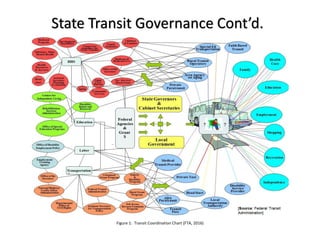
State Transit Governance Cont’d.
Figure 1: Transit Coordination Chart (FTA, 2016)
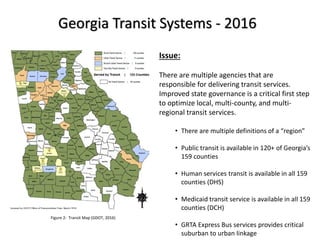
Georgia Transit Systems - 2016
Issue:
There are multiple agencies that are
responsible for delivering transit services.
Improved state governance is a critical first step
to optimize local, multi-county, and multi-
regional transit services.
• There are multiple definitions of a “region”
• Public transit is available in 120+ of Georgia’s
159 counties
• Human services transit is available in all 159
counties (DHS)
• Medicaid transit service is available in all 159
counties (DCH)
• GRTA Express Bus services provides critical
suburban to urban linkage
Figure 2: Transit Map (GDOT, 2016)
Regional Transit Governance
Regional Level Transit Governance
The Georgia Transit Association (GTA) supports a regional transit governance model that
enhances access to public and human services transit, preserves local control, and
coordinates existing transit programs to eliminate the duplication of services.
Recommendations
• Develop a voluntary process for local governments to designate
a transit service region, and to establish all reasonable and
necessary intergovernmental agreements to administer public
and human services transit programs, streamline policy
guidance, and to maximize funding to create a stronger transit
network.

Georgia Transit Association Governance Principles

  • 1.
  • 2.
    State Transit Governance StateLevel Transit Governance The Georgia Transit Association (GTA) supports a state transit governance model that enhances access to public and human services transit, preserves local control, and coordinates existing transit programs to eliminate the duplication of services. Recommendations • Designate a single state agency to administer public and human services transit programs, streamline policy guidance, and to maximize state transit funding to create a stronger transit network. • Authorize the state agency to establish a statewide transit planning process, and direct it to produce a strategic transit plan every five years.
  • 3.
    State Transit GovernanceCont’d. Figure 1: Transit Coordination Chart (FTA, 2016)
  • 4.
    Georgia Transit Systems- 2016 Issue: There are multiple agencies that are responsible for delivering transit services. Improved state governance is a critical first step to optimize local, multi-county, and multi- regional transit services. • There are multiple definitions of a “region” • Public transit is available in 120+ of Georgia’s 159 counties • Human services transit is available in all 159 counties (DHS) • Medicaid transit service is available in all 159 counties (DCH) • GRTA Express Bus services provides critical suburban to urban linkage Figure 2: Transit Map (GDOT, 2016)
  • 5.
    Regional Transit Governance RegionalLevel Transit Governance The Georgia Transit Association (GTA) supports a regional transit governance model that enhances access to public and human services transit, preserves local control, and coordinates existing transit programs to eliminate the duplication of services. Recommendations • Develop a voluntary process for local governments to designate a transit service region, and to establish all reasonable and necessary intergovernmental agreements to administer public and human services transit programs, streamline policy guidance, and to maximize funding to create a stronger transit network.