THE FUTURE Present Simple Present Continuous Be Going To Will + infinitive Future continuous: will + be +V-ing Future perfect: will + have + past participle
PRESENT SIMPLE In sentences that concern events that are on a  definite schedule or timetable . These sentences usually contain future words.  Only a few verbs are used in this way, eg:  to be, open, close, begin, start, end, finish, arrive, come, leave, return. EXAMPLES: The train  LEAVES  London at 9pm tonight. Joanna  STARTS  work next week. Tomorrow  IS  Thursday.
PRESENT CONTINUOUS BE (present) + V-ING In sentences that concern a  definite plan or arrangement . These sentences usually contain future words, or the future is understood from the context. EXAMPLES: Marek  IS TAKING  his CAE exam next year. They can’t play tennis with you tomorrow. They ’RE   WORKING .
BE GOING TO When the speaker is making a  prediction based on evidence . There’s a cloud in the sky. It ’S   GOING TO  rain. When the speaker already has an  intention or plan . We ’RE   GOING TO  paint our bedroom tomorrow. Simon has won the lottery. He says he ’S   GOING TO  buy a  house in Oxford.
WILL + INFINITIVE When the speaker is making a  prediction . Tomorrow  WILL BE  hot and sunny. People  WILL GO  to Mars in the next decade. When the speaker decides to do something at the time of  speaking. He had  no previous plan .  Spontaneous . Hold on. I ’LL GET  a pencil. We  WILL SEE  what we can do to help you Maybe we ’LL   STAY IN  and  WATCH  television.
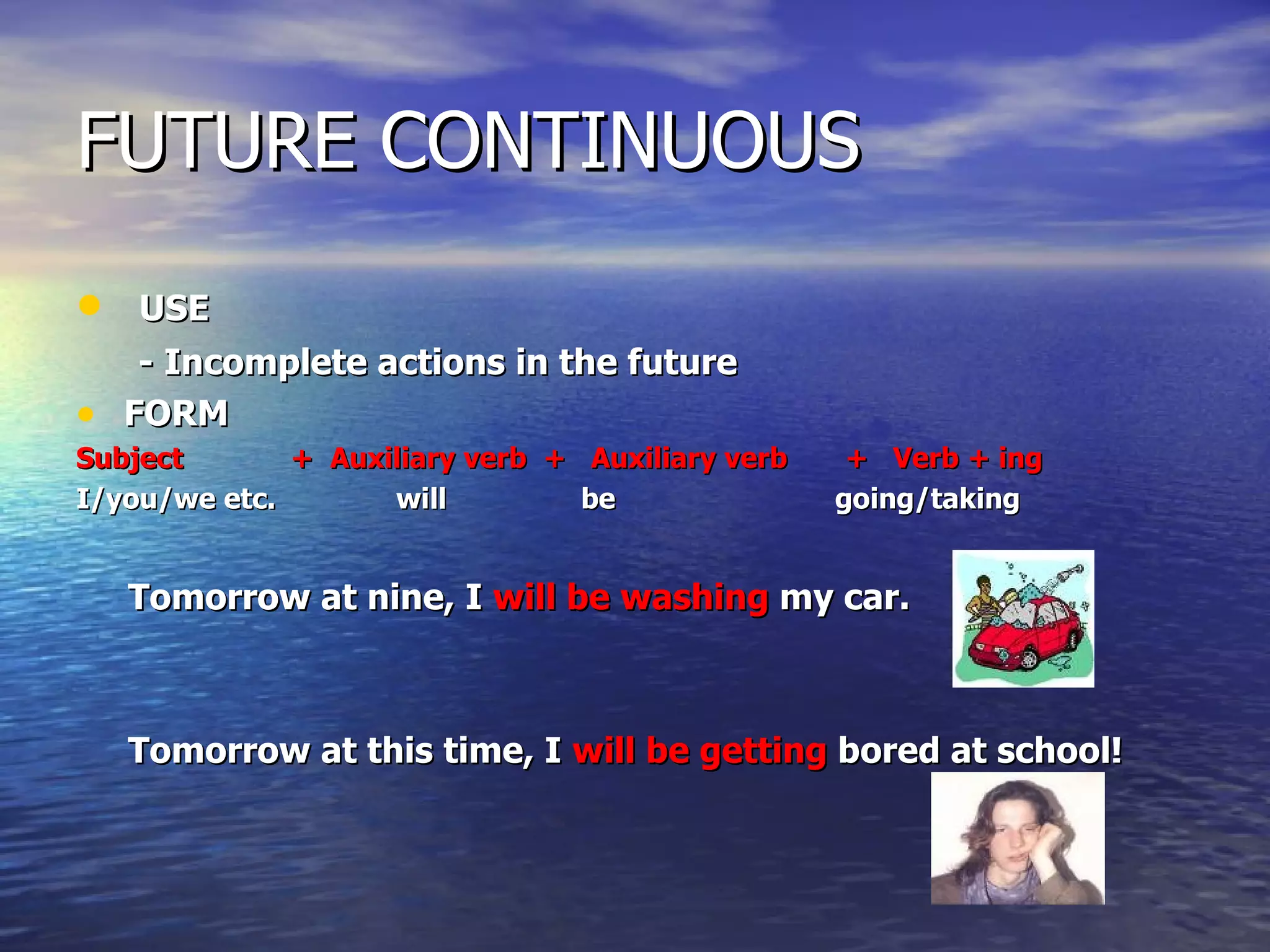
FUTURE CONTINUOUS USE - Incomplete actions in the future FORM Subject  +  Auxiliary verb  +  Auxiliary verb  +  Verb + ing I/you/we etc.    will    be    going/taking Tomorrow at nine, I  will be washing  my car. Tomorrow at this time, I  will be getting  bored at school!
FUTURE PERFECT USE - Actions that will be finished before some point  in the future FORM Subject  +  Auxiliary verb  +  Auxiliary verb  +  Past participle I/a dog etc.    will    have    gone, seen, etc They  will have graduated  from  Cambridge by July 2009. I  will have retired  by the end of the year. I read 40 pages a day. If I keep up the pace, I  will have read  the book by Tuesday.

The Future

  • 1.
    THE FUTURE PresentSimple Present Continuous Be Going To Will + infinitive Future continuous: will + be +V-ing Future perfect: will + have + past participle
  • 2.
    PRESENT SIMPLE Insentences that concern events that are on a definite schedule or timetable . These sentences usually contain future words. Only a few verbs are used in this way, eg: to be, open, close, begin, start, end, finish, arrive, come, leave, return. EXAMPLES: The train LEAVES London at 9pm tonight. Joanna STARTS work next week. Tomorrow IS Thursday.
  • 3.
    PRESENT CONTINUOUS BE(present) + V-ING In sentences that concern a definite plan or arrangement . These sentences usually contain future words, or the future is understood from the context. EXAMPLES: Marek IS TAKING his CAE exam next year. They can’t play tennis with you tomorrow. They ’RE WORKING .
  • 4.
    BE GOING TOWhen the speaker is making a prediction based on evidence . There’s a cloud in the sky. It ’S GOING TO rain. When the speaker already has an intention or plan . We ’RE GOING TO paint our bedroom tomorrow. Simon has won the lottery. He says he ’S GOING TO buy a house in Oxford.
  • 5.
    WILL + INFINITIVEWhen the speaker is making a prediction . Tomorrow WILL BE hot and sunny. People WILL GO to Mars in the next decade. When the speaker decides to do something at the time of speaking. He had no previous plan . Spontaneous . Hold on. I ’LL GET a pencil. We WILL SEE what we can do to help you Maybe we ’LL STAY IN and WATCH television.
  • 6.
    FUTURE CONTINUOUS USE- Incomplete actions in the future FORM Subject + Auxiliary verb + Auxiliary verb + Verb + ing I/you/we etc. will be going/taking Tomorrow at nine, I will be washing my car. Tomorrow at this time, I will be getting bored at school!
  • 7.
    FUTURE PERFECT USE- Actions that will be finished before some point in the future FORM Subject + Auxiliary verb + Auxiliary verb + Past participle I/a dog etc. will have gone, seen, etc They will have graduated from Cambridge by July 2009. I will have retired by the end of the year. I read 40 pages a day. If I keep up the pace, I will have read the book by Tuesday.