The future of video


   Presented by Phil and Jenna
The background to video

• Today a quarter of the web’s bandwidth is video. It’s predicted to rise
  to 90% by 2013.

• The digital universe grew by 62% in 2010 to 800,000 petabytes
   (million gigabytes) and by 2020 is expected be 50 times that!

• The fastest growing category of data on the web is metadata –
  particularly useful in video.

• Around 70% of the digital universe is generated by individuals,
  moving towards data rich environments.
The background to video

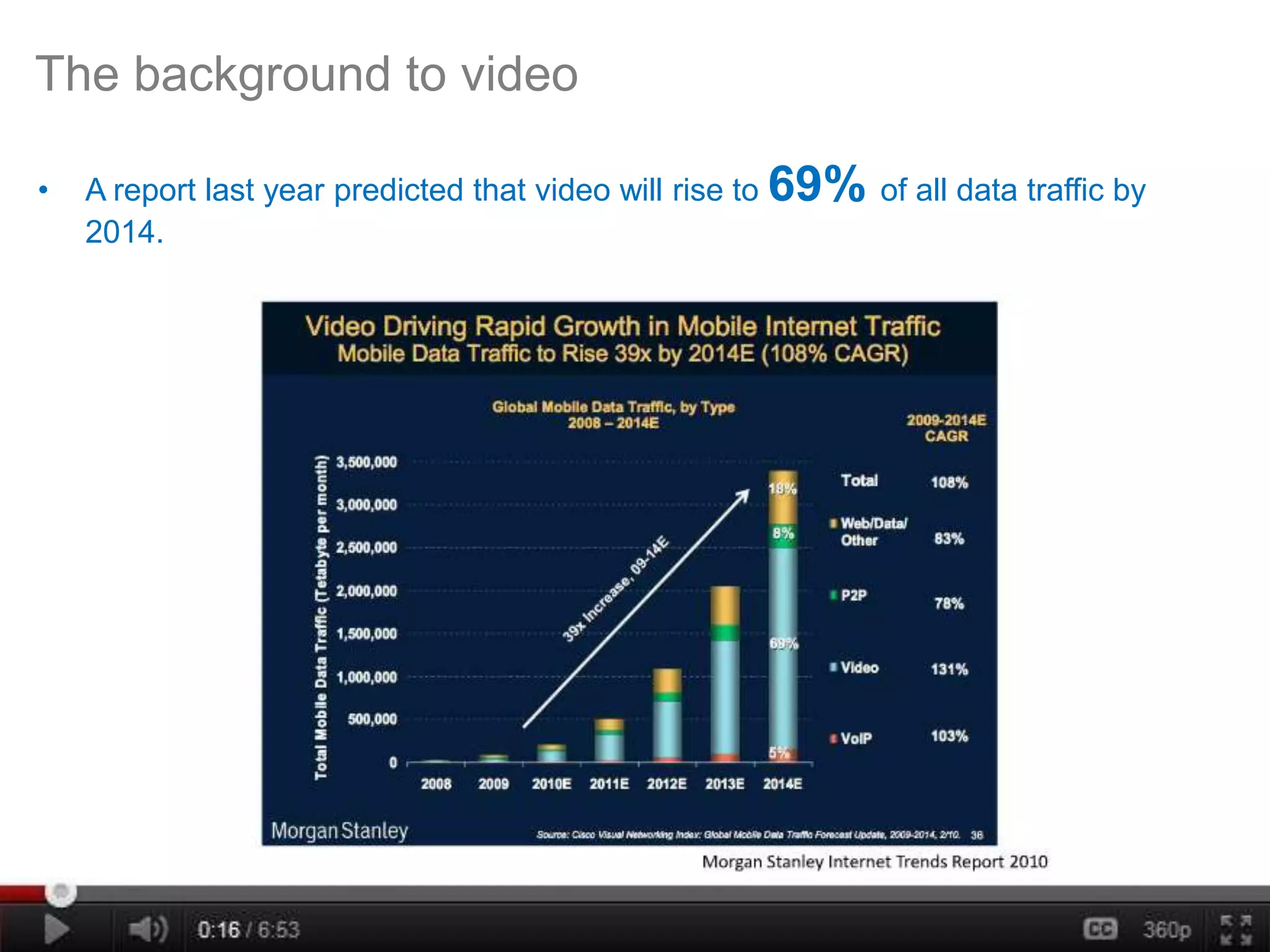
•   A report last year predicted that video will rise to 69% of all data traffic by
    2014.
Did you know…
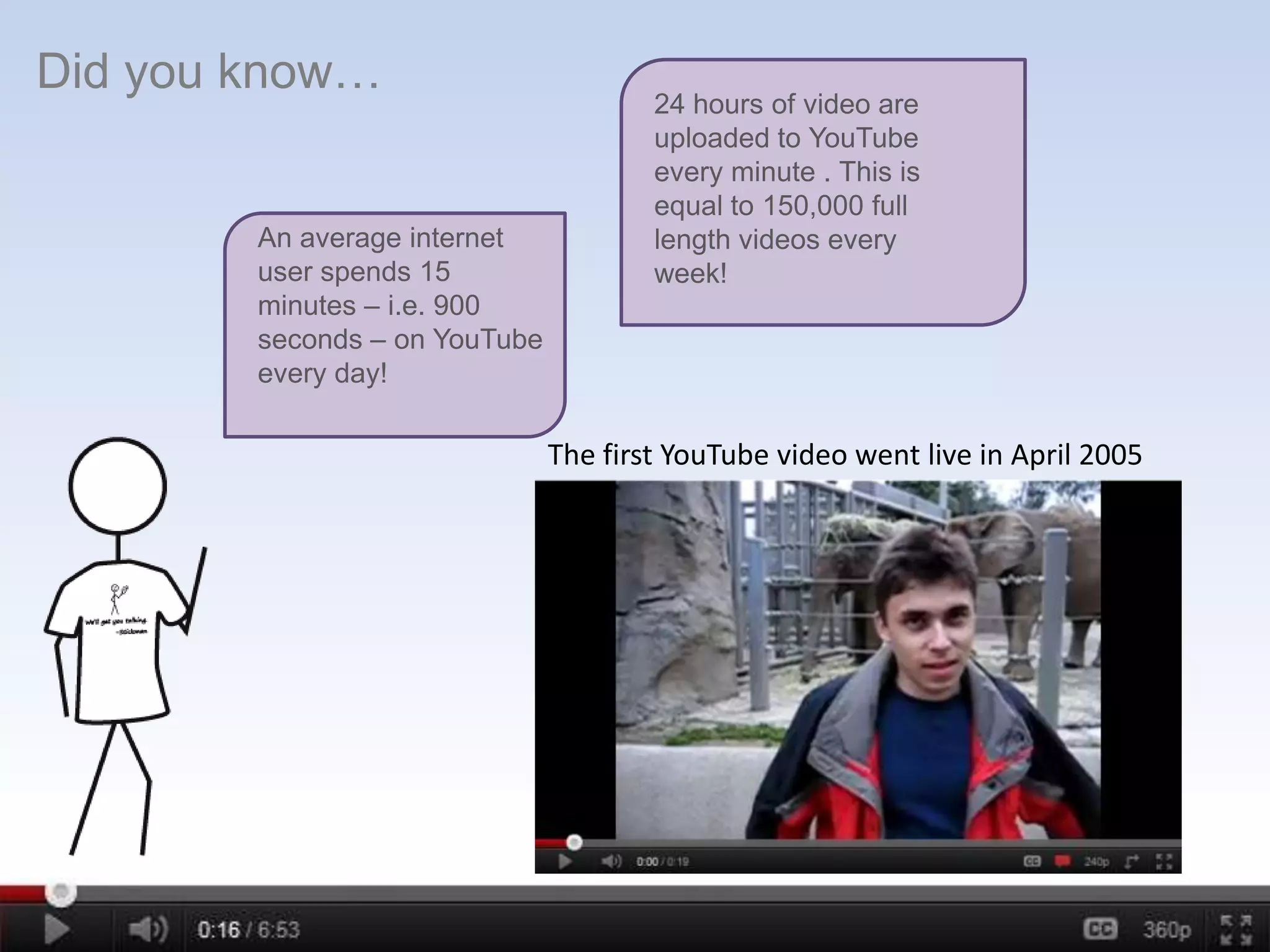
                                       24 hours of video are
                                       uploaded to YouTube
                                       every minute . This is
                                       equal to 150,000 full
        An average internet            length videos every
        user spends 15                 week!
        minutes – i.e. 900
        seconds – on YouTube
        every day!

                               The first YouTube video went live in April 2005
What’s around the corner?

• By 2020, wireless electricity will power and recharge video devices such
  as TVs, cameras, video smartphones and camcorders.

How does it work: ‘WiTricity’ is powered via coupling, creating higher
charging efficiency. This means charging your video devices will be quicker
and less costly than plugging it in.

• By 2020, video users will be able to edit complex objects in video in just
  a few moments, enriching edited video content.

How does it work: Microsoft have announced a new system which allows
easy editing of complex 3D objects, eliminating the frame by frame editing
we use today.
What’s around the corner?

• Hollywood movies and video games will use motion capture systems to allow the
  creation of highly realistic character enhancing CGI development by 2015.

What does this mean: More users will be able to create and combine digital sets,
actors and props into visually compelling videos.

• By 2015, filmmakers will embrace digital storyboard software tools; they are
  expected to go mainstream by 2020 for consumers.

What does this mean: It will be easy to create props, scripts, location shots,
scenes and more.

• By 2015, all digital cameras and camcorders will be continuously connected to
  the internet for instant content sharing!

What does this mean: 3G and Wi-Fi connections will continuously facilitate the
upload of content directly into media sharing sites for instant sharing.
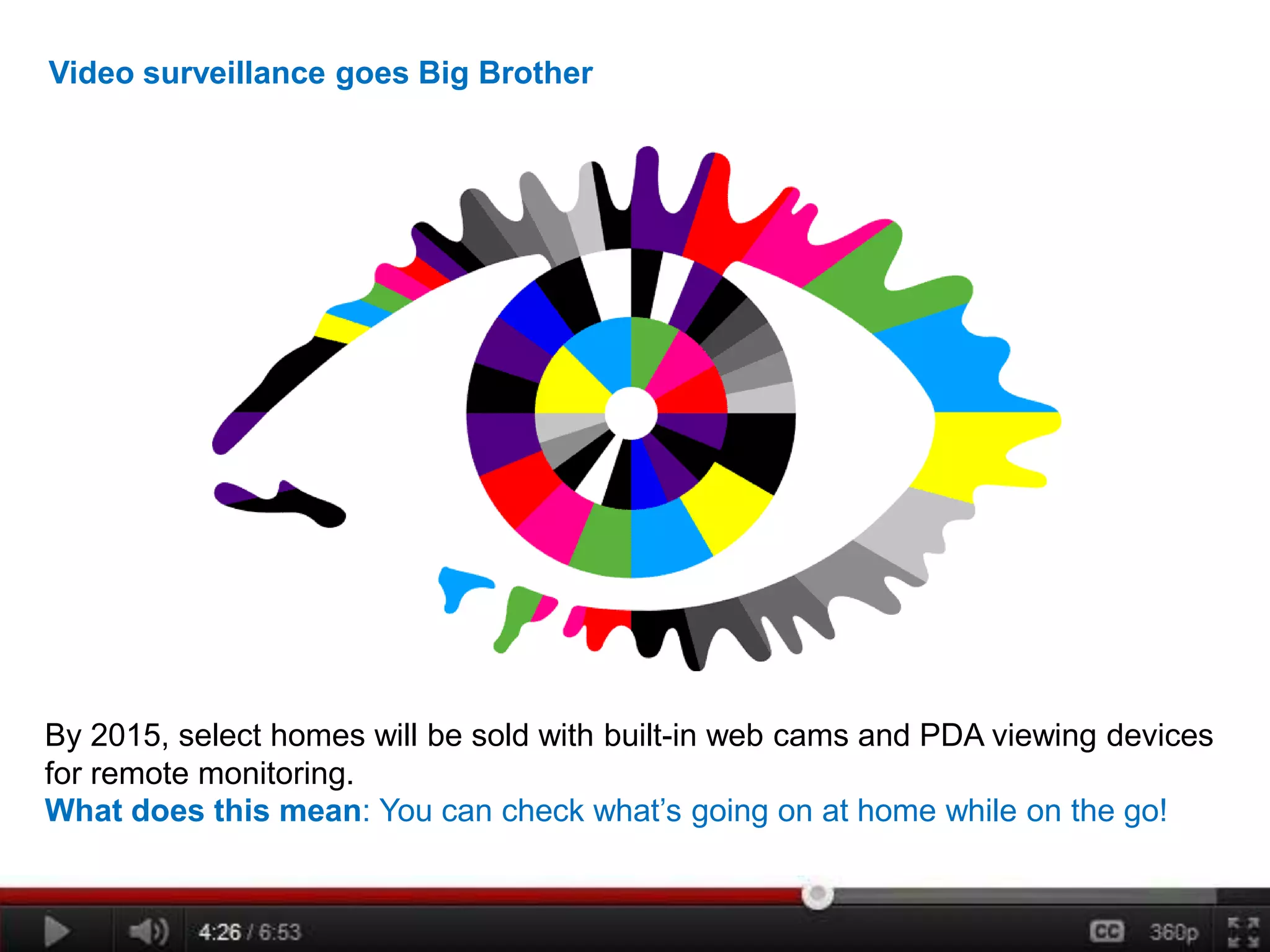
Video surveillance goes Big Brother


By 2015, select homes will be sold with built-in web cams and PDA viewing devices
for remote monitoring.
What does this mean: You can check what’s going on at home while on the go!
Avatars


By 2015, consumers will be creating digital versions of themselves
(avatars) for insertion in video games, TV shows and more virtual worlds,
publishing them throughout social media networks.

The concept of a ‘Digital You’ will appear in TV ads and video games.

These avatars will also interact with other people.

What does this mean: Photorealistic avatars will be embeddable into digital
video, social media and video games.
Flexible display


• Flexible, bendable video displays will be available to the mass market
  consumer by 2020 and used on technology all around us.


• This is currently being tested in Taiwan in newspapers and magazines, and
  being implemented in smartphone technology for 2012.
Video interaction
• Holographic television and video games are expected to be available by
  2020.

• By 2020 the ‘Minority Report’ style interactive video displays will have
  arrived .

• Social networking television will be an integral part of TV and web.

• Viewing by 2015 – Channel 4 have started to experiment with this recently
  by joining up with Zeebox for the programme Desperate Scousewives.

• Video systems will watch their audience and deliver
  targeted advertising to consumers by 2015.

• Cloud networking will form a portion of the internet infrastructure and will
  enable zero latency, non-buffering and ultra-high definition video by 2015.
Video in real life


• From 2D to immersive HD and 3D video – this is coming through in various
  formats such as interactive augmented reality.


• Video and interaction becomes augmented reality in everyday life. Digital
  contact lenses and video wrist watches are just the start of this – they will be
  appearing from 2015 onwards. Here is a glimpse of the interactive future.
Thanks for watching!


Sources used in this presentation:
YouTube
Vimeo
The Future of Video – Institute for the Future Tech Horizons

The future of video

  • 1.
    The future ofvideo Presented by Phil and Jenna
  • 2.
    The background tovideo • Today a quarter of the web’s bandwidth is video. It’s predicted to rise to 90% by 2013. • The digital universe grew by 62% in 2010 to 800,000 petabytes (million gigabytes) and by 2020 is expected be 50 times that! • The fastest growing category of data on the web is metadata – particularly useful in video. • Around 70% of the digital universe is generated by individuals, moving towards data rich environments.
  • 3.
    The background tovideo • A report last year predicted that video will rise to 69% of all data traffic by 2014.
  • 4.
    Did you know… 24 hours of video are uploaded to YouTube every minute . This is equal to 150,000 full An average internet length videos every user spends 15 week! minutes – i.e. 900 seconds – on YouTube every day! The first YouTube video went live in April 2005
  • 5.
    What’s around thecorner? • By 2020, wireless electricity will power and recharge video devices such as TVs, cameras, video smartphones and camcorders. How does it work: ‘WiTricity’ is powered via coupling, creating higher charging efficiency. This means charging your video devices will be quicker and less costly than plugging it in. • By 2020, video users will be able to edit complex objects in video in just a few moments, enriching edited video content. How does it work: Microsoft have announced a new system which allows easy editing of complex 3D objects, eliminating the frame by frame editing we use today.
  • 6.
    What’s around thecorner? • Hollywood movies and video games will use motion capture systems to allow the creation of highly realistic character enhancing CGI development by 2015. What does this mean: More users will be able to create and combine digital sets, actors and props into visually compelling videos. • By 2015, filmmakers will embrace digital storyboard software tools; they are expected to go mainstream by 2020 for consumers. What does this mean: It will be easy to create props, scripts, location shots, scenes and more. • By 2015, all digital cameras and camcorders will be continuously connected to the internet for instant content sharing! What does this mean: 3G and Wi-Fi connections will continuously facilitate the upload of content directly into media sharing sites for instant sharing.
  • 7.
    Video surveillance goesBig Brother By 2015, select homes will be sold with built-in web cams and PDA viewing devices for remote monitoring. What does this mean: You can check what’s going on at home while on the go!
  • 9.
    Avatars By 2015, consumerswill be creating digital versions of themselves (avatars) for insertion in video games, TV shows and more virtual worlds, publishing them throughout social media networks. The concept of a ‘Digital You’ will appear in TV ads and video games. These avatars will also interact with other people. What does this mean: Photorealistic avatars will be embeddable into digital video, social media and video games.
  • 10.
    Flexible display • Flexible,bendable video displays will be available to the mass market consumer by 2020 and used on technology all around us. • This is currently being tested in Taiwan in newspapers and magazines, and being implemented in smartphone technology for 2012.
  • 11.
    Video interaction • Holographictelevision and video games are expected to be available by 2020. • By 2020 the ‘Minority Report’ style interactive video displays will have arrived . • Social networking television will be an integral part of TV and web. • Viewing by 2015 – Channel 4 have started to experiment with this recently by joining up with Zeebox for the programme Desperate Scousewives. • Video systems will watch their audience and deliver targeted advertising to consumers by 2015. • Cloud networking will form a portion of the internet infrastructure and will enable zero latency, non-buffering and ultra-high definition video by 2015.
  • 12.
    Video in reallife • From 2D to immersive HD and 3D video – this is coming through in various formats such as interactive augmented reality. • Video and interaction becomes augmented reality in everyday life. Digital contact lenses and video wrist watches are just the start of this – they will be appearing from 2015 onwards. Here is a glimpse of the interactive future.
  • 13.
    Thanks for watching! Sourcesused in this presentation: YouTube Vimeo The Future of Video – Institute for the Future Tech Horizons

Editor's Notes

  • #5 NOTE TO VIEWER – Click on video screen to play video
  • #6 Unwrapping – uses a mathematical process to unwrap the visual before wrapping it back into the original object.
  • #7 Unwrapping – uses a mathematical process to unwrap the visual before wrapping it back into the original object.
  • #8 Unwrapping – uses a mathematical process to unwrap the visual before wrapping it back into the original object.
  • #9 NOTE TO VIEWER – Click on The Birth of an Avatar to play video
  • #10 NOTE TO VIEWER – Click on the paly bar at 00:40 to play video
  • #11 NOTE TO VIEWER – Click on both bullet points to play videos
  • #12 NOTE TO VIEWER – Click on hyperlinks to play videos
  • #13 NOTE TO VIEWER – Click on both bullet points to play videos
  • #14 NOTE TO VIEWER – Click on both bullet points to play videos