The future of
reference
management
systems:
technology – people
– institutions
20130924, Jeroen Bosman
@jeroenbosman
http://www.slideshare.net/hierohiero
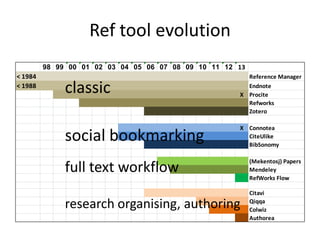
Ref tool evolution
98 99 00 01 02 03 04 05 06 07 08 09 10 11 12 13
< 1984 Reference Manager
< 1988 Endnote
X Procite
Refworks
Zotero
X Connotea
CiteUlike
BibSonomy
(Mekentosj) Papers
Mendeley
RefWorks Flow
Citavi
Qiqqa
Colwiz
Authorea
classic
social bookmarking
full text workflow
research organising, authoring
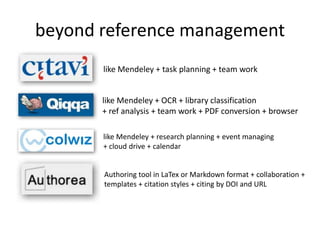
beyond reference management
like Mendeley + task planning + team work
like Mendeley + OCR + library classification
+ ref analysis + team work + PDF conversion + browser
like Mendeley + research planning + event managing
+ cloud drive + calendar
Authoring tool in LaTex or Markdown format + collaboration +
templates + citation styles + citing by DOI and URL
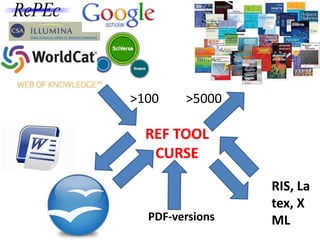
REF TOOL
CURSE
>100 >5000
PDF-versions
RIS, La
tex, X
ML
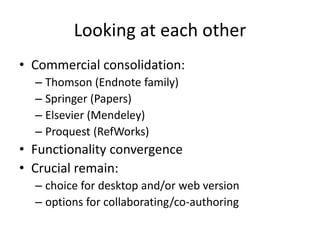
Looking at each other
• Commercial consolidation:
– Thomson (Endnote family)
– Springer (Papers)
– Elsevier (Mendeley)
– Proquest (RefWorks)
• Functionality convergence
• Crucial remain:
– choice for desktop and/or web version
– options for collaborating/co-authoring
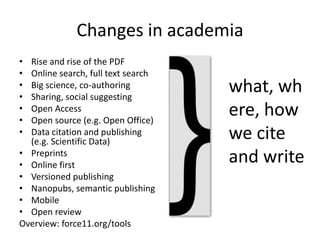
Changes in academia
• Rise and rise of the PDF
• Online search, full text search
• Big science, co-authoring
• Sharing, social suggesting
• Open Access
• Open source (e.g. Open Office)
• Data citation and publishing
(e.g. Scientific Data)
• Preprints
• Online first
• Versioned publishing
• Nanopubs, semantic publishing
• Mobile
• Open review
Overview: force11.org/tools
what, wh
ere, how
we cite
and write
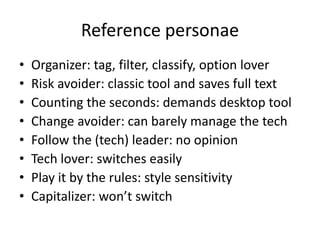
Reference personae
• Organizer: tag, filter, classify, option lover
• Risk avoider: classic tool and saves full text
• Counting the seconds: demands desktop tool
• Change avoider: can barely manage the tech
• Follow the (tech) leader: no opinion
• Tech lover: switches easily
• Play it by the rules: style sensitivity
• Capitalizer: won’t switch
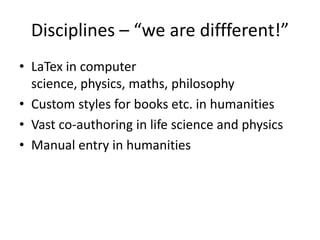
Disciplines – “we are diffferent!”
• LaTex in computer
science, physics, maths, philosophy
• Custom styles for books etc. in humanities
• Vast co-authoring in life science and physics
• Manual entry in humanities
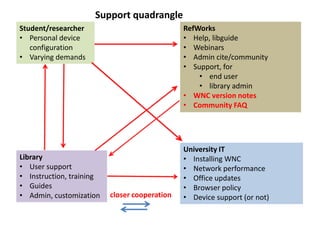
Student/researcher
• Personal device
configuration
• Varying demands
Library
• User support
• Instruction, training
• Guides
• Admin, customization
RefWorks
• Help, libguide
• Webinars
• Admin cite/community
• Support, for
• end user
• library admin
• WNC version notes
• Community FAQ
University IT
• Installing WNC
• Network performance
• Office updates
• Browser policy
• Device support (or not)
Support quadrangle
closer cooperation
Irreproducability
• WNC version (3/4)
• OS type and version (Windows/iOS)
• Browser type and version (IE/FF/Chrome)
• Text editor type and version
• On/off campus
Cloud, BYOD, advising
• Avoid installing
• Support devices
• Advise on tools choice and use
But can’t know it all → community

The future of reference management systems

  • 1.
    The future of reference management systems: technology– people – institutions 20130924, Jeroen Bosman @jeroenbosman http://www.slideshare.net/hierohiero
  • 2.
    Ref tool evolution 9899 00 01 02 03 04 05 06 07 08 09 10 11 12 13 < 1984 Reference Manager < 1988 Endnote X Procite Refworks Zotero X Connotea CiteUlike BibSonomy (Mekentosj) Papers Mendeley RefWorks Flow Citavi Qiqqa Colwiz Authorea classic social bookmarking full text workflow research organising, authoring
  • 3.
    beyond reference management likeMendeley + task planning + team work like Mendeley + OCR + library classification + ref analysis + team work + PDF conversion + browser like Mendeley + research planning + event managing + cloud drive + calendar Authoring tool in LaTex or Markdown format + collaboration + templates + citation styles + citing by DOI and URL
  • 4.
  • 5.
    Looking at eachother • Commercial consolidation: – Thomson (Endnote family) – Springer (Papers) – Elsevier (Mendeley) – Proquest (RefWorks) • Functionality convergence • Crucial remain: – choice for desktop and/or web version – options for collaborating/co-authoring
  • 6.
    Changes in academia •Rise and rise of the PDF • Online search, full text search • Big science, co-authoring • Sharing, social suggesting • Open Access • Open source (e.g. Open Office) • Data citation and publishing (e.g. Scientific Data) • Preprints • Online first • Versioned publishing • Nanopubs, semantic publishing • Mobile • Open review Overview: force11.org/tools what, wh ere, how we cite and write
  • 7.
    Reference personae • Organizer:tag, filter, classify, option lover • Risk avoider: classic tool and saves full text • Counting the seconds: demands desktop tool • Change avoider: can barely manage the tech • Follow the (tech) leader: no opinion • Tech lover: switches easily • Play it by the rules: style sensitivity • Capitalizer: won’t switch
  • 8.
    Disciplines – “weare diffferent!” • LaTex in computer science, physics, maths, philosophy • Custom styles for books etc. in humanities • Vast co-authoring in life science and physics • Manual entry in humanities
  • 9.
    Student/researcher • Personal device configuration •Varying demands Library • User support • Instruction, training • Guides • Admin, customization RefWorks • Help, libguide • Webinars • Admin cite/community • Support, for • end user • library admin • WNC version notes • Community FAQ University IT • Installing WNC • Network performance • Office updates • Browser policy • Device support (or not) Support quadrangle closer cooperation
  • 10.
    Irreproducability • WNC version(3/4) • OS type and version (Windows/iOS) • Browser type and version (IE/FF/Chrome) • Text editor type and version • On/off campus
  • 11.
    Cloud, BYOD, advising •Avoid installing • Support devices • Advise on tools choice and use But can’t know it all → community