








Digital Communications Revolution
              Drew Spencer
           Chief Strategy Officer
            Euro RSCG Riley
             21 October 2009
First... a look
    back
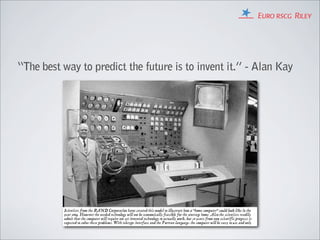
“The best way to predict the future is to invent it.” - Alan Kay
In 2000...

“iPod” did not refer to a music player
youtube was nonsense
Wikipedia was brand new
Facebook hadn’t even been dreamt of yet

                               Source: Google Blog
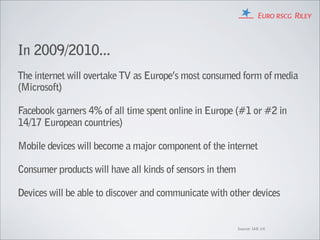
In 2009/2010...
The internet will overtake TV as Europe’s most consumed form of media
(Microsoft)

Facebook garners 4% of all time spent online in Europe (#1 or #2 in
14/17 European countries)

Mobile devices will become a major component of the internet

Consumer products will have all kinds of sensors in them

Devices will be able to discover and communicate with other devices


                                                           Source: IAB UK
What we will discuss...
Relevance
Analysis
Search
Video
Social media
Mobile
It’s all about
  relevance
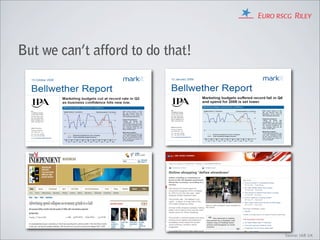
But we can’t afford to do that!


                                  Source: IAB UK
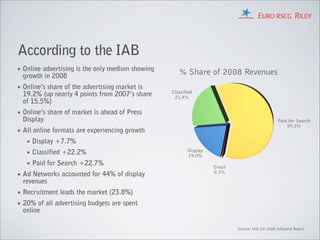
According to the IAB
★   Online advertising is the only medium showing
    growth in 2008
                                                       % Share of 2008 Revenues
★   Online’s share of the advertising market is
                                                    Classified
    19.2% (up nearly 4 points from 2007’s share      21.4%
    of 15.5%)
★   Online’s share of market is ahead of Press
    Display                                                                                      Paid for Search
                                                                                                     59.3%
★   All online formats are experiencing growth
     ★   Display +7.7%
     ★   Classified +22.2%                                 Display
                                                           19.0%
     ★   Paid for Search +22.7%                                      Email
                                                                     0.3%
★   Ad Networks accounted for 44% of display
    revenues
★   Recruitment leads the market (23.8%)
★   20% of all advertising budgets are spent
    online

                                                                             Source: IAB UK 2008 AdSpend Report
You have to spend (wisely) online
Do you have a clear definition of your target audience?

Have you developed a hierarchy of targeting importance, based on your
objectives and research learning?

Have you used pre-testing to understand the likely variations in creative
response so that executions can be placed accordingly?

Are you comprehensively monitoring performance of your targeting to
understand cost effectiveness?

Are you feeding learnings back into future planning and buying decisions?
On the web you can tell...
Age
Gender
Geography
Technography
Interests
Values
Behaviours
Context
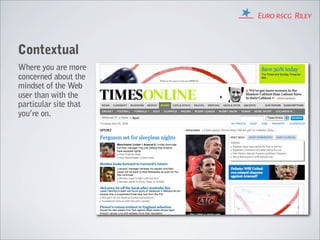
Contextual
Where you are more
concerned about the
mindset of the Web
user than with the
particular site that
you’re on.
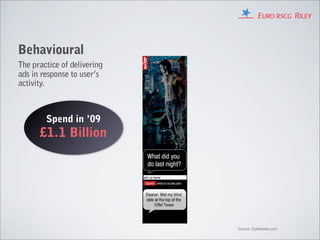
Behavioural
The practice of delivering
ads in response to user’s
activity.


        Spend in ’09
      £1.1 Billion


                             Source: Eyeblaster.com
It’s all about
   analysis
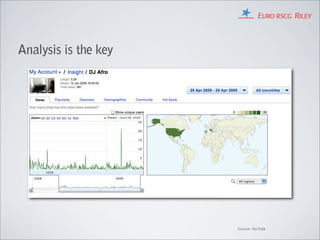
Analysis is the key


                      Source: YouTube
Analysis is key
Creative messages
Advertising format and size
Level of interaction
Media
Time of day
Type of interaction
Social Media
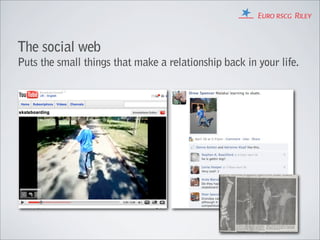
The social web
Puts the small things that make a relationship back in your life.
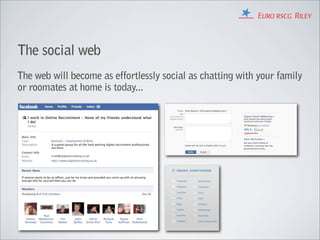
The social web
The web will become as effortlessly social as chatting with your family
or roomates at home is today...
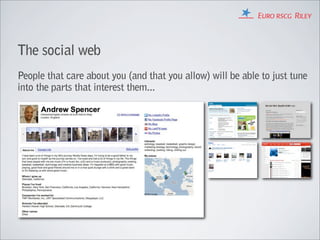
The social web
People that care about you (and that you allow) will be able to just tune
into the parts that interest them...
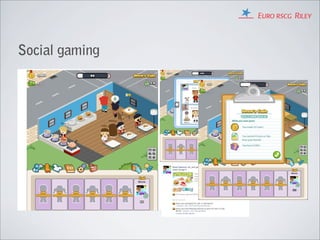
Social gaming
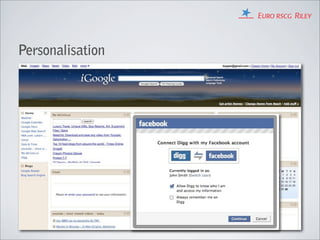
Personalisation
Personalisation
Search
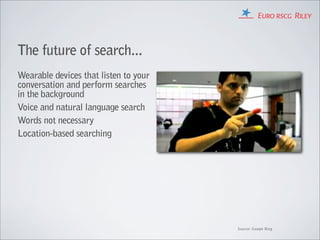
The future of search...
Wearable devices that listen to your
conversation and perform searches
in the background
Voice and natural language search
Words not necessary
Location-based searching


                                       Source: Google Blog
Search is learning...
Where you are located
What you already know
What you learned earlier today
Your preferences
What device you are using
Who your friends are and how you relate to them
What language you speak


                                                  Source: Google Blog
Video
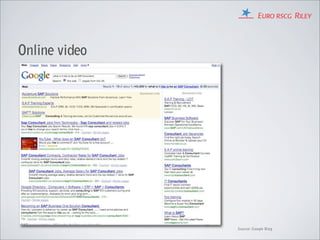
Online video
YouTube rumoured to be the 3rd largest search engine
13 hours of video uploaded to YouTube every minute and growing
exponentially
Available on any screen
Online video will be the most ubiquitous and accessible form of
communication
The tools for recording video will continue to become smaller and more
affordable
More people will become creators of video


                                                       Source: Google Blog
Online video


               Source: Google Blog
Mobile
Mobile
3.2 billion mobile subscribers
800 million cars
1.4 billion credit cards
1 billion applications downloaded from iTunes
Twitter grew 1,382% year-on-year (Feb ’08 - Feb ’09)

“The mobile phone may be the most prolific consumer product ever
invented” (Google Blog)


                                                       Source: Google Blog/IAB/Yahoo.com
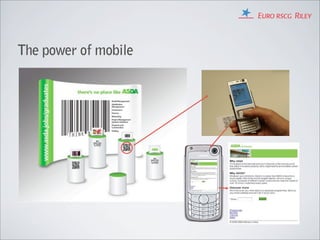
The power of mobile
10 times more powerful than a PC of 8-9 years ago
It has: clock, power sensor, thermometer, light meter, location sensor,
accelerometer, compass
It’s always with you, always on and always connected
Well integrated with social networks:
   Average UK mobile internet user spends 19 minutes per day on
   Facebook, and 9 minutes on BBC


                                                         Source: Google Blog, Mobile Marketing
                                                         Association
The power of mobile
UK Population: 60 million people
48 million own mobile phones
70 million active mobile connections (active = last 90 days)
More households in UK with a mobile phone and no land-line than the
other way around (since 2006)
Less than 1/3 of mobile subscribers regularly use the mobile internet, and
they average only one page per day... but this is growing at a clip of 9%
month-on-month
1 billion pages viewed per month (October 2007)
5 billion pages will be viewed per month by end of 2008
The average smartphone user spends an average of 2.5 hours browsing
the web in the UK (4.75 hours in US)
                                                        Source: IAB
The benefits of mobile
Extremely personal - only used by one person
Always with the user - target people in ways that no other device can
Always on - allow people to access your messages anytime
Highly interactive - camera, SMS, music player, web browser, video
games... all in one device
Unparalleled reach - 90% of the UK population owns at least one handset


                                                     Source: IAB UK
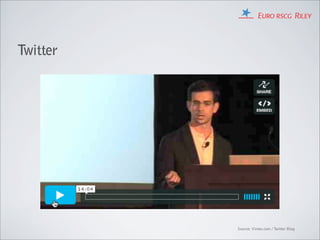
Twitter


          Source: Vimeo.com / Twitter Blog
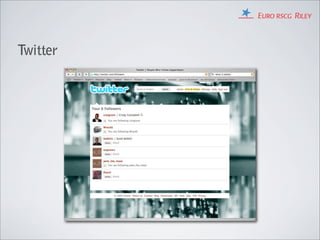
Twitter
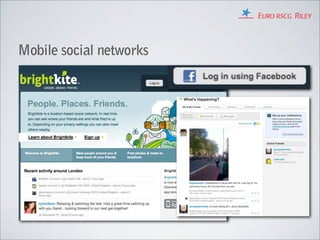
Mobile social networks
The power of mobile
Augmented reality
Mobile predictions
1. Alerts get smarter
Monitoring your behaviour and preferences will deliver only the
information that you most need in the moment. So, your phone knows
that you are running late for your dinner appointment, suggests
alternative transportation and offers to notify the restaurant that you are
late.
2. Augmented Reality
Your phone senses that you are standing outside the Cinema, remembers
that you looked at a trailer for the new Star Trek movie and tells you the
next available showing, prices and a restaurant nearby.


                                                         Source: Google Blog
Mobile predictions
3. Crowd Sourcing goes Mainstream
Everyone in the world is sharing their experiences in real-time. This
content is archived, sorted and redeployed in new and interesting ways.
The web shows you interesting sites in your vicinity, and reviews and
pictures that have been uploaded of nearby attractions. Then sends you
directions.
4. Sensors everywhere
Weather information is updated more frequently. Traffic data is more
accurate.


                                                       Source: Google Blog
Mobile predictions
4. Tool for deployment
Fishermen use text to find the best market for their daily catch. Farmers
get to the minute updates on the movements of swine flu.
5. Futureproofing
Opening up operating systems (like on the Web) means that developers
can create or improve applications and content, and updates are
automatically downloaded to your phone
6. Safer software
Your phone will provide tools and information to empower you to decide
what to download, what to see and what to share


                                                       Source: Google Blog
Conclusions
Where is it all going?
1. Online advertising is growing, even in the midst of this recession... this is
due to the ability to analyse, refine and target your campaign to be more
effective... and more creative
2. Social media has put us back in touch with the little things that connect
us to people and products that we allow into our lives and video has added
sight, sound and motion to the way we communicate... permanently
3. People expect communication to be more relevant to them, and more
personally relevant to their demographic profile, behaviour and attitude and
even to their location, device and preferences... and instant
4. The need for information, which drives innovation in Search, has
expanded well beyond keywords and the “10-blue links” and will soon
present no barriers to the “ambient findability” of information
5. It’s at the touch of a button that is always on, always connected and fits
in your pocket
Things to do tomorrow...
1. Ask for statistics on the performance of your advertising
2. Search for your brand on YouTube, Facebook and Twitter and see who you’re connected to
and what you can learn about them
3. Acquire some website traffic stats and see what computers (or phones) people are using to
access your site
4. Make and publish some video content
5. Commit more time to the planning stages of your advertising
6. Look at what percent of your advertising spend is online, and what the split is within that
spend (are you spending enough on Search?)
7. Find out what search phrases lead people to your website
8. Analyse your content against different devices, locations and needs
9. Record and publish some audio content
10. Tag and track everything! Learn from it!
11. Get a smartphone
12. Visit my Cafe on CafeWorld
Be findable,
relevant and
  engaging
Questions?
           Drew Spencer
       Chief Strategy Officer
 drew.spencer@eurorscg-riley.co.uk
     www.eurorscg-riley.co.uk

The Future of Digital

  • 1.
    Digital Communications Revolution Drew Spencer Chief Strategy Officer Euro RSCG Riley 21 October 2009
  • 2.
  • 3.
    “The best wayto predict the future is to invent it.” - Alan Kay
  • 4.
    In 2000... “iPod” didnot refer to a music player youtube was nonsense Wikipedia was brand new Facebook hadn’t even been dreamt of yet Source: Google Blog
  • 5.
    In 2009/2010... The internetwill overtake TV as Europe’s most consumed form of media (Microsoft) Facebook garners 4% of all time spent online in Europe (#1 or #2 in 14/17 European countries) Mobile devices will become a major component of the internet Consumer products will have all kinds of sensors in them Devices will be able to discover and communicate with other devices Source: IAB UK
  • 6.
    What we willdiscuss... Relevance Analysis Search Video Social media Mobile
  • 7.
  • 8.
    But we can’tafford to do that! Source: IAB UK
  • 9.
    According to theIAB ★ Online advertising is the only medium showing growth in 2008 % Share of 2008 Revenues ★ Online’s share of the advertising market is Classified 19.2% (up nearly 4 points from 2007’s share 21.4% of 15.5%) ★ Online’s share of market is ahead of Press Display Paid for Search 59.3% ★ All online formats are experiencing growth ★ Display +7.7% ★ Classified +22.2% Display 19.0% ★ Paid for Search +22.7% Email 0.3% ★ Ad Networks accounted for 44% of display revenues ★ Recruitment leads the market (23.8%) ★ 20% of all advertising budgets are spent online Source: IAB UK 2008 AdSpend Report
  • 10.
    You have tospend (wisely) online Do you have a clear definition of your target audience? Have you developed a hierarchy of targeting importance, based on your objectives and research learning? Have you used pre-testing to understand the likely variations in creative response so that executions can be placed accordingly? Are you comprehensively monitoring performance of your targeting to understand cost effectiveness? Are you feeding learnings back into future planning and buying decisions?
  • 11.
    On the webyou can tell... Age Gender Geography Technography Interests Values Behaviours Context
  • 12.
    Contextual Where you aremore concerned about the mindset of the Web user than with the particular site that you’re on.
  • 13.
    Behavioural The practice ofdelivering ads in response to user’s activity. Spend in ’09 £1.1 Billion Source: Eyeblaster.com
  • 14.
  • 16.
    Analysis is thekey Source: YouTube
  • 17.
    Analysis is key Creativemessages Advertising format and size Level of interaction Media Time of day Type of interaction
  • 18.
  • 19.
    The social web Putsthe small things that make a relationship back in your life.
  • 20.
    The social web Theweb will become as effortlessly social as chatting with your family or roomates at home is today...
  • 21.
    The social web Peoplethat care about you (and that you allow) will be able to just tune into the parts that interest them...
  • 22.
  • 23.
  • 24.
  • 25.
  • 26.
    The future ofsearch... Wearable devices that listen to your conversation and perform searches in the background Voice and natural language search Words not necessary Location-based searching Source: Google Blog
  • 27.
    Search is learning... Whereyou are located What you already know What you learned earlier today Your preferences What device you are using Who your friends are and how you relate to them What language you speak Source: Google Blog
  • 28.
  • 29.
    Online video YouTube rumouredto be the 3rd largest search engine 13 hours of video uploaded to YouTube every minute and growing exponentially Available on any screen Online video will be the most ubiquitous and accessible form of communication The tools for recording video will continue to become smaller and more affordable More people will become creators of video Source: Google Blog
  • 30.
    Online video Source: Google Blog
  • 31.
  • 32.
    Mobile 3.2 billion mobilesubscribers 800 million cars 1.4 billion credit cards 1 billion applications downloaded from iTunes Twitter grew 1,382% year-on-year (Feb ’08 - Feb ’09) “The mobile phone may be the most prolific consumer product ever invented” (Google Blog) Source: Google Blog/IAB/Yahoo.com
  • 33.
    The power ofmobile 10 times more powerful than a PC of 8-9 years ago It has: clock, power sensor, thermometer, light meter, location sensor, accelerometer, compass It’s always with you, always on and always connected Well integrated with social networks: Average UK mobile internet user spends 19 minutes per day on Facebook, and 9 minutes on BBC Source: Google Blog, Mobile Marketing Association
  • 34.
    The power ofmobile UK Population: 60 million people 48 million own mobile phones 70 million active mobile connections (active = last 90 days) More households in UK with a mobile phone and no land-line than the other way around (since 2006) Less than 1/3 of mobile subscribers regularly use the mobile internet, and they average only one page per day... but this is growing at a clip of 9% month-on-month 1 billion pages viewed per month (October 2007) 5 billion pages will be viewed per month by end of 2008 The average smartphone user spends an average of 2.5 hours browsing the web in the UK (4.75 hours in US) Source: IAB
  • 35.
    The benefits ofmobile Extremely personal - only used by one person Always with the user - target people in ways that no other device can Always on - allow people to access your messages anytime Highly interactive - camera, SMS, music player, web browser, video games... all in one device Unparalleled reach - 90% of the UK population owns at least one handset Source: IAB UK
  • 36.
    Twitter Source: Vimeo.com / Twitter Blog
  • 37.
  • 38.
  • 39.
  • 40.
  • 41.
    Mobile predictions 1. Alertsget smarter Monitoring your behaviour and preferences will deliver only the information that you most need in the moment. So, your phone knows that you are running late for your dinner appointment, suggests alternative transportation and offers to notify the restaurant that you are late. 2. Augmented Reality Your phone senses that you are standing outside the Cinema, remembers that you looked at a trailer for the new Star Trek movie and tells you the next available showing, prices and a restaurant nearby. Source: Google Blog
  • 42.
    Mobile predictions 3. CrowdSourcing goes Mainstream Everyone in the world is sharing their experiences in real-time. This content is archived, sorted and redeployed in new and interesting ways. The web shows you interesting sites in your vicinity, and reviews and pictures that have been uploaded of nearby attractions. Then sends you directions. 4. Sensors everywhere Weather information is updated more frequently. Traffic data is more accurate. Source: Google Blog
  • 43.
    Mobile predictions 4. Toolfor deployment Fishermen use text to find the best market for their daily catch. Farmers get to the minute updates on the movements of swine flu. 5. Futureproofing Opening up operating systems (like on the Web) means that developers can create or improve applications and content, and updates are automatically downloaded to your phone 6. Safer software Your phone will provide tools and information to empower you to decide what to download, what to see and what to share Source: Google Blog
  • 44.
  • 45.
    Where is itall going? 1. Online advertising is growing, even in the midst of this recession... this is due to the ability to analyse, refine and target your campaign to be more effective... and more creative 2. Social media has put us back in touch with the little things that connect us to people and products that we allow into our lives and video has added sight, sound and motion to the way we communicate... permanently 3. People expect communication to be more relevant to them, and more personally relevant to their demographic profile, behaviour and attitude and even to their location, device and preferences... and instant 4. The need for information, which drives innovation in Search, has expanded well beyond keywords and the “10-blue links” and will soon present no barriers to the “ambient findability” of information 5. It’s at the touch of a button that is always on, always connected and fits in your pocket
  • 46.
    Things to dotomorrow... 1. Ask for statistics on the performance of your advertising 2. Search for your brand on YouTube, Facebook and Twitter and see who you’re connected to and what you can learn about them 3. Acquire some website traffic stats and see what computers (or phones) people are using to access your site 4. Make and publish some video content 5. Commit more time to the planning stages of your advertising 6. Look at what percent of your advertising spend is online, and what the split is within that spend (are you spending enough on Search?) 7. Find out what search phrases lead people to your website 8. Analyse your content against different devices, locations and needs 9. Record and publish some audio content 10. Tag and track everything! Learn from it! 11. Get a smartphone 12. Visit my Cafe on CafeWorld
  • 47.
  • 48.
    Questions? Drew Spencer Chief Strategy Officer drew.spencer@eurorscg-riley.co.uk www.eurorscg-riley.co.uk