Faculty	
  Fellow,	
  BC	
  Open	
  Textbook	
  Project
OER	
  Research	
  Fellow,	
  Open	
  Education	
  Group
Dept.	
  of	
  Psychology,	
  Kwantlen	
  Polytechnic	
  University
Rajiv	
  Jhangiani,	
  Ph.D.
The	
  Desirable	
  and	
  Inevitable	
  Shift	
  Towards	
  
Open	
  Pedagogy	
  and	
  Open	
  Science
THE	
  FUTURE	
  IS	
  OPEN
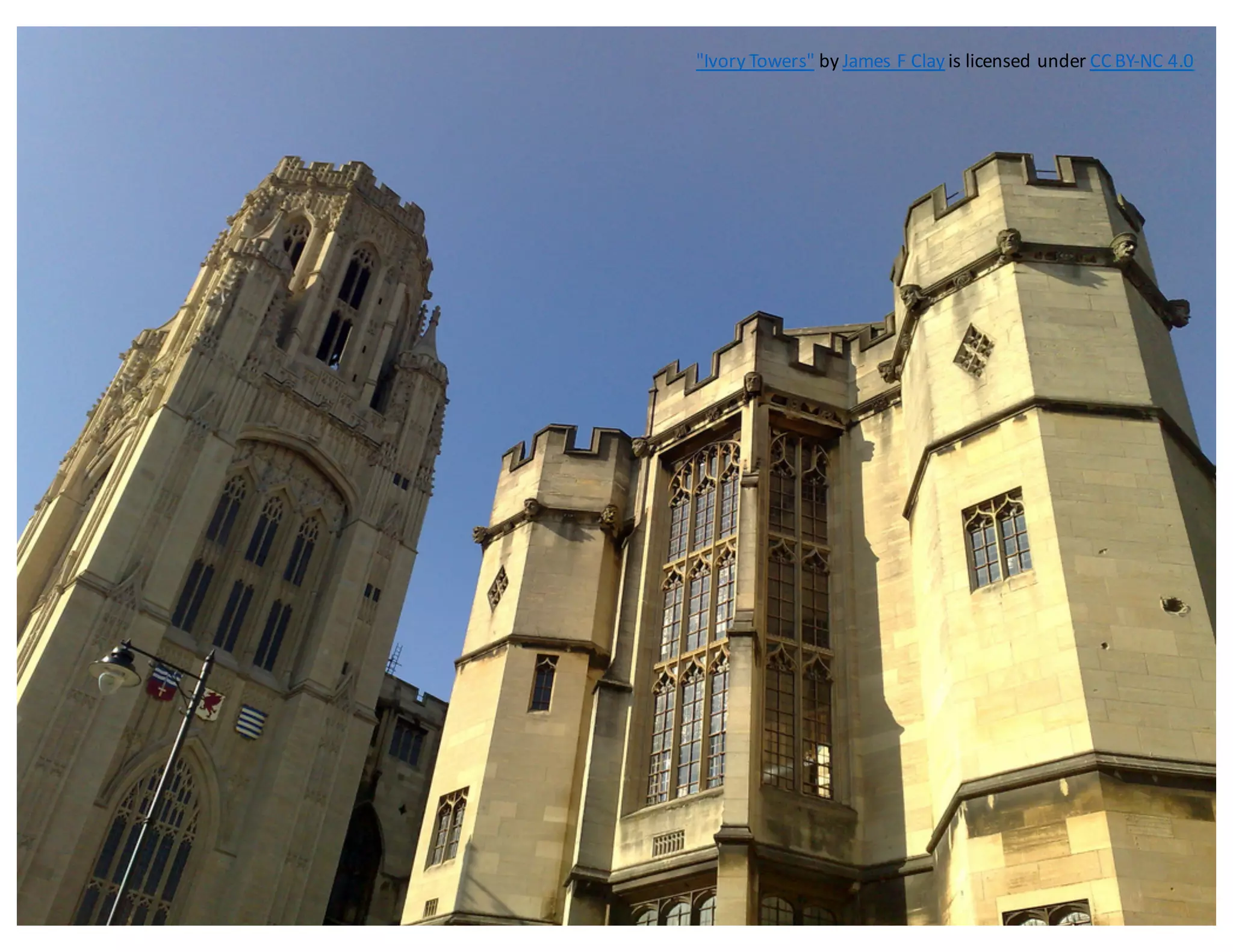
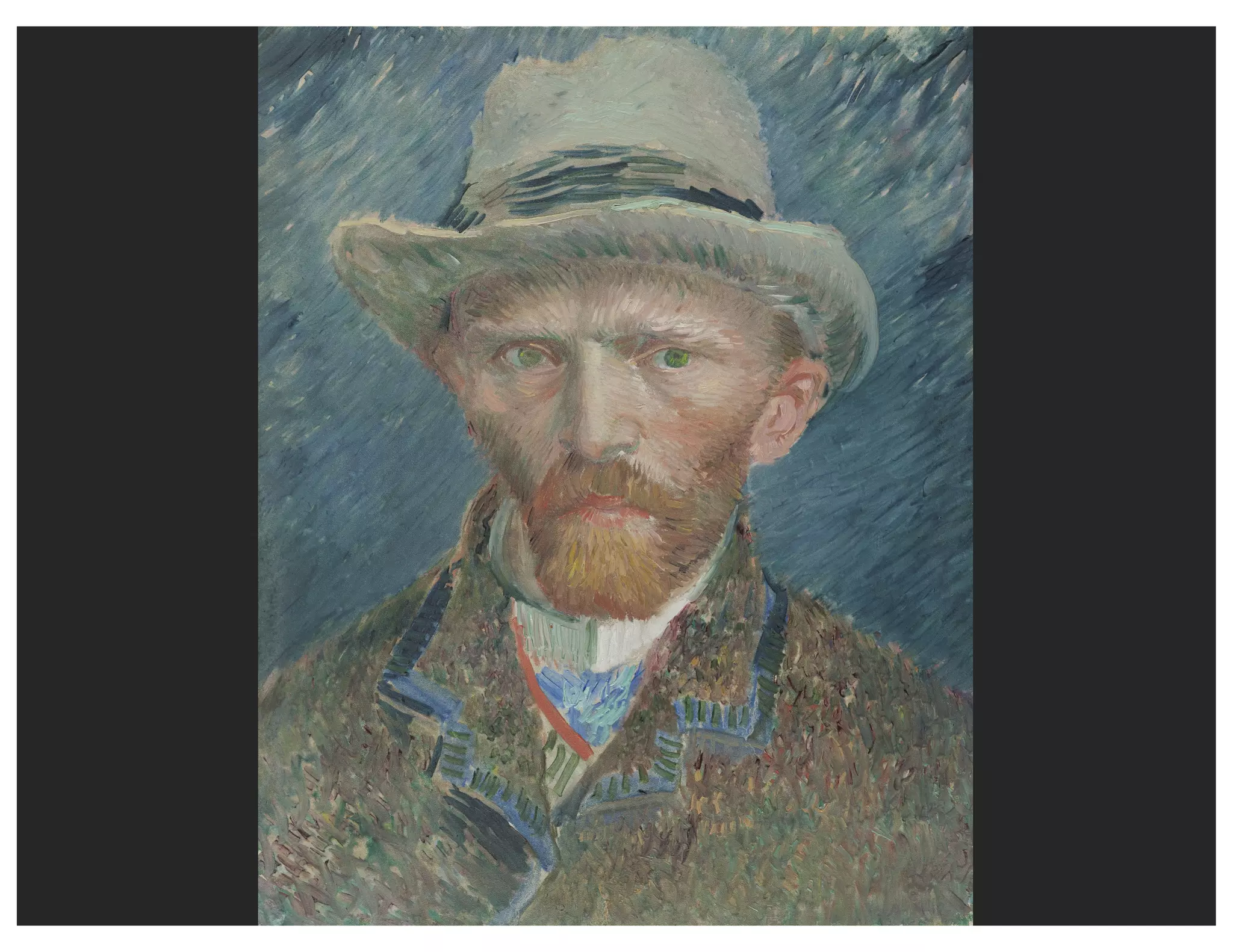
"Ivory	
  Towers" by James	
  F	
  Clay is	
  licensed	
  under CC	
  BY-­‐NC	
  4.0
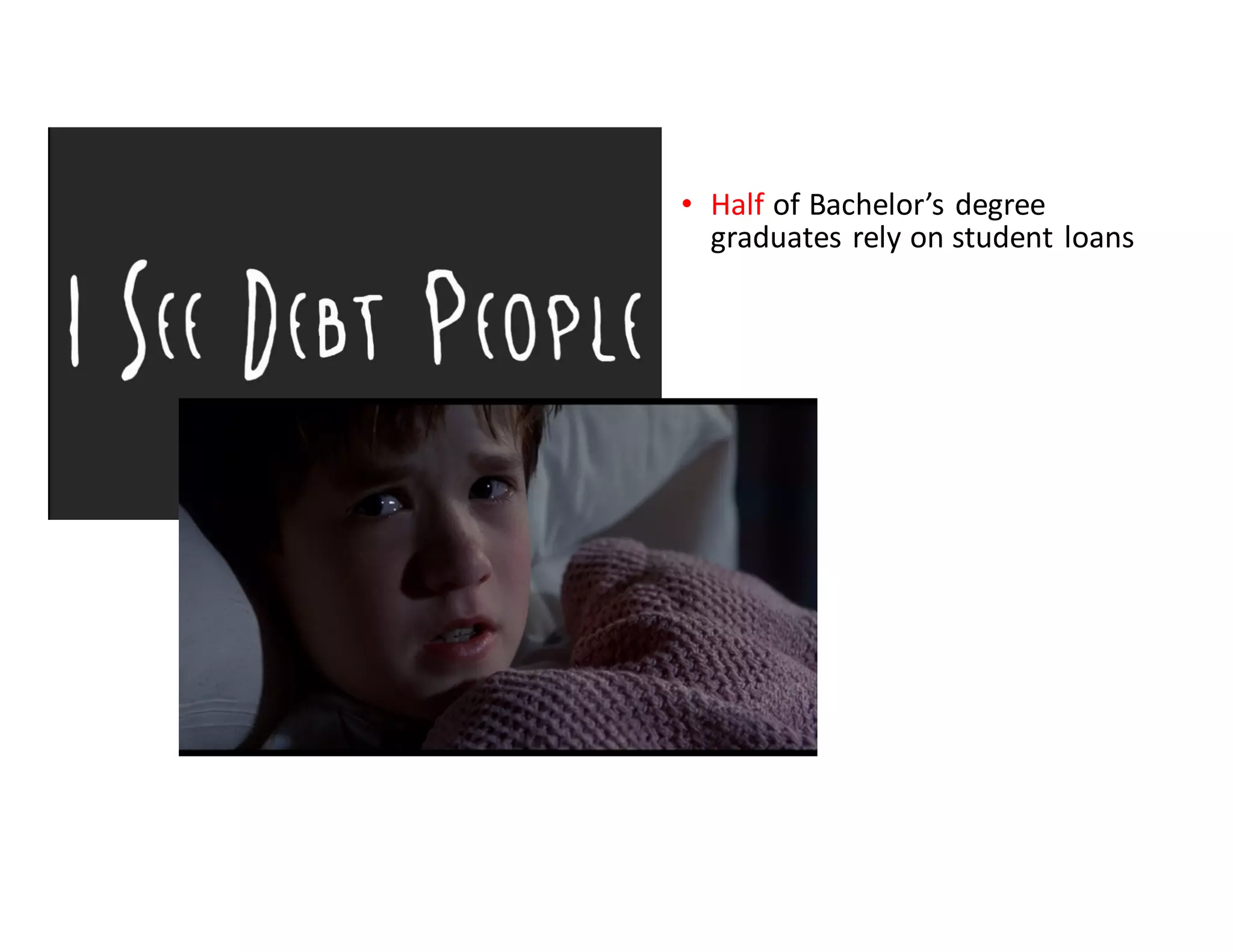
• Half of	
  Bachelor’s	
  degree	
  
graduates	
  rely	
  on	
  student	
  loans
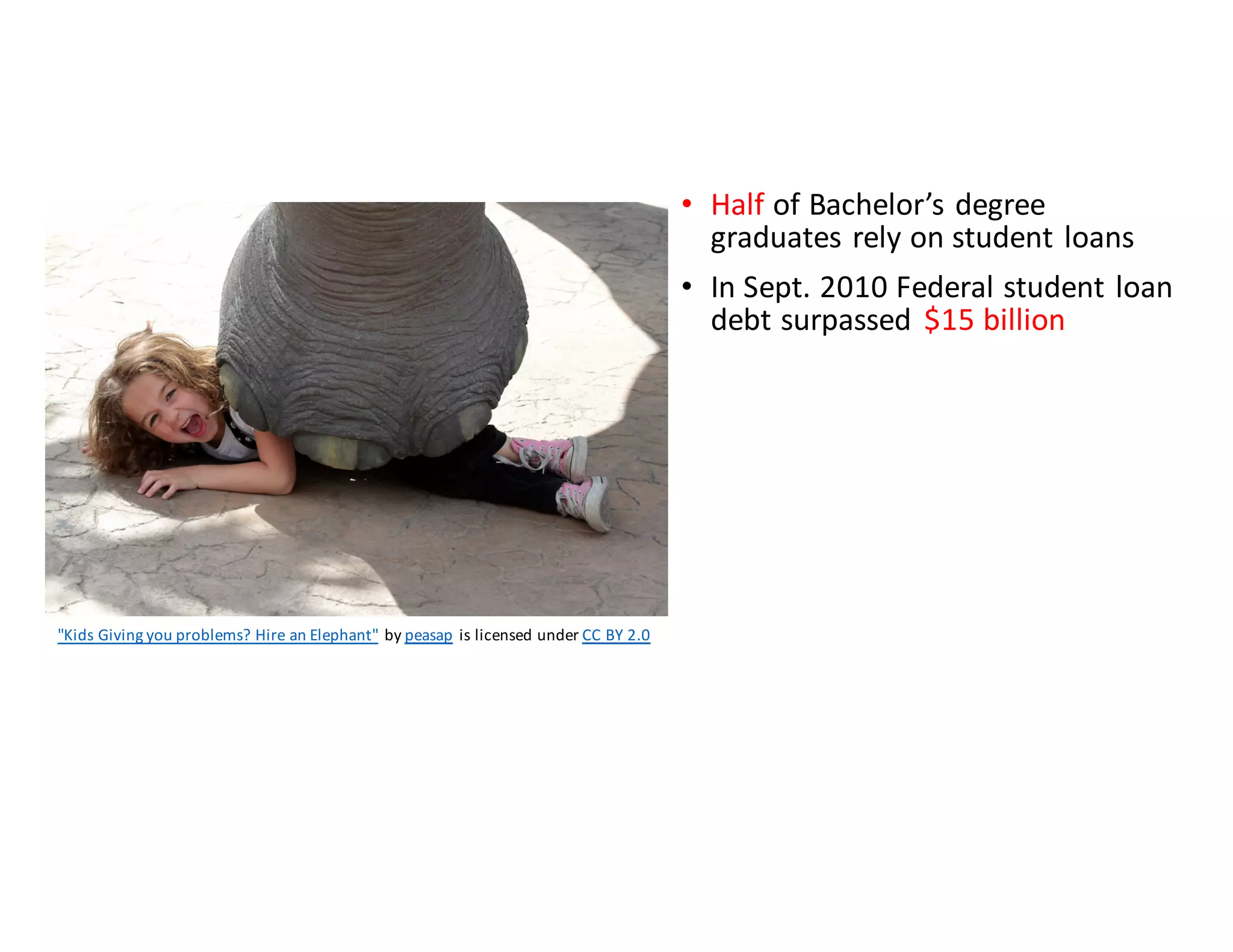
• In	
  Sept.	
  2010	
  Federal	
  student	
  loan	
  
debt	
  surpassed	
   $15	
  billion
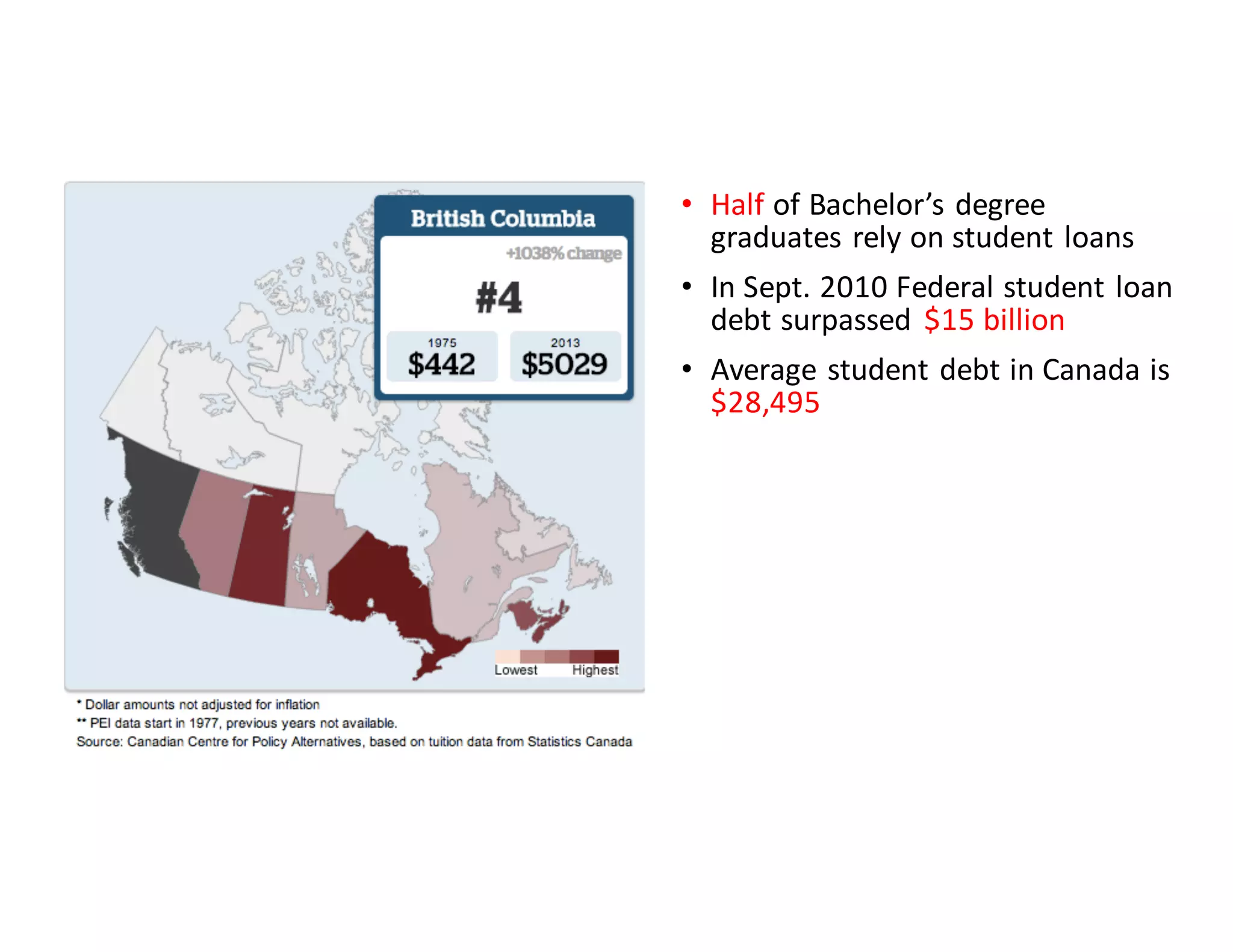
• Average	
  BC	
  student	
  debt	
  in	
  2011	
  
was	
  $29,497
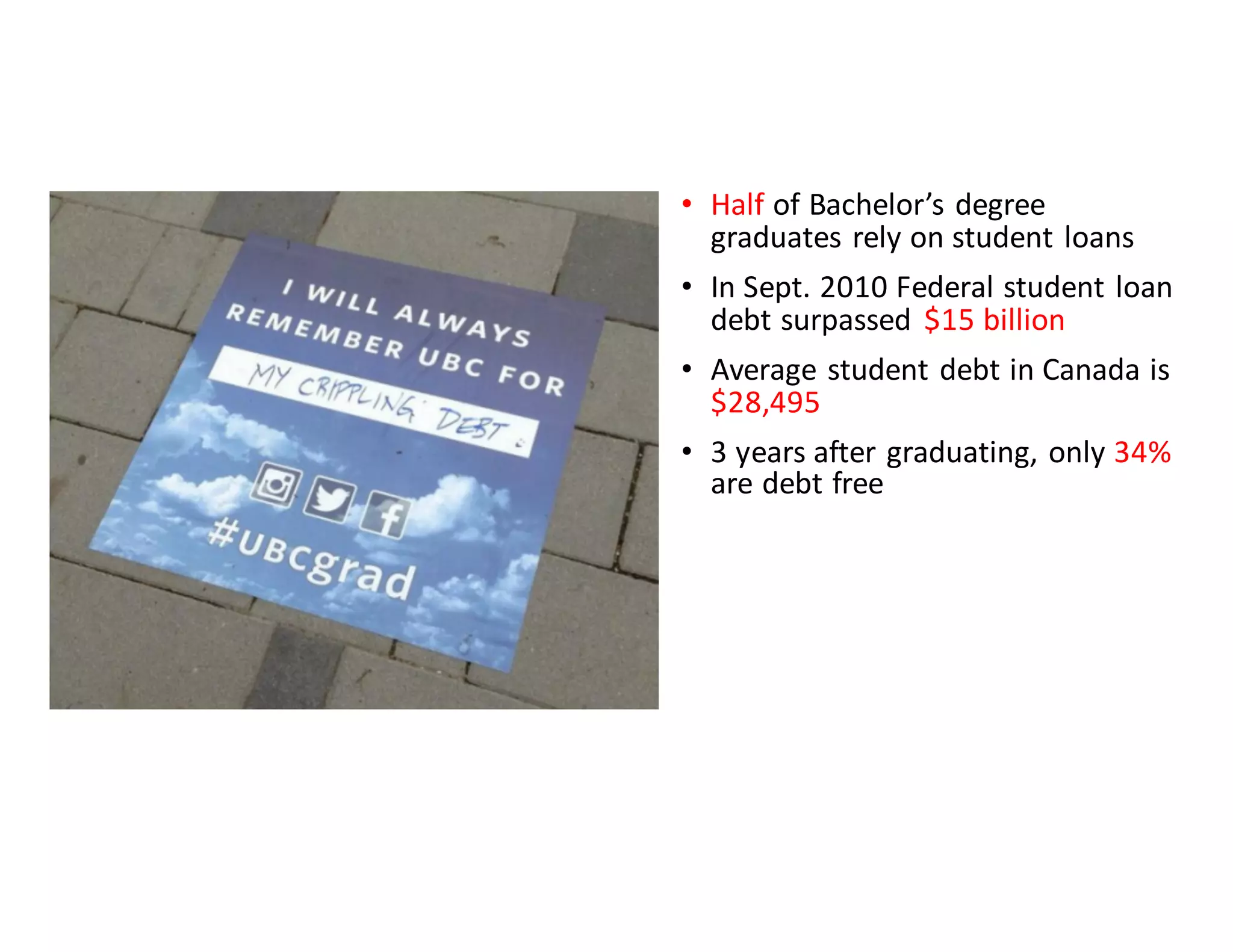
• 3	
  years	
  after	
  graduating,	
  only	
  34%	
  
are	
  debt	
  free
• BC	
  students	
  now	
  work	
  180%	
  more	
  
hours	
  than	
  they	
  did	
  in	
  1975	
  to	
  pay	
  
for	
  PSE
• When	
  debt	
  reaches	
  $10,000,	
  
program	
  completion	
  rates	
  drop	
  
from	
  59%	
  to	
  8%
• The	
  cost	
  of	
  textbooks	
  has	
  risen	
  by	
  
1041%	
  since	
  1977
"Kids	
  Giving	
  you	
  problems?	
  Hire	
  an	
  Elephant" by peasap is	
  licensed	
  under CC	
  BY	
  2.0
• Half of	
  Bachelor’s	
  degree	
  
graduates	
  rely	
  on	
  student	
  loans
• In	
  Sept.	
  2010	
  Federal	
  student	
  loan	
  
debt	
  surpassed	
   $15	
  billion
• Average	
  BC	
  student	
  debt	
  in	
  2011	
  
was	
  $29,497
• 3	
  years	
  after	
  graduating,	
  only	
  34%	
  
are	
  debt	
  free
• BC	
  students	
  now	
  work	
  180%	
  more	
  
hours	
  than	
  they	
  did	
  in	
  1975	
  to	
  pay	
  
for	
  PSE
• When	
  debt	
  reaches	
  $10,000,	
  
program	
  completion	
  rates	
  drop	
  
from	
  59%	
  to	
  8%
• The	
  cost	
  of	
  textbooks	
  has	
  risen	
  by	
  
1041%	
  since	
  1977
• Half of	
  Bachelor’s	
  degree	
  
graduates	
  rely	
  on	
  student	
  loans
• In	
  Sept.	
  2010	
  Federal	
  student	
  loan	
  
debt	
  surpassed	
   $15	
  billion
• Average	
  student	
  debt	
  in	
  Canada	
  is	
  
$28,495
• 3	
  years	
  after	
  graduating,	
  only	
  34%	
  
are	
  debt	
  free
• BC	
  students	
  now	
  work	
  180%	
  more	
  
hours	
  than	
  they	
  did	
  in	
  1975	
  to	
  pay	
  
for	
  PSE
• When	
  debt	
  reaches	
  $10,000,	
  
program	
  completion	
  rates	
  drop	
  
from	
  59%	
  to	
  8%
• The	
  cost	
  of	
  textbooks	
  has	
  risen	
  by	
  
1041%	
  since	
  1977
• Half of	
  Bachelor’s	
  degree	
  
graduates	
  rely	
  on	
  student	
  loans
• In	
  Sept.	
  2010	
  Federal	
  student	
  loan	
  
debt	
  surpassed	
   $15	
  billion
• Average	
  student	
  debt	
  in	
  Canada	
  is	
  
$28,495
• 3	
  years	
  after	
  graduating,	
  only	
  34%
are	
  debt	
  free
• BC	
  students	
  now	
  work	
  180%	
  more	
  
hours	
  than	
  they	
  did	
  in	
  1975	
  to	
  pay	
  
for	
  PSE
• When	
  debt	
  reaches	
  $10,000,	
  
program	
  completion	
  rates	
  drop	
  
from	
  59%	
  to	
  8%
• The	
  cost	
  of	
  textbooks	
  has	
  risen	
  by	
  
1041%	
  since	
  1977
• Half of	
  Bachelor’s	
  degree	
  
graduates	
  rely	
  on	
  student	
  loans
• In	
  Sept.	
  2010	
  Federal	
  student	
  loan	
  
debt	
  surpassed	
   $15	
  billion
• Average	
  student	
  debt	
  in	
  Canada	
  is	
  
$28,495
• 3	
  years	
  after	
  graduating,	
  only	
  34%
are	
  debt	
  free
• BC	
  Students	
  now	
  work	
  180%	
  more	
  
hours	
  than	
  they	
  did	
  in	
  1975	
  to	
  pay	
  
for	
  PSE
• When	
  debt	
  reaches	
  $10,000,	
  
program	
  completion	
  rates	
  drop	
  
from	
  59%	
  to	
  8%
• The	
  cost	
  of	
  textbooks	
  has	
  risen	
  by	
  
1041%	
  since	
  1977
• Half of	
  Bachelor’s	
  degree	
  
graduates	
  rely	
  on	
  student	
  loans
• In	
  Sept.	
  2010	
  Federal	
  student	
  loan	
  
debt	
  surpassed	
   $15	
  billion
• Average	
  student	
  debt	
  in	
  Canada	
  is	
  
$28,495
• 3	
  years	
  after	
  graduating,	
  only	
  34%
are	
  debt	
  free
• BC	
  Students	
  now	
  work	
  180%	
  more	
  
hours	
  than	
  they	
  did	
  in	
  1975	
  to	
  pay	
  
for	
  PSE
• When	
  debt	
  reaches	
  $10,000,	
  
program	
  completion	
  rates	
  drop	
  
from	
  59%	
  to	
  8%
• The	
  cost	
  of	
  textbooks	
  has	
  risen	
  by	
  
1041%	
  since	
  1977
• Half of	
  Bachelor’s	
  degree	
  
graduates	
  rely	
  on	
  student	
  loans
• In	
  Sept.	
  2010	
  Federal	
  student	
  loan	
  
debt	
  surpassed	
   $15	
  billion
• Average	
  student	
  debt	
  in	
  Canada	
  is	
  
$28,495
• 3	
  years	
  after	
  graduating,	
  only	
  34%
are	
  debt	
  free
• BC	
  Students	
  now	
  work	
  180%	
  more	
  
hours	
  than	
  they	
  did	
  in	
  1975	
  to	
  pay	
  
for	
  PSE
• When	
  debt	
  reaches	
  $10,000,	
  
program	
  completion	
  rates	
  drop	
  
from	
  59%	
  to	
  8%
• The	
  cost	
  of	
  textbooks	
  has	
  risen	
  by	
  
1041% since	
  1977
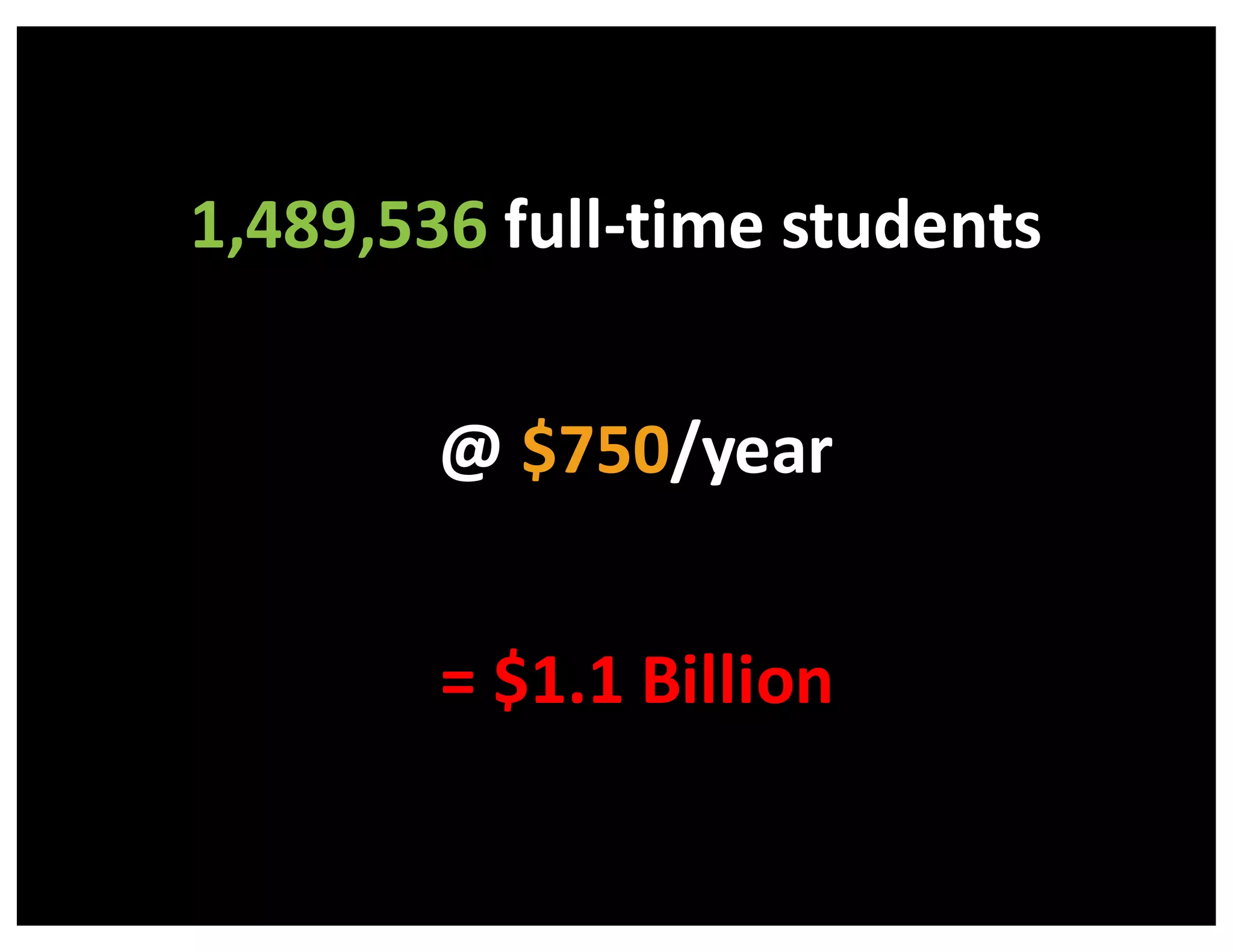
1,489,536 full-­‐time	
  students
@	
  $750/year
=	
  $1.1	
  Billion
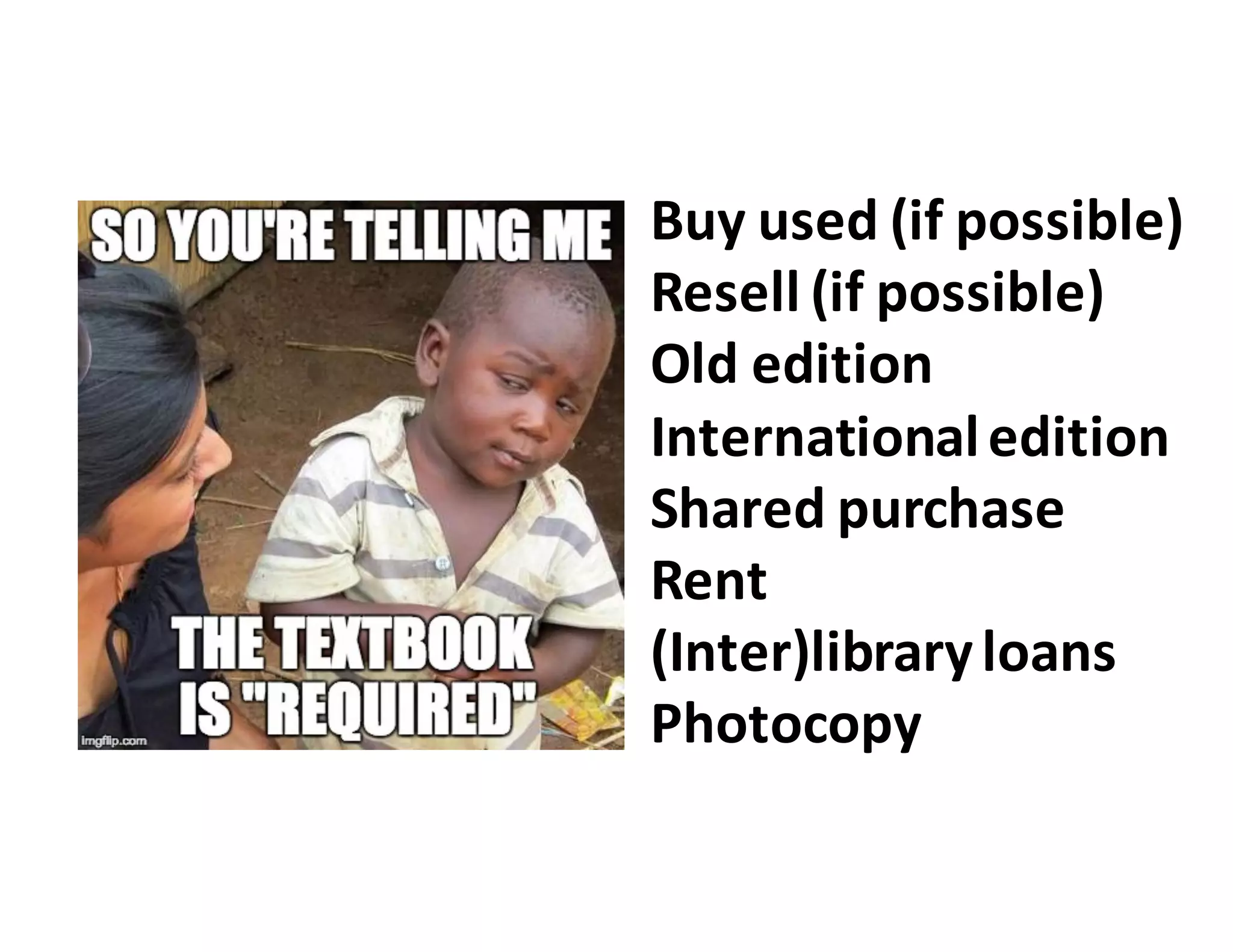
Buy	
  used	
  (if	
  possible)
Resell	
  (if	
  possible)
Old	
  edition
International	
  edition
Shared	
  purchase
Rent
(Inter)library	
  loans
Photocopy
€€€
€€
€€
€
€

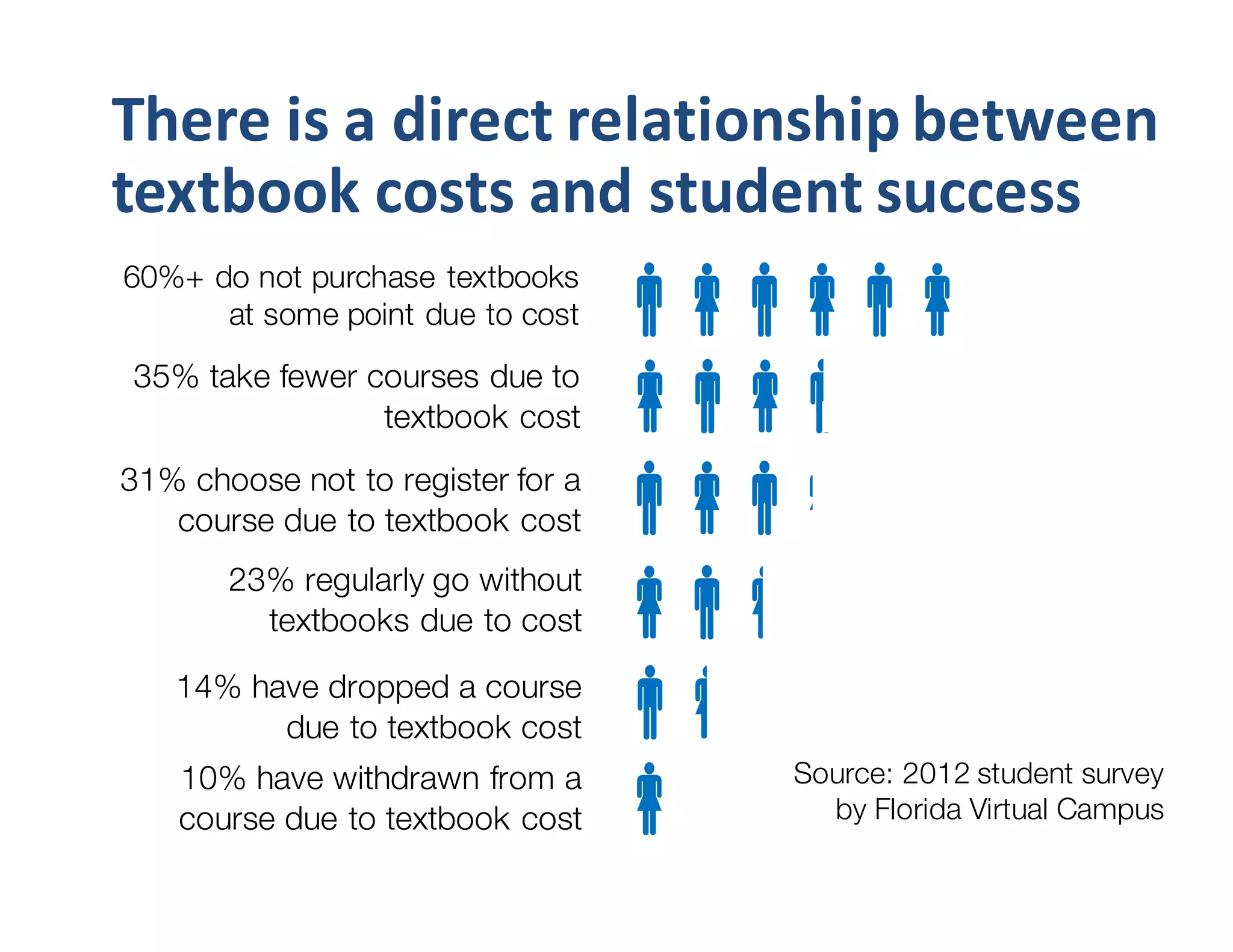
60%+ do not purchase textbooks
at some point due to cost
35% take fewer courses due to
textbook cost
31% choose not to register for a
course due to textbook cost
23% regularly go without
textbooks due to cost
14% have dropped a course
due to textbook cost
10% have withdrawn from a
course due to textbook cost
Source: 2012 student survey
by Florida Virtual Campus
There	
  is	
  a	
  direct	
  relationship	
  between	
  
textbook	
  costs	
  and	
  student	
  success
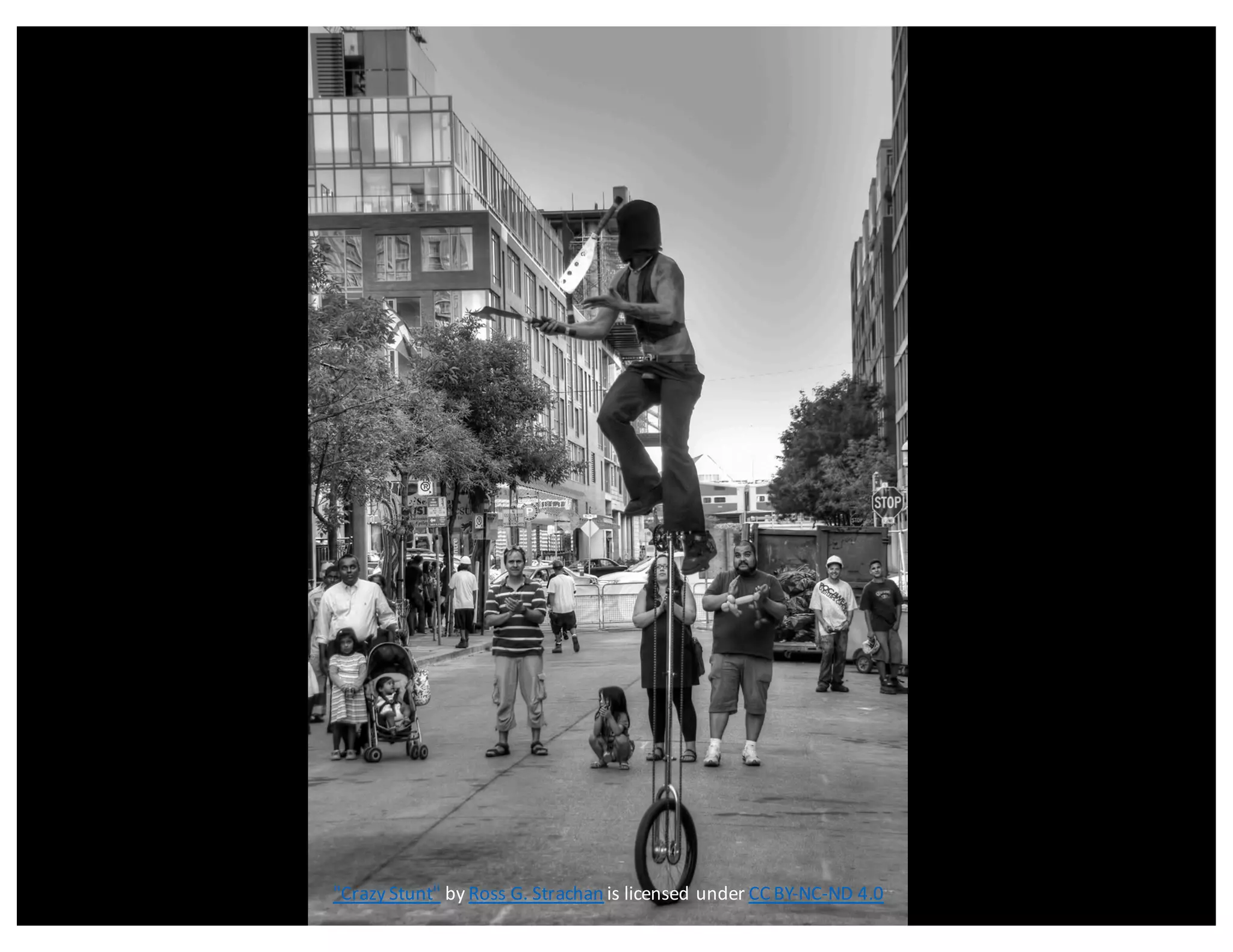
"Crazy	
  Stunt" by Ross	
  G.	
  Strachan is	
  licensed	
  under CC	
  BY-­‐NC-­‐ND	
  4.0
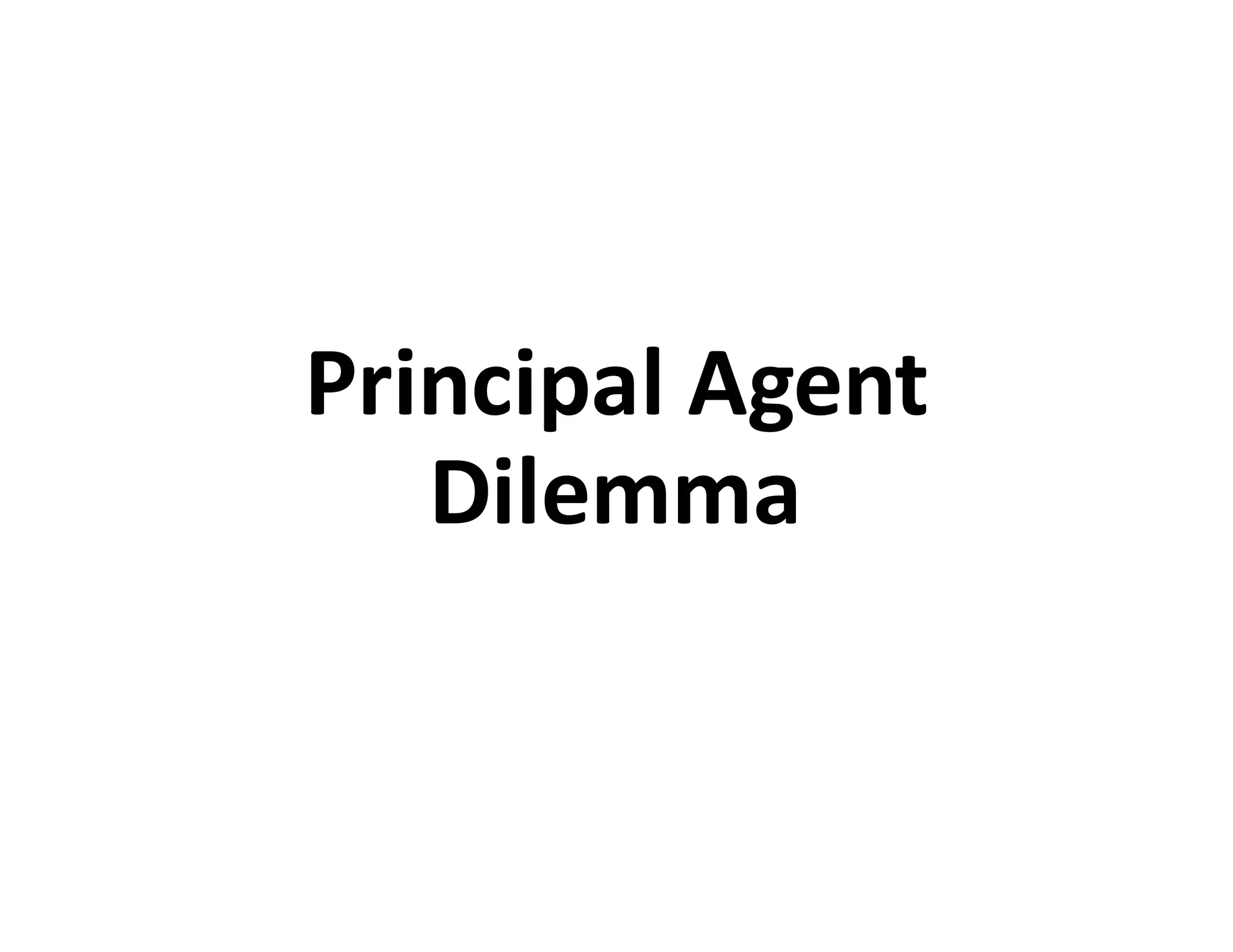
"circa	
  1890	
  -­‐ Hamlin's	
  Wizard	
  Oil"byclotho98 is	
  licensed	
  
under CC	
  BY-­‐NC	
  4.0
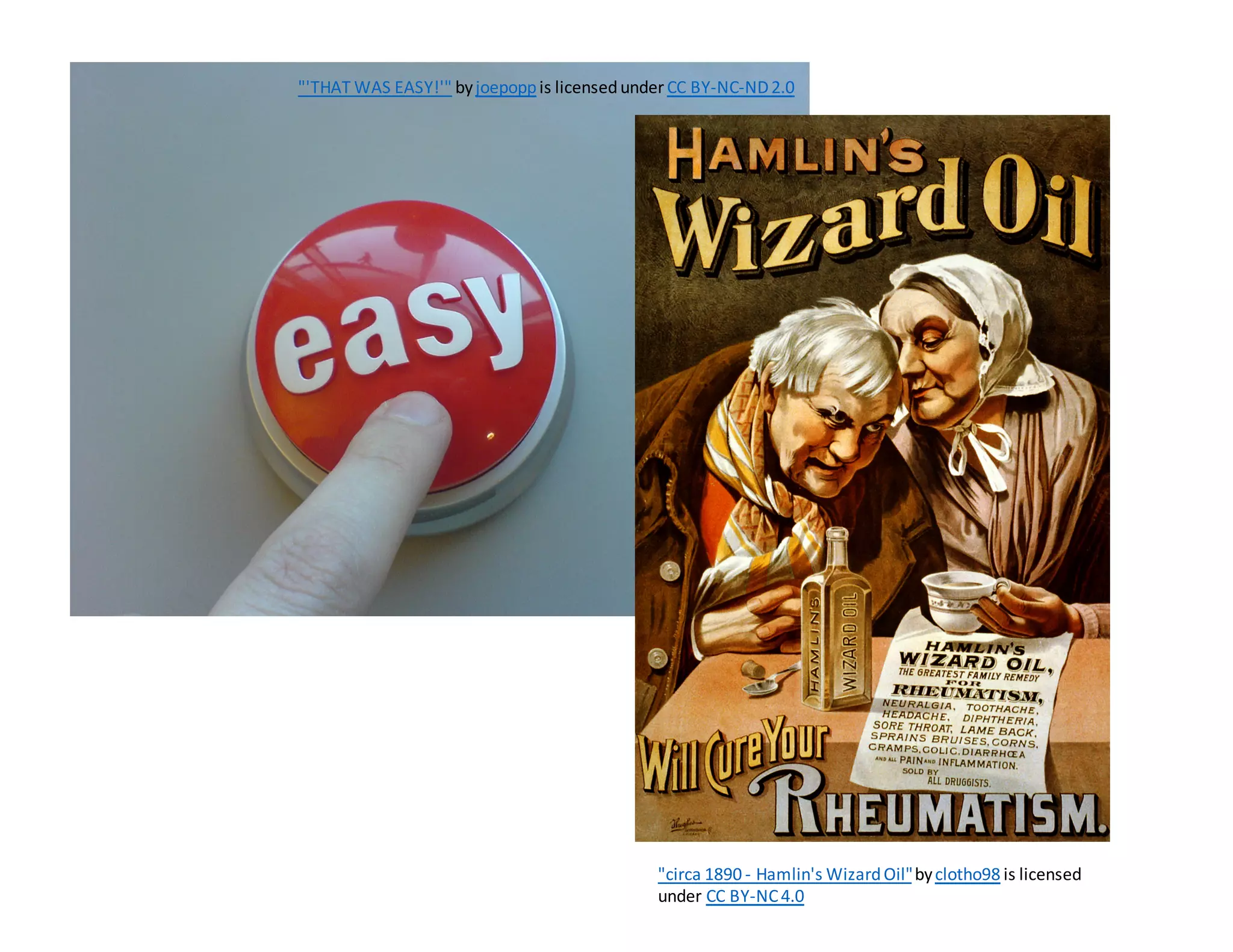
"'THAT	
  WAS	
  EASY!'" byjoepoppis	
  licensed	
  underCC	
  BY-­‐NC-­‐ND	
  2.0
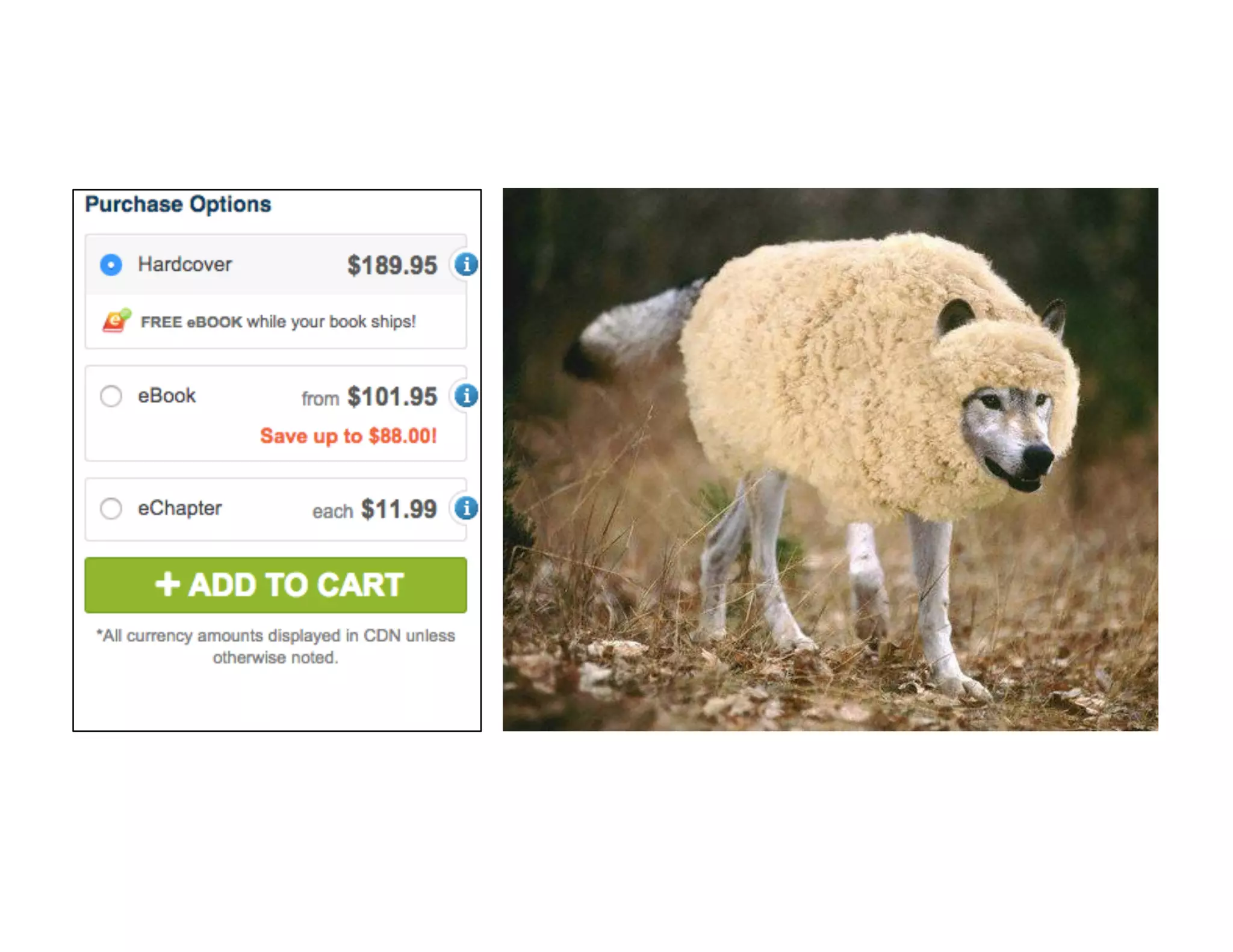
Principal	
  Agent	
  
Dilemma
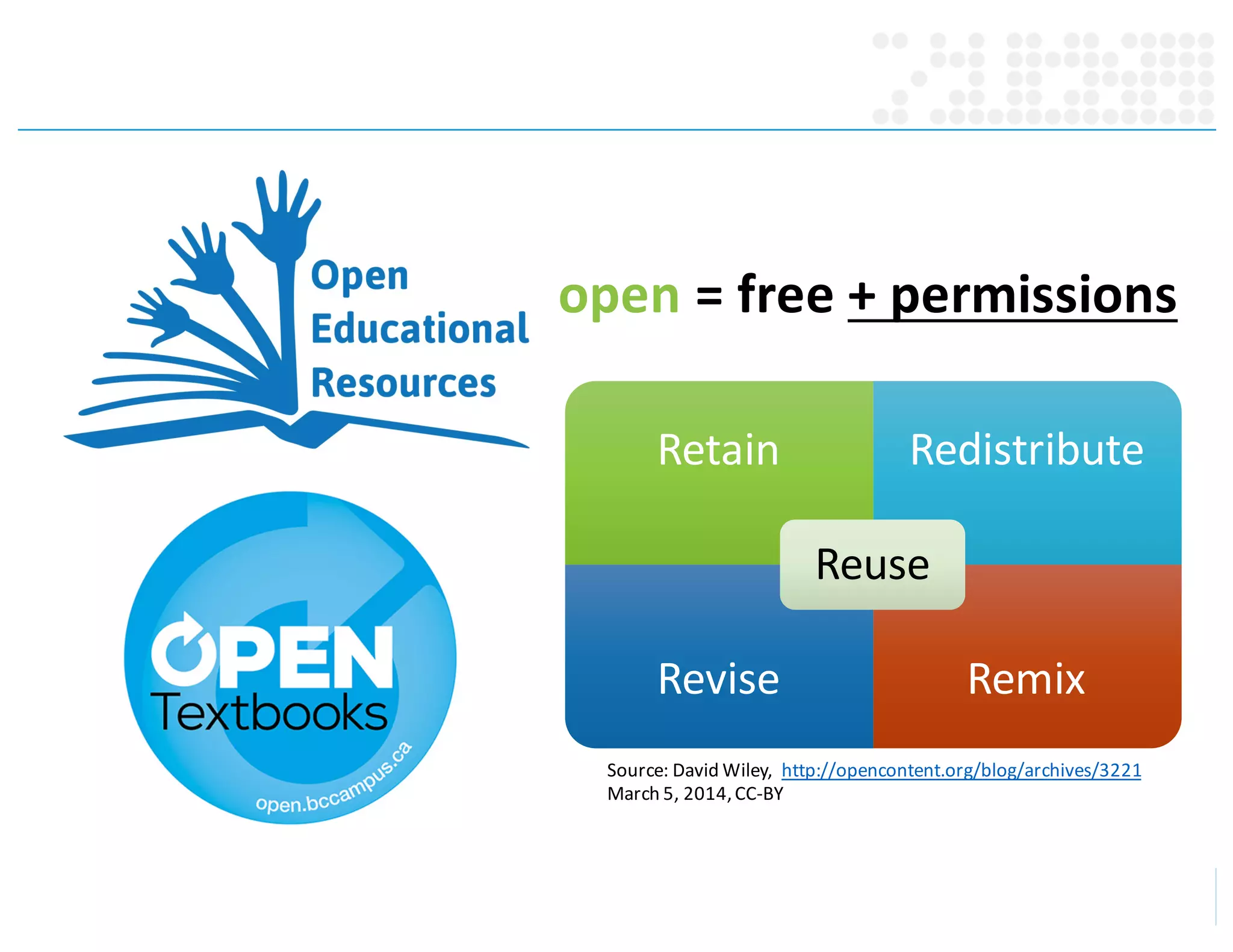
Retain Redistribute
Revise Remix
Reuse
Source:	
  David	
  Wiley,	
  	
  http://opencontent.org/blog/archives/3221
March	
  5,	
  2014,	
  CC-­‐BY
open =	
  free	
  +	
  permissions
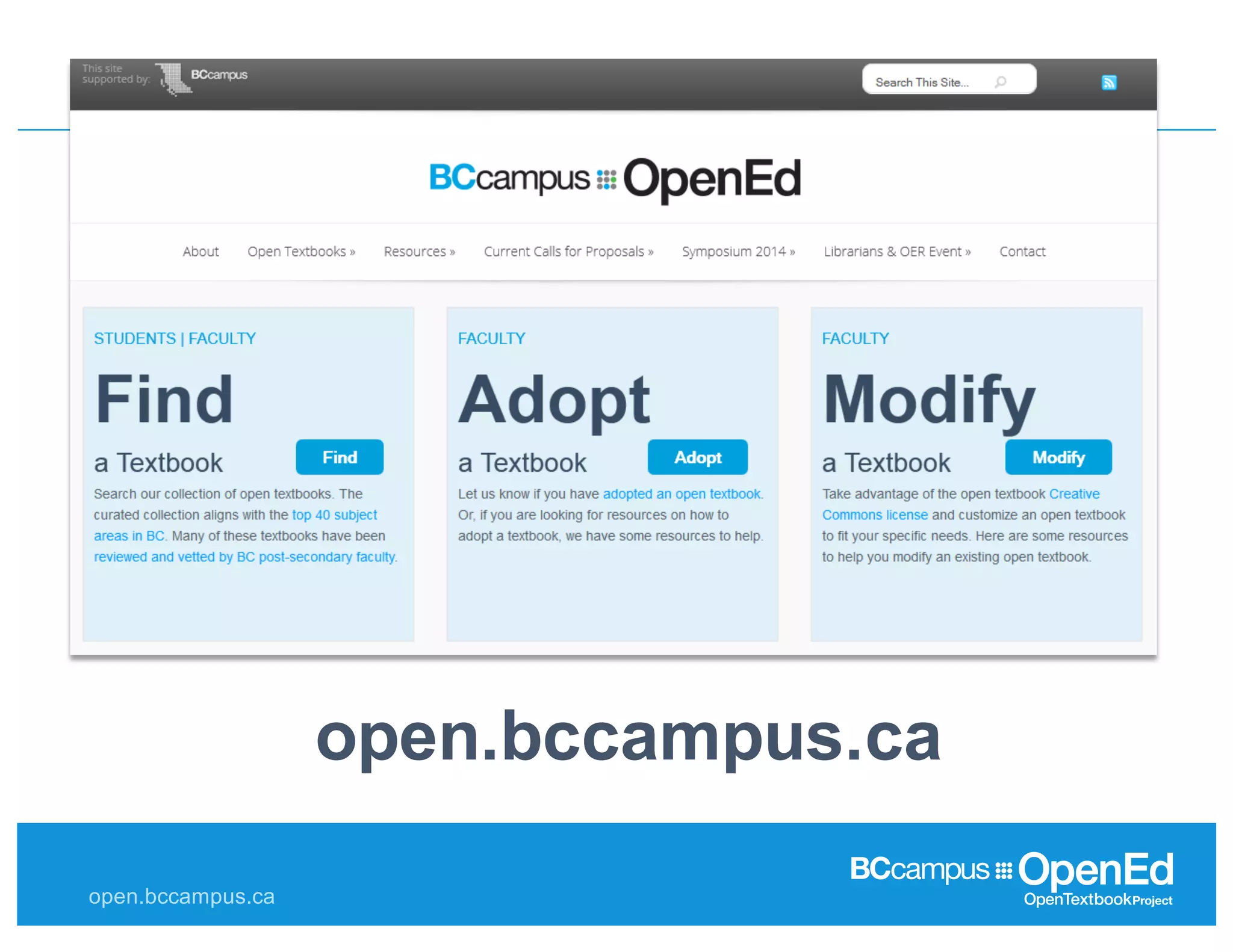
open.bccampus.ca
open.bccampus.ca
open.bccampus.ca
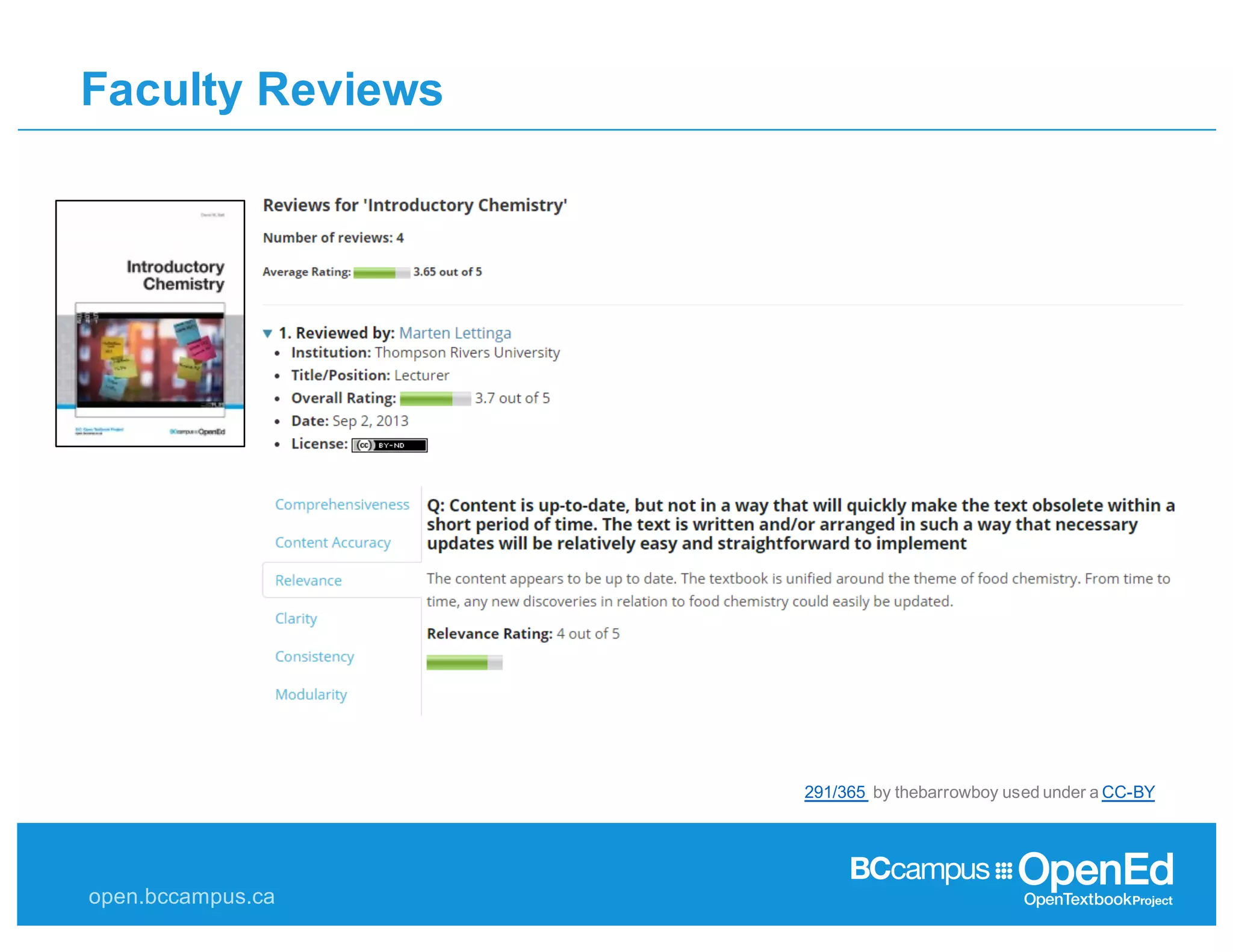
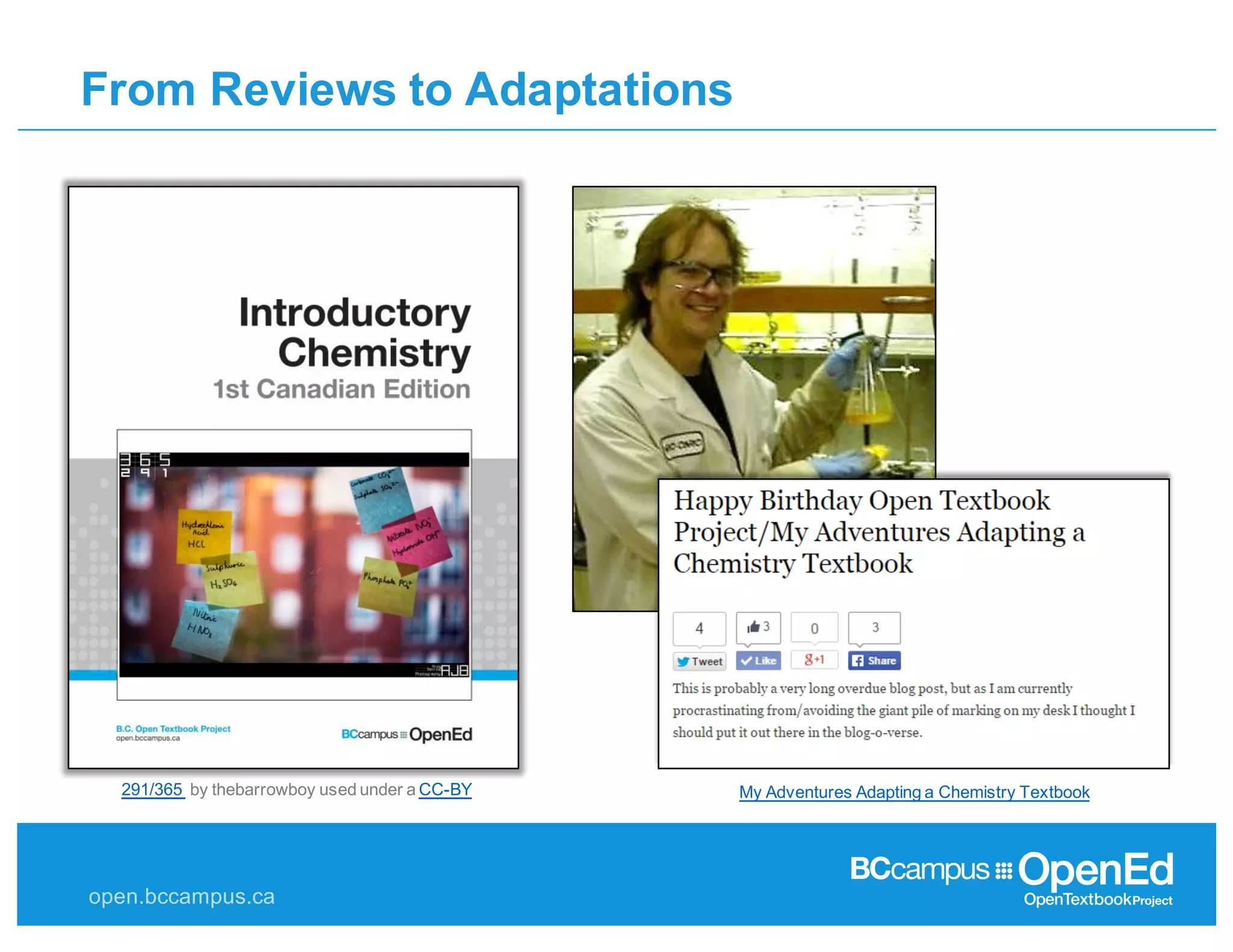
Faculty  Reviews
291/365   by  thebarrowboy used  under  a  CC-­BY
open.bccampus.ca
From  Reviews  to  Adaptations
My  Adventures  Adapting  a  Chemistry  Textbook291/365   by  thebarrowboy used  under  a  CC-­BY
open.bccampus.ca
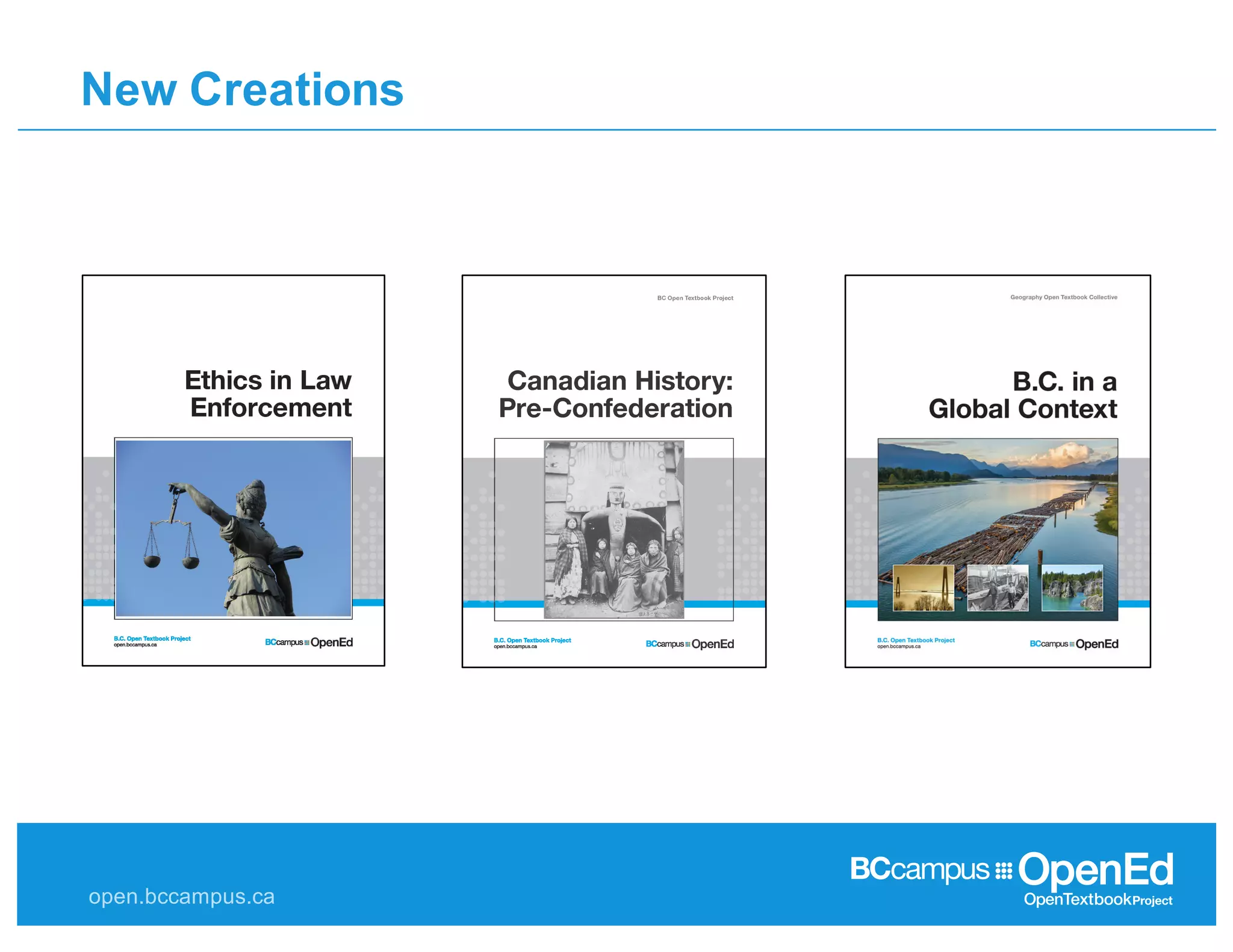
New  Creations
"Opening	
  the	
  Curriculum:	
  Open	
  Education	
  Resources	
  in	
  U.S.	
  Higher	
  Education,	
  2014"by I.	
  Elaine	
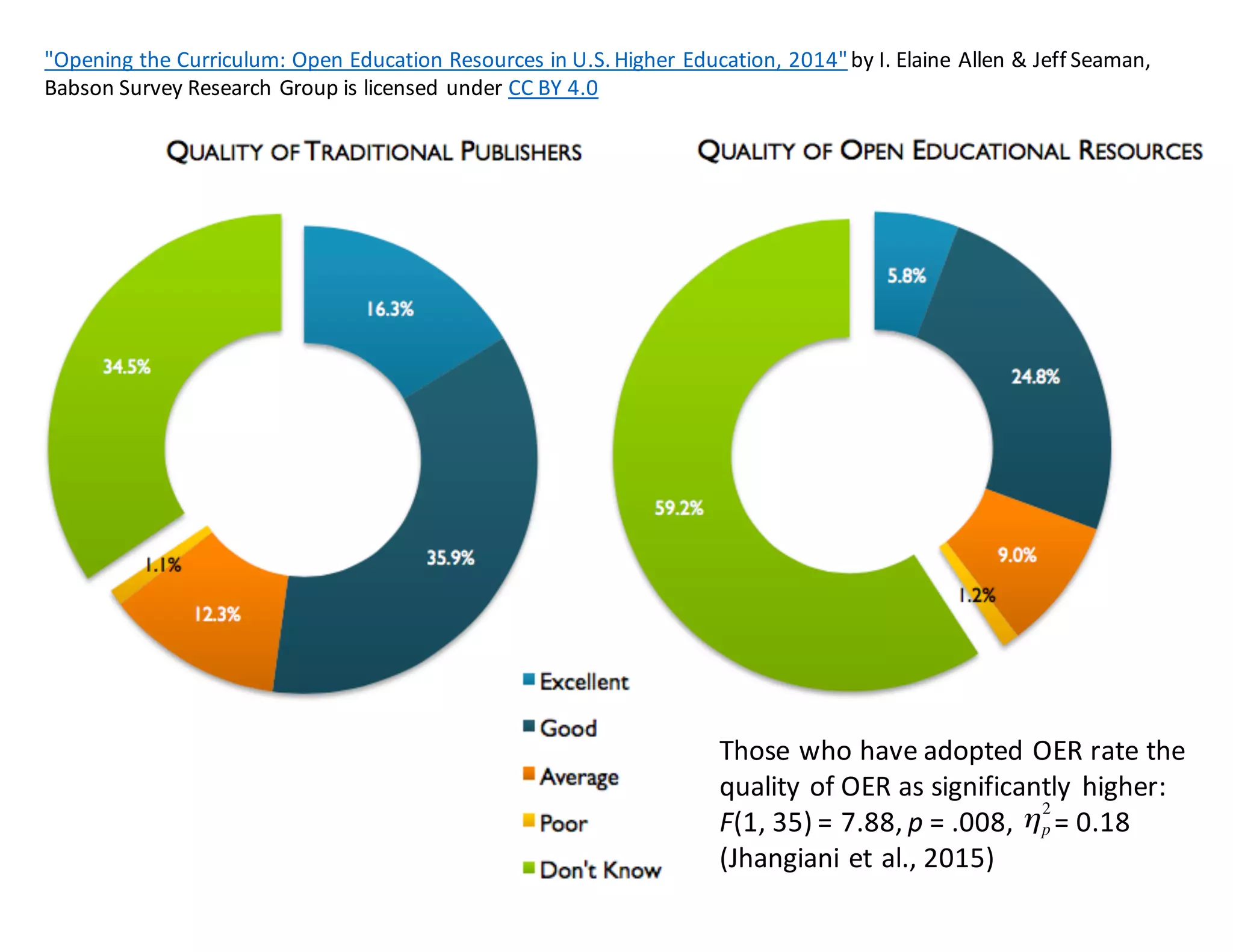
  Allen	
  &	
  Jeff	
  Seaman,	
  
Babson	
  Survey	
  Research	
  Group is	
  licensed	
  under CC	
  BY	
  4.0
Those	
  who	
  have	
  adopted	
  OER	
  rate	
  the	
  
quality	
  of	
  OER	
  as	
  significantly	
  higher:	
  
F(1,	
  35)	
  =	
  7.88,	
  p =	
  .008,	


  =	
  0.18
(Jhangiani	
  et	
  al.,	
  2015)
ηp
2
0.00
10.00
20.00
30.00
40.00
50.00
60.00
70.00
Strongly	
  disagree Disagree Neutral Agree Strongly	
  agree
Rajiv
Richard
Overall,	
  I	
  am	
  satisfied	
  with	
  the	
  quality	
  of	
  the	
  
modules/chapters	
  in	
  the	
  open	
  textbook
Jhangiani	
  &	
  Le	
  Grand	
  (2014)
N	
  =	
  105
%
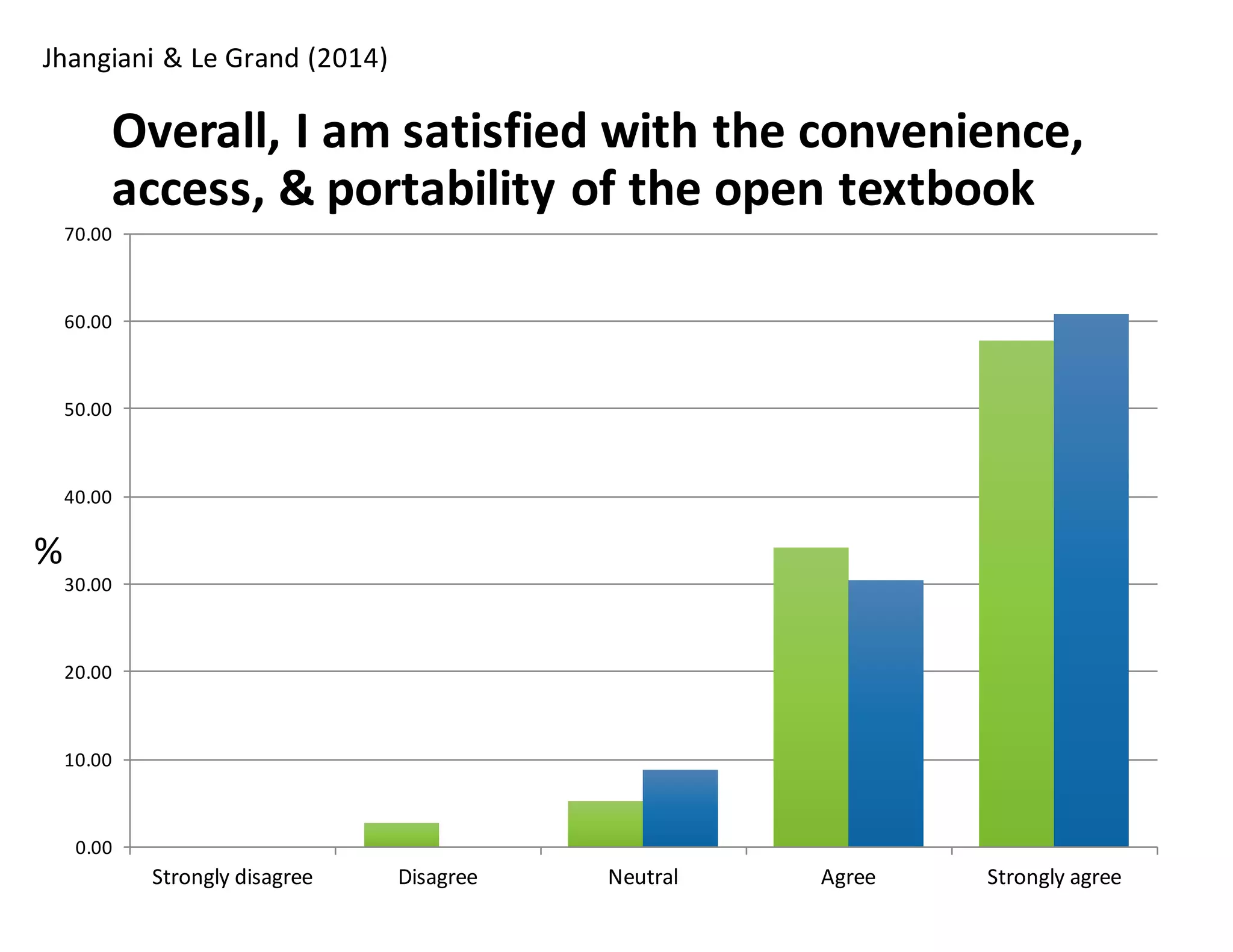
Overall,	
  I	
  am	
  satisfied	
  with	
  the	
  convenience,	
  
access,	
  &	
  portability	
  of	
  the	
  open	
  textbook
0.00
10.00
20.00
30.00
40.00
50.00
60.00
70.00
Strongly	
  disagree Disagree Neutral Agree Strongly	
  agree
%
Jhangiani	
  &	
  Le	
  Grand	
  (2014)
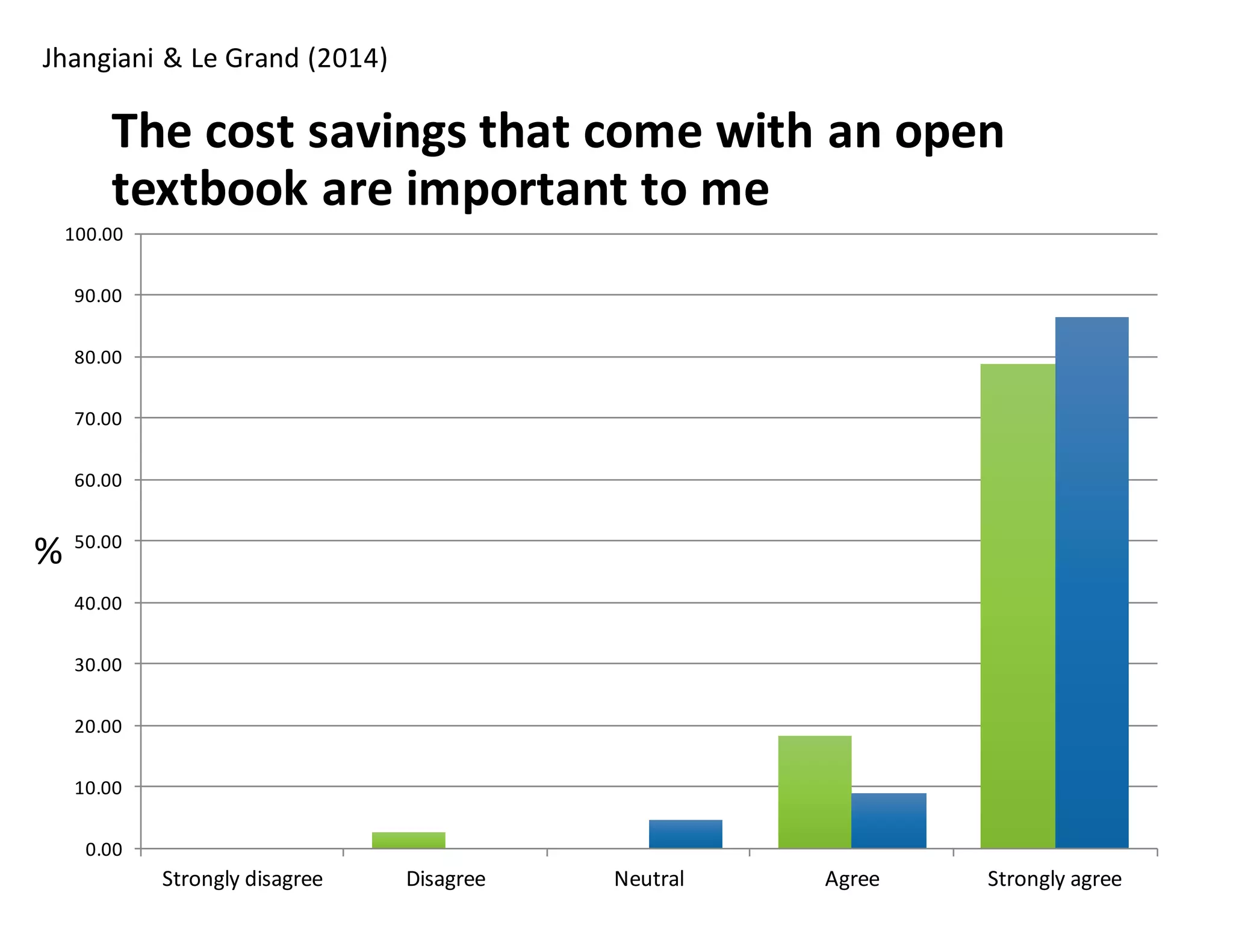
The	
  cost	
  savings	
  that	
  come	
  with	
  an	
  open	
  
textbook	
  are	
  important	
  to	
  me
0.00
10.00
20.00
30.00
40.00
50.00
60.00
70.00
80.00
90.00
100.00
Strongly	
  disagree Disagree Neutral Agree Strongly	
  agree
%
Jhangiani	
  &	
  Le	
  Grand	
  (2014)
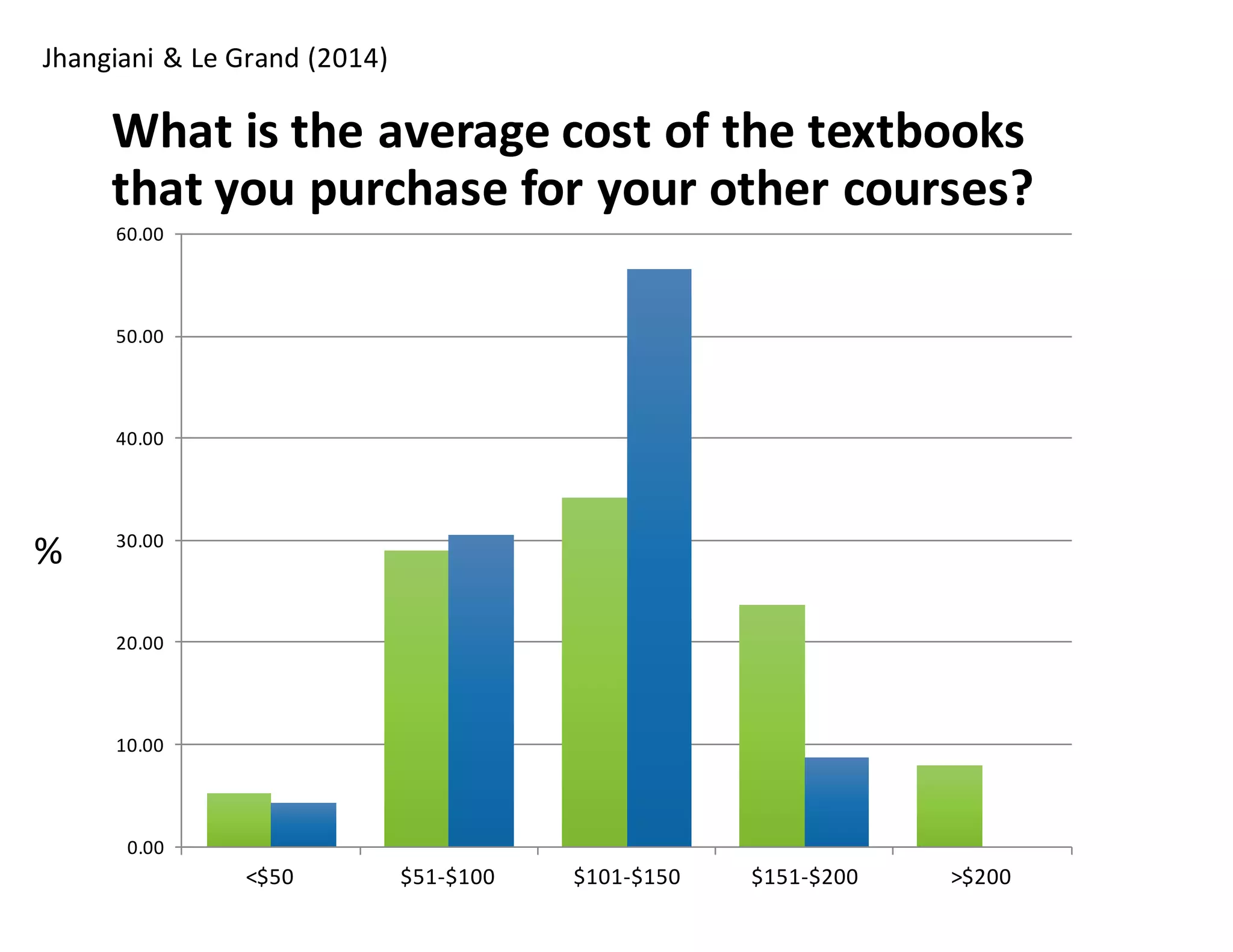
What	
  is	
  the	
  average	
  cost	
  of	
  the	
  textbooks	
  
that	
  you	
  purchase	
  for	
  your	
  other	
  courses?
0.00
10.00
20.00
30.00
40.00
50.00
60.00
<$50 $51-­‐$100 $101-­‐$150 $151-­‐$200 >$200
Rajiv
Richard
Jhangiani	
  &	
  Le	
  Grand	
  (2014)
%
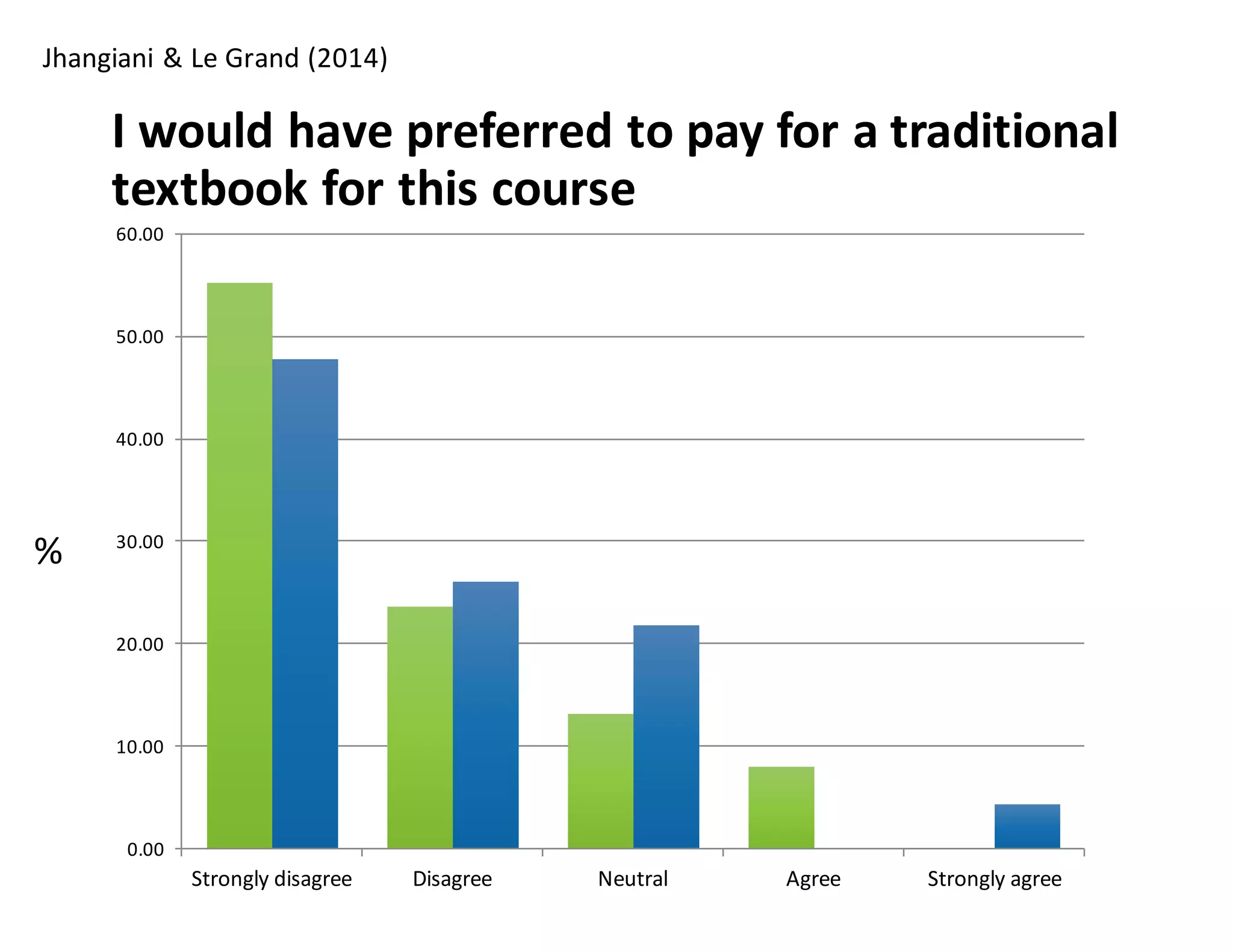
I	
  would	
  have	
  preferred	
  to	
  pay	
  for	
  a	
  traditional	
  
textbook	
  for	
  this	
  course
0.00
10.00
20.00
30.00
40.00
50.00
60.00
Strongly	
  disagree Disagree Neutral Agree Strongly	
  agree
Rajiv
Richard
Jhangiani	
  &	
  Le	
  Grand	
  (2014)
%
I	
  like	
  how	
  the	
  theories	
   are	
  explained	
  in	
  
more	
  understandable	
   ways	
  compared	
  to	
  
other	
  textbooks	
  where	
  the	
  author	
  tends	
  to	
  
talk	
  in	
  circles	
  before	
  explaining	
  what	
  is	
  
being	
  talked	
  about
I	
  would	
  not	
  have	
  bought	
  the	
  text	
  book	
  for	
  
this	
  course	
  because	
  it's	
  an	
  elective.	
  I	
  
would	
  have	
  possibly	
  walked	
  away	
  with	
  a	
  
C,	
  now	
  I	
  might	
  actually	
  get	
  an	
  A-­‐
It	
  is	
  easily	
  accessible	
   and	
  
convenient.	
  Material	
  is	
  easy	
  
to	
  understand	
  and	
  follow
I	
  personally	
  really	
  like	
  the	
  convenience	
   of	
  
having	
  the	
  complete	
  set	
  of	
  chapters	
  on	
  my	
  
computer	
  and	
  even	
  accessible	
   from	
  my	
  
phone	
  if	
  I	
  need	
  it.	
  I	
  like	
  that	
  I	
  don't	
  have	
  to	
  
lug	
  around	
  another	
  text	
  book
It's	
  free	
  and	
  it's	
  a	
  great	
  money	
  saver
11 Peer	
  Reviewed	
  Studies
http://openedgroup.org/	
  
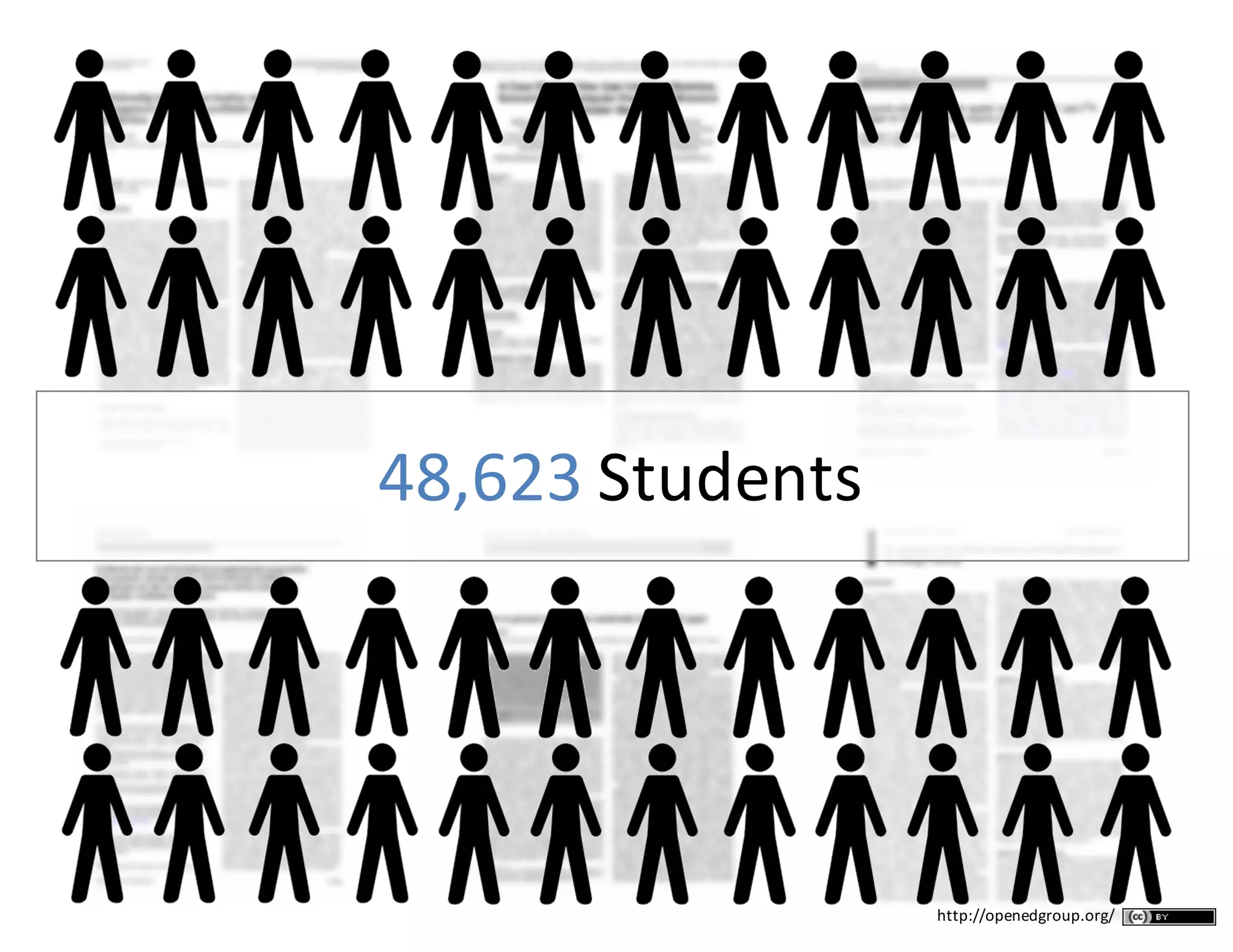
48,623 Students
http://openedgroup.org/	
  
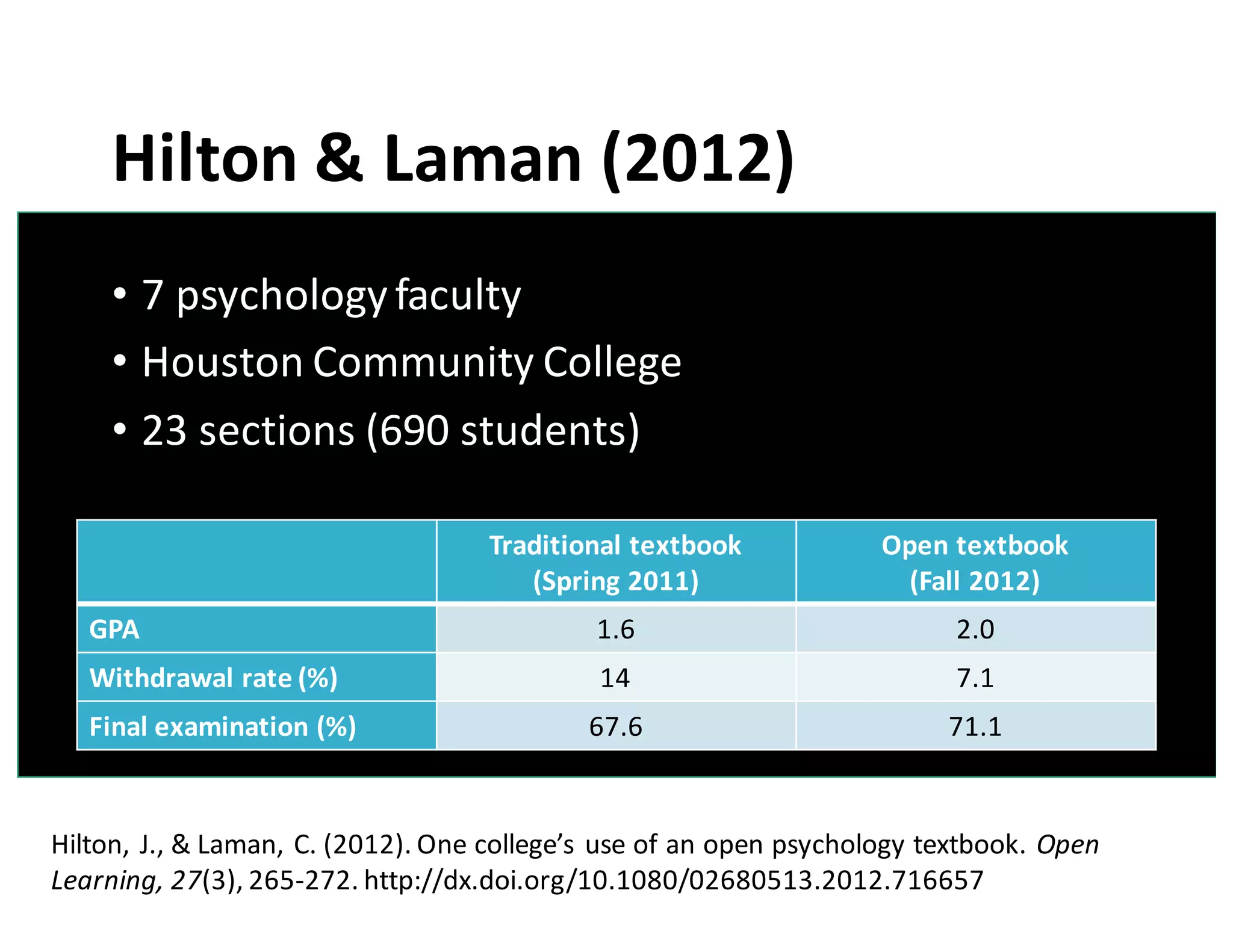
Hilton	
  &	
  Laman (2012)
• 7	
  psychology	
  faculty
• Houston	
  Community	
  College
• 23	
  sections	
  (690	
  students)
Traditional textbook	
  
(Spring	
  2011)
Open	
  textbook
(Fall 2012)
GPA 1.6 2.0
Withdrawal	
  rate	
  (%) 14 7.1
Final examination	
  (%) 67.6 71.1
Hilton,	
  J.,	
  &	
  Laman,	
  C.	
  (2012).	
  One	
  college’s	
  use	
  of	
  an	
  open	
  psychology	
  textbook.	
  Open	
  
Learning,	
  27(3),	
  265-­‐272.	
  http://dx.doi.org/10.1080/02680513.2012.716657
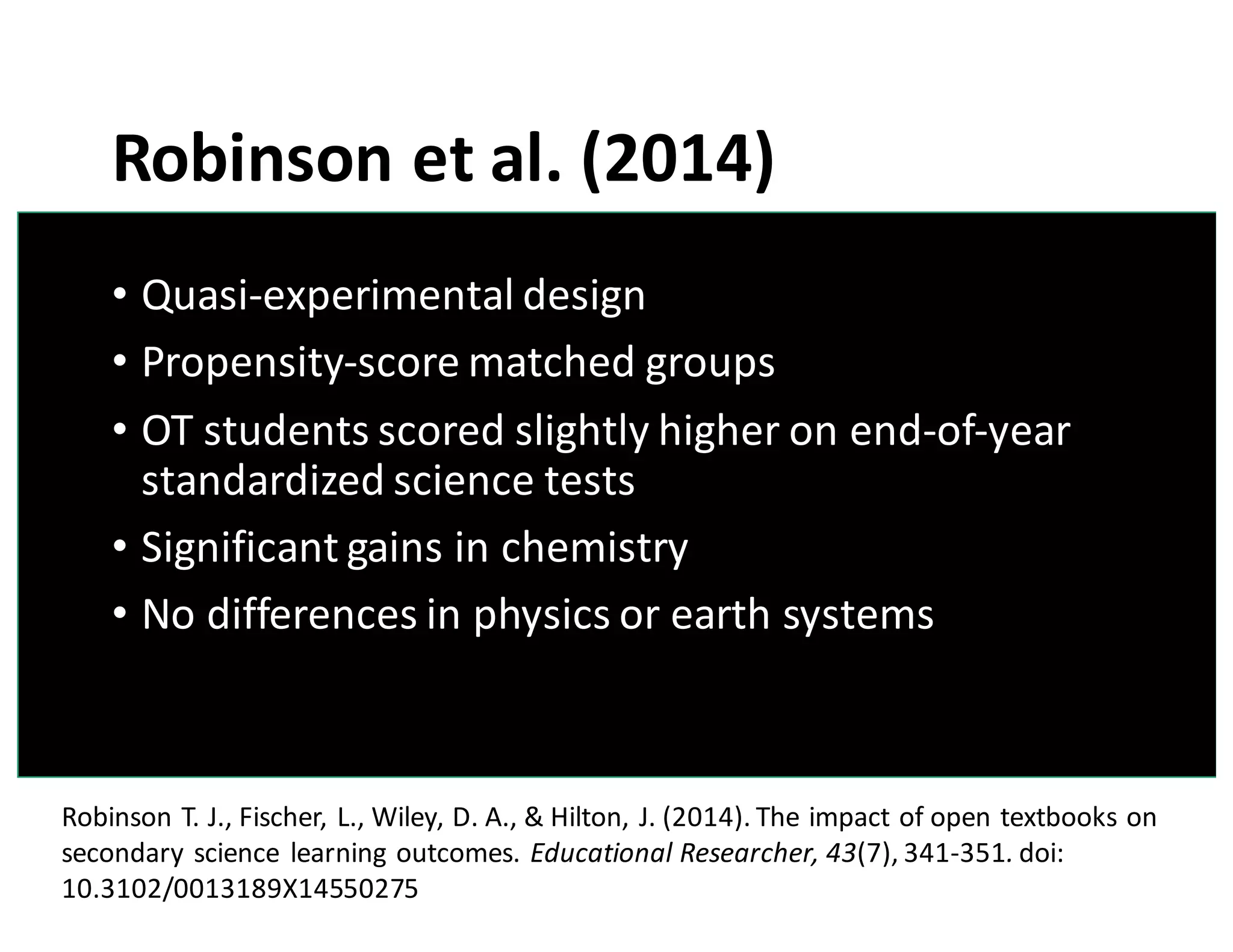
Robinson	
  et	
  al.	
  (2014)
• Quasi-­‐experimental	
  design
• Propensity-­‐score	
  matched	
  groups
• OT	
  students	
  scored	
  slightly	
  higher	
  on	
  end-­‐of-­‐year	
  
standardized	
  science	
  tests
• Significant	
  gains	
  in	
  chemistry
• No	
  differences	
  in	
  physics	
  or	
  earth	
  systems
Robinson	
  T.	
  J.,	
  Fischer,	
  L.,	
  Wiley,	
  D.	
  A.,	
  &	
  Hilton,	
  J.	
  (2014).	
  The	
  impact	
  of	
  open	
  textbooks	
  on	
  
secondary	
  science	
  learning	
  outcomes.	
  Educational	
  Researcher,	
  43(7),	
  341-­‐351. doi:	
  
10.3102/0013189X14550275
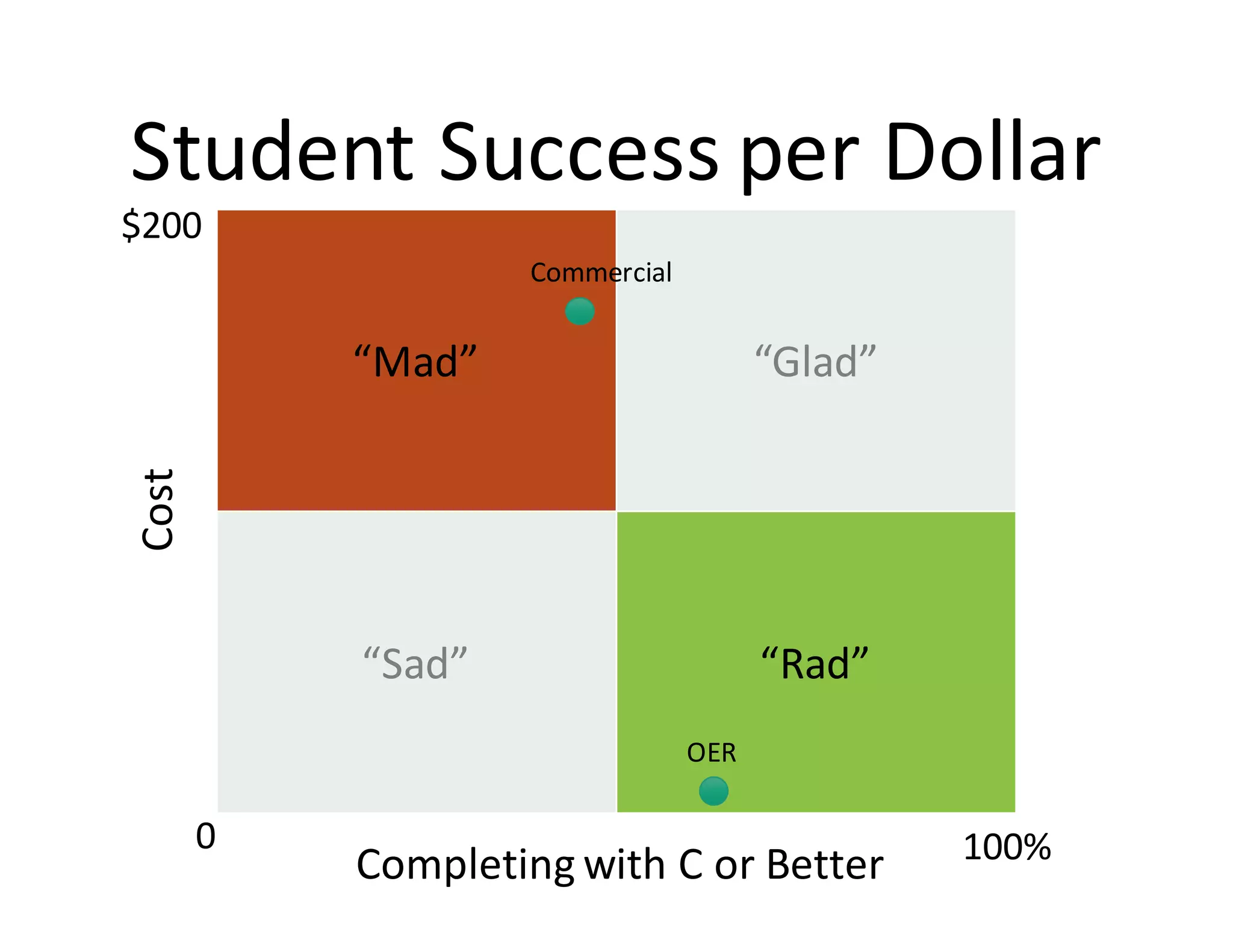
“Mad” “Glad”
“Sad” “Rad”
Cost
Completing	
  with	
  C	
  or	
  Better
Commercial
OER
Student	
  Success	
  per	
  Dollar
0 100%
$200
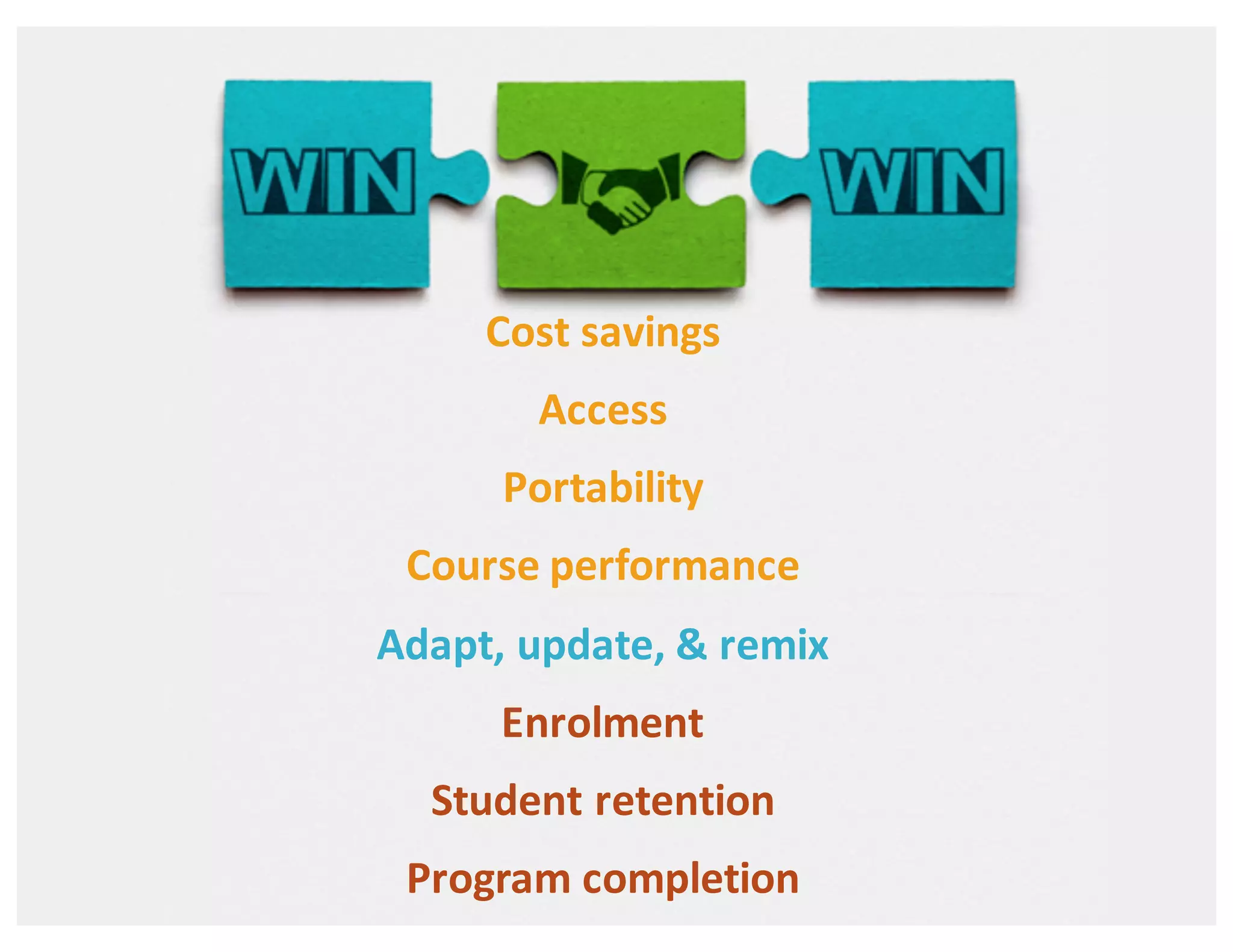
Cost	
  savings
Access
Portability
Course	
  performance
Adapt,	
  update,	
  &	
  remix
Enrolment
Student	
  retention
Program	
  completion
open.bccampus.ca
What  can  YOU  do?
• Survey  your  student  body
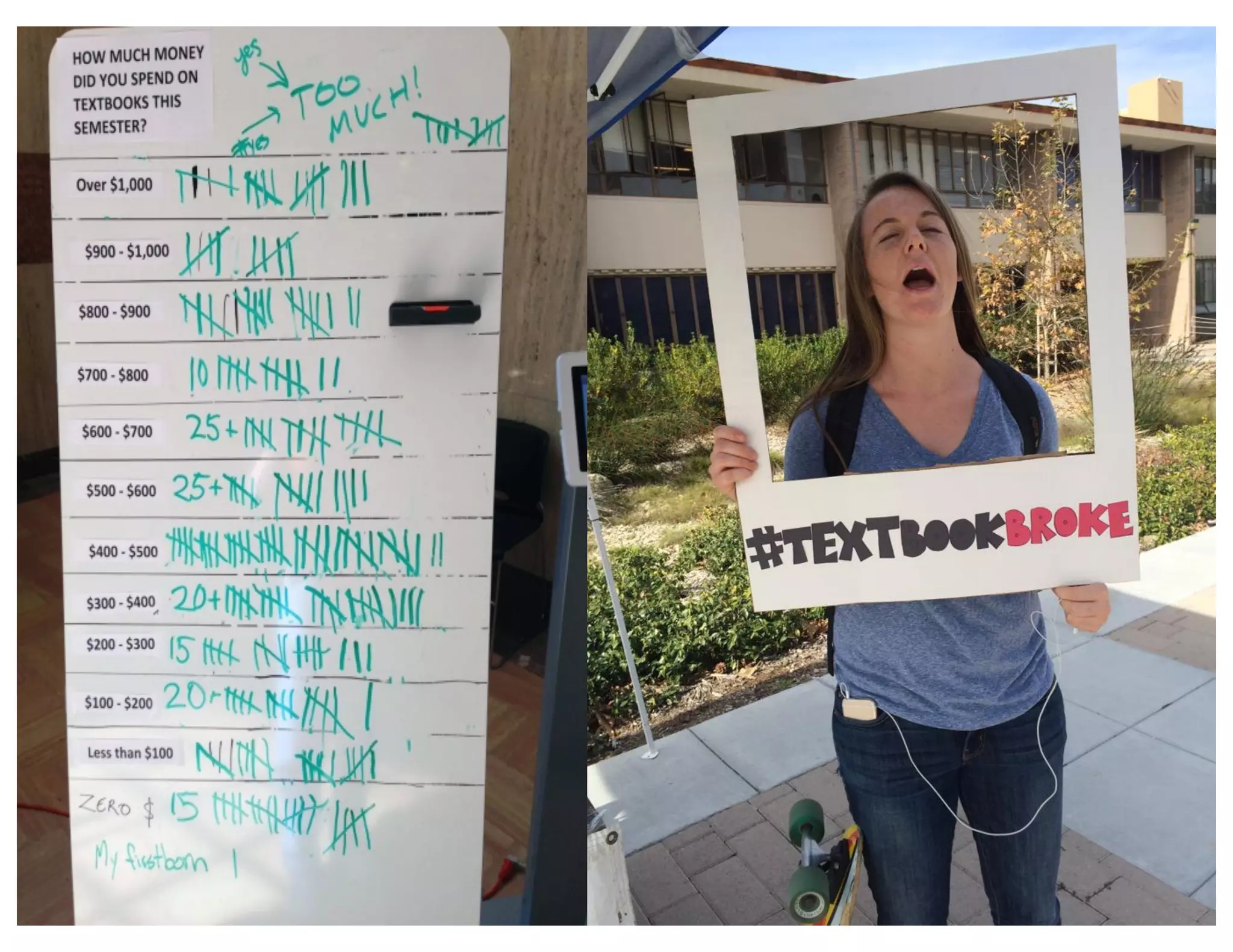
• #textbookbroke campaign
• Presentations  
• Utilize  visuals,  create  displays
• Speak  directly  to  faculty  &  admin
• Suggest  that  faculty  review  a  textbook
• Showcase  examples
• Form  a  student-­led  OER  group
• Connect.  Collaborate.
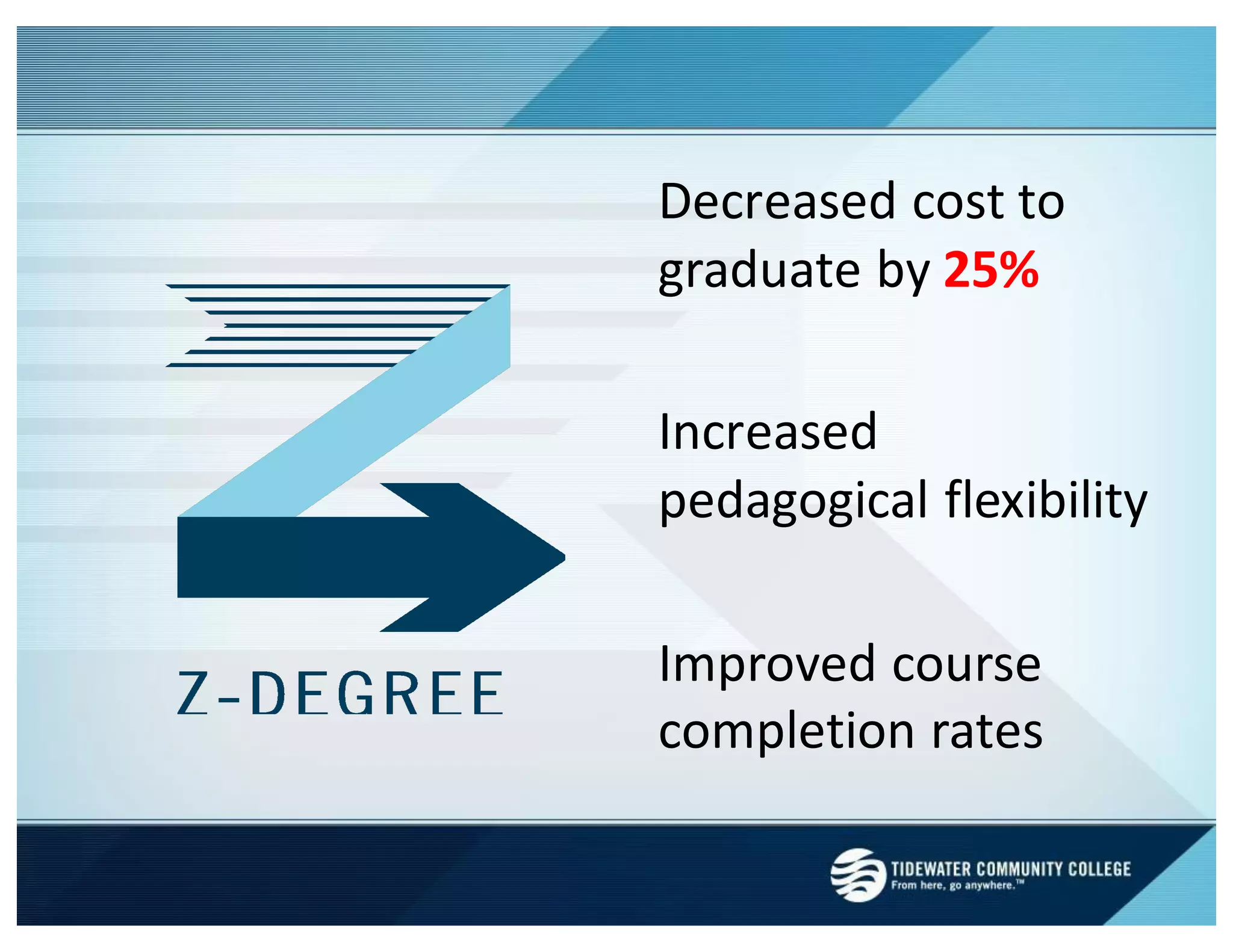
The Z-Degree
REMOVING TEXTBOOK COSTS AS A
BARRIER TO STUDENT SUCCESS
THROUGH AN OER-BASED CURRICULUM
Decreased	
  cost	
  to	
  
graduate	
  by	
  25%
Increased	
  
pedagogical	
  flexibility
Improved	
  course	
  
completion	
  rates
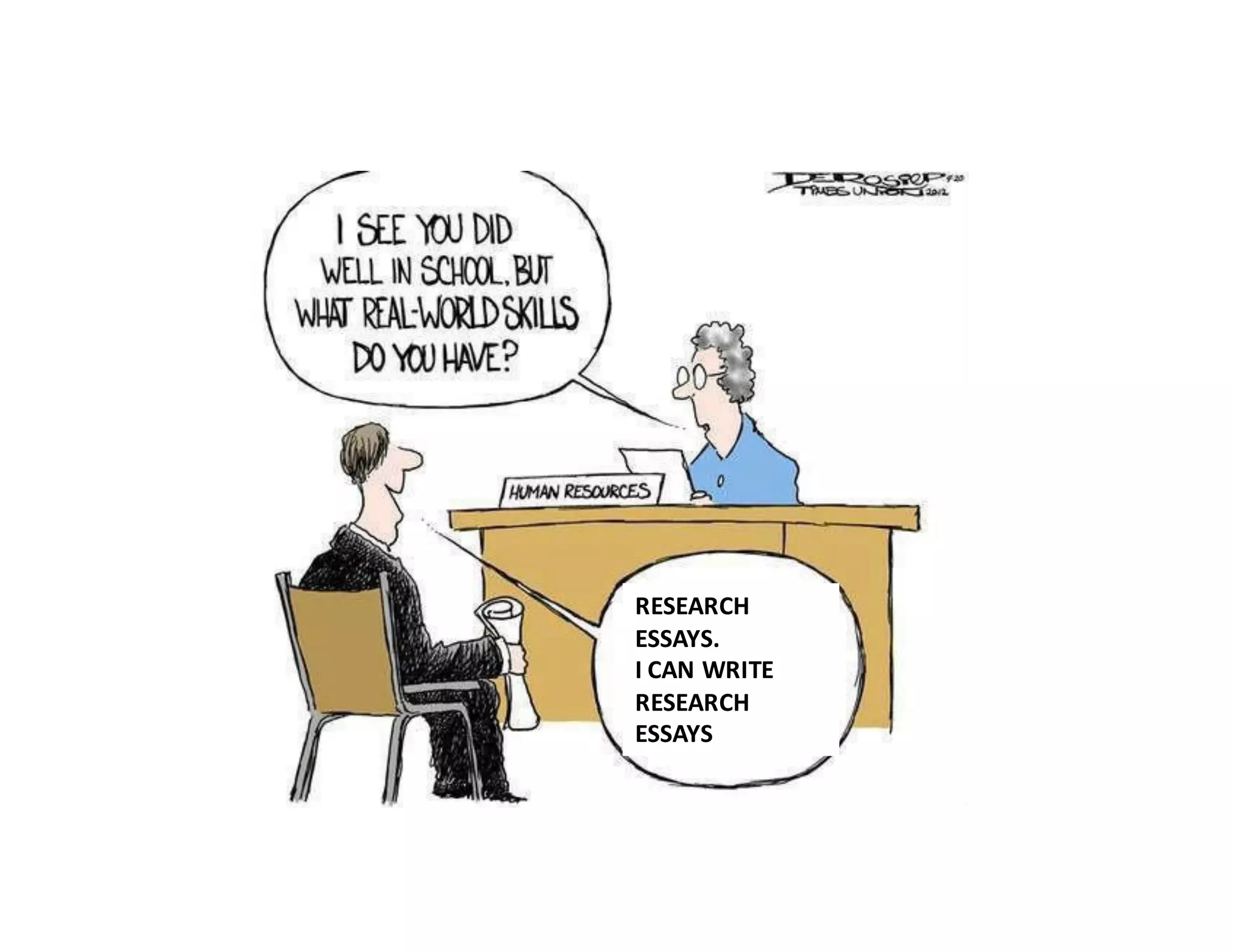
RESEARCH	
  
ESSAYS.
I	
  CAN	
  WRITE	
  
RESEARCH	
  
ESSAYS
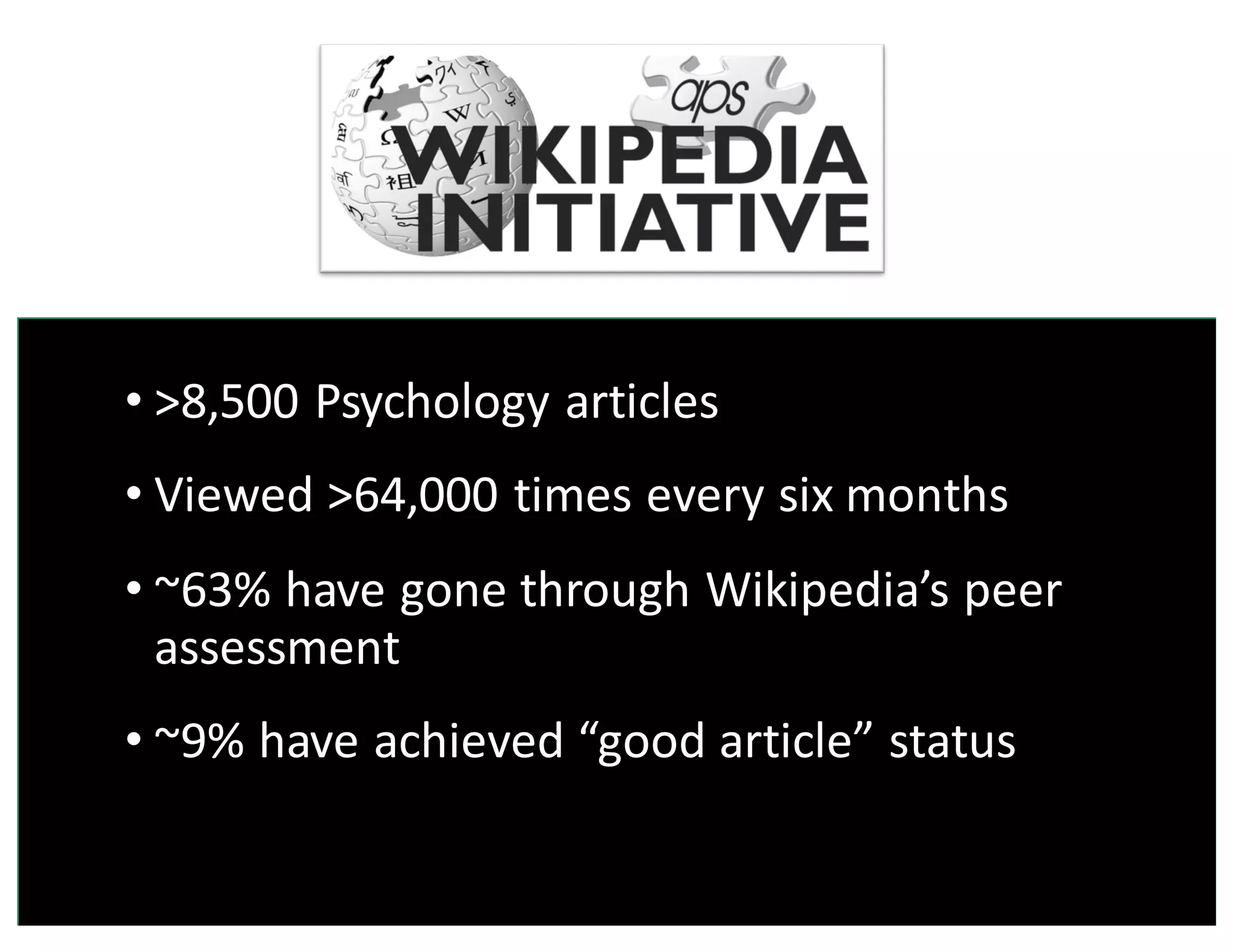
• >8,500	
  Psychology	
  articles
• Viewed	
  >64,000	
  times	
  every	
  six	
  months
• ~63%	
  have	
  gone	
  through	
  Wikipedia’s	
  peer	
  
assessment
• ~9%	
  have	
  achieved	
  “good	
  article”	
  status
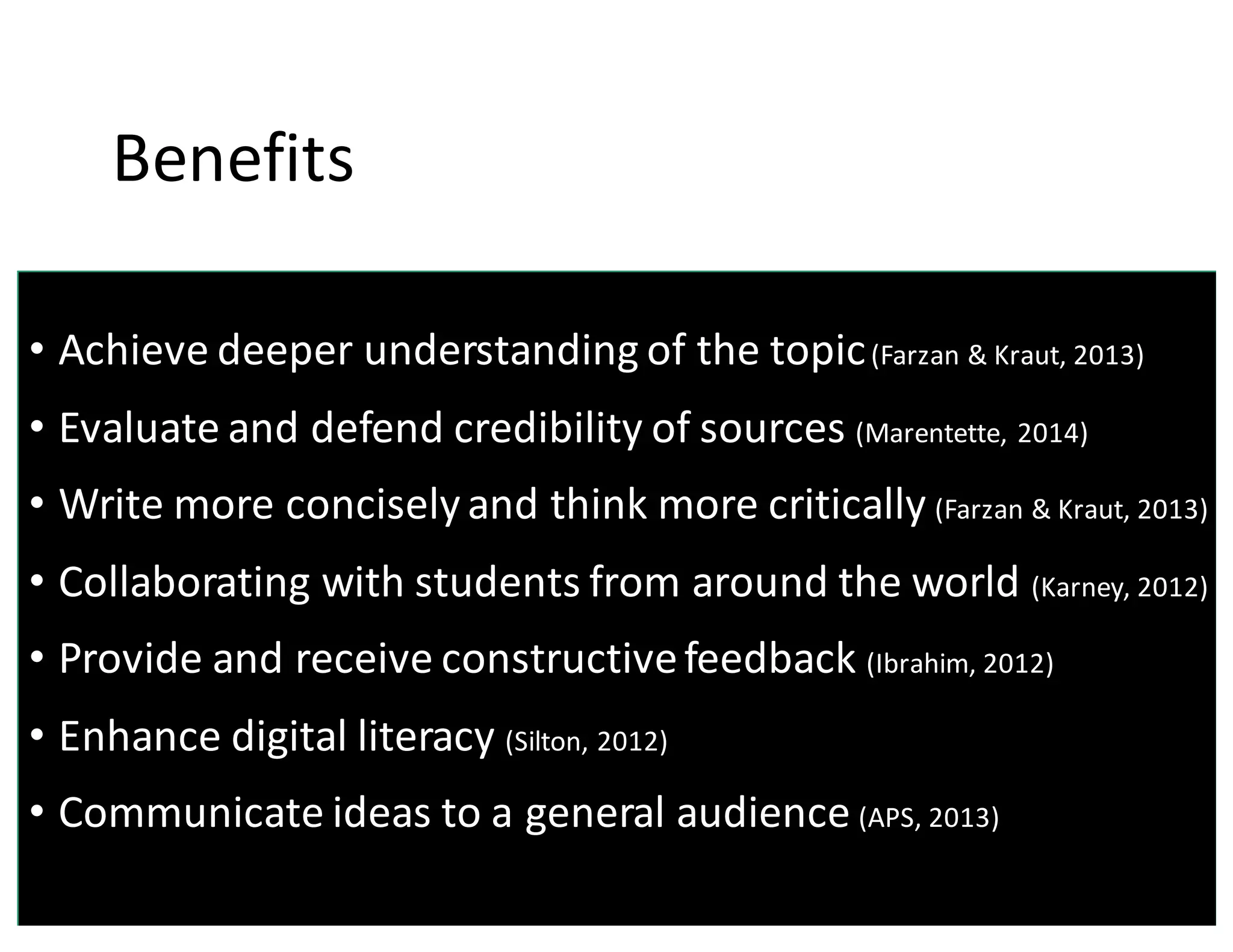
Benefits
• Achieve	
  deeper	
  understanding	
  of	
  the	
  topic(Farzan &	
  Kraut,	
  2013)
• Evaluate	
  and	
  defend	
  credibility	
  of	
  sources	
  (Marentette,	
  2014)
• Write	
  more	
  concisely	
  and	
  think	
  more	
  critically	
  (Farzan &	
  Kraut,	
  2013)
• Collaborating	
  with	
  students	
  from	
  around	
  the	
  world	
  (Karney,	
  2012)
• Provide	
  and	
  receive	
  constructive	
  feedback	
  (Ibrahim,	
  2012)
• Enhance	
  digital	
  literacy	
  (Silton,	
  2012)
• Communicate	
  ideas	
  to	
  a	
  general	
  audience	
  (APS,	
  2013)
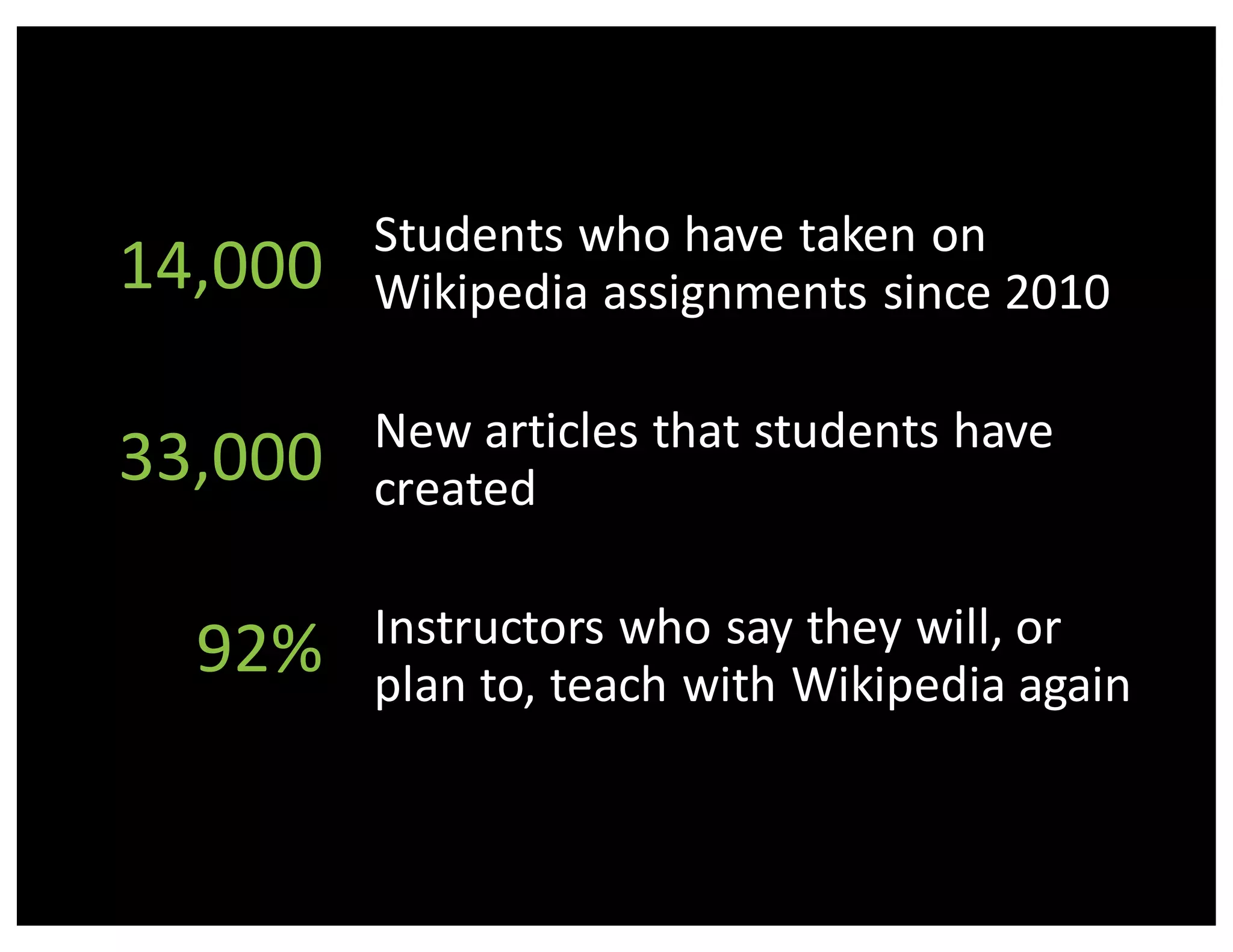
14,000
33,000
92%
Students	
  who	
  have	
  taken	
  on	
  
Wikipedia	
  assignments	
  since	
  2010
New	
  articles	
  that	
  students	
  have	
  
created
Instructors	
  who	
  say	
  they	
  will,	
  or	
  
plan	
  to,	
  teach	
  with	
  Wikipedia	
  again
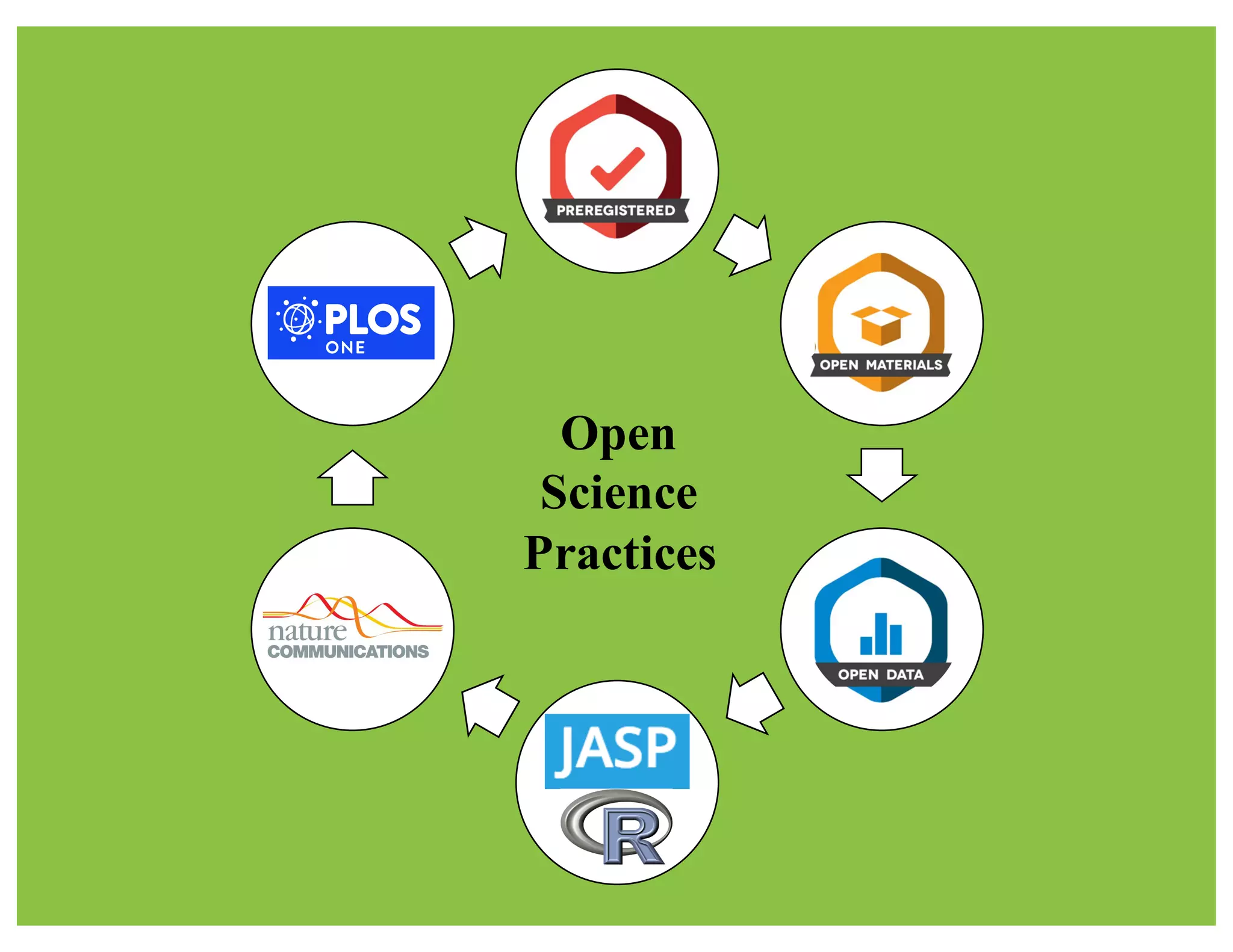
Open	
  
hypotheses	
  
&	
  analysis	
  
plan
Open	
  
research	
  
materials
Open	
  data
Open	
  
source	
  
statistical	
  
software
Open	
  peer	
  
review
Open	
  
publishing
Open
Science
Practices
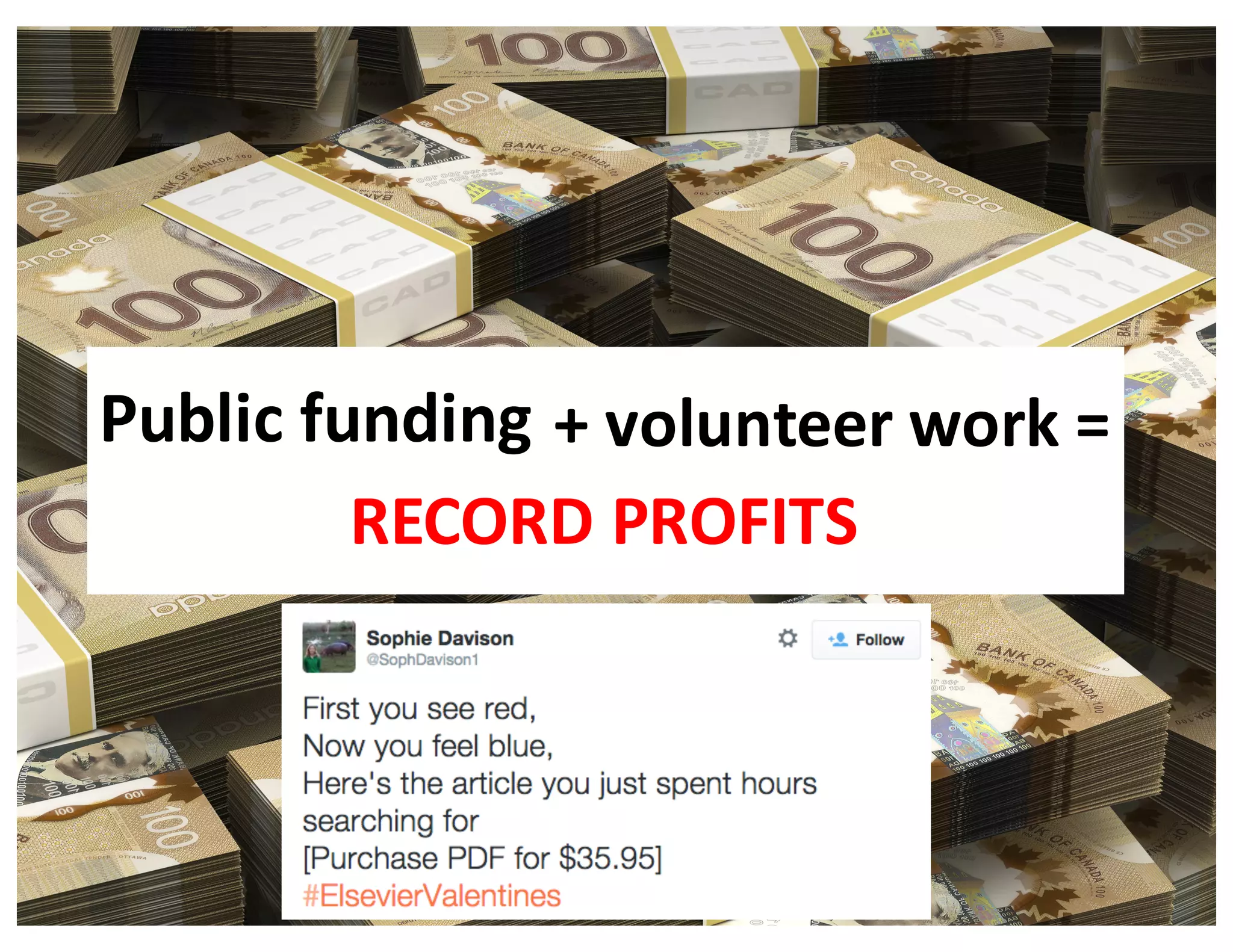
RECORD	
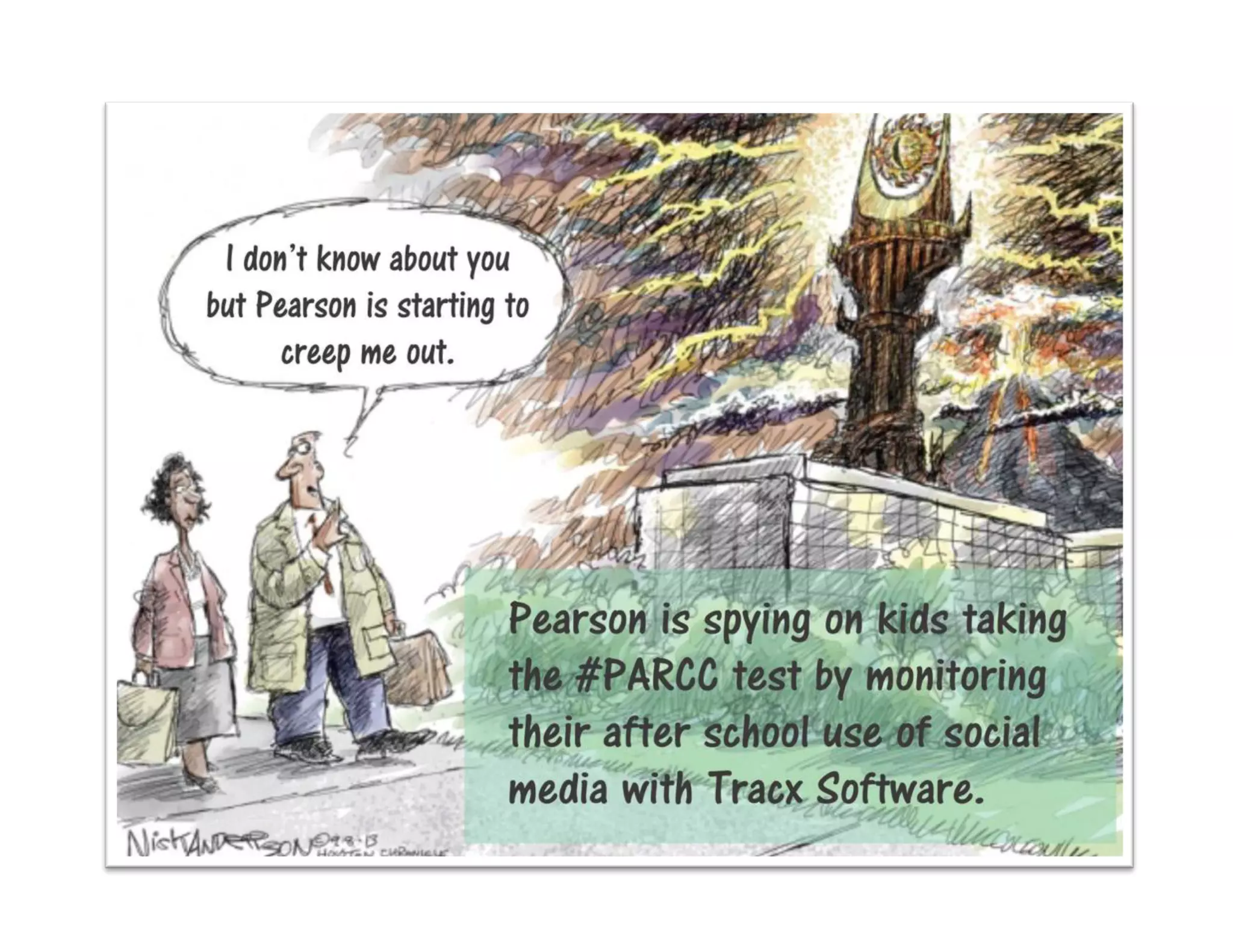
  PROFITS
+	
  volunteer	
  work	
  =Public	
  funding
Where	
  Social	
  Justice	
  Meets	
  Good	
  Pedagogy
rajiv.jhangiani@kpu.ca
@thatpsychprof
Thank	
  you!

Douglas College PD Event: The Desirable and Inevitable Shift Towards Open Pedagogy and Open Science

  • 1.
    Faculty  Fellow,  BC  Open  Textbook  Project OER  Research  Fellow,  Open  Education  Group Dept.  of  Psychology,  Kwantlen  Polytechnic  University Rajiv  Jhangiani,  Ph.D. The  Desirable  and  Inevitable  Shift  Towards   Open  Pedagogy  and  Open  Science THE  FUTURE  IS  OPEN
  • 4.
    "Ivory  Towers" byJames  F  Clay is  licensed  under CC  BY-­‐NC  4.0
  • 5.
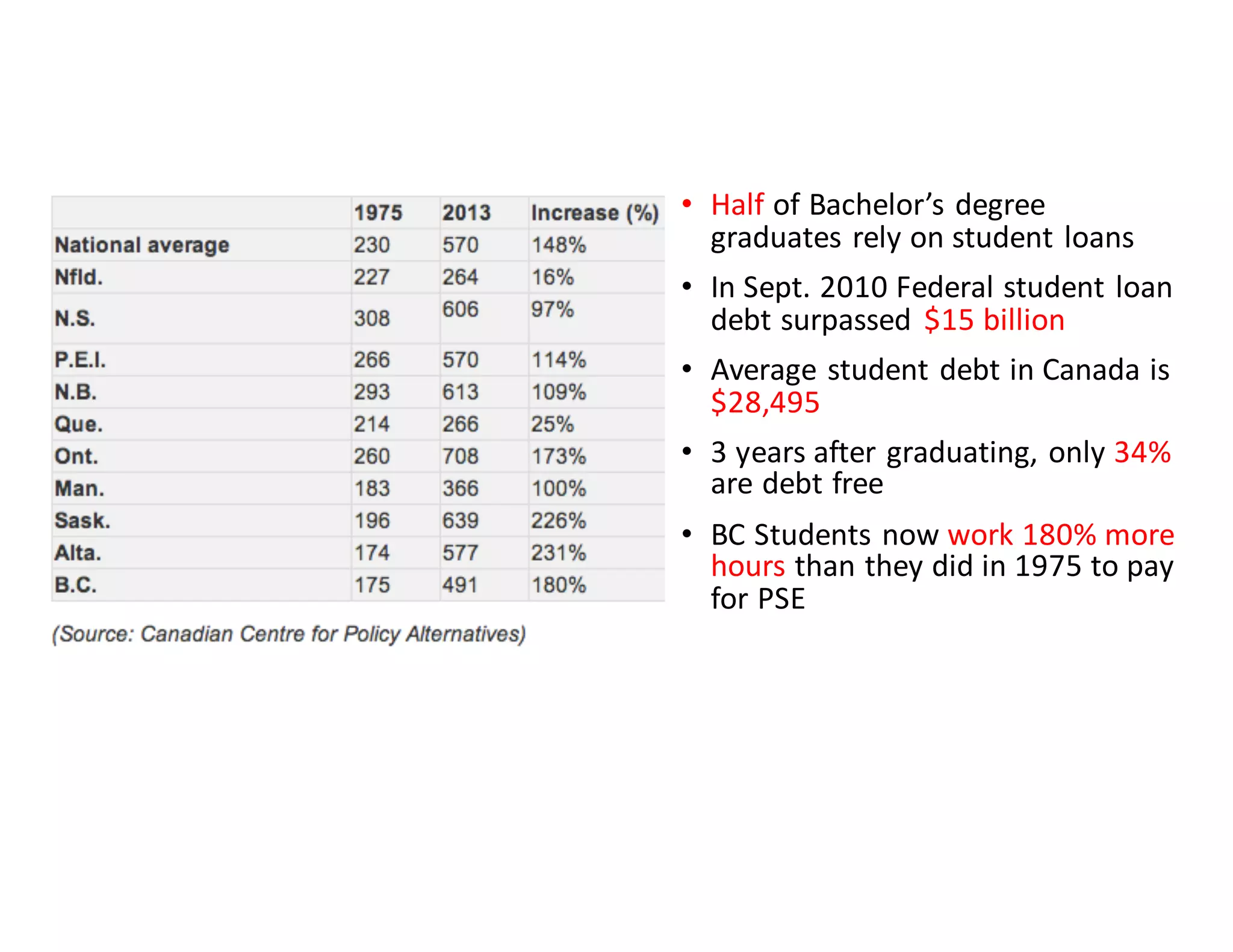
    • Half of  Bachelor’s  degree   graduates  rely  on  student  loans • In  Sept.  2010  Federal  student  loan   debt  surpassed   $15  billion • Average  BC  student  debt  in  2011   was  $29,497 • 3  years  after  graduating,  only  34%   are  debt  free • BC  students  now  work  180%  more   hours  than  they  did  in  1975  to  pay   for  PSE • When  debt  reaches  $10,000,   program  completion  rates  drop   from  59%  to  8% • The  cost  of  textbooks  has  risen  by   1041%  since  1977
  • 6.
    "Kids  Giving  you  problems?  Hire  an  Elephant" by peasap is  licensed  under CC  BY  2.0 • Half of  Bachelor’s  degree   graduates  rely  on  student  loans • In  Sept.  2010  Federal  student  loan   debt  surpassed   $15  billion • Average  BC  student  debt  in  2011   was  $29,497 • 3  years  after  graduating,  only  34%   are  debt  free • BC  students  now  work  180%  more   hours  than  they  did  in  1975  to  pay   for  PSE • When  debt  reaches  $10,000,   program  completion  rates  drop   from  59%  to  8% • The  cost  of  textbooks  has  risen  by   1041%  since  1977
  • 7.
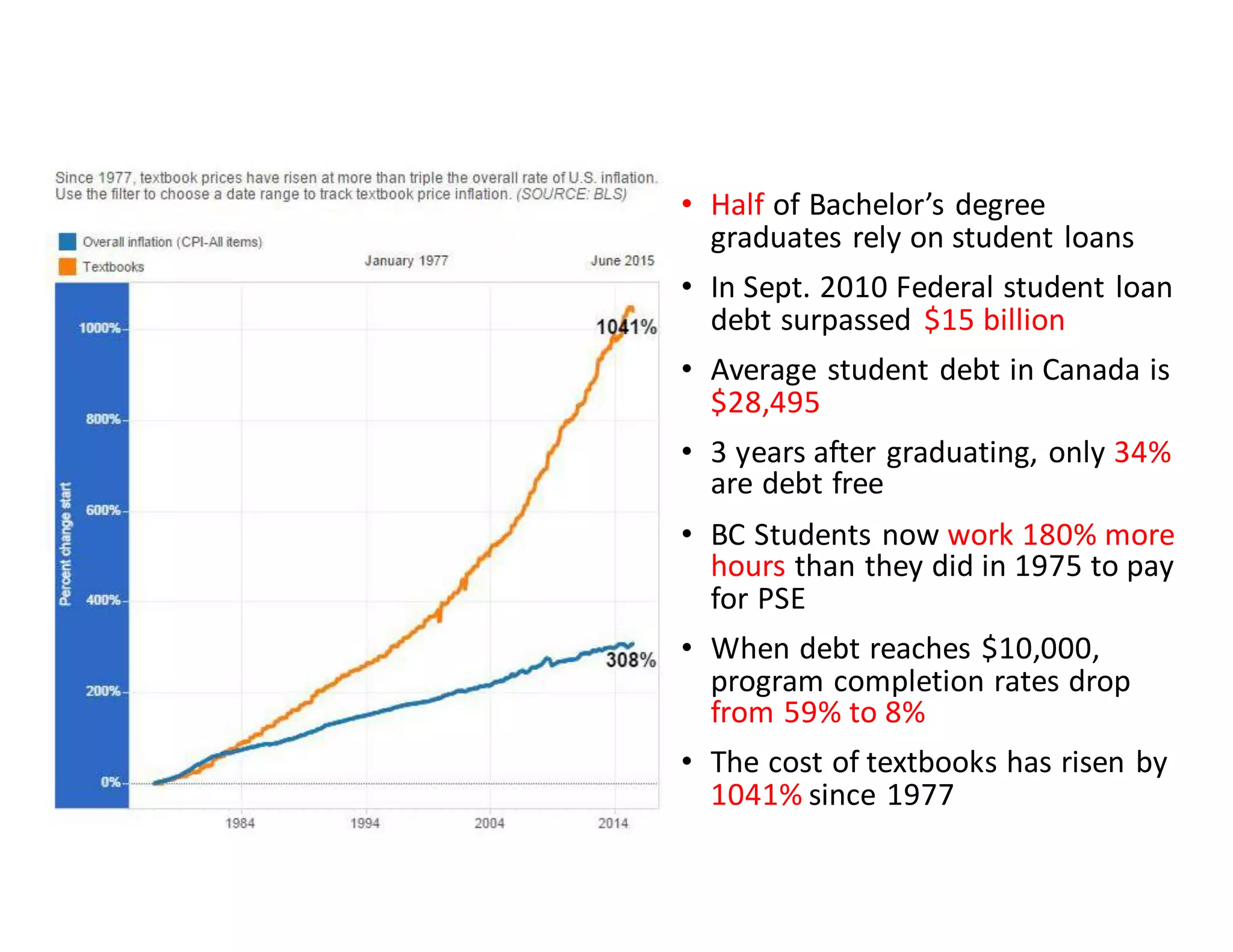
    • Half of  Bachelor’s  degree   graduates  rely  on  student  loans • In  Sept.  2010  Federal  student  loan   debt  surpassed   $15  billion • Average  student  debt  in  Canada  is   $28,495 • 3  years  after  graduating,  only  34%   are  debt  free • BC  students  now  work  180%  more   hours  than  they  did  in  1975  to  pay   for  PSE • When  debt  reaches  $10,000,   program  completion  rates  drop   from  59%  to  8% • The  cost  of  textbooks  has  risen  by   1041%  since  1977
  • 8.
    • Half of  Bachelor’s  degree   graduates  rely  on  student  loans • In  Sept.  2010  Federal  student  loan   debt  surpassed   $15  billion • Average  student  debt  in  Canada  is   $28,495 • 3  years  after  graduating,  only  34% are  debt  free • BC  students  now  work  180%  more   hours  than  they  did  in  1975  to  pay   for  PSE • When  debt  reaches  $10,000,   program  completion  rates  drop   from  59%  to  8% • The  cost  of  textbooks  has  risen  by   1041%  since  1977
  • 9.
    • Half of  Bachelor’s  degree   graduates  rely  on  student  loans • In  Sept.  2010  Federal  student  loan   debt  surpassed   $15  billion • Average  student  debt  in  Canada  is   $28,495 • 3  years  after  graduating,  only  34% are  debt  free • BC  Students  now  work  180%  more   hours  than  they  did  in  1975  to  pay   for  PSE • When  debt  reaches  $10,000,   program  completion  rates  drop   from  59%  to  8% • The  cost  of  textbooks  has  risen  by   1041%  since  1977
  • 10.
    • Half of  Bachelor’s  degree   graduates  rely  on  student  loans • In  Sept.  2010  Federal  student  loan   debt  surpassed   $15  billion • Average  student  debt  in  Canada  is   $28,495 • 3  years  after  graduating,  only  34% are  debt  free • BC  Students  now  work  180%  more   hours  than  they  did  in  1975  to  pay   for  PSE • When  debt  reaches  $10,000,   program  completion  rates  drop   from  59%  to  8% • The  cost  of  textbooks  has  risen  by   1041%  since  1977
  • 11.
    • Half of  Bachelor’s  degree   graduates  rely  on  student  loans • In  Sept.  2010  Federal  student  loan   debt  surpassed   $15  billion • Average  student  debt  in  Canada  is   $28,495 • 3  years  after  graduating,  only  34% are  debt  free • BC  Students  now  work  180%  more   hours  than  they  did  in  1975  to  pay   for  PSE • When  debt  reaches  $10,000,   program  completion  rates  drop   from  59%  to  8% • The  cost  of  textbooks  has  risen  by   1041% since  1977
  • 14.
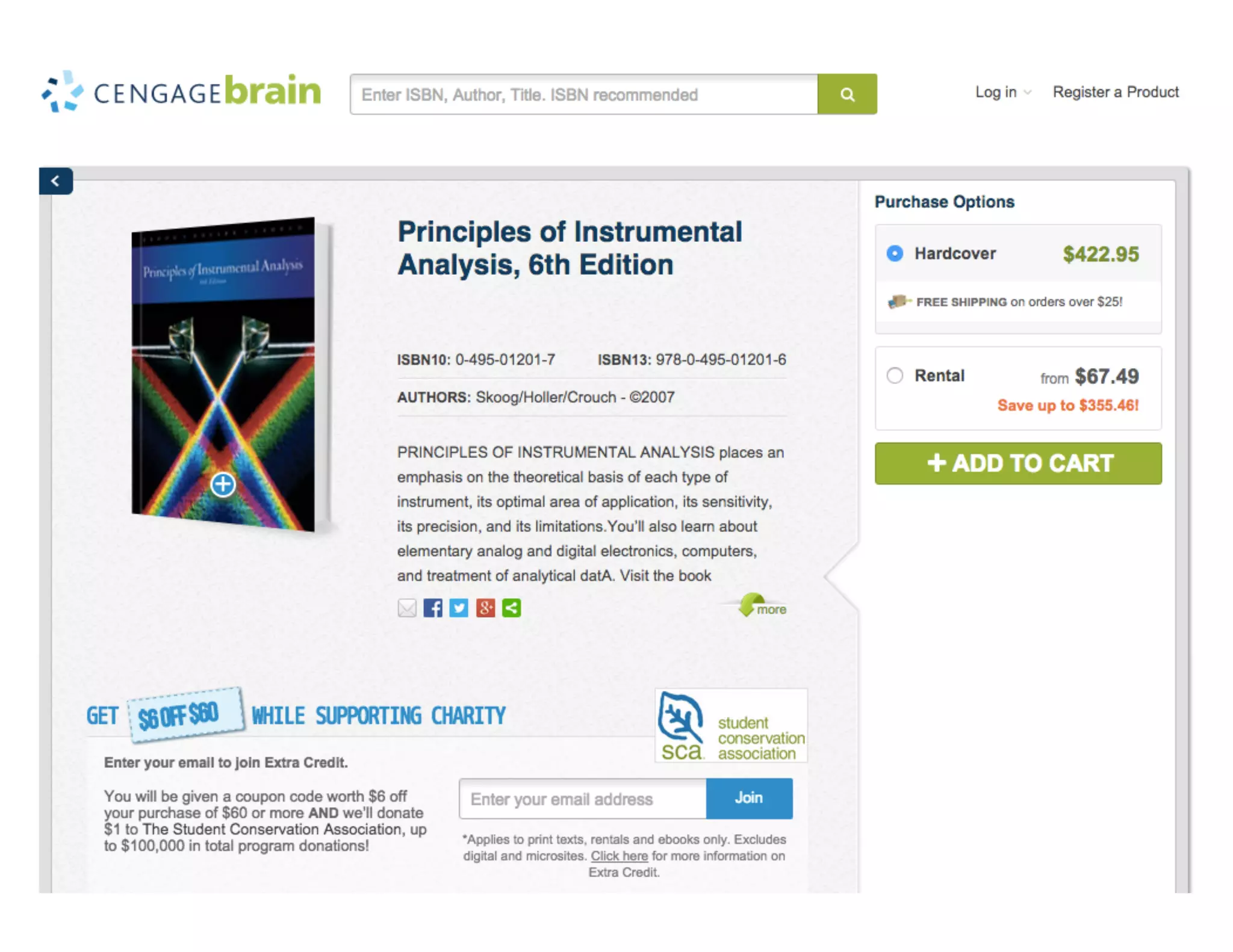
    1,489,536 full-­‐time  students @  $750/year =  $1.1  Billion
  • 16.
    Buy  used  (if  possible) Resell  (if  possible) Old  edition International  edition Shared  purchase Rent (Inter)library  loans Photocopy
  • 20.
    €€€ €€ €€ € €  60%+ do notpurchase textbooks at some point due to cost 35% take fewer courses due to textbook cost 31% choose not to register for a course due to textbook cost 23% regularly go without textbooks due to cost 14% have dropped a course due to textbook cost 10% have withdrawn from a course due to textbook cost Source: 2012 student survey by Florida Virtual Campus There  is  a  direct  relationship  between   textbook  costs  and  student  success
  • 21.
    "Crazy  Stunt" byRoss  G.  Strachan is  licensed  under CC  BY-­‐NC-­‐ND  4.0
  • 22.
    "circa  1890  -­‐Hamlin's  Wizard  Oil"byclotho98 is  licensed   under CC  BY-­‐NC  4.0 "'THAT  WAS  EASY!'" byjoepoppis  licensed  underCC  BY-­‐NC-­‐ND  2.0
  • 23.
  • 28.
    Retain Redistribute Revise Remix Reuse Source:  David  Wiley,    http://opencontent.org/blog/archives/3221 March  5,  2014,  CC-­‐BY open =  free  +  permissions
  • 32.
  • 33.
    open.bccampus.ca Faculty  Reviews 291/365  by  thebarrowboy used  under  a  CC-­BY
  • 34.
    open.bccampus.ca From  Reviews  to Adaptations My  Adventures  Adapting  a  Chemistry  Textbook291/365   by  thebarrowboy used  under  a  CC-­BY
  • 35.
  • 37.
    "Opening  the  Curriculum:  Open  Education  Resources  in  U.S.  Higher  Education,  2014"by I.  Elaine  Allen  &  Jeff  Seaman,   Babson  Survey  Research  Group is  licensed  under CC  BY  4.0 Those  who  have  adopted  OER  rate  the   quality  of  OER  as  significantly  higher:   F(1,  35)  =  7.88,  p =  .008,            =  0.18 (Jhangiani  et  al.,  2015) ηp 2
  • 38.
    0.00 10.00 20.00 30.00 40.00 50.00 60.00 70.00 Strongly  disagree DisagreeNeutral Agree Strongly  agree Rajiv Richard Overall,  I  am  satisfied  with  the  quality  of  the   modules/chapters  in  the  open  textbook Jhangiani  &  Le  Grand  (2014) N  =  105 %
  • 39.
    Overall,  I  am  satisfied  with  the  convenience,   access,  &  portability  of  the  open  textbook 0.00 10.00 20.00 30.00 40.00 50.00 60.00 70.00 Strongly  disagree Disagree Neutral Agree Strongly  agree % Jhangiani  &  Le  Grand  (2014)
  • 40.
    The  cost  savings  that  come  with  an  open   textbook  are  important  to  me 0.00 10.00 20.00 30.00 40.00 50.00 60.00 70.00 80.00 90.00 100.00 Strongly  disagree Disagree Neutral Agree Strongly  agree % Jhangiani  &  Le  Grand  (2014)
  • 41.
    What  is  the  average  cost  of  the  textbooks   that  you  purchase  for  your  other  courses? 0.00 10.00 20.00 30.00 40.00 50.00 60.00 <$50 $51-­‐$100 $101-­‐$150 $151-­‐$200 >$200 Rajiv Richard Jhangiani  &  Le  Grand  (2014) %
  • 42.
    I  would  have  preferred  to  pay  for  a  traditional   textbook  for  this  course 0.00 10.00 20.00 30.00 40.00 50.00 60.00 Strongly  disagree Disagree Neutral Agree Strongly  agree Rajiv Richard Jhangiani  &  Le  Grand  (2014) %
  • 43.
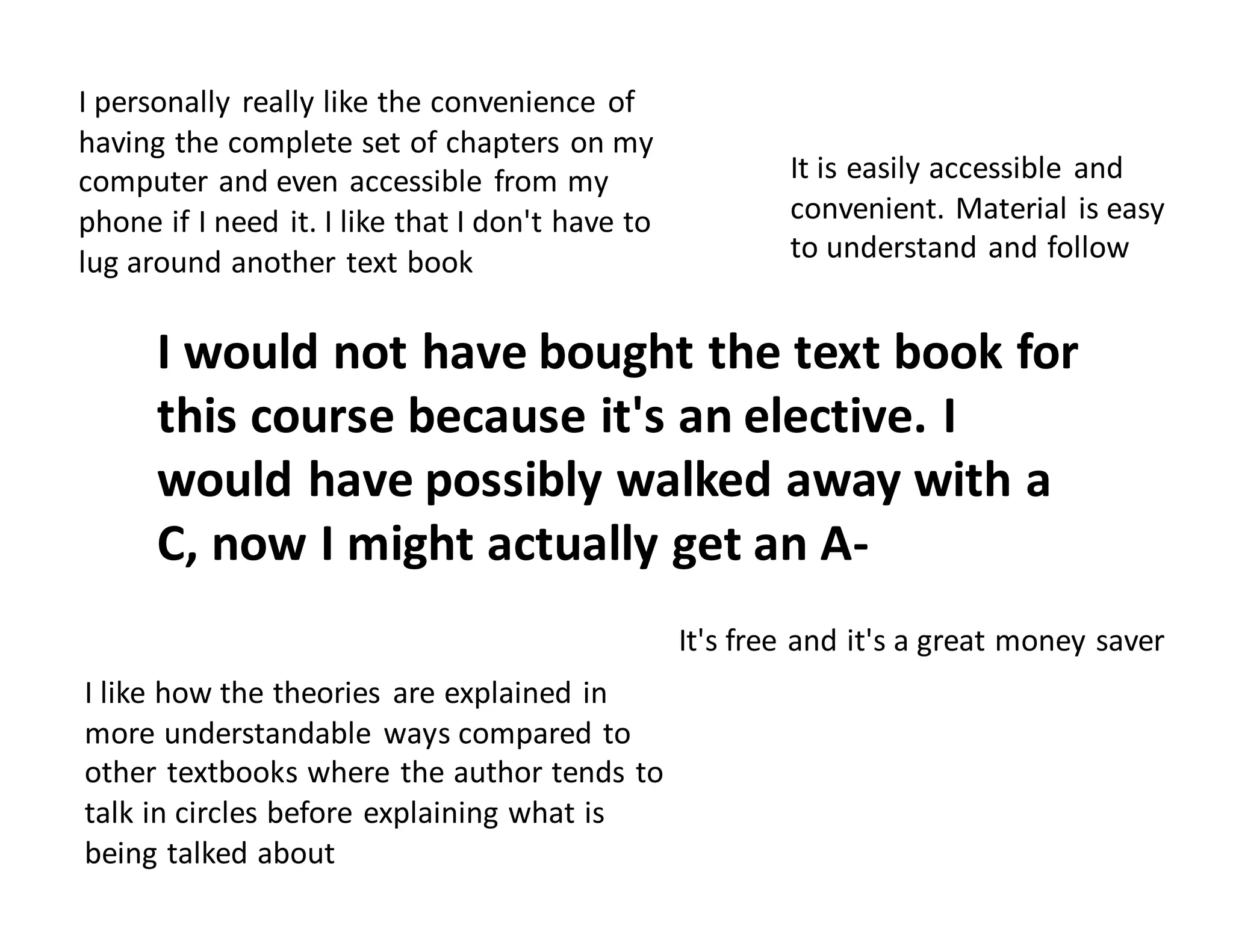
    I  like  how  the  theories   are  explained  in   more  understandable   ways  compared  to   other  textbooks  where  the  author  tends  to   talk  in  circles  before  explaining  what  is   being  talked  about I  would  not  have  bought  the  text  book  for   this  course  because  it's  an  elective.  I   would  have  possibly  walked  away  with  a   C,  now  I  might  actually  get  an  A-­‐ It  is  easily  accessible   and   convenient.  Material  is  easy   to  understand  and  follow I  personally  really  like  the  convenience   of   having  the  complete  set  of  chapters  on  my   computer  and  even  accessible   from  my   phone  if  I  need  it.  I  like  that  I  don't  have  to   lug  around  another  text  book It's  free  and  it's  a  great  money  saver
  • 45.
    11 Peer  Reviewed  Studies http://openedgroup.org/  
  • 46.
  • 47.
    Hilton  &  Laman(2012) • 7  psychology  faculty • Houston  Community  College • 23  sections  (690  students) Traditional textbook   (Spring  2011) Open  textbook (Fall 2012) GPA 1.6 2.0 Withdrawal  rate  (%) 14 7.1 Final examination  (%) 67.6 71.1 Hilton,  J.,  &  Laman,  C.  (2012).  One  college’s  use  of  an  open  psychology  textbook.  Open   Learning,  27(3),  265-­‐272.  http://dx.doi.org/10.1080/02680513.2012.716657
  • 48.
    Robinson  et  al.  (2014) • Quasi-­‐experimental  design • Propensity-­‐score  matched  groups • OT  students  scored  slightly  higher  on  end-­‐of-­‐year   standardized  science  tests • Significant  gains  in  chemistry • No  differences  in  physics  or  earth  systems Robinson  T.  J.,  Fischer,  L.,  Wiley,  D.  A.,  &  Hilton,  J.  (2014).  The  impact  of  open  textbooks  on   secondary  science  learning  outcomes.  Educational  Researcher,  43(7),  341-­‐351. doi:   10.3102/0013189X14550275
  • 49.
    “Mad” “Glad” “Sad” “Rad” Cost Completing  with  C  or  Better Commercial OER Student  Success  per  Dollar 0 100% $200
  • 51.
    Cost  savings Access Portability Course  performance Adapt,  update,  &  remix Enrolment Student  retention Program  completion
  • 53.
    open.bccampus.ca What  can  YOU do? • Survey  your  student  body • #textbookbroke campaign • Presentations   • Utilize  visuals,  create  displays • Speak  directly  to  faculty  &  admin • Suggest  that  faculty  review  a  textbook • Showcase  examples • Form  a  student-­led  OER  group • Connect.  Collaborate.
  • 54.
    The Z-Degree REMOVING TEXTBOOKCOSTS AS A BARRIER TO STUDENT SUCCESS THROUGH AN OER-BASED CURRICULUM Decreased  cost  to   graduate  by  25% Increased   pedagogical  flexibility Improved  course   completion  rates
  • 55.
    RESEARCH   ESSAYS. I  CAN  WRITE   RESEARCH   ESSAYS
  • 59.
    • >8,500  Psychology  articles • Viewed  >64,000  times  every  six  months • ~63%  have  gone  through  Wikipedia’s  peer   assessment • ~9%  have  achieved  “good  article”  status
  • 61.
    Benefits • Achieve  deeper  understanding  of  the  topic(Farzan &  Kraut,  2013) • Evaluate  and  defend  credibility  of  sources  (Marentette,  2014) • Write  more  concisely  and  think  more  critically  (Farzan &  Kraut,  2013) • Collaborating  with  students  from  around  the  world  (Karney,  2012) • Provide  and  receive  constructive  feedback  (Ibrahim,  2012) • Enhance  digital  literacy  (Silton,  2012) • Communicate  ideas  to  a  general  audience  (APS,  2013)
  • 63.
    14,000 33,000 92% Students  who  have  taken  on   Wikipedia  assignments  since  2010 New  articles  that  students  have   created Instructors  who  say  they  will,  or   plan  to,  teach  with  Wikipedia  again
  • 70.
    Open   hypotheses   &  analysis   plan Open   research   materials Open  data Open   source   statistical   software Open  peer   review Open   publishing Open Science Practices
  • 71.
    RECORD  PROFITS +  volunteer  work  =Public  funding
  • 72.
    Where  Social  Justice  Meets  Good  Pedagogy
  • 73.