Christine May P. Brillantes
Teacher III
Antipolo National High School
Christine May P. Brillantes
Teacher III
Antipolo National High School
OBJECTIVES
Define what
Frayer Model is
Create activities
that make use of
the Frayer Model
analyze and synthesize
vocabulary information
using the Frayer Moder
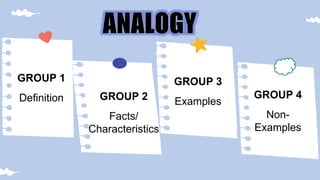
GROUP 1
Definition
GROUP 3
Examples
GROUP 2
Facts/
Characteristics
GROUP 4
Non-
Examples
Vocabulary plays a
fundamental role in the
reading process and is critical
to reading comprehension.
Vocabulary
knowledge is important
because it encompasses all the
words we must know to access
our background knowledge,
express our ideas and
communicate effectively, and
learn about new concepts.
If students do not adequately
and steadily grow their
vocabulary knowledge, reading
comprehension will be affected
(Chall & Jacobs, 2003).
In its analysis of the research on
vocabulary instruction, the
National Reading Panel (2000)
found that there is no one best
method for vocabulary
instruction, and that vocabulary
should be taught both directly
and indirectly.
The FRAYER MODEL is a graphic
organizer that helps students
determine or clarify the meaning of
vocabulary words encountered
while listening, reading, and viewing
texts
This technique requires students to define target
vocabulary and apply their knowledge by generating
examples and non- examples, giving characteristics,
and/ or drawing a picture to illustrate the meaning of
the word.
This information is placed on a chart that is divided into
four sections to provide a visual representation for
students.
This strategy stresses understanding words within the
larger context of a reading selection by requiring
students, first, to analyze the items (definition and
characteristics) and, second, to synthesize/apply this
information by thinking of examples and non-
examples.
BEFORE
READING
to activate
background
knowledge
The Frayer Model can be used:
AFTER
READING
to assess
vocabulary
DURING
READING
to monitor
vocabulary
develop understanding of key
concepts and vocabulary
The Frayer Model helps you
draw on prior knowledge to make
connections among concepts
compare attributes and
examples.
think critically to find
relationships between concepts
and to develop deeper
understand word meanings
The Frayer Model helps you
make visual connections and
personal associations
review key vocabulary before a
test or quiz
create a “vocabulary wall” for
quick reference of word meanings
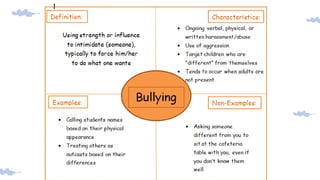
Elements of Frayer Model
DEFINITION
FACTS/
CHARACTERISTICS
EXAMPLES NON-EXAMPLES
Explain the Frayer model chart to the class by
using a common word to demonstrate the
various components. Model the type and
quality of desired answers when giving the
examples. Think out loud as you try to come
up with examples and non examples, etc.
Pictures/symbols can also be used.
Step 1
Then review a pre-selected list
of key concept words with the
class before reading about the
topic in the textbook. Read
the text selection.
Step 2
Choose a key concept or word
from the topic read and have
students help you complete
the Frayer chart.
Step 3
Pass out blank copies of the
Frayer Model or have students
create a chart in their copies.
Step 4
Then students practice the
strategy in pairs or in small groups
with the key concepts and key
vocabulary from the topic. (Each
group could also be given different
key concept words).
Step 5
The groups share their completed
charts with each other. Students
can then add additional words/
images/symbols to the Frayer
chart until all four categories are
substantially represented.
Step 6
Use this tool to quickly assess students for learning.
Make copies of each Frayer graphic organizer so every
student has a copy of all key concepts to use for review.
OR display completed Frayer graphic organizers on a
“Vocabulary Wall” for student reference.
Use the Pic Collage app for iPad to allow students to create
Frayer model graphic organizers using a tablet device (see
http: //pic-collage.com).
Use online templates to create models that give students a
clear understanding of the concepts under discussion.
The Frayer Model
Application across the
curriculum
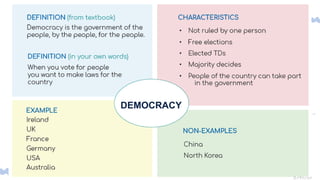
DEMOCRACY
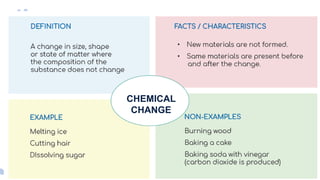
CHEMICAL
CHANGE
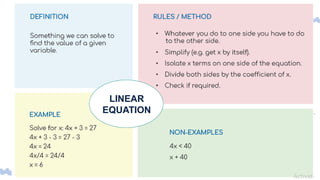
LINEAR
EQUATION
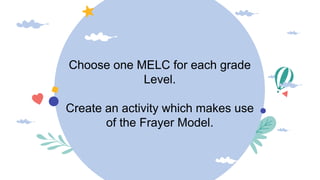
Choose one MELC for each grade
Level.
Create an activity which makes use
of the Frayer Model.

The Frayer Model.pptx

  • 1.
    Christine May P.Brillantes Teacher III Antipolo National High School
  • 2.
    Christine May P.Brillantes Teacher III Antipolo National High School
  • 3.
    OBJECTIVES Define what Frayer Modelis Create activities that make use of the Frayer Model analyze and synthesize vocabulary information using the Frayer Moder
  • 4.
    GROUP 1 Definition GROUP 3 Examples GROUP2 Facts/ Characteristics GROUP 4 Non- Examples
  • 5.
    Vocabulary plays a fundamentalrole in the reading process and is critical to reading comprehension.
  • 6.
    Vocabulary knowledge is important becauseit encompasses all the words we must know to access our background knowledge, express our ideas and communicate effectively, and learn about new concepts.
  • 7.
    If students donot adequately and steadily grow their vocabulary knowledge, reading comprehension will be affected (Chall & Jacobs, 2003).
  • 8.
    In its analysisof the research on vocabulary instruction, the National Reading Panel (2000) found that there is no one best method for vocabulary instruction, and that vocabulary should be taught both directly and indirectly.
  • 10.
    The FRAYER MODELis a graphic organizer that helps students determine or clarify the meaning of vocabulary words encountered while listening, reading, and viewing texts
  • 11.
    This technique requiresstudents to define target vocabulary and apply their knowledge by generating examples and non- examples, giving characteristics, and/ or drawing a picture to illustrate the meaning of the word. This information is placed on a chart that is divided into four sections to provide a visual representation for students.
  • 12.
    This strategy stressesunderstanding words within the larger context of a reading selection by requiring students, first, to analyze the items (definition and characteristics) and, second, to synthesize/apply this information by thinking of examples and non- examples.
  • 13.
    BEFORE READING to activate background knowledge The FrayerModel can be used: AFTER READING to assess vocabulary DURING READING to monitor vocabulary
  • 14.
    develop understanding ofkey concepts and vocabulary The Frayer Model helps you draw on prior knowledge to make connections among concepts compare attributes and examples. think critically to find relationships between concepts and to develop deeper
  • 15.
    understand word meanings TheFrayer Model helps you make visual connections and personal associations review key vocabulary before a test or quiz create a “vocabulary wall” for quick reference of word meanings
  • 16.
    Elements of FrayerModel DEFINITION FACTS/ CHARACTERISTICS EXAMPLES NON-EXAMPLES
  • 18.
    Explain the Frayermodel chart to the class by using a common word to demonstrate the various components. Model the type and quality of desired answers when giving the examples. Think out loud as you try to come up with examples and non examples, etc. Pictures/symbols can also be used. Step 1
  • 19.
    Then review apre-selected list of key concept words with the class before reading about the topic in the textbook. Read the text selection. Step 2
  • 20.
    Choose a keyconcept or word from the topic read and have students help you complete the Frayer chart. Step 3
  • 21.
    Pass out blankcopies of the Frayer Model or have students create a chart in their copies. Step 4
  • 22.
    Then students practicethe strategy in pairs or in small groups with the key concepts and key vocabulary from the topic. (Each group could also be given different key concept words). Step 5
  • 23.
    The groups sharetheir completed charts with each other. Students can then add additional words/ images/symbols to the Frayer chart until all four categories are substantially represented. Step 6
  • 24.
    Use this toolto quickly assess students for learning. Make copies of each Frayer graphic organizer so every student has a copy of all key concepts to use for review. OR display completed Frayer graphic organizers on a “Vocabulary Wall” for student reference. Use the Pic Collage app for iPad to allow students to create Frayer model graphic organizers using a tablet device (see http: //pic-collage.com). Use online templates to create models that give students a clear understanding of the concepts under discussion.
  • 25.
    The Frayer Model Applicationacross the curriculum
  • 26.
  • 27.
  • 28.
  • 30.
    Choose one MELCfor each grade Level. Create an activity which makes use of the Frayer Model.

Editor's Notes

  • #5  Before Reading Use the graphic organizer to activate students’ prior knowledge. Show students a completed Frayer Model but leave out the name in the concept circle. See if they can name the main concept by looking at the four squares. During Reading As a class, generate a list of words that connect to the main concept. Then, divide students into small groups to fill in the four sections of the Frayer Model using the list of words that was brainstormed. After Reading Discuss the main concept of the Frayer Model and talk about the nonexamples. Add any new knowledge to the graphic organizer.
  • #14  Before Reading Use the graphic organizer to activate students’ prior knowledge. Show students a completed Frayer Model but leave out the name in the concept circle. See if they can name the main concept by looking at the four squares. During Reading As a class, generate a list of words that connect to the main concept. Then, divide students into small groups to fill in the four sections of the Frayer Model using the list of words that was brainstormed. After Reading Discuss the main concept of the Frayer Model and talk about the nonexamples. Add any new knowledge to the graphic organizer.