Reading Comprehension and Vocabulary Development in the Content Area25 February Class MeetingAEDR 518 | Spring 2011
Before readingAEDR 518 | Spring 2011During readingAfter reading
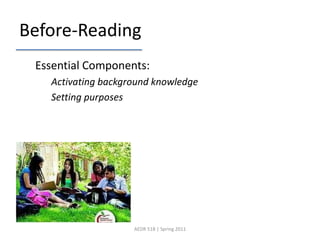
Before-ReadingEssential Components:Activating background knowledgeSetting purposesAEDR 518 | Spring 2011
Before-ReadingStrategiesPreviewing 		What do I already know about the topic?Setting Purposes for Reading 			I will read this text to learn . . .Predicting and inferring 		What can I hypothesize based on what I already 	know and what I am able to assume from the 	text?AEDR 518 | Spring 2011
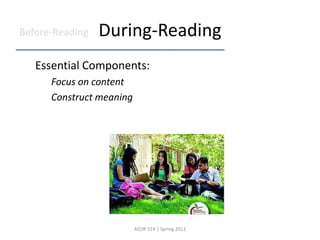
During-ReadingEssential Components:Focus on contentConstruct meaningAEDR 518 | Spring 2011Before-Reading
During-ReadingStrategiesSelf-questioning		Do I understand what I just read?Monitoring/Clarifying		Does this make sense?Visualizing		Forming mental images…AEDR 518 | Spring 2011Before-Reading
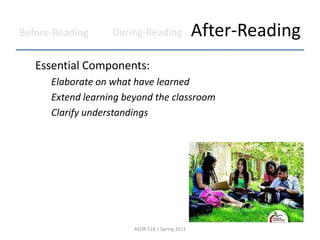
After-ReadingEssential Components:Elaborate on what have learnedExtend learning beyond the classroomClarify understandingsAEDR 518 | Spring 2011During-ReadingBefore-Reading
After-ReadingStrategiesSummarizing		What is the essential information?Evaluating		Is the author’s message consistent?		Whose perspective is presented in the text?AEDR 518 | Spring 2011During-ReadingBefore-Reading
Reading Comprehension StrategiesAEDR 518 | Spring 2011Next -> Vocabulary instruction
Teaching Vocabulary in Your Content AreaAEDR 518 | Spring 2011
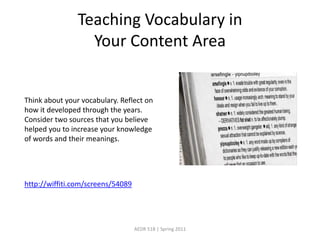
Teaching Vocabulary in Your Content AreaAEDR 518 | Spring 2011Think about your vocabulary. Reflect on how it developed through the years. Consider two sources that you believe helped you to increase your knowledge of words and their meanings.http://wiffiti.com/screens/54089
Strategies for Teaching Vocabulary in Your Content Area1. Frayermodel (with video example)2. Concept Definition modelAEDR 518 | Spring 2011
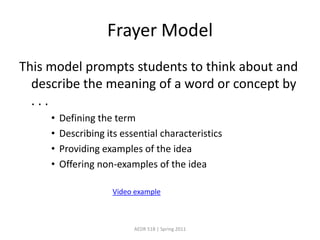
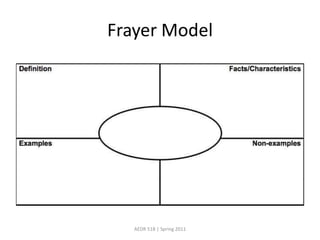
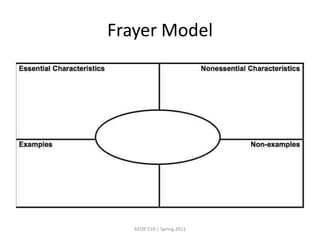
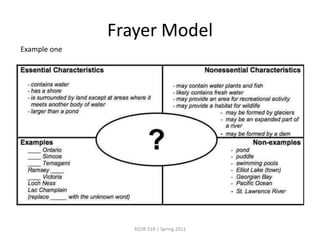
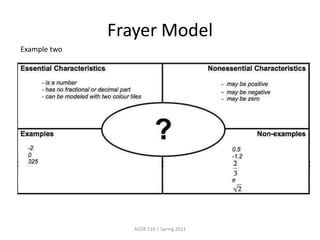
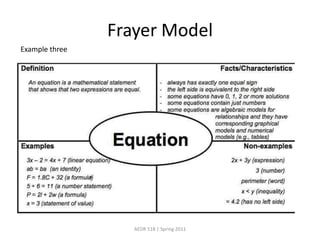
Frayer ModelThis model prompts students to think about and describe the meaning of a word or concept by . . . Defining the termDescribing its essential characteristicsProviding examples of the idea Offering non-examples of the ideaAEDR 518 | Spring 2011Video example
Frayer ModelAEDR 518 | Spring 2011
Frayer ModelAEDR 518 | Spring 2011Example one
Frayer ModelAEDR 518 | Spring 2011Example two
Frayer ModelAEDR 518 | Spring 2011Example three
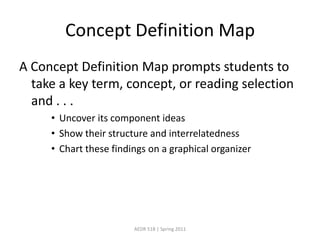
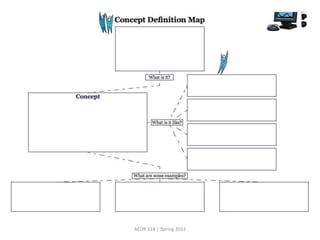
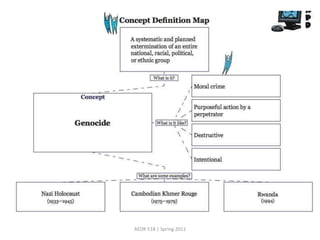
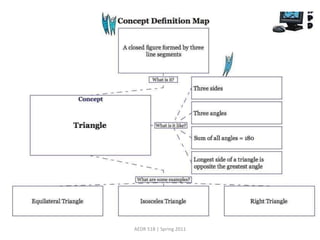
Concept Definition MapAEDR 518 | Spring 2011A Concept Definition Map prompts students to take a key term, concept, or reading selection and . . . Uncover its component ideas Show their structure and interrelatednessChart these findings on a graphical organizer
AEDR 518 | Spring 2011
PollTake out your cell phones!Send a text message to …..http://www.polleverywhere.com/multiple_choice_polls/MTQ0NzM3MTE4Mwhttp://www.polleverywhere.com/multiple_choice_polls/LTE2OTQ2ODE4NDEhttp://www.polleverywhere.com/multiple_choice_polls/MTgwMjUyODQ5MQhttp://www.polleverywhere.com/multiple_choice_polls/LTg4MTcxNzI3NQAEDR 518 | Spring 2011
Sources Just Read Nowhttp://www.justreadnow.com/strategies/vocabulary.htmContent Area Reading: Teaching and Learning in an Age of Multiple Literacieshttp://www.coursesmart.com/9780138140809My Education Labhttp://www.myeducationlab.com/literacy/deploy/literacy.htmlAEDR 518 | Spring 2011

Comprehension&vocabularyinstruction

  • 1.
    Reading Comprehension andVocabulary Development in the Content Area25 February Class MeetingAEDR 518 | Spring 2011
  • 2.
    Before readingAEDR 518| Spring 2011During readingAfter reading
  • 3.
    Before-ReadingEssential Components:Activating backgroundknowledgeSetting purposesAEDR 518 | Spring 2011
  • 4.
    Before-ReadingStrategiesPreviewing What doI already know about the topic?Setting Purposes for Reading I will read this text to learn . . .Predicting and inferring What can I hypothesize based on what I already know and what I am able to assume from the text?AEDR 518 | Spring 2011
  • 5.
    Before-ReadingStrategiesPreviewing What doI already know about the topic?Setting Purposes for Reading I will read this text to learn . . .Predicting and inferring What can I hypothesize based on what I already know and what I am able to assume from the text?AEDR 518 | Spring 2011
  • 6.
    During-ReadingEssential Components:Focus oncontentConstruct meaningAEDR 518 | Spring 2011Before-Reading
  • 7.
    During-ReadingStrategiesSelf-questioning Do I understandwhat I just read?Monitoring/Clarifying Does this make sense?Visualizing Forming mental images…AEDR 518 | Spring 2011Before-Reading
  • 8.
    After-ReadingEssential Components:Elaborate onwhat have learnedExtend learning beyond the classroomClarify understandingsAEDR 518 | Spring 2011During-ReadingBefore-Reading
  • 9.
    After-ReadingStrategiesSummarizing What is theessential information?Evaluating Is the author’s message consistent? Whose perspective is presented in the text?AEDR 518 | Spring 2011During-ReadingBefore-Reading
  • 10.
    Reading Comprehension StrategiesAEDR518 | Spring 2011Next -> Vocabulary instruction
  • 11.
    Teaching Vocabulary inYour Content AreaAEDR 518 | Spring 2011
  • 12.
    Teaching Vocabulary inYour Content AreaAEDR 518 | Spring 2011Think about your vocabulary. Reflect on how it developed through the years. Consider two sources that you believe helped you to increase your knowledge of words and their meanings.http://wiffiti.com/screens/54089
  • 13.
    Strategies for TeachingVocabulary in Your Content Area1. Frayermodel (with video example)2. Concept Definition modelAEDR 518 | Spring 2011
  • 14.
    Frayer ModelThis modelprompts students to think about and describe the meaning of a word or concept by . . . Defining the termDescribing its essential characteristicsProviding examples of the idea Offering non-examples of the ideaAEDR 518 | Spring 2011Video example
  • 15.
  • 16.
  • 17.
    Frayer ModelAEDR 518| Spring 2011Example one
  • 18.
    Frayer ModelAEDR 518| Spring 2011Example two
  • 19.
    Frayer ModelAEDR 518| Spring 2011Example three
  • 20.
    Concept Definition MapAEDR518 | Spring 2011A Concept Definition Map prompts students to take a key term, concept, or reading selection and . . . Uncover its component ideas Show their structure and interrelatednessChart these findings on a graphical organizer
  • 21.
    AEDR 518 |Spring 2011
  • 22.
    AEDR 518 |Spring 2011
  • 23.
    AEDR 518 |Spring 2011
  • 24.
    PollTake out yourcell phones!Send a text message to …..http://www.polleverywhere.com/multiple_choice_polls/MTQ0NzM3MTE4Mwhttp://www.polleverywhere.com/multiple_choice_polls/LTE2OTQ2ODE4NDEhttp://www.polleverywhere.com/multiple_choice_polls/MTgwMjUyODQ5MQhttp://www.polleverywhere.com/multiple_choice_polls/LTg4MTcxNzI3NQAEDR 518 | Spring 2011
  • 25.
    Sources Just ReadNowhttp://www.justreadnow.com/strategies/vocabulary.htmContent Area Reading: Teaching and Learning in an Age of Multiple Literacieshttp://www.coursesmart.com/9780138140809My Education Labhttp://www.myeducationlab.com/literacy/deploy/literacy.htmlAEDR 518 | Spring 2011