APPLIED ECONOMICS
OPENING PRAYER
We come to you in prayer this afternoon. We pray that
you guide us and lead us in your way. We thank you for
being our protector and our provider. We ask for your
strength and wisdom to get through the day.
We pray for those who are sick, or hurting, or lonely, that
they may feel your love through the prayers of others.
We pray for those who are lost and searching that they may
find their way home.
We pray for those who are grieving that they may find
peace in knowing their loved one is happy with you now.
And we pray that we can show love to each other
today, even if it is difficult at times.
In Jesus name we pray, Amen
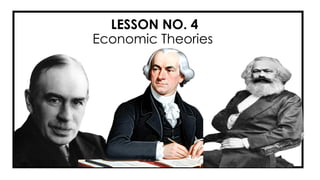
LESSON NO. 4
Economic Theories
LESSON OBJECTIVE:
•explain the
economic theories
and models.
WHAT IS ECONOMICS THEORY?
Economic theory is the set of general
principles or statements that seek to
interpret economic reality.
Economic theory develops lines of thought
that seek to explain an economic
problem at a given historical moment.
TWO APPROACHES IN
ECONOMIC THEORY
MACROECONOMICS MICROECONOMICS
Which analyzes
the economic
variables of a
region, a country,
or the world.
which studies a
given productive
unit and the
behavior of the
individual consumer
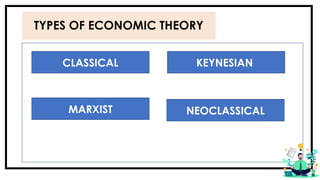
TYPES OF ECONOMIC THEORY
CLASSICAL
NEOCLASSICAL
MARXIST
KEYNESIAN
WHAT IS CLASSICAL THEORY?
• Classical economic theory tends to favor a free market
system.
• This theory-based its positions on the empirical study of
reality, formulating conceptual models through which
they enunciated natural laws.
• The areas of interest of this theory were the groups or
classes of individuals, the study of the wages received by
workers, and the wealth of nations through the generation
of value not paid to the worker that the employer or
capitalist received ( surplus value ).
WHAT IS CLASSICAL THEORY?
• Classical economists believe that individuals
allowed to act in their self-interests will present a
strong group of consumers.
• Terms like capitalism and supply-
side economics also describe this theory.
• The protection of personal property through courts
of law is often a major component of free-market
economics.
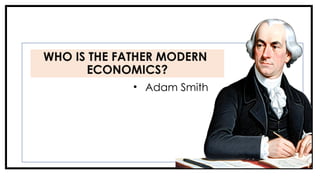
• Adam Smith
WHO IS THE FATHER MODERN
ECONOMICS?
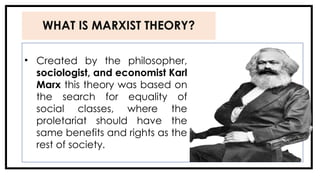
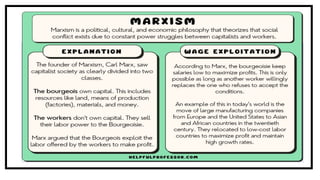
WHAT IS MARXIST THEORY?
• Created by the philosopher,
sociologist, and economist Karl
Marx this theory was based on
the search for equality of
social classes, where the
proletariat should have the
same benefits and rights as the
rest of society.
WHAT IS MARXIST THEORY?
• a set of ideas and beliefs that are dominant in society and are
used to justify the power and privilege of the ruling class.
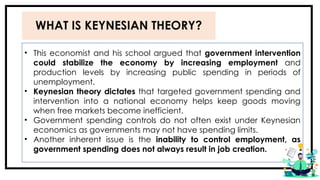
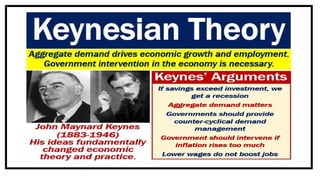
WHAT IS KEYNESIAN THEORY?
• This economist and his school argued that government intervention
could stabilize the economy by increasing employment and
production levels by increasing public spending in periods of
unemployment.
• Keynesian theory dictates that targeted government spending and
intervention into a national economy helps keep goods moving
when free markets become inefficient.
• Government spending controls do not often exist under Keynesian
economics as governments may not have spending limits.
• Another inherent issue is the inability to control employment, as
government spending does not always result in job creation.
WHAT IS NEOCLASSICAL
THEORY?
• It emerged in the mid-nineteenth century as a
reaction to the classical school.
• main contribution was the marginal theory of the
value of a good, the increase in total utility that
involves consuming an additional unit of that good.
• Its field of action is individual economic units
(people, companies, etc.), that is, microeconomics.
WHAT IS ECONOMIC MODEL?
Economic model is a theoretical construct that
represents a process by several variables and a
set of quantitative or logical relationships
between them – to determine what might
happen in different scenarios or at a future date.
An economic model is a simplified representation
of economic processes and relationships.
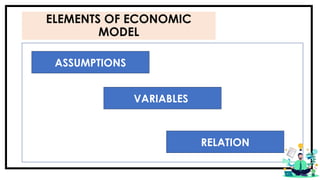
ELEMENTS OF ECONOMIC
MODEL
ASSUMPTIONS
RELATION
VARIABLES
ELEMENTS OF ECONOMIC
MODEL
ASSUMPTIONS
• Since a model is a simplification, to create a model, it’s
necessary to make assumptions.
• Examples of assumptions usually made by economists
are rational expectations or perfect information.
• The assumptions cannot contradict each other.
• One must be careful to choose the right model for the
right task.
ELEMENTS OF ECONOMIC
MODEL
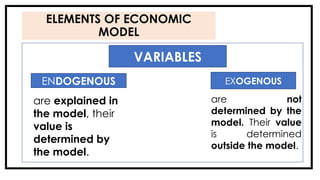
VARIABLES
ENDOGENOUS EXOGENOUS
are explained in
the model, their
value is
determined by
the model.
are not
determined by the
model. Their value
is determined
outside the model.
ELEMENTS OF ECONOMIC
MODEL
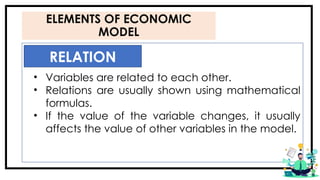
RELATION
• Variables are related to each other.
• Relations are usually shown using mathematical
formulas.
• If the value of the variable changes, it usually
affects the value of other variables in the model.
How does an assumption
affect the economic
status of a state? Justify
your answer.
CLOSING PRAYER

DAY 4 - PRESENTATION FOR APPLIED ECONOMICS

  • 1.
  • 2.
  • 3.
    We come toyou in prayer this afternoon. We pray that you guide us and lead us in your way. We thank you for being our protector and our provider. We ask for your strength and wisdom to get through the day. We pray for those who are sick, or hurting, or lonely, that they may feel your love through the prayers of others. We pray for those who are lost and searching that they may find their way home. We pray for those who are grieving that they may find peace in knowing their loved one is happy with you now. And we pray that we can show love to each other today, even if it is difficult at times. In Jesus name we pray, Amen
  • 5.
  • 6.
  • 7.
    WHAT IS ECONOMICSTHEORY? Economic theory is the set of general principles or statements that seek to interpret economic reality. Economic theory develops lines of thought that seek to explain an economic problem at a given historical moment.
  • 8.
    TWO APPROACHES IN ECONOMICTHEORY MACROECONOMICS MICROECONOMICS Which analyzes the economic variables of a region, a country, or the world. which studies a given productive unit and the behavior of the individual consumer
  • 9.
    TYPES OF ECONOMICTHEORY CLASSICAL NEOCLASSICAL MARXIST KEYNESIAN
  • 10.
    WHAT IS CLASSICALTHEORY? • Classical economic theory tends to favor a free market system. • This theory-based its positions on the empirical study of reality, formulating conceptual models through which they enunciated natural laws. • The areas of interest of this theory were the groups or classes of individuals, the study of the wages received by workers, and the wealth of nations through the generation of value not paid to the worker that the employer or capitalist received ( surplus value ).
  • 11.
    WHAT IS CLASSICALTHEORY? • Classical economists believe that individuals allowed to act in their self-interests will present a strong group of consumers. • Terms like capitalism and supply- side economics also describe this theory. • The protection of personal property through courts of law is often a major component of free-market economics.
  • 12.
    • Adam Smith WHOIS THE FATHER MODERN ECONOMICS?
  • 13.
    WHAT IS MARXISTTHEORY? • Created by the philosopher, sociologist, and economist Karl Marx this theory was based on the search for equality of social classes, where the proletariat should have the same benefits and rights as the rest of society.
  • 14.
    WHAT IS MARXISTTHEORY? • a set of ideas and beliefs that are dominant in society and are used to justify the power and privilege of the ruling class.
  • 15.
    WHAT IS KEYNESIANTHEORY? • This economist and his school argued that government intervention could stabilize the economy by increasing employment and production levels by increasing public spending in periods of unemployment. • Keynesian theory dictates that targeted government spending and intervention into a national economy helps keep goods moving when free markets become inefficient. • Government spending controls do not often exist under Keynesian economics as governments may not have spending limits. • Another inherent issue is the inability to control employment, as government spending does not always result in job creation.
  • 17.
    WHAT IS NEOCLASSICAL THEORY? •It emerged in the mid-nineteenth century as a reaction to the classical school. • main contribution was the marginal theory of the value of a good, the increase in total utility that involves consuming an additional unit of that good. • Its field of action is individual economic units (people, companies, etc.), that is, microeconomics.
  • 18.
    WHAT IS ECONOMICMODEL? Economic model is a theoretical construct that represents a process by several variables and a set of quantitative or logical relationships between them – to determine what might happen in different scenarios or at a future date. An economic model is a simplified representation of economic processes and relationships.
  • 19.
  • 20.
    ELEMENTS OF ECONOMIC MODEL ASSUMPTIONS •Since a model is a simplification, to create a model, it’s necessary to make assumptions. • Examples of assumptions usually made by economists are rational expectations or perfect information. • The assumptions cannot contradict each other. • One must be careful to choose the right model for the right task.
  • 21.
    ELEMENTS OF ECONOMIC MODEL VARIABLES ENDOGENOUSEXOGENOUS are explained in the model, their value is determined by the model. are not determined by the model. Their value is determined outside the model.
  • 22.
    ELEMENTS OF ECONOMIC MODEL RELATION •Variables are related to each other. • Relations are usually shown using mathematical formulas. • If the value of the variable changes, it usually affects the value of other variables in the model.
  • 24.
    How does anassumption affect the economic status of a state? Justify your answer.
  • 25.