Proving Your Impact: 
Pain-free Monitoring and Evaluation 
10th November 2014 
Robin Beveridge and Tony Sacco
Introduction 
• Domestics 
• Who’s who 
• What’s in store today 
• Ground rules 
• Networking and learning from each other
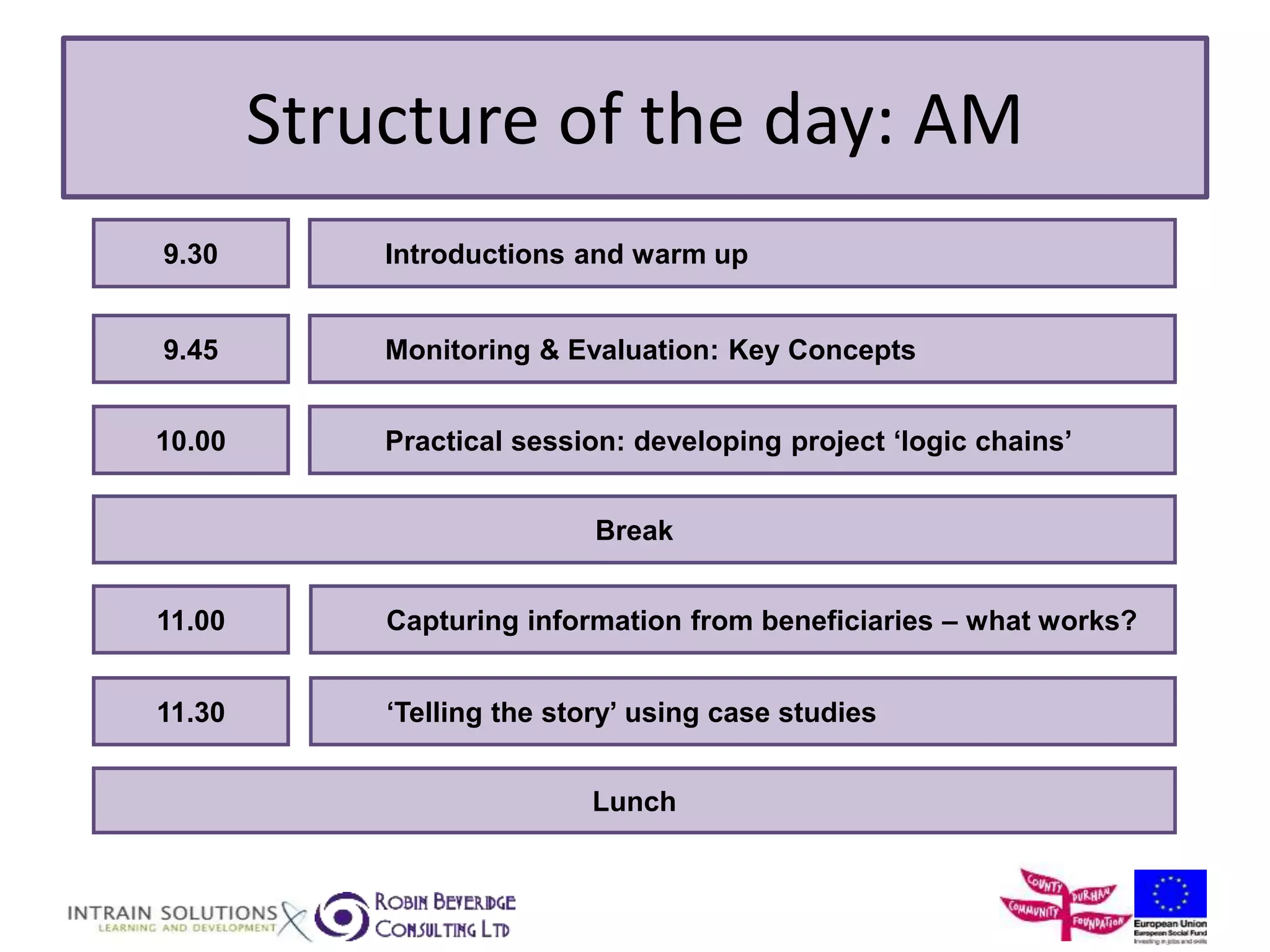
Structure of the day: AM 
9.30 Introductions and warm up 
9.45 Monitoring & Evaluation: Key Concepts 
10.00 Practical session: developing project ‘logic chains’ 
Break 
11.00 Capturing information from beneficiaries – what works? 
11.30 ‘Telling the story’ using case studies 
Lunch
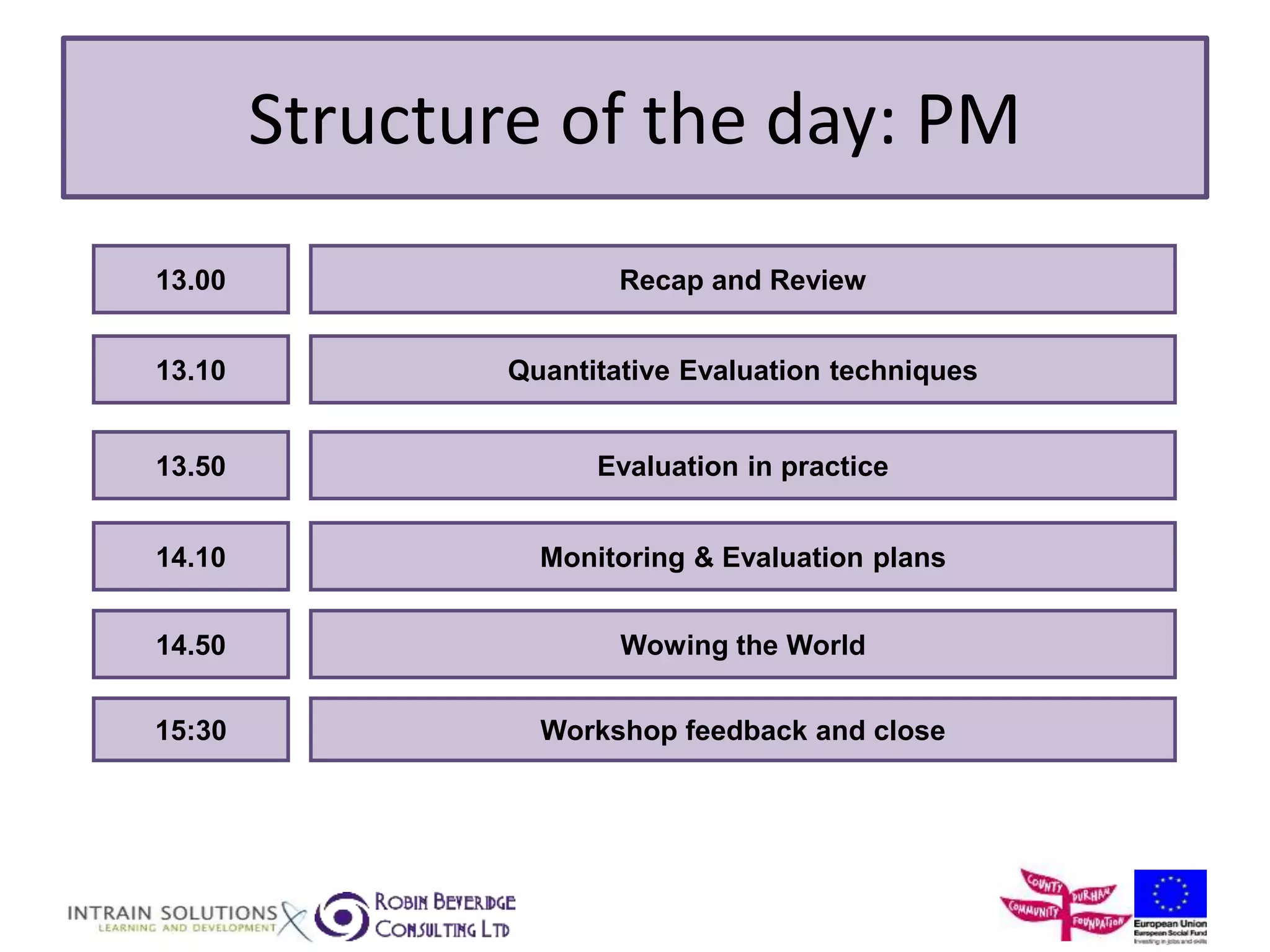
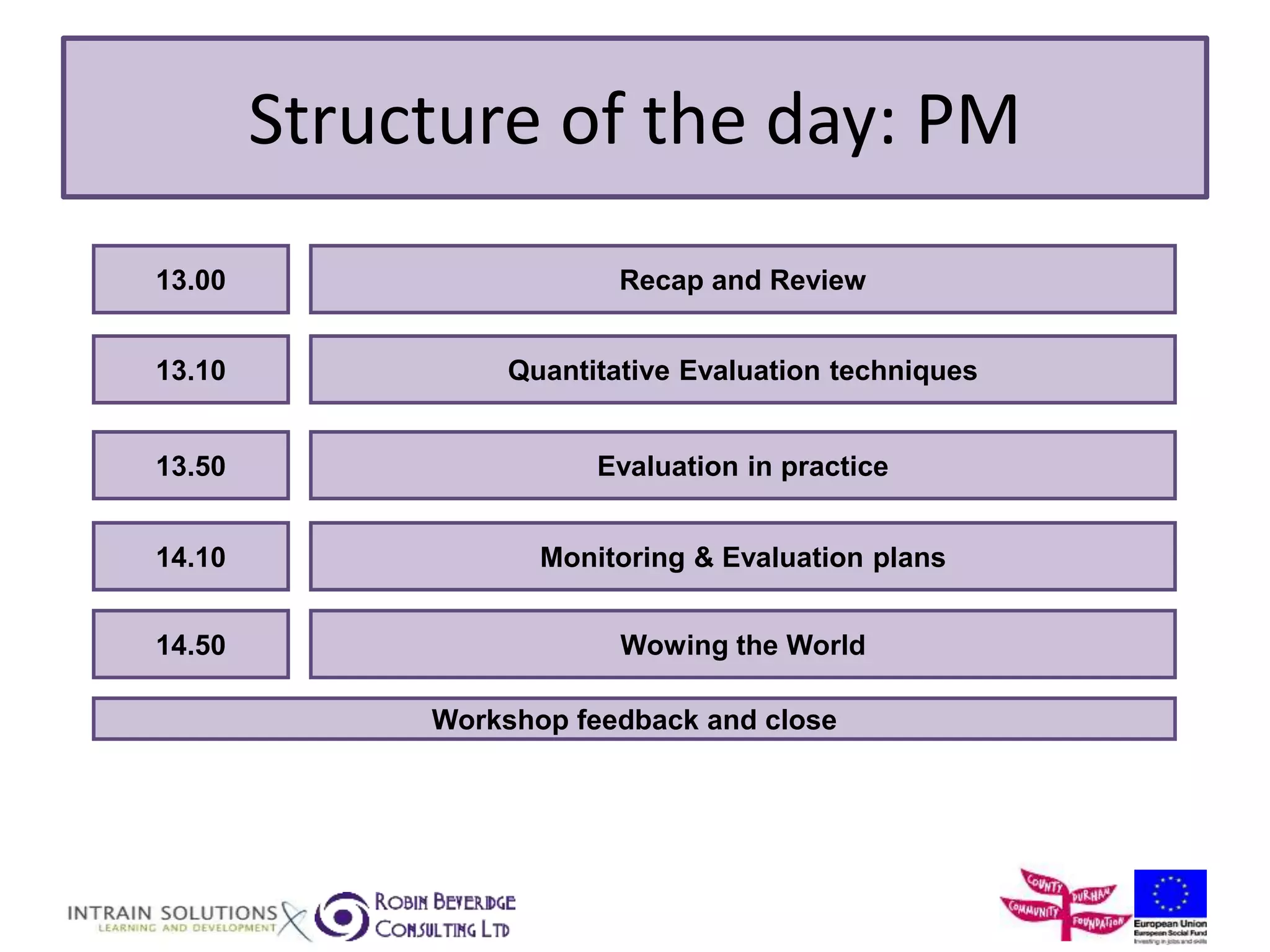
Structure of the day: PM 
13.00 Recap and Review 
13.10 
13.50 
14.10 
14.50 
Quantitative Evaluation techniques 
Evaluation in practice 
Monitoring & Evaluation plans 
Wowing the World 
Workshop feedback and close 
15:30
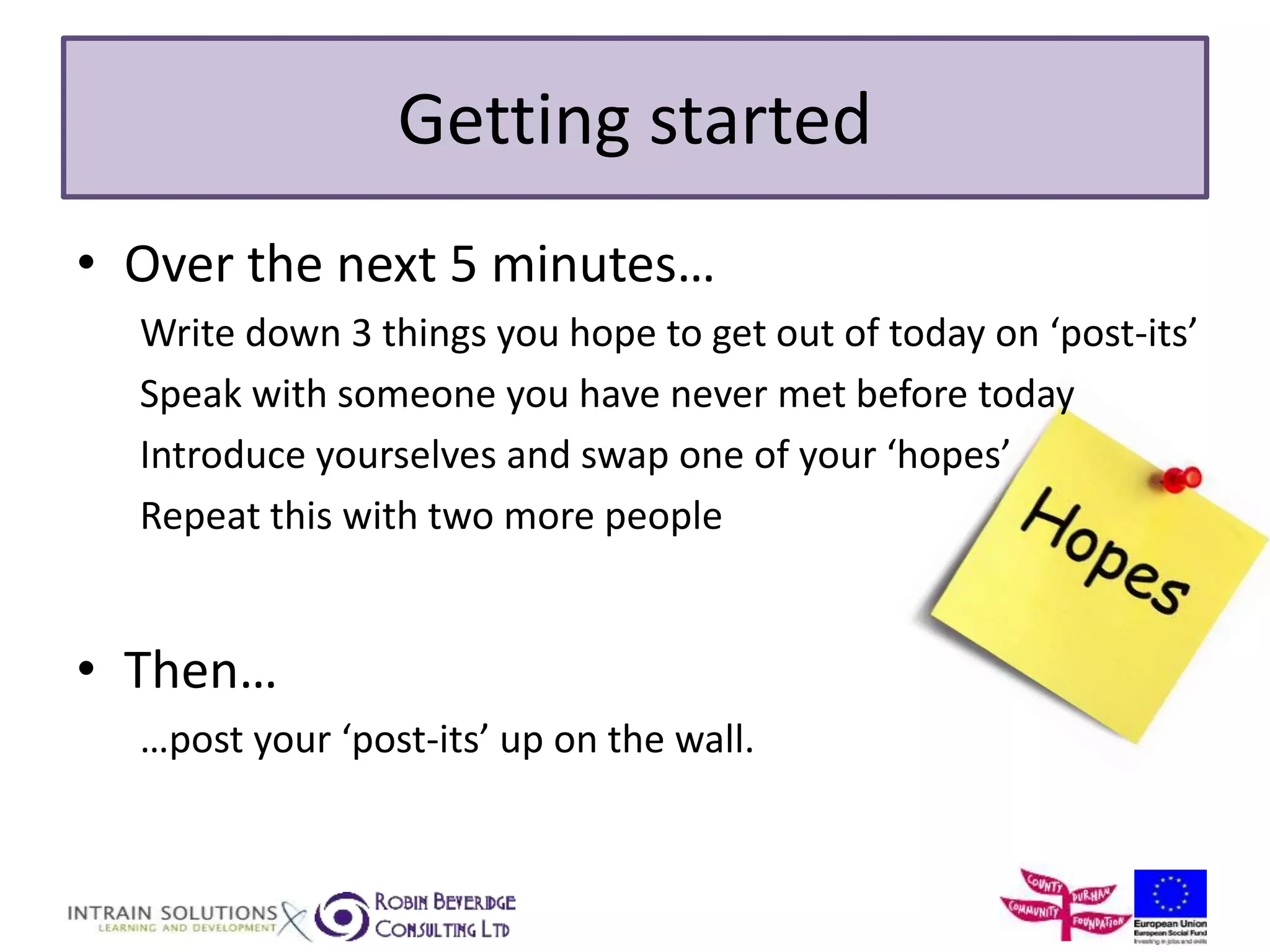
Getting started 
• Over the next 5 minutes… 
Write down 3 things you hope to get out of today on ‘post-its’ 
Speak with someone you have never met before today 
Introduce yourselves and swap one of your ‘hopes’ 
Repeat this with two more people 
• Then… 
…post your ‘post-its’ up on the wall.
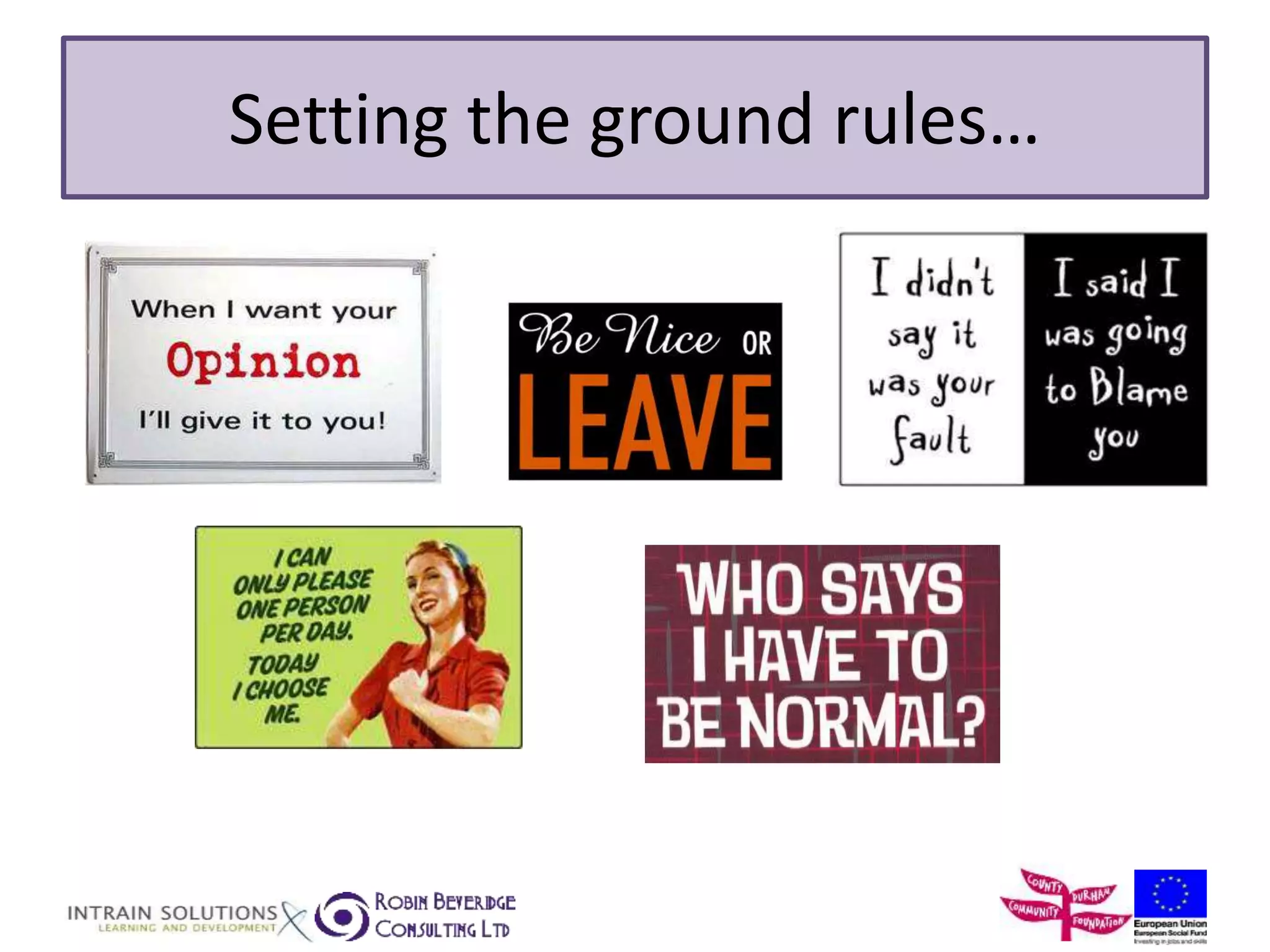
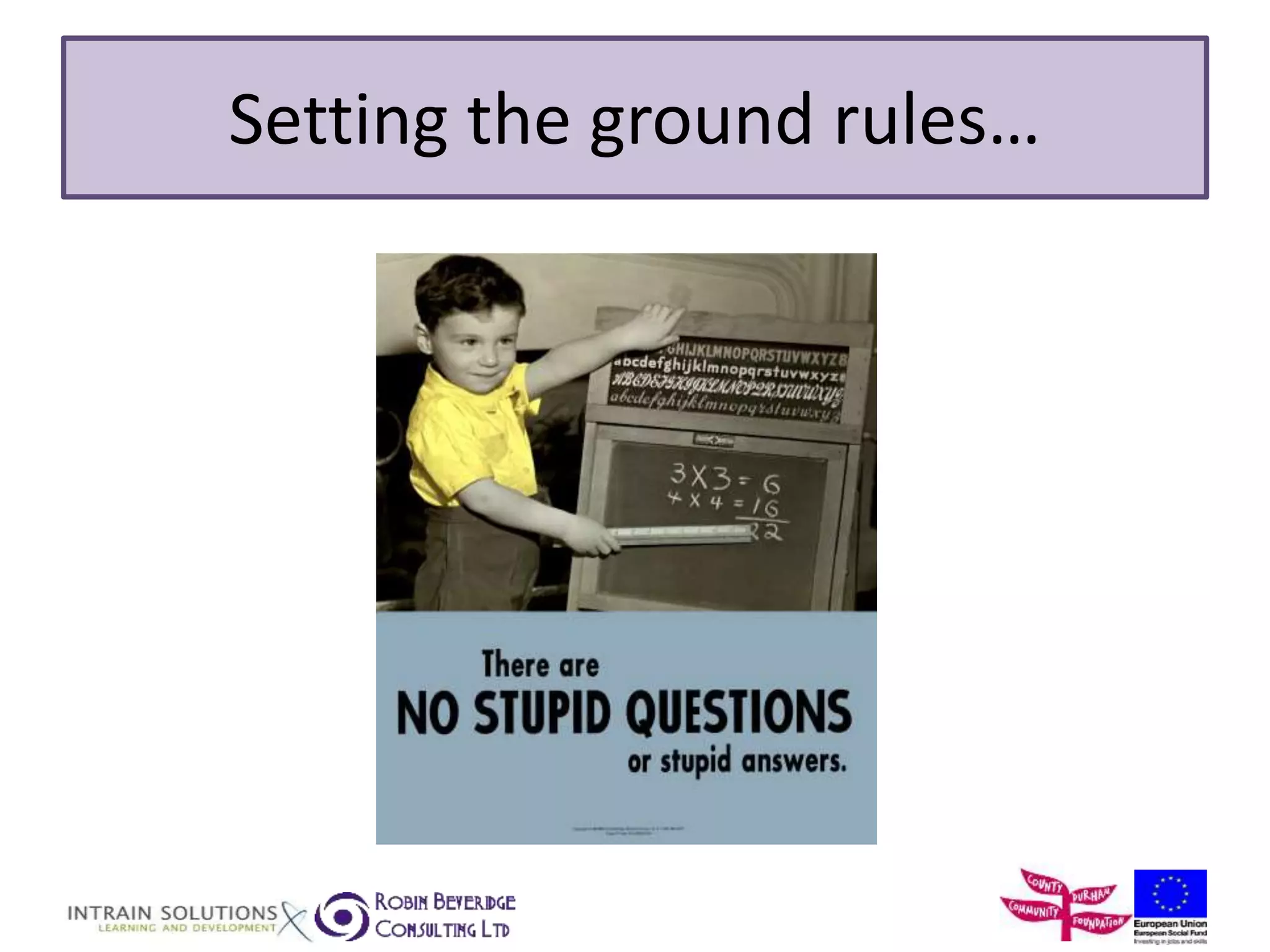
Setting the ground rules…
Key Concepts 
• Monitoring 
• Evaluation 
• Outputs 
• Outcomes 
• Impact 
• Aims 
• Objectives 
• Quantitative 
• Qualitative 
• Beneficiaries 
• Stakeholders 
• Value for Money 
• Additionality 
• Social Return
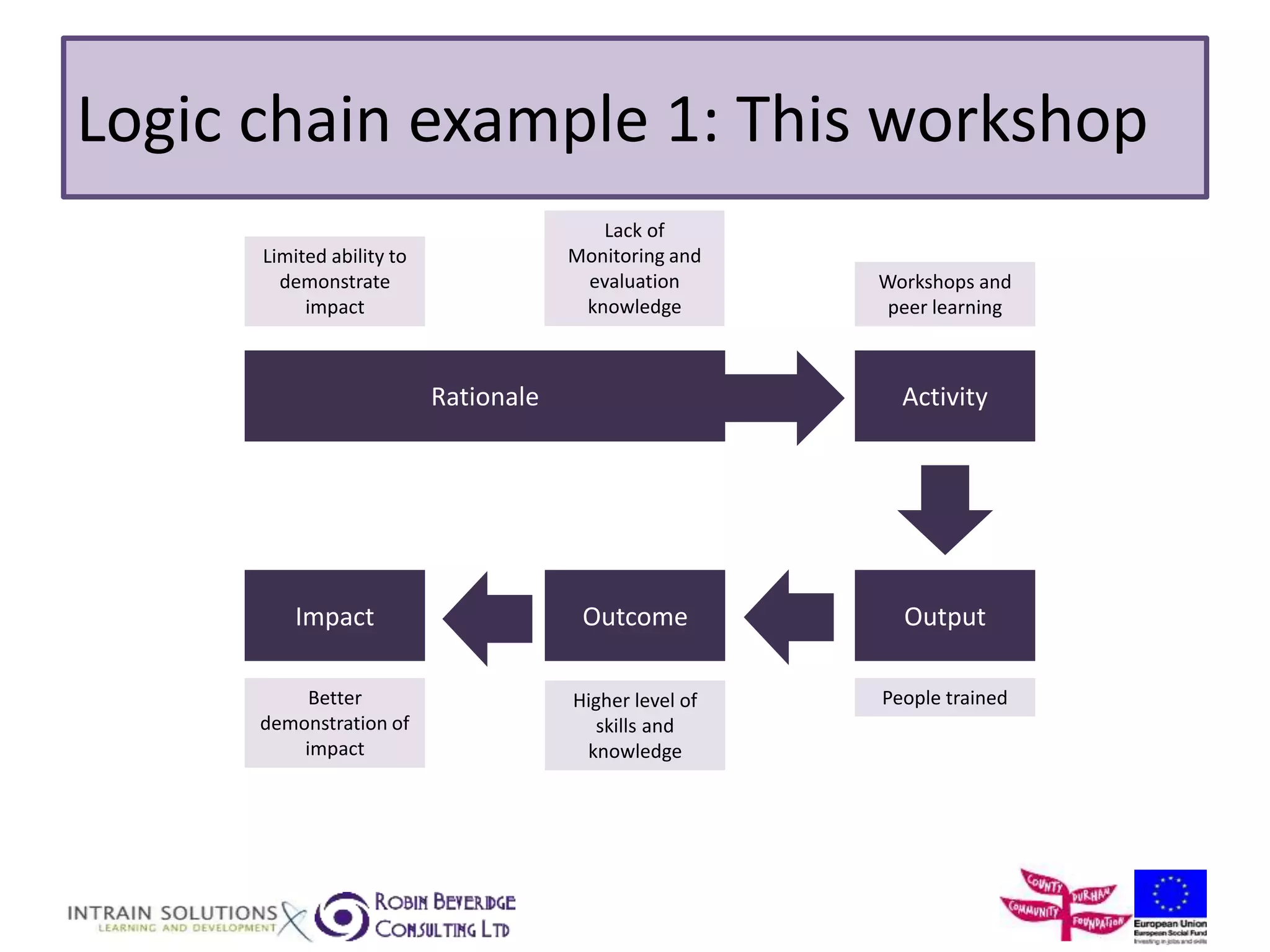
Logic chain example 1: This workshop 
Limited ability to 
demonstrate 
impact 
Need Activity 
Caused by 
Output 
Impact Outcome 
Workshops and 
peer learning 
Higher level of People trained 
skills and 
knowledge 
Better 
demonstration of 
impact 
Lack of 
Monitoring and 
evaluation 
knowledge 
Rationale
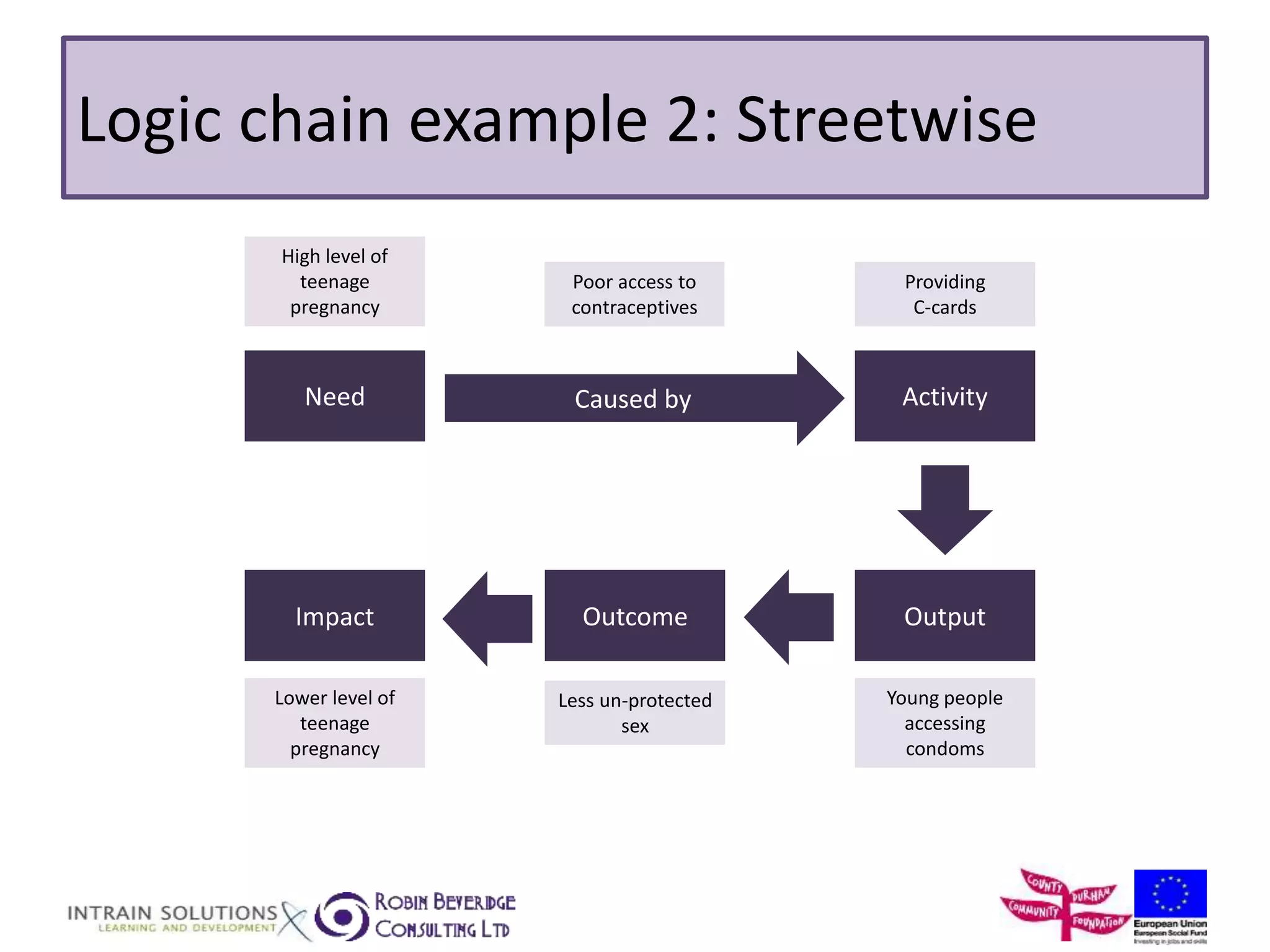
Logic chain example 2: Streetwise 
High level of 
teenage 
pregnancy 
Need Activity 
Caused by 
Output 
Impact Outcome 
Providing 
C-cards 
Young people 
accessing 
condoms 
Less un-protected 
sex 
Lower level of 
teenage 
pregnancy 
Poor access to 
contraceptives
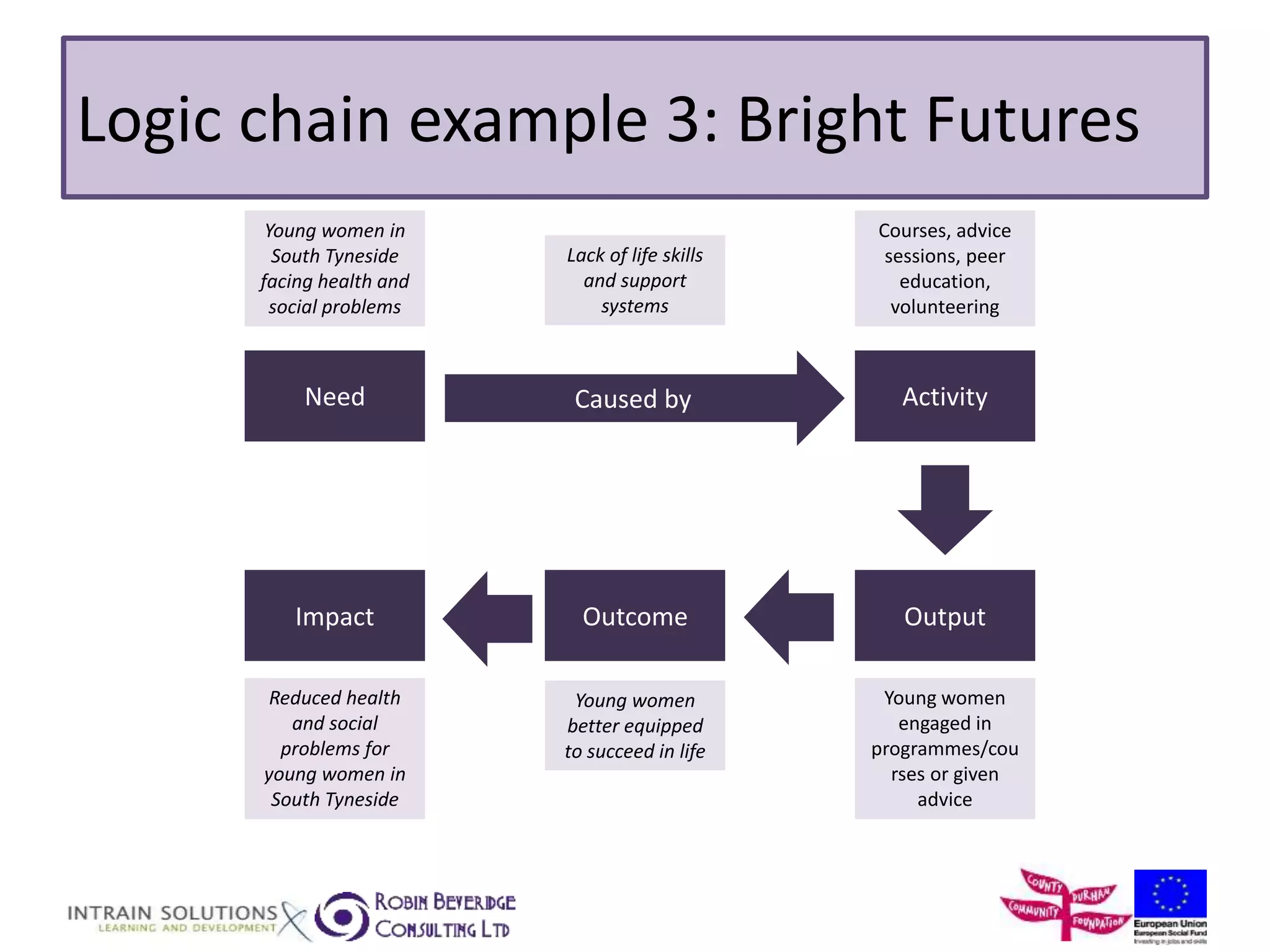
Logic chain example 3: Bright Futures 
Young women in 
South Tyneside 
facing health and 
social problems 
Need Activity 
Caused by 
Output 
Impact Outcome 
Courses, advice 
sessions, peer 
education, 
volunteering 
Young women 
engaged in 
programmes/cou 
rses or given 
advice 
Young women 
better equipped 
to succeed in life 
Reduced health 
and social 
problems for 
young women in 
South Tyneside 
Lack of life skills 
and support 
systems
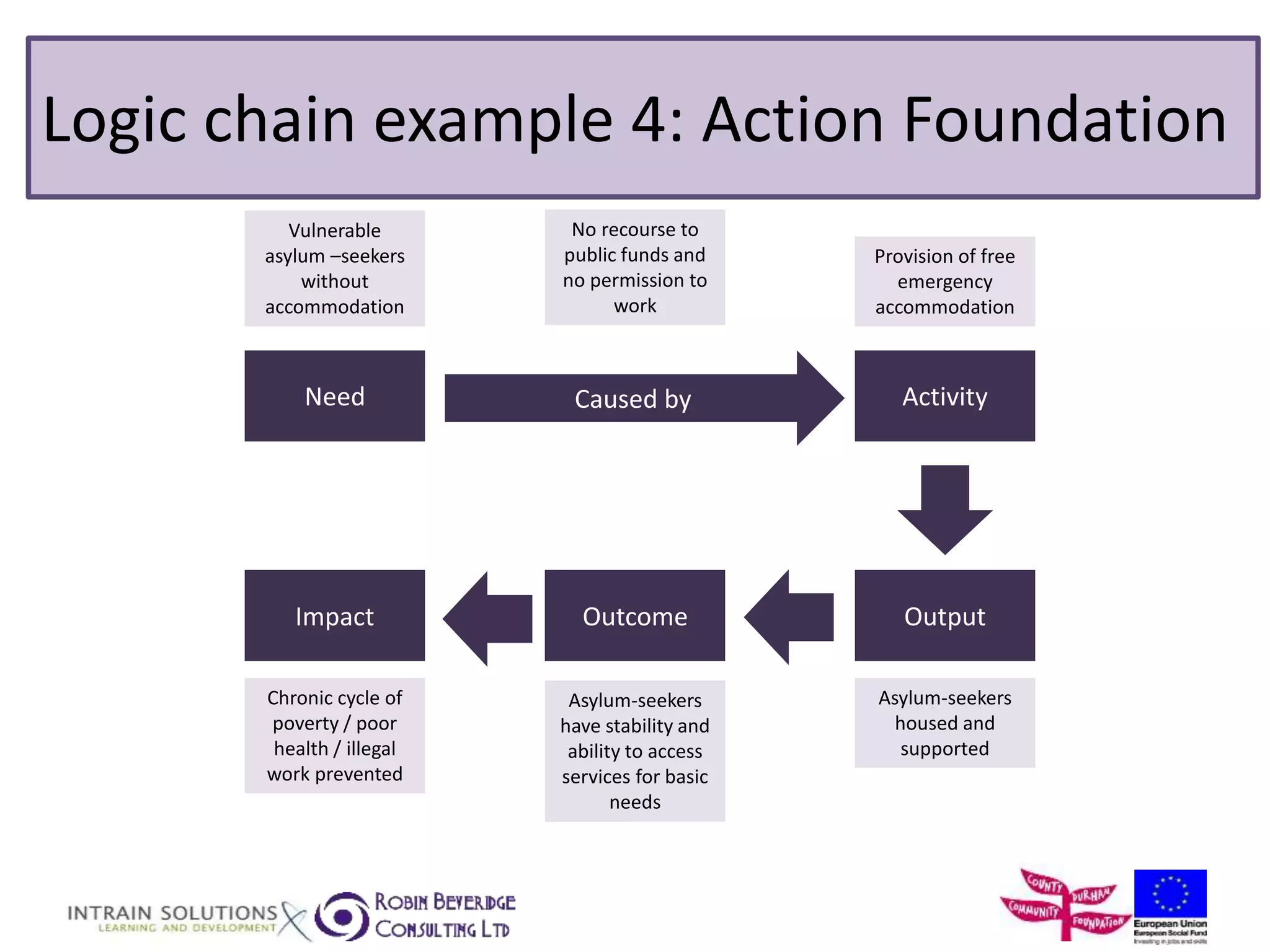
Logic chain example 4: Action Foundation 
Vulnerable 
asylum –seekers 
without 
accommodation 
Need Activity 
Caused by 
Output 
Impact Outcome 
Provision of free 
emergency 
accommodation 
Asylum-seekers 
housed and 
supported 
Asylum-seekers 
have stability and 
ability to access 
services for basic 
needs 
Chronic cycle of 
poverty / poor 
health / illegal 
work prevented 
No recourse to 
public funds and 
no permission to 
work
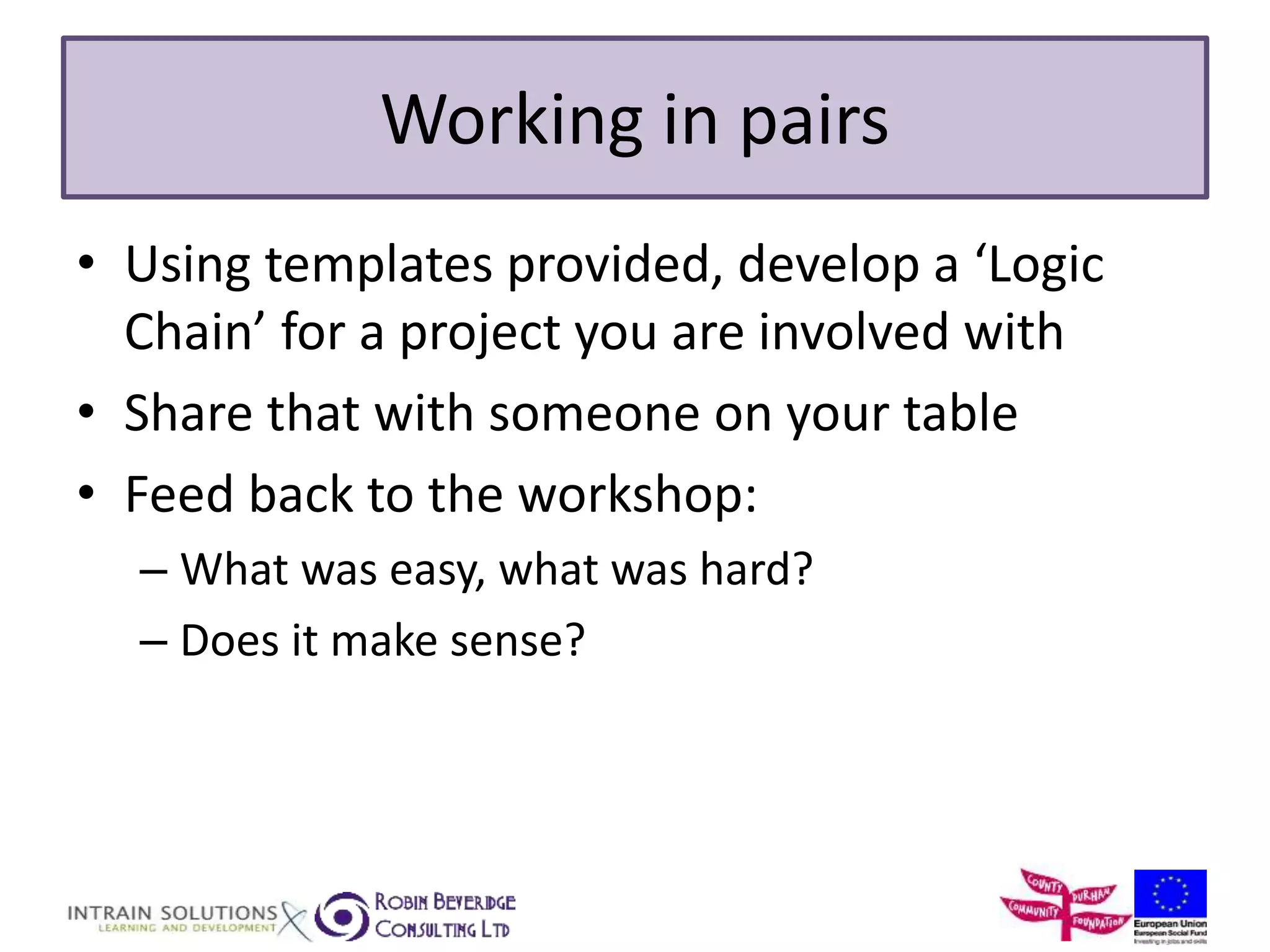
Working in pairs 
• Using templates provided, develop a ‘Logic 
Chain’ for a project you are involved with 
• Share that with someone on your table 
• Feed back to the workshop: 
– What was easy, what was hard? 
– Does it make sense?
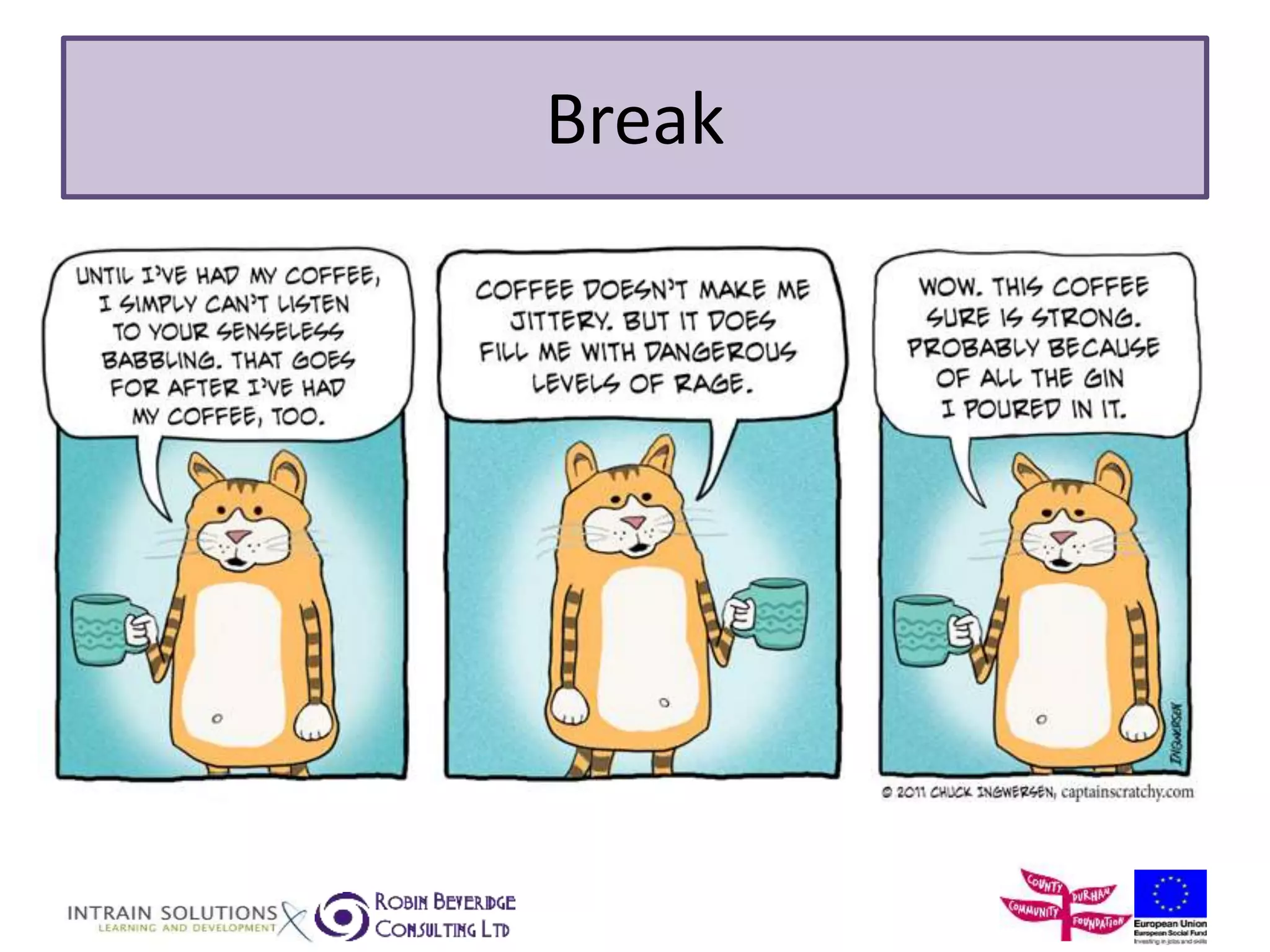
Break
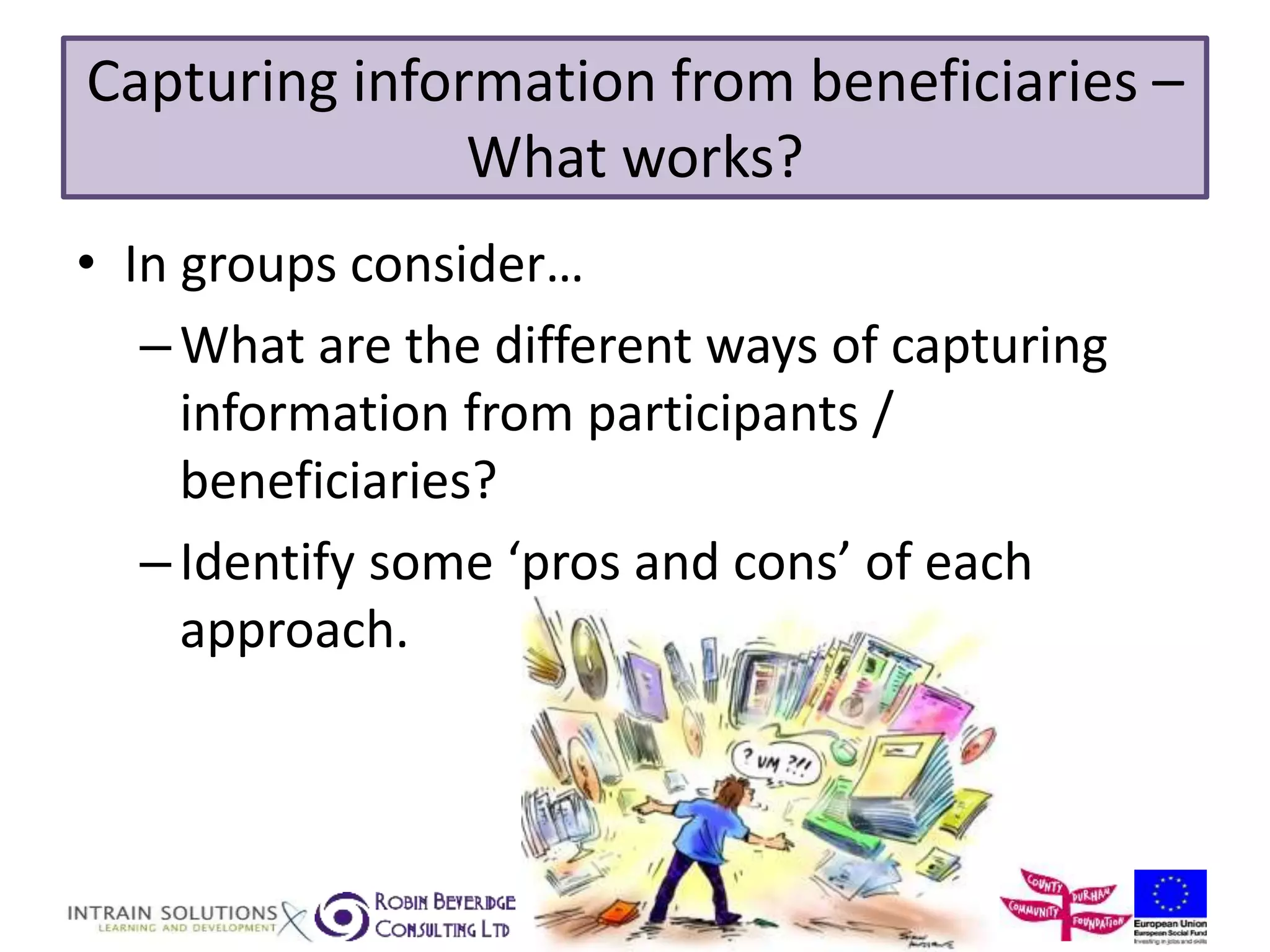
Capturing information from beneficiaries – 
What works? 
• In groups consider… 
–What are the different ways of capturing 
information from participants / 
beneficiaries? 
– Identify some ‘pros and cons’ of each 
approach.
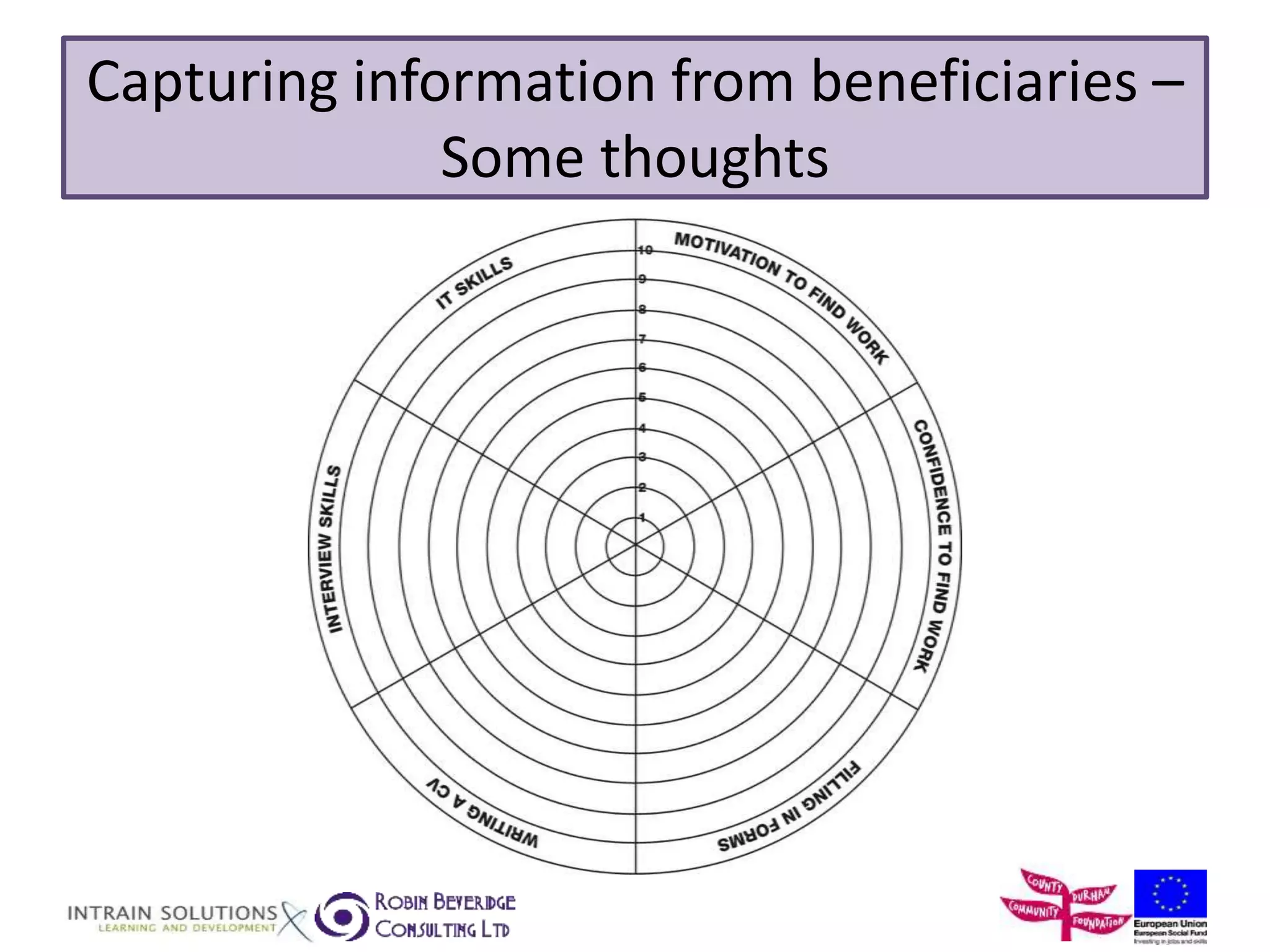
Capturing information from beneficiaries – 
Some thoughts 
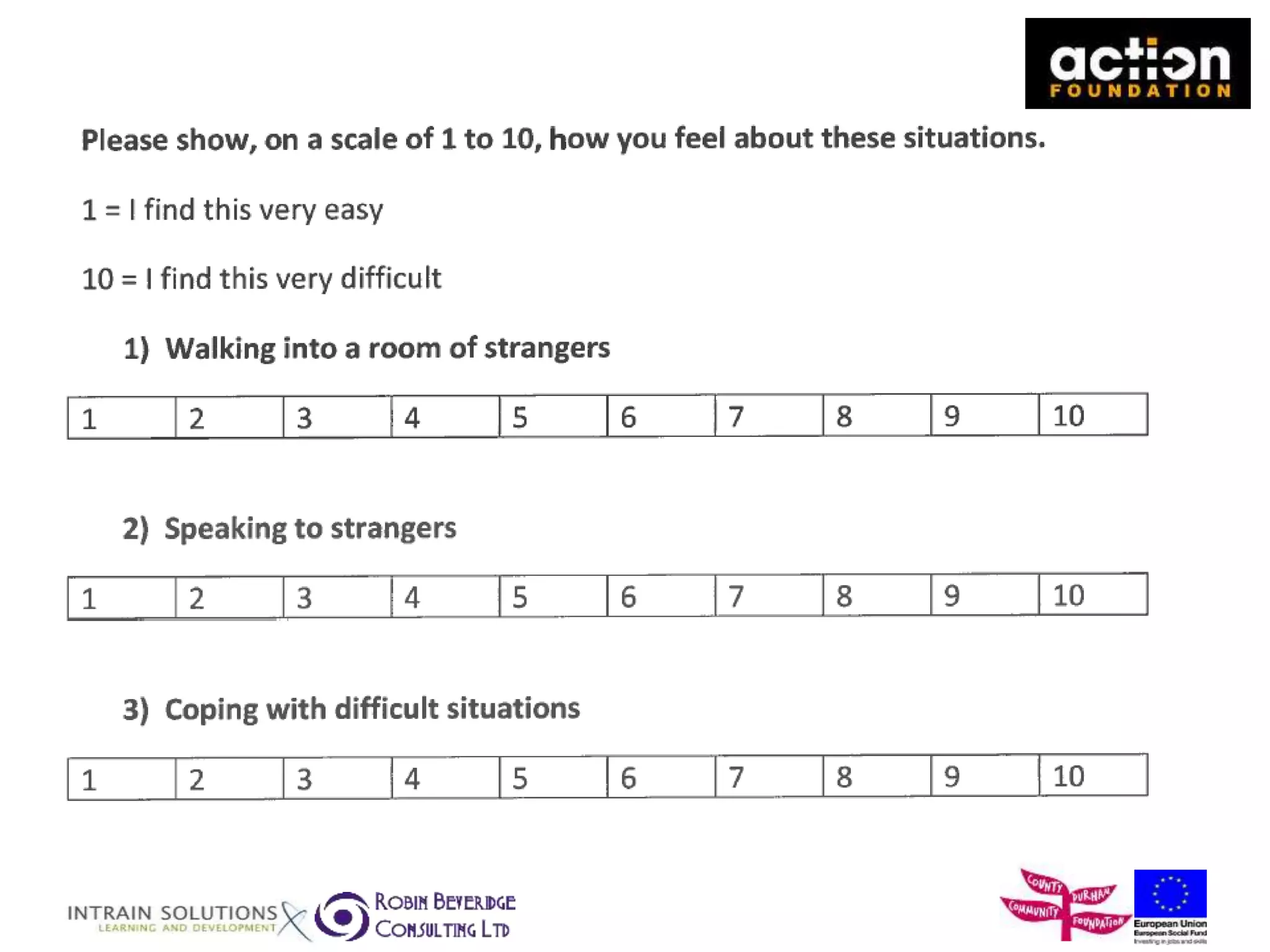
Questionnaires 
• Wide coverage 
• Tick box / narrative approach? 
• Accessibility 
• Self-completed or ‘managed’ 
• ‘Survey Monkey’ 
• Before / after / distance travelled 
• Confidentiality 
• Response rate
Capturing information from beneficiaries – 
Some thoughts
Capturing information from beneficiaries – 
some thoughts 
Feedback forms 
• Immediate feedback from ‘captive 
audience’? 
• More of / less of 
• Most useful / least useful 
• Improvements 
• Can be superficial and ‘too immediate’ 
• Follow up again later?
Capturing information from beneficiaries – 
some thoughts 
In-depth interview 
• Richer content 
• Particular insights 
• Range of views / perspectives 
• Resource intensive
Capturing information from beneficiaries – 
some thoughts 
Focus Groups 
• A group with similar characteristics 
(e.g. single parents) 
• ‘Managing’ the group 
• Recording the outcomes 
Round Table 
• Different perspectives
Capturing information from beneficiaries – 
some thoughts 
In-depth interview 
• Richer content 
• Particular insights 
• Different perspectives 
• Resource intensive
Capturing information from beneficiaries – 
some thoughts 
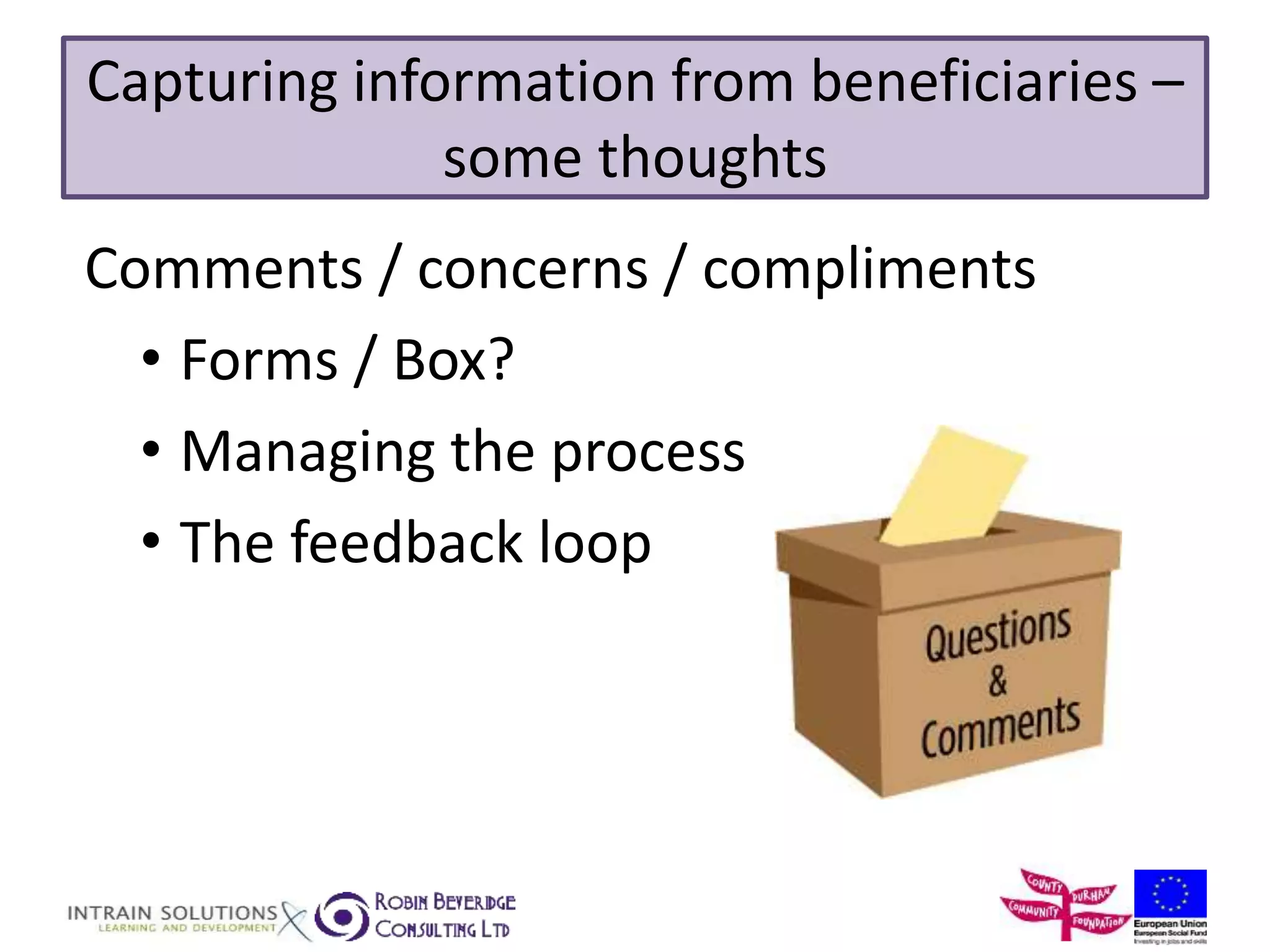
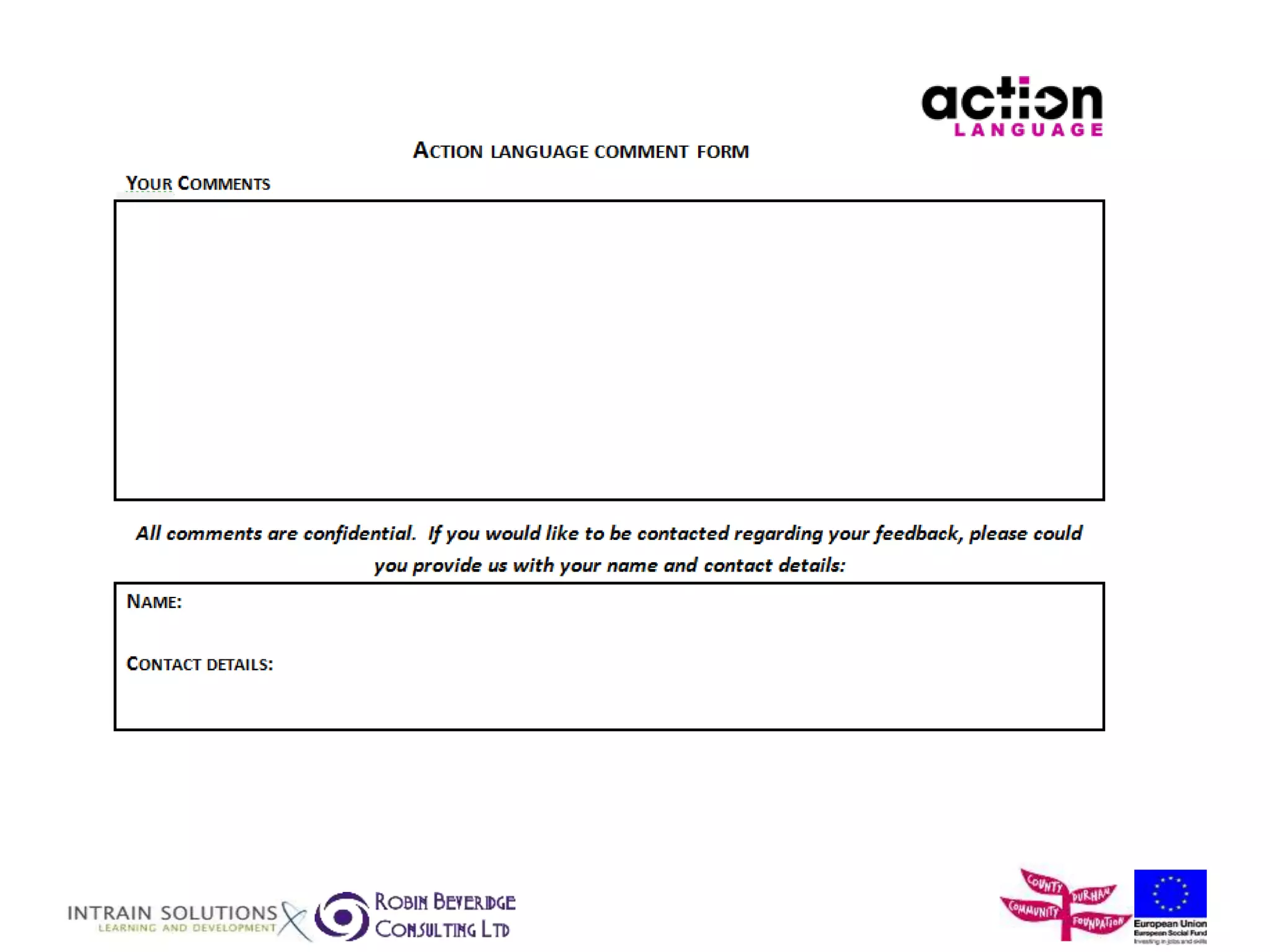
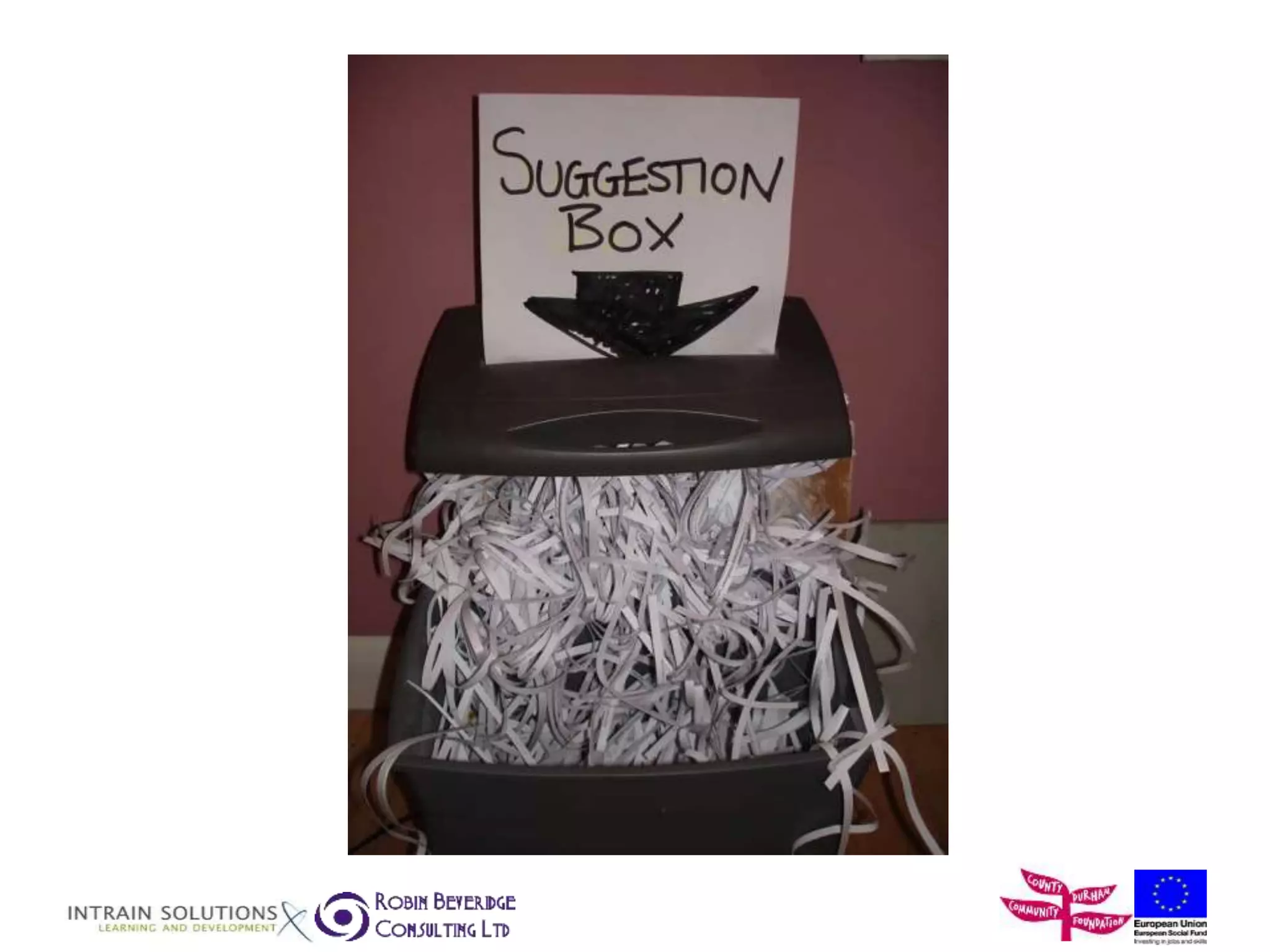
Comments / concerns / compliments 
• Forms / Box? 
• Managing the process 
• The feedback loop
Timing issues… 
• Captive audience 
• Getting buy-in from the outset 
• ‘When they’re gone they’re gone!’ 
• Bias? 
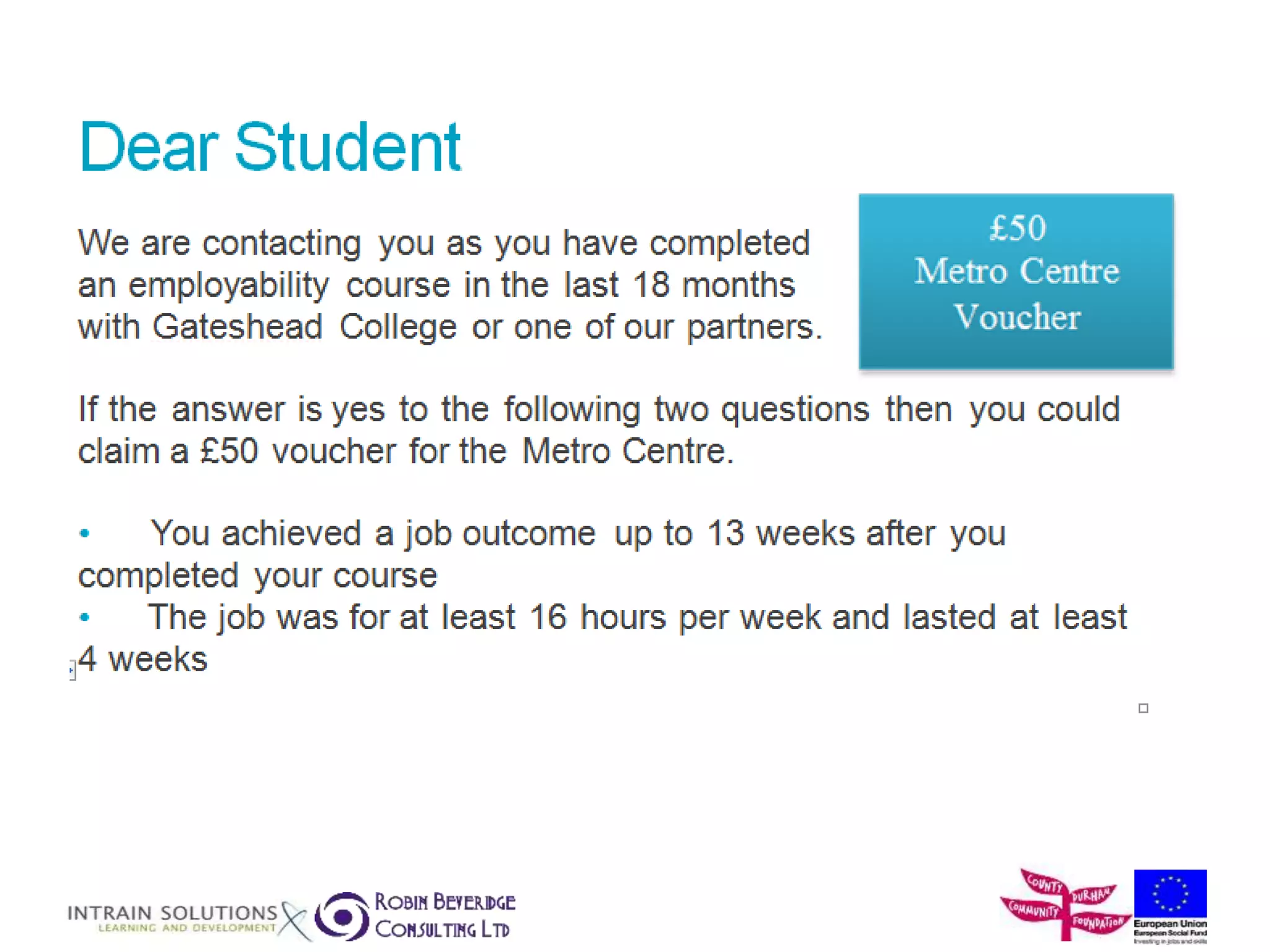
• Incentives?
Storage issues… 
• Paper based 
• Spreadsheets 
• Databases 
• Bespoke approaches?
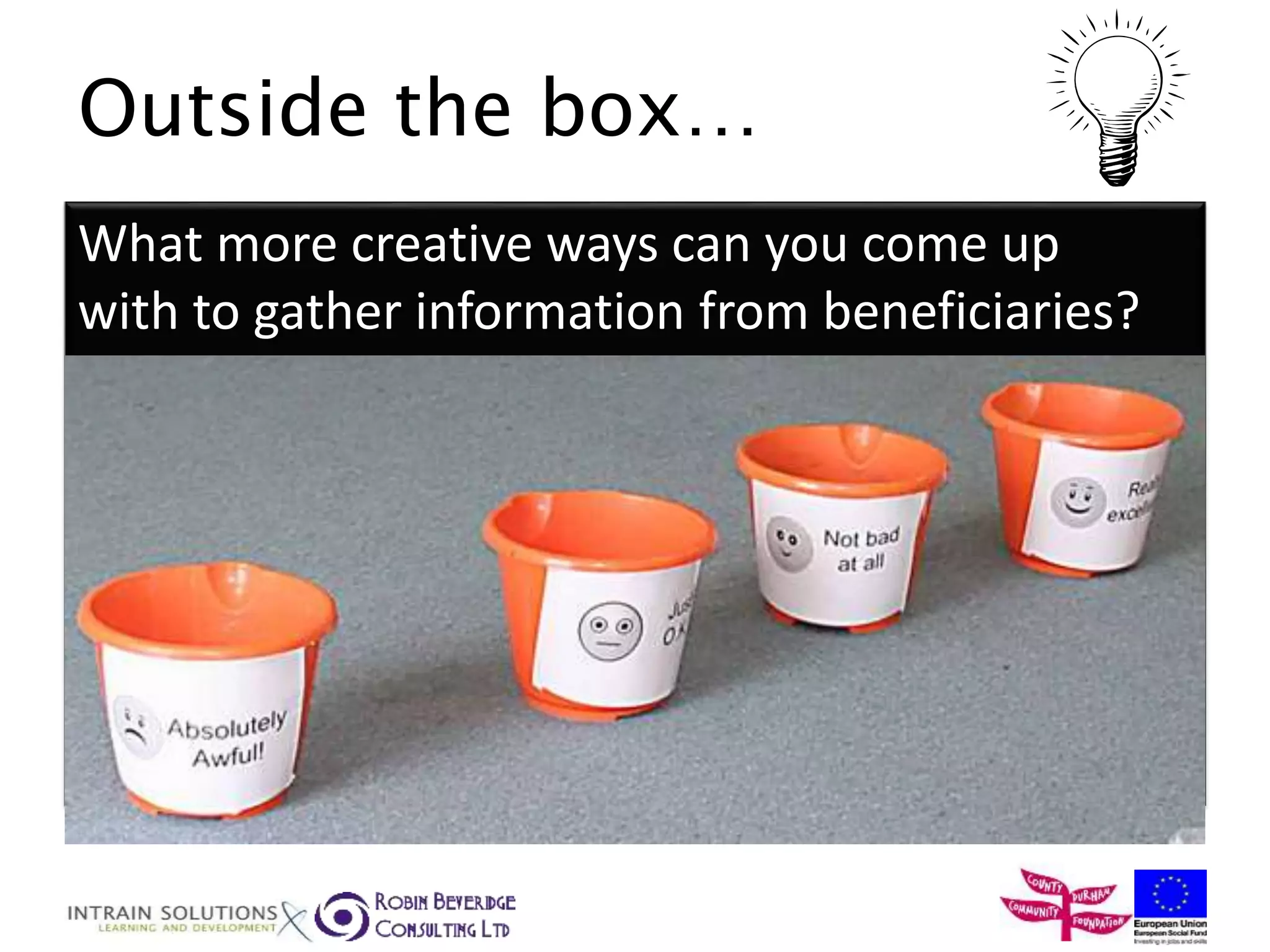
Outside the box… 
What more creative ways can you come up 
with to gather information from beneficiaries?
Telling the Story 
Using Case Studies 
Spend a couple of minutes discussing with 
one or two others… 
When and why might we use a case study?
Telling the Story 
Using Case Studies 
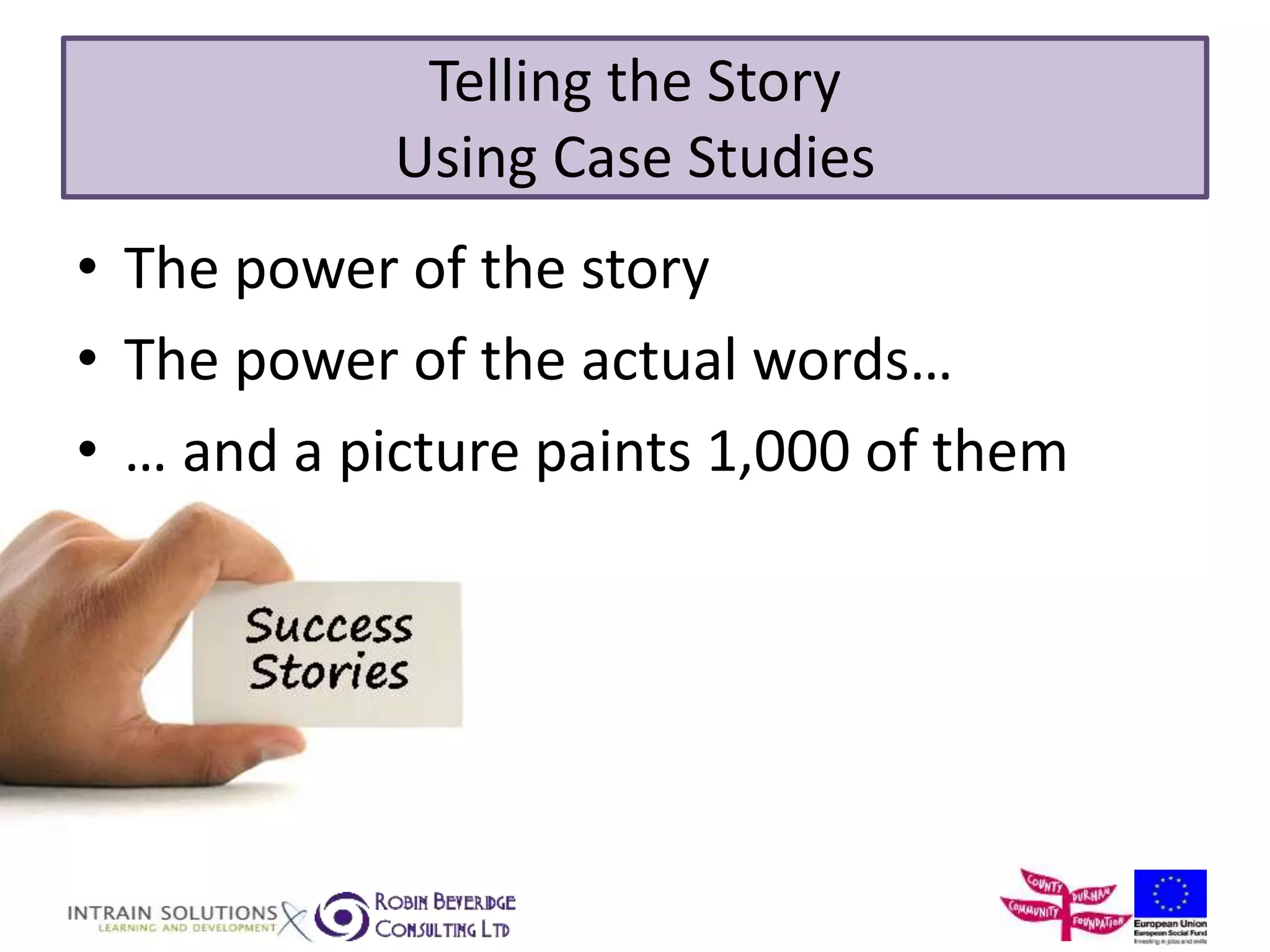
• The power of the story 
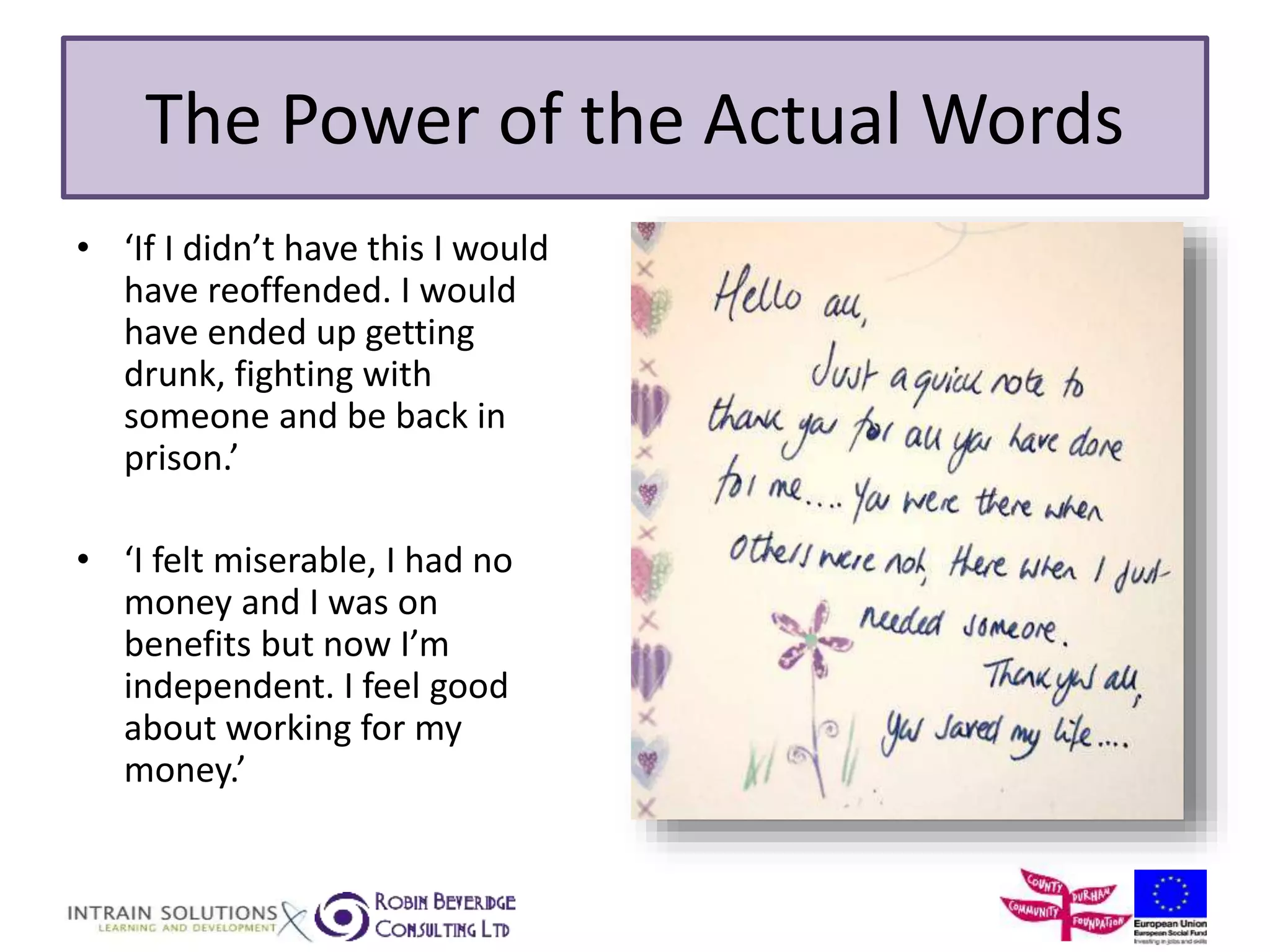
• The power of the actual words… 
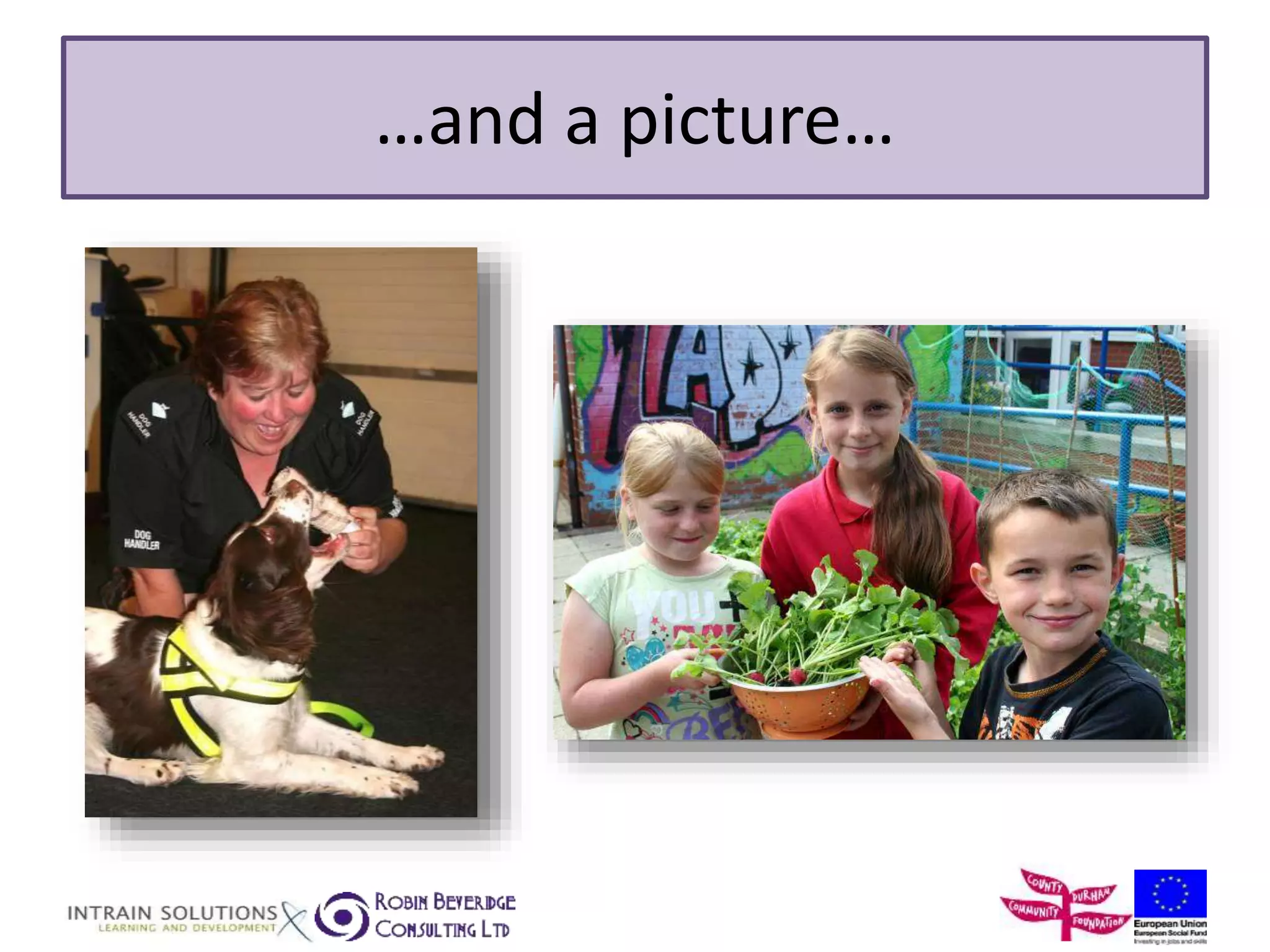
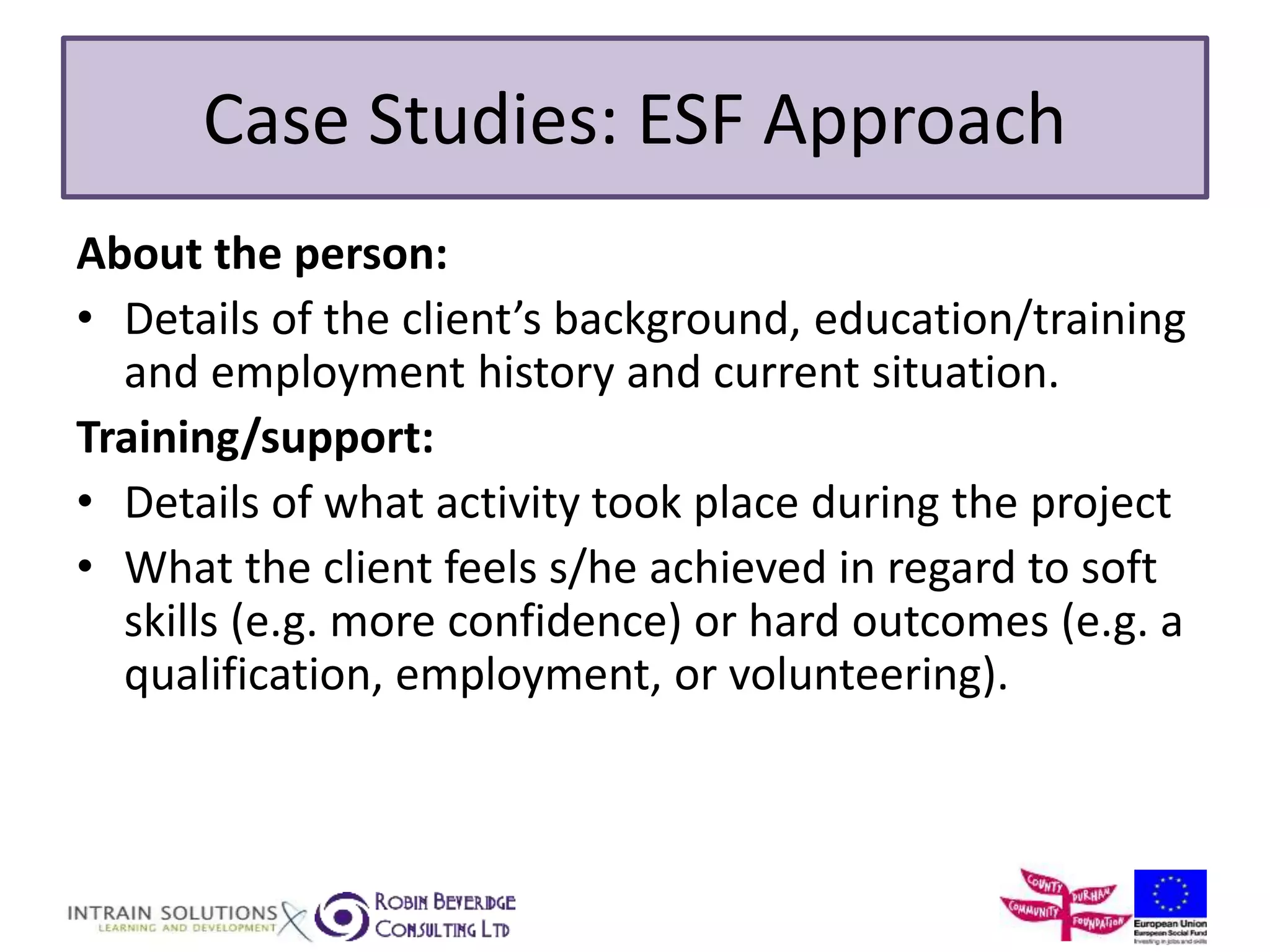
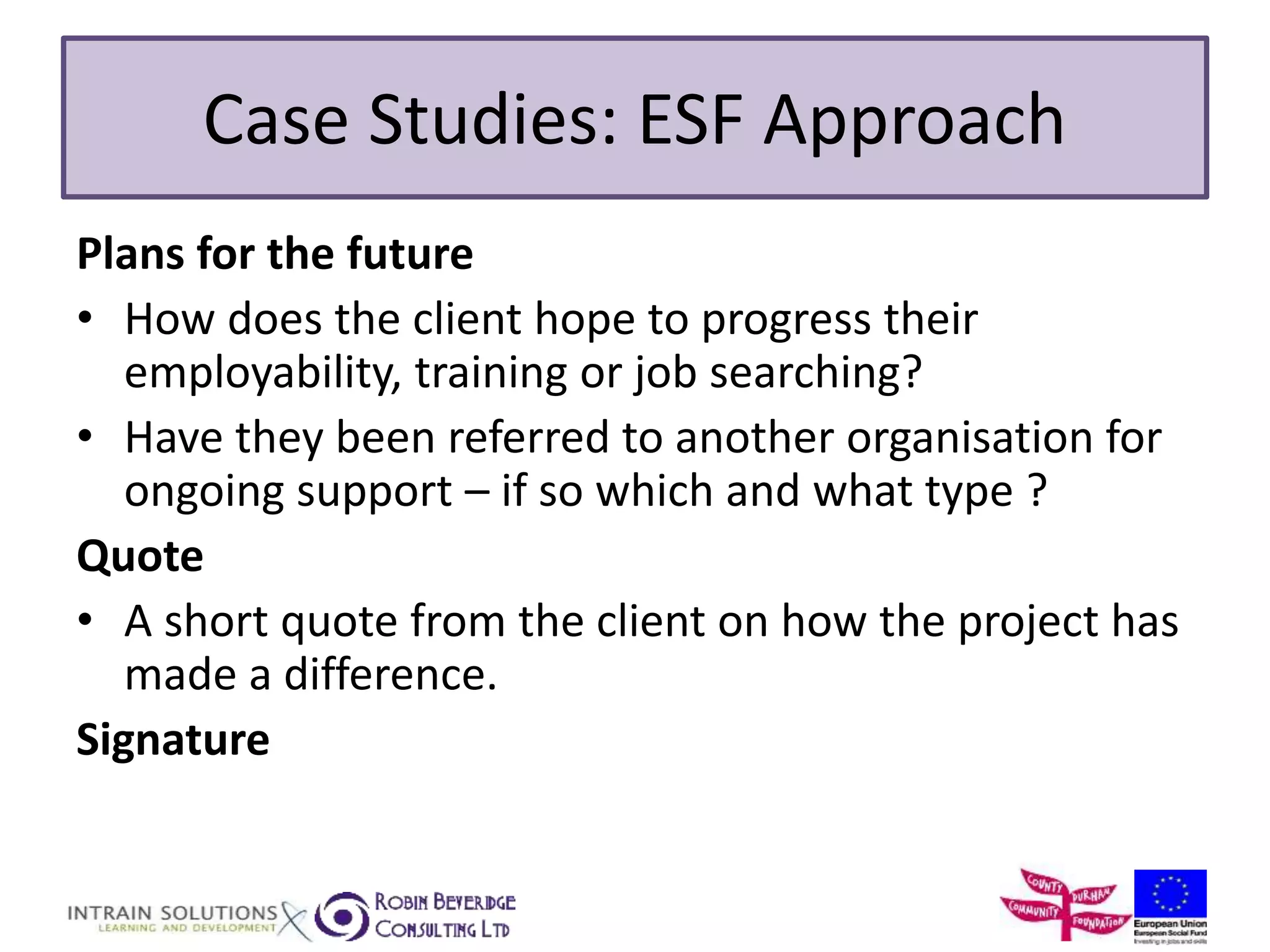
• … and a picture paints 1,000 of them
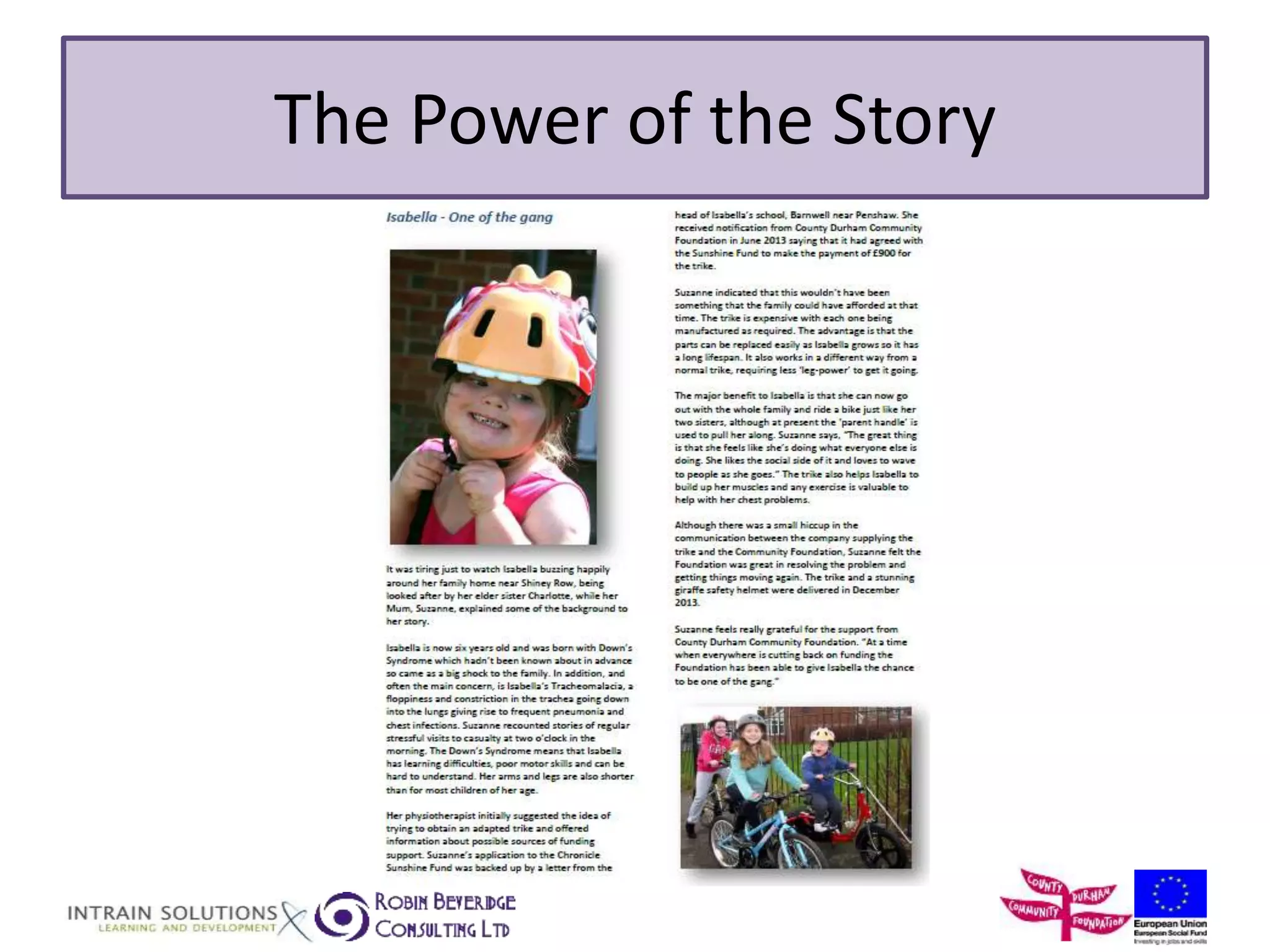
The Power of the Story
The Power of the Actual Words 
• ‘If I didn’t have this I would 
have reoffended. I would 
have ended up getting 
drunk, fighting with 
someone and be back in 
prison.’ 
• ‘I felt miserable, I had no 
money and I was on 
benefits but now I’m 
independent. I feel good 
about working for my 
money.’
…and a picture…
Case Studies: ESF Approach 
About the person: 
• Details of the client’s background, education/training 
and employment history and current situation. 
Training/support: 
• Details of what activity took place during the project 
• What the client feels s/he achieved in regard to soft 
skills (e.g. more confidence) or hard outcomes (e.g. a 
qualification, employment, or volunteering).
Case Studies: ESF Approach 
Plans for the future 
• How does the client hope to progress their 
employability, training or job searching? 
• Have they been referred to another organisation for 
ongoing support – if so which and what type ? 
Quote 
• A short quote from the client on how the project has 
made a difference. 
Signature
Case Studies: A Quick Checklist 
• Before you start 
• Setting up the interview 
• On the day 
• After the event 
• Other thoughts
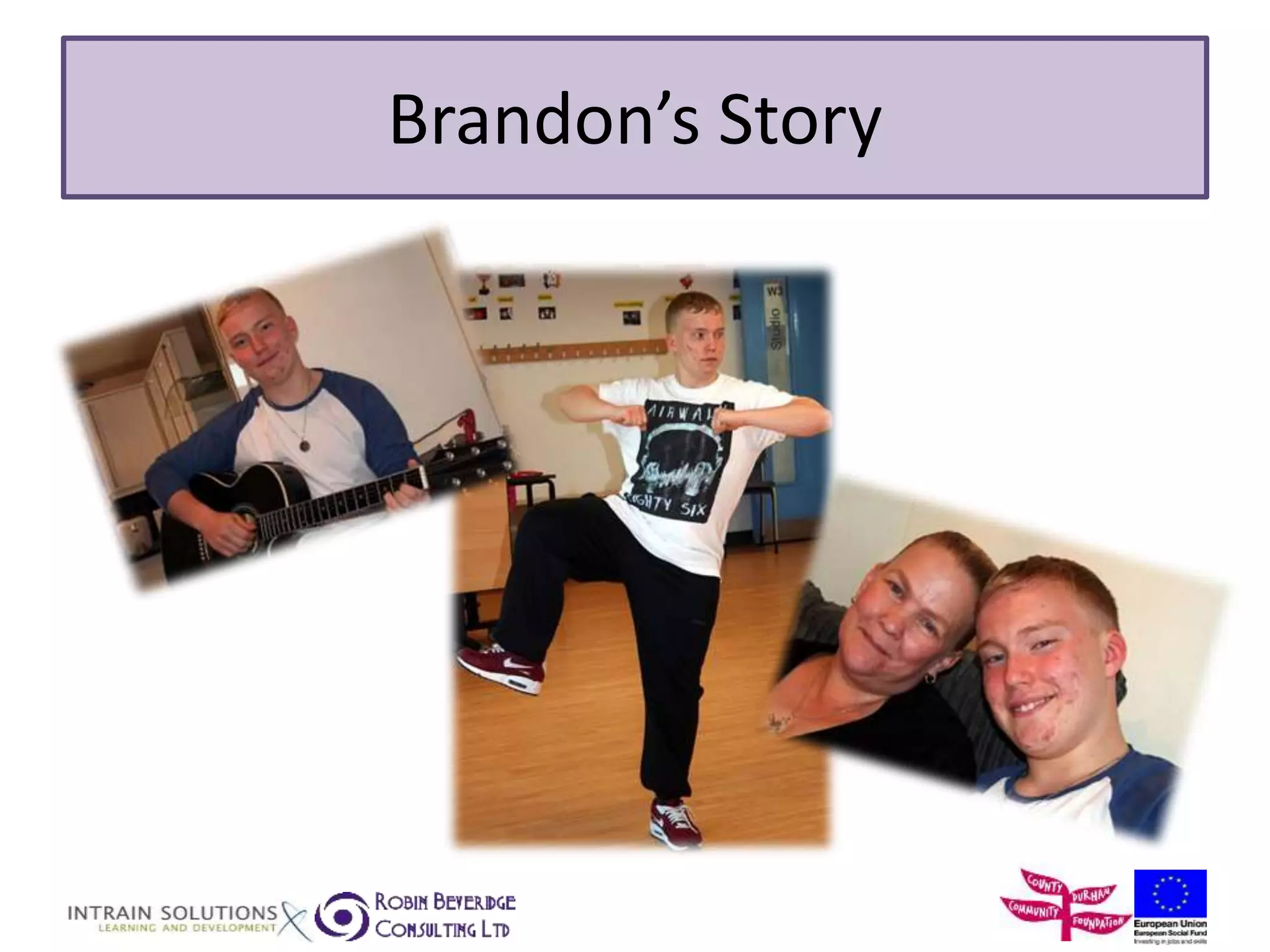
Brandon’s Story
Lunch
Recap
Structure of the day: PM 
13.00 Recap and Review 
13.10 
13.50 
14.10 
14.50 
Quantitative Evaluation techniques 
Evaluation in practice 
Monitoring & Evaluation plans 
Wowing the World 
Workshop feedback and close
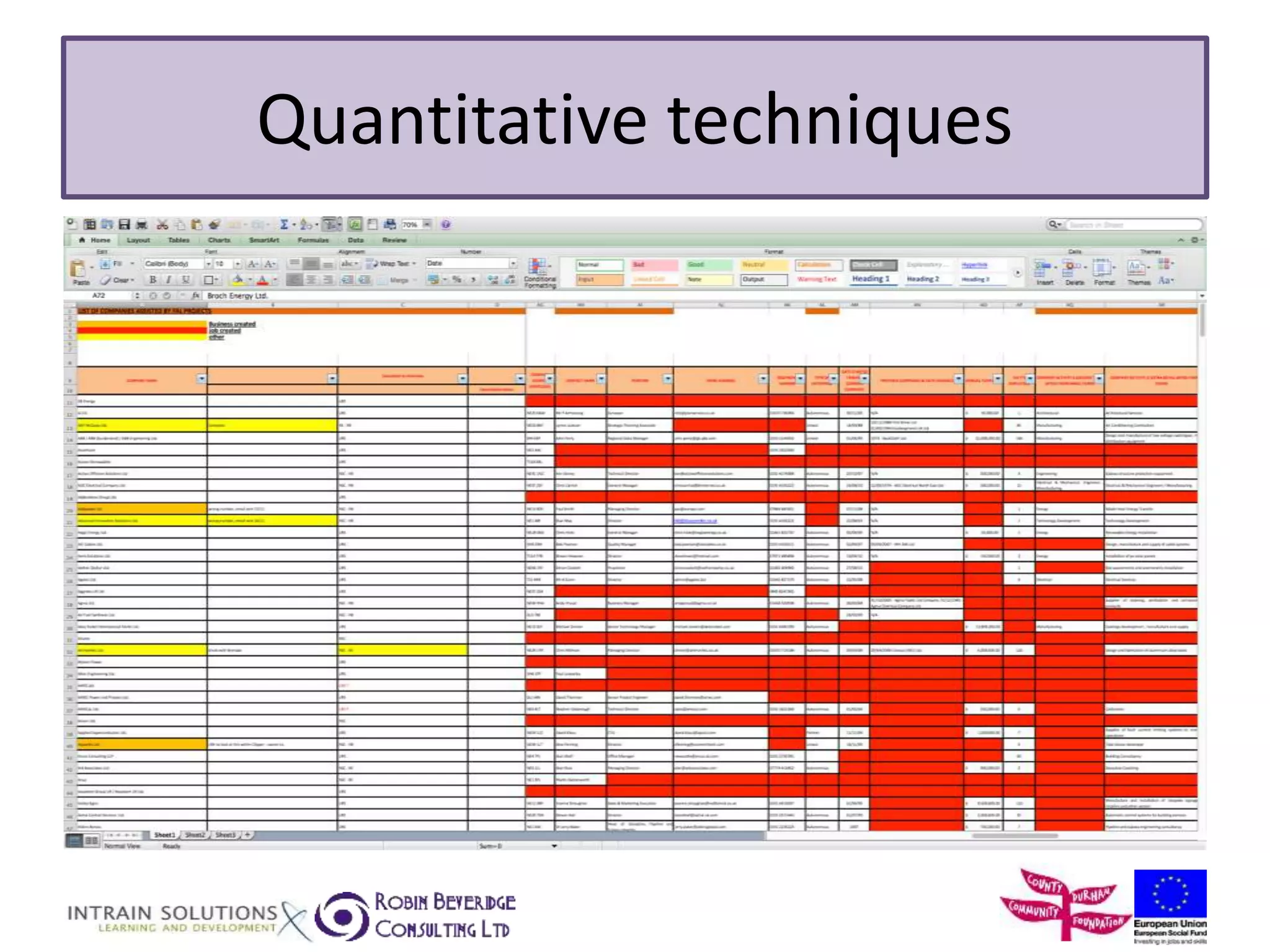
Quantitative techniques
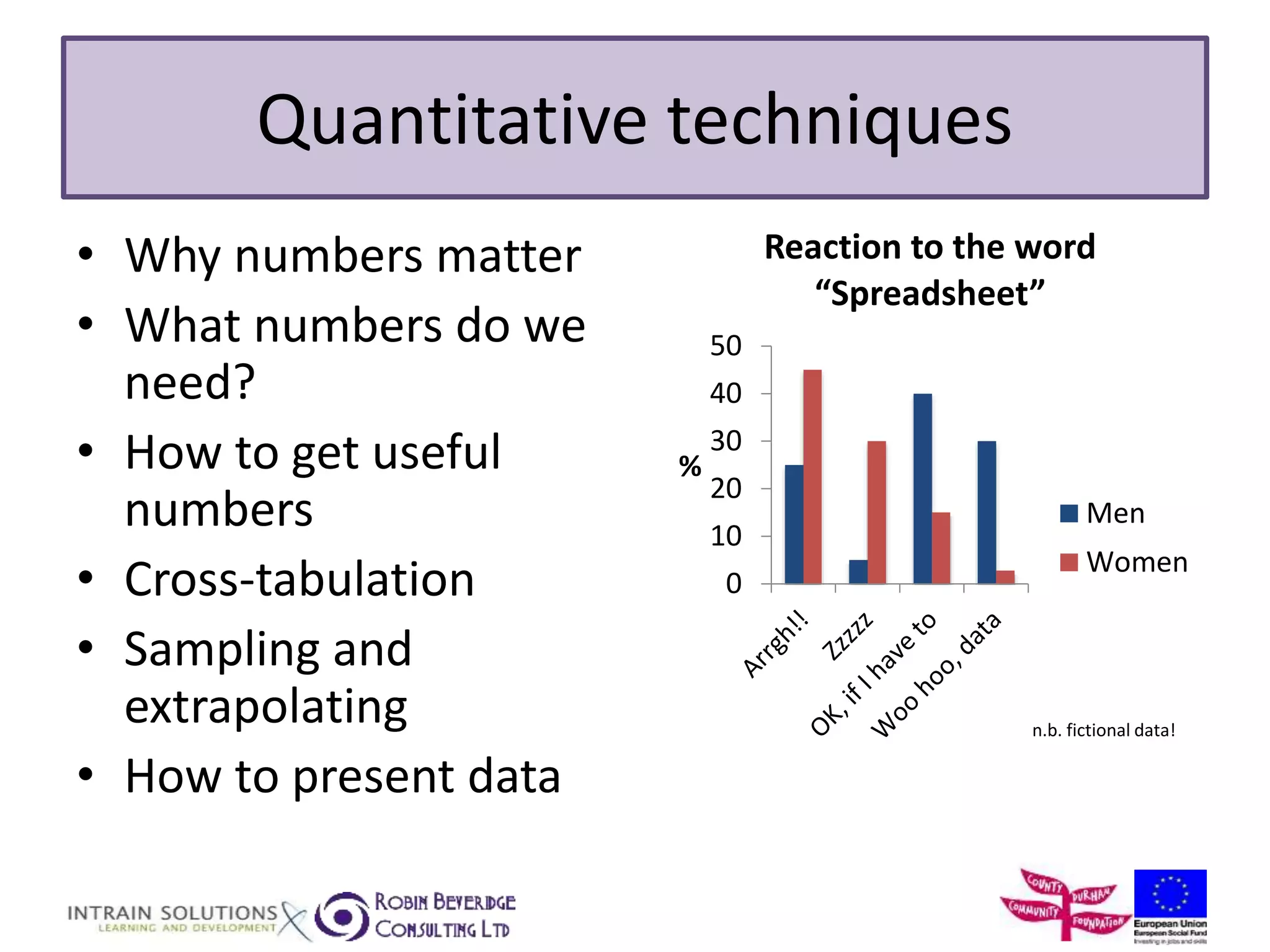
Quantitative techniques 
• Why numbers matter 
• What numbers do we 
need? 
• How to get useful 
numbers 
• Cross-tabulation 
• Sampling and 
extrapolating 
• How to present data 
50 
40 
30 
20 
10 
0 
% 
Reaction to the word 
“Spreadsheet” 
Men 
Women 
n.b. fictional data!
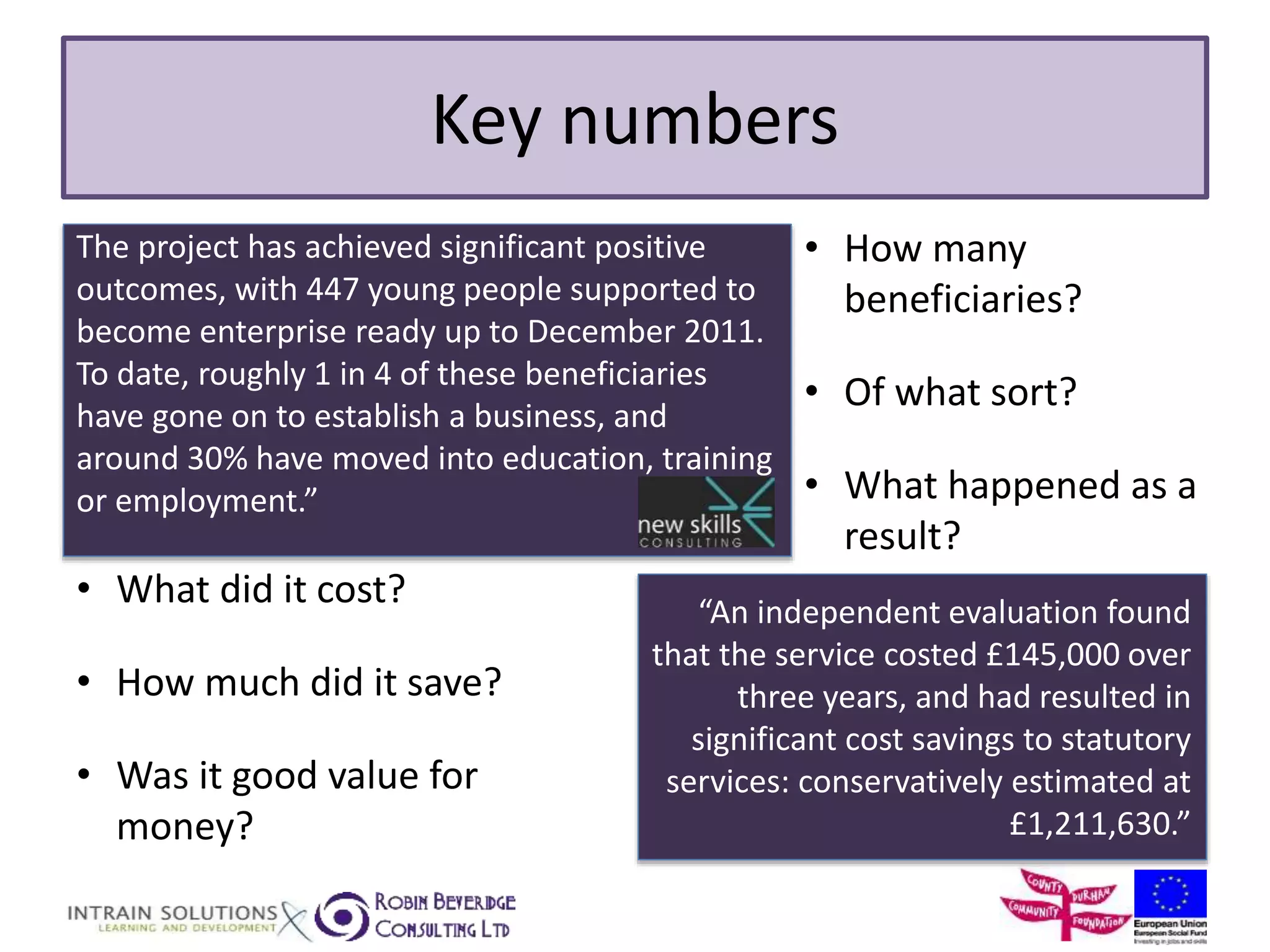
Key numbers 
The project has achieved significant positive 
outcomes, with 447 young people supported to 
become enterprise ready up to December 2011. 
To date, roughly 1 in 4 of these beneficiaries 
have gone on to establish a business, and 
around 30% have moved into education, training 
or employment.” 
• How many 
beneficiaries? 
• Of what sort? 
• What happened as a 
result? 
“An independent evaluation found 
that the service costed £145,000 over 
three years, and had resulted in 
significant cost savings to statutory 
services: conservatively estimated at 
£1,211,630.” 
• What did it cost? 
• How much did it save? 
• Was it good value for 
money?
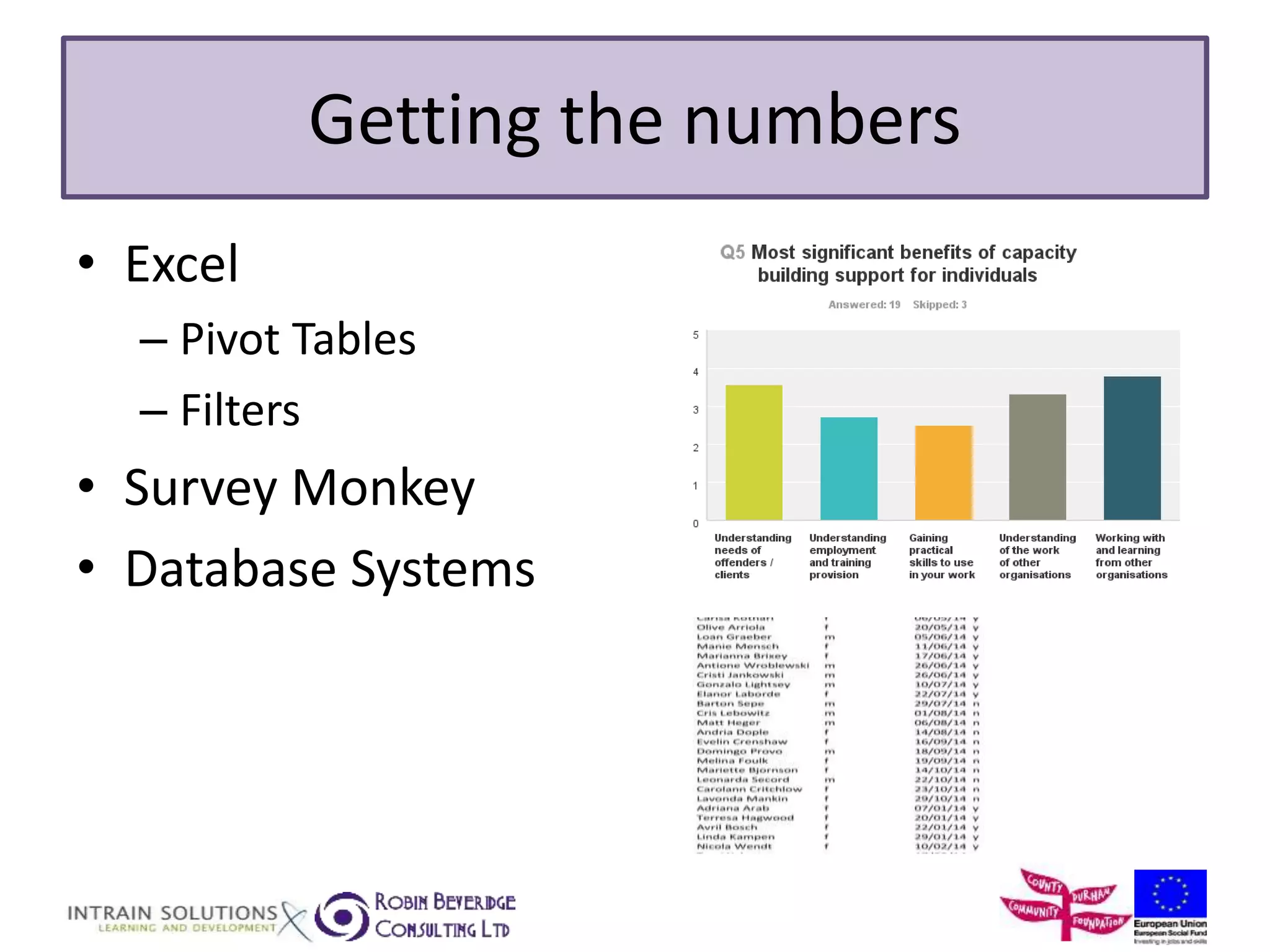
Getting the numbers 
• Excel 
– Pivot Tables 
– Filters 
• Survey Monkey 
• Database Systems
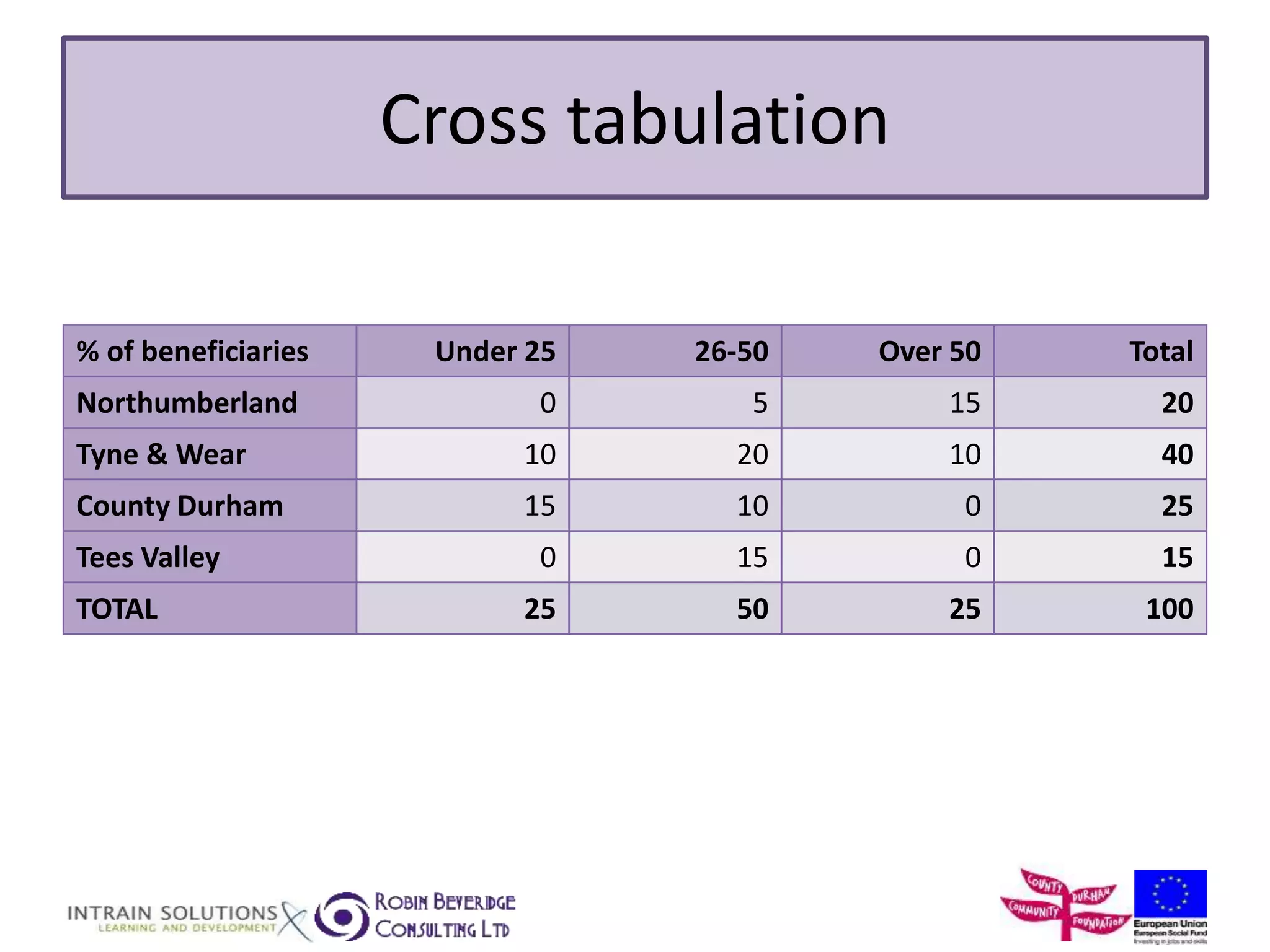
Cross tabulation 
% of beneficiaries Under 25 26-50 Over 50 Total 
Northumberland 0 5 15 20 
Tyne &Wear 10 20 10 40 
County Durham 15 10 0 25 
Tees Valley 0 15 0 15 
TOTAL 25 50 25 100
Sampling and extrapolation 
• Most evaluation is based on a sample 
• How representative is your sample? 
• How diverse is your ‘population’? 
• Evaluation is NOT a science 
• Be aware of potential ‘bias’ in the sample 
• Use caveats in extrapolating
Sampling example 
120 
100 
80 
60 
40 
20 
0 
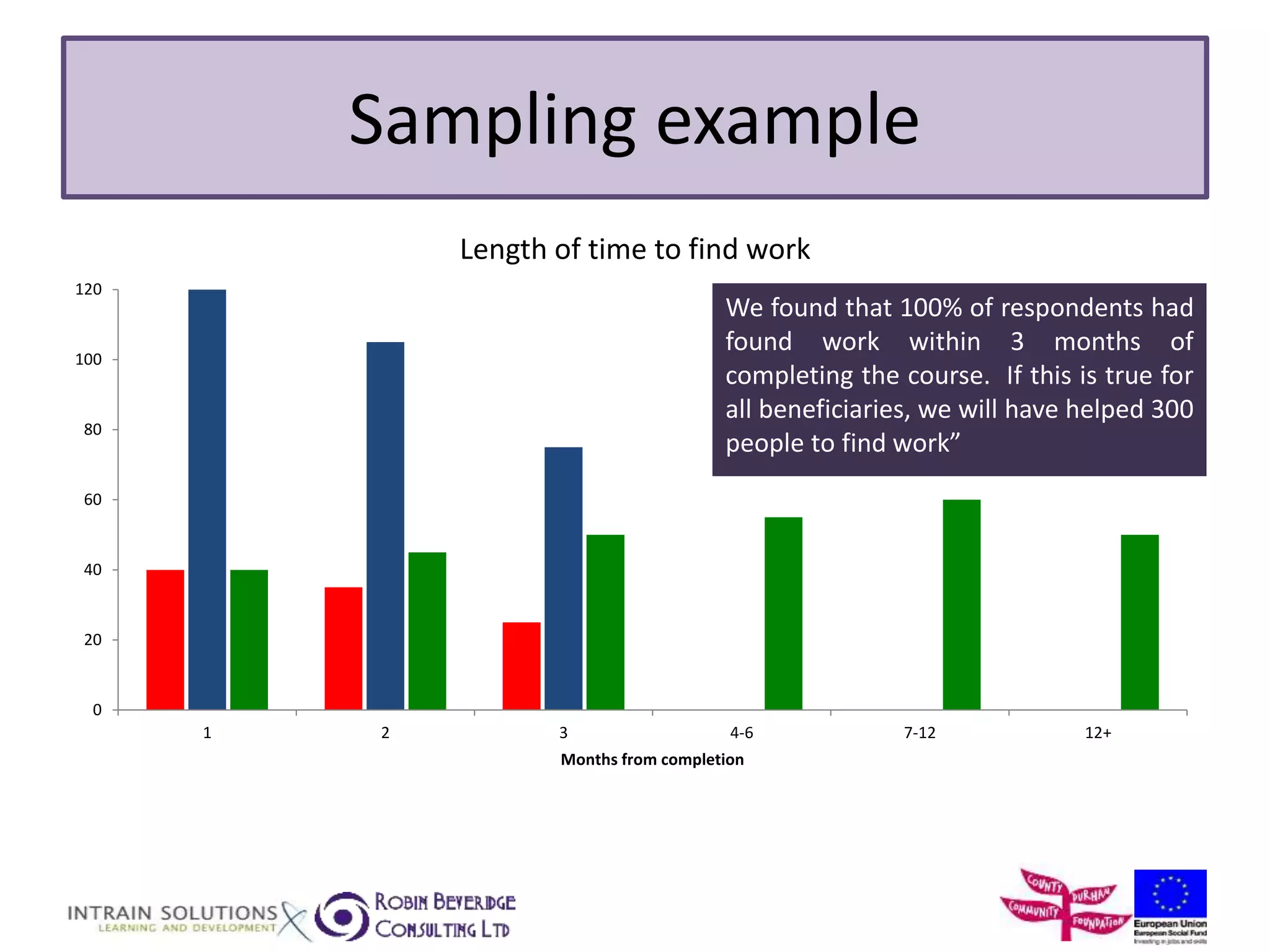
Length of time to find work 
We found that 100% of respondents had 
found work within 3 months of 
completing the course. If this is true for 
all beneficiaries, we will have helped 300 
people to find work” 
1 2 3 4-6 7-12 12+ 
Months from completion
Presenting Data – some tips 
• Not too much information 
• Order bars from high to low 
• Use a variety of formats, but not too many 
• Keep a consistent colour scheme 
• Remember titles, axes and legends 
• Keep it as clean as possible
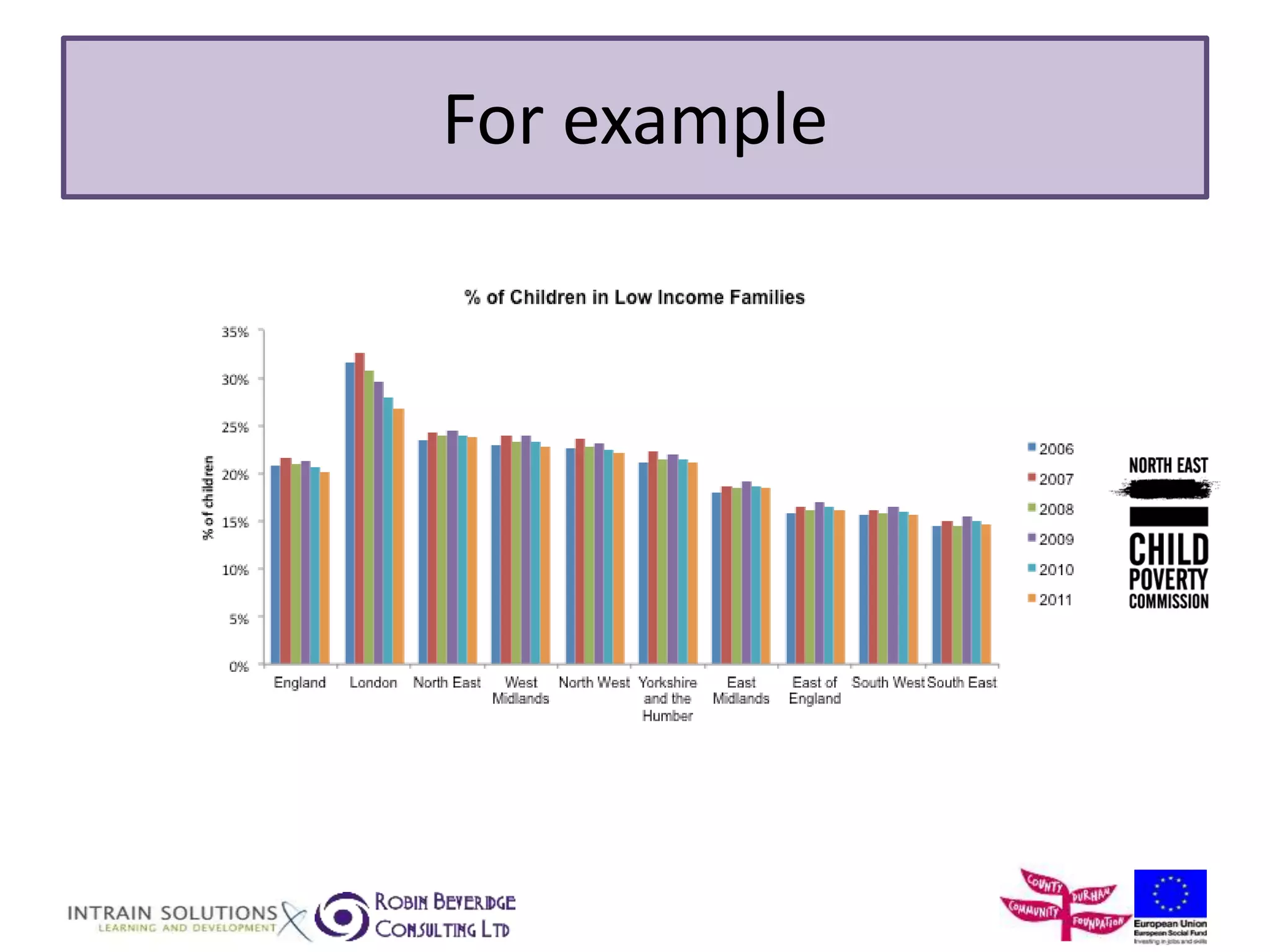
For example
Presenting Data – some tips 
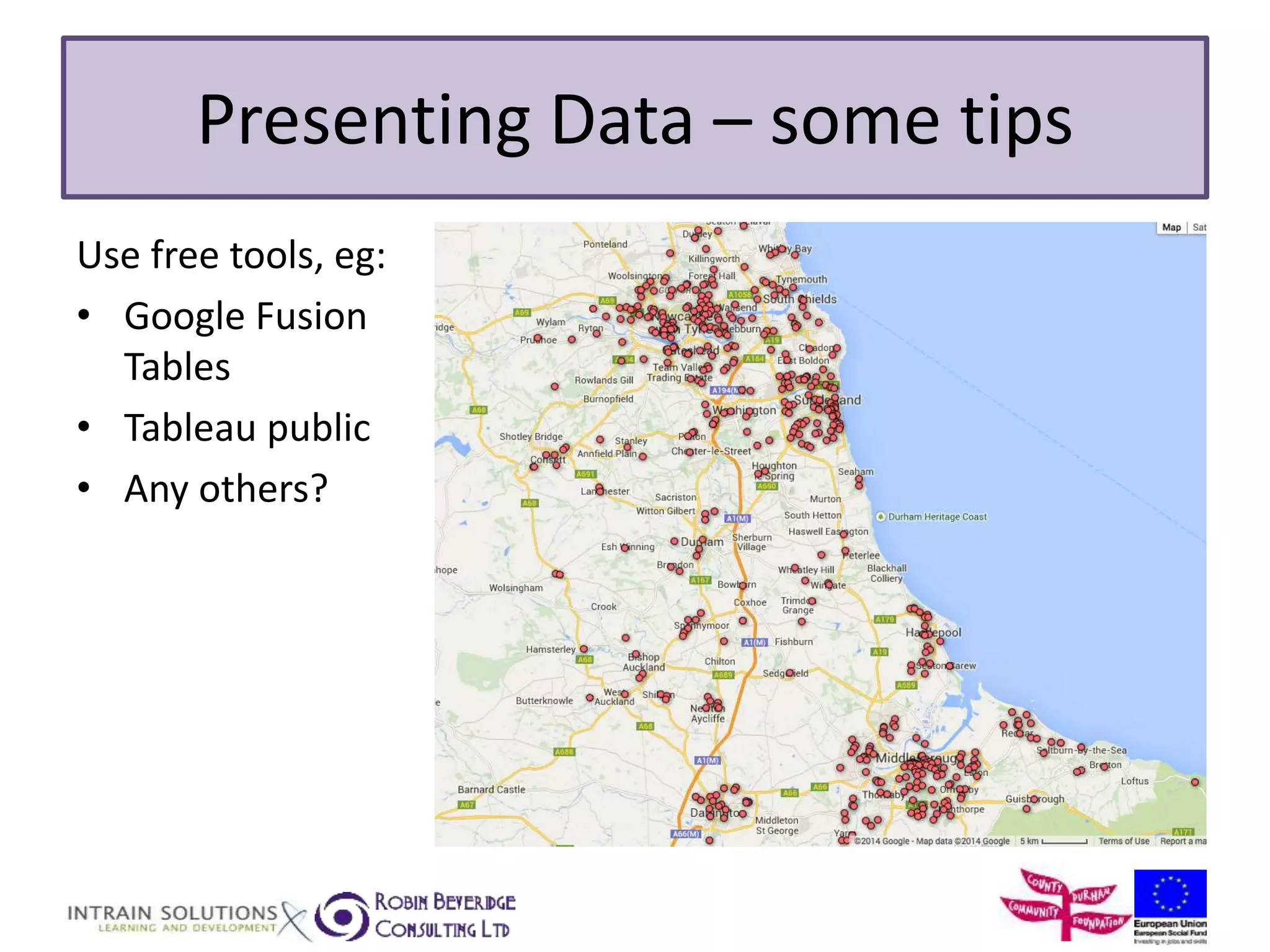
Use free tools, eg: 
• Google Fusion 
Tables 
• Tableau public 
• Any others?
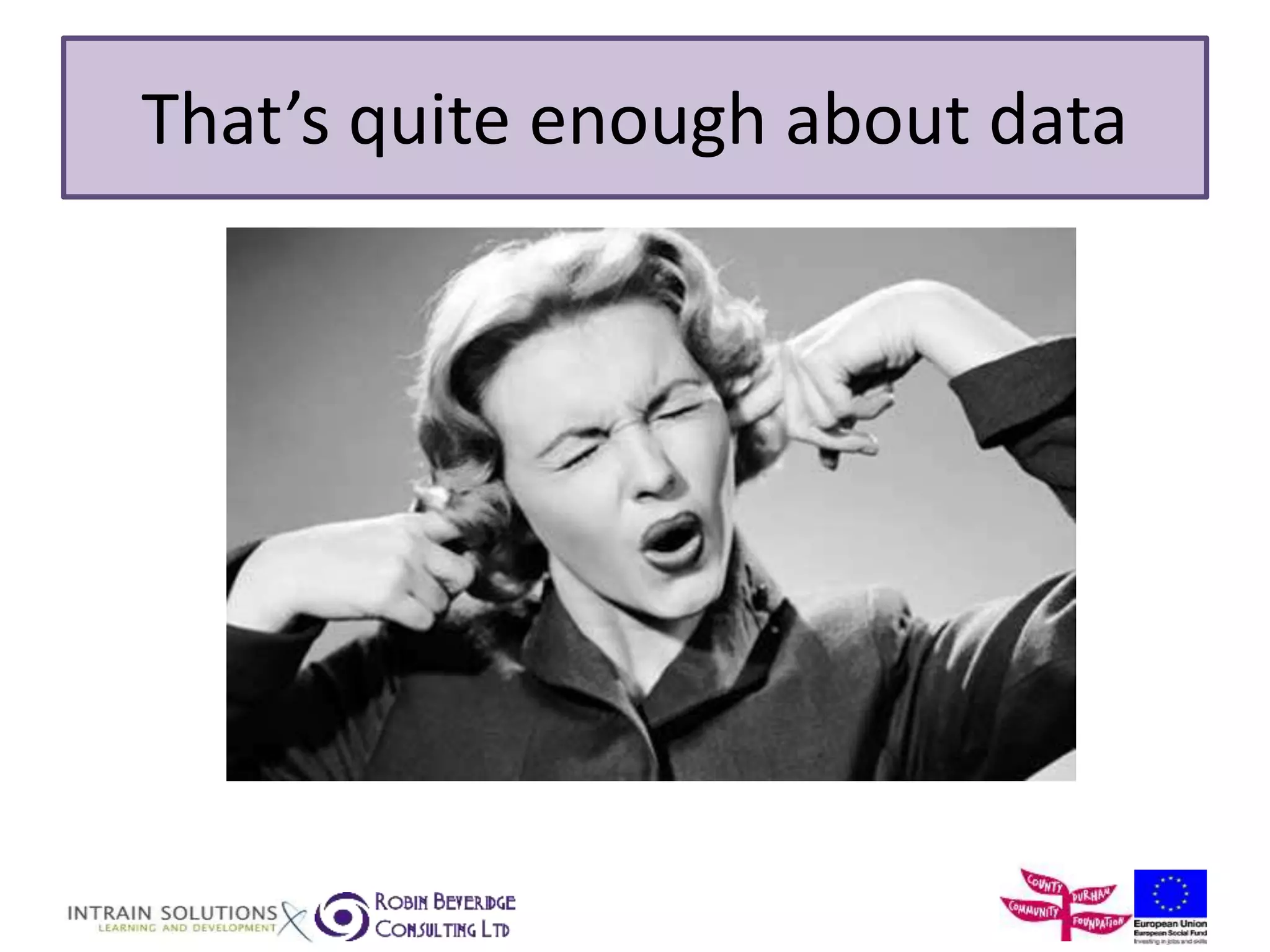
That’s quite enough about data
Developing an Evaluation Plan: 
Some things to think about 
• Scope and Purpose 
– What? 
– Level – e.g. Project, Programme, Organisation 
– Formative / Summative 
– Audience?
Developing an Evaluation Plan: 
Some things to think about 
• Timing and Phasing 
– When? 
– Single phase or multiphase? 
• How do they fit together? 
– Previous evaluations? 
• The same approach or different? 
– Key deadlines? 
• ‘Doomed to success’
Developing an Evaluation Plan: 
Some things to think about 
• Collecting Data 
– What is required? 
• Back to the logic chain 
– Where can you get the data 
– What have you got already? 
– Storage and analysis 
– Any barriers to using data?
Developing an Evaluation Plan: 
Some things to think about 
• Who does it? 
– Internal / External? 
– Buy-in? 
– Objectivity 
– Budget
Developing an Evaluation Plan: 
Some things to think about 
• Collecting views 
– Options for beneficiaries? 
– Key stakeholders? 
– Options for Stakeholders
Developing an Evaluation Plan: 
Some things to think about 
• Managing the evaluation process 
– Who is responsible? 
– Sign off? 
• Dissemination 
– Who and how?
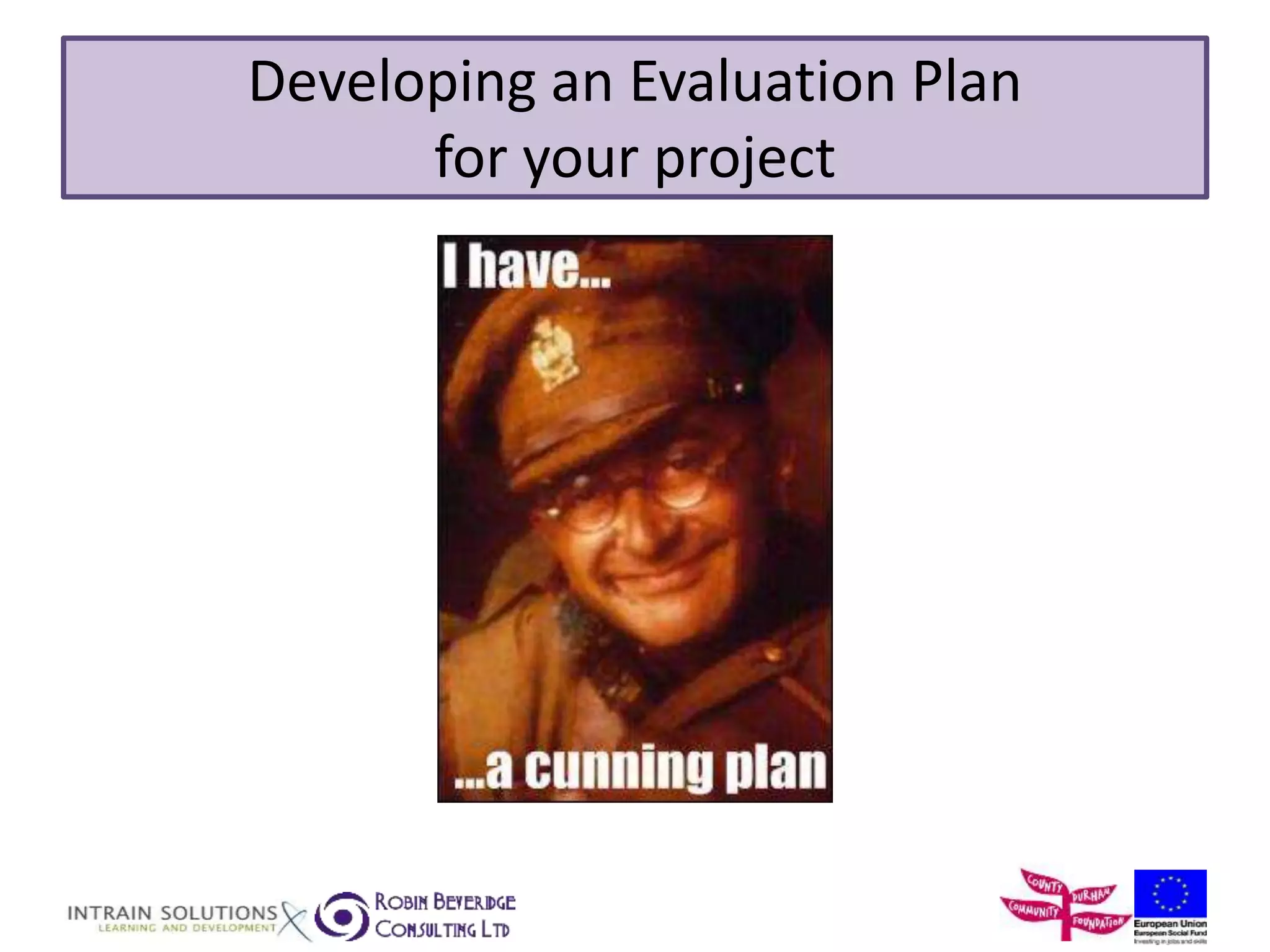
Developing an Evaluation Plan 
for your project
Wowing the World 
• Why are we doing this again? 
– Because we have to? 
– To improve our services to clients? 
– To attract new clients? 
– To demonstrate to ourselves and / or others that 
what we’re doing is effective? 
– To show Value for Money? 
– To convince people to give us some more?
Wowing the World 
• Whatever the reason we need 
to ‘broadcast it’ in some way 
• What approaches have you 
used that have been 
particularly effective in 
broadcasting what you’ve 
achieved and the impact that it 
has made?
Wowing the World
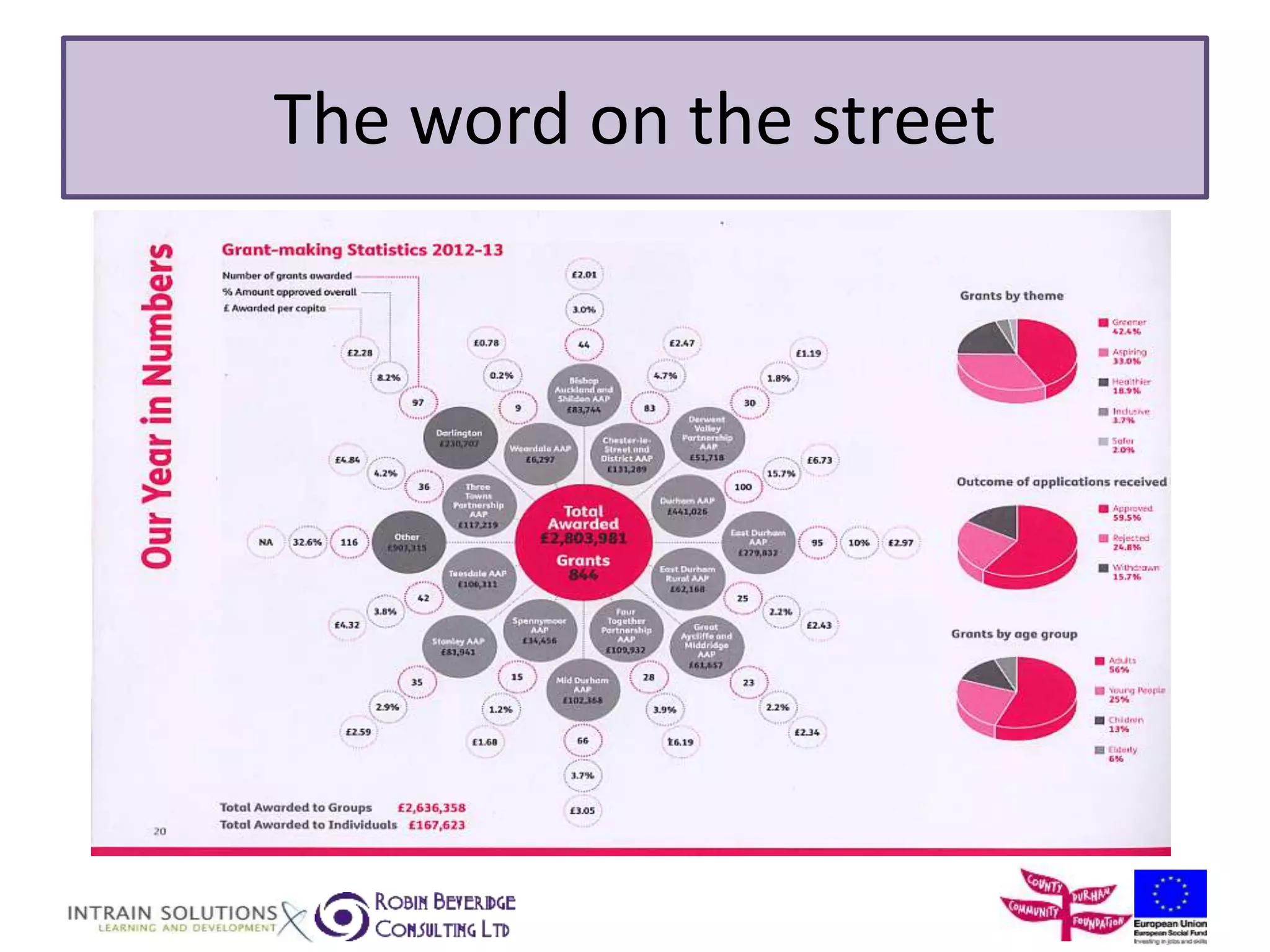
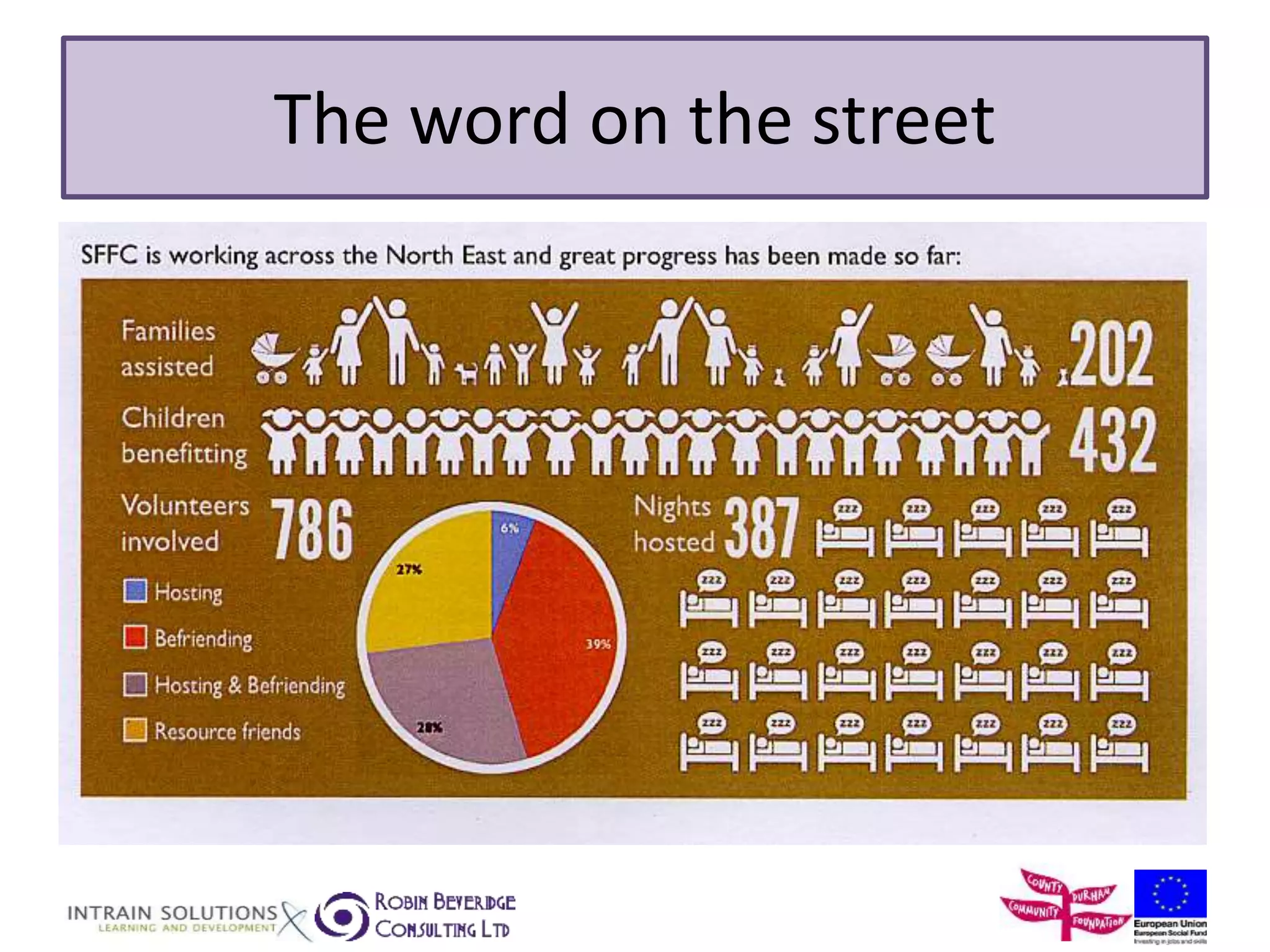
The word on the street 
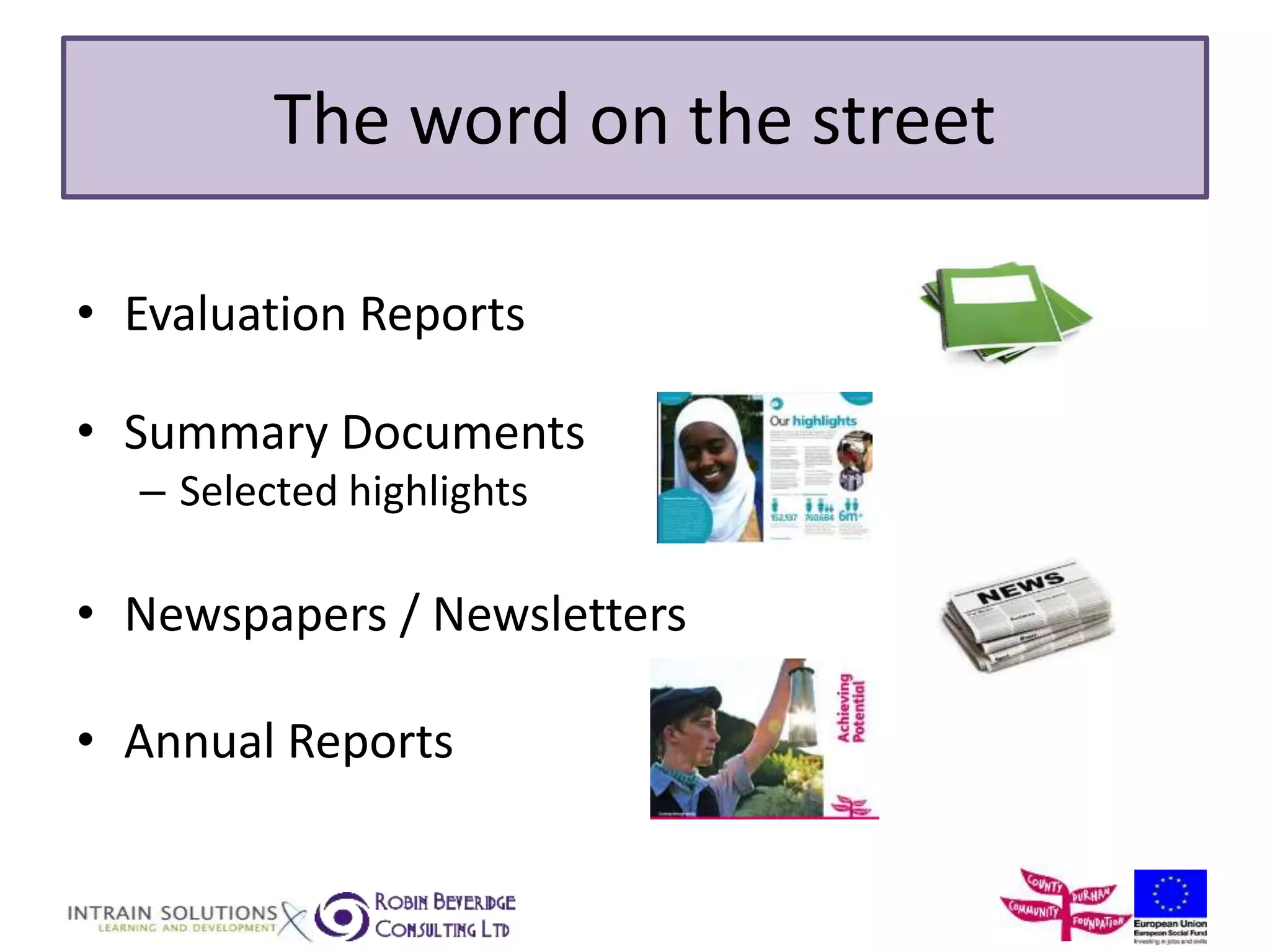
• Evaluation Reports 
• Summary Documents 
– Selected highlights 
• Newspapers / Newsletters 
• Annual Reports
The word on the street
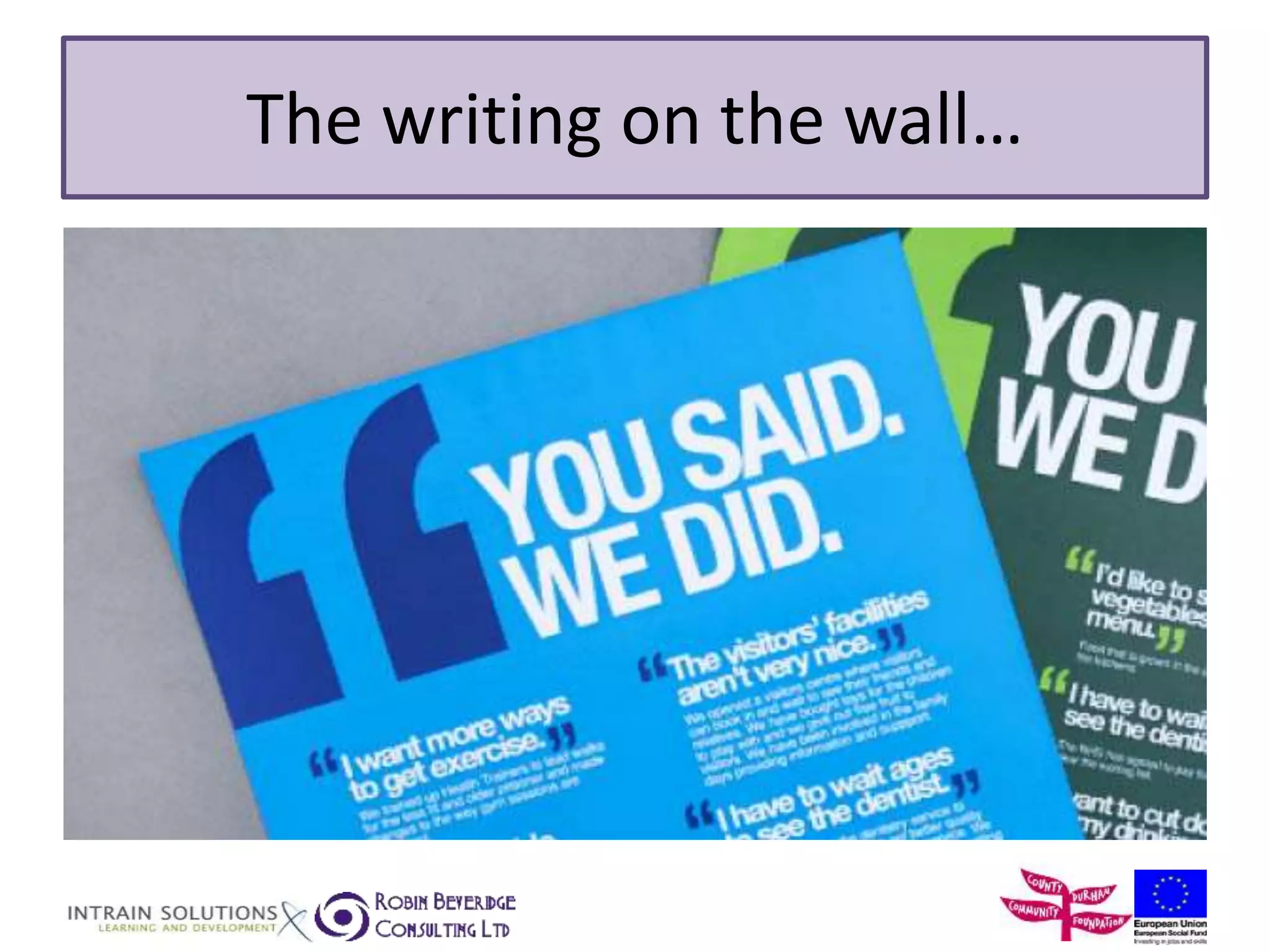
The writing on the wall…
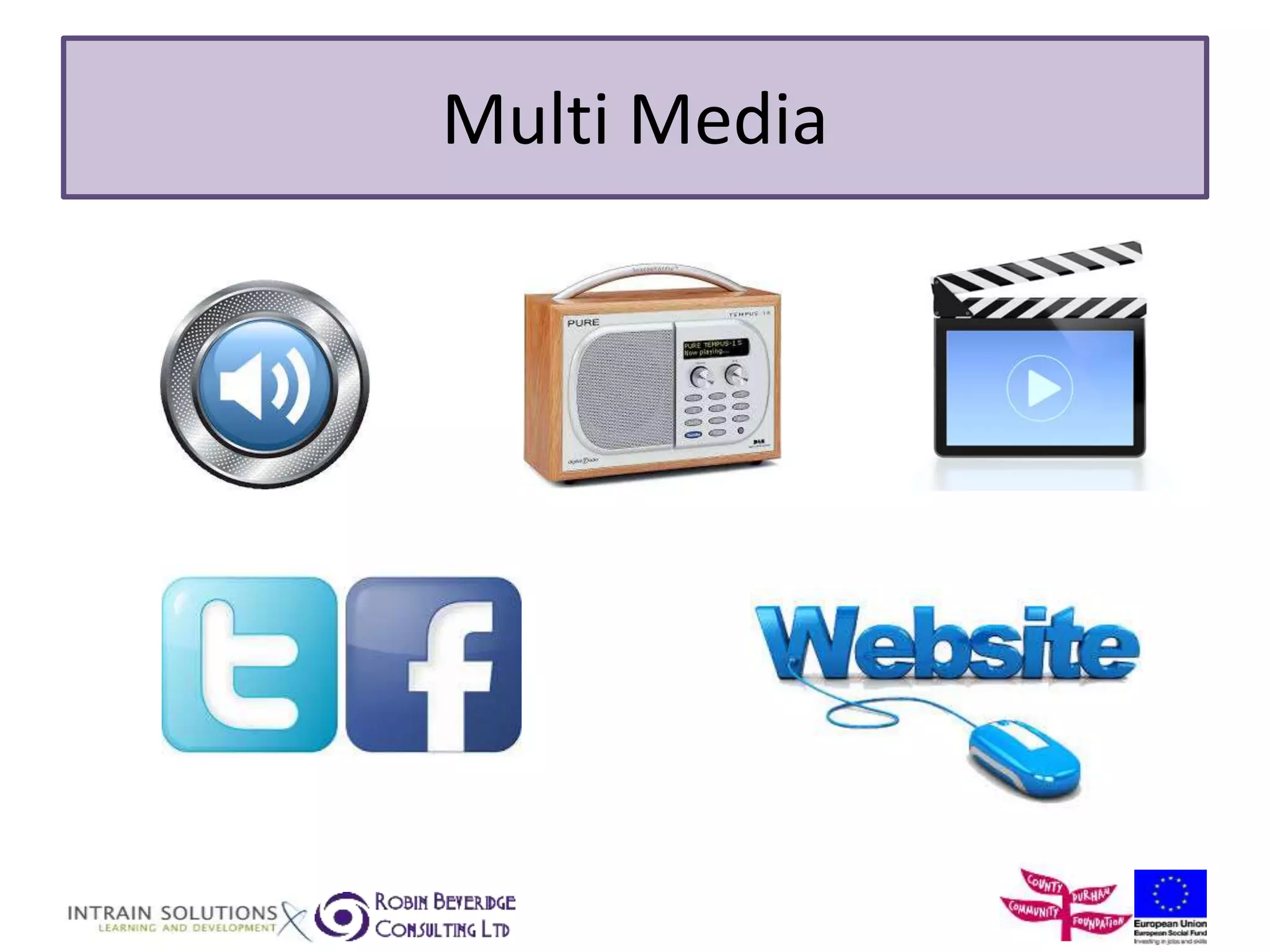
Multi Media
Summary and questions
Your Evaluation! 
• Any immediate thoughts? 
• Evaluation sheet – Free prize 
draw! 
• A more detailed conversation? 
• Peer support network?
An Introduction to Monitoring & Evaluation

An Introduction to Monitoring & Evaluation

  • 1.
    Proving Your Impact: Pain-free Monitoring and Evaluation 10th November 2014 Robin Beveridge and Tony Sacco
  • 2.
    Introduction • Domestics • Who’s who • What’s in store today • Ground rules • Networking and learning from each other
  • 3.
    Structure of theday: AM 9.30 Introductions and warm up 9.45 Monitoring & Evaluation: Key Concepts 10.00 Practical session: developing project ‘logic chains’ Break 11.00 Capturing information from beneficiaries – what works? 11.30 ‘Telling the story’ using case studies Lunch
  • 4.
    Structure of theday: PM 13.00 Recap and Review 13.10 13.50 14.10 14.50 Quantitative Evaluation techniques Evaluation in practice Monitoring & Evaluation plans Wowing the World Workshop feedback and close 15:30
  • 5.
    Getting started •Over the next 5 minutes… Write down 3 things you hope to get out of today on ‘post-its’ Speak with someone you have never met before today Introduce yourselves and swap one of your ‘hopes’ Repeat this with two more people • Then… …post your ‘post-its’ up on the wall.
  • 6.
  • 7.
  • 8.
    Key Concepts •Monitoring • Evaluation • Outputs • Outcomes • Impact • Aims • Objectives • Quantitative • Qualitative • Beneficiaries • Stakeholders • Value for Money • Additionality • Social Return
  • 9.
    Logic chain example1: This workshop Limited ability to demonstrate impact Need Activity Caused by Output Impact Outcome Workshops and peer learning Higher level of People trained skills and knowledge Better demonstration of impact Lack of Monitoring and evaluation knowledge Rationale
  • 10.
    Logic chain example2: Streetwise High level of teenage pregnancy Need Activity Caused by Output Impact Outcome Providing C-cards Young people accessing condoms Less un-protected sex Lower level of teenage pregnancy Poor access to contraceptives
  • 11.
    Logic chain example3: Bright Futures Young women in South Tyneside facing health and social problems Need Activity Caused by Output Impact Outcome Courses, advice sessions, peer education, volunteering Young women engaged in programmes/cou rses or given advice Young women better equipped to succeed in life Reduced health and social problems for young women in South Tyneside Lack of life skills and support systems
  • 12.
    Logic chain example4: Action Foundation Vulnerable asylum –seekers without accommodation Need Activity Caused by Output Impact Outcome Provision of free emergency accommodation Asylum-seekers housed and supported Asylum-seekers have stability and ability to access services for basic needs Chronic cycle of poverty / poor health / illegal work prevented No recourse to public funds and no permission to work
  • 13.
    Working in pairs • Using templates provided, develop a ‘Logic Chain’ for a project you are involved with • Share that with someone on your table • Feed back to the workshop: – What was easy, what was hard? – Does it make sense?
  • 14.
  • 15.
    Capturing information frombeneficiaries – What works? • In groups consider… –What are the different ways of capturing information from participants / beneficiaries? – Identify some ‘pros and cons’ of each approach.
  • 16.
    Capturing information frombeneficiaries – Some thoughts Questionnaires • Wide coverage • Tick box / narrative approach? • Accessibility • Self-completed or ‘managed’ • ‘Survey Monkey’ • Before / after / distance travelled • Confidentiality • Response rate
  • 17.
    Capturing information frombeneficiaries – Some thoughts
  • 19.
    Capturing information frombeneficiaries – some thoughts Feedback forms • Immediate feedback from ‘captive audience’? • More of / less of • Most useful / least useful • Improvements • Can be superficial and ‘too immediate’ • Follow up again later?
  • 20.
    Capturing information frombeneficiaries – some thoughts In-depth interview • Richer content • Particular insights • Range of views / perspectives • Resource intensive
  • 21.
    Capturing information frombeneficiaries – some thoughts Focus Groups • A group with similar characteristics (e.g. single parents) • ‘Managing’ the group • Recording the outcomes Round Table • Different perspectives
  • 22.
    Capturing information frombeneficiaries – some thoughts In-depth interview • Richer content • Particular insights • Different perspectives • Resource intensive
  • 23.
    Capturing information frombeneficiaries – some thoughts Comments / concerns / compliments • Forms / Box? • Managing the process • The feedback loop
  • 26.
    Timing issues… •Captive audience • Getting buy-in from the outset • ‘When they’re gone they’re gone!’ • Bias? • Incentives?
  • 28.
    Storage issues… •Paper based • Spreadsheets • Databases • Bespoke approaches?
  • 29.
    Outside the box… What more creative ways can you come up with to gather information from beneficiaries?
  • 30.
    Telling the Story Using Case Studies Spend a couple of minutes discussing with one or two others… When and why might we use a case study?
  • 31.
    Telling the Story Using Case Studies • The power of the story • The power of the actual words… • … and a picture paints 1,000 of them
  • 32.
    The Power ofthe Story
  • 33.
    The Power ofthe Actual Words • ‘If I didn’t have this I would have reoffended. I would have ended up getting drunk, fighting with someone and be back in prison.’ • ‘I felt miserable, I had no money and I was on benefits but now I’m independent. I feel good about working for my money.’
  • 34.
  • 35.
    Case Studies: ESFApproach About the person: • Details of the client’s background, education/training and employment history and current situation. Training/support: • Details of what activity took place during the project • What the client feels s/he achieved in regard to soft skills (e.g. more confidence) or hard outcomes (e.g. a qualification, employment, or volunteering).
  • 36.
    Case Studies: ESFApproach Plans for the future • How does the client hope to progress their employability, training or job searching? • Have they been referred to another organisation for ongoing support – if so which and what type ? Quote • A short quote from the client on how the project has made a difference. Signature
  • 37.
    Case Studies: AQuick Checklist • Before you start • Setting up the interview • On the day • After the event • Other thoughts
  • 38.
  • 39.
  • 40.
  • 41.
    Structure of theday: PM 13.00 Recap and Review 13.10 13.50 14.10 14.50 Quantitative Evaluation techniques Evaluation in practice Monitoring & Evaluation plans Wowing the World Workshop feedback and close
  • 42.
  • 43.
    Quantitative techniques •Why numbers matter • What numbers do we need? • How to get useful numbers • Cross-tabulation • Sampling and extrapolating • How to present data 50 40 30 20 10 0 % Reaction to the word “Spreadsheet” Men Women n.b. fictional data!
  • 44.
    Key numbers Theproject has achieved significant positive outcomes, with 447 young people supported to become enterprise ready up to December 2011. To date, roughly 1 in 4 of these beneficiaries have gone on to establish a business, and around 30% have moved into education, training or employment.” • How many beneficiaries? • Of what sort? • What happened as a result? “An independent evaluation found that the service costed £145,000 over three years, and had resulted in significant cost savings to statutory services: conservatively estimated at £1,211,630.” • What did it cost? • How much did it save? • Was it good value for money?
  • 45.
    Getting the numbers • Excel – Pivot Tables – Filters • Survey Monkey • Database Systems
  • 46.
    Cross tabulation %of beneficiaries Under 25 26-50 Over 50 Total Northumberland 0 5 15 20 Tyne &Wear 10 20 10 40 County Durham 15 10 0 25 Tees Valley 0 15 0 15 TOTAL 25 50 25 100
  • 47.
    Sampling and extrapolation • Most evaluation is based on a sample • How representative is your sample? • How diverse is your ‘population’? • Evaluation is NOT a science • Be aware of potential ‘bias’ in the sample • Use caveats in extrapolating
  • 48.
    Sampling example 120 100 80 60 40 20 0 Length of time to find work We found that 100% of respondents had found work within 3 months of completing the course. If this is true for all beneficiaries, we will have helped 300 people to find work” 1 2 3 4-6 7-12 12+ Months from completion
  • 49.
    Presenting Data –some tips • Not too much information • Order bars from high to low • Use a variety of formats, but not too many • Keep a consistent colour scheme • Remember titles, axes and legends • Keep it as clean as possible
  • 50.
  • 51.
    Presenting Data –some tips Use free tools, eg: • Google Fusion Tables • Tableau public • Any others?
  • 52.
  • 53.
    Developing an EvaluationPlan: Some things to think about • Scope and Purpose – What? – Level – e.g. Project, Programme, Organisation – Formative / Summative – Audience?
  • 54.
    Developing an EvaluationPlan: Some things to think about • Timing and Phasing – When? – Single phase or multiphase? • How do they fit together? – Previous evaluations? • The same approach or different? – Key deadlines? • ‘Doomed to success’
  • 55.
    Developing an EvaluationPlan: Some things to think about • Collecting Data – What is required? • Back to the logic chain – Where can you get the data – What have you got already? – Storage and analysis – Any barriers to using data?
  • 56.
    Developing an EvaluationPlan: Some things to think about • Who does it? – Internal / External? – Buy-in? – Objectivity – Budget
  • 57.
    Developing an EvaluationPlan: Some things to think about • Collecting views – Options for beneficiaries? – Key stakeholders? – Options for Stakeholders
  • 58.
    Developing an EvaluationPlan: Some things to think about • Managing the evaluation process – Who is responsible? – Sign off? • Dissemination – Who and how?
  • 59.
    Developing an EvaluationPlan for your project
  • 60.
    Wowing the World • Why are we doing this again? – Because we have to? – To improve our services to clients? – To attract new clients? – To demonstrate to ourselves and / or others that what we’re doing is effective? – To show Value for Money? – To convince people to give us some more?
  • 61.
    Wowing the World • Whatever the reason we need to ‘broadcast it’ in some way • What approaches have you used that have been particularly effective in broadcasting what you’ve achieved and the impact that it has made?
  • 62.
  • 63.
    The word onthe street • Evaluation Reports • Summary Documents – Selected highlights • Newspapers / Newsletters • Annual Reports
  • 64.
    The word onthe street
  • 65.
    The word onthe street
  • 66.
    The writing onthe wall…
  • 67.
  • 68.
  • 69.
    Your Evaluation! •Any immediate thoughts? • Evaluation sheet – Free prize draw! • A more detailed conversation? • Peer support network?

Editor's Notes

  • #49 Sample 40 35 24 100 Pop 1 120 105 75 300 Pop 2 40 45 50 55 60 50 300