APOLINARIO, MICHELLE B.
CABRILLOS, ROLLIN GRACE M.
ESPINOSA, KENNETH A.
RAGO, MAY A.
THE EXTENT OF TECHNOLOGY
INTEGRATION AMONG TEACHERS
IN THE COLLEGE OF EDUCATION
OF NORTHERN NEGROS STATE
COLLEGE OF SCIENCE AND
TECHNOLOGY
The 21st century is described as increasingly complex
kind of life and work environment. In education, technology
plays an important role in every educational instruction.
Schools and teachers need to be aware of improving their
technological tools and skills to be able to catch student
attention and interests. However teachers are facing
challenges in their efforts to integrate technology in
teaching.
According to UNESCO’s 2007 Partnership for 21st
Century Skills teachers must possess or develop Information,
Media and Technology Skills. As future teachers we want to
know the extent of technology integration of the faculty in
the College of Education in order to identify if the teacher is
well capacitated with technology and that of the level of
technological skills.
RATIONALE
This study aims to determine the extent of
technology integration of teachers in the College of
Education of Northern Negros State College of Science
and Technology.
Specifically, this study will answer the following
questions;
1.What is the profile of the respondent in terms of:
1.1 Age
1.2 Sex
1.3 Civil Status
1.4 Subject Taught/Content Area
1.5 Educational Attainment
1.6 Length of Service
STATEMENT OF THE PROBLEM
2. What is the extent of teachers’ technology integration
for teaching and learning in the classroom as a whole and
when grouped according to:
2.1 Understanding of the technology operations
and concept.
2.2 Planning and designing learning
environments and experiences.
2.3 Planning of Curriculum.
2.4 Evaluation and assessment
2.5 Enhancing their productivity and professional
practice.
2.6 Understand the social, ethical, legal and
human issues of technology and apply that
understanding in their practice.
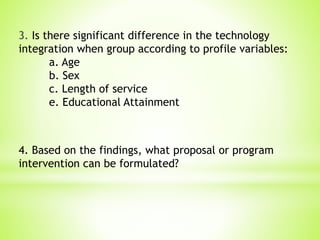
3. Is there significant difference in the technology
integration when group according to profile variables:
a. Age
b. Sex
c. Length of service
e. Educational Attainment
4. Based on the findings, what proposal or program
intervention can be formulated?
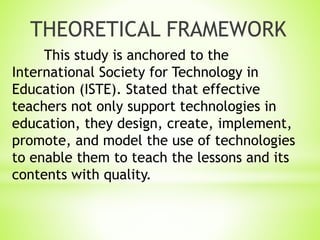
This study is anchored to the
International Society for Technology in
Education (ISTE). Stated that effective
teachers not only support technologies in
education, they design, create, implement,
promote, and model the use of technologies
to enable them to teach the lessons and its
contents with quality.
THEORETICAL FRAMEWORK
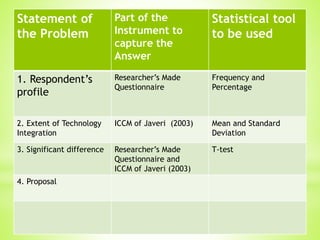
Statement of
the Problem
Part of the
Instrument to
capture the
Answer
Statistical tool
to be used
1. Respondent’s
profile
Researcher’s Made
Questionnaire
Frequency and
Percentage
2. Extent of Technology
Integration
ICCM of Javeri (2003) Mean and Standard
Deviation
3. Significant difference Researcher’s Made
Questionnaire and
ICCM of Javeri (2003)
T-test
4. Proposal
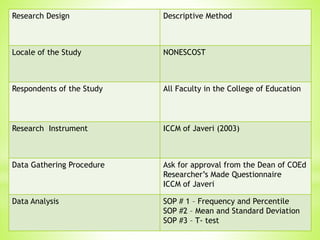
METHODOLOGY
Research Design Descriptive Method
Locale of the Study NONESCOST
Respondents of the Study All Faculty in the College of Education
Research Instrument ICCM of Javeri (2003)
Data Gathering Procedure Ask for approval from the Dean of COEd
Researcher’s Made Questionnaire
ICCM of Javeri
Data Analysis SOP # 1 – Frequency and Percentile
SOP #2 – Mean and Standard Deviation
SOP #3 – T- test

The extent of technology integration

  • 1.
    APOLINARIO, MICHELLE B. CABRILLOS,ROLLIN GRACE M. ESPINOSA, KENNETH A. RAGO, MAY A. THE EXTENT OF TECHNOLOGY INTEGRATION AMONG TEACHERS IN THE COLLEGE OF EDUCATION OF NORTHERN NEGROS STATE COLLEGE OF SCIENCE AND TECHNOLOGY
  • 2.
    The 21st centuryis described as increasingly complex kind of life and work environment. In education, technology plays an important role in every educational instruction. Schools and teachers need to be aware of improving their technological tools and skills to be able to catch student attention and interests. However teachers are facing challenges in their efforts to integrate technology in teaching. According to UNESCO’s 2007 Partnership for 21st Century Skills teachers must possess or develop Information, Media and Technology Skills. As future teachers we want to know the extent of technology integration of the faculty in the College of Education in order to identify if the teacher is well capacitated with technology and that of the level of technological skills. RATIONALE
  • 3.
    This study aimsto determine the extent of technology integration of teachers in the College of Education of Northern Negros State College of Science and Technology. Specifically, this study will answer the following questions; 1.What is the profile of the respondent in terms of: 1.1 Age 1.2 Sex 1.3 Civil Status 1.4 Subject Taught/Content Area 1.5 Educational Attainment 1.6 Length of Service STATEMENT OF THE PROBLEM
  • 4.
    2. What isthe extent of teachers’ technology integration for teaching and learning in the classroom as a whole and when grouped according to: 2.1 Understanding of the technology operations and concept. 2.2 Planning and designing learning environments and experiences. 2.3 Planning of Curriculum. 2.4 Evaluation and assessment 2.5 Enhancing their productivity and professional practice. 2.6 Understand the social, ethical, legal and human issues of technology and apply that understanding in their practice.
  • 5.
    3. Is theresignificant difference in the technology integration when group according to profile variables: a. Age b. Sex c. Length of service e. Educational Attainment 4. Based on the findings, what proposal or program intervention can be formulated?
  • 6.
    This study isanchored to the International Society for Technology in Education (ISTE). Stated that effective teachers not only support technologies in education, they design, create, implement, promote, and model the use of technologies to enable them to teach the lessons and its contents with quality. THEORETICAL FRAMEWORK
  • 7.
    Statement of the Problem Partof the Instrument to capture the Answer Statistical tool to be used 1. Respondent’s profile Researcher’s Made Questionnaire Frequency and Percentage 2. Extent of Technology Integration ICCM of Javeri (2003) Mean and Standard Deviation 3. Significant difference Researcher’s Made Questionnaire and ICCM of Javeri (2003) T-test 4. Proposal
  • 8.
    METHODOLOGY Research Design DescriptiveMethod Locale of the Study NONESCOST Respondents of the Study All Faculty in the College of Education Research Instrument ICCM of Javeri (2003) Data Gathering Procedure Ask for approval from the Dean of COEd Researcher’s Made Questionnaire ICCM of Javeri Data Analysis SOP # 1 – Frequency and Percentile SOP #2 – Mean and Standard Deviation SOP #3 – T- test