Presentation adapted from Space Foundation
Robotics/Nanotechnology 2009
A robot is defined as:
1. A mechanical device that sometimes resembles a human
and is capable of performing a variety of often complex
human tasks on command or by being programmed in
advance.
2. A machine or device that operates automatically or by
remote control
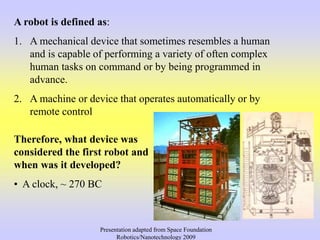
Therefore, what device was
considered the first robot and
when was it developed?
• A clock, ~ 270 BC
Presentation adapted from Space Foundation
Robotics/Nanotechnology 2009
A Short History of Robots
Robot Timeline:
• 350 BC - the Greek mathematician, Archytas (ahr ky’ tuhs) builds
a mechanical bird dubbed “the pigeon” that is propelled by steam.
• 270 BC - a Greek engineer named Ctesibus (ti sib’ ee uhs) made a
pipe organ called a “hydraulis” and water clocks with movable
figures. These clocks were the most accurate until the use of the
pendulum in the 17th century.
• 1801 – Joseph Jacquard builds an automated loom that is
controlled by a punch card. Punch cards are later used as an input
method for some early 20th century computers.
http://prime.jsc.nasa.gov/ROV/history.html http://en.wikipedia.org/wiki/Archytas
http://robotics.megagiant.com/history.html
Presentation adapted from Space Foundation
Robotics/Nanotechnology 2009
• 1818 - Mary Shelley wrote "Frankenstein" which was about a
frightening artificial life form created by Dr. Frankenstein.
• 1941 - Science fiction writer Isaac Asimov first used the word
"robotics" to describe the technology of robots and predicted the
rise of a powerful robot industry.
• 1942 - Asimov wrote "Runaround", a story about robots which
contained the "Three Laws of Robotics"
• 1921 - The term "robot" was first used in a play called "R.U.R."
or "Rossum's Universal Robots" by the Czech writer Karel Capek
(chap’ ek). The plot was simple: man makes robot then robot kills
man!
http://prime.jsc.nasa.gov/ROV/history.html http://en.wikipedia.org/wiki/Archytas
http://robotics.megagiant.com/history.html
Presentation adapted from Space Foundation
Robotics/Nanotechnology 2009
• 1940 – Isaac Asimov produces a series of short stories about
robots starting with “A Strange Playfellow” (later renamed
“Robbie”) for Super Science Stories magazine. The story is about a
robot bound to protect a child. It is later compiled into the volume,
“I, Robot” in 1950.
• 1948 - "Cybernetics", an influence on artificial intelligence
research was published by Norbert Wiener.
• 1956 - George Devol and Joseph Engelberger formed the world's
first robot company.
http://prime.jsc.nasa.gov/ROV/history.html http://en.wikipedia.org/wiki/Archytas
http://robotics.megagiant.com/history.html
Presentation adapted from Space Foundation
Robotics/Nanotechnology 2009
Three Laws of Robotics
by Isaac Asimov
• A robot may not injure a human, or, through inaction,
allow a human being to come to harm.
• A robot must obey the orders it by human beings except
where such orders would conflict with the First Law.
• A robot must protect its own existence as long as such
protection does not conflict with the First or Second
Law.
• He later adds the “Zeroth Law”. A robot may not injure
humanity, or, through inaction, allow humanity to come to
harm.
http://prime.jsc.nasa.gov/ROV/history.html http://en.wikipedia.org/wiki/Archytas
http://robotics.megagiant.com/history.html
Presentation adapted from Space Foundation
Robotics/Nanotechnology 2009
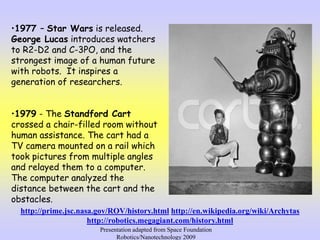
•1977 – Star Wars is released.
George Lucas introduces watchers
to R2-D2 and C-3PO, and the
strongest image of a human future
with robots. It inspires a
generation of researchers.
•1979 - The Standford Cart
crossed a chair-filled room without
human assistance. The cart had a
TV camera mounted on a rail which
took pictures from multiple angles
and relayed them to a computer.
The computer analyzed the
distance between the cart and the
obstacles.
http://prime.jsc.nasa.gov/ROV/history.html http://en.wikipedia.org/wiki/Archytas
http://robotics.megagiant.com/history.html
Presentation adapted from Space Foundation
Robotics/Nanotechnology 2009
• 1997 –Pathfinder lands on Mars.
• 1997 – The first node of the ISS is
placed in orbit using a robotic arm.
• 1998 – Tiger Electronics introduces
Furby. It can react to its
environment and communicate using
over 800 phrases.
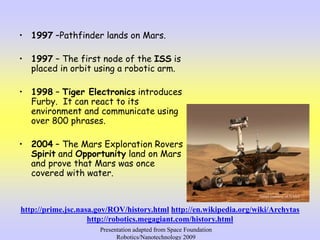
• 2004 – The Mars Exploration Rovers
Spirit and Opportunity land on Mars
and prove that Mars was once
covered with water.
Image courtesy of NASA
http://prime.jsc.nasa.gov/ROV/history.html http://en.wikipedia.org/wiki/Archytas
http://robotics.megagiant.com/history.html
Presentation adapted from Space Foundation
Robotics/Nanotechnology 2009
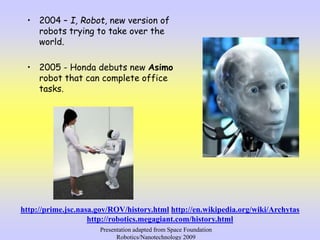
• 2004 – I, Robot, new version of
robots trying to take over the
world.
• 2005 - Honda debuts new Asimo
robot that can complete office
tasks.
http://prime.jsc.nasa.gov/ROV/history.html http://en.wikipedia.org/wiki/Archytas
http://robotics.megagiant.com/history.html
Presentation adapted from Space Foundation
Robotics/Nanotechnology 2009
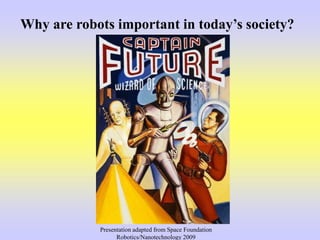
Why are robots important in today’s society?
Presentation adapted from Space Foundation
Robotics/Nanotechnology 2009
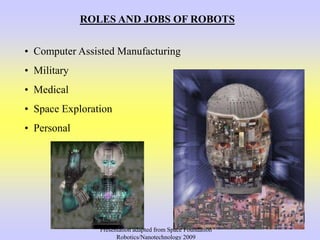
ROLES AND JOBS OF ROBOTS
• Computer Assisted Manufacturing
• Military
• Medical
• Space Exploration
• Personal
Presentation adapted from Space Foundation
Robotics/Nanotechnology 2009
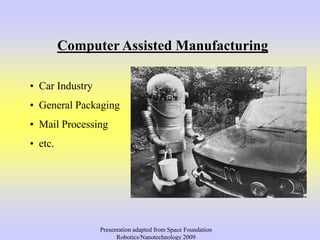
Computer Assisted Manufacturing
• Car Industry
• General Packaging
• Mail Processing
• etc.
Presentation adapted from Space Foundation
Robotics/Nanotechnology 2009
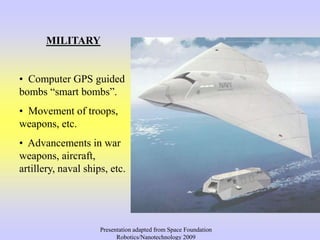
MILITARY
• Computer GPS guided
bombs “smart bombs”.
• Movement of troops,
weapons, etc.
• Advancements in war
weapons, aircraft,
artillery, naval ships, etc.
Presentation adapted from Space Foundation
Robotics/Nanotechnology 2009
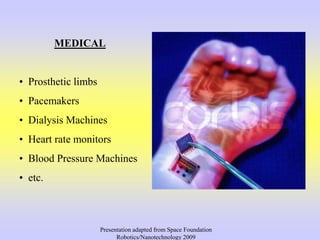
MEDICAL
• Prosthetic limbs
• Pacemakers
• Dialysis Machines
• Heart rate monitors
• Blood Pressure Machines
• etc.
Presentation adapted from Space Foundation
Robotics/Nanotechnology 2009
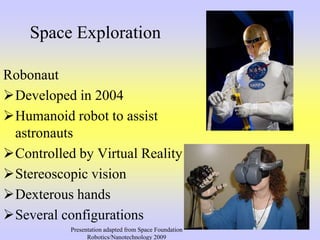
Space Exploration
Robonaut
Developed in 2004
Humanoid robot to assist
astronauts
Controlled by Virtual Reality
Stereoscopic vision
Dexterous hands
Several configurations
Presentation adapted from Space Foundation
Robotics/Nanotechnology 2009
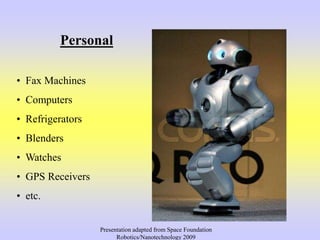
Personal
• Fax Machines
• Computers
• Refrigerators
• Blenders
• Watches
• GPS Receivers
• etc.
Presentation adapted from Space Foundation
Robotics/Nanotechnology 2009
ADVANTAGES, DISADVANTAGES, AND
FUTURE CONCERNS OF ROBOTS
PROS:
• Each machine “robot” helps our population greatly via technology
advances and improvements in the overall health of our society.
• Medicinal advancements
• Labor intensive activities are decreased due to machines “robots”.
• Mathematical & statistical computations.
• Robots can go and do things that are unsafe for humans (Example:
bomb disarming robots, space probes, etc..
Presentation adapted from Space Foundation
Robotics/Nanotechnology 2009
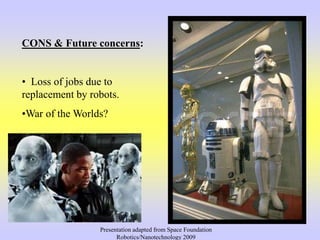
CONS & Future concerns:
• Loss of jobs due to
replacement by robots.
•War of the Worlds?
Presentation adapted from Space Foundation
Robotics/Nanotechnology 2009

Robot PPT.ppt

  • 1.
    Presentation adapted fromSpace Foundation Robotics/Nanotechnology 2009
  • 2.
    A robot isdefined as: 1. A mechanical device that sometimes resembles a human and is capable of performing a variety of often complex human tasks on command or by being programmed in advance. 2. A machine or device that operates automatically or by remote control Therefore, what device was considered the first robot and when was it developed? • A clock, ~ 270 BC Presentation adapted from Space Foundation Robotics/Nanotechnology 2009
  • 3.
    A Short Historyof Robots Robot Timeline: • 350 BC - the Greek mathematician, Archytas (ahr ky’ tuhs) builds a mechanical bird dubbed “the pigeon” that is propelled by steam. • 270 BC - a Greek engineer named Ctesibus (ti sib’ ee uhs) made a pipe organ called a “hydraulis” and water clocks with movable figures. These clocks were the most accurate until the use of the pendulum in the 17th century. • 1801 – Joseph Jacquard builds an automated loom that is controlled by a punch card. Punch cards are later used as an input method for some early 20th century computers. http://prime.jsc.nasa.gov/ROV/history.html http://en.wikipedia.org/wiki/Archytas http://robotics.megagiant.com/history.html Presentation adapted from Space Foundation Robotics/Nanotechnology 2009
  • 4.
    • 1818 -Mary Shelley wrote "Frankenstein" which was about a frightening artificial life form created by Dr. Frankenstein. • 1941 - Science fiction writer Isaac Asimov first used the word "robotics" to describe the technology of robots and predicted the rise of a powerful robot industry. • 1942 - Asimov wrote "Runaround", a story about robots which contained the "Three Laws of Robotics" • 1921 - The term "robot" was first used in a play called "R.U.R." or "Rossum's Universal Robots" by the Czech writer Karel Capek (chap’ ek). The plot was simple: man makes robot then robot kills man! http://prime.jsc.nasa.gov/ROV/history.html http://en.wikipedia.org/wiki/Archytas http://robotics.megagiant.com/history.html Presentation adapted from Space Foundation Robotics/Nanotechnology 2009
  • 5.
    • 1940 –Isaac Asimov produces a series of short stories about robots starting with “A Strange Playfellow” (later renamed “Robbie”) for Super Science Stories magazine. The story is about a robot bound to protect a child. It is later compiled into the volume, “I, Robot” in 1950. • 1948 - "Cybernetics", an influence on artificial intelligence research was published by Norbert Wiener. • 1956 - George Devol and Joseph Engelberger formed the world's first robot company. http://prime.jsc.nasa.gov/ROV/history.html http://en.wikipedia.org/wiki/Archytas http://robotics.megagiant.com/history.html Presentation adapted from Space Foundation Robotics/Nanotechnology 2009
  • 6.
    Three Laws ofRobotics by Isaac Asimov • A robot may not injure a human, or, through inaction, allow a human being to come to harm. • A robot must obey the orders it by human beings except where such orders would conflict with the First Law. • A robot must protect its own existence as long as such protection does not conflict with the First or Second Law. • He later adds the “Zeroth Law”. A robot may not injure humanity, or, through inaction, allow humanity to come to harm. http://prime.jsc.nasa.gov/ROV/history.html http://en.wikipedia.org/wiki/Archytas http://robotics.megagiant.com/history.html Presentation adapted from Space Foundation Robotics/Nanotechnology 2009
  • 7.
    •1977 – StarWars is released. George Lucas introduces watchers to R2-D2 and C-3PO, and the strongest image of a human future with robots. It inspires a generation of researchers. •1979 - The Standford Cart crossed a chair-filled room without human assistance. The cart had a TV camera mounted on a rail which took pictures from multiple angles and relayed them to a computer. The computer analyzed the distance between the cart and the obstacles. http://prime.jsc.nasa.gov/ROV/history.html http://en.wikipedia.org/wiki/Archytas http://robotics.megagiant.com/history.html Presentation adapted from Space Foundation Robotics/Nanotechnology 2009
  • 8.
    • 1997 –Pathfinderlands on Mars. • 1997 – The first node of the ISS is placed in orbit using a robotic arm. • 1998 – Tiger Electronics introduces Furby. It can react to its environment and communicate using over 800 phrases. • 2004 – The Mars Exploration Rovers Spirit and Opportunity land on Mars and prove that Mars was once covered with water. Image courtesy of NASA http://prime.jsc.nasa.gov/ROV/history.html http://en.wikipedia.org/wiki/Archytas http://robotics.megagiant.com/history.html Presentation adapted from Space Foundation Robotics/Nanotechnology 2009
  • 9.
    • 2004 –I, Robot, new version of robots trying to take over the world. • 2005 - Honda debuts new Asimo robot that can complete office tasks. http://prime.jsc.nasa.gov/ROV/history.html http://en.wikipedia.org/wiki/Archytas http://robotics.megagiant.com/history.html Presentation adapted from Space Foundation Robotics/Nanotechnology 2009
  • 10.
    Why are robotsimportant in today’s society? Presentation adapted from Space Foundation Robotics/Nanotechnology 2009
  • 11.
    ROLES AND JOBSOF ROBOTS • Computer Assisted Manufacturing • Military • Medical • Space Exploration • Personal Presentation adapted from Space Foundation Robotics/Nanotechnology 2009
  • 12.
    Computer Assisted Manufacturing •Car Industry • General Packaging • Mail Processing • etc. Presentation adapted from Space Foundation Robotics/Nanotechnology 2009
  • 13.
    MILITARY • Computer GPSguided bombs “smart bombs”. • Movement of troops, weapons, etc. • Advancements in war weapons, aircraft, artillery, naval ships, etc. Presentation adapted from Space Foundation Robotics/Nanotechnology 2009
  • 14.
    MEDICAL • Prosthetic limbs •Pacemakers • Dialysis Machines • Heart rate monitors • Blood Pressure Machines • etc. Presentation adapted from Space Foundation Robotics/Nanotechnology 2009
  • 15.
    Space Exploration Robonaut Developed in2004 Humanoid robot to assist astronauts Controlled by Virtual Reality Stereoscopic vision Dexterous hands Several configurations Presentation adapted from Space Foundation Robotics/Nanotechnology 2009
  • 16.
    Personal • Fax Machines •Computers • Refrigerators • Blenders • Watches • GPS Receivers • etc. Presentation adapted from Space Foundation Robotics/Nanotechnology 2009
  • 17.
    ADVANTAGES, DISADVANTAGES, AND FUTURECONCERNS OF ROBOTS PROS: • Each machine “robot” helps our population greatly via technology advances and improvements in the overall health of our society. • Medicinal advancements • Labor intensive activities are decreased due to machines “robots”. • Mathematical & statistical computations. • Robots can go and do things that are unsafe for humans (Example: bomb disarming robots, space probes, etc.. Presentation adapted from Space Foundation Robotics/Nanotechnology 2009
  • 18.
    CONS & Futureconcerns: • Loss of jobs due to replacement by robots. •War of the Worlds? Presentation adapted from Space Foundation Robotics/Nanotechnology 2009