Innovations in communication Since 18th Century in
India, UK, France & USA
BRCM Public School Vidyagram
Bahal Bhiwani Haryana
innovations on COMMUNICATION
Communication is key to maintaining
successful business relations. Communication
begins with language, the distinctive ability which
has made possible the evolution of human
society. With language any message, can be
conveyed between people over a limited distance
i.e. within a room or place of assembly, or across
a short open space.
innovations on COMMUNICATION
Communication with Writing:
When running with a message, to convey it
in spoken form, it is safer to do it oneself. Sending
anyone else is unreliable, So another requirement
for efficient communication is a system of
writing.
innovations on COMMUNICATION
Imperial communication: 522-486 BC.
Speeding up the messenger: 2nd - 11th century.
Pigeon post: from the 11th century.
Gutenberg and western printing: 1439 – 1457.
The spread of printing: 1457-1500.
First with the news: 1609-1690.
Improving the post: 1633-1639.
invention of the telescope in the 17th century.
innovations on COMMUNICATION
Types of Communication:
Verbal Communication
Non-Verbal Communication
Written Communication
innovations on COMMUNICATION
VERBAL COMMUNICATION:
Verbal or oral communication uses spoken
words to communicate a message. When most
people think of verbal communication, they think
of speaking, but listening is an equally important
skill for this type of communication to be
successful. Verbal communication is applicable to
a wide range of situations, ranging from informal
office discussions to public speeches made to
thousands of people.
innovations on COMMUNICATION
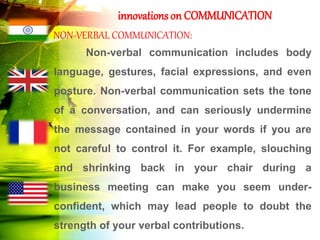
NON-VERBAL COMMUNICATION:
Non-verbal communication includes body
language, gestures, facial expressions, and even
posture. Non-verbal communication sets the tone
of a conversation, and can seriously undermine
the message contained in your words if you are
not careful to control it. For example, slouching
and shrinking back in your chair during a
business meeting can make you seem under-
confident, which may lead people to doubt the
strength of your verbal contributions.
innovations on COMMUNICATION
WRITTEN COMMUNICATION:
Written communication is essential for
communicating complicated information, such
as statistics or other data, that could not be
easily communicated through speech alone.
Written communication also allows information
to be recorded so that it can be referred to at a
later date.
innovations on COMMUNICATION
Optical signals: 18th century
In the 18th century communication was
very limited compared to us now but they
wrote letters, sent telegrams, gave a message
to a messenger, attached a letter to a bird and
(obviously) talked to each other.
innovations on COMMUNICATION
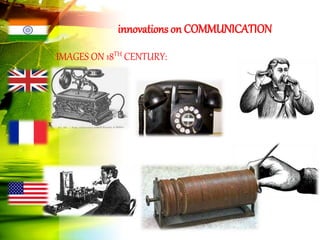
IMAGES ON 18TH CENTURY:
innovations on COMMUNICATION
19th century communication system:
The 19th century introduced new and increasingly
efficient forms of transportation and communication to
Newfoundland and Labrador. Roads and railways linked
many isolated communities by providing fast and convenient
modes of land-based transportation, while government-
subsidized steamships transported mail, freight, and
passengers to remote coastal settlements and urban centres.
innovations on COMMUNICATION
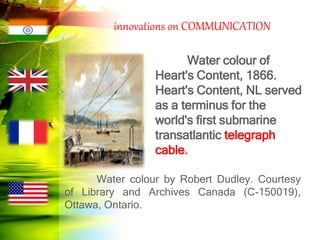
Water colour of
Heart's Content, 1866.
Heart's Content, NL served
as a terminus for the
world's first submarine
transatlantic telegraph
cable.
Water colour by Robert Dudley. Courtesy
of Library and Archives Canada (C-150019),
Ottawa, Ontario.
innovations on COMMUNICATION
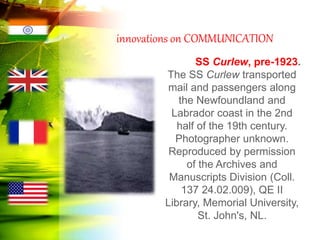
SS Curlew, pre-1923.
The SS Curlew transported
mail and passengers along
the Newfoundland and
Labrador coast in the 2nd
half of the 19th century.
Photographer unknown.
Reproduced by permission
of the Archives and
Manuscripts Division (Coll.
137 24.02.009), QE II
Library, Memorial University,
St. John's, NL.
innovations on COMMUNICATION
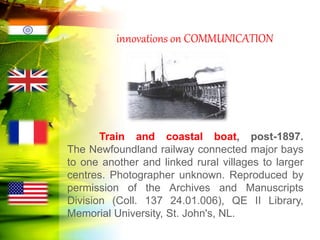
Train and coastal boat, post-1897.
The Newfoundland railway connected major bays
to one another and linked rural villages to larger
centres. Photographer unknown. Reproduced by
permission of the Archives and Manuscripts
Division (Coll. 137 24.01.006), QE II Library,
Memorial University, St. John's, NL.
innovations on COMMUNICATION
Communications:
Advancements in telecommunications during the 19th
century significantly altered the way Newfoundland and Labrador
people interacted with one another and the rest of the world.
Instead of waiting weeks or even months for mail and news to arrive
by boat, residents in rural and urban communities could use the
telegraph and later telephone to almost instantly contact people and
businesses in other towns and countries. As North America's most
easterly point, the island of Newfoundland played a central role in
the development of transatlantic telecommunications, which earned
it a degree of international fame and a place in telecommunications
history.
innovations on COMMUNICATION
Telegraph:
A telegraph is a machine that can send
and receive messages by wire over long
distances using Morse code. Telegraph lines
existed in much of North America by 1850, but
not in Newfoundland and Labrador. In
September 1851, telegraph engineer Frederick
Grisborne submitted a proposal to the
Newfoundland and Labrador legislature to build
a telegraph system from St. John's to Cape
Race, on the southeastern tip of the Avalon
Peninsula, and to Cape Ray on the island's
west coast, and to connect that line to Nova
Scotia by submarine cable.

innovations on COMMUNICATION
Telephone:
Alexander Graham Bell
introduced another form of fast and
convenient long-distance communication
in 1874 when he invented the telephone.
innovations on COMMUNICATION
20th century communication system:
Radio:
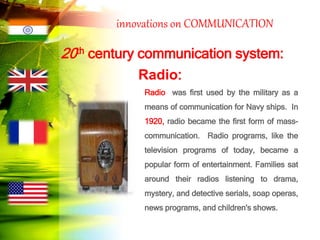
Radio was first used by the military as a
means of communication for Navy ships. In
1920, radio became the first form of mass-
communication. Radio programs, like the
television programs of today, became a
popular form of entertainment. Families sat
around their radios listening to drama,
mystery, and detective serials, soap operas,
news programs, and children's shows.
innovations on COMMUNICATION
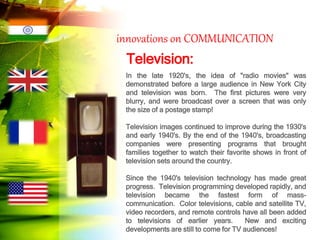
Television:
In the late 1920's, the idea of "radio movies" was
demonstrated before a large audience in New York City
and television was born. The first pictures were very
blurry, and were broadcast over a screen that was only
the size of a postage stamp!
Television images continued to improve during the 1930's
and early 1940's. By the end of the 1940's, broadcasting
companies were presenting programs that brought
families together to watch their favorite shows in front of
television sets around the country.
Since the 1940's television technology has made great
progress. Television programming developed rapidly, and
television became the fastest form of mass-
communication. Color televisions, cable and satellite TV,
video recorders, and remote controls have all been added
to televisions of earlier years. New and exciting
developments are still to come for TV audiences!
innovations on COMMUNICATION
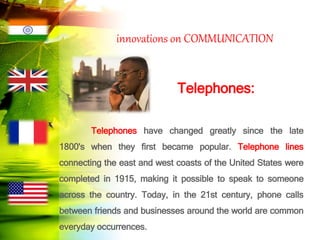
Telephones:
Telephones have changed greatly since the late
1800's when they first became popular. Telephone lines
connecting the east and west coasts of the United States were
completed in 1915, making it possible to speak to someone
across the country. Today, in the 21st century, phone calls
between friends and businesses around the world are common
everyday occurrences.
innovations on COMMUNICATION
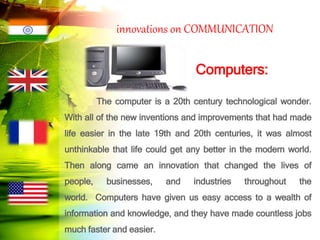
Computers:
The computer is a 20th century technological wonder.
With all of the new inventions and improvements that had made
life easier in the late 19th and 20th centuries, it was almost
unthinkable that life could get any better in the modern world.
Then along came an innovation that changed the lives of
people, businesses, and industries throughout the
world. Computers have given us easy access to a wealth of
information and knowledge, and they have made countless jobs
much faster and easier.
innovations on COMMUNICATION
21st century communication system:
The 21st century is the current century of
the Anno Domini era or the Common Era, in
accordance with the Gregorian calendar. It
began on January 1, 2001, and will end on
December 31, 2100. It is the first century of the
3rd millennium. It is distinct from the century
known as the 2000s, which began on January 1,
2000 and will end on December 31, 2099.
innovations on COMMUNICATION
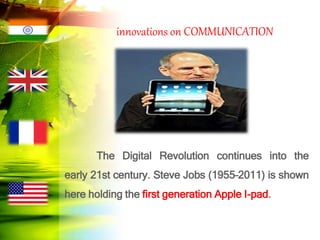
The Digital Revolution continues into the
early 21st century. Steve Jobs (1955–2011) is shown
here holding the first generation Apple I-pad.
innovations on COMMUNICATION
21st Century Innovation Topics :
1. Energy conservation
2. Resource protection
3. Food and water production and distribution
4. Waste management
5. Education and learning
6. Medicine and prolonging life
7. Security and counter-terrorism
8. New technology
9. Genetics and cloning
10. Global communication
11. Traffic and population logistics
innovations on COMMUNICATION
12. Knowledge sharing
13. Integrated electronic environment
14. Globalization
15. AI, interfaces and robotics
16. Weather prediction and control
17. Sustainable development
18. Entertainment
19. Space exploration
20. "Virtualization" and VR
21. Preservation of history
22. Preservation of species
21st Century Innovation Topics :
innovations on COMMUNICATION
Innovations of the 21st Century:
10 of the Best Inventions in Recent History
1) iPod and iTunes: These two interrelated inventions from Apple Inc.
presented a revolutionary new way for people to listen to music and
fundamentally changed the music and recording industry.
2) iPhone: The iPhone from Apple Inc was released in June of 2007 and radically
altered the way mobile phones are used personally and in business.
3) Electric Car: Tesla Motors was formed in 2003 and unveiled its first production-
model all-electric car in 2008.
4) YouTube: YouTube was debuted in 2005 and had a significant impact on
media distribution and social networking.
5) Teleportation: In 2002, research at the Australian National University resulted
in the successful teleportation of a laser beam.
innovations on COMMUNICATION
Innovations of the 21st Century:
10 of the Best Inventions in Recent History
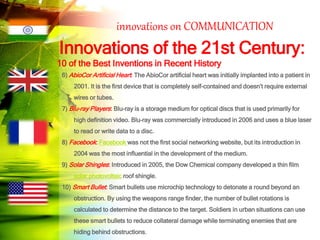
6) AbioCor Artificial Heart: The AbioCor artificial heart was initially implanted into a patient in
2001. It is the first device that is completely self-contained and doesn’t require external
wires or tubes.
7) Blu-ray Players: Blu-ray is a storage medium for optical discs that is used primarily for
high definition video. Blu-ray was commercially introduced in 2006 and uses a blue laser
to read or write data to a disc.
8) Facebook: Facebook was not the first social networking website, but its introduction in
2004 was the most influential in the development of the medium.
9) Solar Shingles: Introduced in 2005, the Dow Chemical company developed a thin film
solar photovoltaic roof shingle.
10) Smart Bullet: Smart bullets use microchip technology to detonate a round beyond an
obstruction. By using the weapons range finder, the number of bullet rotations is
calculated to determine the distance to the target. Soldiers in urban situations can use
these smart bullets to reduce collateral damage while terminating enemies that are
hiding behind obstructions.
innovations on COMMUNICATION
The New Century:
The 21st century is only a decade old. The
future is promising, and it will be interesting to
see how the list of the best inventions of the 21st
century changes as the years unfold.
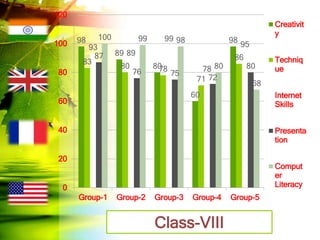
98
89
80
60
98
83
80 78
71
86
93
89
99
78
95
87
76 75
72
80
100 99 98
80
68
0
20
40
60
80
100
120
Group-1 Group-2 Group-3 Group-4 Group-5
Creativit
y
Techniq
ue
Internet
Skills
Presenta
tion
Comput
er
Literacy
98
89
80
60
98
83
80 78
71
86
93
89
99
78
95
87
76 75
72
80
100 99 98
80
68
0
20
40
60
80
100
120
Group-1 Group-2 Group-3 Group-4 Group-5
Creativ
ity
Techni
que
Interne
t Skills
Presen
tation
Compu
ter
Literac
y
Creativity
Internet…
Computer…
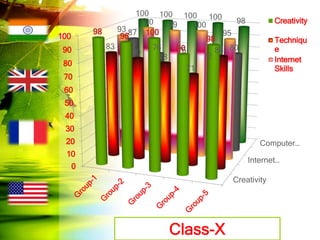
0
10
20
30
40
50
60
70
80
90
100
83
80
78
71
86
93
100 99 100
9587
76 75
72
80
100 100 100 100 98 Creativity
Techniqu
e
Internet
Skills
Thanking U…………….
By:
Sibabrata Balabantaray

Innovations in communications By S B Ray

  • 1.
    Innovations in communicationSince 18th Century in India, UK, France & USA BRCM Public School Vidyagram Bahal Bhiwani Haryana
  • 2.
    innovations on COMMUNICATION Communicationis key to maintaining successful business relations. Communication begins with language, the distinctive ability which has made possible the evolution of human society. With language any message, can be conveyed between people over a limited distance i.e. within a room or place of assembly, or across a short open space.
  • 3.
    innovations on COMMUNICATION Communicationwith Writing: When running with a message, to convey it in spoken form, it is safer to do it oneself. Sending anyone else is unreliable, So another requirement for efficient communication is a system of writing.
  • 4.
    innovations on COMMUNICATION Imperialcommunication: 522-486 BC. Speeding up the messenger: 2nd - 11th century. Pigeon post: from the 11th century. Gutenberg and western printing: 1439 – 1457. The spread of printing: 1457-1500. First with the news: 1609-1690. Improving the post: 1633-1639. invention of the telescope in the 17th century.
  • 5.
    innovations on COMMUNICATION Typesof Communication: Verbal Communication Non-Verbal Communication Written Communication
  • 6.
    innovations on COMMUNICATION VERBALCOMMUNICATION: Verbal or oral communication uses spoken words to communicate a message. When most people think of verbal communication, they think of speaking, but listening is an equally important skill for this type of communication to be successful. Verbal communication is applicable to a wide range of situations, ranging from informal office discussions to public speeches made to thousands of people.
  • 7.
  • 8.
    innovations on COMMUNICATION NON-VERBALCOMMUNICATION: Non-verbal communication includes body language, gestures, facial expressions, and even posture. Non-verbal communication sets the tone of a conversation, and can seriously undermine the message contained in your words if you are not careful to control it. For example, slouching and shrinking back in your chair during a business meeting can make you seem under- confident, which may lead people to doubt the strength of your verbal contributions.
  • 9.
  • 10.
    innovations on COMMUNICATION WRITTENCOMMUNICATION: Written communication is essential for communicating complicated information, such as statistics or other data, that could not be easily communicated through speech alone. Written communication also allows information to be recorded so that it can be referred to at a later date.
  • 11.
  • 12.
    innovations on COMMUNICATION Opticalsignals: 18th century In the 18th century communication was very limited compared to us now but they wrote letters, sent telegrams, gave a message to a messenger, attached a letter to a bird and (obviously) talked to each other.
  • 13.
  • 14.
    innovations on COMMUNICATION 19thcentury communication system: The 19th century introduced new and increasingly efficient forms of transportation and communication to Newfoundland and Labrador. Roads and railways linked many isolated communities by providing fast and convenient modes of land-based transportation, while government- subsidized steamships transported mail, freight, and passengers to remote coastal settlements and urban centres.
  • 15.
    innovations on COMMUNICATION Watercolour of Heart's Content, 1866. Heart's Content, NL served as a terminus for the world's first submarine transatlantic telegraph cable. Water colour by Robert Dudley. Courtesy of Library and Archives Canada (C-150019), Ottawa, Ontario.
  • 16.
    innovations on COMMUNICATION SSCurlew, pre-1923. The SS Curlew transported mail and passengers along the Newfoundland and Labrador coast in the 2nd half of the 19th century. Photographer unknown. Reproduced by permission of the Archives and Manuscripts Division (Coll. 137 24.02.009), QE II Library, Memorial University, St. John's, NL.
  • 17.
    innovations on COMMUNICATION Trainand coastal boat, post-1897. The Newfoundland railway connected major bays to one another and linked rural villages to larger centres. Photographer unknown. Reproduced by permission of the Archives and Manuscripts Division (Coll. 137 24.01.006), QE II Library, Memorial University, St. John's, NL.
  • 18.
    innovations on COMMUNICATION Communications: Advancementsin telecommunications during the 19th century significantly altered the way Newfoundland and Labrador people interacted with one another and the rest of the world. Instead of waiting weeks or even months for mail and news to arrive by boat, residents in rural and urban communities could use the telegraph and later telephone to almost instantly contact people and businesses in other towns and countries. As North America's most easterly point, the island of Newfoundland played a central role in the development of transatlantic telecommunications, which earned it a degree of international fame and a place in telecommunications history.
  • 19.
    innovations on COMMUNICATION Telegraph: Atelegraph is a machine that can send and receive messages by wire over long distances using Morse code. Telegraph lines existed in much of North America by 1850, but not in Newfoundland and Labrador. In September 1851, telegraph engineer Frederick Grisborne submitted a proposal to the Newfoundland and Labrador legislature to build a telegraph system from St. John's to Cape Race, on the southeastern tip of the Avalon Peninsula, and to Cape Ray on the island's west coast, and to connect that line to Nova Scotia by submarine cable.
  • 20.
    innovations on COMMUNICATION Telephone: AlexanderGraham Bell introduced another form of fast and convenient long-distance communication in 1874 when he invented the telephone.
  • 21.
    innovations on COMMUNICATION 20thcentury communication system: Radio: Radio was first used by the military as a means of communication for Navy ships. In 1920, radio became the first form of mass- communication. Radio programs, like the television programs of today, became a popular form of entertainment. Families sat around their radios listening to drama, mystery, and detective serials, soap operas, news programs, and children's shows.
  • 22.
    innovations on COMMUNICATION Television: Inthe late 1920's, the idea of "radio movies" was demonstrated before a large audience in New York City and television was born. The first pictures were very blurry, and were broadcast over a screen that was only the size of a postage stamp! Television images continued to improve during the 1930's and early 1940's. By the end of the 1940's, broadcasting companies were presenting programs that brought families together to watch their favorite shows in front of television sets around the country. Since the 1940's television technology has made great progress. Television programming developed rapidly, and television became the fastest form of mass- communication. Color televisions, cable and satellite TV, video recorders, and remote controls have all been added to televisions of earlier years. New and exciting developments are still to come for TV audiences!
  • 23.
    innovations on COMMUNICATION Telephones: Telephoneshave changed greatly since the late 1800's when they first became popular. Telephone lines connecting the east and west coasts of the United States were completed in 1915, making it possible to speak to someone across the country. Today, in the 21st century, phone calls between friends and businesses around the world are common everyday occurrences.
  • 24.
    innovations on COMMUNICATION Computers: Thecomputer is a 20th century technological wonder. With all of the new inventions and improvements that had made life easier in the late 19th and 20th centuries, it was almost unthinkable that life could get any better in the modern world. Then along came an innovation that changed the lives of people, businesses, and industries throughout the world. Computers have given us easy access to a wealth of information and knowledge, and they have made countless jobs much faster and easier.
  • 25.
    innovations on COMMUNICATION 21stcentury communication system: The 21st century is the current century of the Anno Domini era or the Common Era, in accordance with the Gregorian calendar. It began on January 1, 2001, and will end on December 31, 2100. It is the first century of the 3rd millennium. It is distinct from the century known as the 2000s, which began on January 1, 2000 and will end on December 31, 2099.
  • 26.
    innovations on COMMUNICATION TheDigital Revolution continues into the early 21st century. Steve Jobs (1955–2011) is shown here holding the first generation Apple I-pad.
  • 27.
    innovations on COMMUNICATION 21stCentury Innovation Topics : 1. Energy conservation 2. Resource protection 3. Food and water production and distribution 4. Waste management 5. Education and learning 6. Medicine and prolonging life 7. Security and counter-terrorism 8. New technology 9. Genetics and cloning 10. Global communication 11. Traffic and population logistics
  • 28.
    innovations on COMMUNICATION 12.Knowledge sharing 13. Integrated electronic environment 14. Globalization 15. AI, interfaces and robotics 16. Weather prediction and control 17. Sustainable development 18. Entertainment 19. Space exploration 20. "Virtualization" and VR 21. Preservation of history 22. Preservation of species 21st Century Innovation Topics :
  • 29.
    innovations on COMMUNICATION Innovationsof the 21st Century: 10 of the Best Inventions in Recent History 1) iPod and iTunes: These two interrelated inventions from Apple Inc. presented a revolutionary new way for people to listen to music and fundamentally changed the music and recording industry. 2) iPhone: The iPhone from Apple Inc was released in June of 2007 and radically altered the way mobile phones are used personally and in business. 3) Electric Car: Tesla Motors was formed in 2003 and unveiled its first production- model all-electric car in 2008. 4) YouTube: YouTube was debuted in 2005 and had a significant impact on media distribution and social networking. 5) Teleportation: In 2002, research at the Australian National University resulted in the successful teleportation of a laser beam.
  • 30.
    innovations on COMMUNICATION Innovationsof the 21st Century: 10 of the Best Inventions in Recent History 6) AbioCor Artificial Heart: The AbioCor artificial heart was initially implanted into a patient in 2001. It is the first device that is completely self-contained and doesn’t require external wires or tubes. 7) Blu-ray Players: Blu-ray is a storage medium for optical discs that is used primarily for high definition video. Blu-ray was commercially introduced in 2006 and uses a blue laser to read or write data to a disc. 8) Facebook: Facebook was not the first social networking website, but its introduction in 2004 was the most influential in the development of the medium. 9) Solar Shingles: Introduced in 2005, the Dow Chemical company developed a thin film solar photovoltaic roof shingle. 10) Smart Bullet: Smart bullets use microchip technology to detonate a round beyond an obstruction. By using the weapons range finder, the number of bullet rotations is calculated to determine the distance to the target. Soldiers in urban situations can use these smart bullets to reduce collateral damage while terminating enemies that are hiding behind obstructions.
  • 31.
    innovations on COMMUNICATION TheNew Century: The 21st century is only a decade old. The future is promising, and it will be interesting to see how the list of the best inventions of the 21st century changes as the years unfold.
  • 33.
    98 89 80 60 98 83 80 78 71 86 93 89 99 78 95 87 76 75 72 80 10099 98 80 68 0 20 40 60 80 100 120 Group-1 Group-2 Group-3 Group-4 Group-5 Creativit y Techniq ue Internet Skills Presenta tion Comput er Literacy
  • 34.
    98 89 80 60 98 83 80 78 71 86 93 89 99 78 95 87 76 75 72 80 10099 98 80 68 0 20 40 60 80 100 120 Group-1 Group-2 Group-3 Group-4 Group-5 Creativ ity Techni que Interne t Skills Presen tation Compu ter Literac y
  • 35.
  • 36.