EVOLUTION OF
COMMUNICATION
BY BHUWNESH BHATT (B.ED 2ND SEM)
F r o m s i g n s t o s i g n a l s
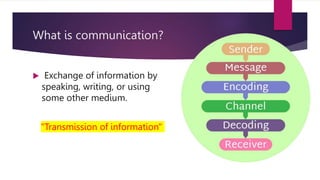
What is communication?
 Exchange of information by
speaking, writing, or using
some other medium.
"Transmission of information"
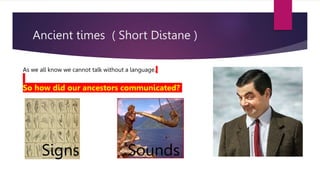
Ancient times ( Short Distane )
As we all know we cannot talk without a language.
So how did our ancestors communicated?
Signs Sounds
Long Distance
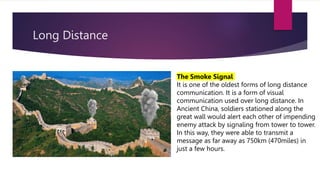
The Smoke Signal
It is one of the oldest forms of long distance
communication. It is a form of visual
communication used over long distance. In
Ancient China, soldiers stationed along the
great wall would alert each other of impending
enemy attack by signaling from tower to tower.
In this way, they were able to transmit a
message as far away as 750km (470miles) in
just a few hours.
Pigeon Post
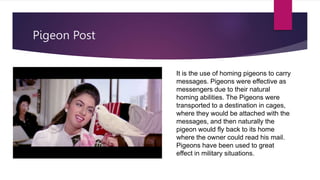
It is the use of homing pigeons to carry
messages. Pigeons were effective as
messengers due to their natural
homing abilities. The Pigeons were
transported to a destination in cages,
where they would be attached with the
messages, and then naturally the
pigeon would fly back to its home
where the owner could read his mail.
Pigeons have been used to great
effect in military situations.
Mailing System
 Mail or post is a system for transporting letters & other
tangible objects: written documents typically enclosed in
envelopes & also small packages are delivered to
destinations around the world.
 Anything sent through the postal system is called mail or
post. A postal service can be private or public, though many
governments place restrictions on private systems.
Mailing System
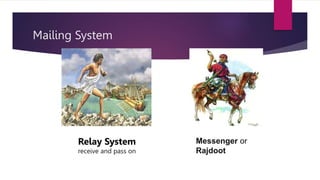
Relay System
receive and pass on
Messenger or
Rajdoot
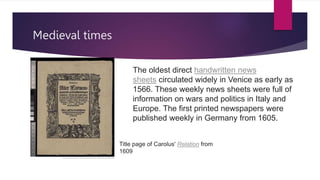
Medieval times
The oldest direct handwritten news
sheets circulated widely in Venice as early as
1566. These weekly news sheets were full of
information on wars and politics in Italy and
Europe. The first printed newspapers were
published weekly in Germany from 1605.
Title page of Carolus' Relation from
1609
Modern Ways ( The industrial Revolution)
 The Industrial Revolution (was a period of global
transition of human economy towards more efficient
and stable manufacturing processes using high tech
machines.
 This occurred during the period from around
1760 from Britain.
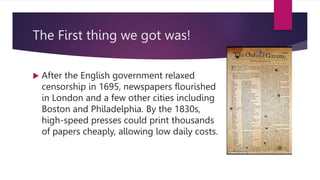
The First thing we got was!
 After the English government relaxed
censorship in 1695, newspapers flourished
in London and a few other cities including
Boston and Philadelphia. By the 1830s,
high-speed presses could print thousands
of papers cheaply, allowing low daily costs.
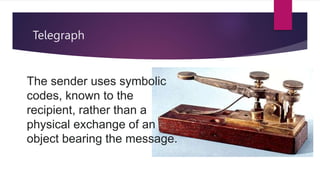
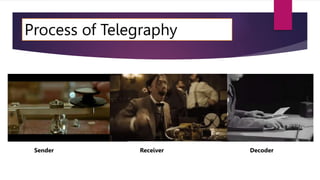
Telegraph
The sender uses symbolic
codes, known to the
recipient, rather than a
physical exchange of an
object bearing the message.
Process of Telegraphy
Sender Receiver Decoder
Telephone
In 1876, Alexander Graham Bell was
the first to be granted a United
States patent for a device that produced
clearly intelligible replication of the
human voice at a second device.[2] This
instrument was further developed by
many others, and became rapidly
indispensable in business, government,
and in households.
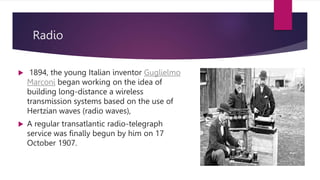
Radio
 1894, the young Italian inventor Guglielmo
Marconi began working on the idea of
building long-distance a wireless
transmission systems based on the use of
Hertzian waves (radio waves),
 A regular transatlantic radio-telegraph
service was finally begun by him on 17
October 1907.
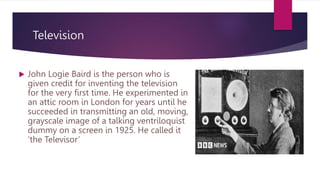
Television
 John Logie Baird is the person who is
given credit for inventing the television
for the very first time. He experimented in
an attic room in London for years until he
succeeded in transmitting an old, moving,
grayscale image of a talking ventriloquist
dummy on a screen in 1925. He called it
‘the Televisor’
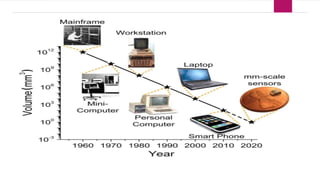
Computing Technology
 British mathematician Charles
Babbage came up with the idea
for an automatic computer,
powered by steam, in 1837. He
finished designing his invention
in 1856, more than 100 years
before the first electronic ones.
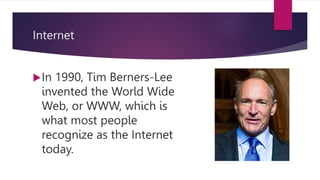
Internet
In 1990, Tim Berners-Lee
invented the World Wide
Web, or WWW, which is
what most people
recognize as the Internet
today.
Evolution Of Communication

Evolution Of Communication

  • 1.
    EVOLUTION OF COMMUNICATION BY BHUWNESHBHATT (B.ED 2ND SEM) F r o m s i g n s t o s i g n a l s
  • 2.
    What is communication? Exchange of information by speaking, writing, or using some other medium. "Transmission of information"
  • 3.
    Ancient times (Short Distane ) As we all know we cannot talk without a language. So how did our ancestors communicated? Signs Sounds
  • 4.
    Long Distance The SmokeSignal It is one of the oldest forms of long distance communication. It is a form of visual communication used over long distance. In Ancient China, soldiers stationed along the great wall would alert each other of impending enemy attack by signaling from tower to tower. In this way, they were able to transmit a message as far away as 750km (470miles) in just a few hours.
  • 5.
    Pigeon Post It isthe use of homing pigeons to carry messages. Pigeons were effective as messengers due to their natural homing abilities. The Pigeons were transported to a destination in cages, where they would be attached with the messages, and then naturally the pigeon would fly back to its home where the owner could read his mail. Pigeons have been used to great effect in military situations.
  • 6.
    Mailing System  Mailor post is a system for transporting letters & other tangible objects: written documents typically enclosed in envelopes & also small packages are delivered to destinations around the world.  Anything sent through the postal system is called mail or post. A postal service can be private or public, though many governments place restrictions on private systems.
  • 7.
    Mailing System Relay System receiveand pass on Messenger or Rajdoot
  • 8.
    Medieval times The oldestdirect handwritten news sheets circulated widely in Venice as early as 1566. These weekly news sheets were full of information on wars and politics in Italy and Europe. The first printed newspapers were published weekly in Germany from 1605. Title page of Carolus' Relation from 1609
  • 9.
    Modern Ways (The industrial Revolution)  The Industrial Revolution (was a period of global transition of human economy towards more efficient and stable manufacturing processes using high tech machines.  This occurred during the period from around 1760 from Britain.
  • 10.
    The First thingwe got was!  After the English government relaxed censorship in 1695, newspapers flourished in London and a few other cities including Boston and Philadelphia. By the 1830s, high-speed presses could print thousands of papers cheaply, allowing low daily costs.
  • 11.
    Telegraph The sender usessymbolic codes, known to the recipient, rather than a physical exchange of an object bearing the message.
  • 12.
  • 13.
    Telephone In 1876, AlexanderGraham Bell was the first to be granted a United States patent for a device that produced clearly intelligible replication of the human voice at a second device.[2] This instrument was further developed by many others, and became rapidly indispensable in business, government, and in households.
  • 14.
    Radio  1894, theyoung Italian inventor Guglielmo Marconi began working on the idea of building long-distance a wireless transmission systems based on the use of Hertzian waves (radio waves),  A regular transatlantic radio-telegraph service was finally begun by him on 17 October 1907.
  • 15.
    Television  John LogieBaird is the person who is given credit for inventing the television for the very first time. He experimented in an attic room in London for years until he succeeded in transmitting an old, moving, grayscale image of a talking ventriloquist dummy on a screen in 1925. He called it ‘the Televisor’
  • 17.
    Computing Technology  Britishmathematician Charles Babbage came up with the idea for an automatic computer, powered by steam, in 1837. He finished designing his invention in 1856, more than 100 years before the first electronic ones.
  • 19.
    Internet In 1990, TimBerners-Lee invented the World Wide Web, or WWW, which is what most people recognize as the Internet today.