
THE EUROPEAN INTEGRATION
IVASHEV AKHMED
PLAN
• Progress of European integration
• Enlargement of the European union
• Preparation of economic and monetary union (EMU)
• Three stages of economic and monetary union (EMU)
• Convergence criterion
• Economic and monetary union
• Benefits of the EURO
• Key characteristic
of the euro area
• Financial integration
of the euro area
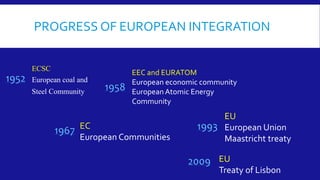
PROGRESS OF EUROPEAN INTEGRATION
1952
ECSC
European coal and
Steel Community 1958
EEC and EURATOM
European economic community
EuropeanAtomic Energy
Community
1967 EC
European Communities
1993
EU
European Union
Maastricht treaty
2009 EU
Treaty of Lisbon
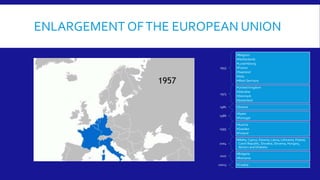
ENLARGEMENT OFTHE EUROPEAN UNION
1953
•Belgium
•Netherlands
•Luxembourg
•France
•Saarland
•Italy
•West Germany
1973
•United Kingdom
•Gibraltar
•Denmark
•Greenland
1981 •Greece
1986
•Spain
•Portugal
1995
•Austria
•Sweden
•Finland
2004
•Malta, Cyprus, Estonia, Latvia, Lithuania, Poland,
Czech Republic, Slovakia, Slovenia, Hungary,
Akrotiri and Dhekelia
2007
•Bulgaria
•Romania
20013 •Croatia
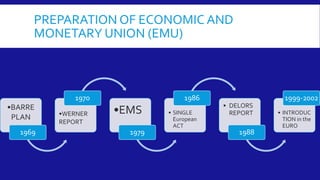
PREPARATION OF ECONOMIC AND
MONETARY UNION (EMU)
•BARRE
PLAN
1969
•WERNER
REPORT
1970
•EMS
1979
• SINGLE
European
ACT
1986
• DELORS
REPORT
1988
• INTRODUC
TION in the
EURO
1999-2002
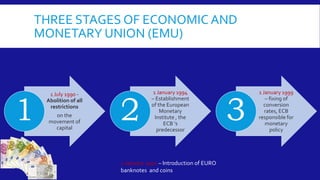
THREE STAGES OF ECONOMIC AND
MONETARY UNION (EMU)
1 July 1990 -
Abolition of all
restrictions
on the
movement of
capital
1
1 January 1994
– Establishment
of the European
Monetary
Institute , the
ECB ‘s
predecessor
2
1 January 1999
– fixing of
conversion
rates, ECB
responsible for
monetary
policy
3
1 January 2002 – Introduction of EURO
banknotes and coins
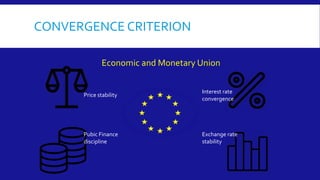
CONVERGENCE CRITERION
Economic and Monetary Union
Interest rate
convergence
Exchange rate
stability
Price stability
Pubic Finance
discipline
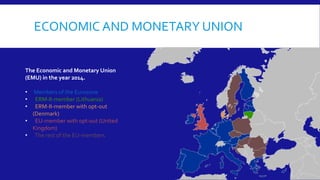
ECONOMIC AND MONETARY UNION
The Economic and Monetary Union
(EMU) in the year 2014.
• Members of the Eurozone
• ERM-II-member (Lithuania)
• ERM-II-member with opt-out
(Denmark)
• EU-member with opt-out (United
Kingdom)
• The rest of the EU-members
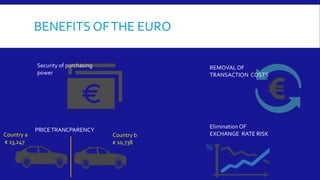
BENEFITS OFTHE EURO
Security of purchasing
power
PRICETRANCPARENCY
REMOVALOF
TRANSACTION COSTS
Elimination OF
EXCHANGE RATE RISKCountry b
€ 10,738
Country a
€ 13,247
KEY CHARACTERISTIC
OFTHE EURO AREA
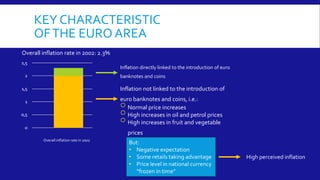
Overall inflation rate in 2002: 2.3%
Inflation directly linked to the introduction of euro
banknotes and coins
Inflation not linked to the introduction of
euro banknotes and coins, i.e.:
o Normal price increases
o High increases in oil and petrol prices
o High increases in fruit and vegetable
prices
Overall inflation rate in 2002
But:
• Negative expectation
• Some retails taking advantage
• Price level in national currency
“frozen in time”
High perceived inflation
FINANCIAL INTEGRATION
OFTHE EURO AREA
Integration of financial markets, financial
infrastructures and financial institutions
o results in economies of scale, larger
variety of financial products at lower cost
o enhances transmission of monetary policy
impulses
o contributes to safeguarding of financial
stability and smooth operation of
payment systems
EU today
Euro area
THANKYOU
FOR YOUR
ATTANTION

The European integration

  • 1.
  • 2.
    PLAN • Progress ofEuropean integration • Enlargement of the European union • Preparation of economic and monetary union (EMU) • Three stages of economic and monetary union (EMU) • Convergence criterion • Economic and monetary union • Benefits of the EURO • Key characteristic of the euro area • Financial integration of the euro area
  • 3.
    PROGRESS OF EUROPEANINTEGRATION 1952 ECSC European coal and Steel Community 1958 EEC and EURATOM European economic community EuropeanAtomic Energy Community 1967 EC European Communities 1993 EU European Union Maastricht treaty 2009 EU Treaty of Lisbon
  • 4.
    ENLARGEMENT OFTHE EUROPEANUNION 1953 •Belgium •Netherlands •Luxembourg •France •Saarland •Italy •West Germany 1973 •United Kingdom •Gibraltar •Denmark •Greenland 1981 •Greece 1986 •Spain •Portugal 1995 •Austria •Sweden •Finland 2004 •Malta, Cyprus, Estonia, Latvia, Lithuania, Poland, Czech Republic, Slovakia, Slovenia, Hungary, Akrotiri and Dhekelia 2007 •Bulgaria •Romania 20013 •Croatia
  • 5.
    PREPARATION OF ECONOMICAND MONETARY UNION (EMU) •BARRE PLAN 1969 •WERNER REPORT 1970 •EMS 1979 • SINGLE European ACT 1986 • DELORS REPORT 1988 • INTRODUC TION in the EURO 1999-2002
  • 6.
    THREE STAGES OFECONOMIC AND MONETARY UNION (EMU) 1 July 1990 - Abolition of all restrictions on the movement of capital 1 1 January 1994 – Establishment of the European Monetary Institute , the ECB ‘s predecessor 2 1 January 1999 – fixing of conversion rates, ECB responsible for monetary policy 3 1 January 2002 – Introduction of EURO banknotes and coins
  • 7.
    CONVERGENCE CRITERION Economic andMonetary Union Interest rate convergence Exchange rate stability Price stability Pubic Finance discipline
  • 8.
    ECONOMIC AND MONETARYUNION The Economic and Monetary Union (EMU) in the year 2014. • Members of the Eurozone • ERM-II-member (Lithuania) • ERM-II-member with opt-out (Denmark) • EU-member with opt-out (United Kingdom) • The rest of the EU-members
  • 9.
    BENEFITS OFTHE EURO Securityof purchasing power PRICETRANCPARENCY REMOVALOF TRANSACTION COSTS Elimination OF EXCHANGE RATE RISKCountry b € 10,738 Country a € 13,247
  • 10.
    KEY CHARACTERISTIC OFTHE EUROAREA Overall inflation rate in 2002: 2.3% Inflation directly linked to the introduction of euro banknotes and coins Inflation not linked to the introduction of euro banknotes and coins, i.e.: o Normal price increases o High increases in oil and petrol prices o High increases in fruit and vegetable prices Overall inflation rate in 2002 But: • Negative expectation • Some retails taking advantage • Price level in national currency “frozen in time” High perceived inflation
  • 11.
    FINANCIAL INTEGRATION OFTHE EUROAREA Integration of financial markets, financial infrastructures and financial institutions o results in economies of scale, larger variety of financial products at lower cost o enhances transmission of monetary policy impulses o contributes to safeguarding of financial stability and smooth operation of payment systems EU today Euro area
  • 12.