 “Enron is a company that reached dramatic
heights, only to face a dizzying collapse. The
story ends with the bankruptcy of one of
America's largest corporations.”
 In 1985, after federal deregulation of natural gas
pipelines, Enron was born from the merger of
Houston Natural Gas and InterNorth, a Nebraska
pipeline company.
 By 1992 ENRON was the largest seller of natural
gas in North America with revenue of $122 million,
specifically in natural gas contracts.
 Total revenues of $101 billion (2000) and
approximately 20,000 employees (2000).
 By 2001 it had won “Most innovative Company” for
six straight years (Fortune Magazine).
 “In an attempt to achieve further growth,
Enron pursued a diversification strategy. The
company owned and operated a variety of
assets including gas pipelines, electricity
plants, pulp and paper plants, water plants,
and broadband services across the globe. The
corporation also gained additional revenue by
trading contracts for the same array of
products and services with which it was
involved.[10]”
Kenneth Lay
 Founder and Former CEO of Enron
 He quit as CEO in February 2001
 He returned as CEO in August
2001until he resigned on Jan. 23,
2002
 He quit the Enron board altogether
on Feb. 4.
 Jeffrey Skilling
 Enron's chief executive in the first half of
2001
 Since joining the company in 1990, Skilling
helped transform Enron from a natural-gas
pipeline company into an energy-trading
powerhouse.
 Between January and August 2001 he sold off
about $20 million in Enron stock
 Resigned after the close of markets on Aug.
14 2001
Andrew Fastow
 Former Chief Financial Officer of
Enron
 The mastermind behind the
deceptive accounting practices
David Duncan
 Enron's chief auditor at Anderson
 His job was to check Enron’s accounts
 He is accused of ordering the
shredding of thousands of Enron-
related documents in an effort to hide
them from Securities and Exchange
Commission investigators
 A derivative is an instrument whose value is
“derived” from the underlying value of
something else, such as a stock, a bond, or in
the case of Enron’s derivatives, a unit of
electricity.
 Derivatives are useful because they enable an
investor to hedge against a decline in value.
 Example: Enron could enter a contract with a
purchaser of electricity, such as a utility,
guaranteeing that the purchaser would pay a
certain price for a certain amount of electricity
at a certain date in the future.
 Derivatives can be traded in two ways: on
regulated exchanges or in unregulated over-
the-counter (OTC) markets.
 Enron’s activities – involve the OTC
derivatives markets.”
 Political Atmosphere at this time.
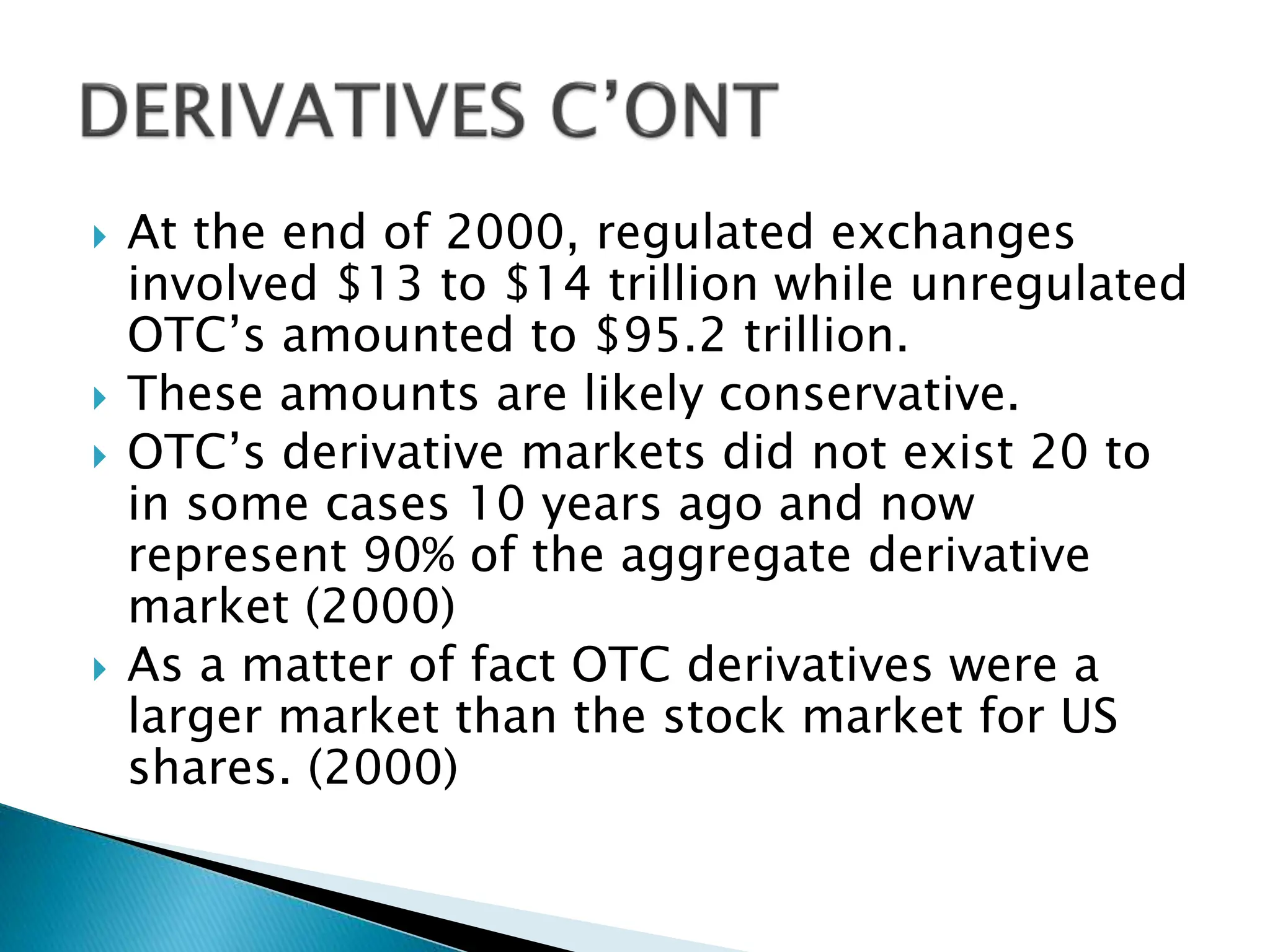
 At the end of 2000, regulated exchanges
involved $13 to $14 trillion while unregulated
OTC’s amounted to $95.2 trillion.
 These amounts are likely conservative.
 OTC’s derivative markets did not exist 20 to
in some cases 10 years ago and now
represent 90% of the aggregate derivative
market (2000)
 As a matter of fact OTC derivatives were a
larger market than the stock market for US
shares. (2000)
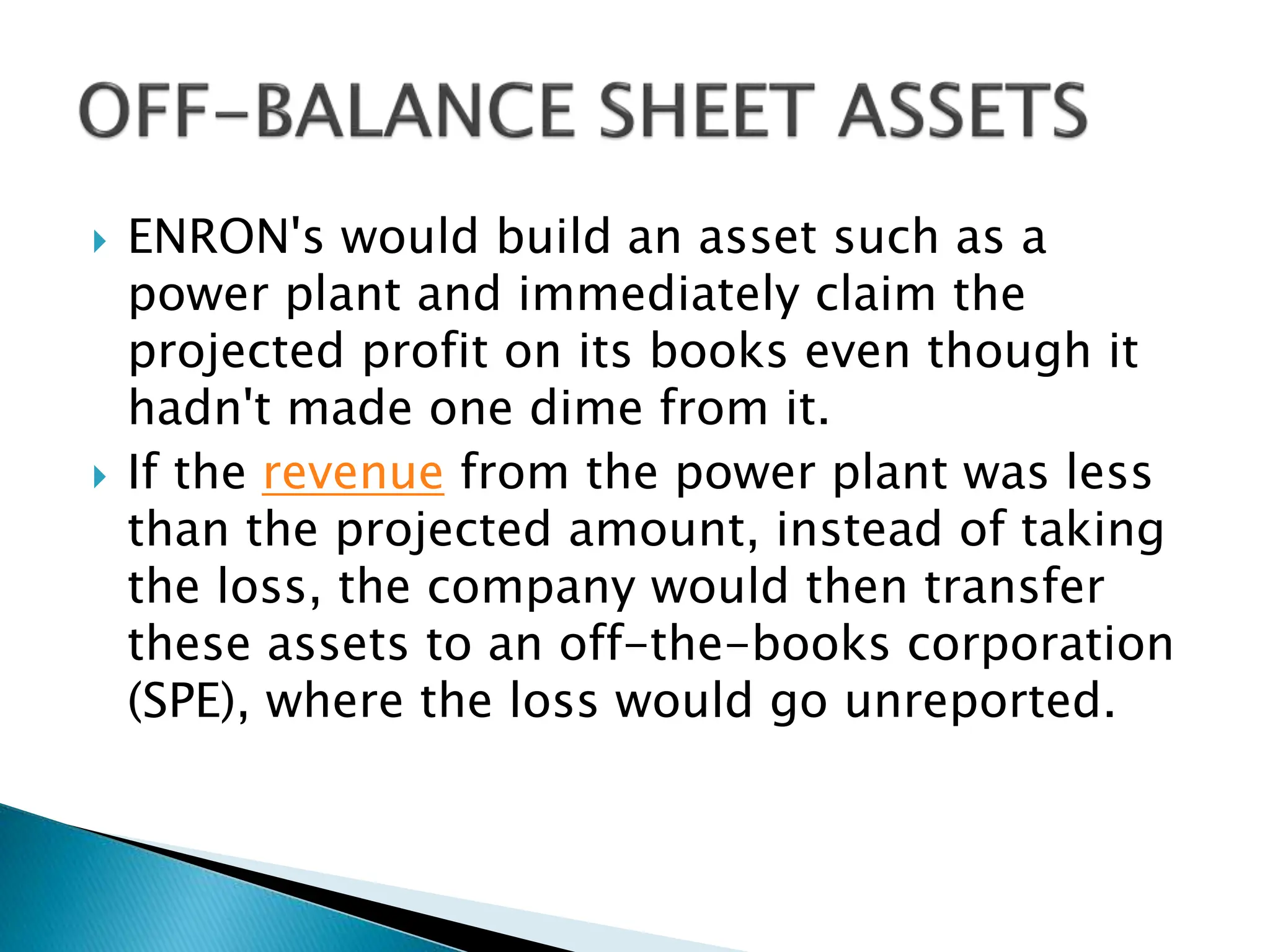
 ENRON's would build an asset such as a
power plant and immediately claim the
projected profit on its books even though it
hadn't made one dime from it.
 If the revenue from the power plant was less
than the projected amount, instead of taking
the loss, the company would then transfer
these assets to an off-the-books corporation
(SPE), where the loss would go unreported.
 SPE’s reflect a common financing technique for
companies. Companies can cut their risk by moving
assets into separate partnerships that can be sold
to outside investors.
 Give example of financing SPE.
 As long as ENRON had 50% or less ownership of
the SPE and the SPE investor puts up at least 3% of
the SPE's equity. The company can contribute the
rest and still qualify for off-balance-sheet
treatment.
 To get around the 50% rule ENRON created some
SPE’s with only $1 of equity.
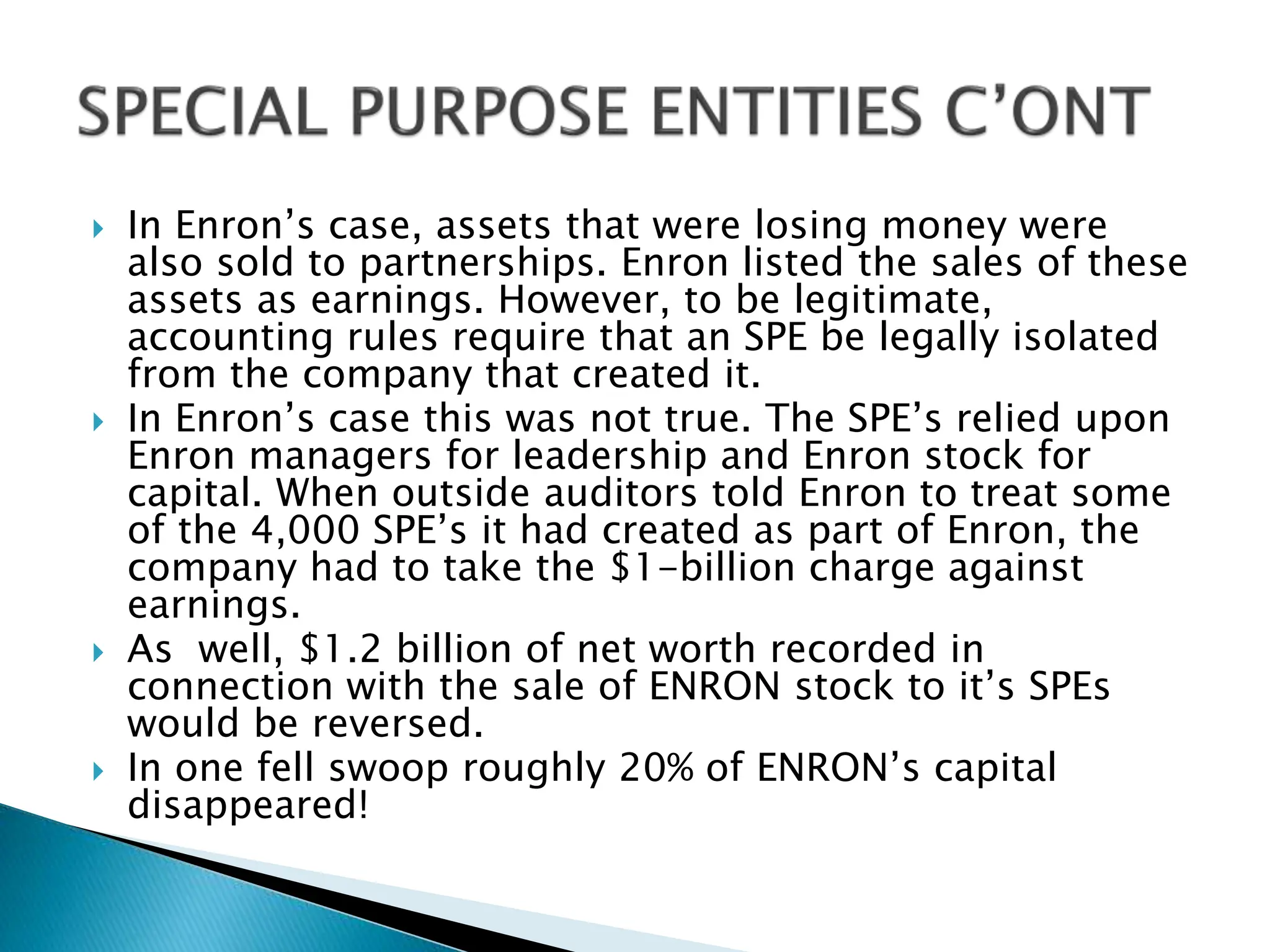
 In Enron’s case, assets that were losing money were
also sold to partnerships. Enron listed the sales of these
assets as earnings. However, to be legitimate,
accounting rules require that an SPE be legally isolated
from the company that created it.
 In Enron’s case this was not true. The SPE’s relied upon
Enron managers for leadership and Enron stock for
capital. When outside auditors told Enron to treat some
of the 4,000 SPE’s it had created as part of Enron, the
company had to take the $1-billion charge against
earnings.
 As well, $1.2 billion of net worth recorded in
connection with the sale of ENRON stock to it’s SPEs
would be reversed.
 In one fell swoop roughly 20% of ENRON’s capital
disappeared!
 ENRON entered into derivative transactions
with it’s SPEs in order to:
1. Hide spectacular losses it suffered on
technology stocks
2. Hide huge debts from financing
unprofitable new businesses
3. Inflating the value of other troubled
businesses
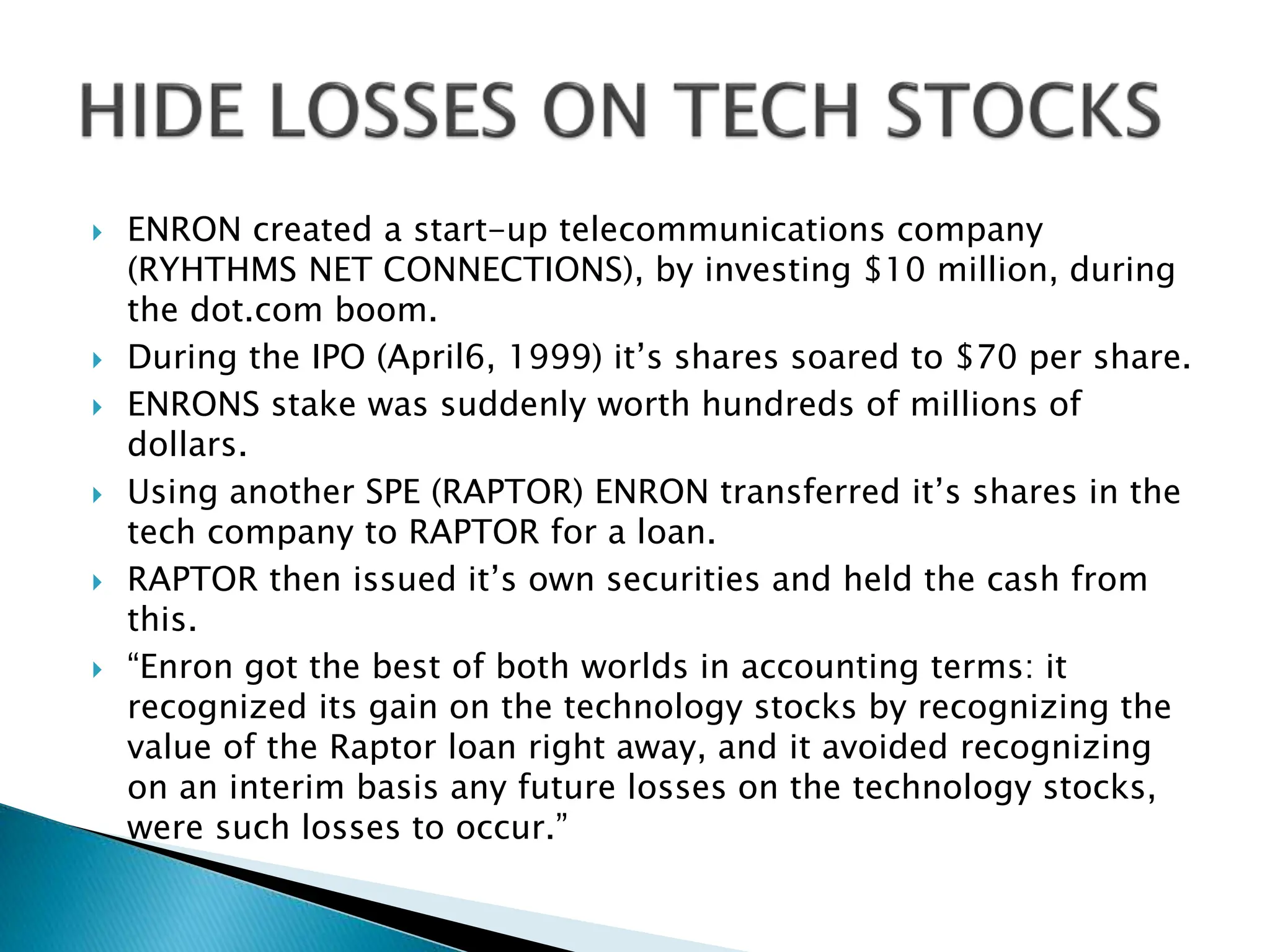
 ENRON created a start-up telecommunications company
(RYHTHMS NET CONNECTIONS), by investing $10 million, during
the dot.com boom.
 During the IPO (April6, 1999) it’s shares soared to $70 per share.
 ENRONS stake was suddenly worth hundreds of millions of
dollars.
 Using another SPE (RAPTOR) ENRON transferred it’s shares in the
tech company to RAPTOR for a loan.
 RAPTOR then issued it’s own securities and held the cash from
this.
 “Enron got the best of both worlds in accounting terms: it
recognized its gain on the technology stocks by recognizing the
value of the Raptor loan right away, and it avoided recognizing
on an interim basis any future losses on the technology stocks,
were such losses to occur.”
 ENRON had engaged in a price swap derivative with
RAPTOR.
 This mean’t that if RAPTORS assets fell in value,
ENRON would issue it’s own shares to cover the
decline.
 When the dot.com bubble burst in 2001 and
RYHTHMS NET CONNECTIONS shares became
worthless, RAPTOR, the holder of the shares suffered
tremendous losses and ENRON was forced to issue
shares to cover such losses.
 As ENRON shares declined in value and RAPTOR’s
assets also declined ENRON’s stock became more and
more diluted.
 Many such transactions were conducted by ENRON.
 Using an array of complex derivatives and two SPEs
Enron was able to hide their debt and not show it on the
balance sheet.
 The end result is that ENRON has reduced it’s debt,
making it’s Balance Sheet look better thus improving
it’s stock value.
 As the derivatives are difficult to value and ENRON does
not perceive of taking a loss on these guarantees they
are not required to be recorded in the financial
statements.
 The only thing that ENRON must do is disclose these
guarantees in the notes of it’s financial statement. They
were buried on page 48 of the notes!
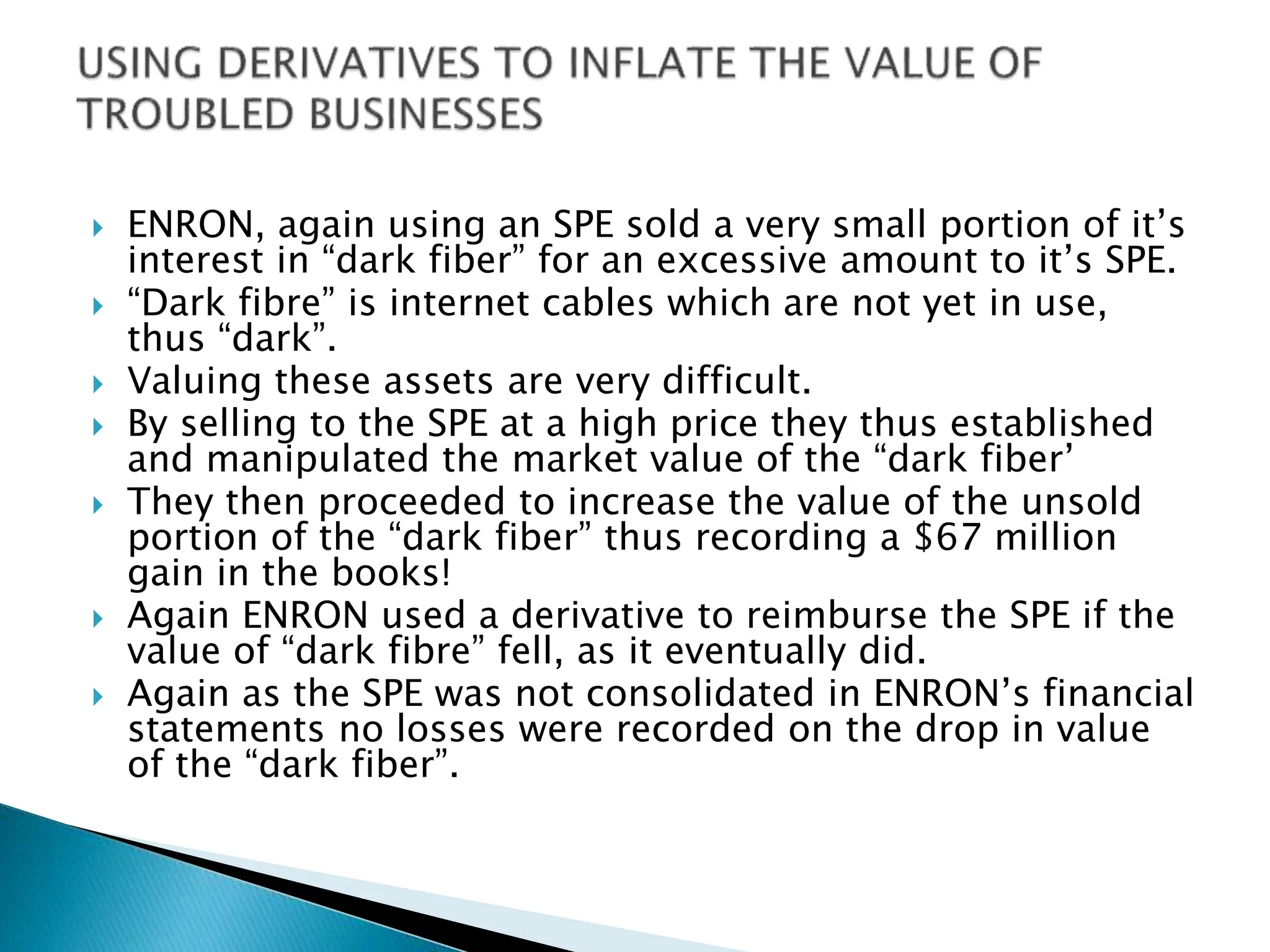
 ENRON, again using an SPE sold a very small portion of it’s
interest in “dark fiber” for an excessive amount to it’s SPE.
 “Dark fibre” is internet cables which are not yet in use,
thus “dark”.
 Valuing these assets are very difficult.
 By selling to the SPE at a high price they thus established
and manipulated the market value of the “dark fiber’
 They then proceeded to increase the value of the unsold
portion of the “dark fiber” thus recording a $67 million
gain in the books!
 Again ENRON used a derivative to reimburse the SPE if the
value of “dark fibre” fell, as it eventually did.
 Again as the SPE was not consolidated in ENRON’s financial
statements no losses were recorded on the drop in value
of the “dark fiber”.
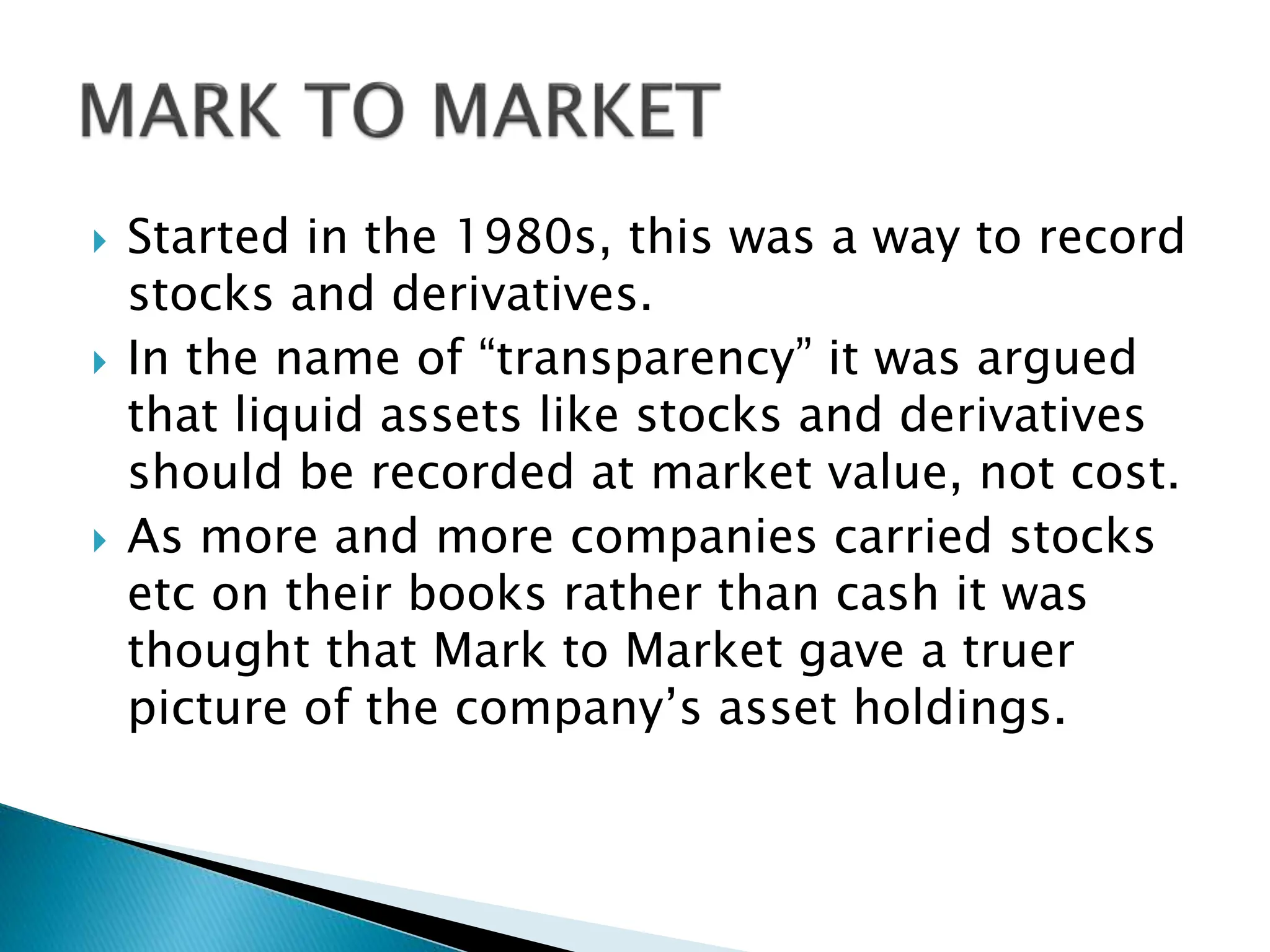
 Started in the 1980s, this was a way to record
stocks and derivatives.
 In the name of “transparency” it was argued
that liquid assets like stocks and derivatives
should be recorded at market value, not cost.
 As more and more companies carried stocks
etc on their books rather than cash it was
thought that Mark to Market gave a truer
picture of the company’s asset holdings.
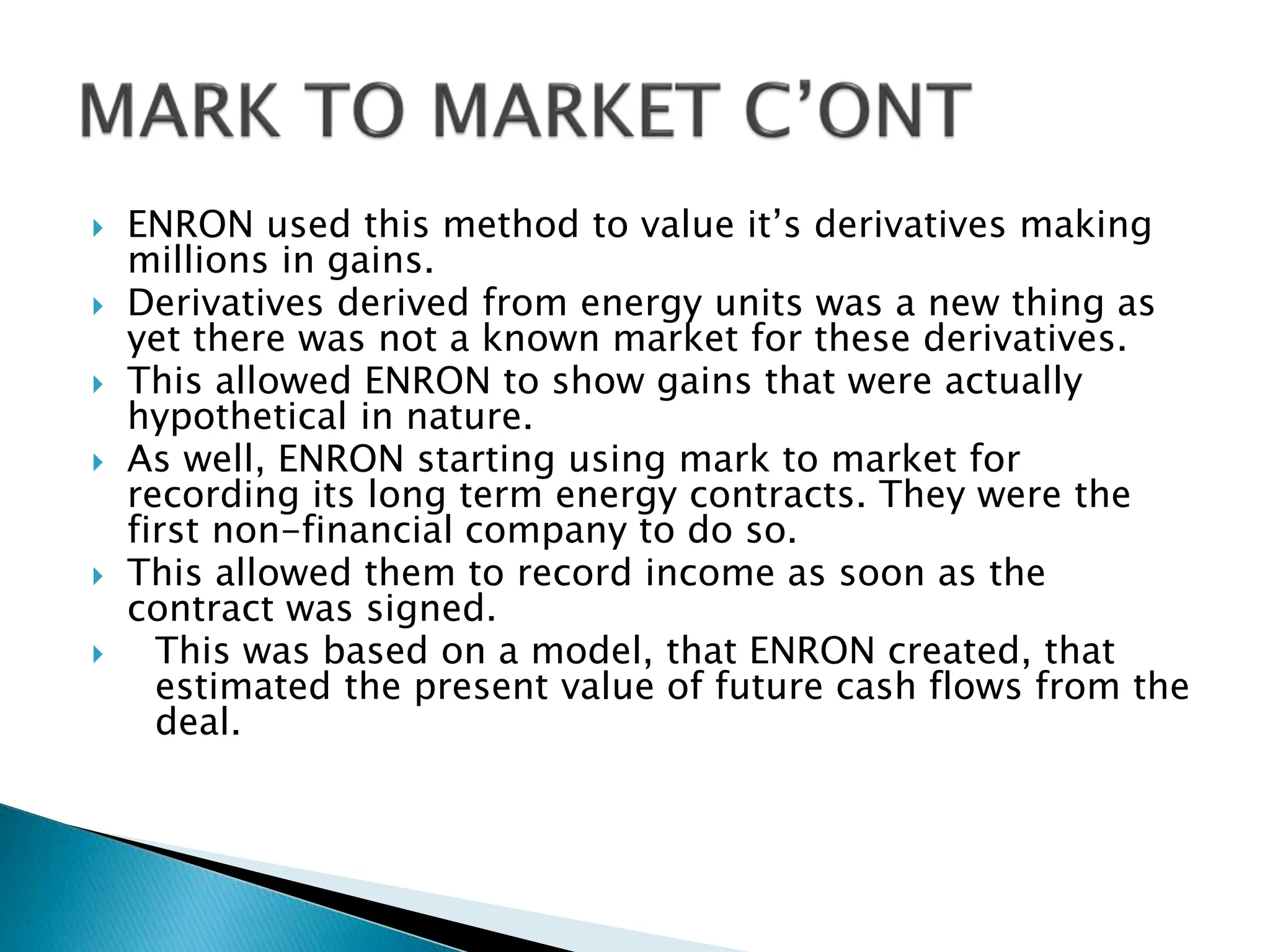
 ENRON used this method to value it’s derivatives making
millions in gains.
 Derivatives derived from energy units was a new thing as
yet there was not a known market for these derivatives.
 This allowed ENRON to show gains that were actually
hypothetical in nature.
 As well, ENRON starting using mark to market for
recording its long term energy contracts. They were the
first non-financial company to do so.
 This allowed them to record income as soon as the
contract was signed.
 This was based on a model, that ENRON created, that
estimated the present value of future cash flows from the
deal.
 Enron and other energy suppliers earned
profits by providing services such as
wholesale trading and risk management in
addition to building and maintaining electric
power plants, natural gas pipelines, storage,
and processing facilities.
 Service providers, when classified as agents,
are able to report trading and brokerage fees
as revenue.[18] This is called the “agent
model” and is used by most trading
institutions (ie. Merrill Lynch)
 ENRON instead used the merchant model,
which was a much more aggressive
accounting treatment.
 For example, if I am an agent I am bringing
together a buyer and sellor, I am a third
party. Sellor is selling for $8 and I am
charging $10 to the buyer. Thus my revenue
as an agent is $2. As a merchant I would
record $10 in revenue and $8 as cost of
sales. Now what is the difference? I just
increased revenue by 500%!
Kenneth Lay
 Lay, the politically connected founder of
Enron, was convicted on six securities fraud
counts and four bank fraud counts in 2006,
but the convictions were wiped out when Lay
died before he was able to appeal.
Jeffrey Skilling
 Skilling, now five years into a 24-year prison
sentence for conspiracy, fraud and insider
trading, is continuing to appeal his
convictions, including a new petition to the
Supreme Court just this week (Feb 2012).
Andrew Fastow
 Pleaded guilty to two counts of conspiracy,
forfeited nearly $24 million, and spent more
than five years in prison for securities fraud.
 Is free now, doing seminars at Ivy League
Universities.
THE ENRON SCANDAL.ppt

THE ENRON SCANDAL.ppt

  • 2.
     “Enron isa company that reached dramatic heights, only to face a dizzying collapse. The story ends with the bankruptcy of one of America's largest corporations.”
  • 3.
     In 1985,after federal deregulation of natural gas pipelines, Enron was born from the merger of Houston Natural Gas and InterNorth, a Nebraska pipeline company.  By 1992 ENRON was the largest seller of natural gas in North America with revenue of $122 million, specifically in natural gas contracts.  Total revenues of $101 billion (2000) and approximately 20,000 employees (2000).  By 2001 it had won “Most innovative Company” for six straight years (Fortune Magazine).
  • 4.
     “In anattempt to achieve further growth, Enron pursued a diversification strategy. The company owned and operated a variety of assets including gas pipelines, electricity plants, pulp and paper plants, water plants, and broadband services across the globe. The corporation also gained additional revenue by trading contracts for the same array of products and services with which it was involved.[10]”
  • 5.
    Kenneth Lay  Founderand Former CEO of Enron  He quit as CEO in February 2001  He returned as CEO in August 2001until he resigned on Jan. 23, 2002  He quit the Enron board altogether on Feb. 4.
  • 6.
     Jeffrey Skilling Enron's chief executive in the first half of 2001  Since joining the company in 1990, Skilling helped transform Enron from a natural-gas pipeline company into an energy-trading powerhouse.  Between January and August 2001 he sold off about $20 million in Enron stock  Resigned after the close of markets on Aug. 14 2001
  • 7.
    Andrew Fastow  FormerChief Financial Officer of Enron  The mastermind behind the deceptive accounting practices
  • 8.
    David Duncan  Enron'schief auditor at Anderson  His job was to check Enron’s accounts  He is accused of ordering the shredding of thousands of Enron- related documents in an effort to hide them from Securities and Exchange Commission investigators
  • 9.
     A derivativeis an instrument whose value is “derived” from the underlying value of something else, such as a stock, a bond, or in the case of Enron’s derivatives, a unit of electricity.  Derivatives are useful because they enable an investor to hedge against a decline in value.  Example: Enron could enter a contract with a purchaser of electricity, such as a utility, guaranteeing that the purchaser would pay a certain price for a certain amount of electricity at a certain date in the future.
  • 10.
     Derivatives canbe traded in two ways: on regulated exchanges or in unregulated over- the-counter (OTC) markets.  Enron’s activities – involve the OTC derivatives markets.”  Political Atmosphere at this time.
  • 11.
     At theend of 2000, regulated exchanges involved $13 to $14 trillion while unregulated OTC’s amounted to $95.2 trillion.  These amounts are likely conservative.  OTC’s derivative markets did not exist 20 to in some cases 10 years ago and now represent 90% of the aggregate derivative market (2000)  As a matter of fact OTC derivatives were a larger market than the stock market for US shares. (2000)
  • 12.
     ENRON's wouldbuild an asset such as a power plant and immediately claim the projected profit on its books even though it hadn't made one dime from it.  If the revenue from the power plant was less than the projected amount, instead of taking the loss, the company would then transfer these assets to an off-the-books corporation (SPE), where the loss would go unreported.
  • 13.
     SPE’s reflecta common financing technique for companies. Companies can cut their risk by moving assets into separate partnerships that can be sold to outside investors.  Give example of financing SPE.  As long as ENRON had 50% or less ownership of the SPE and the SPE investor puts up at least 3% of the SPE's equity. The company can contribute the rest and still qualify for off-balance-sheet treatment.  To get around the 50% rule ENRON created some SPE’s with only $1 of equity.
  • 14.
     In Enron’scase, assets that were losing money were also sold to partnerships. Enron listed the sales of these assets as earnings. However, to be legitimate, accounting rules require that an SPE be legally isolated from the company that created it.  In Enron’s case this was not true. The SPE’s relied upon Enron managers for leadership and Enron stock for capital. When outside auditors told Enron to treat some of the 4,000 SPE’s it had created as part of Enron, the company had to take the $1-billion charge against earnings.  As well, $1.2 billion of net worth recorded in connection with the sale of ENRON stock to it’s SPEs would be reversed.  In one fell swoop roughly 20% of ENRON’s capital disappeared!
  • 15.
     ENRON enteredinto derivative transactions with it’s SPEs in order to: 1. Hide spectacular losses it suffered on technology stocks 2. Hide huge debts from financing unprofitable new businesses 3. Inflating the value of other troubled businesses
  • 16.
     ENRON createda start-up telecommunications company (RYHTHMS NET CONNECTIONS), by investing $10 million, during the dot.com boom.  During the IPO (April6, 1999) it’s shares soared to $70 per share.  ENRONS stake was suddenly worth hundreds of millions of dollars.  Using another SPE (RAPTOR) ENRON transferred it’s shares in the tech company to RAPTOR for a loan.  RAPTOR then issued it’s own securities and held the cash from this.  “Enron got the best of both worlds in accounting terms: it recognized its gain on the technology stocks by recognizing the value of the Raptor loan right away, and it avoided recognizing on an interim basis any future losses on the technology stocks, were such losses to occur.”
  • 17.
     ENRON hadengaged in a price swap derivative with RAPTOR.  This mean’t that if RAPTORS assets fell in value, ENRON would issue it’s own shares to cover the decline.  When the dot.com bubble burst in 2001 and RYHTHMS NET CONNECTIONS shares became worthless, RAPTOR, the holder of the shares suffered tremendous losses and ENRON was forced to issue shares to cover such losses.  As ENRON shares declined in value and RAPTOR’s assets also declined ENRON’s stock became more and more diluted.  Many such transactions were conducted by ENRON.
  • 18.
     Using anarray of complex derivatives and two SPEs Enron was able to hide their debt and not show it on the balance sheet.  The end result is that ENRON has reduced it’s debt, making it’s Balance Sheet look better thus improving it’s stock value.  As the derivatives are difficult to value and ENRON does not perceive of taking a loss on these guarantees they are not required to be recorded in the financial statements.  The only thing that ENRON must do is disclose these guarantees in the notes of it’s financial statement. They were buried on page 48 of the notes!
  • 19.
     ENRON, againusing an SPE sold a very small portion of it’s interest in “dark fiber” for an excessive amount to it’s SPE.  “Dark fibre” is internet cables which are not yet in use, thus “dark”.  Valuing these assets are very difficult.  By selling to the SPE at a high price they thus established and manipulated the market value of the “dark fiber’  They then proceeded to increase the value of the unsold portion of the “dark fiber” thus recording a $67 million gain in the books!  Again ENRON used a derivative to reimburse the SPE if the value of “dark fibre” fell, as it eventually did.  Again as the SPE was not consolidated in ENRON’s financial statements no losses were recorded on the drop in value of the “dark fiber”.
  • 20.
     Started inthe 1980s, this was a way to record stocks and derivatives.  In the name of “transparency” it was argued that liquid assets like stocks and derivatives should be recorded at market value, not cost.  As more and more companies carried stocks etc on their books rather than cash it was thought that Mark to Market gave a truer picture of the company’s asset holdings.
  • 21.
     ENRON usedthis method to value it’s derivatives making millions in gains.  Derivatives derived from energy units was a new thing as yet there was not a known market for these derivatives.  This allowed ENRON to show gains that were actually hypothetical in nature.  As well, ENRON starting using mark to market for recording its long term energy contracts. They were the first non-financial company to do so.  This allowed them to record income as soon as the contract was signed.  This was based on a model, that ENRON created, that estimated the present value of future cash flows from the deal.
  • 22.
     Enron andother energy suppliers earned profits by providing services such as wholesale trading and risk management in addition to building and maintaining electric power plants, natural gas pipelines, storage, and processing facilities.  Service providers, when classified as agents, are able to report trading and brokerage fees as revenue.[18] This is called the “agent model” and is used by most trading institutions (ie. Merrill Lynch)
  • 23.
     ENRON insteadused the merchant model, which was a much more aggressive accounting treatment.  For example, if I am an agent I am bringing together a buyer and sellor, I am a third party. Sellor is selling for $8 and I am charging $10 to the buyer. Thus my revenue as an agent is $2. As a merchant I would record $10 in revenue and $8 as cost of sales. Now what is the difference? I just increased revenue by 500%!
  • 24.
    Kenneth Lay  Lay,the politically connected founder of Enron, was convicted on six securities fraud counts and four bank fraud counts in 2006, but the convictions were wiped out when Lay died before he was able to appeal.
  • 25.
    Jeffrey Skilling  Skilling,now five years into a 24-year prison sentence for conspiracy, fraud and insider trading, is continuing to appeal his convictions, including a new petition to the Supreme Court just this week (Feb 2012).
  • 26.
    Andrew Fastow  Pleadedguilty to two counts of conspiracy, forfeited nearly $24 million, and spent more than five years in prison for securities fraud.  Is free now, doing seminars at Ivy League Universities.